SBDD vs LBDD: A Comprehensive Guide to Structure-Based and Ligand-Based Drug Design
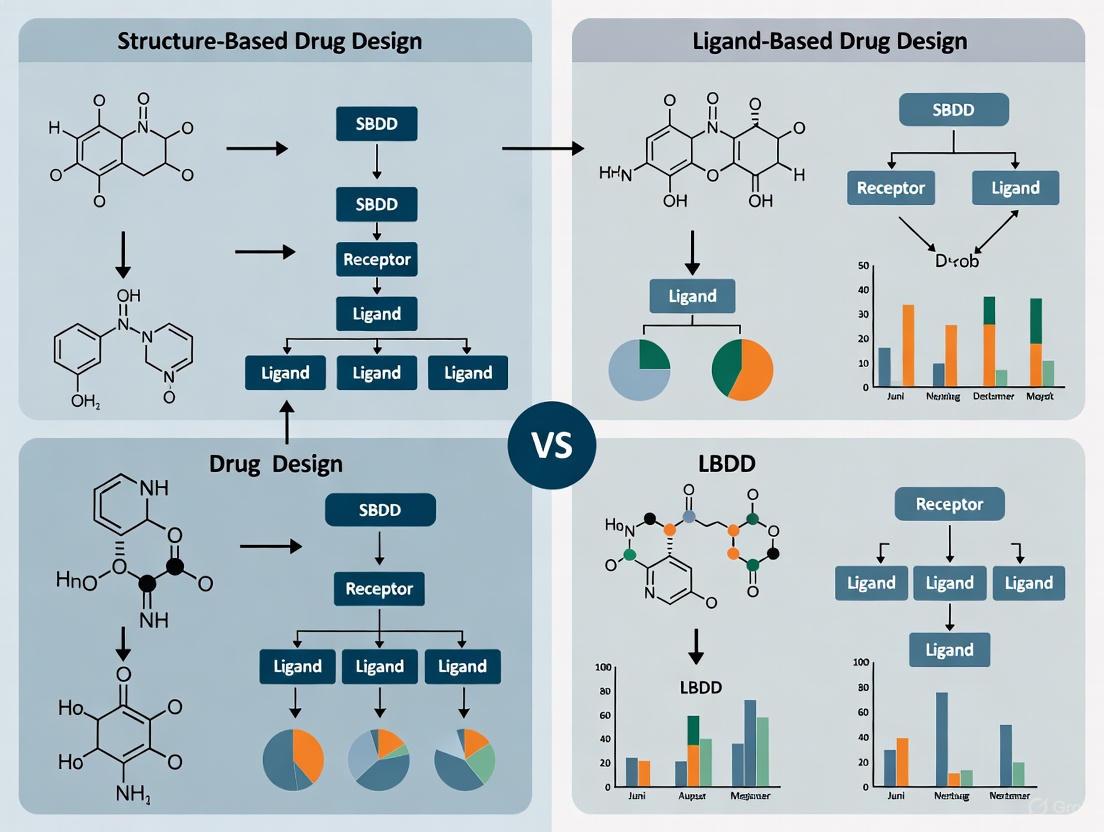
This article provides researchers, scientists, and drug development professionals with a detailed comparison of Structure-Based Drug Design (SBDD) and Ligand-Based Drug Design (LBDD).
SBDD vs LBDD: A Comprehensive Guide to Structure-Based and Ligand-Based Drug Design
Abstract
This article provides researchers, scientists, and drug development professionals with a detailed comparison of Structure-Based Drug Design (SBDD) and Ligand-Based Drug Design (LBDD). It explores the foundational principles, core methodologies, and practical applications of both approaches. The content addresses common challenges and optimization strategies, offers comparative analysis for method selection, and examines the growing impact of AI and integrated workflows on modern computational drug discovery.
SBDD and LBDD Explained: Core Principles and When to Use Each Approach
Structure-Based Drug Design (SBDD) is a foundational computational methodology in modern drug discovery that relies on the three-dimensional structural information of biological targets to guide the design and optimization of small-molecule therapeutics. This approach operates on the fundamental principle that a drug's biological activity stems from its precise molecular interaction with a specific target, typically a protein, nucleic acid, or other macromolecule involved in a disease pathway. By analyzing the atomic-level structure of the target's binding site—including its geometry, electrostatic properties, and hydrophobicity—researchers can rationally design molecules with complementary features to achieve high binding affinity and specificity [1] [2].
The pivotal distinction between SBDD and Ligand-Based Drug Design (LBDD) lies in their foundational information sources. SBDD directly utilizes the 3D structure of the target protein itself, while LBDD infers design principles from the known properties and structures of active small molecules (ligands) that bind to the target, without requiring direct knowledge of the protein's structure [1] [3]. This makes SBDD a target-centric approach, suitable when high-quality structural data is available, whereas LBDD serves as a powerful alternative when structural information is absent or limited. The sequential or parallel integration of both approaches often provides complementary insights that enhance the efficiency of early-stage drug discovery [3].
Core Methodologies and Experimental Protocols in SBDD
The successful application of SBDD relies on a multi-step, cyclical process that integrates structural biology, computational modeling, and experimental validation. The core workflow begins with obtaining a high-resolution structure of the target and proceeds through binding site analysis, molecular design, and optimization [1].
Target Structure Determination
The initial and most critical step in SBDD is acquiring an accurate, high-resolution three-dimensional structure of the target macromolecule. Several experimental and computational techniques are employed for this purpose, each with distinct strengths and applications.
Table 1: Key Techniques for Protein Structure Determination in SBDD
| Technique | Basic Principle | Resolution & Applicability | Key Advantages | Common Use in SBDD |
|---|---|---|---|---|
| X-ray Crystallography | Analyzes X-ray diffraction patterns from protein crystals to determine atomic positions. | High (often <2.5 Å); requires stable, crystallizable proteins. | Provides highly detailed, atomic-resolution structures. | Historically the most common source for SBDD target structures [1]. |
| Cryo-Electron Microscopy (Cryo-EM) | Images protein complexes flash-frozen in vitreous ice using electron beams. | High to Medium (now often <3 Å); suitable for large complexes and membrane proteins. | No crystallization needed; ideal for large, flexible complexes like membrane proteins [4]. | Growing use for targets difficult to crystallize (e.g., GPCRs, ion channels) [1] [4]. |
| Nuclear Magnetic Resonance (NMR) | Measures magnetic properties of atomic nuclei in solution to deduce interatomic distances and angles. | Medium; suitable for smaller proteins and studying dynamics. | Provides information on protein dynamics and flexibility in a solution state. | Used to study ligand interactions and conformational changes [1]. |
| Computational Prediction (e.g., AlphaFold) | Uses machine learning to predict protein 3D structure from its amino acid sequence. | Varies; can be very high for some targets. | Rapid generation of models for targets with no experimental structure [4]. | Unprecedented access to models for previously inaccessible targets; requires validation [4] [3]. |
Molecular Docking and Virtual Screening
Once a reliable target structure is obtained, molecular docking is used to predict the preferred orientation and conformation (the "pose") of a small molecule when bound to the target. Docking also provides a score estimating the binding affinity, enabling the virtual screening of large compound libraries to identify potential hits [2] [3].
Detailed Protocol for Molecular Docking and Virtual Screening:
- Preparation of Structures: The protein structure is prepared by adding hydrogen atoms, assigning partial charges, and defining the protonation states of amino acid residues. The binding site is explicitly defined, often based on the location of a co-crystallized ligand or known functional residues. Small molecules from virtual libraries are also prepared by generating their 3D conformations and assigning appropriate charges [2].
- Conformational Search: The docking algorithm performs a search to explore possible binding modes for the ligand within the defined binding site. This involves sampling the ligand's translational, rotational, and torsional degrees of freedom [2]. Common search algorithms include:
- Systematic Search (Incremental Construction): The ligand is fragmented and rebuilt piece-by-piece within the binding site, as implemented in programs like FlexX and Surflex [2].
- Stochastic Search (Genetic Algorithms): The ligand's conformation and orientation are randomly varied, and "populations" of poses are evolved over generations to find optimal solutions. This is used by programs like AutoDock and GOLD [2].
- Scoring and Ranking: Each generated pose is evaluated using a scoring function. These functions are mathematical approximations that estimate the binding free energy by considering various terms such as hydrogen bonding, van der Waals forces, electrostatic interactions, and desolvation penalties [2]. The top-ranked compounds based on these scores are selected for further experimental testing.
Accounting for Flexibility: Molecular Dynamics Simulations
A significant limitation of standard docking is its treatment of the protein as a rigid body. In reality, proteins are dynamic, and their conformations change upon ligand binding. Molecular Dynamics (MD) Simulations address this by simulating the physical movements of atoms over time, providing insights into the dynamic behavior of the drug-target complex [4].
Detailed Protocol for the Relaxed Complex Method:
This method combines MD simulations with docking to account for target flexibility [4].
- MD Simulation of the Target: An extensive MD simulation is run on the apo (unliganded) protein or an existing ligand-protein complex.
- Conformational Sampling: The simulation trajectory is analyzed to capture a diverse set of protein conformations, including those that may reveal cryptic pockets not observed in the initial crystal structure [4].
- Ensemble Docking: Representative "snapshot" structures from the MD trajectory are used as individual targets for molecular docking. This allows screening against multiple, physiologically relevant conformations of the target, increasing the chances of identifying hits that might be missed using a single, static structure [4].
The Scientist's Toolkit: Essential Reagents and Computational Solutions
Table 2: Key Research Reagent Solutions for SBDD
| Category / Tool Name | Function / Application | Key Features |
|---|---|---|
| Protein Production & Crystallization | ||
| Cloning Vectors (e.g., pET series) | High-yield recombinant protein expression in host systems (e.g., E. coli, insect cells). | Essential for producing milligram quantities of pure, stable protein for structural studies. |
| Crystallization Screening Kits (e.g., from Hampton Research) | Identify initial conditions for growing diffraction-quality protein crystals. | Pre-formulated solutions streamline the often labor-intensive crystallization process. |
| Structure Determination & Analysis | ||
| Cryo-EM Grids | Support samples for flash-freezing and imaging in the electron microscope. | Enable high-resolution structure determination without crystallization. |
| Molecular Graphics Software (e.g., PyMol, ChimeraX) | Visualization, analysis, and manipulation of 3D structural data. | Critical for analyzing binding sites, protein-ligand interactions, and preparing figures. |
| Computational Screening & Design | ||
| Ultra-Large Virtual Libraries (e.g., ZINC, Enamine REAL) | Source of billions of synthesizable small molecules for virtual screening. | Dramatically expands the explorable chemical space beyond physical compound collections [4] [5]. |
| Molecular Docking Software (e.g., AutoDock Vina, GLIDE, GOLD) | Predict binding poses and affinities of ligands to a target structure. | Core tool for structure-based virtual screening and pose prediction [2] [5]. |
| Molecular Dynamics Software (e.g., GROMACS, NAMD, AMBER) | Simulate the time-dependent dynamic behavior of proteins and complexes. | Used for refining models, studying stability, and sampling conformations (e.g., Relaxed Complex Method) [4]. |
SBDD Cyclical Workflow
SBDD vs. LBDD: A Comparative Analysis
SBDD and LBDD represent two complementary paradigms in computational drug discovery. The choice between them depends primarily on the availability of structural or ligand information.
Table 3: Comparative Analysis: SBDD vs. LBDD
| Parameter | Structure-Based Drug Design (SBDD) | Ligand-Based Drug Design (LBDD) |
|---|---|---|
| Fundamental Basis | 3D structure of the biological target (receptor). | Known active ligands that bind to the target. |
| Primary Objective | Design molecules complementary to the target's binding site. | Design molecules similar to known active ligands. |
| Key Techniques | Molecular docking, structure-based virtual screening (SBVS), molecular dynamics (MD), free-energy perturbation (FEP). | Quantitative Structure-Activity Relationship (QSAR), pharmacophore modeling, ligand-based virtual screening (LBVS), similarity searching [1] [2] [3]. |
| Data Requirements | High-resolution protein structure (experimental or predicted). | A set of known active and inactive compounds with associated bioactivity data. |
| Major Advantages | Rational design: Allows for direct optimization of interactions. Scaffold hopping: Can identify novel chemotypes that fit the binding site. High specificity and potential to reduce off-target effects [1]. | No protein structure needed. Fast and computationally efficient for screening. Excellent for establishing initial Structure-Activity Relationships (SAR) [1] [3]. |
| Key Limitations | Dependent on the availability and quality of the target structure. Limited by inherent protein flexibility. Scoring functions can be inaccurate [1] [4] [3]. | Limited to the chemical space defined by known actives. Difficult to design truly novel scaffolds (scaffold hopping). Cannot directly visualize target interactions [1] [3]. |
Case Studies and Clinical Impact
SBDD has been instrumental in developing numerous approved drugs across therapeutic areas, validating its power and practicality.
- Captopril (Capoten): One of the earliest successes of SBDD, this antihypertensive drug was developed based on the structure of carboxypeptidase A, leading to the first orally active Angiotensin-Converting Enzyme (ACE) inhibitor [4] [6].
- HIV-1 Protease Inhibitors (e.g., Saquinavir, Ritonavir): The design of these antiviral agents relied heavily on the 3D structures of HIV protease and its complexes, which allowed for the creation of potent inhibitors that fit precisely into the enzyme's active site, revolutionizing AIDS treatment [6].
- Oseltamivir (Tamiflu): This neuraminidase inhibitor, used for treating influenza, was developed using the crystal structure of influenza neuraminidase, enabling the design of a transition-state analogue that effectively blocks the enzyme's function [6].
The field of SBDD is being transformed by several converging technological advances. The integration of machine learning (ML) is enhancing predictive accuracy in virtual screening and binding affinity prediction, as demonstrated by studies identifying natural inhibitors against specific tubulin isotypes [5]. The explosion of structural data, driven by the AlphaFold database of predicted structures and advances in Cryo-EM, is providing unprecedented access to previously intractable targets [4]. Furthermore, the ability to screen ultra-large chemical libraries containing billions of molecules is expanding the horizons of discoverable chemical space [4] [3].
In conclusion, Structure-Based Drug Design stands as a powerful, target-centric pillar of modern drug discovery. By leveraging atomic-level structural information, it enables the rational and precise design of therapeutic molecules, differentiating it fundamentally from ligand-based approaches. As computational power, algorithms, and structural data continue to grow, SBDD is poised to become even more integral to the efficient and innovative development of new medicines.
In the field of computer-aided drug discovery (CADD), Ligand-Based Drug Design (LBDD) represents a fundamental paradigm that leverages chemical information from known active compounds to guide the development of new therapeutic candidates. This approach stands in contrast to Structure-Based Drug Design (SBDD), which relies on three-dimensional structural information of the biological target [1] [4]. LBDD emerges as a particularly valuable strategy when the three-dimensional structure of the target protein is unavailable or difficult to obtain, allowing researchers to proceed with drug discovery efforts based solely on knowledge of compounds that effectively modulate the target of interest [7]. The core premise of LBDD is that structurally similar molecules often exhibit similar biological activities—a principle that enables the prediction and design of new chemical entities with desired pharmacological properties [8].
The strategic position of LBDD within the drug discovery toolkit becomes especially important for targets that resist structural characterization through methods like X-ray crystallography, NMR, or cryo-EM, particularly membrane proteins and large complexes [1] [4]. Furthermore, even when structural information is available, LBDD offers complementary approaches that can accelerate early-stage hit identification and optimization through efficient analysis of chemical space and structure-activity relationships [9]. This technical guide explores the core principles, methodologies, and applications of LBDD, framing it within the broader context of SBDD versus LBDD research paradigms for drug development professionals seeking to maximize the value of chemical information in their discovery campaigns.
Core Principles of Ligand-Based Drug Design
LBDD operates on several fundamental principles that distinguish it from structure-based approaches. The most central of these is the similarity principle, which posits that molecules with similar structural features are likely to exhibit similar biological activities and properties [8] [9]. This principle enables researchers to extrapolate from known active compounds to predict the activity of new chemical entities, forming the basis for many LBDD techniques. The similarity principle is mathematically operationalized through various molecular descriptors and similarity metrics that quantify the degree of structural or property resemblance between compounds.
A second key principle is the pharmacophore concept, which abstracts specific molecular features from active compounds that are essential for their biological activity [1]. A pharmacophore model captures the spatial arrangement of critical functional groups—such as hydrogen bond donors, hydrogen bond acceptors, hydrophobic regions, and charged groups—that facilitate molecular recognition between a ligand and its biological target. This abstraction allows researchers to design novel compounds that maintain these essential features while exploring diverse chemical scaffolds.
Third, LBDD relies on the principle of cheminformatic pattern recognition, where statistical relationships between chemical structures and biological activities are derived from experimental data [1] [7]. Through Quantitative Structure-Activity Relationship (QSAR) modeling and machine learning approaches, these patterns can be formalized into predictive models that guide compound optimization and prioritization. This data-driven approach becomes increasingly powerful as the volume and diversity of compound activity data grow, enabling more accurate predictions of potency, selectivity, and ADMET (Absorption, Distribution, Metabolism, Excretion, and Toxicity) properties.
Table 1: Core Principles of Ligand-Based Drug Design
| Principle | Key Concept | Methodological Implementation |
|---|---|---|
| Similarity Principle | Structurally similar compounds have similar biological activities | Molecular similarity searching, molecular fingerprints, shape-based alignment |
| Pharmacophore Concept | Essential structural features required for biological activity | Pharmacophore modeling, feature alignment, 3D database screening |
| Cheminformatic Pattern Recognition | Statistical relationships between structure and activity can be modeled | QSAR, machine learning, classification models |
Key Methodologies and Techniques in LBDD
Quantitative Structure-Activity Relationship (QSAR)
Quantitative Structure-Activity Relationship (QSAR) represents one of the most established methodologies in LBDD, employing mathematical models to correlate quantitative molecular descriptors with biological activity [1] [9]. The fundamental premise of QSAR is that variations in biological activity can be correlated with changes in measurable or calculable molecular properties through statistical methods. The standard QSAR workflow begins with molecular descriptor calculation, where numerical representations of chemical structures are generated, encompassing physicochemical properties (e.g., logP, molecular weight, polar surface area), electronic features, and topological indices [1]. These descriptors serve as independent variables in mathematical models that predict biological activity as the dependent variable.
The second critical phase involves model building and validation, where statistical techniques—ranging from traditional regression methods to modern machine learning algorithms—identify relationships between molecular descriptors and biological activity [7] [9]. Model validation is essential to ensure predictive capability and avoid overfitting, typically employing techniques such as cross-validation, external test sets, and y-scrambling. A properly validated QSAR model can significantly accelerate lead optimization by predicting the activity of unsynthesized compounds, prioritizing chemical series with the highest potential, and identifying key structural features that drive potency.
More advanced implementations include 3D-QSAR approaches, which incorporate spatial molecular fields and alignment information to create more sophisticated models that capture stereoelectronic requirements for biological activity [9]. These techniques, including Comparative Molecular Field Analysis (CoMFA) and Comparative Molecular Similarity Indices Analysis (CoMSIA), provide visual representations of structure-activity relationships that guide medicinal chemists in rational compound design. The experimental protocol for QSAR modeling requires careful curation of biological data, appropriate descriptor selection, rigorous validation procedures, and application within the model's defined applicability domain to ensure reliable predictions.
Pharmacophore Modeling
Pharmacophore modeling is a powerful LBDD technique that identifies the essential steric and electronic features necessary for molecular recognition at a biological target [1]. A pharmacophore model abstractly represents these critical features and their spatial relationships without explicit reference to specific molecular scaffolds, enabling scaffold hopping and identification of structurally diverse compounds that maintain the necessary elements for binding. The methodology typically begins with conformational analysis of known active compounds to explore their accessible three-dimensional shapes, followed by common feature identification that extracts shared structural elements across multiple active molecules.
The construction of a pharmacophore model can follow either a ligand-based or structure-based approach, with ligand-based methods relying exclusively on the structural features and alignment of known active compounds [1]. These ligand-based approaches include common feature pharmacophore generation, which identifies shared elements among actives, and quantitative pharmacophore modeling, which incorporates activity data to weight feature importance. Once developed, pharmacophore models serve as virtual screening queries to identify potential hits from compound databases, as design templates for novel compound synthesis, and as analytical tools to understand key interactions driving biological activity [1] [9].
The experimental protocol for pharmacophore modeling requires a carefully curated set of active compounds with diverse structural features, conformational analysis to represent molecular flexibility, feature definition and spatial alignment, model validation using known actives and inactives, and application to database screening or compound design. Successful pharmacophore models can significantly accelerate early drug discovery by enabling efficient exploration of chemical space and identification of novel chemotypes that would not be discovered through simple similarity searching.
Similarity-Based Virtual Screening
Similarity-based virtual screening leverages the similarity principle to identify potential active compounds from large chemical libraries based on their resemblance to known active molecules [8] [9]. This methodology employs various molecular representation schemes to quantify chemical similarity, with molecular fingerprints representing one of the most common approaches for rapid similarity searching in massive compound collections. These binary bit strings encode the presence or absence of specific structural patterns or chemical features within a molecule, enabling efficient calculation of similarity metrics such as Tanimoto coefficients.
Advanced similarity methods extend into three-dimensional space, comparing molecules based on shape similarity and electrostatic complementarity rather than two-dimensional structural features [8] [9]. These 3D similarity approaches can identify compounds that share similar spatial arrangements of key functional groups despite having different molecular scaffolds, potentially revealing structurally novel active compounds. The BioSolveIT platform, for example, offers tools for both 2D similarity searching in trillion-sized chemical spaces and 3D molecule superpositioning to match shape and chemical features of template ligands [8].
The implementation of similarity-based virtual screening involves selection of appropriate query compounds, choice of molecular representation and similarity metric, definition of similarity thresholds, efficient searching of chemical databases, and experimental validation of prioritized compounds. When properly executed, this approach provides an efficient method for hit identification that complements other virtual screening techniques, particularly in the early stages of drug discovery when target structural information may be limited.
Comparative Analysis: LBDD vs. SBDD
Understanding the distinctions and complementary strengths between Ligand-Based and Structure-Based Drug Design is essential for deploying the most effective strategy for a given drug discovery scenario. While SBDD requires detailed three-dimensional structural information of the target protein—obtained through experimental methods like X-ray crystallography, NMR, or cryo-EM, or predicted through AI systems like AlphaFold—LBDD operates independently of target structure, relying instead on chemical information from known active compounds [1] [4] [9]. This fundamental difference in required input information dictates the applicability of each approach and influences their respective advantages and limitations.
SBDD provides atomic-level insights into protein-ligand interactions, enabling rational design of compounds with optimized binding geometries and specific molecular interactions [1] [4]. Techniques such as molecular docking and free-energy perturbation (FEP) calculations allow researchers to predict binding modes and affinities, guiding structure-based optimization with high precision. However, SBDD faces challenges including target flexibility, difficulties in modeling induced fit and allosteric effects, and computational demands when handling large compound libraries [4]. Additionally, the quality of SBDD predictions is highly dependent on the accuracy and relevance of the protein structure used, with potential errors propagating through the design process [9].
In contrast, LBDD excels in its ability to rapidly screen vast chemical spaces using efficient similarity-based methods, making it particularly valuable during early hit identification when structural information may be limited [9]. By leveraging patterns in existing chemical and biological data, LBDD can identify novel chemotypes through scaffold hopping and guide optimization through quantitative structure-activity relationships. The limitations of LBDD include its reliance on existing active compounds, potential bias toward known chemical space, and lack of explicit structural context for understanding binding interactions [9]. The complementary nature of these approaches has led to increased integration in modern drug discovery, with hybrid workflows that leverage the strengths of both paradigms.
Table 2: Comparison of Ligand-Based and Structure-Based Drug Design Approaches
| Parameter | Ligand-Based Drug Design (LBDD) | Structure-Based Drug Design (SBDD) |
|---|---|---|
| Required Information | Known active compounds and their activities | 3D structure of the target protein |
| Key Techniques | QSAR, pharmacophore modeling, similarity searching | Molecular docking, molecular dynamics, FEP |
| Applicability Domain | Targets without structural information | Targets with known or predictable structures |
| Computational Efficiency | High-throughput screening of large libraries | More computationally intensive, especially for flexible docking |
| Strengths | Scaffold hopping, rapid screening, patentability | Rational design, specificity optimization, binding mode prediction |
| Limitations | Limited to known chemical space, no structural context | Dependent on structure quality, challenges with flexibility |
The Scientist's Toolkit: Essential Research Reagents and Solutions
Successful implementation of LBDD methodologies requires both computational tools and chemical resources that enable effective exploration of chemical space and validation of computational predictions. The research reagent solutions outlined below represent essential components of a modern LBDD workflow, facilitating everything from initial model development to experimental confirmation of predicted activities.
Table 3: Essential Research Reagents and Solutions for LBDD
| Tool Category | Representative Solutions | Function in LBDD |
|---|---|---|
| Chemical Databases | REAL Database, SAVI, Commercial Screening Libraries | Sources of compounds for virtual screening and purchasing candidates for experimental validation [4] |
| Cheminformatics Platforms | BioSolveIT's infiniSee, SeeSAR, Scaffold Hopper | Navigation of chemical spaces, similarity searching, and compound prioritization [8] |
| Molecular Modeling Software | Schrodinger Suite, Cresset's Spark | Conformational analysis, pharmacophore modeling, and 3D-QSAR studies [7] |
| Building Block Collections | Enamine BUILDING BLOCK Database, Key Organics | Sources for virtual compound libraries and custom synthesis of designed molecules [4] |
| Screening Compounds | Fragment Libraries, Diverse Compound Sets | Experimental validation of computational predictions and structure-activity relationship exploration |
Chemical databases and virtual libraries form the foundation of LBDD efforts, providing the structural data necessary for similarity searching, pharmacophore mapping, and QSAR modeling. The dramatic expansion of accessible chemical space—with virtual libraries now containing billions of readily synthesizable compounds—has significantly enhanced the potential of LBDD to identify novel active chemotypes [4]. These databases include commercially available compounds, virtual compounds accessible through on-demand synthesis, and specialized collections targeting specific protein families or therapeutic areas.
Computational platforms for chemical space navigation represent another critical component, enabling researchers to efficiently search trillion-sized molecular collections for compounds similar to query structures [8]. Tools such as BioSolveIT's infiniSee platform provide specialized search modes including Scaffold Hopper for discovering new chemical scaffolds that maintain core features of active molecules, Analog Hunter for locating and evaluating similar compounds, and Motif Matcher for identifying compounds containing specific molecular substructures [8]. These platforms often incorporate both 2D similarity methods for rapid screening and 3D approaches for shape-based alignment and functional overlap assessment.
Specialized software for molecular modeling and analysis enables the implementation of specific LBDD techniques including pharmacophore modeling, 3D-QSAR, and molecular alignment. Platforms such as the Schrodinger software suite and Cresset's Spark provide tools for ligand-based design that complement structure-based approaches, allowing researchers to generate design hypotheses based on known active compounds [7] [9]. These tools facilitate the transition from computational models to practical design suggestions that medicinal chemists can implement through compound synthesis or procurement.
Integrated Approaches: Combining LBDD and SBDD
While LBDD and SBDD represent distinct approaches with different information requirements, their integration offers powerful synergies that can enhance the efficiency and success of drug discovery campaigns [9]. Integrated workflows typically follow either sequential or parallel implementation patterns, with each strategy offering distinct advantages depending on the available data and project objectives. In sequential approaches, ligand-based methods often provide an initial filtering of chemical space, followed by structure-based refinement of the most promising candidates [9]. This strategy leverages the computational efficiency of LBDD for handling large compound libraries while employing more resource-intensive SBDD methods on a focused subset.
Parallel implementation involves independent application of both LBDD and SBDD methods to the same compound library, with results combined through consensus scoring or hybrid ranking schemes [9]. This approach helps mitigate the limitations inherent in each method—for instance, when docking scores are compromised by inaccurate pose prediction, similarity-based methods may still recover active compounds based on known ligand features. The complementary nature of these approaches extends to their fundamental perspectives: structure-based methods provide atomic-level insights into specific protein-ligand interactions, while ligand-based methods infer critical binding features from patterns across known active molecules [9].
Advanced implementations of integrated drug discovery include the use of protein conformational ensembles derived from molecular dynamics simulations to capture binding site flexibility, with accompanying sets of diverse ligands that provide complementary information for both structure-based and ligand-based screening [4] [9]. Similarly, combining 3D-QSAR-based binding affinity predictions with free-energy perturbation calculations has demonstrated complementarity in both prediction error and applicability domains [9]. These integrated strategies represent the cutting edge of computational drug discovery, leveraging the complementary strengths of LBDD and SBDD to maximize the probability of identifying high-quality lead compounds with optimal properties.
The field of Ligand-Based Drug Design continues to evolve, driven by advancements in computational power, algorithmic innovation, and the growing availability of chemical and biological data. Machine learning and artificial intelligence are revolutionizing LBDD approaches, enabling more accurate predictions of activity, selectivity, and ADMET properties from chemical structure alone [10] [11]. Deep learning architectures can now identify complex patterns in chemical data that transcend traditional molecular descriptors, potentially uncovering novel structure-activity relationships that would remain hidden to conventional methods. The integration of these AI approaches with physics-based modeling represents a promising direction for next-generation drug design [11].
The exponential growth of accessible chemical space—with virtual libraries now encompassing billions to trillions of synthesizable compounds—presents both opportunities and challenges for LBDD [4]. While this expansion dramatically increases the potential for discovering novel chemotypes, it also demands more efficient methods for navigating this vast chemical territory. Future developments will likely focus on intelligent exploration strategies that balance diversity with predicted activity, leveraging both ligand-based and structure-based insights to prioritize the most promising regions of chemical space for synthesis and testing.
In conclusion, Ligand-Based Drug Design remains an essential component of the modern drug discovery toolkit, particularly when structural information about the biological target is limited or unavailable. By leveraging chemical information from known active compounds, LBDD enables efficient exploration of chemical space, identification of novel chemotypes through scaffold hopping, and optimization of potency and properties through quantitative structure-activity relationships. When combined with structure-based approaches in integrated workflows, LBDD contributes to a comprehensive drug discovery strategy that maximizes the value of available information to accelerate the development of new therapeutic agents. As computational methods continue to advance, the role of LBDD is likely to expand further, solidifying its position as a cornerstone of efficient, data-driven drug discovery.
In modern computational drug discovery, Structure-Based Drug Design (SBDD) and Ligand-Based Drug Design (LBDD) represent two fundamental paradigms for identifying and optimizing therapeutic compounds [12] [9]. SBDD utilizes the three-dimensional structure of a biological target to guide drug design, whereas LBDD infers drug-target interactions from the known properties of active ligands when structural information is unavailable [9] [13]. The selection between these approaches carries significant implications for project feasibility, resource allocation, and ultimate success. This technical guide provides researchers and drug development professionals with a comprehensive comparison of these methodologies, enabling data-driven decision-making within pharmaceutical research programs.
Fundamental Principles and Data Requirements
Core Methodological Differences
The foundational distinction between SBDD and LBDD lies in their starting information and underlying philosophy.
Structure-Based Drug Design (SBDD) requires knowledge of the target's 3D molecular structure, typically obtained through experimental methods like X-ray crystallography, cryo-electron microscopy (cryo-EM), or computational predictions from tools like AlphaFold [4] [9]. This structural knowledge enables researchers to visualize the target's binding sites and directly model how potential drug molecules might interact with it. SBDD focuses on designing compounds that form complementary steric and electronic interactions with the target, utilizing techniques such as molecular docking to predict binding orientation and affinity [4] [14]. The SBDD approach is particularly powerful for targeting novel binding sites and achieving high specificity.
Ligand-Based Drug Design (LBDD) is employed when the 3D structure of the target protein is unknown or unavailable. Instead, this approach leverages information from known active compounds that bind to the target of interest [9] [13]. The core assumption is that structurally similar molecules tend to exhibit similar biological activities—the "similarity principle" [9]. LBDD methods include similarity searching, pharmacophore modeling, and Quantitative Structure-Activity Relationship (QSAR) modeling, which establishes mathematical relationships between molecular descriptors and biological activity [13]. This approach is especially valuable for optimizing existing drug classes and exploring chemical analogs.
The data requirements and sources for these approaches differ significantly, influencing their applicability in various research scenarios.
Table 1: Data Requirements for SBDD and LBDD
| Aspect | Structure-Based Drug Design (SBDD) | Ligand-Based Drug Design (LBDD) |
|---|---|---|
| Primary Data | 3D protein structure from PDB, AlphaFold, or experimental methods | Chemical structures and biological activity data of known ligands |
| Data Sources | Protein Data Bank (PDB), AlphaFold Database, experimental structural biology | DrugBank, ChEMBL, in-house corporate databases, published IC50/Ki values |
| Key Inputs | Atomic coordinates of target binding site, co-crystallized ligands | Molecular descriptors, fingerprints, bioactivity measurements (IC50, Ki) |
| Data Challenges | Structure quality, resolution, conformational flexibility, solvation effects | Data quality, consistency of activity measurements, molecular diversity |
For SBDD, the Protein Data Bank (PDB) remains the primary repository for experimentally determined structures, while the AlphaFold Database now provides over 214 million predicted protein structures, dramatically expanding structural coverage of the proteome [4]. These resources enable SBDD for targets previously inaccessible to structural methods. However, challenges persist regarding structure quality, conformational dynamics, and the biological relevance of certain structural states [4] [15].
LBDD relies on chemical and bioactivity databases such as DrugBank and ChEMBL, which contain curated information on known active compounds and their measured effects [16] [13]. The quality and diversity of this ligand data directly impact model reliability, with limitations including activity measurement inconsistencies, insufficient chemical diversity, and potential biases in reported compounds [9] [13].
Technical Methodologies and Experimental Protocols
Structure-Based Drug Design Workflow
SBDD employs a suite of computational techniques that leverage structural information to predict and optimize drug-target interactions.
SBDD Methodology Workflow
Molecular Docking Protocol is a cornerstone SBDD technique for predicting how small molecules bind to a protein target [4] [9]. A standardized protocol involves:
Protein Preparation: Obtain the 3D structure from PDB or AlphaFold. Remove water molecules and cofactors unless functionally relevant. Add hydrogen atoms, assign partial charges, and define protonation states of residues using tools like PDB2PQR or protein preparation modules in molecular modeling suites.
Binding Site Definition: Identify the binding cavity using computational methods such as FPocket or SiteMap. For targets with known active sites, define the search space using a grid box centered on the key residues.
Ligand Preparation: Generate 3D structures of candidate molecules. Assign proper bond orders, add hydrogen atoms, and generate possible tautomers and protonation states at physiological pH using tools like LigPrep or MOE.
Docking Execution: Perform flexible ligand docking against a rigid or semi-flexible protein using software like AutoDock Vina, GLIDE, or GOLD. Use standardized parameters with appropriate search exhaustiveness.
Pose Scoring and Ranking: Evaluate binding poses using scoring functions (e.g., ChemScore, PLP). Select top-ranked compounds based on docking scores and visual inspection of key interactions.
Molecular Dynamics (MD) Simulation provides insights beyond static docking by modeling the dynamic behavior of protein-ligand complexes [4]. A typical MD protocol includes:
System Setup: Solvate the protein-ligand complex in a water box (e.g., TIP3P water model). Add ions to neutralize the system and achieve physiological salt concentration.
Energy Minimization: Perform steepest descent and conjugate gradient minimization to remove steric clashes and bad contacts.
Equilibration: Run simulations with position restraints on heavy atoms of the protein and ligand, gradually releasing restraints while maintaining constant temperature (300K) and pressure (1 bar).
Production Run: Conduct unrestrained MD simulation for timescales relevant to the biological process (typically 100ns-1μs). Use packages like AMBER, GROMACS, or NAMD.
Trajectory Analysis: Calculate root-mean-square deviation (RMSD), radius of gyration (Rg), and hydrogen bonding patterns. Identify stable binding modes and conformational changes using tools like VMD and MDTraj.
Ligand-Based Drug Design Workflow
LBDD methodologies extract information from chemical structures to predict activity without requiring target structural data.
LBDD Methodology Workflow
QSAR Modeling Protocol establishes quantitative relationships between molecular structure and biological activity [13]. A robust QSAR development process includes:
Dataset Curation: Collect a minimum of 20-30 compounds with consistent, reliable activity data (e.g., IC50, Ki values). Divide into training (∼80%) and test sets (∼20%) using rational division methods like Kennard-Stone or random sampling.
Molecular Descriptor Calculation: Compute thousands of molecular descriptors capturing structural, electronic, and topological features using tools like Dragon, RDKit, or PaDEL-Descriptor. Include constitutional, topological, geometrical, charge-related, and constitutional descriptors.
Descriptor Selection and Reduction: Apply feature selection techniques like genetic algorithms, stepwise regression, or VIP scores to identify the most relevant descriptors and avoid overfitting.
Model Building: Employ machine learning algorithms including Multiple Linear Regression (MLR), Partial Least Squares (PLS), Support Vector Machines (SVM), or Artificial Neural Networks (ANN). For ANN, optimize architecture (e.g., [8.11.11.1] topology) and training parameters [13].
Model Validation: Perform internal validation (cross-validation, leave-one-out) and external validation using the test set. Calculate statistical metrics: R², Q², RMSE. Define the applicability domain using the leverage approach to identify reliable prediction boundaries [13].
Pharmacophore Modeling Protocol identifies the spatial arrangement of chemical features essential for biological activity:
Active Ligand Selection: Choose 3-10 structurally diverse compounds with confirmed high activity against the target.
Conformational Analysis: Generate representative conformational ensembles for each compound using algorithms like Monte Carlo Multiple Minimum or systematic torsion driving.
Feature Mapping: Identify common chemical features (hydrogen bond donors/acceptors, hydrophobic regions, aromatic rings, charged groups) across active conformations.
Model Generation: Use software like HypoGen, Phase, or MOE Pharmacophore to generate pharmacophore hypotheses with optimal spatial alignment of features.
Model Validation: Test the model against a set of known active and inactive compounds. Calculate enrichment factors and use ROC curves to evaluate predictive performance.
Comparative Analysis: Key Differentiators
Performance and Application Metrics
Table 2: Quantitative Comparison of SBDD and LBDD Approaches
| Parameter | Structure-Based Drug Design (SBDD) | Ligand-Based Drug Design (LBDD) |
|---|---|---|
| Success Rate | Hit rates of 10-40% in experimental testing [4] | Varies with data quality and model applicability domain |
| Computational Cost | High (docking, MD simulations require GPU clusters) | Moderate (descriptor calculation, similarity searches) |
| Time Requirements | Days to weeks for screening billion-compound libraries [4] | Hours to days for screening comparable libraries |
| Data Requirements | Single protein structure sufficient to begin | Dozens of active compounds recommended for reliable models |
| Novel Scaffold Identification | Excellent for discovering novel chemotypes | Limited by similarity to known actives (scaffold hopping possible) |
| Market Adoption | ~55% revenue share in CADD market [17] | Growing at fastest CAGR in CADD market [17] |
Strengths and Limitations Analysis
SBDD Advantages include the ability to design entirely novel chemotypes not limited by existing chemical knowledge, high potential for rational optimization of binding interactions, and direct visualization of binding modes that facilitates mechanistic understanding [4] [14]. The approach is particularly powerful for targets with deep, well-defined binding pockets and when pursuing allosteric modulators targeting novel sites.
SBDD Limitations involve significant dependency on structure quality and resolution, computational intensity especially for flexible systems, challenges with accurately scoring binding affinities, and limited consideration of pharmacokinetic properties without additional modeling [4] [9]. Membrane proteins and highly flexible targets remain particularly challenging despite advances in structural biology.
LBDD Advantages include applicability when no structural information is available, faster screening of ultra-large chemical libraries, proven effectiveness for lead optimization series, and established success in predicting ADMET properties [9] [13]. The methodology demonstrates particular strength in scaffold hopping and rapid analog optimization.
LBDD Limitations encompass requirement for sufficient known active compounds, potential bias toward existing chemical scaffolds, inability to directly visualize binding interactions, and challenges extrapolating beyond the chemical space of training data [9] [13]. Model interpretability remains a concern with complex machine learning approaches.
Decision Framework and Integrated Approaches
Strategic Selection Guidelines
Choosing between SBDD and LBDD depends on multiple project-specific factors. The following decision framework supports systematic approach selection:
Drug Design Approach Decision Framework
Prioritize SBDD When:
- High-resolution experimental or predicted structures are available (e.g., from PDB or AlphaFold)
- Novel chemical scaffolds are desired, distinct from known actives
- Target has well-defined, druggable binding pockets
- Project goals include structure-based rational optimization
- Adequate computational resources are available for docking and simulations
Prioritize LBDD When:
- No reliable structural information exists for the target
- Substantial SAR data is available for similar compounds
- Rapid screening of large compound libraries is required
- Limited computational resources are available
- Project focuses on analog optimization and scaffold hopping
Integrated Workflows and Hybrid Approaches
Combining SBDD and LBDD creates synergistic workflows that leverage the strengths of both approaches [9]. Effective integration strategies include:
Sequential Integration: Large compound libraries are first filtered using fast ligand-based methods (similarity searching, QSAR), followed by structure-based docking of the prioritized subset [9]. This approach balances computational efficiency with structural insights, particularly useful when screening billion-compound libraries.
Parallel Screening: Both SBDD and LBDD methods are applied independently to the same compound library, with results combined using consensus scoring [9]. This strategy mitigates method-specific limitations and increases confidence in selected hits.
Hybrid Scoring: Combines ranks from both approaches through multiplication or weighted averaging, favoring compounds ranked highly by both methods [9]. This approach increases specificity and reduces false positives in virtual screening campaigns.
Essential Research Reagents and Computational Tools
Research Reagent Solutions
Table 3: Essential Research Materials for SBDD and LBDD
| Reagent/Tool | Function | Application Context |
|---|---|---|
| REAL Database | Commercially available on-demand compound library (>6.7B compounds) | Virtual screening for both SBDD and LBDD [4] |
| SAVI Library | Synthetically accessible virtual inventory by NIH | Access to synthesizable chemical space for screening [4] |
| Selective Side-Chain Labeling Kits | NMR-driven SBDD for protein-ligand complexes | Enables characterization of molecular interactions in solution [15] |
| DNA-Encoded Libraries (DELs) | High-throughput screening of millions of compounds | Hit discovery for both approaches [18] |
| Click Chemistry Toolkits | Rapid synthesis of diverse compound libraries | Generating analogs for SAR expansion [18] |
| QSAR Model Development Software | Build predictive activity models | LBDD optimization and activity prediction [13] |
SBDD and LBDD represent complementary paradigms in modern drug discovery, each with distinct strengths, limitations, and optimal application domains. SBDD provides atomic-level insights for rational design when structural information is available, while LBDD offers efficient screening and optimization capabilities based on chemical similarity principles. The most successful drug discovery programs strategically integrate both approaches, leveraging their complementary strengths to accelerate the identification and optimization of therapeutic candidates. As both methodologies continue to advance—through improved AI-driven structure prediction in SBDD and more sophisticated machine learning in LBDD—their synergistic application will remain fundamental to addressing the increasing complexity of drug discovery challenges.
In modern computational drug discovery, Structure-Based Drug Design (SBDD) and Ligand-Based Drug Design (LBDD) represent the two foundational pillars that researchers employ to identify and optimize therapeutic compounds [19]. The fundamental distinction between these approaches lies in their starting point: SBDD requires detailed three-dimensional structural information of the biological target, while LBDD leverages knowledge from existing active molecules that bind to the target [1]. This distinction creates a clear divergence in their application domains, methodological frameworks, and implementation prerequisites.
Choosing between these methodologies is not merely a technical decision but a strategic one that significantly influences the trajectory of a drug discovery campaign. The right choice depends critically on the available structural and ligand information, resource constraints, and the specific biological target under investigation [9]. This guide examines the essential prerequisites for both approaches, providing researchers with a structured framework for selecting the optimal path based on their specific project context and available resources.
Core Principles and Technical Foundations
Structure-Based Drug Design (SBDD)
SBDD is a methodology that designs or optimizes small molecule compounds by analyzing the spatial configuration and physicochemical properties of a target protein's binding site [1]. This approach operates on the principle of molecular recognition - designing molecules that are stereochemically and electrostatically complementary to a specific binding site on a target protein [2]. The availability of a high-resolution three-dimensional structure enables researchers to visually inspect binding site topology, including clefts, cavities, sub-pockets, and electrostatic properties [2].
The core process of SBDD involves a cyclic workflow of knowledge acquisition that begins with obtaining a reliable target structure, followed by in silico studies to identify potential ligands, synthesis of promising compounds, and experimental evaluation of biological properties [2]. When active compounds are identified, the three-dimensional structure of the ligand-receptor complex can be determined, providing critical insights into binding conformations, key intermolecular interactions, and ligand-induced conformational changes that inform the next design cycle [2].
Ligand-Based Drug Design (LBDD)
LBDD employs information from known active small molecules (ligands) to design new compounds when the three-dimensional structure of the target protein is unavailable or poorly characterized [1]. This approach is grounded in the similarity principle, which posits that structurally similar molecules are likely to exhibit similar biological activities [9]. By analyzing the chemical properties, substructure patterns, and mechanism of action of existing ligands, researchers can predict and design compounds with comparable or improved activity [1].
LBDD methods infer critical binding features indirectly by identifying patterns within sets of known active and inactive compounds [9]. These approaches excel at pattern recognition and generalization across chemically diverse ligands for a given target, even with limited structure-activity data [9]. The effectiveness of LBDD increases with the number and diversity of known active compounds available for analysis, as this provides a more comprehensive basis for identifying the essential features required for biological activity.
Decision Framework: Choosing Between SBDD and LBDD
The choice between SBDD and LBDD hinges on several critical factors, primarily the availability of structural information about the target protein and known active compounds. The following table summarizes the key decision criteria and optimal use cases for each approach.
Table 1: Decision Framework for Selecting Between SBDD and LBDD
| Factor | Structure-Based Drug Design (SBDD) | Ligand-Based Drug Design (LBDD) |
|---|---|---|
| Primary Requirement | 3D structure of target protein (experimental or predicted) [19] [9] | Known active ligands with measured activity [1] |
| Structural Information | Essential - from X-ray crystallography, Cryo-EM, NMR, or AI prediction (AlphaFold) [4] [1] | Not required - applied when structure is unknown [19] |
| Ligand Information | Beneficial but not mandatory | Essential - requires sufficient known actives for pattern recognition [9] |
| Target Flexibility Handling | Requires specialized methods (MD simulations, ensemble docking) [4] [2] | Naturally accounts for flexibility through diverse ligand structures |
| Optimal Use Cases | Target-focused screening, rational design, optimizing binding interactions [2] [9] | Scaffold hopping, early hit identification, QSAR modeling [9] [1] |
| Computational Intensity | Generally higher, especially with dynamics simulations [4] [9] | Generally lower, more scalable for large libraries [9] |
The decision workflow for selecting the appropriate approach can be visualized as follows:
Key Methodologies and Experimental Protocols
SBDD Methodologies
Molecular Docking
Molecular docking is a cornerstone SBDD technique that predicts the bound conformation (pose) of small molecule ligands within a target binding site and provides a ranking of their binding potential based on scoring functions [2] [9]. The process involves two critical steps: (1) exploration of conformational space representing various potential binding modes, and (2) accurate prediction of interaction energy for each predicted binding conformation [2].
Docking algorithms employ different conformational search strategies. Systematic search methods incrementally modify structural parameters through techniques like incremental construction, where ligands are gradually built within the binding site [2]. Stochastic methods randomly modify structural parameters using algorithms such as Genetic Algorithms (GA), which apply concepts of natural selection to efficiently explore conformational space [2].
Table 2: Common Molecular Docking Software and Their Methodologies
| Software | Search Algorithm | Key Features | Applications |
|---|---|---|---|
| AutoDock [2] | Genetic Algorithm | Efficient conformational sampling, free energy calculation | Virtual screening, binding mode prediction |
| GOLD [2] | Genetic Algorithm | Protein flexibility, chemical accuracy | Lead optimization, pose prediction |
| GLIDE [2] | Systematic search | Hierarchical filters, precision docking | High-throughput virtual screening |
| Surflex-Dock [2] | Incremental construction | Molecular similarity, protonol generation | Fragment-based design, lead discovery |
| DOCK [2] | Incremental construction | Sphere matching, chemical matching | Geometry-based docking, library screening |
Molecular Dynamics Simulations
Molecular dynamics (MD) simulations address a significant limitation of conventional docking: target flexibility [4]. By simulating the physical movements of atoms and molecules over time, MD can model conformational changes within a ligand-target complex upon binding [4]. The Relaxed Complex Method is a systematic approach that selects representative target conformations from MD simulations for use in docking studies, often revealing novel, cryptic binding sites not apparent in static crystal structures [4].
Advanced MD methods like accelerated molecular dynamics (aMD) address the timescale limitation of conventional MD by adding a boost potential to smooth the system's potential energy surface, thereby decreasing energy barriers and accelerating transitions between different low-energy states [4]. This enables more efficient sampling of distinct biomolecular conformations and helps address receptor flexibility and cryptic pocket problems [4].
LBDD Methodologies
Quantitative Structure-Activity Relationship (QSAR)
QSAR modeling establishes a mathematical relationship between chemical structure descriptors and biological activity using statistical and machine learning methods [2] [1]. The fundamental protocol involves: (1) calculating molecular descriptors (physicochemical properties, 2D fingerprints, substructure patterns, 3D shape), (2) selecting appropriate descriptors correlated with activity, (3) model training using known active compounds, and (4) model validation and activity prediction for new compounds [1].
Recent advances in 3D QSAR methods, particularly those grounded in physics-based representations of molecular interactions, have improved their ability to predict activity even with limited structural data [9]. While SBDD methods like free energy perturbation are often limited to small structural changes around a known reference compound, 3D QSAR models can generalize well across chemically diverse ligands for a given target [9].
Pharmacophore Modeling
Pharmacophore modeling identifies the essential molecular features responsible for biological activity by extracting common characteristics from a set of known active compounds [1]. A pharmacophore model typically includes features such as hydrogen bond donors, hydrogen bond acceptors, hydrophobic regions, aromatic rings, and charged groups, along with their spatial relationships [1].
The experimental protocol involves: (1) selecting a diverse set of known active compounds, (2) conformational analysis to explore flexible geometries, (3) molecular alignment to identify common features, (4) model generation capturing critical interactions, and (5) virtual screening using the validated model [1]. Pharmacophore models are particularly valuable for scaffold hopping - identifying novel chemical structures that maintain the essential features required for binding [9].
Integrated Approaches and Workflow Design
While SBDD and LBDD are powerful independently, integrating these approaches creates synergistic workflows that leverage their complementary strengths [9]. Integrated strategies can follow sequential, parallel, or hybrid screening frameworks to maximize efficiency and effectiveness in early-stage drug discovery.
Sequential Workflow Integration
A common integrated approach employs a sequential workflow where large compound libraries are first filtered using rapid ligand-based screening based on 2D/3D similarity to known actives or QSAR models [9]. The most promising subset of compounds then undergoes more computationally intensive structure-based techniques like molecular docking and binding affinity predictions [9]. This sequential integration narrows the chemical space, enabling structure-guided approaches to focus on the most viable candidates and significantly improving overall computational efficiency [9].
Parallel and Hybrid Screening Approaches
Advanced discovery pipelines employ parallel screening, running SBDD and LBDD methods independently but simultaneously on the same compound library [9]. Each method generates its own ranking, with results compared or combined in a consensus framework. In hybrid scoring, compound ranks from each method are multiplied to yield a unified rank order, favoring compounds ranked highly by both approaches and thus prioritizing specificity [9]. This parallelism helps mitigate limitations inherent in each approach - when docking scores are compromised by inaccurate pose prediction, similarity-based methods may still recover actives based on known ligand features [9].
The following diagram illustrates the complementary information captured by SBDD and LBDD approaches:
Successful implementation of SBDD and LBDD approaches requires access to specialized databases, software tools, and computational resources. The following table catalogues essential resources for designing and executing effective drug discovery campaigns.
Table 3: Essential Research Toolkit for SBDD and LBDD
| Resource Category | Specific Tools/Databases | Key Application | Access |
|---|---|---|---|
| Protein Structure Databases | PDB (Protein Data Bank) [4], AlphaFold Database [4] | Experimental & predicted structures for SBDD | Public |
| Ultra-Large Compound Libraries | Enamine REAL [4], NIH SAVI [4] | Billions of synthesizable compounds for screening | Commercial/Public |
| Molecular Docking Software | AutoDock [2], GOLD [2], GLIDE [2] | Binding pose prediction and virtual screening | Commercial/Academic |
| QSAR & Modeling Platforms | Open3DQSAR [1], Schrodinger QSAR [2] | Ligand-based activity prediction | Commercial/Academic |
| MD Simulation Packages | GROMACS, AMBER, NAMD [4] | Sampling flexibility and binding dynamics | Academic/Commercial |
| Structural Biology Techniques | X-ray Crystallography [1], Cryo-EM [1], NMR [1] | Experimental structure determination | Specialized Facilities |
The choice between Structure-Based Drug Design and Ligand-Based Drug Design represents a critical early decision in drug discovery that significantly influences project trajectory and resource allocation. SBDD offers atomic-level precision for rational design when reliable target structures are available, while LBDD provides powerful pattern recognition capabilities when ligand information is abundant but structural data is limited. Rather than viewing these approaches as mutually exclusive, modern drug discovery increasingly leverages their complementary strengths through integrated workflows that maximize the utility of both target-specific information and known ligand activity data.
As structural biology advances through methods like Cryo-EM and AI-based structure prediction, and chemical libraries expand to billions of accessible compounds, the strategic integration of SBDD and LBDD will continue to enhance prediction accuracy, accelerate hit identification, and ultimately improve the efficiency of early-stage drug discovery. Researchers who thoughtfully combine these approaches while understanding their respective prerequisites and limitations will be best positioned to navigate the complex landscape of modern pharmaceutical development.
Techniques in Action: Core Methodologies and Real-World Applications of SBDD and LBDD
Structure-Based Drug Design (SBDD) and Ligand-Based Drug Design (LBDD) represent two fundamental paradigms in modern drug discovery. While LBDD infers drug-target interactions indirectly by analyzing known active molecules, SBDD utilizes the three-dimensional structural information of the biological target to directly design or optimize compounds [19] [1]. This distinction is analogous to designing a key by studying the lock itself (SBDD) versus copying patterns from existing keys (LBDD) [20]. The SBDD approach is uniquely powerful for generating novel chemical scaffolds and optimizing binding interactions when a reliable protein structure is available [20] [1].
The core SBDD toolkit comprises sophisticated computational techniques that leverage structural information, with molecular docking, molecular dynamics (MD), and free energy perturbation (FEP) forming a critical methodology hierarchy. These techniques enable researchers to predict how small molecules interact with target proteins, study the dynamic behavior of these complexes, and quantitatively calculate binding affinities [2] [4] [9]. The integration of these methods has become increasingly vital in addressing the high costs and failure rates in drug discovery, with computational approaches potentially reducing discovery costs by up to 50% [4].
This technical guide examines the principles, methodologies, and applications of these three cornerstone SBDD techniques, providing researchers with a comprehensive framework for their implementation in modern drug discovery pipelines.
Molecular Docking: Predicting Ligand-Receptor Interactions
Fundamental Principles and Applications
Molecular docking is a fundamental SBDD technique that predicts the preferred orientation and conformation of a small molecule ligand when bound to a protein target. By simulating this molecular recognition process, docking algorithms generate binding poses and score them based on interaction energetics, enabling virtual screening of compound libraries and analysis of binding modes [2] [9]. The method operates on the molecular recognition principle that optimal binding occurs when steric, electrostatic, and hydrophobic complementarity are achieved between ligand and receptor [2].
The primary applications of molecular docking include:
- Virtual screening: Rapid evaluation of large chemical libraries to identify potential hit compounds [2] [4]
- Binding mode analysis: Prediction of molecular interactions stabilizing ligand-receptor complexes [2]
- Lead optimization: Guidance for structural modifications to improve binding affinity and selectivity [9]
Key Methodological Components
Docking methodologies incorporate two essential components: conformational search algorithms and scoring functions [2].
Table 1: Molecular Docking Conformational Search Algorithms
| Algorithm Type | Representative Software | Key Characteristics | Limitations |
|---|---|---|---|
| Systematic Search | FRED, Surflex-Dock, DOCK | Incremental ligand construction in binding site; avoids combinatorial explosion | May converge to local energy minima |
| Stochastic Search | AutoDock, Gold | Genetic algorithms explore energy landscape broadly; better global minimum identification | Higher computational cost |
Scoring functions estimate binding affinity using various approaches:
- Force field-based: Calculate energies using molecular mechanics force fields
- Empirical: Parameterized using experimental binding data
- Knowledge-based: Derived from statistical analysis of atom pair frequencies in known structures [2]
Experimental Protocol for Molecular Docking
A robust molecular docking protocol involves these critical steps:
Protein Preparation
Ligand Preparation
- Generate 3D structures from 1D/2D representations
- Assign proper bond orders and formal charges
- Generate possible tautomers and stereoisomers
Docking Execution
- Select appropriate search algorithm based on ligand flexibility
- Define search space encompassing binding pocket
- Perform multiple docking runs to ensure reproducibility
Pose Analysis and Validation
- Cluster resulting poses by spatial similarity
- Analyze key molecular interactions (H-bonds, hydrophobic contacts, π-stacking)
- Validate protocol through redocking known crystallographic ligands [9]
For challenging flexible molecules like macrocycles, enhanced sampling or multi-conformer approaches are recommended [9].
Molecular Dynamics: Accounting for Flexibility and Dynamics
Principles and Significance
Molecular dynamics simulations address a critical limitation of molecular docking: the inherent flexibility of both ligands and protein targets. By simulating the time-dependent evolution of a molecular system, MD captures conformational changes, binding/unbinding events, and allosteric transitions that static docking cannot [4]. This capability is particularly valuable for studying membrane proteins, which constitute over 50% of drug targets but represent only a small fraction of structures in the PDB [20].
The implementation of MD in SBDD has been transformative, enabling:
- Dynamic behavior assessment: Evaluation of binding stability and residence times
- Flexible docking: Utilization of multiple receptor conformations
- Cryptic pocket identification: Detection of transient binding sites not apparent in crystal structures [4]
Accelerated Molecular Dynamics Methods
Traditional MD simulations face timescale limitations in observing rare events like complete ligand unbinding. Accelerated MD (aMD) addresses this by applying a boost potential to smooth energy barriers, enhancing conformational sampling [4]. The core principle involves modifying the potential energy surface according to:
[ V'(r) = V(r) + \Delta V(r) ]
Where (V(r)) is the original potential and (\Delta V(r)) is the boost potential applied when (V(r) < E), creating a flattened effective surface that facilitates transitions between low-energy states.
The Relaxed Complex Method
The Relaxed Complex Method (RCM) represents a powerful integration of MD and docking that explicitly accounts for receptor flexibility [4]. This approach involves:
- Conformational sampling: Running extended MD simulations of the target protein
- Representative structure selection: Clustering trajectories to identify distinct conformational states
- Ensemble docking: Screening compounds against multiple protein conformations
RCM significantly improves virtual screening hit rates compared to single-structure docking, as it accounts for the dynamic nature of binding sites and enables identification of compounds that target transient pockets [4].
Table 2: Molecular Dynamics Simulation Parameters and Applications
| Parameter | Typical Values/Range | Application Context |
|---|---|---|
| Simulation Time | Nanoseconds to milliseconds | Dependent on process kinetics and sampling method |
| Force Field | CHARMM, AMBER, OPLS | Determines accuracy of physical interactions |
| Enhanced Sampling | aMD, Meta-dynamics | Rare event sampling and barrier crossing |
| Solvation Model | Explicit, Implicit | Balance between accuracy and computational cost |
Free Energy Perturbation: Quantitative Binding Affinity Prediction
Theoretical Foundations
Free Energy Perturbation represents the most computationally intensive yet theoretically rigorous approach in the SBDD toolkit for predicting binding affinities. FEP applies statistical mechanics principles to calculate free energy differences between related systems, typically comparing protein-ligand complexes with slight structural modifications [9]. The method operates through thermodynamic cycles that transform one ligand into another in both bound and unbound states, enabling calculation of relative binding free energies without directly simulating the physical binding process.
The FEP approach is particularly valuable in lead optimization stages, where it can quantitatively predict the impact of small chemical modifications on binding affinity, potentially distinguishing between favorable changes of ~1 kcal/mol (approximately 5-fold affinity improvement) and unfavorable modifications [9].
FEP Implementation Protocol
A standard FEP calculation involves these methodological stages:
System Preparation
- Create initial structures for both bound and unbound states
- Solvate systems in explicit water molecules with appropriate ion concentrations
- Ensure consistent atom mapping between initial and final states
λ-Window Setup
- Divide the transformation pathway into discrete λ windows (typically 12-24)
- Each λ value represents a different hybrid potential combining initial and final states
Simulation Execution
- Run equilibration phases at each λ window
- Perform production simulations with sufficient sampling
- Employ Hamiltonian replica exchange to enhance phase space overlap
Free Energy Calculation
- Analyze energy differences using Bennett Acceptance Ratio (BAR) or Multistate BAR (MBAR)
- Estimate statistical uncertainties through block averaging or bootstrapping
The computational expense of FEP limits its application to relatively small chemical perturbations, typically involving changes of a few heavy atoms [9].
Integrated Workflows and Complementary Approaches
Synergistic Method Integration
The most effective SBDD strategies combine docking, MD, and FEP in complementary workflows that leverage the respective strengths of each technique [4] [9]. A typical integrated approach might include:
- Initial screening: Molecular docking of large virtual libraries
- Pose refinement and validation: MD simulations of top-ranked complexes
- Affinity optimization: FEP calculations on closely related analogs
This hierarchical strategy maximizes efficiency by applying increasingly accurate but computationally expensive methods to progressively smaller compound sets [9].
SBDD and LBDD Complementarity
While this guide focuses on SBDD methodologies, the most robust drug discovery pipelines often integrate both structure-based and ligand-based approaches [19] [9]. LBDD techniques like Quantitative Structure-Activity Relationship (QSAR) modeling and pharmacophore mapping provide valuable complementary information, particularly when structural data is limited or to validate SBDD predictions [1] [9]. Hybrid approaches can leverage ligand-based screening to narrow chemical space before applying more resource-intensive structure-based methods [9].
Table 3: Comparison of SBDD Computational Techniques
| Method | Typical Application | Computational Cost | Key Limitations |
|---|---|---|---|
| Molecular Docking | Virtual screening, binding mode prediction | Low to moderate | Fixed receptor conformation, approximate scoring |
| Molecular Dynamics | Binding stability, conformational sampling | Moderate to high | Timescale limitations, force field accuracy |
| Free Energy Perturbation | Lead optimization, affinity prediction | Very high | Limited to small perturbations, system setup sensitivity |
Research Reagent Solutions
Table 4: Essential Computational Tools for SBDD Methodologies
| Tool Category | Representative Software | Primary Function |
|---|---|---|
| Docking Software | AutoDock, Glide, GOLD, FRED | Ligand pose prediction and scoring |
| MD Simulation Packages | AMBER, CHARMM, GROMACS, NAMD | Biomolecular dynamics simulation |
| FEP Platforms | Schrödinger FEP+, OpenFE | Binding free energy calculations |
| Structure Preparation | MOE, Chimera, Maestro | Protein and ligand preprocessing |
| Visualization & Analysis | VMD, PyMOL, MDTraj | Simulation trajectory analysis |
Visualization of SBDD Workflows
Integrated SBDD Methodology Framework
SBDD Methodology Integration
Relaxed Complex Method Workflow
Relaxed Complex Method
The SBDD toolkit comprising molecular docking, molecular dynamics, and free energy perturbation provides a powerful, hierarchical approach to modern drug discovery. While each method has distinct strengths and limitations, their integrated application enables researchers to navigate the complex landscape of molecular recognition with increasing precision. As structural biology advances through experimental methods and AI-based prediction tools like AlphaFold [20] [4], and as computational resources continue to grow, these SBDD methodologies will play an increasingly vital role in reducing the high costs and failure rates that have traditionally plagued drug development [20] [4]. The continued refinement of these approaches, particularly through better integration with machine learning and enhanced sampling algorithms, promises to further accelerate the discovery of novel therapeutic agents for challenging disease targets.
Ligand-Based Drug Design (LBDD) represents a powerful computational approach in modern drug discovery that operates without requiring the three-dimensional structure of the target protein. When structural information about a biological target is unavailable or difficult to obtain, LBDD methodologies leverage the chemical information from known active molecules (ligands) to design new compounds with enhanced properties [1] [19]. This approach is grounded in the fundamental principle that molecules with similar structural features tend to exhibit similar biological activities [22]. The LBDD paradigm has proven particularly valuable for targeting membrane proteins, ion channels, and other complex systems where obtaining high-resolution structural data remains challenging [4] [3].
The core LBDD toolkit encompasses three principal methodologies: Quantitative Structure-Activity Relationship (QSAR) modeling, pharmacophore modeling, and similarity searching. These techniques enable researchers to extract critical information from sets of known active compounds and apply this knowledge to screen virtual compound libraries, optimize lead compounds, and design novel therapeutic agents [1] [3]. With recent advancements in artificial intelligence and machine learning, these classical approaches have undergone significant transformation, gaining enhanced predictive power and the ability to navigate increasingly vast chemical spaces [23] [24]. This technical guide examines each component of the LBDD toolkit in detail, providing methodologies, applications, and practical implementation strategies for drug discovery researchers and scientists.
Theoretical Foundation of LBDD
Key Principles and Assumptions
LBDD operates on several fundamental principles that guide its application in drug discovery. The primary assumption, known as the "similarity principle," states that structurally similar molecules are likely to have similar biological properties [22]. This principle enables researchers to extrapolate from known active compounds to predict the activity of untested molecules. Another critical concept is the "pharmacophore hypothesis," which identifies the essential steric and electronic features necessary for optimal molecular interactions with a specific biological target [1]. These features may include hydrogen bond donors and acceptors, hydrophobic regions, aromatic rings, and charged groups that collectively define the molecular recognition pattern required for biological activity.
The effectiveness of LBDD approaches depends heavily on the quality and diversity of known active compounds available for analysis. As the number and structural variety of known actives increases, the models derived from them become more robust and predictive [3]. LBDD methods are particularly advantageous in the early stages of drug discovery when structural information about the target is limited, but bioactivity data for small molecules is available [19]. Furthermore, these approaches are computationally efficient compared to structure-based methods, allowing for rapid screening of large chemical libraries and prioritization of compounds for experimental testing [1] [3].
Comparative Framework: LBDD vs. SBDD
Table 1: Comparison between Ligand-Based and Structure-Based Drug Design Approaches
| Feature | LBDD | SBDD |
|---|---|---|
| Data Requirement | Bioactivity data of known ligands [22] | 3D structural data of target protein [22] |
| Primary Approach | Inference from known active compounds [19] | Direct design based on protein structure [1] |
| Key Techniques | QSAR, pharmacophore modeling, similarity searching [1] [22] | Molecular docking, molecular dynamics, de novo design [1] [4] |
| Use Cases | Target structure unknown; sufficient known actives available [19] [22] | High-quality protein structure available [1] |
| Computational Efficiency | Generally faster, suitable for large library screening [3] | More computationally intensive [4] |
| Limitations | Dependent on quality and diversity of known actives [3] | Dependent on quality and relevance of protein structure [1] [4] |
The complementary nature of LBDD and Structure-Based Drug Design (SBDD) allows researchers to leverage both approaches in integrated drug discovery workflows [3]. In many modern drug discovery programs, initial ligand-based screening identifies promising chemical scaffolds, which are then optimized using structure-based approaches once structural information becomes available [3]. This synergistic approach maximizes the advantages of both methodologies while mitigating their individual limitations.
QSAR Modeling
Theoretical Foundations and Molecular Descriptors
Quantitative Structure-Activity Relationship (QSAR) modeling constitutes a cornerstone methodology in LBDD that mathematically correlates molecular structural features with biological activity [1] [23]. By establishing quantitative relationships between chemical structure and biological response, QSAR models enable the prediction of activities for novel compounds before their synthesis or biological testing. The fundamental assumption underlying QSAR is that variance in biological activity can be correlated with changes in molecular structural properties, encoded as numerical descriptors [23].
Molecular descriptors quantitatively represent structural, topological, electronic, and physicochemical properties of compounds [23]. These descriptors are typically categorized by dimensionality:
- 1D Descriptors: Global molecular properties such as molecular weight, atom counts, and bond counts [23].
- 2D Descriptors: Topological descriptors derived from molecular connectivity, including molecular connectivity indices, path counts, and electronic descriptors calculated from 2D structure [23].
- 3D Descriptors: Geometric descriptors derived from 3D molecular structure, such as molecular surface area, volume, and shape-related parameters [23].
- 4D Descriptors: Conformationally averaged properties that account for molecular flexibility by considering ensembles of molecular structures [23].
Recent advancements have introduced "deep descriptors" learned directly from molecular graphs or SMILES strings using deep learning architectures such as Graph Neural Networks (GNNs) and autoencoders [23] [24]. These data-driven representations capture hierarchical molecular features without manual engineering, often revealing non-intuitive structure-activity relationships.
Table 2: Categories of Molecular Descriptors in QSAR Modeling
| Descriptor Type | Examples | Applications | Advantages | Limitations |
|---|---|---|---|---|
| 1D Descriptors | Molecular weight, atom counts, logP [23] | Preliminary screening, simple property prediction | Fast calculation, interpretable | Limited structural information |
| 2D Descriptors | Topological indices, molecular connectivity indices [23] | Virtual screening, toxicity prediction | No conformation required, comprehensive | No 3D spatial information |
| 3D Descriptors | Molecular surface area, volume, shape parameters [23] | Receptor-ligand interaction modeling | Captures spatial arrangement | Conformation-dependent |
| Quantum Chemical | HOMO-LUMO energies, electrostatic potential [23] | Mechanism-based modeling, reaction prediction | Electronic structure insight | Computationally intensive |
| Deep Descriptors | Graph embeddings, latent representations [23] [24] | Complex activity prediction, novel chemical space | Data-driven, high predictive power | Black box nature |
Classical and Machine Learning Approaches
QSAR modeling has evolved from classical statistical methods to contemporary machine learning algorithms. Classical approaches include Multiple Linear Regression (MLR), Partial Least Squares (PLS), and Principal Component Regression (PCR), which are valued for their interpretability and computational efficiency [23]. These methods perform well when linear relationships exist between descriptors and activity, and when the number of descriptors is modest compared to the number of compounds.
Modern QSAR increasingly employs machine learning algorithms that can capture complex nonlinear relationships in high-dimensional descriptor spaces [23]. Key algorithms include:
- Support Vector Machines (SVM): Effective for high-dimensional data and small datasets, using kernel functions to model nonlinear relationships [23].
- Random Forests (RF): Ensemble method that constructs multiple decision trees and aggregates their predictions, robust against overfitting and noise [23].
- k-Nearest Neighbors (kNN): Instance-based learning that predicts activity based on similar compounds in the training set [23].
- Graph Neural Networks (GNNs): Deep learning approach that operates directly on molecular graph structures, automatically learning relevant features [24].
The predictive performance of QSAR models depends critically on rigorous validation protocols. Internal validation (e.g., cross-validation) assesses model robustness, while external validation with test sets not used in model building evaluates generalizability [23]. Best practices include the use of applicability domain analysis to identify compounds for which predictions are reliable, and mechanistic interpretation whenever possible [23].
Experimental Protocol: QSAR Model Development
QSAR Modeling Workflow
Step 1: Data Collection and Curation Collect bioactivity data (e.g., IC₅₀, Ki, EC₅₀) for a diverse set of compounds from public databases (ChEMBL, PubChem) or proprietary sources. Critical considerations include:
- Data quality assessment and normalization
- Chemical structure standardization
- Removal of duplicates and erroneous structures
- Activity data consistency across different sources
- Division into training (≈80%) and test sets (≈20%) using rational splitting methods (e.g., Kennard-Stone, sphere exclusion) [23]
Step 2: Molecular Descriptor Calculation Compute molecular descriptors using software such as RDKit, PaDEL, or Dragon. The process includes:
- Generation of optimized 3D structures (if using 3D descriptors)
- Calculation of 1D, 2D, and 3D descriptors
- Removal of constant or near-constant descriptors
- Preliminary correlation analysis to identify highly correlated descriptor pairs [23]
Step 3: Feature Selection and Dimensionality Reduction Apply feature selection techniques to identify the most relevant descriptors:
- Filter methods (correlation-based, mutual information)
- Wrapper methods (stepwise regression, recursive feature elimination)
- Embedded methods (LASSO, Random Forest feature importance)
- Dimensionality reduction (Principal Component Analysis, t-SNE) for visualization [23]
Step 4: Model Training and Parameter Optimization Train QSAR models using selected descriptors and bioactivity data:
- Algorithm selection based on dataset characteristics
- Hyperparameter optimization via grid search or Bayesian optimization
- Ensemble methods (stacking, bagging) for improved performance
- Implementation using scikit-learn, KNIME, or specialized QSAR platforms [23]
Step 5: Model Validation Assess model performance using multiple validation strategies:
- Internal validation: k-fold cross-validation, leave-one-out cross-validation
- External validation: Prediction on held-out test set
- Y-randomization: Ensure model not based on chance correlations
- Calculation of metrics: R², Q², RMSE, MAE for regression; accuracy, precision, recall for classification [23]
Step 6: Model Application and Interpretation Apply validated models to novel compounds and extract chemical insights:
- Virtual screening of compound libraries
- Activity prediction for proposed analogs
- Interpretation via feature importance (SHAP, LIME)
- Identification of key structural features driving activity [23]
Pharmacophore Modeling
Theoretical Framework and Feature Definition
Pharmacophore modeling is a methodology that identifies the essential steric and electronic features responsible for a molecule's biological activity [1]. A pharmacophore is defined as "an ensemble of steric and electronic features that is necessary to ensure the optimal supramolecular interactions with a specific biological target structure and to trigger (or to block) its biological response" [1]. This approach abstracts specific chemical structures into generalized interaction capabilities, enabling the identification of structurally diverse compounds that share common interaction patterns with a biological target.
The fundamental features comprising pharmacophore models include:
- Hydrogen Bond Donors: Features representing the ability to donate hydrogen bonds in specific directional geometries.
- Hydrogen Bond Acceptors: Features representing the ability to accept hydrogen bonds with specific geometry constraints.
- Hydrophobic Regions: Features representing aliphatic or aromatic carbon chains that participate in hydrophobic interactions.
- Positive/Ionizable Groups: Features representing positively charged or ionizable groups that form electrostatic interactions.
- Negative/Ionizable Groups: Features representing negatively charged or ionizable groups for electrostatic interactions.
- Aromatic Rings: Features representing π-systems involved in cation-π, π-π, or hydrophobic interactions.
Pharmacophore models can be developed through two primary approaches: ligand-based and structure-based methods. Ligand-based pharmacophore modeling extracts common features from a set of known active compounds, while structure-based approaches derive features from analysis of the target binding site [1]. In the LBDD context, ligand-based approaches predominate when structural information about the target is unavailable.
Experimental Protocol: Ligand-Based Pharmacophore Modeling
Pharmacophore Modeling Workflow
Step 1: Selection of Training Set Compounds Curate a set of known active compounds with diverse chemical structures but common biological activity. Key considerations include:
- Selection of 10-30 compounds spanning a range of potencies (ideally >100-fold activity range)
- Structural diversity to avoid bias toward specific chemotypes
- Inclusion of both high-affinity and low-affinity compounds to distinguish essential from optional features
- Careful curation of biologically relevant conformations [1]
Step 2: Conformational Analysis Generate representative conformational ensembles for each compound:
- Use systematic search, molecular dynamics, or stochastic methods
- Ensure adequate coverage of accessible conformational space
- Apply energy window criteria (e.g., 10-20 kcal/mol above global minimum)
- Consider biologically relevant conformations if known [3]
Step 3: Pharmacophoric Feature Identification and Alignment Identify common pharmacophoric features across active compounds:
- Abstract specific functional groups into generalized feature types (H-bond donor/acceptor, hydrophobic, etc.)
- Employ clique detection or pattern recognition algorithms
- Align molecules based on pharmacophore features rather than atomic coordinates
- Generate multiple hypotheses to account for different binding modes [1]
Step 4: Model Generation and Hypothesis Testing Develop quantitative pharmacophore models:
- Assign weights or tolerances to features based on their importance
- Incorporate excluded volumes to represent steric constraints
- Use statistical methods to validate hypothesis significance
- Select the best model based on its ability to discriminate actives from inactives [1] [3]
Step 5: Model Validation Validate pharmacophore models using rigorous testing protocols:
- Test with external set of known active and inactive compounds not used in training
- Assess enrichment factors in virtual screening experiments
- Evaluate model selectivity using decoy compounds or compounds with different mechanisms
- Validate against known structure-activity relationship data [3]
Step 6: Virtual Screening Application Apply validated pharmacophore models for database screening:
- Screen large compound libraries (e.g., ZINC, Enamine REAL, in-house collections)
- Use flexible search methods to account for conformational variability
- Apply post-processing filters (drug-likeness, synthetic accessibility)
- Select top-ranking compounds for experimental testing [1] [3]
Advanced Applications and Recent Developments
Contemporary pharmacophore approaches have evolved beyond traditional methods through integration with other computational techniques. Complex pharmacophore models now incorporate:
- Shape-Based Features: Molecular shape and excluded volumes to enhance selectivity [3]
- Dynamic Pharmacophores: Incorporation of protein flexibility through molecular dynamics simulations [4]
- Machine Learning-Enhanced Models: Use of random forests or support vector machines to improve feature weighting and activity prediction [23] [24]
- Target-Specific Customization: Specialized feature types for particular target classes (e.g., metal coordinators for metalloenzymes)
The integration of pharmacophore modeling with structure-based approaches has proven particularly powerful. When experimental structures become available, pharmacophore models can be validated and refined through docking studies, creating a synergistic cycle of model improvement [3]. Additionally, the combination of pharmacophore screening with molecular dynamics simulations enables assessment of binding stability and identification of transient interactions not evident from static models [4].
Similarity Searching
Theoretical Foundation and Molecular Representations
Similarity searching operates on the fundamental premise that structurally similar molecules have similar biological properties [3]. This approach represents one of the most computationally efficient methods for virtual screening, making it particularly valuable for scanning ultra-large chemical libraries containing billions of compounds [4]. The effectiveness of similarity searching depends critically on how molecular similarity is quantified, which in turn relies on the method used to represent chemical structures.
The principal molecular representations used in similarity searching include:
2D Fingerprints: Binary bit strings encoding the presence or absence of specific structural patterns or substructures. Common implementations include:
- Extended Connectivity Fingerprints (ECFP): Circular fingerprints that capture radial substructures around each atom [24]
- MACCS Keys: A set of 166 predefined structural fragments widely used for chemical similarity assessment
- Path-Based Fingerprints: Enumeration of all linear paths up to a specified length within the molecular graph
3D Shape and Field-Based Methods: Representations that capture molecular volume, shape, and electrostatic properties:
- ROCS (Rapid Overlay of Chemical Structures): Aligns molecules based on 3D shape and chemical features [3]
- Electrostatic Potential Similarity: Compares molecular electrostatic potentials calculated on molecular surfaces
- Pharmacophore Fingerprints: Encode the spatial arrangement of pharmacophoric features
Graph-Based Representations: Molecular graphs where atoms represent nodes and bonds represent edges, enabling the application of graph theory and graph neural networks [24]
AI-Generated Embeddings: Continuous vector representations learned by deep learning models such as Graph Neural Networks (GNNs), Variational Autoencoders (VAEs), and Transformers [24]. These embeddings capture complex structural relationships in a latent space and have demonstrated superior performance in scaffold hopping and novel chemical space exploration [24].
Experimental Protocol: Similarity-Based Virtual Screening
Step 1: Reference Compound Selection Choose appropriate reference compounds for similarity searches:
- Select known high-affinity ligands with well-characterized activity
- Consider using multiple diverse reference compounds to cover different activity mechanisms
- Evaluate chemical attractiveness (drug-likeness, synthetic tractability) of reference compounds
- For scaffold hopping, select references with desired biological profiles but undesirable properties [3]
Step 2: Molecular Representation Generation Compute molecular representations for reference compounds and screening database:
- For 2D fingerprints: Generate ECFP4 or similar fingerprints with appropriate parameters (radius=2, 1024-2048 bits)
- For 3D methods: Generate conformationally expanded databases using tools like OMEGA or CONFIRM
- For graph representations: Create molecular graphs with atom and bond features
- For AI embeddings: Process compounds through pre-trained models [3] [24]
Step 3: Similarity Calculation Compute similarity between reference and database compounds:
- For 2D fingerprints: Use Tanimoto coefficient, Dice coefficient, or Tversky index
- For 3D shape: Use Shape Tanimoto or combo scores combining shape and feature similarity
- For graph representations: Use graph kernel methods or neural graph fingerprints
- For embeddings: Use cosine similarity or Euclidean distance in latent space [3]
Table 3: Similarity Coefficients and Their Applications in Virtual Screening
| Similarity Metric | Formula | Optimal Range | Applications | Advantages |
|---|---|---|---|---|
| Tanimoto Coefficient | ( T = \frac{c}{a+b-c} ) | 0.4-0.8 for actives [3] | General purpose 2D similarity | Balanced performance, widely used |
| Dice Coefficient | ( D = \frac{2c}{a+b} ) | 0.5-0.85 for actives | Similar to Tanimoto, slightly different weighting | Emphasizes common features |
| Tversky Index | ( TV = \frac{c}{\alpha(a-c) + \beta(b-c) + c} ) | Structure-dependent [3] | Asymmetric similarity | Customizable for reference or target bias |
| Cosine Similarity | ( C = \frac{\vec{A} \cdot \vec{B}}{|\vec{A}||\vec{B}|} ) | 0.6-0.9 for embeddings [24] | Continuous vectors, embeddings | Direction-based, not magnitude |
| Euclidean Distance | ( E = \sqrt{\sum(Ai-Bi)^2} ) | Lower values more similar [24] | Continuous vectors, embeddings | Direct spatial distance |
Step 4: Result Ranking and Analysis Rank database compounds by similarity scores and analyze results:
- Apply similarity thresholds based on validation studies or historical data
- Use multiple reference compounds and combine results through data fusion techniques
- Apply scaffold hopping analysis to identify structurally diverse hits
- Incorporate additional filters (properties, substructures) to focus on desirable chemical space [3]
Step 5: Experimental Prioritization Select compounds for experimental testing based on:
- High similarity to multiple active reference compounds
- Structural novelty relative to known actives
- Favorable physicochemical properties and drug-likeness
- Commercial availability or synthetic accessibility
- Diversity of selected hit compounds [3]
Advanced Applications: Scaffold Hopping and AI-Enhanced Similarity
Similarity searching has evolved beyond simple structural analogy to enable sophisticated scaffold hopping—the identification of structurally distinct compounds that share similar biological activity [24]. Modern scaffold hopping techniques include:
- Feature-Based Scaffold Hopping: Focuses on conservation of key pharmacophoric features while allowing significant structural changes to the molecular core [24]
- Shape-Based Scaffold Hopping: Uses 3D molecular shape similarity to identify structurally diverse compounds with compatible steric properties [3]
- AI-Driven Scaffold Hopping: Employs deep learning models trained on chemical and biological data to recognize non-obvious structural relationships [24]
The integration of artificial intelligence has dramatically expanded the capabilities of similarity searching. Graph Neural Networks (GNNs) learn molecular representations that capture complex structural patterns beyond predefined substructures, enabling identification of functionally similar molecules with minimal structural resemblance [24]. Transformer-based models trained on SMILES sequences learn contextual relationships between molecular fragments, facilitating prediction of bioactivity across diverse chemical scaffolds [24]. These AI-enhanced approaches have demonstrated remarkable success in scaffold hopping applications, discovering novel active chemotypes that would be missed by traditional similarity methods [24].
Integrated LBDD Workflows and Case Studies
Sequential and Parallel Integration Strategies
The individual components of the LBDD toolkit demonstrate significant synergistic potential when combined in integrated workflows. Two primary integration strategies have emerged:
Sequential Integration applies LBDD methods in a staged approach where the output of one method informs the application of the next [3]. A typical sequential workflow might include:
- Similarity-Based Prescreening: Rapid filtering of ultra-large libraries (billions of compounds) using 2D similarity to known actives [3]
- Pharmacophore-Based Screening: Application of 3D pharmacophore models to the similarity-prescreened subset [3]
- QSAR Prioritization: Prediction of potency and ADMET properties for top pharmacophore hits using QSAR models [3]
- Structural Validation: Optional docking studies if structural information becomes available [3]
This sequential approach maximizes computational efficiency by applying more resource-intensive methods to progressively smaller compound sets [3].
Parallel Integration employs multiple LBDD methods independently on the same compound library, then combines results through consensus strategies [3]. Common parallel integration approaches include:
- Consensus Scoring: Combining rankings from different methods (e.g., similarity searching, pharmacophore screening, QSAR prediction) [3]
- Data Fusion Techniques: Using methods such as rank multiplication or reciprocal rank summation to merge results from different approaches [3]
- Machine Learning Meta-Models: Training classifiers or regressors using predictions from multiple LBDD methods as features [3]
Parallel integration reduces method-specific biases and increases the probability of identifying true actives, particularly those that might be missed by individual methods [3].
Research Reagent Solutions
Table 4: Essential Research Reagents and Computational Tools for LBDD
| Tool Category | Specific Tools/Software | Primary Function | Key Features | Access |
|---|---|---|---|---|
| Cheminformatics Platforms | RDKit [23], OpenBabel [22], PaDEL [23] | Molecular descriptor calculation, fingerprint generation | Open-source, comprehensive descriptor sets, Python API | Free |
| QSAR Modeling | scikit-learn [23], KNIME [23], QSARINS [23] | Machine learning model development, validation | Extensive algorithm library, workflow management, robust validation | Free/Commercial |
| Pharmacophore Modeling | MOE [25], Phase [3] | Pharmacophore model development, 3D screening | Feature identification, model validation, database screening | Commercial |
| Similarity Searching | OpenBabel [22], ChemFP, ROCS [3] | 2D/3D similarity calculations, shape-based screening | Multiple similarity metrics, high performance, 3D alignment | Free/Commercial |
| Chemical Databases | ChEMBL [23], ZINC [4], Enamine REAL [4] | Source of bioactive compounds, screening libraries | Annotated bioactivity data, purchasable compounds, ultra-large libraries | Free/Commercial |
| AI/ML Frameworks | PyTorch [24], TensorFlow [24], DeepChem [24] | Deep learning model development | GNNs, transformers, reinforcement learning | Free |
Case Studies and Applications
Case Study 1: Beta-Blocker Development The development of propranolol and other beta-blockers for cardiovascular diseases exemplifies successful LBDD application [22]. Researchers began with the endogenous ligand epinephrine and systematically modified the structure based on QSAR analyses of analogs [22]. Similarity searching identified compounds that maintained key interactions with adrenergic receptors while optimizing selectivity for beta-receptors over alpha-receptors [22]. This ligand-based approach enabled the development of progressively more selective beta-blockers without requiring structural information about adrenergic receptors, which remained elusive for decades [22].
Case Study 2: NSAID Optimization The optimization of non-steroidal anti-inflammatory drugs (NSAIDs) demonstrates the power of pharmacophore modeling in LBDD [22]. Analysis of diverse NSAIDs revealed a common pharmacophore featuring:
- A carboxylic acid group for ionic interaction with arginine residues
- An aromatic ring for hydrophobic interactions
- A hydrogen bond acceptor group for additional binding interactions [22]
This pharmacophore model guided the development of novel NSAIDs with improved potency and reduced side effects, culminating in drugs such as celecoxib and rofecoxib [22].
Case Study 3: AI-Enhanced Scaffold Hopping for Kinase Inhibitors A recent breakthrough application combined QSAR, similarity searching, and deep learning for kinase inhibitor discovery [24]. Researchers trained graph neural networks on known kinase inhibitors, then used the learned embeddings to search for novel scaffolds [24]. The AI-enhanced similarity approach identified structurally distinct compounds with potent kinase activity that traditional similarity methods had missed [24]. Experimental validation confirmed several novel chemotypes with nanomolar activity against multiple kinase targets, demonstrating the power of integrated AI-driven LBDD approaches [24].
Emerging Trends and Future Directions
The LBDD field is undergoing rapid transformation driven by advances in artificial intelligence, data availability, and computing resources. Several emerging trends are poised to further reshape the LBDD landscape:
Generative AI for Molecular Design: Generative models including Variational Autoencoders (VAEs), Generative Adversarial Networks (GANs), and transformer-based architectures are being increasingly deployed to design novel molecular structures with desired properties [24]. These models can explore chemical space more efficiently than traditional screening approaches, generating structures that optimize multiple parameters simultaneously [24].
Multimodal Molecular Representations: Emerging approaches combine different molecular representations (e.g., SMILES, graphs, 3D conformers) within unified models [24]. These multimodal representations capture complementary aspects of molecular structure, potentially leading to more robust activity predictions and enhanced scaffold hopping capabilities [24].
Federated Learning and Privacy-Preserving QSAR: As data privacy concerns grow, federated learning approaches enable model training across multiple institutions without sharing proprietary data [23]. This collaborative paradigm could significantly expand the chemical space covered by QSAR models while protecting intellectual property [23].
Explainable AI (XAI) for Model Interpretation: The development of interpretable AI systems addresses the "black box" limitation of complex deep learning models [23]. Techniques such as SHAP (SHapley Additive exPlanations) and LIME (Local Interpretable Model-agnostic Explanations) provide insights into which molecular features drive model predictions, enhancing chemist trust and facilitating rational design [23].
Integration with Experimental Data Streams: Modern LBDD increasingly operates within closed-loop systems that integrate computational predictions with high-throughput experimentation [23] [24]. Automated synthesis and testing platforms provide rapid feedback for model refinement, creating accelerated design-make-test-analyze cycles [23].
The LBDD toolkit comprising QSAR modeling, pharmacophore modeling, and similarity searching provides a powerful foundation for drug discovery when structural information about biological targets is limited or unavailable. While each method has distinct strengths and applications, their integrated implementation creates synergistic effects that enhance prediction accuracy and chemical insight. The ongoing incorporation of artificial intelligence and machine learning approaches is addressing traditional limitations of LBDD methods, particularly in navigating vast chemical spaces and identifying non-obvious structure-activity relationships.
As the field advances, the distinction between ligand-based and structure-based approaches continues to blur, with many drug discovery campaigns strategically employing both paradigms at different stages [3]. This integrative philosophy, leveraging the complementary strengths of LBDD and SBDD, represents the future of computational drug discovery. For researchers and drug development professionals, mastery of the LBDD toolkit remains an essential competency for addressing the complex challenges of modern therapeutic development.
In modern drug discovery, knowing the precise three-dimensional structure of a biological target provides a critical advantage. This knowledge is the cornerstone of Structure-Based Drug Design (SBDD), an approach that directly utilizes the 3D structure of a target protein to design and optimize potential drugs [1]. SBDD contrasts with Ligand-Based Drug Design (LBDD), which is employed when the target's structure is unknown; instead, LBDD infers the properties of the binding site from the characteristics of known active molecules, or ligands [1] [3]. The primary objective of this guide is to provide a technical overview of the key experimental and computational methods—X-ray Crystallography, Cryo-Electron Microscopy (Cryo-EM), Nuclear Magnetic Resonance (NMR), and AlphaFold—used to obtain the atomic-resolution structures that empower SBDD. The availability of a high-quality 3D structure allows researchers to visualize the binding site, understand key interactions, and rationally design molecules for improved affinity, selectivity, and efficacy [1] [26].
Core Techniques for Determining 3D Structures
The determination of biomolecular structures relies on a suite of sophisticated techniques. Each method has unique strengths, limitations, and ideal application areas, as summarized in the table below.
Table 1: Comparison of Key 3D Structure Determination Techniques
| Feature | X-ray Crystallography | Cryo-Electron Microscopy (Cryo-EM) | Nuclear Magnetic Resonance (NMR) | AlphaFold (AI Prediction) |
|---|---|---|---|---|
| Key Principle | Analyzes X-ray diffraction patterns from protein crystals [1] | Captures images of frozen-hydrated molecules and computes 3D reconstructions [1] | Measures magnetic reactions of atomic nuclei to determine inter-atomic distances and angles in solution [1] | Uses deep learning to predict protein structures from amino acid sequences [26] |
| Typical Resolution | Atomic to near-atomic [1] | Near-atomic to atomic (for many targets) [1] | Atomic [1] | Varies; can approach atomic accuracy |
| Sample State | Crystalline solid | Vitrified solution (non-crystalline) | Solution (native-like) | In silico (computational) |
| Key Advantage | High resolution; historical gold standard [1] | Does not require crystallization; excellent for large complexes and membrane proteins [1] | Studies dynamics and flexibility in a native-like environment; no crystallization needed [1] | Extremely fast; no experimental setup required; predicts structures for proteins with unknown homologs [26] |
| Main Limitation / Challenge | Requires high-quality crystals, which can be difficult to obtain [1] | Requires high sample homogeneity and sophisticated data processing | Limited by protein size; complex data analysis | Accuracy can vary; does not model ligands or multiple conformational states natively |
| Best Suited For | Proteins that crystallize readily; detailed binding interactions | Large macromolecular complexes, membrane proteins, viruses [1] | Small to medium-sized proteins; studying dynamics and conformational changes [1] | Rapid generation of structural hypotheses; targets with no available experimental structure [3] |
X-ray Crystallography
Experimental Workflow:
- Protein Purification and Crystallization: The target protein is purified to homogeneity and induced to form highly ordered crystals. This is often the major bottleneck.
- Data Collection: A crystal is exposed to a high-energy X-ray beam. The resulting diffraction pattern is captured on a detector.
- Phase Problem Solving: The phases of the diffracted waves must be determined (via methods like molecular replacement or experimental phasing) to reconstruct the electron density map.
- Model Building and Refinement: An atomic model is built into the electron density map and iteratively refined against the diffraction data to achieve the best possible fit [1].
X-ray crystallography has been instrumental in providing the structural basis for understanding how drugs like inhibitors bind to their targets, such as enzymes and GPCRs [1].
Nuclear Magnetic Resonance (NMR) Spectroscopy
Experimental Workflow:
- Sample Preparation: The protein is purified and dissolved in a solvent. Isotopic labeling with ¹⁵N and ¹³C is typically required for larger proteins.
- Data Collection: A series of multi-dimensional NMR experiments (e.g., NOESY, HSQC) are performed. These experiments provide information on through-space interactions between nuclei (NOEs) and through-bond correlations.
- Structure Calculation: Inter-atomic distances derived from NOE signals are used as constraints in computational algorithms that calculate an ensemble of structures consistent with the experimental data [1].
NMR is uniquely powerful for studying the dynamics of protein-ligand interactions and for resolving structures of proteins that are difficult to crystallize, providing real-time insights into molecular interactions in solution [1].
Cryo-Electron Microscopy (Cryo-EM)
Experimental Workflow:
- Vitrification: A purified sample solution is applied to a grid and rapidly frozen in liquid ethane, embedding the molecules in a thin layer of vitreous ice.
- Imaging: The grid is imaged in an electron microscope under cryo-conditions, collecting thousands of low-dose electron micrographs.
- Single-Particle Analysis:
- Particle Picking: Individual particle images are automatically selected from the micrographs.
- 2D Classification: Particles are grouped into classes representing different views.
- 3D Reconstruction: Iterative refinement algorithms are used to reconstruct a 3D density map from the 2D particle images.
- Model Building: An atomic model is built, refined, and validated against the final cryo-EM map [1].
Cryo-EM has revolutionized structural biology by enabling the determination of high-resolution structures for large, complex targets like G protein-coupled receptors (GPCRs) in complex with their signaling partners, which were previously intractable [1].
AlphaFold and AI-Based Prediction
Methodology: AlphaFold is a deep learning system that predicts a protein's 3D structure from its amino acid sequence. Its methodology includes:
- Multiple Sequence Alignment (MSA): The input sequence is used to search databases and generate a multiple sequence alignment, which contains evolutionary information.
- Neural Network Inference: A deep neural network, trained on known structures from the Protein Data Bank (PDB), processes the MSA and the sequence patterns to predict the distances between amino acid pairs and the torsion angles of the protein backbone.
- Structure Generation: The output predictions are used as constraints to generate a 3D atomic model [26].
AlphaFold has demonstrated remarkable accuracy and is particularly valuable for generating rapid structural hypotheses, validating experimental findings, and providing models for targets where experimental structure determination is not feasible [26] [3]. However, it may be less accurate for regions with intrinsic disorder or for modeling specific protein-ligand complexes.
Connecting 3D Structures to SBDD and LBDD
The interplay between 3D structure determination and computational drug design is a fundamental driver of modern drug discovery. The following diagram illustrates how these elements integrate into a cohesive drug discovery workflow.
SBDD relies directly on the 3D structural information obtained from the techniques described above [1]. When a structure is available, core SBDD techniques include:
- Molecular Docking: Predicts the binding pose and affinity of a small molecule within a protein's binding site [3]. It is a workhorse for virtual screening and analyzing protein-ligand interactions.
- Molecular Dynamics (MD) Simulations: Models the physical movements of atoms and molecules over time, providing insights into the flexibility and stability of protein-ligand complexes [3].
LBDD is used when the target structure is unavailable. Key techniques include:
- Quantitative Structure-Activity Relationship (QSAR): Builds mathematical models that relate measurable molecular features of known ligands to their biological activity [1] [3].
- Pharmacophore Modeling: Identifies the essential steric and electronic features responsible for a ligand's biological activity, which can be used to search databases for new scaffolds [1].
As shown in Figure 1, these approaches are not mutually exclusive. Experimental data from validation cycles continuously feeds back to improve both SBDD and LBDD models [26]. Furthermore, an integrated approach is often most powerful. For example, a large compound library can first be rapidly filtered using ligand-based similarity or QSAR models, and the resulting subset can then be evaluated with more computationally expensive structure-based docking [3]. This leverages the speed of LBDD and the mechanistic insight of SBDD.
The Scientist's Toolkit: Essential Reagents and Materials
Successful structure determination requires a range of specialized reagents and materials. The following table details key solutions used in the featured experimental workflows.
Table 2: Key Research Reagent Solutions for Structural Biology
| Reagent / Material | Function and Importance |
|---|---|
| Purified Protein Target | The fundamental starting material. Requires high purity, homogeneity, and stability for crystallization, grid preparation for Cryo-EM, or NMR studies. |
| Crystallization Screening Kits | Commercial kits containing a wide array of chemical conditions (precipitants, buffers, salts) to empirically identify initial conditions for protein crystallization. |
| Cryo-Protectants | Chemicals (e.g., glycerol, ethylene glycol) used in Cryo-EM to prevent the formation of crystalline ice, which can damage samples, ensuring preservation in a vitreous state. |
| Isotopically Labeled Nutrients (for NMR) | Sources of ¹⁵N (as ammonium chloride) and ¹³C (as glucose) for bacterial growth media. Essential for producing labeled proteins for multi-dimensional NMR spectroscopy. |
| Grids for Cryo-EM | Specimen supports (e.g., gold or copper grids with a porous carbon film) onto which the protein sample is applied and vitrified for imaging in the electron microscope. |
| Synchrotron Beamtime | Not a reagent, but a critical resource for X-ray crystallography. Synchrotrons provide high-intensity X-ray beams necessary for collecting high-resolution diffraction data. |
The ability to determine and utilize high-resolution 3D structures has fundamentally transformed drug discovery. X-ray Crystallography, NMR, and Cryo-EM provide complementary experimental avenues for visualizing biological targets, while AI-based tools like AlphaFold are dramatically expanding the universe of accessible structures. These methods provide the foundational data that enables rational, structure-based drug design, allowing scientists to design drugs with precision rather than relying solely on screening. When integrated with ligand-based approaches, these techniques form a powerful, synergistic strategy that accelerates the identification and optimization of novel therapeutics, ultimately bringing life-saving medicines to patients more efficiently.
Virtual screening (VS) has become a cornerstone of modern drug discovery, serving as a computational powerhouse for identifying novel hit compounds from vast chemical libraries. By leveraging sophisticated algorithms and structural data, VS efficiently prioritizes molecules with the highest potential for experimental testing, dramatically reducing the time and cost associated with traditional high-throughput screening (HTS) [27]. This approach is particularly powerful when framed within the two predominant computational drug design paradigms: Structure-Based Drug Design (SBDD) and Ligand-Based Drug Design (LBDD). SBDD utilizes the three-dimensional structure of the biological target to design or identify molecules that complement the binding site, while LBDD relies on knowledge of known active ligands to infer molecular features necessary for biological activity when target structural information is unavailable or limited [19] [1].
The strategic selection between SBDD and LBDD approaches depends critically on available data, with many modern workflows integrating both methodologies to harness their complementary strengths. As the volume of available chemical and structural data continues to expand, and computational methods become increasingly sophisticated, virtual screening workflows have evolved into sophisticated pipelines capable of efficiently navigating chemical space to identify promising starting points for drug development campaigns [3]. This technical guide examines the core principles, methodologies, and practical implementations of virtual screening workflows for hit identification, with particular emphasis on their relationship to foundational SBDD and LBDD strategies.
Conceptual Foundations: SBDD and LBDD
Structure-Based Drug Design (SBDD)
Structure-Based Drug Design operates on the fundamental principle of molecular recognition, where drugs exert their effects by binding to specific target proteins. SBDD requires detailed three-dimensional structural information of the target protein, typically obtained through experimental methods such as X-ray crystallography, nuclear magnetic resonance (NMR) spectroscopy, or cryo-electron microscopy (cryo-EM) [1]. The availability of target structures enables researchers to examine binding sites at atomic resolution, identifying key interactions that contribute to binding affinity and specificity.
The core process of SBDD involves analyzing the target protein's binding site and designing molecules that form favorable interactions with specific residues and structural features. For instance, if a binding site contains a positively charged region, researchers would design ligands with complementary negatively charged groups to enhance electrostatic interactions [19]. This structure-guided approach allows for rational optimization of molecular properties, potentially improving potency, selectivity, and other pharmacological parameters. SBDD techniques are particularly valuable for understanding molecular interactions at atomic resolution and performing direct optimization of binding interactions, though they depend entirely on the availability and quality of structural target information [15].
Ligand-Based Drug Design (LBDD)
Ligand-Based Drug Design offers an alternative approach when three-dimensional structural information of the target protein is unavailable. Instead of relying on target structure, LBDD utilizes information from known active compounds (ligands) that interact with the target of interest. By analyzing the structural and physicochemical properties of these active compounds, researchers can derive patterns and features associated with biological activity, then apply this knowledge to design or identify new compounds with improved properties [19] [1].
Common LBDD techniques include Quantitative Structure-Activity Relationship (QSAR) modeling, which establishes mathematical relationships between molecular descriptors and biological activity, and pharmacophore modeling, which identifies essential molecular features responsible for biological activity [1]. The fundamental assumption underlying LBDD is that structurally similar molecules tend to exhibit similar biological activities—a principle known as the "similarity principle" in medicinal chemistry. LBDD approaches are particularly valuable in the early stages of drug discovery when structural information is limited, and they excel at identifying novel chemical scaffolds through "scaffold hopping" based on known active compounds [3].
Comparative Analysis of SBDD and LBDD
Table 1: Comparison of Structure-Based and Ligand-Based Drug Design Approaches
| Feature | Structure-Based Drug Design (SBDD) | Ligand-Based Drug Design (LBDD) |
|---|---|---|
| Primary Data | 3D structure of target protein | Known active ligands and their activities |
| Key Methods | Molecular docking, structure-based virtual screening, molecular dynamics simulations | QSAR, pharmacophore modeling, shape similarity screening |
| Requirements | High-quality protein structure (X-ray, NMR, Cryo-EM) | Sufficient number of known active compounds with activity data |
| Advantages | Direct visualization of binding interactions; rational design of novel scaffolds; understanding of binding mechanisms | No need for protein structure; faster screening; effective with sufficient ligand data |
| Limitations | Dependent on availability and quality of protein structures; may not account full flexibility | Limited by chemical space of known actives; difficult for novel targets with few known ligands |
| Best Applications | Targets with well-characterized structures; optimizing binding interactions | Early discovery when structures unavailable; scaffold hopping; rapid screening |
Virtual Screening Workflows: Methodologies and Implementation
Structure-Based Virtual Screening (SBVS)
Structure-Based Virtual Screening utilizes the three-dimensional structure of a biological target to computationally screen large libraries of compounds. The fundamental steps in SBVS begin with careful preparation of both the target structure and the compound library, followed by docking calculations that predict how each compound binds to the target, and finally scoring and ranking of the compounds based on their predicted binding affinities [27].
The success of SBVS heavily depends on the quality of the starting protein structure. Protein preparation involves multiple critical steps: assignment of proper protonation states to amino acid residues using tools like PROPKA or H++; optimization of hydrogen bonding networks; addition of missing side chains or loop regions; and treatment of water molecules and cofactors [27]. Concurrently, compound libraries require preprocessing to generate plausible tautomeric, stereochemical, and protonation states, followed by energy minimization to ensure structural realism. The preprocessed compounds are then "docked" into the target binding site, where docking algorithms explore possible binding orientations (poses) and conformations of each ligand within the binding site [27].
Scoring functions evaluate each predicted pose and estimate the binding affinity, enabling ranking of compounds for further consideration. Post-processing of top-ranked compounds involves careful examination of predicted binding modes, assessment of chemical novelty, and filtering based on drug-like properties before selecting candidates for experimental validation [27]. Recent advances in SBVS include ensemble docking (using multiple protein conformations), induced fit docking (accounting for receptor flexibility), and consensus docking (combining multiple scoring functions) to improve prediction accuracy and hit rates [27].
Ligand-Based Virtual Screening (LBVS)
Ligand-Based Virtual Screening employs information from known active compounds to identify new chemical entities with potential biological activity, without requiring explicit knowledge of the target structure. The most established LBVS methods include shape-based similarity screening, pharmacophore modeling, and QSAR approaches [3].
Shape-based similarity screening operates on the principle that molecules with similar three-dimensional shapes to known active compounds are likely to interact with the same biological target. Tools like ROCS (Rapid Overlay of Chemical Structures) rapidly compare molecular shapes and chemical features against template active compounds, prioritizing molecules with high shape and feature complementarity [28]. Pharmacophore modeling identifies essential molecular features responsible for biological activity—such as hydrogen bond donors/acceptors, hydrophobic regions, and charged groups—and uses these abstracted feature maps to screen compound libraries [29]. Modern implementations like the O-LAP algorithm generate shape-focused pharmacophore models by clustering overlapping atomic content from docked active ligands, creating negative image-based models that represent the optimal cavity shape and electrostatic properties for binding [28].
Quantitative Structure-Activity Relationship (QSAR) modeling establishes statistical relationships between molecular descriptors and biological activity using machine learning methods. Traditional 2D QSAR models use molecular fingerprints and physicochemical properties, while 3D QSAR methods incorporate spatial and electrostatic parameters to create more sophisticated predictive models [3]. LBVS approaches are particularly valuable for targets with limited structural information but sufficient known actives, and they often serve as efficient filters to reduce chemical space before applying more computationally intensive structure-based methods [3].
Integrated Screening Approaches
Modern virtual screening increasingly leverages hybrid approaches that combine both structure-based and ligand-based methods to capitalize on their complementary strengths. Integrated workflows typically apply LBVS methods as initial filters to rapidly reduce large chemical libraries to more manageable subsets, followed by SBVS methods to provide detailed binding mode analysis and affinity predictions for the prioritized compounds [3] [30].
Sequential integration represents one common hybrid strategy, where large compound libraries are first filtered using fast ligand-based methods (e.g., 2D/3D similarity searching or QSAR models), and the resulting subset undergoes more computationally intensive structure-based docking [3]. This approach efficiently narrows the chemical space while ensuring that structure-based methods focus on the most promising candidates. Parallel screening represents an alternative strategy, where both SBDD and LBDD methods are applied independently to the same compound library, with results combined through consensus scoring or rank multiplication to prioritize compounds highly ranked by both approaches [3].
Advanced implementations may incorporate multiple protein conformations (ensemble docking) to account for binding site flexibility, complemented by ligand-based similarity searching against diverse known actives to enhance chemical diversity in the resulting hit list [3]. These integrated workflows maximize the likelihood of identifying novel, potent hits while mitigating the limitations inherent to any single method.
Table 2: Key Virtual Screening Methods and Their Applications
| Screening Method | Key Techniques | Data Requirements | Typical Application Context |
|---|---|---|---|
| Structure-Based Virtual Screening | Molecular docking, scoring functions, molecular dynamics | Protein 3D structure (X-ray, NMR, Cryo-EM) | Targets with available high-quality structures; detailed binding mode analysis |
| Ligand-Based Virtual Screening | Shape similarity, pharmacophore modeling, QSAR | Known active compounds with activity data | Targets without structural information; rapid screening of large libraries |
| Shape-Based Screening | ROCS, USR/USRCAT, ShaEP | 3D structure of known active ligand | Scaffold hopping; identifying diverse chemotypes with similar shape |
| Integrated Screening | Sequential filtering, consensus scoring, hybrid models | Both protein structures and known active ligands | Maximizing hit rates; balancing efficiency and accuracy |
Case Studies in Virtual Screening Implementation
Identification of Abl Kinase Inhibitors for CML Treatment
A recent study demonstrated the power of integrated virtual screening for identifying novel Abl kinase inhibitors to address resistance mechanisms in chronic myeloid leukemia (CML) treatment [30]. Researchers implemented a sophisticated workflow that combined both LBDD and SBDD approaches to screen an extensive library of approximately 670 million compounds from the ZINC20 database. The workflow initiated with rapid shape-based similarity filtering using USR and USRCAT algorithms, which compared compounds against six known Abl kinase inhibitors as templates. This ligand-based pre-filtering dramatically reduced the library size to a more manageable number of candidates while preserving potentially active chemotypes.
The shape-similar candidates subsequently underwent structure-based molecular docking against the Abl kinase domain, with particular attention to compounds capable of addressing common resistance mutations like the T315I "gatekeeper" mutation. Top-ranked docking hits were further evaluated using molecular dynamics (MD) simulations to assess binding stability, followed by binding free energy calculations using MM/GBSA and free energy perturbation (FEP) methods to quantitatively estimate binding affinities [30]. This multi-stage workflow identified five promising candidate compounds with predicted binding energies comparable to or better than established Abl kinase inhibitors like Imatinib and Bafetinib, demonstrating the effectiveness of combining LBDD and SBDD strategies for identifying novel inhibitors against challenging drug targets.
SARS-CoV-2 Main Protease Inhibitor Discovery
Another illustrative example comes from COVID-19 drug discovery efforts targeting the SARS-CoV-2 main protease (Mpro) [29]. Researchers employed a pharmacophore-based molecular docking strategy to identify potential Mpro inhibitors derived from the natural product Astrakurkurone. The workflow began with molecular docking of the parent compound against the native Mpro structure, followed by generation of a three-dimensional interaction model from the docked complex. Key pharmacophore features responsible for binding—including hydrogen bond donors/acceptors and hydrophobic contact points—were extracted and used to screen the ZINCPharmer database for analogous compounds.
This pharmacophore-based screening identified twenty Astrakurkurone analogues, which were subsequently evaluated through molecular docking against both native Mpro and a hypothetical mutant structure containing seven mutations. Two analogues (ZINC89341287 and ZINC12128321) demonstrated superior docking scores compared to the control drug Telaprevir, with functional group analysis revealing that two aromatic rings and one acceptor group were primarily responsible for key interactions with the target protein [29]. Molecular dynamics simulations further confirmed the stability of these complexes under near-physiological conditions, validating the screening approach and highlighting the utility of pharmacophore-guided screening for natural product optimization.
Practical Implementation: Tools and Reagent Solutions
Successful implementation of virtual screening workflows requires access to appropriate computational tools, compound libraries, and structural data resources. The following section outlines key resources and methodologies for establishing effective virtual screening pipelines.
Research Reagent Solutions for Virtual Screening
Table 3: Essential Research Reagents and Computational Tools for Virtual Screening
| Resource Category | Specific Tools/Resources | Function and Application |
|---|---|---|
| Protein Structure Databases | Protein Data Bank (PDB), AlphaFold DB | Source of experimental and predicted protein structures for SBDD |
| Compound Libraries | ZINC20, PubChem, ChEMBL | Large collections of purchasable or annotated compounds for screening |
| Molecular Docking Software | PLANTS, AutoDock, Glide, GOLD | Predict binding poses and scores for protein-ligand complexes |
| Shape Similarity Tools | ROCS, USR/USRCAT, ShaEP | Rapid 3D shape and electrostatic comparison for LBVS |
| Pharmacophore Modeling | ZINCPharmer, LigandScout, O-LAP | Create and screen based on essential binding features |
| Molecular Dynamics | GROMACS, AMBER, Desmond | Assess binding stability and calculate binding free energies |
| Free Energy Calculations | FEP+, MM/GBSA, MM/PBSA | Quantitative binding affinity prediction for lead optimization |
Workflow Visualization and Implementation Strategies
The sequential integration of LBDD and SBDD approaches can be visualized through the following workflow, which illustrates how these methods combine to form an efficient screening pipeline:
Diagram 1: Virtual Screening Workflow Selection - This diagram illustrates the decision process for selecting appropriate virtual screening strategies based on data availability, and how these strategies integrate into a comprehensive hit identification pipeline.
For scenarios involving integrated screening approaches, the following workflow demonstrates how LBDD and SBDD methods can be combined in sequential or parallel configurations:
Diagram 2: Integrated Virtual Screening Pipeline - This diagram outlines a specific implementation of an integrated virtual screening workflow where ligand-based methods initially filter large compound libraries, followed by structure-based approaches for detailed analysis of prioritized compounds.
Virtual screening workflows represent powerful methodologies for initial hit identification in drug discovery, with approaches strategically selected based on available structural and ligand data. Structure-based methods provide atomic-level insights into binding interactions but require high-quality target structures, while ligand-based approaches offer efficient screening capabilities without structural dependencies. The most effective modern implementations increasingly leverage integrated strategies that combine both approaches, utilizing their complementary strengths to maximize the probability of identifying novel, potent hits while optimizing computational efficiency.
As structural biology advances continue to expand the universe of available protein structures through experimental methods and AI-based prediction tools like AlphaFold, and as chemical libraries grow in both size and diversity, virtual screening methodologies will undoubtedly play an increasingly central role in drug discovery pipelines. Future developments will likely focus on improved incorporation of protein flexibility, more accurate scoring functions, tighter integration with AI and machine learning approaches, and enhanced scalability to navigate the expanding chemical space efficiently. Through continued refinement and validation, virtual screening workflows will remain indispensable tools for transforming fundamental structural and chemical knowledge into promising therapeutic starting points.
Lead optimization is a critical phase in the drug discovery pipeline, dedicated to transforming promising "hit" compounds into refined drug candidates by optimizing their affinity, specificity, and pharmacokinetic properties. This process occurs within the broader strategic framework of computer-aided drug design (CADD), which is primarily divided into two complementary approaches: Structure-Based Drug Design (SBDD) and Ligand-Based Drug Design (LBDD) [19] [31]. SBDD relies on the three-dimensional structural information of the target protein (often obtained via X-ray crystallography, NMR, or cryo-EM) to guide the design of molecules that complement the binding site [1] [4]. In contrast, LBDD is employed when the target structure is unknown; it leverages information from known active ligands to establish a Structure-Activity Relationship (SAR) and predict new compounds with improved activity [19] [1]. The ultimate goal of lead optimization is to conduct iterative Design-Make-Test-Analyze (DMTA) cycles, rapidly refining compounds to enhance potency while minimizing off-target effects and poor drug-like properties [32] [33]. This technical guide details the core methodologies, experimental protocols, and strategic integration of SBDD and LBDD to efficiently achieve high-affinity and specific drug candidates.
Computational Approaches for Optimizing Affinity and Specificity
Structure-Based Drug Design (SBDD) Methods
Molecular Docking and Free Energy Calculations Molecular docking is a cornerstone SBDD technique used to predict the binding conformation and orientation of a small molecule within a protein's active site [2]. The process involves a conformational search algorithm and a scoring function to rank ligand poses. Search algorithms can be systematic (e.g., incremental construction as used in FlexX) or stochastic (e.g., genetic algorithms as used in AutoDock and GOLD) [2]. For lead optimization, docking helps rationalize SAR and propose new analogs by visualizing key molecular interactions such as hydrogen bonds, hydrophobic contacts, and salt bridges.
Beyond docking, more rigorous free energy perturbation (FEP) calculations provide a thermodynamic estimate of binding affinity. This advanced physics-based method calculates the free energy change associated with alchemical transformations of one ligand into another, offering high accuracy in predicting binding potency [34]. For instance, Schrödinger's FEP+ platform can be used to computationally screen thousands of virtual compounds, prioritizing synthesis efforts toward those with predicted nanomolar affinity [34].
Molecular Dynamics (MD) Simulations Conventional docking often treats the protein as rigid, which is a significant limitation. MD simulations address this by modeling the flexibility and dynamics of the protein-ligand complex over time [4]. This allows researchers to:
- Identify stable binding modes and assess the thermodynamic stability of a complex.
- Discover cryptic pockets that are not visible in the static crystal structure but may open during simulation, revealing new opportunities for drug binding [4].
- The Relaxed Complex Method (RCM) is a powerful approach that involves docking compounds into multiple protein conformations (snapshots) extracted from an MD simulation. This increases the probability of finding ligands that bind to different conformational states, thereby enhancing both affinity and selectivity [4].
Ligand-Based Drug Design (LBDD) Methods
Quantitative Structure-Activity Relationship (QSAR) QSAR is a mathematical modeling technique that correlates measurable molecular descriptors (e.g., logP, polar surface area, topological indices) of a series of compounds with their biological activity [1]. A robust QSAR model can predict the activity of new, unsynthesized compounds, guiding the optimization of lead compounds for improved potency. The model provides a quantitative framework for understanding which physicochemical properties are critical for activity, enabling a more rational design process.
Pharmacophore Modeling A pharmacophore model abstractly defines the essential steric and electronic features necessary for a molecule to interact with a biological target [1]. These features include hydrogen bond donors/acceptors, hydrophobic regions, and charged groups. During lead optimization, a pharmacophore model generated from known active ligands can be used as a 3D query to screen in-house or commercial virtual libraries, identifying novel chemical scaffolds that fulfill the same spatial and chemical constraints, thereby promoting affinity and maintaining the desired mechanism of action [31] [1].
Table 1: Key Computational Methods in Lead Optimization
| Method | Primary Use in Lead Optimization | Key Output | Example Software/Tools |
|---|---|---|---|
| Molecular Docking | Predict binding pose and affinity | Binding mode, protein-ligand interaction map | AutoDock Vina, GLIDE, DOCK [31] [2] |
| Free Energy Perturbation (FEP) | High-accuracy binding affinity prediction | ΔΔG of binding for congeneric series | Schrödinger FEP+, OpenMM [34] |
| Molecular Dynamics (MD) | Model protein-ligand dynamics & stability | Identification of cryptic pockets, binding pathways | CHARMM, AMBER, GROMACS, NAMD [31] [4] |
| QSAR | Predict activity from molecular structure | Predictive model of bioactivity | MOE, Schrödinger, OpenEye [1] |
| Pharmacophore Modeling | Identify novel scaffolds & optimize features | 3D query for virtual screening | MOE, Phase, Catalyst [1] |
Experimental Validation and Analytical Techniques
Computational predictions must be empirically validated. The following techniques are essential for confirming enhanced affinity and specificity during lead optimization.
Biophysical Techniques for Binding Affinity and Kinetics
- Surface Plasmon Resonance (SPR): SPR is a label-free technique used to study biomolecular interactions in real-time. It provides crucial information beyond simple affinity (KD), including association (ka) and dissociation (kd) rate constants [32]. A slow dissociation rate (low kd) is often correlated with a longer drug residence time and improved efficacy in vivo. Modern SPR systems can profile a lead compound against multiple related targets simultaneously, offering a direct readout of selectivity [32].
- Cellular Thermal Shift Assay (CETSA): CETSA directly measures target engagement in a physiologically relevant cellular environment [33]. It detects the stabilization of a protein target upon ligand binding by applying a thermal challenge. A 2024 study utilized CETSA to confirm dose-dependent engagement of DPP9 in rat tissue, bridging the gap between biochemical potency and cellular efficacy [33].
Structural Biology for Rational Design
- X-ray Crystallography: Determining the high-resolution 3D structure of a protein-lead compound complex is the gold standard for SBDD. It reveals the precise atomic interactions, solvation patterns, and ligand-induced conformational changes, providing an unambiguous blueprint for further chemical optimization [1] [2].
- Cryo-Electron Microscopy (Cryo-EM): Cryo-EM is increasingly used for targets difficult to crystallize, such as membrane proteins (e.g., GPCRs, ion channels) and large complexes [1] [4]. It provides high-resolution structural information without the need for crystallization, enabling structure-guided optimization for previously intractable targets.
Table 2: Key Experimental Techniques for Validating Affinity and Specificity
| Technique | Parameter Measured | Key Insight for Optimization | Sample Throughput |
|---|---|---|---|
| Surface Plasmon Resonance (SPR) | Binding affinity (KD), kinetics (ka, kd) | Drug residence time, selectivity profiling | Medium to High [32] |
| Cellular Thermal Shift Assay (CETSA) | Target engagement in cells | Confirmation of cellular activity & mechanistic validity | Medium [33] |
| X-ray Crystallography | Atomic-level 3D structure of complex | Detailed interaction map for rational design | Low |
| Cryo-Electron Microscopy (Cryo-EM) | 3D structure of large/complex targets | Structure-based design for membrane proteins etc. | Low to Medium [4] |
| Native Mass Spectrometry | Stoichiometry, affinity, binding modes | Orthogonal validation of binding in near-physiological conditions | Medium [32] |
Integrated Workflows and Visualization
Successful lead optimization relies on the seamless integration of computational and experimental data within DMTA cycles. The following workflow diagrams illustrate this process and a key methodology.
Lead Optimization Workflow
Diagram 1: Iterative DMTA Cycle in Lead Optimization
Relaxed Complex Method (RCM) Workflow
Diagram 2: Relaxed Complex Method for Flexible Targets
The Scientist's Toolkit: Essential Research Reagents and Materials
Table 3: Key Research Reagent Solutions for Lead Optimization
| Reagent / Material | Function in Lead Optimization | Application Example |
|---|---|---|
| Target Protein (Recombinant) | Provides the biological target for in vitro binding and structural studies. | SPR affinity/kinetics assays; X-ray crystallography co-crystallization [32]. |
| CETSA Kit | Validates direct binding of the lead compound to its target in a cellular context. | Confirming cellular target engagement and linking binding to functional efficacy [33]. |
| Fragment Libraries | Provides starting points for growing or linking molecules to improve affinity. | Structure-based fragment screening to identify new interaction motifs [4]. |
| Building Blocks for Combinatorial Chemistry | Enables rapid synthesis of diverse analog series for SAR exploration. | Generating large numbers of compounds for DMTA cycles via parallel synthesis [32]. |
| Stable Cell Lines | Provides a consistent cellular system for functional and selectivity assays. | Profiling lead compounds against related target family members (e.g., kinase panel) [34]. |
The strategic application of both SBDD and LBDD methodologies within iterative DMTA cycles is paramount for efficiently enhancing the affinity and specificity of lead compounds. SBDD offers an atomic-level roadmap for optimization when structural data is available, while LBDD provides a powerful empirical guide in its absence. The convergence of advanced computational predictions—from FEP and MD to machine learning—with high-quality experimental validation through techniques like SPR, CETSA, and structural biology, creates a robust framework for decision-making. This integrated, multidisciplinary approach enables researchers to mitigate risks early, compress development timelines, and ultimately deliver higher-quality preclinical candidates with a greater probability of clinical success [33] [4].
The drug discovery process is notoriously protracted and expensive, traditionally taking 10–17 years and costing billions of dollars with a success rate of less than 10% [16]. In response to these challenges, computer-aided drug design (CADD) has emerged as a transformative discipline, significantly reducing development timelines and costs while improving success rates [35] [4]. CADD primarily operates through two complementary approaches: structure-based drug design (SBDD) and ligand-based drug design (LBDD). SBDD leverages three-dimensional structural information of biological targets to design novel therapeutics, while LBDD utilizes knowledge of known active compounds to design new drug candidates when structural data is unavailable [35]. This whitepaper examines successful applications of both methodologies through detailed case studies, highlighting their distinctive roles in addressing different drug discovery challenges and their increasing convergence in modern pharmaceutical research.
The fundamental distinction between these approaches lies in their starting points and information requirements. SBDD requires knowledge of the three-dimensional structure of the target protein, obtained through experimental methods like X-ray crystallography, NMR spectroscopy, or cryo-electron microscopy, or through computational predictions from tools like AlphaFold [36] [4]. In contrast, LBDD relies on chemical and pharmacological information about known active compounds to infer design principles for new molecules [35]. The following table summarizes the core distinctions between these two methodologies:
Table 1: Fundamental Distinctions Between SBDD and LBDD Approaches
| Aspect | Structure-Based Drug Design (SBDD) | Ligand-Based Drug Design (LBDD) |
|---|---|---|
| Primary Data Source | 3D structure of biological target | Known active compounds and their properties |
| Key Requirement | Target protein structure (experimental or predicted) | Sufficiently large set of active ligands |
| Common Techniques | Molecular docking, virtual screening, de novo design | QSAR, pharmacophore modeling, similarity searching |
| Primary Advantage | Direct visualization of binding interactions | No need for target structural information |
| Main Limitation | Dependency on quality and relevance of target structure | Limited to chemical space similar to known actives |
Structure-Based Drug Design: Methodology and Case Studies
Core Principles and Workflow of SBDD
Structure-based drug design is a method of drug discovery that relies on the three-dimensional structure of a target protein obtained through techniques such as X-ray crystallography, NMR spectroscopy, or cryo-electron microscopy [36]. By understanding the 3D structure, researchers can design molecules that fit precisely into the protein's active or binding sites [27] [36]. The key advantage of SBDD lies in its ability to provide precision targeting, enabling the design of ligands that specifically fit the protein's binding site, potentially leading to higher efficacy and fewer off-target effects [36].
The generalized workflow for SBDD involves several critical stages, as illustrated below:
Diagram 1: SBDD Workflow
The SBDD process begins with obtaining and preparing the target structure, which involves adding hydrogen atoms, assigning partial charges, and optimizing the hydrogen bond network [27]. Concurrently, compound libraries are prepared by generating relevant tautomeric and protonation states [27]. The prepared compounds are then virtually docked into the target binding site, and their binding poses are scored and ranked based on predicted binding affinities [27] [35]. Top-ranking compounds undergo further post-processing to examine binding poses, metabolic liabilities, and other pharmaceutical properties before proceeding to experimental validation [27].
Case Study: AI-Driven SBDD with DiffSBDD for Novel Inhibitor Design
A recent breakthrough in SBDD methodology demonstrates the power of integrating artificial intelligence with traditional structure-based approaches. Researchers developed DiffSBDD, an SE(3)-equivariant 3D conditional diffusion model for structure-based drug design that respects translation, rotation, and permutation symmetries [37]. This approach represents a significant advancement over traditional docking and screening methods by generating novel ligand structures directly conditioned on protein pockets.
The methodology employs equivariant denoising diffusion probabilistic models (DDPMs) to generate molecules and binding conformations jointly for a given protein target [37]. During training, varying amounts of random noise are applied to 3D structures of real ligands, and a neural network learns to predict the noiseless features of the molecules. For sampling, these predictions parameterize denoising transition probabilities, gradually moving a sample from a standard normal distribution onto the data manifold [37]. Both the protein and ligand are represented as 3D point clouds, with atom types encoded as one-hot vectors and all objects processed as graphs.
Table 2: Performance Comparison of DiffSBDD with Other SBDD Methods
| Method | Vina Score (CrossDocked) | Vina Score (Binding MOAD) | Ring Similarity | Novelty |
|---|---|---|---|---|
| DiffSBDD | -8.92 ± 1.98 | -7.15 ± 1.87 | 0.81 ± 0.19 | High |
| Pocket2Mol | -7.68 ± 1.45 | -6.92 ± 1.62 | 0.79 ± 0.21 | High |
| ResGen | -7.21 ± 1.52 | -6.87 ± 1.58 | 0.75 ± 0.23 | Medium |
| Reference Ligands | -7.68 | -9.17 | 1.00 | N/A |
In application to challenging targets, DiffSBDD demonstrated remarkable capability to generate drug-like candidates with improved properties over native binders. For example, for the target with PDB identifier 6c0b (a human receptor involved in microbial infection and tumor suppression), the model generated molecules with superior quantitative estimate of drug-likeness (QED = 0.87) compared to the native fatty acid ligand (QED = 0.36) [37]. The AI-generated molecules featured aromatic rings connected by few rotatable bonds, allowing complementary binding geometry while reducing entropic penalties—a classic medicinal chemistry optimization strategy implemented through AI [37].
Table 3: Key Research Reagent Solutions for SBDD
| Tool/Category | Specific Examples | Function in SBDD |
|---|---|---|
| Molecular Docking Software | AutoDock Vina, Glide, GOLD, DOCK | Predicts binding poses and affinities of ligands to target structures [35] |
| Protein Structure Prediction | AlphaFold, ESMFold, Rosetta | Generates 3D protein models when experimental structures are unavailable [35] |
| Structure Preparation | Protein Preparation Wizard, PROPKA, PDB2PQR | Prepares protein structures for computational studies by adding H atoms, optimizing H-bonds, etc. [27] |
| Molecular Dynamics | GROMACS, NAMD, CHARMM | Simulates dynamic behavior of protein-ligand complexes over time [35] |
| Visualization Software | PyMOL, Chimera | Enables visualization and analysis of protein-ligand interactions [36] |
| Compound Libraries | Enamine REAL Database, ZINC | Provides vast chemical spaces for virtual screening [4] |
Ligand-Based Drug Design: Methodology and Case Studies
Core Principles of LBDD
When three-dimensional structures of biological targets are unavailable, ligand-based drug design provides a powerful alternative approach. LBDD relies on the principle that similar molecules often have similar biological activities—the "similarity principle" in drug discovery [35]. The core methodology involves analyzing known active compounds to identify structural and physicochemical features responsible for their biological activity, then using this information to guide the design or selection of new candidate molecules [35].
The primary techniques in LBDD include:
Quantitative Structure-Activity Relationship (QSAR) Modeling: This approach explores the relationship between the chemical structure of molecules and their biological activities using statistical methods [35]. QSAR models predict the pharmacological activity of new compounds based on their structural attributes, enabling chemists to make informed modifications to enhance a drug's potency or reduce side effects [35].
Pharmacophore Modeling: A pharmacophore represents the essential steric and electronic features necessary for optimal molecular interactions with a specific biological target. Pharmacophore models can be used for virtual screening to identify compounds that share these critical features.
Similarity Searching: This technique identifies compounds structurally similar to known actives, under the assumption that structural similarity correlates with similar biological activity.
Case Study: Sequence-Based Drug Design with TransformerCPI2.0
A groundbreaking study published in 2023 proposed a novel sequence-to-drug concept that challenges the traditional SBDD pipeline [38]. Recognizing that the conventional SBDD approach is "a complex, human-engineered process with multiple independently optimized steps" that often accumulates errors, researchers developed TransformerCPI2.0—a model that predicts compound-protein interactions using only protein sequence information, completely bypassing the need for 3D structure [38].
The methodology employed an end-to-end differentiable deep learning framework trained on carefully curated datasets from ChEMBL [38]. To address the common issue of ligand bias in compound-protein interaction datasets, the researchers ensured that each compound existed in both positive and negative classes but paired with different proteins. This approach forced the model to utilize protein information along with compound information to understand interaction patterns [38].
Table 4: Performance Metrics of TransformerCPI2.0 vs. Traditional Methods
| Method | AUC | PRC | EF1% (DUD-E) | EF1% (DEKOIS2.0) |
|---|---|---|---|---|
| TransformerCPI2.0 | 0.921 | 0.937 | 25.7 | 32.4 |
| GOLD (Commercial) | N/A | N/A | 28.3 | 29.8 |
| AutoDock Vina | N/A | N/A | 22.1 | 27.5 |
| GraphDTA | 0.883 | 0.901 | N/A | N/A |
| MolTrans | 0.872 | 0.894 | N/A | N/A |
The model demonstrated exceptional generalization capability, performing well on external test sets containing new proteins and molecules, and on time-split tests where it had to learn from past knowledge and generalize to future data [38]. Most notably, TransformerCPI2.0 achieved virtual screening performance comparable to structure-based docking methods like AutoDock Vina and approached the performance of the commercial program GOLD, despite using no 3D structural information [38].
In practical application, the researchers used TransformerCPI2.0 to discover new hits for challenging targets including speckle-type POZ protein (SPOP) and ring finger protein 130 (RNF130), which lack existing 3D structures [38]. Additionally, through inverse application of the model, they identified ADP-ribosylation factor 1 (ARF1) as a new target for proton pump inhibitors (PPIs), demonstrating the versatility of this LBDD approach for both drug discovery and drug repurposing [38].
The following diagram illustrates the fundamental difference between traditional SBDD and the sequence-based approach:
Diagram 2: SBDD vs Sequence-based Drug Design
Comparative Analysis and Future Directions
Integration of SBDD and LBDD in Modern Drug Discovery
While this whitepaper has presented SBDD and LBDD as distinct methodologies, the most successful modern drug discovery campaigns increasingly integrate both approaches in a complementary fashion. The integration of these methods leverages their respective strengths while mitigating their limitations [35]. For instance, structure-based approaches provide atomic-level insights into binding interactions, while ligand-based methods offer efficient exploration of chemical space and activity landscapes.
Recent advances in artificial intelligence and machine learning are further blurring the boundaries between SBDD and LBDD. Deep learning models like the aforementioned DiffSBDD and TransformerCPI2.0 can leverage both structural and ligand information in unified frameworks [16] [38] [37]. The optSAE + HSAPSO framework demonstrates this integration, combining stacked autoencoders for robust feature extraction with hierarchically self-adaptive particle swarm optimization for parameter tuning, achieving 95.52% accuracy in classification tasks relevant to drug discovery [16].
Emerging Trends and Future Outlook
The field of computational drug discovery is evolving rapidly, with several key trends shaping its future:
AI-Driven Integration: The distinction between SBDD and LBDD is becoming increasingly fluid as AI models learn directly from both structural and chemical data without requiring human-engineered pipelines [38] [37].
Ultra-Large Virtual Screening: The availability of synthesizable virtual libraries containing billions of compounds, coupled with advanced computing resources, enables screening of unprecedented chemical space [4].
Dynamic Modeling: Molecular dynamics simulations address the limitations of static structural approaches by modeling target flexibility and revealing cryptic binding pockets [4].
Generative Molecular Design: Rather than merely screening existing compounds, generative AI models now design novel molecular structures with optimized properties [37].
The convergence of these technologies suggests a future where computational methods will play an even more central role in drug discovery, potentially reducing the traditional 10-17 year development timeline and significantly lowering the associated costs [16] [4]. As these methodologies continue to mature, the integration of SBDD and LBDD approaches will likely become standard practice in pharmaceutical research, accelerating the delivery of novel therapeutics for unmet medical needs.
Overcoming Challenges: Troubleshooting and Optimizing SBDD and LBDD Workflows
Structure-based drug design (SBDD) and ligand-based drug design (LBDD) represent two fundamental pillars of modern computational drug discovery. SBDD utilizes the three-dimensional structural information of a target protein to design molecules that complementarily fit into its binding site, whereas LBDD relies on the chemical information of known active ligands to predict new compounds when the target structure is unavailable [19] [1]. This whitepaper focuses on SBDD, a powerful approach that has evolved into an indispensable tool for rational drug design. The core principle of SBDD is the "structure-centric" optimization of small molecules to enhance their binding affinity and selectivity for a specific macromolecular target, a process heavily dependent on techniques such as X-ray crystallography, NMR, cryo-electron microscopy (Cryo-EM), and molecular docking [1] [2].
Despite its transformative impact, traditional SBDD suffers from two critical limitations that can compromise the accuracy and predictive power of its simulations. First, the widespread treatment of the protein target as a static, rigid structure creates a significant gap with real-world biological systems, where proteins are inherently flexible and undergo dynamic conformational changes upon ligand binding [39] [40]. Second, the inaccuracy of empirical scoring functions in predicting binding affinities remains a substantial bottleneck, particularly in distinguishing active from inactive compounds and in the precise ranking of lead molecules during virtual screening campaigns [41] [42]. This technical guide provides an in-depth analysis of these two limitations, presents current advanced methodologies to address them, and offers detailed protocols for their implementation, thereby equipping researchers with the knowledge to enhance the robustness and success rate of their SBDD pipelines.
Core Challenge 1: Accounting for Protein Flexibility
The Critical Need for Flexible Protein Modeling
A traditional technique in SBDD involves mapping protein surfaces with probe molecules to identify key interaction "hot spots." However, many computational solvent-mapping techniques use a fixed protein structure and neglect the impact of protein flexibility, leading to inaccurate results [40]. A seminal study on Hen egg-white lysozyme (HEWL) demonstrated that simulations using a rigid protein or a protein with only side-chain flexibility failed to identify the correct binding site for an acetonitrile probe, instead converging on multiple spurious local minima. Only when full protein flexibility was incorporated did the simulation correctly identify the single, experimentally validated hot spot, eliminating the false positives [40]. This finding underscores that the rugged energy landscape and numerous local minima are not merely artifacts of gas-phase calculations but are direct consequences of using an inflexible protein model, even in an explicit solvent environment.
The biological relevance is clear: protein flexibility is an essential component of ligand binding. Many proteins, especially allosteric regulators and enzymes, undergo substantial conformational transitions between different functional states. Neglecting these dynamics during the design phase can lead to a failure in predicting the correct binding mode or in identifying potent inhibitors that stabilize a particular protein conformation.
Advanced Methodologies for Modeling Flexibility
Molecular Dynamics (MD) with Mixed Solvents (MixMD) MixMD is an advanced protocol that combines full protein flexibility with active competition between water and organic solvent probes, closely mimicking the multiple solvent crystal structure (MSCS) experimental technique.
- Workflow: The protein is solvated in a pre-equilibrated box containing a 50% weight/weight mixture of water and an organic solvent (e.g., acetonitrile). All-atom, fully flexible MD simulations are then run at 300K for multiple independent trajectories (e.g., 5x 10 ns). The solvent positions from the trajectories are converted into occupancy grids, which are directly compared to experimental electron density to validate the identified hot spots [40].
- Key Insight: This method demonstrates that modest simulation timescales are sufficient, provided the protein is fully flexible, allowing for solvent equilibration and convergence while avoiding the risk of protein unfolding.
Deep Generative Models with Flexible Protein Modeling Recent advances in machine learning have produced models like FlexSBDD, which explicitly incorporates protein flexibility into the generative process. FlexSBDD is a deep generative model for SBDD that uses an E(3)-equivariant network within a flow-matching framework. Its key innovation is the ability to model the dynamic structural changes of the protein-ligand complex during ligand generation [39]. By adopting a scalar-vector dual representation, the model can accurately capture the mutual induced fit between the ligand and the protein binding site. The model is trained with novel data augmentation schemes based on structure relaxation and side-chain repacking, which enables it to generate high-affinity molecules with significantly fewer steric clashes and increased favorable interactions, such as hydrogen bonds [39].
Coarse-Grained (CG) Modeling For large protein systems or long-timescale conformational transitions, all-atom MD can be computationally prohibitive. Coarse-grained (CG) models offer a powerful alternative by reducing the number of explicitly treated degrees of freedom.
- The CABS Model: A prominent CG model, CABS reduces amino acid residues to up to four pseudoatoms (Cα, Cβ, and the center of mass of the side-chain). It employs a knowledge-based force field and Monte Carlo (MC) dynamics sampling, which allows for the accurate and rapid modeling of near-native structure fluctuations, large-scale conformational sampling, and flexible molecular docking [43].
- Applications: CG models like CABS are particularly useful for studying protein folding, peptide-protein binding, and the flexibility of large macromolecular complexes, providing insights that can inform higher-resolution SBDD efforts [43].
The following workflow diagram illustrates how these advanced methods can be integrated into a standard SBDD pipeline to account for protein flexibility.
The Scientist's Toolkit: Essential Reagents for Flexibility Studies
Table 1: Key Research Reagents and Tools for Protein Flexibility Analysis
| Reagent / Tool | Function in Flexibility Studies | Key Features / Applications |
|---|---|---|
| AMBER | Molecular dynamics simulation package. | Used for all-atom MixMD simulations with force fields like ff99SB; includes ptraj for occupancy grid analysis [40]. |
| CABS-flex | Coarse-grained simulation tool. | Standalone package for fast Monte Carlo dynamics simulations of near-native protein flexibility and large-scale dynamics [43]. |
| FlexSBDD | Deep generative model for SBDD. | Uses flow matching and E(3)-equivariant networks to generate ligands while modeling flexible protein structural changes [39]. |
| Organic Solvents (e.g., Acetonitrile) | Probe molecules in MixMD. | Used to map hydrophobic and polar hot spots on the protein surface by competing with water molecules [40]. |
| INPHARMA NMR | NMR-based methodology for binding mode determination. | Uses protein-mediated interligand NOEs to filter docking poses and resolve binding modes at high resolution (<1 Å) [44]. |
Core Challenge 2: Improving Scoring Function Accuracy
The Fundamental Limits of Current Scoring Functions
Scoring functions are the core computational engine of molecular docking and virtual screening. Their primary goals are to predict the correct binding mode of a ligand (pose prediction), classify active versus inactive compounds (virtual screening), and predict the absolute binding affinity (affinity prediction) [41] [42]. While pose prediction is often performed with satisfactory accuracy, the correct prediction of binding affinity remains a formidable challenge [41] [2]. This inaccuracy stems from simplifications inherent in their design, such as the treatment of solvation effects, the omission or crude approximation of entropic contributions, and the difficulty in modeling the complex, multi-body interactions that occur at the protein-ligand interface [41].
The three traditional classes of scoring functions are:
- Force Field-Based: Sum of non-bonded interaction energies from a classical force field (e.g., DOCK).
- Knowledge-Based: Statistical potentials derived from the analysis of atom-pair frequencies in known protein-ligand complexes (e.g., DrugScore).
- Empirical: Linear regression models that fit weighted energy terms (e.g., hydrogen bonding, hydrophobic contacts) to experimental binding affinity data (e.g., GlideScore, ChemScore) [41] [42].
Despite their widespread use, these classical functions, particularly the empirical ones, often struggle with generalization and accuracy in affinity prediction, which is crucial for lead optimization.
Innovative Approaches for Enhanced Scoring
Integration of Experimental Data as Restraints The use of sparse experimental data can dramatically improve the accuracy of docking predictions. The INPHARMA (Interligand NOEs for PHARmacophore MApping) NMR method is a powerful example. This technique measures protein-mediated nuclear Overhauser effects (NOEs) between two competitively binding ligands. These experimental interligand NOEs are then used as a scoring filter to rank and select the correct complex model structures from a pool of poses generated by standard docking protocols [44]. This approach has been shown to improve the accuracy of docking experiments by two orders of magnitude, providing high-resolution binding modes (up to less than 1 Å) and is robust to inaccuracies in the initial structural model of the receptor [44].
Machine Learning-Based Scoring Functions Nonlinear machine learning (ML) techniques are increasingly being deployed to develop more accurate scoring functions. These models learn complex, nonlinear relationships between structural descriptors and binding affinities from large datasets of protein-ligand complexes.
- Algorithms: Support-vector machines (SVM), random forests (RF), and deep learning (DL) methods are commonly used [41] [42].
- Advantages over Classical Functions: ML-based functions are not limited to a pre-defined functional form and can inherently capture more complex interactions, leading to improved performance in virtual screening and affinity prediction. A case study on the dopamine receptor DRD2 demonstrated that a structure-based scoring function (molecular docking with Glide) guided a generative model (REINVENT) to produce molecules with predicted affinities beyond those of known active molecules. Furthermore, these molecules occupied novel chemical space and satisfied key residue interactions, a feat difficult to achieve with ligand-based QSAR models alone [45].
Hybrid and Structure-Based VS in Generative Models As demonstrated in the DRD2 case study, using molecular docking as a scoring function for deep generative models like REINVENT offers a significant advantage over ligand-based predictors. This structure-based approach enriches the generated virtual library for a specific target and is particularly valuable in data-poor scenarios or when the goal is to discover truly novel chemotypes not biased by existing ligand data [45].
Table 2: Quantitative Comparison of Scoring Function Types
| Scoring Function Type | Typical R² or AUC for Affinity Prediction | Key Advantages | Primary Limitations |
|---|---|---|---|
| Classical Empirical (Linear) | Lower (Highly variable) [41] | Fast calculation; good for pose prediction [41]. | Limited accuracy for affinity; poor at extrapolating [41] [42]. |
| Knowledge-Based | Moderate [41] | Fast; captures statistical preferences from structural data. | Indirect connection to physics; quality depends on database size/diversity. |
| Machine Learning-Based (Nonlinear) | Higher (Target-dependent) [45] [41] | High accuracy for VS/affinity; captures complex relationships. | Risk of overfitting; performance depends on training data quality/quantity. |
| Experimental Restraints (e.g., INPHARMA) | N/A - Used as a filter | Increases accuracy by 100x; provides high-resolution binding modes [44]. | Requires acquisition of experimental NMR data. |
The strategic integration of different scoring functions is a key trend in modern SBDD. The following diagram outlines a protocol for a high-accuracy virtual screening campaign that combines multiple scoring approaches.
Integrated Experimental Protocol
This section provides a detailed methodology for a state-of-the-art SBDD campaign that integrates the solutions for both protein flexibility and scoring function inaccuracy.
Protocol: High-Accuracy Ligand Screening Using MixMD and INPHARMA-NMR Restraints
I. System Preparation and Flexible Hot-Spot Mapping
- Protein Preparation: Obtain the high-resolution 3D structure of the target protein (e.g., from PDB). Prepare the structure using standard molecular modeling software (e.g., the "protein preparation wizard" in Maestro/Glide) to add hydrogens, assign bond orders, and optimize hydrogen bonding networks.
- MixMD Simulation Setup:
- Solvate the protein in a pre-equilibrated solvent box containing a 50% w/w mixture of TIP3P water and an organic probe (e.g., acetonitrile) using a tool like
tLeAPfrom the AMBER suite. Include neutralizing ions [40]. - Apply the ff99SB force field for the protein and appropriate parameters for the organic solvent.
- Solvate the protein in a pre-equilibrated solvent box containing a 50% w/w mixture of TIP3P water and an organic probe (e.g., acetonitrile) using a tool like
- Production and Analysis:
- Run multiple independent, fully flexible MD simulations (e.g., 5 simulations of 10 ns each) at 300K using an MD engine like
sander(AMBER). Use a 2 fs time step, SHAKE algorithm, and an Anderson thermostat [40]. - Convert the solvent positions from the trajectories into occupancy grids using a tool like
ptraj. Identify consensus high-occupancy sites for the organic probe—these are the prime "hot spots" for ligand design [40].
- Run multiple independent, fully flexible MD simulations (e.g., 5 simulations of 10 ns each) at 300K using an MD engine like
II. Molecular Docking and Pose Generation
- Ensemble Docking: Prepare an ensemble of protein structures representing key conformational states, which can be extracted from the MixMD trajectories or generated using CG models like CABS.
- Ligand Library Docking: Dock a large virtual library of compounds into the pre-identified hot spots of each protein structure in the ensemble. Use a docking program with a robust search algorithm (e.g., GLIDE, PLANTS, or AutoDock) and a standard empirical scoring function for initial pose generation [2].
III. High-Accuracy Pose Selection and Scoring
- Machine Learning Re-Scoring: Extract the top N poses (e.g., 100-200 per compound) from the initial docking. Re-score these poses using a sophisticated, pre-trained ML-based scoring function (e.g., a random forest or deep learning model calibrated on binding affinity data) to re-rank the compounds based on improved affinity predictions [45] [41].
- Experimental Filtering with INPHARMA-NMR:
- Sample Preparation: Select the top-ranked ligands from the ML re-scoring. Prepare an NMR sample containing the target protein (25-30 µM) and two competitively binding ligands (e.g., 150 µM L1 and 450 µM L2) [44].
- Data Acquisition: Record NOESY spectra at two mixing times (e.g., τm = 300 and 600 ms) on a high-field NMR spectrometer (e.g., 800 MHz) [44].
- Pose Filtering: Calculate the theoretical INPHARMA NOEs for the top-ranked complex pairs generated by docking. Rank the poses based on the Pearson correlation coefficient (R²) between the measured and predicted INPHARMA NOEs. Accept structures where R² is above a high threshold (e.g., >0.89) [44]. This step dramatically reduces degeneracy and identifies the correct binding mode at high resolution.
IV. Validation and Iteration The final output is a shortlist of high-confidence hit compounds with accurately predicted binding modes. These compounds should proceed to synthesis and experimental validation (e.g., binding affinity assays). The structural insights gained can be fed back into the cycle for further rounds of rational optimization.
The limitations posed by protein flexibility and scoring function accuracy are not insurmountable barriers but rather active areas of methodological innovation in SBDD. By moving beyond rigid protein representations and embracing techniques like MixMD, coarse-grained simulations, and flexible deep generative models, researchers can achieve a more physiologically realistic representation of the drug-target interaction. Furthermore, by augmenting traditional scoring functions with machine learning models and experimental restraints from techniques like INPHARMA-NMR, the accuracy of binding mode prediction and affinity ranking can be improved by orders of magnitude. The integration of these advanced approaches into a cohesive SBDD workflow, as detailed in this guide, empowers drug development professionals to navigate the complexities of molecular recognition more effectively. This paves the way for the discovery of higher-quality lead compounds with increased efficiency, ultimately enriching the entire drug discovery pipeline and solidifying the role of SBDD as an indispensable partner to LBDD in modern medicinal chemistry.
Ligand-Based Drug Design (LBDD) and Structure-Based Drug Design (SBDD) represent the two principal computational approaches in modern drug discovery. The fundamental distinction between them lies in their starting points: SBDD relies on the three-dimensional structural information of the target protein (often obtained via X-ray crystallography, NMR, or Cryo-EM) to design molecules that complement the binding site [1]. In contrast, LBDD is employed when the target structure is unknown or difficult to obtain; it leverages information from known active small molecules (ligands) to predict and design new compounds with similar or improved activity [1] [19]. While SBDD operates on the direct "lock" (target) structure, LBDD infers the lock's properties by studying many different "keys" (ligands) that fit it.
This reliance on known ligand data makes LBDD uniquely powerful but also introduces specific vulnerabilities. Its success is contingent upon the quality, quantity, and representativeness of the initial ligand data set. This article explores two critical, and often interconnected, pitfalls that can derail LBDD campaigns: bias in the underlying data and insufficient numbers of known active compounds.
The Core Pitfalls of Ligand-Based Drug Design
The Peril of Data Bias
In LBDD, the "ligand-based" paradigm means that the models are only as good as the data they are trained on. Biases in the training data can be reproduced and even amplified, leading to skewed predictions and ultimately, clinical failure.
- Chemical Bias: Historical compound libraries are often skewed toward certain chemical scaffolds, lipophilicities, or molecular weight ranges. This can lead to models that are excellent at identifying more of the same types of compounds but fail to recognize novel, structurally diverse chemotypes with potentially superior properties [46].
- Biological and Demographic Bias: If the biological data for known ligands originates from assays or models that do not fully represent human disease heterogeneity, the resulting models will have blind spots. Furthermore, the rise of AI in drug discovery magnifies this issue. AI models trained on datasets that underrepresent certain demographic groups may produce drugs that perform poorly for those populations, perpetuating healthcare disparities [46]. For instance, a model trained predominantly on data from male subjects may poorly predict efficacy or safety in females.
Table 1: Common Types of Data Bias in LBDD and Their Consequences
| Bias Type | Origin in LBDD | Potential Impact on Drug Discovery |
|---|---|---|
| Chemical/Structural Bias | Over-reliance on known, well-characterized chemical series in training data. | Limited chemical diversity in lead compounds; failure to identify novel scaffolds. |
| Assay or Model Bias | Use of oversimplified in vitro assays that don't recapitulate the disease state [47]. | Poor translation from in vitro activity to in vivo efficacy; high attrition in preclinical development. |
| Demographic Bias | Underrepresentation of certain populations in the genomic or clinical data used to validate ligands. | Reduced drug efficacy or unanticipated toxicity in underrepresented patient subgroups [46]. |
The Challenge of Insufficient Active Compounds
The statistical robustness of core LBDD techniques is directly proportional to the number and diversity of known active ligands. A fundamental challenge arises when there are too few active compounds to build a reliable model.
- Quantitative Structure-Activity Relationship (QSAR) models require a sufficient number of data points (compounds with measured activity) to establish a meaningful mathematical relationship between chemical features and biological effect. With too few actives, the model is prone to overfitting and lacks predictive power for new, untested compounds [1].
- Pharmacophore Modeling involves extracting the common steric and electronic features necessary for molecular recognition. A limited set of active ligands may not provide enough information to define the essential pharmacophore unambiguously, leading to a model that is either too generic (identifying many inactive compounds) or too specific (missing valid actives) [1].
This challenge is acutely felt in early-stage research for neglected diseases or novel targets, where the available chemical starting points are scarce. A hit-to-lead study for kinetoplastid diseases highlighted this very issue, where "compound availability restrictions limited profiling of all chemotypes" [47].
Mitigation Strategies and Experimental Protocols
Mitigating Data Bias
Addressing bias requires a proactive and multi-faceted approach.
- Data Auditing and Curation: Before model building, critically analyze the training dataset for diversity in chemical space, structural features, and the biological provenance of the activity data.
- Explainable AI (xAI): When using AI-driven LBDD models, employ xAI techniques to "open the black box." Tools that provide counterfactual explanations allow researchers to ask "what if" questions, helping to identify which features the model is using for its predictions and revealing potential biases [46]. This transparency enables targeted interventions like rebalancing datasets.
- Prospective Quantitative Decision Criteria: To counter cognitive biases like confirmation bias (overweighting evidence that supports a favored belief) that can compound data bias, establish clear, quantitative go/no-go decision criteria for project advancement before experiments are run [48].
Protocols for Working with Limited Active Compounds
When active compounds are scarce, the strategic focus must shift from pure prediction to intelligent exploration.
Protocol for Analog Searching and Expansion
- Identify the Core Scaffold: From the limited set of actives, identify the common molecular scaffold or pharmacophore.
- Virtual Library Generation: Use computational tools like RACHEL (Real-time Automated Combinatorial Heuristic Enhancement of Lead compounds) to perform automated combinatorial optimization [49]. This software systematically derivatizes user-defined sites on the lead compound to generate a large virtual library of analogs.
- In silico Screening and Ranking: Screen this virtual library using pharmacophore models or simple QSAR models to rank the proposed analogs based on predicted activity and drug-likeness (e.g., adherence to Lipinski's Rule of Five [50]).
- Diverse Selection for Synthesis: Select a diverse subset of the top-ranking proposed analogs for chemical synthesis and biological testing, prioritizing those that explore different regions of chemical space.
Leveraging Publicly Available Compound Repositories: To circumvent internal compound scarcity, researchers can screen large, publicly available chemical libraries. The protocol used by the UF Health Drug Design Core is a prime example: they use supercomputing clusters to computationally dock millions of small molecules from libraries like the National Cancer Institute's Developmental Therapeutics Program against a target of interest [49]. The top-scoring compounds are then acquired for functional testing in vitro and in vivo.
Table 2: Key Research Reagent Solutions for LBDD
| Reagent / Resource | Function in LBDD |
|---|---|
| Commercial & Public Compound Libraries (e.g., NCI DTP [49]) | Provides a vast source of chemically diverse small molecules for virtual and experimental screening to identify new hits and expand a limited dataset. |
| Software for Combinatorial Chemistry (e.g., RACHEL [49]) | Automates the in silico generation and optimization of lead compound analogs by systematically derivatizing a core scaffold. |
| QSAR/Pharmacophore Modeling Software | Used to build predictive models that correlate chemical structure to biological activity, enabling the prioritization of new compounds for synthesis or acquisition. |
| High-Performance Computing (HPC) Cluster | Provides the computational power needed for large-scale virtual screening, molecular dynamics simulations, and processing complex AI/ML models in a feasible time [49]. |
Consequences and the Path Forward
The failure to adequately address these LBDD pitfalls has direct and severe consequences, contributing significantly to the 90% failure rate of clinical drug development [51]. A model built on biased or insufficient data may yield compounds that appear promising in silico and in early in vitro assays but fail due to a lack of clinical efficacy (40-50% of failures) or unmanageable toxicity (30% of failures) in later, more complex biological systems [51].
The path forward requires a holistic view of drug optimization that moves beyond a narrow focus on potency. The emerging concept of Structure–Tissue Exposure/Selectivity–Activity Relationship (STAR) emphasizes that a successful drug must not only be potent and specific but also must achieve adequate exposure in the disease tissue while minimizing exposure in tissues where it causes toxicity [51]. LBDD strategies must evolve to incorporate predictions of these broader ADMET (Absorption, Distribution, Metabolism, Excretion, and Toxicity) properties early in the design process.
In conclusion, while LBDD remains an indispensable tool in drug discovery, its application requires a critical and nuanced understanding of its inherent limitations. By actively combating data bias through rigorous curation and explainable AI, strategically overcoming the challenge of limited actives, and adopting a more holistic optimization framework like STAR, researchers can navigate these pitfalls and significantly improve the odds of developing successful therapeutic agents.
Computer-aided drug design (CADD) has become an indispensable discipline in modern pharmaceutical research, integrating computational techniques to simulate drug-receptor interactions and accelerate the discovery of new therapeutics [52]. The field primarily operates through two distinct yet complementary methodologies: structure-based drug design (SBDD) and ligand-based drug design (LBDD) [31] [4]. SBDD relies on the three-dimensional structural information of macromolecular targets (proteins, RNA, etc.) to design compounds that competitively inhibit essential biological functions [31]. In contrast, LBDD utilizes information from known active ligands to establish structure-activity relationships (SAR) when target structures are unavailable [31] [3]. The strategic selection and implementation of these approaches present significant challenges in balancing computational resource allocation against project constraints including cost, speed, and predictive accuracy [17]. Effective resource management requires careful consideration of the inherent trade-offs between these competing factors throughout the drug discovery pipeline [3]. This technical guide examines the computational economics of both methodologies, providing frameworks for optimal resource deployment across various stages of preclinical drug development.
Fundamental Methodological Differences Between SBDD and LBDD
Structure-Based Drug Design (SBDD) Paradigm
SBDD requires high-resolution three-dimensional structural information of the biological target, typically obtained through experimental methods such as X-ray crystallography, nuclear magnetic resonance (NMR), or cryo-electron microscopy (cryo-EM) [31] [1]. With the recent advances in artificial intelligence, predicted structures from tools like AlphaFold have also become viable starting points, with the AlphaFold Protein Structure Database now containing over 214 million unique protein structures [4]. The core computational techniques in SBDD include:
- Molecular Docking: Predicts the binding orientation and conformation of small molecules within target binding sites [31] [3]. Standard software includes DOCK, AutoDock Vina, and commercial packages like Schrödinger and MOE [31].
- Molecular Dynamics (MD) Simulations: Models the physical movements of atoms and molecules over time, providing insights into protein flexibility, binding stability, and conformational changes [31] [4]. Popular MD codes include CHARMM, AMBER, NAMD, GROMACS, and OpenMM [31].
- Binding Site Identification: Programs like Binding Response, FINDSITE, and ConCavity identify potential binding pockets on protein surfaces [31].
- Free Energy Perturbation (FEP): Calculates relative binding free energies with high accuracy but substantial computational cost, typically reserved for lead optimization phases [3].
Ligand-Based Drug Design (LBDD) Paradigm
LBDD approaches are employed when the three-dimensional structure of the target is unknown or unavailable, instead leveraging chemical information from known active compounds [19] [1]. Key methodologies include:
- Quantitative Structure-Activity Relationship (QSAR) Modeling: Establishes mathematical relationships between molecular descriptors and biological activities using statistical and machine learning methods [3] [52]. Both 2D and 3D QSAR approaches are routinely used.
- Pharmacophore Modeling: Identifies and models essential steric and electronic features necessary for molecular recognition [31] [1].
- Similarity-Based Virtual Screening: Searches large compound libraries for molecules structurally similar to known actives using molecular fingerprints, shape matching, or other descriptors [3].
Figure 1: Decision workflow for selecting between SBDD and LBDD approaches based on available structural and ligand information.
Resource Allocation Across Methodologies
Table 1: Computational Resource Requirements for SBDD and LBDD Techniques
| Methodology | Hardware Requirements | Typical Runtime | Relative Cost | Accuracy Limitations |
|---|---|---|---|---|
| Molecular Docking | CPU clusters/GPUs | Minutes to hours per thousand compounds | Low to Moderate | Limited protein flexibility; scoring function inaccuracies [4] [3] |
| MD Simulations | High-performance CPU/GPU clusters | Days to weeks for µs-scale simulations | High | Sampling limitations; force field approximations [4] |
| Free Energy Perturbation | Specialized GPU clusters | Days for small compound series | Very High | Limited to congeneric series; setup sensitivity [3] |
| QSAR Modeling | Standard workstations | Minutes to hours for model training | Low | Dependent on training data quality; limited extrapolation [3] |
| Pharmacophore Screening | Standard workstations | Seconds to minutes per thousand compounds | Very Low | Limited to known pharmacophores; conformation dependence [1] |
| Similarity Searching | Standard workstations | Seconds for million-compound libraries | Very Low | Bias toward known chemotypes [3] |
Economic Considerations in Method Selection
Table 2: Cost-Benefit Analysis of SBDD vs. LBDD in Different Project Phases
| Project Phase | Recommended Approach | Computational Cost Factor | Time Requirements | Expected Output |
|---|---|---|---|---|
| Target Identification | LBDD (if ligand data exists) | Low | Days to weeks | Putative target hypotheses [16] |
| Hit Identification | Parallel SBDD/LBDD screening | Moderate | Weeks | Diverse hit compounds [3] |
| Lead Optimization | Integrated SBDD/FEP with LBDD-QSAR | High | Months | Optimized lead candidates with improved affinity/ADMET [3] |
| Addressing Resistance | MD simulations with SBDD | Very High | Months | Mechanisms of resistance; new chemical designs [31] |
The conventional drug discovery process typically requires 12-15 years with costs exceeding $2.6 billion per approved drug, while CADD approaches can reduce discovery costs by up to 50% according to industry estimates [17]. The market for CADD technologies reflects this economic impact, with structure-based drug design comprising approximately 55% of the market share in 2024, while ligand-based approaches are growing at the highest compound annual growth rate [17]. This market differentiation underscores the specialized value propositions of each methodology within the pharmaceutical industry.
Experimental Protocols for Resource-Optimized Workflows
Tiered Virtual Screening Protocol
A resource-conscious virtual screening strategy employs sequential filtering to allocate computational resources efficiently:
Rapid Ligand-Based Pre-screening (Days 1-2):
- Input: Library of 10+ million commercially available compounds (e.g., ZINC, REAL Database) [31] [4]
- Method: 2D fingerprint similarity search (Tanimoto coefficient >0.8) against known active ligands
- Tools: SpaceLight, FTrees, or similar ligand-based screening software [53]
- Expected Output: 50,000-100,000 compounds (0.5-1% of initial library)
- Resource Allocation: Standard workstation, 24-48 hours
Structure-Based Docking (Days 3-7):
Refined Docking with Flexibility (Days 8-14):
- Input: Top-ranking compounds from Step 2
- Method: Induced-fit docking or ensemble docking with multiple receptor conformations
- Expected Output: 100-200 compounds with predicted binding modes
- Resource Allocation: GPU-accelerated workstations, 5-7 days
Explicit Solvent MD Refinement (Days 15-30):
- Input: 20-50 top compounds from Step 3
- Method: 50-100 ns MD simulations with explicit solvent to assess binding stability
- Tools: GROMACS, AMBER, or NAMD [31]
- Expected Output: 5-10 prioritized compounds for experimental testing
- Resource Allocation: High-performance computing cluster, 2-3 weeks
Figure 2: Tiered virtual screening workflow that progressively applies more computationally intensive methods to smaller compound sets, optimizing resource allocation.
Cross-Method Validation Protocol
To maximize confidence in computational predictions while managing resource expenditure:
Consensus Scoring Implementation:
- Apply multiple scoring functions (knowledge-based, force field-based, empirical) to docking results
- Prioritize compounds consistently ranked highly across different scoring schemes
- Requires 20-30% additional computation but reduces false positives
LBDD/SBDD Orthogonal Verification:
- For targets with both structural information and known actives
- Run parallel independent screening campaigns using both methodologies
- Experimental validation of compounds selected by: (1) SBDD only, (2) LBDD only, (3) both methods
- Allocate synthetic resources based on consensus results
MD Validation of Binding Poses:
- Subject top docking poses to short (10-20 ns) MD simulations
- Monitor pose stability using RMSD measurements
- Filter compounds maintaining stable binding interactions
- Requires significant computational resources but improves prediction reliability
The Scientist's Toolkit: Essential Research Reagent Solutions
Table 3: Key Computational Tools and Their Applications in SBDD and LBDD
| Tool Category | Specific Tools | Primary Function | Resource Requirements | License Type |
|---|---|---|---|---|
| Molecular Docking | AutoDock Vina, DOCK, FlexX [31] [53] | Predicts ligand binding modes and scores interactions | Moderate (CPU/GPU) | Open source/Commercial |
| MD Simulation | GROMACS, AMBER, NAMD, CHARMM [31] | Models dynamic behavior of protein-ligand complexes | High (HPC clusters) | Open source/Commercial |
| Structure Prediction | AlphaFold, MODELLER, SWISS-MODEL [31] [4] | Generates 3D protein models from sequence | Moderate to High | Open source |
| Virtual Screening | ZINC, REAL Database, Pharmer [31] [4] | Provides screening libraries and search capabilities | Low to Moderate | Commercial/Open source |
| QSAR Modeling | Various in-house or commercial implementations | Builds predictive models from compound activity data | Low | Commercial |
| Pharmacophore Modeling | Included in Discovery Studio, MOE, OpenEye [31] | Identifies essential interaction features for activity | Low | Commercial |
| Visualization & Analysis | SeeSAR, PyMOL, Chimera [53] | Interactive analysis of structures and binding interactions | Low | Commercial/Open source |
Integrated Workflows for Optimal Resource Utilization
The Hybrid SBDD/LBDD Framework
The most resource-efficient strategies combine elements of both SBDD and LBDD in integrated workflows:
Initial Data Assessment Phase:
- Inventory all available structural data (PDB structures, AlphaFold models) and ligand data (known actives, SAR)
- Evaluate quality and completeness of all data sources
- Assign confidence metrics to inform resource allocation decisions
Parallel Track Implementation:
- Run SBDD and LBDD methods simultaneously on the same compound library
- Generate independent compound rankings from each approach
- Apply consensus scoring: prioritize compounds ranked highly by both methods
- Allocate 70% of experimental validation budget to consensus hits, 30% to method-specific outliers
Iterative Learning and Model Refinement:
- Incorporate experimental results from each cycle to improve both SBDD and LBDD models
- Use newly determined structures to refine docking parameters
- Expand QSAR training sets with newly tested compounds
- progressively improve prediction accuracy while controlling computational costs
Dynamic Resource Allocation Based on Project Phase
Resource allocation should shift strategically throughout the drug discovery pipeline:
- Early Discovery (Target Identification → Hit Identification): Emphasis on LBDD and rapid SBDD methods; 80% of computational budget to high-throughput approaches
- Middle Discovery (Hit-to-Lead): Balanced SBDD/LBDD integration; 50% to docking refinement, 30% to MD validation, 20% to SAR expansion
- Late Discovery (Lead Optimization): Focus on high-accuracy methods; 40% to FEP calculations, 40% to long-timescale MD, 20% to ADMET prediction
Effective computational resource management in drug discovery requires thoughtful balancing of SBDD and LBDD approaches throughout the research pipeline. By understanding the distinct cost, speed, and accuracy profiles of each methodology, researchers can implement tiered strategies that maximize output while minimizing unnecessary computational expenditure. The integration of both approaches through consensus methods and orthogonal validation provides a robust framework for decision-making that leverages their complementary strengths. As both methodologies continue to advance—with SBDD benefiting from more accurate force fields and enhanced sampling algorithms, and LBDD profiting from larger chemical databases and machine learning approaches—the strategic integration of these powerful paradigms will remain essential for efficient drug discovery in the era of precision medicine.
Structure-Based Drug Design (SBDD) and Ligand-Based Drug Design (LBDD) represent two foundational computational approaches in modern drug discovery, each with distinct advantages and limitations. SBDD relies on three-dimensional structural information of the biological target, typically obtained through experimental methods like X-ray crystallography or cryo-electron microscopy, or predicted computationally using AI tools such as AlphaFold [4] [54] [9]. This approach enables researchers to visualize and analyze the atomic-level interactions between a target protein and potential drug molecules, providing critical insights for rational drug design. In contrast, LBDD methodologies are employed when the three-dimensional structure of the target is unavailable, instead leveraging information from known active molecules that modulate the target's function [9]. LBDD infers critical binding characteristics through pattern recognition from existing ligand data, making it invaluable during early-stage discovery when structural information may be sparse or nonexistent.
The fundamental distinction between these approaches lies in their starting points and data requirements. SBDD begins with direct structural knowledge of the target protein, enabling precise analysis of binding sites and molecular interactions [2] [54]. Conversely, LBDD starts from known bioactive compounds, deducing structural requirements for activity through comparative analysis of molecular properties [9] [52]. While traditionally used independently, integrating these complementary approaches creates a powerful synergistic workflow that maximizes their respective strengths while mitigating their individual limitations, ultimately accelerating hit identification and optimization in drug discovery pipelines [9].
Core Principles and Techniques of SBDD and LBDD
Structure-Based Drug Design (SBDD) Methodologies
SBDD encompasses a suite of computational techniques that leverage the three-dimensional structure of biological targets to guide drug discovery. The cornerstone methodology is molecular docking, which predicts the binding orientation and conformation (pose) of small molecule ligands within a target's binding pocket [2] [9]. Docking algorithms employ scoring functions to rank compounds based on various interaction energies, including hydrophobic interactions, hydrogen bonds, Coulombic interactions, and ligand strain. Most docking tools perform flexible ligand docking while typically treating proteins as rigid—a simplification that enhances computational throughput but may not fully capture binding site flexibility [9]. Key challenges in molecular docking include accurate pose prediction for large, flexible molecules like macrocycles and peptides, and developing scoring functions that reliably rank correct poses [9].
Beyond docking, more advanced SBDD techniques include molecular dynamics (MD) simulations, which model the dynamic behavior of protein-ligand complexes over time [4]. MD simulations address critical limitations of static docking approaches by sampling protein flexibility, capturing conformational changes, and revealing cryptic pockets not evident in initial structures [4]. The Relaxed Complex Method represents a sophisticated approach that combines MD simulations with docking, wherein representative target conformations from MD trajectories are selected for docking studies, thereby accounting for natural protein flexibility [4]. For precise binding affinity predictions, free-energy perturbation (FEP) calculations provide highly accurate estimates of binding free energies using thermodynamic cycles, though they are computationally expensive and typically limited to small structural modifications around a known reference compound [9].
Table 1: Key SBDD Techniques and Their Applications
| Technique | Primary Function | Typical Application | Computational Cost |
|---|---|---|---|
| Molecular Docking | Predicts binding pose and affinity | Virtual screening, lead optimization | Moderate |
| Molecular Dynamics (MD) | Simulates dynamic behavior of complexes | Assessing flexibility, cryptic pocket discovery | High |
| Free Energy Perturbation (FEP) | Calculates relative binding free energies | Lead optimization for small structural changes | Very High |
| Relaxed Complex Method | Combines MD with docking | Accounting for protein flexibility in screening | High |
Ligand-Based Drug Design (LBDD) Methodologies
LBDD techniques derive predictive models from the chemical and biological information of known active compounds, requiring no direct structural knowledge of the target protein. The most fundamental LBDD approach is similarity-based virtual screening, which operates on the principle that structurally similar molecules tend to exhibit similar biological activities [9]. This technique identifies potential hits from large compound libraries by comparing candidate molecules against known actives using molecular descriptors—ranging from simple 2D fingerprints to complex 3D shape and electrostatic potential comparisons. Successful 3D similarity-based screening requires accurate ligand structure alignment with known active molecules, and alignments of multiple active compounds can generate meaningful binding hypotheses for screening large libraries [9].
Quantitative Structure-Activity Relationship (QSAR) modeling represents another cornerstone LBDD methodology, employing statistical and machine learning methods to correlate molecular descriptors with biological activity [9] [52]. Traditional 2D QSAR models relate structural features and physicochemical properties to biological activity, but often require large datasets of active compounds and may struggle to extrapolate to novel chemical space. Recent advances in 3D QSAR methods, particularly those grounded in physics-based representations of molecular interactions, have improved their predictive capability even with limited structure-activity data [9]. These advanced 3D QSAR models can generalize well across chemically diverse ligands for a given target, offering an advantage over more restricted SBDD methods like FEP [9].
Pharmacophore modeling represents another powerful LBDD approach that identifies the essential molecular features responsible for biological activity—such as hydrogen bond donors/acceptors, hydrophobic regions, and charged groups—and their spatial arrangement [55]. These abstract representations of key interactions can be used for virtual screening when structural information is unavailable, serving as a bridge between ligand-based and structure-based approaches.
Table 2: Key LBDD Techniques and Their Applications
| Technique | Primary Function | Data Requirements | Strengths |
|---|---|---|---|
| Similarity Searching | Identifies compounds structurally similar to known actives | Known active compounds | Fast, scalable for large libraries |
| QSAR Modeling | Predicts activity from molecular structures | Compound structures and activity data | Can extrapolate to new analogs |
| Pharmacophore Modeling | Identifies essential interaction features | Multiple active compounds and/or inactive compounds | Captures key interaction elements |
Integrated Strategies: Sequential, Parallel, and Hybrid Approaches
Sequential Workflow Integration
A common and efficient integration strategy employs a sequential workflow that leverages the unique advantages of both LBDD and SBDD in a staged manner [9]. In this approach, large compound libraries are first rapidly filtered using ligand-based screening techniques such as 2D/3D similarity searching or QSAR models. This initial ligand-based screen serves to narrow the chemical space, potentially identifying novel scaffolds (scaffold hopping) and providing chemically diverse starting points. The most promising subset of compounds identified through LBDD then undergoes more computationally intensive structure-based techniques like molecular docking and binding affinity predictions [9].
This two-stage sequential process significantly improves overall computational efficiency by applying resource-intensive SBDD methods only to a pre-filtered set of candidates [9]. Since structure-based methods are generally more computationally demanding than ligand-based approaches, this strategy optimizes resource allocation while maximizing the likelihood of identifying true positives. The approach is particularly valuable when time and computational resources are constrained, or when protein structural information becomes available progressively during the drug discovery campaign [9].
Diagram 1: Sequential LBDD to SBDD workflow
Parallel and Hybrid Screening Approaches
Advanced integration pipelines employ parallel screening strategies, running both structure-based and ligand-based methods independently but simultaneously on the same compound library [9]. Each method generates its own ranking or scoring of compounds, and results are subsequently compared or combined using consensus scoring frameworks. One effective hybrid approach involves multiplying the compound ranks from each method to yield a unified rank order, favoring compounds ranked highly by both techniques and thereby increasing confidence in selecting true positives [9].
An alternative parallel strategy selects the top-performing compounds from both ligand-based similarity rankings and structure-based docking scores without requiring consensus between them [9]. While this may result in a broader set of candidates for experimental validation, it increases the likelihood of recovering potential actives by mitigating the limitations inherent in each individual approach. For instance, when docking scores are compromised by inaccurate pose prediction or scoring function limitations, similarity-based methods may still recover active compounds based on known ligand features [9].
Another powerful hybrid approach involves using ensemble docking strategies that leverage multiple protein conformations to capture binding site flexibility [9]. These ensembles, often derived from experimental co-crystal structures or MD simulations, provide complementary insights and represent a rich source of information for both structure-based and ligand-based methods. Even without full structural characterization for novel targets, the chemical features of co-crystallized ligands can identify new actives through 2D or 3D similarity metrics or QSAR-based models [9].
Diagram 2: Parallel screening with consensus approach
Quantitative Performance and Experimental Evidence
Performance Metrics and Comparative Studies
Integrated SBDD-LBDD approaches have demonstrated substantial improvements in virtual screening performance, particularly in enrichment metrics that measure the improvement in hit rate over random selection [9]. The complementary nature of these methods enhances the probability of identifying diverse, high-quality hits while reducing false positives. Recent studies indicate that hybrid approaches can achieve hit rates of 10-40% in experimental testing, with novel hits often exhibiting potencies in the 0.1–10-μM range for various targets [4]. Furthermore, advanced frameworks combining stacked autoencoders with optimization algorithms like HSAPSO have reported accuracies as high as 95.52% in classification tasks, with significantly reduced computational complexity (0.010 seconds per sample) and exceptional stability (±0.003) [16].
The integration of machine learning with both SBDD and LBDD has dramatically accelerated virtual screening capabilities, enabling efficient exploration of chemical libraries containing billions of compounds [12] [9]. AI-powered tools have demonstrated transformative potential in drug discovery, with success stories including Insilico Medicine's AI-designed molecule for idiopathic pulmonary fibrosis and BenevolentAI's identification of baricitinib for COVID-19 treatment [12]. These advances highlight how ML integration can enhance both structure-based and ligand-based methods, creating more powerful hybrid approaches.
Table 3: Performance Comparison of Different Screening Strategies
| Screening Approach | Typical Hit Rate | Chemical Diversity | Computational Cost | Key Advantages |
|---|---|---|---|---|
| LBDD Alone | Variable (depends on similarity metric) | Moderate to High | Low | Fast, applicable without target structure |
| SBDD Alone | 10-40% [4] | Limited by docking scoring | Moderate to High | Atomic-level insight, rational design |
| Integrated LBDD+SBDD | Enhanced over either method alone | High | Moderate (with sequential filtering) | Maximizes strengths, mitigates weaknesses |
Detailed Experimental Protocol for Integrated Screening
A robust experimental protocol for integrated SBDD-LBDD screening involves the following key stages:
Stage 1: Library Preparation and Compound Filtering
- Compile compound library from commercial sources (e.g., Enamine REAL Database with 6.7 billion compounds) or in-house collections [4]
- Apply physicochemical filters for drug-likeness (Lipinski's Rule of Five, Veber's rules)
- Prepare 3D structures using energy minimization and conformational sampling
- For macrocyclic peptides or flexible molecules, employ enhanced conformational sampling to account for increased degrees of freedom [9]
Stage 2: Ligand-Based Virtual Screening
- Select known active compounds with confirmed biological activity against target
- Calculate molecular descriptors (2D fingerprints, 3D shape descriptors, physicochemical properties)
- Perform similarity searching using Tanimoto coefficients or 3D shape similarity metrics
- Develop QSAR models using machine learning algorithms (random forest, neural networks) if sufficient activity data exists
- Select top 1-5% of compounds from LBDD screening for structure-based analysis
Stage 3: Structure-Based Virtual Screening
- Prepare protein structure from experimental data (PDB) or predicted models (AlphaFold)
- Define binding site based on known active site or binding site prediction tools
- Perform molecular docking using multiple protein conformations (ensemble docking) to account for flexibility
- Score and rank compounds based on docking scores and interaction analysis
- For selected compounds, perform more rigorous binding affinity prediction using MM/GBSA or FEP
Stage 4: Consensus Scoring and Hit Selection
- Combine rankings from LBDD and SBDD using consensus methods (rank multiplication, weighted scoring)
- Select compounds highly ranked by both methods for experimental validation
- Include structurally diverse compounds that represent different chemotypes
- Prioritize compounds with favorable drug-like properties and synthetic accessibility
Stage 5: Experimental Validation and Iterative Optimization
- Procure or synthesize selected hit compounds
- Evaluate biological activity using biochemical and cell-based assays
- Determine binding affinity using SPR, ITC, or other biophysical methods
- Use structural information of confirmed hits for further optimization cycles
The Scientist's Toolkit: Essential Research Reagent Solutions
Table 4: Essential Research Reagents and Computational Tools for Integrated SBDD-LBDD
| Tool/Reagent Category | Specific Examples | Function in Integrated Workflow |
|---|---|---|
| Protein Structure Sources | PDB, AlphaFold Database, Cryo-EM Maps | Provides 3D structural data for SBDD; AlphaFold offers predicted structures for targets without experimental data [4] [54] |
| Compound Libraries | Enamine REAL Database, ZINC, Commercial Screening Libraries | Sources of compounds for virtual screening; ultra-large libraries (billions of compounds) expand accessible chemical space [4] |
| Molecular Docking Software | AutoDock, Glide, GOLD, DiffDock | Predicts protein-ligand binding poses and scores binding affinity [2] [56] |
| Dynamics Simulation Packages | GROMACS, AMBER, Desmond | Models protein flexibility, conformational changes, and cryptic pockets through MD simulations [57] [4] |
| Cheminformatics Platforms | RDKit, OpenBabel, Schrödinger Suite | Computes molecular descriptors, fingerprints, and similarity metrics for LBDD [9] |
| QSAR Modeling Tools | KNIME, Orange, Weka | Builds predictive models linking chemical structure to biological activity [9] [52] |
| Data Integration Platforms | DesertSci Proasis, Rowan Platform | Integrates diverse datasets (structural, sequence, compound data) into cohesive workflows [57] [54] |
The integration of SBDD and LBDD represents a paradigm shift in computational drug discovery, moving beyond traditional single-method approaches toward synergistic workflows that leverage complementary strengths. As both fields continue to advance—with improvements in AI-based protein structure prediction, more accurate scoring functions, and larger chemical libraries—the opportunities for innovative integration strategies will expand accordingly [4] [12] [9].
Future directions point toward deeper integration of machine learning across both SBDD and LBDD methodologies, enabling more accurate prediction of binding poses, binding affinities, and biological activities [12] [9]. The emergence of federated data ecosystems may further facilitate collaboration while preserving proprietary interests, accelerating discovery across the industry [57]. As these computational approaches continue to evolve, the distinction between structure-based and ligand-based methods may increasingly blur, ultimately converging into unified workflows that seamlessly incorporate all available data to accelerate the discovery of novel therapeutics for unmet medical needs.
The Role of AI and Machine Learning in Overcoming Traditional Limitations
Computational drug discovery relies on two foundational approaches: Structure-Based Drug Design (SBDD) and Ligand-Based Drug Design (LBDD). SBDD utilizes the three-dimensional structure of a biological target to design molecules that complementarily bind to it, whereas LBDD infers drug-target interactions from the known properties of active ligands when structural information is unavailable [1] [3]. Despite their proven utility, both methodologies face significant constraints. SBDD grapples with challenges related to target flexibility, cryptic pocket identification, and the accurate prediction of binding free energies. LBDD is often limited by data scarcity, ligand bias, and difficulties in extrapolating to novel chemical space [4] [3]. The integration of Artificial Intelligence (AI) and Machine Learning (ML) is strategically positioned to overcome these traditional limitations, enhancing the precision, efficiency, and scope of both SBDD and LBDD paradigms. This technical guide examines the transformative impact of AI/ML across key experimental protocols and outlines how these technologies are refining the complementary strengths of structure- and ligand-based approaches.
AI-Driven Advancements in Structure-Based Drug Design
Overcoming the Challenge of Protein Flexibility with Molecular Dynamics
A principal limitation in conventional SBDD is the treatment of proteins as rigid structures during molecular docking, which fails to capture the dynamic nature of binding sites [4]. Molecular dynamics (MD) simulations address this by modeling protein motion, but their computational cost is prohibitive for screening timelines. AI-enhanced simulation techniques, such as accelerated Molecular Dynamics (aMD), apply a boost potential to smooth the energy landscape, enabling more efficient sampling of distinct biomolecular conformations and the identification of cryptic allosteric pockets [4].
Table 1: AI-Enhanced Molecular Dynamics Simulation Protocols
| Simulation Type | Key AI/ML Enhancement | Primary Application in SBDD | Typical Simulation Duration | Key Output |
|---|---|---|---|---|
| Accelerated MD (aMD) [4] | Boost potential to lower energy barriers | Enhanced conformational sampling, cryptic pocket discovery | Nanoseconds to Microseconds | Ensemble of protein conformations for docking |
| Relaxed Complex Method [4] | ML-driven selection of representative structures from MD trajectories | Docking into multiple receptor conformations to account for flexibility | Varies based on system size | Improved virtual screening hit rates |
Experimental Protocol: The Relaxed Complex Method
- System Preparation: Obtain a high-resolution structure of the target protein (e.g., from PDB or an AlphaFold prediction). Solvate the protein in a water box and add ions to neutralize the system.
- Equilibration: Run a standard MD simulation to equilibrate the system at the desired temperature and pressure.
- Enhanced Sampling: Perform accelerated MD (aMD) simulations to overcome energy barriers and sample a wider range of conformational states.
- Cluster Analysis: Use machine learning clustering algorithms (e.g., k-means) on the simulation trajectories to identify a set of representative protein conformations.
- Ensemble Docking: Dock compound libraries into each representative protein structure from the cluster analysis.
- Hit Identification: Rank compounds based on their consensus binding affinity across the ensemble of protein conformations [4].
Leveraging AI-Generated Protein Structures and Ultra-Large Library Screening
The scarcity of experimental protein structures has historically constrained SBDD. The advent of AlphaFold, an AI system that predicts protein structures from amino acid sequences with high accuracy, has dramatically expanded the universe of accessible targets [4] [58]. Concurrently, AI-powered docking tools like Deep Docking leverage deep learning models to rapidly pre-screen and prioritize molecules from ultra-large chemical libraries containing billions of compounds, reducing computational costs by orders of magnitude [4] [58].
Table 2: Key Resources for AI-Enhanced SBDD
| Resource Type | Example | Role in SBDD | Capability/Source |
|---|---|---|---|
| Protein Structure DB | AlphaFold DB [4] | Provides 3D structural models for targets without experimental data | >214 million predicted structures |
| Virtual Library | REAL Database [4] | Source of synthetically accessible compounds for ultra-large screening | >6.7 billion make-on-demand compounds (2024) |
| AI Docking Tool | Deep Docking [58] | ML-based pre-filtering to accelerate virtual screening | Reduces required docking calculations by 10-100x |
Experimental Protocol: AI-Powered Ultra-Large Virtual Screening
- Target Selection and Preparation: Select a target of interest and obtain its 3D structure, either from the PDB or the AlphaFold database. Prepare the structure by adding hydrogen atoms, assigning partial charges, and defining the binding site.
- Library Curation: Access a ultra-large virtual library, such as the Enamine REAL database, which contains billions of readily synthesizable compounds.
- AI-Pre-screening: Implement a Deep Docking protocol: a small, random subset of the library is docked. A deep learning model is trained on this subset to predict the docking scores of the remaining compounds. The model iteratively prioritizes the most promising compounds for full docking calculations.
- High-Fidelity Docking and Scoring: Perform molecular docking with a high-accuracy scoring function on the AI-prioritized compound subset.
- Experimental Validation: Select top-ranking compounds for synthesis and experimental testing (e.g., binding affinity assays) [4] [58].
AI-Enhanced SBDD Workflow
AI-Driven Advancements in Ligand-Based Drug Design
From Traditional QSAR to Advanced Deep Learning Models
Ligand-Based Drug Design (LBDD) traditionally relies on techniques like Quantitative Structure-Activity Relationship (QSAR) modeling, which correlates molecular descriptors with biological activity [1] [3]. While powerful, traditional QSAR requires large, homogenous datasets and struggles with extrapolation. AI/ML, particularly deep learning (DL), has revolutionized LBDD by processing complex, non-linear data directly from molecular structures, enabling accurate predictions even with limited or diverse data [59].
Experimental Protocol: Deep Learning-Based QSAR Modeling
- Data Curation: Compile a dataset of known active and inactive/inactive compounds with associated bioactivity values (e.g., IC50, Ki). Critical steps include data cleaning and chemical structure standardization.
- Molecular Featurization: Represent molecules using advanced featurization schemes suitable for DL, such as:
- SMILES Strings: Simplified Molecular-Input Line-Entry System strings, which can be processed by Recurrent Neural Networks (RNNs) or Transformers.
- Molecular Graphs: Represent atoms as nodes and bonds as edges, processed by Graph Neural Networks (GNNs).
- 3D Molecular Descriptors: For 3D-QSAR, generate spatial and electrostatic potential fields.
- Model Training: Train a deep learning architecture (e.g., Graph Neural Network, Multi-Layer Perceptron, or Transformer) on the featurized data to learn the mapping between molecular structure and activity.
- Validation and Prediction: Validate the model using rigorous cross-validation and external test sets. Deploy the trained model to predict the activity of novel compounds in a virtual library [60] [59].
De Novo Molecular Design with Generative AI
A paradigm shift in LBDD is the use of generative AI models for de novo molecular design. Instead of screening existing libraries, these models invent new chemical entities from scratch with desired properties [60].
Table 3: Generative AI Models for De Novo Molecular Design
| Model Type | Mechanism | Advantage in LBDD | Example Application |
|---|---|---|---|
| Variational Autoencoder (VAE) [60] | Encodes molecules into a continuous latent space; new molecules are decoded from this space. | Enables smooth exploration and optimization of chemical space. | Generating novel inhibitors for a target based on known actives. |
| Generative Adversarial Network (GAN) [60] | A generator creates molecules while a discriminator evaluates them, competing to improve realism. | Can generate highly diverse and novel structures. | Designing new chemotypes for immune checkpoint modulation. |
| Reinforcement Learning (RL) [60] | An agent learns to propose molecules and is rewarded for meeting desired property profiles. | Directly optimizes for complex, multi-parameter objectives (e.g., activity, solubility, synthetic accessibility). | Multi-parameter optimization of lead compounds for cancer immunotherapy. |
Experimental Protocol: Generative AI for Lead Optimization
- Goal Definition: Define the multi-parameter optimization goals, such as high binding affinity, favorable ADMET properties, and synthetic accessibility.
- Model Setup: Initialize a generative model (e.g., a VAE or a GAN combined with RL). The model is pre-trained on a large corpus of drug-like molecules.
- Reinforcement Learning Cycle:
- Generation: The model (agent) proposes a set of new molecular structures.
- Evaluation: The proposed molecules are scored by predictive models (environment) against the defined goals (e.g., a QSAR model for activity, a classifier for toxicity).
- Reward: The model receives a reward signal proportional to how well the molecules meet the objectives.
- Iteration: The model updates its parameters based on the reward and iterates the cycle to progressively generate better molecules [60].
- Output and Synthesis: Select top-generated compounds for in silico validation and subsequent synthesis and testing.
The Integrated Future: Converging SBDD and LBDD with AI
The most powerful modern workflows integrate SBDD and LBDD, leveraging AI to harness their complementary strengths. This hybrid approach mitigates the individual limitations of each method [3].
Hybrid SBDD/LBDD Screening Workflow
Experimental Protocol: Hybrid SBDD/LBDD Virtual Screening
- Initial Library: Begin with an ultra-large virtual compound library.
- Parallel Screening:
- LBDD Arm: Screen the library using a high-speed AI-QSAR model or 2D/3D similarity search based on known active ligands.
- SBDD Arm: Simultaneously, screen the library using AI-powered molecular docking against the target structure (optionally an ensemble from MD simulations).
- Consensus Scoring: Independently rank compounds from each arm. Implement a consensus strategy, such as:
- Rank Fusion: Multiply the ranks from each method to create a unified score, favoring compounds that rank highly in both.
- Top-% Selection: Select the top-performing compounds from each list independently to ensure diversity and mitigate method-specific biases.
- Hit Prioritization: The final, synergistically prioritized compound list undergoes further in silico evaluation (e.g., ADMET prediction, medicinal chemistry inspection) before experimental validation [3].
Table 4: Key Research Reagent Solutions for AI-Enhanced Drug Discovery
| Category | Item | Specific Function | Example & Notes |
|---|---|---|---|
| Data Resources | Protein Structure Database | Provides 3D atomic coordinates of target proteins for SBDD. | PDB (experimental), AlphaFold DB (AI-predicted) [4] [58] |
| Chemical Compound Library | Source of small molecules for virtual and experimental screening. | Enamine REAL Database (billions of make-on-demand compounds) [4] | |
| Bioactivity Dataset | Curated data linking compounds to biological targets for training LBDD models. | ChEMBL, PubChem | |
| Software & Tools | Molecular Docking Suite | Predicts binding pose and affinity of a small molecule to a protein target. | AutoDock Vina, Glide, GOLD [4] [3] |
| Molecular Dynamics Software | Simulates the physical movements of atoms and molecules over time. | GROMACS, AMBER, NAMD [57] [4] | |
| AI/ML Platform | Provides environments for building, training, and deploying AI models for drug discovery. | TensorFlow, PyTorch, DeepChem | |
| Computational Infrastructure | High-Performance Computing (HPC) | CPU clusters for running complex simulations (MD, FEP). | Essential for dynamics-based discovery [4] |
| GPU Accelerators | Massively parallel processors for training deep learning models and accelerated docking. | Critical for AI/ML tasks and ultra-large screening [4] |
The distinctions between SBDD and LBDD, while foundational, are becoming increasingly fluid due to the pervasive integration of AI and ML. By overcoming core limitations—such as protein flexibility in SBDD and data dependency in LBDD—AI technologies are not merely accelerating existing workflows but are enabling fundamentally new approaches to drug discovery. The emergence of generative AI for molecular design and the strategic fusion of structure-based and ligand-based insights heralds a future where the discovery of novel, effective, and safe therapeutics is more rational, efficient, and personalized. For researchers and drug development professionals, mastering these integrated, AI-powered tools is no longer optional but essential for leading the next wave of biomedical innovation.
Validation and Comparative Analysis: Measuring Success in SBDD and LBDD
In modern drug discovery, the division between Structure-Based Drug Design (SBDD) and Ligand-Based Drug Design (LBDD) represents two fundamental approaches for identifying and optimizing therapeutic candidates. SBDD leverages the three-dimensional structural information of the target protein, designing molecules that complement the specific geometry and chemical environment of the binding site [9] [1]. In contrast, LBDD operates without direct target structure knowledge, instead inferring molecular requirements from the known properties and activities of active ligands [9] [1]. While these computational approaches have significantly accelerated early discovery phases, their true value remains theoretical without rigorous experimental validation. The transition from in-silico prediction to biological confirmation constitutes the most critical step in the pipeline, serving to verify model accuracy, refine computational parameters, and ultimately justify further investment in candidate development.
This guide details the essential experimental frameworks for validating predictions derived from both SBDD and LBDD approaches. We present a structured pathway from computational output to experimental readout, providing researchers with methodologies to confirm binding, assess activity, and evaluate specificity, thereby bridging the virtual and physical realms of drug discovery.
Core Validation Paradigms: SBDD vs. LBDD
The validation strategy for computational predictions is largely dictated by the originating approach. SBDD, being target-centric, naturally lends itself to direct biophysical methods that probe the protein-ligand interaction. LBDD, being ligand-centric, often relies more heavily on functional activity assays and phenotypic readouts.
Table 1: Core Validation Assays for SBDD and LBDD Approaches
| Validation Aspect | SBDD-Focused Assays | LBDD-Focused Assays |
|---|---|---|
| Binding Confirmation | Surface Plasmon Resonance (SPR), Isothermal Titration Calorimetry (ITC), NMR Spectroscopy [15] | Competitive Binding Assays, Radioligand Binding Assays |
| Binding Affinity | ITC, Microscale Thermophoresis (MST) [15] | Inhibition Constant (Ki) Determination |
| Functional Activity | Enzyme Inhibition/Activation Assays, Cell-Based Reporter Assays | Functional Activity Assays, Phenotypic Screening |
| Selectivity & Off-Target Profiling | Counter-Screening against related targets (e.g., kinase panels) [61] | Panel-based profiling, Polypharmacology prediction and testing [61] |
| Structural Validation | X-ray Crystallography, Cryo-EM [4] [15] | Not typically applicable |
Structural Validation of SBDD Predictions
For SBDD, the most definitive validation is obtaining high-resolution structural data confirming the predicted binding mode.
Experimental Protocol: X-ray Crystallography for Complex Validation
- Protein Preparation: Purify the target protein to homogeneity. For crystallography, produce milligram quantities of high-purity, monodisperse protein.
- Complex Formation: Incubate the protein with a ~2-5 molar excess of the candidate ligand. Ensure sufficient incubation time for complex equilibration.
- Crystallization: Screen for crystallization conditions using the protein-ligand complex. Employ vapor diffusion, microbatch, or lipidic cubic phase methods, particularly for membrane proteins [4].
- Data Collection and Structure Solution: Flash-cool crystals in liquid nitrogen. Collect X-ray diffraction data at a synchrotron source. Solve the structure by molecular replacement using the apo protein structure as a model.
- Analysis: Examine the electron density map (e.g., 2Fo-Fc map) contoured around the binding pocket. A well-defined density that fits the ligand's structure confirms binding. Analyze key protein-ligand interactions (hydrogen bonds, hydrophobic contacts, salt bridges) that were predicted by the SBDD model [15].
Limitations and Complementarity: X-ray crystallography provides a static snapshot and may not capture dynamic interactions. NMR spectroscopy serves as a powerful complementary technique, offering insights into protein-ligand interactions in solution and elucidating dynamic behavior and weaker, non-classical interactions involving hydrogen atoms that are often missed by X-ray crystallography [15].
Functional and Binding Validation for LBDD Predictions
Since LBDD lacks structural information on the target, validation focuses on confirming that the predicted activity is realized and is specific.
Experimental Protocol: Quantitative Structure-Activity Relationship (QSAR) Model Validation
- Compound Synthesis/Procurement: Acquire or synthesize the top-ranking compounds identified by the LBDD virtual screen, along with a set of inactive or decoy molecules to serve as negative controls.
- Primary Activity Screening: Test all compounds in a dose-response assay (e.g., measuring IC₅₀ for an enzyme inhibitor). This defines the experimental activity landscape.
- Model Correlation: Compare the experimental activity data with the computational predictions (e.g., predicted pIC₅₀). A strong positive correlation validates the QSAR model.
- External Validation Set: To test generalizability, use the validated model to predict the activity of a new, external set of compounds not used in training. Subsequent experimental testing of these predictions provides a robust measure of model performance [9].
For target identification from ligand similarity, experimental confirmation is crucial. As highlighted in a benchmark study, methods like MolTarPred can predict new targets for existing drugs (e.g., predicting CAII as a target for Actarit), but these predictions require subsequent in vitro validation to confirm the interaction [61].
Quantitative Analysis of Validation Assays
Selecting the appropriate assay depends on the required information, throughput, and material availability. The following table summarizes key biophysical and biochemical techniques.
Table 2: Key Experimental Assays for Validating Computational Predictions
| Assay Technique | Information Provided | Throughput | Sample Consumption | Key Applications |
|---|---|---|---|---|
| Surface Plasmon Resonance (SPR) | Binding kinetics (kₐ, k𝒅), Affinity (K𝙳) | Medium | Low | SBDD: Direct binding confirmation and kinetics [15] |
| Isothermal Titration Calorimetry (ITC) | Affinity (K𝙳), Stoichiometry (n), Thermodynamics (ΔH, ΔS) | Low | High | SBDD: Label-free binding affinity and mechanism |
| Microscale Thermophoresis (MST) | Affinity (K𝙳), Binding | Medium | Very Low | SBDD: Affinity measurement with minimal sample |
| Cellular Thermal Shift Assay (CETSA) | Target engagement in cells | Medium | Low | SBDD/LBDD: Functional validation in a cellular context |
| Enzyme Activity Assay | Functional potency (IC₅₀) | High | Low | SBDD/LBDD: Direct functional impact of inhibitors |
The Scientist's Toolkit: Essential Research Reagents
A successful validation campaign requires carefully selected biological and chemical reagents. The following table details essential components for key experiments.
Table 3: Essential Research Reagent Solutions for Validation Assays
| Reagent / Material | Function / Application | Key Considerations |
|---|---|---|
| Recombinant Protein | Target for biophysical assays (SPR, ITC, Crystallography) | High purity (>95%), monodispersity, correct folding/activity; labeling for some techniques [15] |
| Stable Cell Line | Cellular assays, CETSA, functional validation | Endogenous or overexpressing target protein; relevant physiological context |
| Ligand Libraries | Positive/Negative controls for binding and activity | Known high-affinity binders, known inactive compounds, and the novel candidates for testing |
| Isotope-Labeled Precursors (e.g., ¹³C-Amino Acids) | NMR-SBDD for protein structural studies | Enables specific labeling of protein side chains for detailed NMR analysis of interactions [15] |
| Crystallization Screens | Identifying conditions for protein and protein-ligand crystal formation | Commercial sparse matrix screens (e.g., from Hampton Research, Molecular Dimensions) |
| Activity Assay Kits | Functional validation (e.g., kinase, protease activity) | Well-validated, robust signal-to-noise ratio, suitable for high-throughput screening |
Integrated Validation Workflows
A robust validation strategy employs an orthogonal approach, using multiple techniques to build confidence in the computational prediction. The workflows for SBDD and LBDD, while distinct, share the common goal of confirming that a predicted molecule is a true and effective binder.
Diagram 1: Orthogonal validation workflows for SBDD and LBDD. The SBDD path prioritizes direct binding and structural confirmation, while the LBDD path focuses initially on functional activity.
Addressing Key Challenges in Validation
Accounting for Dynamics and Solvent Effects
Computational models, particularly in SBDD, often use static protein structures. However, proteins are dynamic, and their conformational changes can profoundly impact ligand binding. Molecular Dynamics (MD) simulations can be used to sample protein flexibility and identify cryptic pockets not evident in the static structure [4]. The Relaxed Complex Method (RCM) leverages MD-derived receptor conformations for docking, often leading to the identification of novel binders [4]. Experimentally, NMR-driven SBDD is exceptional at capturing the dynamic behavior of ligand-protein complexes in solution, providing a more physiologically relevant validation than a single static crystal structure [15].
Managing False Positives and Negatives
A significant cause of failure in later stages is off-target binding and insufficient selectivity [20] [61]. It is crucial to profile hits against panels of related targets (e.g., kinase panels, GPCR screens) early in the validation cascade. In-silico target prediction tools can help identify potential off-targets for experimental counter-screening [61]. Furthermore, the use of orthogonal assays with different readout mechanisms (e.g., SPR + ITC + functional assay) is the most effective strategy to eliminate false positives resulting from assay-specific artifacts.
The rigorous experimental validation of computational predictions is the non-negotiable linchpin of modern drug discovery. While SBDD and LBDD offer powerful, complementary paths to candidate generation, their outputs remain hypotheses until proven in the laboratory. A strategic, multi-faceted validation plan—incorporating biophysical, biochemical, and cellular techniques—is essential for translating in-silico potential into tangible therapeutic candidates. As computational models, particularly AI-driven approaches, continue to evolve in complexity and predictive power [20] [62] [60], the parallel development of more sensitive, high-throughput, and informative validation assays will be critical to keep pace and ultimately improve the dismal attrition rates that have long plagued the pharmaceutical industry.
Computer-aided drug design (CADD) is a specialized discipline that uses computational methods to simulate drug-receptor interactions, playing an indispensable role in modern pharmaceutical development. CADD methodologies are broadly categorized into two distinct but complementary approaches: structure-based drug design (SBDD) and ligand-based drug design (LBDD). SBDD relies on the three-dimensional structural information of the biological target, while LBDD utilizes information from known active ligands when the target structure is unavailable. The selection between these approaches represents a critical strategic decision in early drug discovery, with significant implications for project timelines, resource allocation, and eventual success rates. This technical analysis provides a comprehensive comparison of SBDD and LBDD across three fundamental dimensions: predictive accuracy, computational efficiency, and applicability domains, offering researchers an evidence-based framework for methodological selection in therapeutic development.
Core Principles and Fundamental Differences
Structure-Based Drug Design (SBDD)
SBDD is predicated on the direct utilization of the three-dimensional structure of the biological target, typically obtained through experimental methods such as X-ray crystallography, nuclear magnetic resonance (NMR), or cryo-electron microscopy (cryo-EM), or increasingly through computational predictions from tools like AlphaFold. The core paradigm is "structure-centric" optimization, where compounds are designed or selected based on their predicted complementarity to the target's binding site. This approach enables rational design grounded in physical principles of molecular recognition.
The fundamental premise of SBDD is that a drug's biological activity is determined by its three-dimensional structure and its ability to form specific, favorable interactions with its target. By analyzing the spatial configuration and physicochemical properties of the binding site—including features such as electrostatic potentials, hydrogen bonding opportunities, and hydrophobic patches—researchers can design molecules that optimally fit these environments. SBDD methods directly model the atomic-level interactions between a ligand and its target, providing detailed mechanistic insights that guide molecular optimization.
Ligand-Based Drug Design (LBDD)
In contrast, LBDD operates without direct knowledge of the target structure, instead inferring molecular requirements for activity from known bioactive compounds. This approach is founded on the similar property principle, which states that structurally similar molecules tend to exhibit similar biological activities. LBDD methods establish quantitative or qualitative relationships between chemical structures and their biological effects, creating models that can predict the activity of new compounds.
LBDD transforms chemical intuition into computational models by identifying patterns and common features among active compounds. These models capture the essential structural and physicochemical requirements for binding and activity, even in the absence of detailed target structural information. The strength of LBDD lies in its ability to generalize from known examples and efficiently explore chemical space based on established structure-activity relationships.
Table 1: Fundamental Characteristics of SBDD and LBDD
| Feature | Structure-Based Drug Design (SBDD) | Ligand-Based Drug Design (LBDD) |
|---|---|---|
| Primary Data Source | 3D structure of target protein | Known active ligands & their activities |
| Key Assumption | Binding affinity determined by molecular complementarity | Similar molecules have similar activities |
| Structural Requirement | Requires experimental or predicted 3D structure | No target structure information needed |
| Molecular Insight | Direct atomic-level interaction details | Inferred binding features from ligand patterns |
| Typical Applications | Hit identification, lead optimization, novel target exploitation | Scaffold hopping, SAR development, early screening |
Accuracy Assessment: Predictive Performance Across Domains
Binding Pose Prediction Accuracy
The accuracy of SBDD in predicting correct binding poses varies significantly with methodological implementation and system characteristics. Standard molecular docking approaches successfully predict binding modes within 2.0 Å root-mean-square deviation (RMSD) from experimental structures in approximately 70-80% of cases when validated with cognate ligands. However, this performance drops to 50-60% for non-cognate ligands (structurally distinct from those used in structure determination), highlighting a critical limitation in generalizability. Performance is further compromised for highly flexible molecules like macrocycles and peptides, where exhaustive conformational sampling becomes challenging.
The incorporation of molecular dynamics (MD) simulations significantly enhances pose prediction accuracy by accounting for target flexibility and solvation effects. Advanced implementations like the Relaxed Complex Method sample representative target conformations from MD trajectories, including cryptic pockets not evident in static structures, improving docking accuracy for systems with conformational flexibility. Free Energy Perturbation (FEP) calculations provide even higher accuracy in binding affinity predictions, with modern implementations achieving correlation coefficients (R²) of 0.6-0.8 against experimental data for congeneric series, but remain limited to small structural perturbations around known reference compounds.
Activity Prediction Accuracy
LBDD methods demonstrate variable accuracy depending on data quality, descriptor selection, and model architecture. Quantitative Structure-Activity Relationship (QSAR) models typically achieve correlation coefficients (R²) of 0.6-0.8 on test sets when built with sufficient, high-quality data. The predictive accuracy is highly dependent on the applicability domain of the model, with performance degrading significantly for compounds structurally distinct from the training set.
Pharmacophore models successfully identify active compounds in virtual screening with hit rates typically 10-50 times higher than random screening, though absolute performance depends on target complexity and training data quality. Recent advances in 3D-QSAR methods grounded in physics-based representations have improved extrapolation to novel chemical space, with some models demonstrating robust predictive performance even with limited structure-activity data.
Comparative studies of integrated approaches reveal that parallel application of SBDD and LBDD with consensus scoring identifies hits with higher validated activity rates than either method alone, demonstrating the complementary strengths of both approaches.
Table 2: Quantitative Accuracy Metrics for SBDD and LBDD Methods
| Method | Accuracy Metric | Typical Performance Range | Key Limitations |
|---|---|---|---|
| Molecular Docking | Pose prediction RMSD | 1.5-2.5 Å (cognate); 2.0-3.0 Å (non-cognate) | Sensitivity to scoring functions; protein flexibility |
| Free Energy Perturbation | Affinity prediction R² | 0.6-0.8 | Limited to small perturbations; high computational cost |
| MD Simulations | Binding site characterization | Identifies cryptic pockets missed in crystal structures | Limited timescale sampling; force field accuracy |
| QSAR Models | Activity prediction R² | 0.6-0.8 (test set) | Limited extrapolation beyond training domain |
| Pharmacophore Models | Virtual screening enrichment | 10-50x over random | Dependent on training set comprehensiveness |
| Similarity Screening | Hit identification rate | Varies by target & similarity metric | Bias toward known chemotypes |
Experimental Validation Protocols
Molecular Docking Validation: Proper docking protocol validation should include both cognate re-docking (binding pose reproduction of known ligands) and non-cognate docking (prediction for structurally distinct ligands). The latter more accurately represents real-world virtual screening scenarios. Performance metrics should include RMSD of heavy atoms for pose prediction and receiver operating characteristic (ROC) curves or enrichment factors for virtual screening performance.
QSAR Model Validation: Regulatory-standard QSAR development requires rigorous validation including: (1) internal validation using cross-correlation coefficients (Q²) through 5-fold or 10-fold cross-validation; (2) external validation with a hold-out test set calculating predictive R²; (3) applicability domain definition using methods like leverage or distance-based approaches; and (4) mechanistic interpretation consistent with established biological knowledge.
Integrated Workflow Validation: Combined SBDD/LBDD approaches require validation of both individual components and the integrated workflow. Success metrics include improved hit rates over either method alone, chemical diversity of identified hits, and experimental confirmation of binding and activity through biological assays.
Computational Cost and Scalability
SBDD exhibits extreme variation in computational requirements depending on methodological complexity. Standard molecular docking can screen 100-1,000 compounds per hour on a single CPU core, making it suitable for large virtual libraries of millions of compounds. However, this throughput is highly dependent on ligand flexibility, with macrocycles and other flexible molecules requiring 10-100 times more computational resources due to the exponential growth of accessible conformers.
Advanced SBDD methods carry substantially higher computational burdens. Molecular dynamics simulations of protein-ligand systems typically require 100-1,000 CPU core-hours per nanosecond of simulation, limiting routine application to focused compound sets. Free Energy Perturbation calculations are even more demanding, with each perturbation requiring 1,000-10,000 GPU hours for converged results, effectively restricting application to tens of compounds during lead optimization.
LBDD methods generally offer superior computational efficiency, particularly for initial screening phases. 2D similarity searches can process 1,000-10,000 compounds per second on standard hardware, enabling rapid screening of ultra-large chemical libraries containing billions of compounds. QSAR model prediction is similarly efficient, with trained models capable of screening millions of compounds per hour. This throughput advantage makes LBDD particularly valuable in early discovery phases where chemical space exploration priorities outweigh atomic-level precision.
Resource Optimization Strategies
Sequential integration of LBDD and SBDD provides significant efficiency gains by applying resource-intensive methods only to pre-filtered compound sets. A common workflow employs rapid ligand-based screening (2D/3D similarity or QSAR) to reduce large virtual libraries by 90-99%, followed by molecular docking on the remaining 1-10% of candidates. This hierarchical approach maintains screening quality while reducing computational requirements by one to two orders of magnitude.
Parallel screening approaches independently apply SBDD and LBDD methods to the same compound library, then combine results through consensus scoring or rank multiplication. This strategy improves the robustness of virtual screening by mitigating method-specific limitations while providing complementary perspectives on compound prioritization.
Diagram 1: Integrated SBDD/LBDD Workflow for Optimal Efficiency. This hierarchical approach combines the high-throughput advantage of LBDD with the structural insights of SBDD.
Applicability Domains: Scope and Limitations
Structural Dependency and Data Requirements
SBDD applicability is intrinsically linked to the availability and quality of structural information. With experimental structures from X-ray crystallography, cryo-EM, or NMR, SBDD provides atomic-level insights for rational design. The recent revolution in protein structure prediction through AlphaFold has dramatically expanded SBDD's applicability, with the AlphaFold database now containing over 214 million predicted protein structures. However, predicted structures may lack conformational diversity and specific ligand-induced folding details, potentially limiting accuracy for certain targets.
The presence of structural waters, ions, and cofactors in experimental structures significantly enhances SBDD accuracy by preserving native binding environments. Membrane proteins and large complexes, while historically challenging, have become more accessible through cryo-EM advances. Nevertheless, highly flexible targets with multiple functional states remain problematic for static structure approaches.
LBDD requires sufficient known active compounds with measured activities to establish meaningful structure-activity relationships. As a rule of thumb, robust QSAR models need minimum 20-30 diverse compounds with reliable activity data, with performance improving with larger and more diverse datasets. The applicability domain of LBDD models is constrained by the chemical space covered in the training data, with unreliable predictions for structurally novel scaffolds dissimilar to known actives.
Target Class Considerations
SBDD demonstrates particular strength for targets with deep, well-defined binding pockets such as enzymes, where complementary small molecules can be rationally designed. Its performance is more limited for protein-protein interactions with large, shallow interfaces, and for intrinsically disordered targets lacking stable structure.
LBDD excels for target classes with extensive historical screening data, such as GPCRs and kinases, where large corpora of known active compounds enable robust model building. It struggles for unprecedented targets with minimal known ligands, requiring initial experimental screening to generate training data.
Integration Strategies for Expanded Applicability
Strategic integration of SBDD and LBDD overcomes individual limitations and expands collective applicability. When structural information is partial or uncertain, ligand-based models can guide structure-based approaches by highlighting key molecular features associated with activity. Conversely, when ligand data is limited, structure-based insights can inform rational compound selection for initial screening to efficiently build structure-activity datasets.
Hybrid approaches leverage experimental structures of homologous proteins with ligand data for the target of interest, combining comparative modeling with QSAR to bridge information gaps. This is particularly valuable for novel targets without direct structural characterization.
Table 3: Applicability Domain Comparison Across Common Scenarios
| Scenario | SBDD Suitability | LBDD Suitability | Recommended Approach |
|---|---|---|---|
| Novel Target with Known Structure | High (with validation) | Low (no known ligands) | SBDD primary; LBDD after initial screening |
| Established Target with Rich Compound Data | Moderate to High | High | Integrated consensus approach |
| Membrane Protein Target | Moderate (cryo-EM advances) | Moderate to High | Parallel screening with both methods |
| Protein-Protein Interaction Target | Low to Moderate | Variable | LBDD primary if sufficient actives exist |
| Lead Optimization Phase | High (with FEP/MD) | Moderate (limited extrapolation) | SBDD primary with LBDD SAR context |
| Scaffold Hopping | Moderate | High | LBDD primary with SBDD validation |
Table 4: Key Research Reagent Solutions for SBDD and LBDD
| Resource Category | Specific Tools & Reagents | Primary Function | Application Context |
|---|---|---|---|
| Structural Biology Resources | X-ray crystallography platforms; Cryo-EM systems; NMR instrumentation | Determine high-resolution 3D structures of targets and complexes | SBDD foundation; binding mode validation |
| Compound Libraries | ZINC database (90M compounds); Enamine REAL (6.7B+ compounds); In-house screening collections | Provide chemical matter for virtual and experimental screening | Both SBDD and LBDD screening campaigns |
| Molecular Dynamics Software | CHARMM, AMBER, NAMD, GROMACS, OpenMM | Simulate dynamic behavior of protein-ligand complexes | SBDD target flexibility assessment; binding mechanism |
| Docking & Virtual Screening | AutoDock Vina, DOCK, Schrödinger Suite, MOE | Predict binding poses and rank compounds by binding affinity | Core SBDD applications for hit identification |
| QSAR & Machine Learning | RDKit, Scikit-learn, DeepChem, proprietary platforms | Build predictive models linking structure to activity | LBDD applications for activity prediction |
| Free Energy Calculations | FEP+, Desmond FEP, OpenMM free energy plugins | Calculate relative binding affinities with high accuracy | SBDD lead optimization for precise affinity prediction |
| Pharmacophore Modeling | Catalyst, Phase, MOE pharmacophore | Define essential structural features for activity | LBDD scaffold hopping and virtual screening |
| Structure Prediction | AlphaFold2/3, RoseTTAFold, MODELLER, SWISS-MODEL | Predict 3D structures for targets without experimental data | SBDD enabling technology for novel targets |
The comparative analysis of SBDD and LBDD reveals a landscape of complementary strengths rather than competitive approaches. SBDD provides atomic-level mechanistic insights and enables rational design for structurally characterized targets, while LBDD offers unparalleled efficiency and applicability when ligand data is abundant but structural information is limited. Accuracy considerations are context-dependent, with SBDD excelling in binding pose prediction and LBDD demonstrating robust activity prediction within its applicability domain.
The evolving CADD landscape increasingly favors integrated approaches that combine the strategic advantages of both methodologies. Sequential workflows that apply high-throughput LBDD filtering followed by focused SBDD analysis optimize resource utilization while maintaining prediction quality. Parallel implementations with consensus scoring mitigate methodological limitations and provide more robust compound prioritization.
Future directions point toward deeper integration of artificial intelligence across both paradigms. Machine learning approaches are enhancing scoring functions in SBDD, enabling more accurate affinity predictions from structural data. Similarly, advanced neural architectures are expanding the predictive capabilities and applicability domains of LBDD models. The convergence of these trends with experimental automation promises to further accelerate the drug discovery process, with SBDD and LBDD remaining foundational pillars of computational molecular design.
The pharmaceutical industry perpetually strives to mitigate the exorbitant costs and high attrition rates associated with traditional drug discovery, where the average expense of bringing a drug to market is estimated at $2.2 billion and failure rates in clinical phases exceed 90% [20]. In response, rational drug design paradigms have emerged as transformative methodologies. Structure-Based Drug Design (SBDD) and Ligand-Based Drug Design (LBDD) represent the two foundational computational approaches that underpin modern drug discovery efforts [63] [3]. SBDD leverages three-dimensional structural information of the biological target, typically a protein, to guide the design and optimization of novel drug candidates. In contrast, LBDD infers molecular characteristics and activity from known active compounds when the target structure is unavailable [3]. This analysis provides a comprehensive examination of the market adoption, impact, methodologies, and integrative applications of SBDD and LBDD, framed within the context of their distinct yet complementary roles in advancing pharmaceutical innovation.
Fundamental Principles and Comparative Analysis
The core distinction between SBDD and LBDD lies in their foundational data sources, which subsequently dictate their respective applications, strengths, and limitations.
Structure-Based Drug Design (SBDD) requires knowledge of the target's three-dimensional structure, obtained experimentally through X-ray crystallography, cryo-electron microscopy (cryo-EM), or computationally via prediction tools like AlphaFold [4] [3]. By analyzing the atomic-level details of the binding site, SBDD enables the direct, rational design of compounds that complement the target's topology and chemical features. This approach is analogous to designing a key after having a blueprint of the lock itself, free from the biases imposed by existing key designs [20].
Ligand-Based Drug Design (LBDD) is employed when the target structure is unknown or inaccessible, a common scenario for many pharmacologically vital targets such as membrane proteins [20]. Instead, LBDD utilizes information from known active ligands to establish Structure-Activity Relationships (SAR) and create predictive models. The underlying premise is that structurally similar molecules are likely to exhibit similar biological activities [3].
Table 1: Fundamental Comparison Between SBDD and LBDD
| Feature | Structure-Based Drug Design (SBDD) | Ligand-Based Drug Design (LBDD) |
|---|---|---|
| Primary Data Source | 3D structure of the target protein | Known active ligands (e.g., inhibitors, substrates) |
| Prerequisite | Availability of a reliable protein structure | A set of compounds with known activity/property data |
| Core Philosophy | Direct, rational design based on complementarity | Inference and extrapolation from molecular similarity |
| Key Methodologies | Molecular docking, Molecular Dynamics (MD), Free Energy Perturbation (FEP) | Quantitative Structure-Activity Relationship (QSAR), similarity searching, pharmacophore modeling |
| Primary Advantage | Ability to design novel scaffolds and elucidate binding modes | Applicability when structural data is unavailable; high computational efficiency |
| Primary Limitation | Dependence on the availability and quality of the target structure | Limited by the chemical diversity and quality of known actives |
Market Adoption Drivers and Current Trends
The adoption of SBDD and LBDD within the pharmaceutical industry is propelled by technological advancements that continuously expand the feasibility and scope of their application.
The Proliferation of Structural Data
The feasibility of SBDD has dramatically increased with the unprecedented growth in available protein structures. This expansion is driven by revolutions in structural biology techniques, such as cryo-EM, and the recent breakthrough of machine learning-based prediction tools, most notably AlphaFold [4]. The AlphaFold Protein Structure Database has released over 214 million unique protein structures, vastly overshadowing the approximately 200,000 experimentally determined structures in the Protein Data Bank (PDB) [4]. This wealth of structural data provides unprecedented opportunities for SBDD on targets that were previously intractable.
Expansion of Accessible Chemical Space
The chemical space accessible for virtual screening has grown exponentially, moving from libraries containing a few million compounds to ultra-large virtual libraries encompassing billions of synthesizable molecules [4]. For instance, the Enamine REAL database grew from approximately 170 million compounds in 2017 to more than 6.7 billion compounds in 2024 [4]. This expansion, coupled with advanced cloud and GPU computing resources, enables the efficient screening of vast chemical landscapes to identify novel hit candidates with high diversity and patentability [4].
The Critical Role of LBDD
Despite the surge in structural data, LBDD remains a vital tool. Entire families of critical drug targets, such as membrane proteins which account for over 50% of modern drug targets, remain underrepresented in structural databases due to experimental challenges [20]. In these prevalent scenarios, LBDD provides the only viable computational path forward. Furthermore, the speed and scalability of LBDD methods like similarity searching make them indispensable for the initial filtering of massive compound libraries, even when structural information is available [3].
Methodologies and Experimental Protocols
Core SBDD Workflow and Protocols
The standard SBDD workflow involves target preparation, molecular docking, and binding affinity assessment.
Protocol 1: Molecular Docking for Virtual Screening
Target Preparation:
- Obtain the 3D structure of the target protein from the PDB or a prediction database like AlphaFold.
- Process the structure using software like Schrödinger's Protein Preparation Wizard or UCSF Chimera. This involves adding hydrogen atoms, assigning protonation states, and optimizing hydrogen bonding networks.
- Define the binding site coordinates, typically centered on a known ligand or a residues of interest.
Ligand Library Preparation:
- Curate a library of small molecules in a suitable format (e.g., SDF, MOL2).
- Generate realistic 3D conformations for each ligand and minimize their energy. Tools like Open Babel or OMEGA can be used.
Docking Execution:
- Select a docking program such as AutoDock Vina, Glide, or GOLD.
- Configure the docking grid to encompass the defined binding site.
- Run the docking simulation, which predicts the binding pose (orientation and conformation) of each ligand in the binding site.
Post-Docking Analysis:
- Analyze the results based on the docking score, which estimates binding affinity.
- Visually inspect the top-ranked poses to evaluate key protein-ligand interactions (e.g., hydrogen bonds, hydrophobic contacts, pi-stacking).
Protocol 2: Free Energy Perturbation (FEP) for Lead Optimization
System Setup:
- Start with a high-quality protein-ligand structure, often from a docked pose or, preferably, an experimental co-crystal structure.
- Solvate the complex in a water box and add ions to neutralize the system.
Thermodynamic Cycle Definition:
- Define the alchemical transformation between a reference ligand and a modified derivative. This creates a closed thermodynamic cycle.
Simulation and Sampling:
- Using FEP software, run molecular dynamics simulations to gradually "mutate" the reference ligand into the new ligand.
- This process calculates the free energy difference associated with the chemical change.
Result Interpretation:
- The output is a predicted relative binding free energy (ΔΔG) between the two ligands.
- This quantitative prediction helps prioritize which synthetic analogs are most likely to have improved affinity [3].
Core LBDD Workflow and Protocols
LBDD methodologies derive insights directly from the chemical information of known active compounds.
Protocol 1: Quantitative Structure-Activity Relationship (QSAR) Modeling
Data Curation:
- Assemble a dataset of compounds with reliable biological activity data (e.g., IC50, Ki).
- Divide the data into training and test sets. A common practice is to use a scaffold-based split to assess the model's ability to generalize to new chemotypes [64].
Molecular Descriptor Calculation:
- Compute numerical descriptors that encode molecular properties for each compound. These can be 2D descriptors (e.g., molecular weight, logP, topological indices), 2D fingerprints (e.g., ECFP, MACCS keys), or 3D descriptors (e.g., shape, electrostatic potentials).
Model Training:
- Use a machine learning algorithm to establish a mathematical relationship between the molecular descriptors and the biological activity.
- While deep learning is an option, traditional algorithms like Random Forests (RF) and Extreme Gradient Boosting (XGBoost) often demonstrate superior performance, especially in low-data regimes common in drug discovery [64].
Model Validation and Application:
- Validate the model's predictive power on the held-out test set.
- Use the validated model to predict the activity of new, untested compounds from a virtual library, prioritizing those with predicted high activity [3].
Protocol 2: Similarity-Based Virtual Screening
Reference Ligand Selection:
- Choose one or more known active compounds with desired activity and properties as reference molecules.
Similarity Search:
- Calculate molecular fingerprints for the reference ligand(s) and the entire database to be screened.
- Compute a similarity metric, such as the Tanimoto coefficient, for every compound in the database against the reference.
Result Ranking:
- Rank the database compounds based on their similarity scores.
- The top-ranked compounds, which are structurally most similar to the known actives, are selected as candidate hits for further testing [3].
The Scientist's Toolkit: Essential Research Reagents and Solutions
Table 2: Key Research Reagents and Computational Tools in SBDD and LBDD
| Category | Item/Software | Function and Application |
|---|---|---|
| Structural Biology | X-ray Crystallography | Determines high-resolution 3D atomic structures of protein-ligand complexes. |
| Cryo-Electron Microscopy (Cryo-EM) | Determines structures of large protein complexes and membrane proteins. | |
| Solution-State NMR Spectroscopy | Provides solution-state structural and dynamic information on protein-ligand interactions, including data on hydrogen bonding; crucial when crystallization fails [15]. | |
| Computational Tools | Molecular Docking Software (e.g., AutoDock Vina, Glide) | Predicts the binding pose and affinity of a small molecule within a protein's binding site. |
| Molecular Dynamics Software (e.g., GROMACS, NAMD) | Simulates the physical movements of atoms over time, used to study conformational changes and refine binding poses. | |
| QSAR Modeling Software (e.g., KNIME, Python/R with RDKit) | Builds predictive models that relate chemical structure to biological activity. | |
| Chemical Resources | Ultra-Large Virtual Libraries (e.g., Enamine REAL) | Provides access to billions of synthesizable compounds for virtual screening. |
| Fragment Libraries | Curated sets of small, simple molecules used in Fragment-Based Drug Design (FBDD) to identify initial weak binders. | |
| Specialized Reagents | 13C-labeled Amino Acid Precursors | Used in NMR-SBDD for selective isotopic labeling of proteins, simplifying spectra and enabling the study of larger proteins [15]. |
Integrated Workflows and Synergistic Applications
The most powerful modern drug discovery campaigns strategically combine SBDD and LBDD to leverage their complementary strengths and mitigate their individual limitations.
Sequential Integration: A prevalent workflow involves using a fast LBDD method (e.g., similarity search or a QSAR model) to rapidly filter an ultra-large compound library down to a more manageable size. This subset, enriched with potential actives, is then subjected to the more computationally intensive SBDD techniques like molecular docking. This sequential approach optimizes resource allocation and efficiency [3].
Parallel Hybrid Screening: Advanced pipelines run SBDD and LBDD methods independently but in parallel on the same compound library. The results are then combined using a consensus scoring framework. For example, a compound's final rank may be derived from the product of its docking score rank and its similarity score rank. This approach prioritizes compounds that are favored by both structure- and ligand-based evidence, thereby increasing the confidence in selected hits [3].
Capturing Complementary Information: Integrated workflows can capture a more holistic view of the drug-target interaction. For instance, an ensemble of protein conformations from MD simulations can be used for docking to account for flexibility, while simultaneously, the chemical features of known co-crystallized ligands can be used for 3D similarity screening. This synergy helps overcome the inherent limitations of each method when used in isolation [3].
Impact Analysis and Future Perspectives
The implementation of SBDD and LBDD has fundamentally reshaped drug discovery, contributing to reduced timelines and costs. Computer-aided drug discovery (CADD) approaches are estimated to reduce the cost of drug discovery and development by up to 50% [4]. The impact is evident in successful AI-driven discoveries, such as Insilico Medicine's AI-designed molecule for idiopathic pulmonary fibrosis and BenevolentAI's identification of baricitinib for COVID-19 [12].
Despite these advances, challenges persist. The "data hunger" of advanced deep learning models often makes traditional machine learning with fixed molecular representations more effective in the low-data regimes typical of drug discovery projects [64]. Furthermore, accounting for full protein flexibility and the dynamic nature of binding interactions remains computationally challenging, though methods like accelerated Molecular Dynamics (aMD) are providing solutions [4].
The future direction of the field points toward deeper integration. The convergence of more accurate predictive models, the vast structural coverage provided by AlphaFold, and the ability to screen billions of compounds is paving the way for a new era of rational drug design. This will be characterized by unified digital platforms that seamlessly integrate SBDD, LBDD, and experimental data, creating a continuous learning cycle that systematically improves the efficiency and success rate of pharmaceutical R&D [65].
The drug discovery process is increasingly reliant on sophisticated computational methodologies to navigate the complexities of disease mechanisms. Structure-Based Drug Design (SBDD) and Ligand-Based Drug Design (LBDD) represent the two foundational pillars of computer-aided drug design (CADD), each with distinct approaches and applications [19] [1]. SBDD utilizes the three-dimensional structural information of biological targets to design molecules that precisely fit and modulate the target's function [1] [2]. In contrast, LBDD is employed when the target structure is unknown or difficult to obtain; it leverages information from known active molecules (ligands) to predict and design new compounds with similar or improved activity [1] [4]. The global CADD market reflects the prominence of these approaches, with the SBDD segment accounting for a major market share in 2024, while the LBDD segment is projected to grow at a rapid pace in the coming years [66].
The integration of these computational strategies has become particularly transformative in oncology and infectious disease research. These therapeutic areas present unique challenges—including complex disease mechanisms, rapid resistance development, and the urgent need for targeted therapies—that can be addressed through the complementary strengths of SBDD and LBDD [67] [68] [69]. This technical guide examines the application of these methodologies in cancer and infectious disease research, providing detailed protocols, comparative analyses, and resource guidance for research professionals.
Core Methodological Frameworks
Structure-Based Drug Design (SBDD): A Target-Centric Approach
SBDD operates on the principle of designing therapeutic molecules based on the atomic-level three-dimensional structure of biological targets [2]. This approach requires high-resolution structural data, typically obtained through X-ray crystallography, nuclear magnetic resonance (NMR) spectroscopy, or cryo-electron microscopy (cryo-EM) [1]. The core advantage of SBDD lies in its ability to enable rational drug design by visualizing precise molecular interactions between ligands and their targets [1] [4].
The standard SBDD workflow begins with target selection and structure determination, followed by binding site analysis, molecular docking, scoring and ranking of compounds, and iterative optimization based on structural insights [2]. Molecular docking serves as a cornerstone technique in SBDD, predicting how small molecules bind to protein targets and calculating binding affinities through scoring functions [2]. Docking algorithms employ various conformational search methods, including systematic searches (used in programs like FRED, Surflex, and DOCK) and stochastic methods (implemented in AutoDock and GOLD) to explore possible ligand orientations within binding sites [2].
Recent advances have significantly enhanced SBDD capabilities. The integration of molecular dynamics (MD) simulations addresses the critical challenge of target flexibility by modeling atomic movements over time, revealing transient binding pockets and conformational changes relevant to drug binding [4]. Furthermore, breakthroughs in artificial intelligence (AI)-driven structure prediction, most notably through AlphaFold, have dramatically expanded the structural universe available for drug discovery [67] [4]. The AlphaFold Protein Structure Database now provides over 214 million unique protein structures, compared to approximately 200,000 in the Protein Data Bank (PDB), offering unprecedented opportunities for targets without experimental structures [4].
Ligand-Based Drug Design (LBDD): A Knowledge-Driven Approach
LBDD methodologies are employed when three-dimensional structural information of the target is unavailable or limited [19] [1]. Instead of relying on target structure, LBDD leverages known bioactive molecules to establish quantitative relationships between chemical structure and biological activity, enabling the prediction and design of novel therapeutics [1].
The primary LBDD techniques include:
- Quantitative Structure-Activity Relationship (QSAR) Modeling: This computational approach develops mathematical models that correlate measurable molecular properties (descriptors) with biological activity [1]. QSAR models enable the prediction of activity for new compounds and guide structural optimization toward enhanced potency and selectivity.
- Pharmacophore Modeling: A pharmacophore represents the essential steric and electronic features necessary for molecular recognition at a target binding site [1]. Pharmacophore models abstract key interaction patterns from active ligands and serve as templates for virtual screening of compound libraries to identify novel scaffolds with potential activity.
- Similarity Searching and Machine Learning: These methods identify compounds structurally similar to known actives under the principle that structurally similar molecules often exhibit similar biological properties [1] [66]. Advanced machine learning algorithms now enhance these approaches by recognizing complex patterns in chemical data that may not be apparent through traditional methods.
LBDD offers distinct advantages in scenarios where target structural information is scarce, such as for many membrane proteins or complex multicomponent systems [1]. It also enables rapid screening of large chemical libraries with relatively low computational cost compared to some SBDD approaches [19]. However, LBDD is inherently limited by the quantity and quality of known active compounds for a given target, and it may struggle to identify truly novel chemotypes that diverge significantly from established structural patterns.
Table 1: Comparison of SBDD and LBDD Approaches
| Feature | Structure-Based Drug Design (SBDD) | Ligand-Based Drug Design (LBDD) |
|---|---|---|
| Core Principle | Utilizes 3D structure of biological target | Leverages known active ligands |
| Data Requirements | Protein structures (X-ray, Cryo-EM, NMR, AlphaFold predictions) | Chemical structures and biological activity data of known compounds |
| Key Techniques | Molecular docking, molecular dynamics simulations, structure-based virtual screening | QSAR, pharmacophore modeling, similarity searching, machine learning |
| Primary Applications | Hit identification, lead optimization, novel target exploration | Lead optimization, scaffold hopping, analog design |
| Advantages | Direct visualization of binding interactions; rational design of novel scaffolds | Independent of target structure; generally faster and less computationally intensive |
| Limitations | Dependent on quality of structural data; challenges with protein flexibility | Limited by chemical space of known actives; may miss novel chemotypes |
Experimental Protocols and Workflows
Structure-Based Virtual Screening Protocol
Structure-based virtual screening (SBVS) employs molecular docking to computationally screen large compound libraries against a target protein structure. The following protocol outlines a comprehensive SBVS workflow for identifying novel hit compounds in cancer and infectious disease targets:
Target Preparation:
- Obtain the three-dimensional structure of the target protein from the PDB or generate a homology model using AlphaFold [67] [4].
- Process the protein structure by removing water molecules and cofactors not essential for binding, adding hydrogen atoms, and assigning appropriate protonation states for ionizable residues.
- For crystal structures, correct structural artifacts and missing residues using molecular modeling software.
Binding Site Identification:
- Define the binding site coordinates based on known ligand positions from co-crystal structures or through computational detection of surface cavities and pockets.
- For targets with no known binders, utilize pocket detection algorithms (e.g., FPOCKET, DeepSite) to identify potential binding sites.
Compound Library Preparation:
- Curate a diverse library of small molecules in appropriate chemical file formats (e.g., SDF, MOL2).
- Generate plausible 3D conformations for each compound and minimize their energies using molecular mechanics force fields.
- Filter compounds using drug-likeness criteria (e.g., Lipinski's Rule of Five) and structural alerts for toxicity.
Molecular Docking:
- Select appropriate docking software (e.g., AutoDock Vina, Glide, GOLD) based on target characteristics and computational resources [2].
- Configure docking parameters including search space dimensions, rotational and translational steps, and scoring function options.
- Execute parallel docking runs to enhance conformational sampling, particularly for flexible ligands.
Post-Docking Analysis:
- Analyze top-ranking poses for conserved interactions with key binding site residues (e.g., hydrogen bonds, hydrophobic contacts, π-stacking).
- Cluster similar binding poses to identify representative binding modes.
- Apply more rigorous binding affinity estimation methods (e.g., MM/PBSA, MM/GBSA) to refine the selection of candidate hits [68].
Experimental Validation:
- Prioritize compounds based on docking scores, interaction patterns, and chemical diversity for in vitro testing.
- Validate hits through biochemical and cellular assays to confirm biological activity.
Diagram 1: SBDD Virtual Screening Workflow - This flowchart illustrates the sequential steps in structure-based virtual screening.
Ligand-Based QSAR Modeling Protocol
Quantitative Structure-Activity Relationship (QSAR) modeling establishes predictive relationships between molecular descriptors and biological activity. This protocol details the development and validation of robust QSAR models for lead optimization in anti-cancer and antimicrobial drug discovery:
Dataset Curation:
- Compile a structurally diverse set of compounds with consistent biological activity data (e.g., IC50, Ki) from public databases (e.g., ChEMBL, PubChem) or proprietary sources.
- Ensure a sufficient number of data points (typically 50+ compounds) spanning a wide potency range (preferably ≥3 log units).
- Apply strict criteria for data quality, excluding compounds with uncertain potency measurements or structural ambiguities.
Chemical Structure Standardization:
- Standardize molecular representations by neutralizing charges, removing counterions, and generating canonical tautomers.
- Curate stereochemistry information for chiral compounds to ensure accurate representation.
Molecular Descriptor Calculation:
- Compute comprehensive molecular descriptors capturing structural, electronic, and physicochemical properties using tools like RDKit, Dragon, or MOE.
- Include 2D descriptors (e.g., molecular weight, logP, topological indices) and 3D descriptors (e.g., molecular surface area, volume, shape indices) when conformer generation is feasible.
- Apply descriptor preprocessing including removal of constant or near-constant variables and detection of correlated descriptors.
Dataset Division:
- Split the dataset into training (70-80%), validation (10-15%), and test sets (10-15%) using rational methods (e.g., Kennard-Stone, sphere exclusion) to ensure representative chemical space coverage.
- Maintain similar activity distributions across all sets to avoid bias.
Model Development:
- Employ machine learning algorithms (e.g., partial least squares, random forest, support vector machines) to build regression models correlating descriptors with activity.
- Implement feature selection techniques (e.g., genetic algorithms, stepwise selection) to identify the most relevant descriptors and avoid overfitting.
- Optimize model hyperparameters through cross-validation on the training set.
Model Validation:
- Assess model performance using multiple metrics including R², root mean square error (RMSE), and mean absolute error (MAE) for both internal (cross-validation) and external (test set) validation.
- Apply strict criteria for external predictivity (Q²ext > 0.6) to ensure model reliability for prospective compound prediction.
- Perform Y-randomization tests to confirm the model is not based on chance correlations.
Model Application:
- Utilize the validated QSAR model to predict activities of virtual compounds before synthesis or purchase.
- Perform applicability domain analysis to identify compounds for which predictions are reliable based on similarity to the training set.
Diagram 2: LBDD QSAR Modeling Workflow - This flowchart outlines the key steps in developing and validating QSAR models.
Applications in Cancer Research
SBDD Applications in Oncology
SBDD has revolutionized cancer drug discovery by enabling targeted inhibition of oncogenic proteins. A prominent success story is the development of Sotorasib, a KRAS G12C inhibitor approved for non-small cell lung cancer. The design leveraged advanced structural insights into KRAS conformational changes, optimizing drug binding to this previously "undruggable" target [67]. Similarly, analysis of EGFR mutation structures through AlphaFold has enhanced the efficacy of breast cancer drugs Erlotinib and Gefitinib by elucidating active site configurations [67].
In 2024, cancer research dominated the CADD market application segment, driven by urgent needs for novel targeted therapies [66]. Recent breakthroughs include linvoseltamab (Lynozyfic), a bispecific T-cell engager for multiple myeloma approved in 2025, which utilized CADD to engineer simultaneous binding to cancer cells and immune cells for targeted immune response [66]. SBDD approaches have been particularly valuable for targeting protein-protein interactions, allosteric sites, and conformation-specific states that are difficult to address through traditional screening methods.
The integration of molecular dynamics (MD) simulations has addressed critical challenges in oncology drug discovery, particularly for proteins with high flexibility or multiple conformational states. MD simulations track atomic movements over time, providing insights into drug-target interactions that static crystal structures cannot capture [68] [4]. For example, the Relaxed Complex Method combines MD simulations with molecular docking, using representative target conformations from simulations—including novel cryptic binding sites—for enhanced virtual screening [4]. This approach proved valuable in developing the first FDA-approved inhibitor of HIV integrase and has since been applied to various cancer targets [4].
LBDD Applications in Oncology
LBDD strategies have demonstrated significant impact in cancer drug discovery, particularly through multi-target therapeutic approaches. Network pharmacology (NP), which constructs drug-target-disease networks through systems biology methods, facilitates the development of multi-target strategies that address cancer complexity and heterogeneity [68]. Research indicates that multi-target xanthine oxidase inhibitors can synergistically lower uric acid production and reduce adverse reactions, demonstrating the principle of polypharmacology in cancer treatment [68].
Natural products represent a rich source of anti-cancer agents where LBDD approaches have been particularly valuable. For example, research on parthenolide (PTL) and its effects on breast cancer pathways required integration of molecular docking, MD simulation, and experimental validation to confirm its multi-target activity [68]. Similarly, the investigation of Formononetin (FM) in liver cancer employed network pharmacology to screen action targets, followed by mathematical modeling to determine core components, molecular docking to evaluate binding, and MD simulation to confirm binding stability to glutathione peroxidase 4 (GPX4) [68]. This comprehensive approach revealed that FM induces ferroptosis and suppresses liver cancer progression through regulation of the p53/xCT/GPX4 pathway.
LBDD also plays a crucial role in drug repurposing efforts in oncology, where existing drugs are investigated for new anti-cancer applications. Computational target prediction methods analyze drug-target interactions to identify novel therapeutic applications for approved drugs, significantly reducing development time and costs compared to de novo drug discovery [69]. For instance, sildenafil (Viagra), originally developed for angina, was repurposed for erectile dysfunction and continues to be investigated for potential applications in cancer [69].
Table 2: CADD Applications in Cancer versus Infectious Diseases
| Aspect | Cancer Research Applications | Infectious Disease Applications |
|---|---|---|
| Target Types | Kinases, GPCRs, nuclear receptors, protein-protein interactions | Viral enzymes, bacterial proteins, host-pathogen interaction sites |
| SBDD Success Examples | Sotorasib (KRAS G12C), EGFR inhibitors (Erlotinib, Gefitinib), linvoseltamab | HIV protease inhibitors, SARS-CoV-2 main protease inhibitors, coumarin-based antibiotics |
| LBDD Approaches | Multi-target kinase inhibitors, natural product optimization, drug repurposing | QSAR models for antibiotic optimization, pharmacophore modeling for antiviral discovery |
| Special Challenges | Tumor heterogeneity, drug resistance, target plasticity | Rapid mutation rates, host toxicity, intracellular penetration |
| Emerging Trends | AI-driven target identification, covalent inhibitor design, protein degradation | Targeting host factors, resistance prediction, broad-spectrum agents |
Applications in Infectious Diseases
SBDD Applications in Antimicrobial Development
SBDD has accelerated the development of antiviral and antibacterial agents, particularly in response to emerging pathogens and antimicrobial resistance. The COVID-19 pandemic demonstrated the power of SBDD, with tools like AlphaFold enabling rapid structure determination of SARS-CoV-2 proteins, while molecular docking and dynamics simulations facilitated the identification and optimization of inhibitors [67] [66]. The infectious diseases segment of the CADD market is projected to experience rapid expansion, driven by the persistent threat of antimicrobial resistance and emerging pathogens [66].
Notable successes include nirmatrelvir/ritonavir (Paxlovid), which applied SBDD principles to develop protease inhibitors by leveraging the viral protease structure to design targeted inhibitors [66]. Similarly, molecular docking tools like AutoDock Vina have been employed to determine targets such as the RdRp enzyme in antivirals, while MD simulations have enhanced the precision of drug design for infectious disease targets [66].
Recent advances in March 2025 demonstrated CADD-guided design of coumarin-based compounds as potential antibiotics, utilizing molecular docking and dynamics simulations to examine compound binding to bacterial DNA gyrase [66]. This approach exemplifies how SBDD can streamline the development of novel antimicrobial scaffolds to address drug-resistant bacteria.
LBDD Applications in Antimicrobial Development
LBDD approaches have proven valuable in infectious disease drug discovery, particularly through quantitative structure-activity relationship (QSAR) models that optimize antimicrobial compounds. For antibacterial development, LBDD techniques have been employed to analyze structural features contributing to potency against resistant strains, guiding medicinal chemistry efforts to enhance efficacy while reducing toxicity [1].
In antiviral research, pharmacophore modeling has identified key interaction patterns essential for activity against viral targets. For instance, studies on natural multi-target neuraminidase inhibitors have revealed how compounds exert antiviral effects by regulating pathways such as Toll-like receptor 4 (TLR4) and Interleukin-6 (IL-6), broadening the understanding of drug action mechanisms beyond direct viral inhibition [68]. This systems-level approach exemplifies how LBDD can uncover polypharmacological effects that contribute to therapeutic efficacy.
Scaffold hopping—a technique to identify structurally diverse molecules with similar biological activity to known lead compounds—has emerged as a powerful LBDD strategy in infectious disease research [66]. This approach enables the discovery of novel chemotypes that maintain activity while potentially overcoming resistance mechanisms or improving pharmacokinetic properties. The expanded chemical space accessible through LBDD virtual screening has been particularly valuable for targeting conserved regions of rapidly mutating viral proteins.
Table 3: Computational Tools and Resources for SBDD and LBDD
| Resource Category | Specific Tools/Platforms | Key Functionality | Therapeutic Application Examples |
|---|---|---|---|
| Protein Structure Prediction | AlphaFold, RaptorX | Predict 3D protein structures from amino acid sequences | KRAS G12C inhibitor design, GPCR structure analysis [67] [4] |
| Molecular Docking | AutoDock Vina, Glide, GOLD | Predict ligand binding modes and affinities | Virtual screening for SARS-CoV-2 main protease inhibitors [66] [2] |
| Molecular Dynamics | GROMACS, AMBER, NAMD | Simulate protein-ligand dynamics and binding processes | Cryptic pocket identification, binding mechanism elucidation [68] [4] |
| QSAR Modeling | RDKit, Dragon, MOE | Calculate molecular descriptors and build predictive models | Antibiotic optimization, compound prioritization [1] [69] |
| Pharmacophore Modeling | PharmaGist, LigandScout | Identify essential chemical features for biological activity | Natural product screening, scaffold hopping [1] [69] |
| Chemical Databases | ChEMBL, ZINC, REAL Database | Provide compound libraries for virtual screening | Ultra-large library screening for diverse targets [69] [4] |
| Network Pharmacology | Cytoscape, STITCH | Construct drug-target-disease interaction networks | Multi-target cancer therapy development [68] |
The complementary applications of SBDD and LBDD in cancer and infectious disease research have fundamentally transformed the drug discovery landscape. SBDD provides atomic-level insights into target-ligand interactions, enabling rational design of highly specific therapeutics, while LBDD leverages accumulated chemical knowledge to efficiently explore structure-activity relationships and identify novel bioactive compounds. The integration of these approaches—often termed consensus or hybrid-based drug design—represents the most powerful strategy, overcoming individual limitations and enhancing prediction accuracy [67].
Future advances in both fields will be increasingly driven by artificial intelligence and machine learning. AI-based scoring functions are enhancing docking accuracy, while generative models are creating novel molecular structures with optimized properties [12] [66]. The integration of multi-omics data with CADD approaches enables more comprehensive understanding of disease mechanisms and drug effects, particularly for complex conditions like cancer [68]. Additionally, the expansion of ultra-large chemical libraries combined with cloud computing resources is dramatically increasing the accessible chemical space for virtual screening [4].
For research professionals, mastering both SBDD and LBDD methodologies provides a competitive advantage in addressing the unique challenges of cancer and infectious disease drug discovery. As computational power increases and algorithms become more sophisticated, the integration of these complementary approaches will continue to accelerate the development of innovative therapeutics for these critical therapeutic areas.
The relentless pursuit of efficient and innovative therapeutics demands continuous evolution in drug discovery methodologies. Structure-Based Drug Design (SBDD) and Ligand-Based Drug Design (LBDD) have long served as the foundational computational pillars of this endeavor. This whitepaper examines the evolving, interdependent roles of SBDD and LBDD in modern research and development, framing them not as opposing strategies but as complementary forces. Driven by advancements in artificial intelligence (AI), the availability of ultra-large chemical libraries, and a deeper understanding of molecular dynamics, the integration of these approaches is becoming the cornerstone of a future-proof drug discovery pipeline. We explore how their synergistic application accelerates the identification and optimization of novel candidates, ultimately enhancing the precision and success rates of bringing new therapies to market.
Computer-Aided Drug Design (CADD) is a specialized discipline that uses computational methods to simulate drug-receptor interactions, determining both the binding propensity and affinity of a molecule to a biological target [4]. The global CADD market is experiencing rapid growth, a testament to its critical role in modern pharmacology [17] [70]. CADD methodologies are broadly classified into two categories:
- Structure-Based Drug Design (SBDD): This approach is employed when the three-dimensional (3D) structure of the target (typically a protein) is known. It involves designing or optimizing small molecule compounds based on the spatial configuration and physicochemical properties of the target's binding site [1] [4]. Its core principle is "structure-centric" optimization.
- Ligand-Based Drug Design (LBDD): This strategy is applied when the target's structure is unknown or difficult to obtain. Instead, it leverages information from known active small molecules (ligands) that bind to the target. It infers the characteristics of a potential drug by analyzing the chemical properties and mechanisms of action of these existing ligands [1] [9].
The traditional view often presents these methods as separate paths. However, the future of robust and efficient drug discovery lies in understanding their complementary strengths and weaknesses and strategically integrating them to mitigate their individual limitations [9] [71].
Core Principles and Techniques: A Comparative Analysis
Structure-Based Drug Design (SBDD)
SBDD requires a high-resolution 3D structure of the target protein, which can be obtained experimentally or through prediction.
Key Techniques:
- Molecular Docking: A core technique that predicts the bound orientation (pose) of a ligand within a protein's binding pocket and scores its binding potential based on interaction energies [9]. It is the dominant technology in the CADD market, holding a major revenue share [17] [70].
- Free-Energy Perturbation (FEP): A highly accurate but computationally expensive method used during lead optimization to quantitatively evaluate the binding affinity impact of small structural changes to a reference compound [9].
- Molecular Dynamics (MD) Simulations: These simulations model the dynamic behavior of protein-ligand complexes, capturing conformational changes, stability, and the appearance of cryptic pockets that are not visible in static structures [4].
Structural Biology Techniques for SBDD: The quality of SBDD is directly dependent on the quality of the underlying protein structure. Several experimental and computational techniques are used, each with distinct advantages [1] [72] [15].
Table 1: Key Techniques for Protein Structure Determination in SBDD
| Technique | Principle | Advantages | Limitations |
|---|---|---|---|
| X-ray Crystallography | Analyzes X-ray diffraction patterns from protein crystals. | High resolution; historically the most common method [1]. | Requires protein crystallization; infers interactions indirectly; "blind" to hydrogen atoms; captures static snapshots [72] [15]. |
| Cryo-Electron Microscopy (Cryo-EM) | Obtains 3D structures by imaging frozen protein samples with electrons. | Does not require crystallization; suitable for large complexes and membrane proteins [1]. | Lower resolution for some targets; larger protein size requirement [72] [15]. |
| NMR Spectroscopy | Measures magnetic reactions of atomic nuclei in solution. | Provides dynamic information in solution; detects hydrogen bonding; no crystallization needed [1] [15]. | Molecular weight limitations; can be time-consuming and require specialized labeling [72]. |
| AI-Based Prediction (e.g., AlphaFold) | Uses machine learning to predict protein structure from amino acid sequences. | Rapid generation of models; covers millions of proteins without experimental data [12] [4]. | Accuracy depends on the template and target; may not capture ligand-induced conformational changes [9]. |
Ligand-Based Drug Design (LBDD)
When structural data for the target is unavailable, LBDD provides a powerful alternative based on the "similarity-property principle," which states that structurally similar molecules are likely to have similar biological activities [1] [71].
Key Techniques:
- Quantitative Structure-Activity Relationship (QSAR): This technique builds mathematical models that relate quantitative descriptors of a molecule's chemical structure to its biological activity. These models can then predict the activity of new compounds [1] [9].
- Pharmacophore Modeling: A pharmacophore is an abstract model that defines the essential steric and electronic features a molecule must possess for optimal interaction with a target. It is derived from the common features of known active ligands [1].
- Similarity-Based Virtual Screening: This method screens large compound libraries by comparing candidate molecules against known actives using 2D (e.g., molecular fingerprints) or 3D (e.g., molecular shape) descriptors [9].
The Strategic Integration of SBDD and LBDD
The limitations of SBDD (e.g., dependency on high-quality structures) and LBDD (e.g., reliance on existing ligand data, which can limit structural novelty) underscore their complementary nature [9] [71]. Integrated workflows leverage the strengths of both to create a more powerful and efficient discovery engine.
Sequential Integration
This is a funnel-based strategy where a large compound library is first filtered using fast LBDD methods (e.g., similarity searching or a QSAR model). The most promising subset of compounds then undergoes more computationally intensive SBDD techniques like molecular docking. This sequential process improves overall efficiency by applying resource-intensive methods only to a pre-filtered, high-likelihood candidate set [9] [71].
Parallel or Hybrid Screening
In this approach, LBDD and SBVS are run independently but simultaneously on the same compound library. The results from each method are then combined using a consensus scoring or data fusion framework. This strategy mitigates the inherent limitations of each method; for instance, a compound missed by docking due to an inaccurate pose prediction might still be recovered by a ligand-based similarity search [9] [71].
The following diagram illustrates the logical flow and decision points in a combined SBDD/LBDD workflow.
Quantitative Market Landscape and Adoption Trends
The growing reliance on computational methods is reflected in the CADD market. The following table summarizes key quantitative data, highlighting the positions and growth trajectories of SBDD and LBDD.
Table 2: Computer-Aided Drug Design (CADD) Market Overview and Segment Analysis
| Segment | Dominant Leader (2024) | Projected Fastest Growth (2025-2034) | Key Drivers |
|---|---|---|---|
| Overall Type | Structure-Based Drug Design (SBDD) at ~55% share [17] | Ligand-Based Drug Design (LBDD) [17] [70] | SBDD: Availability of protein structures (experimental & AlphaFold) [17] [4]. LBDD: Cost-effectiveness, large ligand databases [17]. |
| Technology | Molecular Docking at ~40% share [17] | AI/ML-based Drug Design [17] [70] | Docking: Ease of use, primary screening step [17]. AI/ML: Ability to analyze massive datasets for pattern recognition [17] [12]. |
| Application | Cancer Research at ~35% share [17] | Infectious Diseases [17] [70] | High prevalence of cancer and demand for novel therapies; rising antimicrobial resistance and emerging pathogens [17]. |
| End-User | Pharmaceutical & Biotech Companies at ~60% share [17] | Academic & Research Institutes [17] [70] | Favorable infrastructure and capital in pharma; increased funding and academic-industry collaborations [17]. |
| Region | North America at ~45% share [17] [70] | Asia-Pacific [17] [70] | Presence of key players and advanced R&D infrastructure in North America; technological innovation and growing healthcare demands in APAC [17]. |
The AI Revolution and Future Outlook
Artificial intelligence is fundamentally reshaping both SBDD and LBDD, moving beyond incremental improvement to enable entirely new capabilities.
- Enhancing LBDD: AI and machine learning (ML), particularly deep learning, are evolving LBDD beyond traditional QSAR. Chemical language models can now generate novel molecular structures de novo, exploring vast chemical spaces beyond the constraints of existing compound libraries [71].
- Revolutionizing SBDD: AI is breaking the traditional "searching-scoring" framework of docking. ML-based scoring functions, trained on vast datasets of protein-ligand complexes, offer improved accuracy in binding affinity prediction and are critical for managing the scale of ultra-large virtual screenings involving billions of compounds [4] [71].
- Physics-Informed ML Models: A promising frontier involves hybrid models that integrate physical principles (e.g., energy functions) with data-driven ML. This approach aims to achieve the generalizability of ML while maintaining the interpretability and thermodynamic grounding of physics-based methods [71].
The convergence of these technologies points to a future where AI-driven, integrated SBDD/LBDD platforms will enable the efficient exploration of chemical spaces containing billions of compounds, dramatically accelerating the discovery of innovative therapeutics for complex diseases [9] [12].
The Scientist's Toolkit: Essential Research Reagents and Solutions
The following table details key reagents, tools, and software essential for conducting modern SBDD and LBDD research.
Table 3: Essential Research Toolkit for SBDD and LBDD
| Category | Item | Function in Research |
|---|---|---|
| Structural Biology Reagents | ¹³C/¹⁵N-labeled Amino Acids | Enables isotope labeling for NMR spectroscopy, simplifying signal assignment and providing atomic-level insight into protein-ligand interactions and dynamics [72] [15]. |
| Software & Databases | Molecular Docking Software (e.g., AutoDock Vina) [5] | Predicts the binding pose and affinity of small molecules to a protein target, a cornerstone of SBVS [9]. |
| MD Simulation Software (e.g., GROMACS, AMBER) | Models the time-dependent dynamic behavior of proteins and complexes, capturing flexibility and revealing cryptic pockets [4]. | |
| Ultra-Large Virtual Libraries (e.g., Enamine REAL) | Provides access to billions of synthesizable compounds for virtual screening, vastly expanding explorable chemical space [4] [71]. | |
| QSAR/ML Modeling Software (e.g., PaDEL-Descriptor) [5] | Calculates molecular descriptors from chemical structures, which are used to build predictive QSAR and machine learning models for activity and property prediction [1] [5]. | |
| Computational Infrastructure | GPU Computing Clusters | Provides the massive computational power required for AI/ML model training, MD simulations, and high-throughput docking of ultra-large libraries [4]. |
| Cloud-Based CADD Platforms | Offers flexible, scalable access to computational resources and software, facilitating collaboration and remote access [17] [70]. |
SBDD and LBDD are not static methodologies but are dynamically evolving disciplines. The trajectory of modern R&D is firmly set toward their synergistic integration, powerfully augmented by AI and ML. Future-proofing drug design requires a deep understanding of both approaches and the strategic wisdom to combine them effectively. By leveraging the atomic-level insights from SBDD and the predictive power and efficiency of LBDD, researchers can navigate the ever-expanding chemical and target space with unprecedented speed and precision. This holistic strategy is key to overcoming the high costs and failure rates of traditional drug discovery, paving the way for a new era of innovative and targeted therapies.
Conclusion
SBDD and LBDD are not mutually exclusive but rather complementary pillars of modern computational drug discovery. The choice between them depends on the available structural and ligand information, with SBDD excelling when high-quality target structures are available and LBDD providing powerful solutions in their absence. The future lies in their synergistic integration, accelerated by AI and machine learning, which are enhancing predictive accuracy and enabling the exploration of vast chemical spaces. Emerging trends such as cloud-based platforms, quantum computing for complex simulations, and increased regulatory support for in-silico methods are poised to further elevate the impact of both approaches. This will continue to drive the development of innovative, targeted therapies for complex diseases, solidifying the role of computational design as an indispensable component of pharmaceutical R&D.
References
- 1. Structure-Based vs Ligand-Based Drug Design [https://www.iaanalysis.com/structure-based-vs-ligand-based-drug-design.html]
- 2. Molecular Docking and Structure-Based Drug Design ... [https://pmc.ncbi.nlm.nih.gov/articles/PMC6332083/]
- 3. Leveraging ligand-based and structure-based approaches ... [https://www.iptonline.com/articles/leveraging-ligand-based-and-structure-based-approaches-for-advan]
- 4. Structure and dynamics in drug discovery [https://www.nature.com/articles/s44386-024-00001-2]
- 5. Structure based drug design and machine learning ... [https://www.nature.com/articles/s41598-025-17708-5]
- 6. Structure-based drug design; Computational strategies in ... [https://www.sciencedirect.com/science/article/abs/pii/S147692712500324X]
- 7. Ligand-based Drug Discovery [https://www.jubilantbiosys.com/services/ligand-based-drug-discovery/]
- 8. LBDD: Ligand-Based Drug Design [https://www.biosolveit.de/drug-discovery-solutions/lbdd/]
- 9. Leveraging ligand-based and structure-based approaches ... [https://www.iptonline.com/collections/ipt-summer-2025/leveraging-ligand-based-and-structure-based-approaches-for-advan]
- 10. Innovative computational approaches in drug discovery ... [https://pubmed.ncbi.nlm.nih.gov/40175036/]
- 11. 2025 Computer Aided Drug Design Conference GRC [https://www.grc.org/computer-aided-drug-design-conference/2025/]
- 12. Artificial intelligence revolution in drug discovery [https://www.sciencedirect.com/science/article/pii/S037851732500626X]
- 13. Advancing QSAR models in drug discovery for best ... [https://www.sciencedirect.com/science/article/abs/pii/S0169743925002291]
- 14. Incorporating targeted protein structure in deep learning ... [https://pubs.rsc.org/en/content/articlehtml/2025/sc/d5sc05748e?page=search]
- 15. NMR-driven structure-based drug discovery by unveiling ... [https://www.nature.com/articles/s42004-025-01542-x]
- 16. Automated drug design for druggable target identification ... [https://www.nature.com/articles/s41598-025-18091-x]
- 17. Computer-Aided Drug Design (CADD) Market Trends 2025 [https://www.towardshealthcare.com/insights/computer-aided-drug-design-cadd-market-sizing]
- 18. New strategies to enhance the efficiency and precision of drug ... [https://pmc.ncbi.nlm.nih.gov/articles/PMC11850385/]
- 19. Structure-based Drug Design vs. Ligand ... - Extrapolations [https://extrapolations.com/structure-based-drug-design-vs-ligand-based-drug-design/]
- 20. Incorporating targeted protein structure in deep learning ... [https://pmc.ncbi.nlm.nih.gov/articles/PMC12560950/]
- 21. Pocket-Based Drug Design: Exploring Pocket Space - PMC [https://pmc.ncbi.nlm.nih.gov/articles/PMC3535113/]
- 22. Drug Designing in Bioinformatics: Methods, Tools [https://llri.in/drug-designing-in-bioinformatics-methods-tools/]
- 23. AI-Integrated QSAR Modeling for Enhanced Drug Discovery [https://pmc.ncbi.nlm.nih.gov/articles/PMC12525248/]
- 24. Recent advances in molecular representation methods and ... [https://www.nature.com/articles/s44386-025-00017-2]
- 25. CCG | UGM and Conference 2025 | North America [https://www.chemcomp.com/UGM-2025-North_America.htm]
- 26. CADD: computer tools and chemists combine to make ... [https://www.oncodesign-services.com/cpt_ressource/cadd-computer-tools-and-chemists-combine-to-make-better-drug-leads/]
- 27. Structure-Based Virtual Screening for Drug Discovery [https://pmc.ncbi.nlm.nih.gov/articles/PMC4443793/]
- 28. Building shape-focused pharmacophore models for effective ... [https://jcheminf.biomedcentral.com/articles/10.1186/s13321-024-00857-6]
- 29. An in-silico pharmacophore-based molecular docking study to ... [https://pmc.ncbi.nlm.nih.gov/articles/PMC9767885/]
- 30. Identification of potential Abl kinase inhibitors using virtual ... [https://www.sciencedirect.com/science/article/abs/pii/S0301462225000821]
- 31. Computer-Aided Drug Design Methods - PMC - PubMed Central [https://pmc.ncbi.nlm.nih.gov/articles/PMC5248982/]
- 32. Lead Optimization [https://www.bruker.com/en/applications/pharma/drug-discovery/lead-optimization.html]
- 33. Top 5 Drug Discovery Trends 2025 Driving Breakthroughs [https://www.pelagobio.com/cetsa-drug-discovery-resources/blog/drug-discovery-trends-2025/]
- 34. Hit-to-Lead & Lead Optimization | Schrödinger [https://www.schrodinger.com/life-science/solutions/hit-to-lead-and-lead-optimization/]
- 35. Computer-Aided Drug Design and Drug Discovery [https://pmc.ncbi.nlm.nih.gov/articles/PMC10819513/]
- 36. Structure-Based Drug Design (SBDD) [https://deeporigin.com/glossary/structure-based-drug-design-sbdd]
- 37. Structure-based drug design with equivariant diffusion ... [https://www.nature.com/articles/s43588-024-00737-x]
- 38. Sequence-based drug design as a concept in ... [https://www.nature.com/articles/s41467-023-39856-w]
- 39. Structure-Based Drug Design with Flexible Protein Modeling [https://arxiv.org/abs/2409.19645]
- 40. Full Protein Flexibility is Essential for Proper Hot-Spot ... [https://pmc.ncbi.nlm.nih.gov/articles/PMC3081398/]
- 41. Empirical Scoring Functions for Structure-Based Virtual ... [https://www.frontiersin.org/journals/pharmacology/articles/10.3389/fphar.2018.01089/full]
- 42. Empirical Scoring Functions for Structure-Based Virtual ... [https://pmc.ncbi.nlm.nih.gov/articles/PMC6165880/]
- 43. Modeling of Protein Structural Flexibility and Large-Scale ... [https://pmc.ncbi.nlm.nih.gov/articles/PMC6274762/]
- 44. An NMR-based scoring function improves the accuracy ... [https://pmc.ncbi.nlm.nih.gov/articles/PMC3266494/]
- 45. Comparison of structure- and ligand-based scoring functions ... [https://jcheminf.biomedcentral.com/articles/10.1186/s13321-021-00516-0]
- 46. Making sense of AI: bias, trust and transparency in pharma ... [https://www.drugtargetreview.com/article/183358/making-sense-of-ai-bias-trust-and-transparency-in-pharma-rd/]
- 47. The challenges of hit-to-lead in drug discovery research [https://www.drugtargetreview.com/article/50524/the-challenges-of-hit-to-lead-in-drug-discovery/]
- 48. How debunking biases in research and development ... [https://pmc.ncbi.nlm.nih.gov/articles/PMC11252826/]
- 49. Lead Discovery - UF Health Cancer Center [https://cancer.ufl.edu/research/supported-shared-resources/other-supported-resources/drug-design-core/lead-discovery/]
- 50. Lead compound [https://en.wikipedia.org/wiki/Lead_compound]
- 51. Why 90% of clinical drug development fails and how to ... [https://pmc.ncbi.nlm.nih.gov/articles/PMC9293739/]
- 52. Computational transformation in drug discovery: A ... [https://www.sciencedirect.com/science/article/pii/S2949866X24000340]
- 53. Drug Discovery Solutions [https://www.biosolveit.de/drug-discovery-solutions/]
- 54. Structure-Based Drug Design - Rowan Scientific [https://www.rowansci.com/technologies/structure-based-drug-design]
- 55. Current perspectives and trend of computer-aided drug design [https://pmc.ncbi.nlm.nih.gov/articles/PMC11175770/]
- 56. Awesome-SBDD: Papers on Structure-based Drug Design ... [https://github.com/zaixizhang/Awesome-SBDD]
- 57. Data as a Product for Structure-Based Drug Design (SBDD) [https://www.desertsci.com/2025/04/17/data-as-a-product-for-structure-based-drug-design-sbdd/]
- 58. Ophthalmic drug discovery and development using artificial ... [https://www.nature.com/articles/s41746-025-01954-y]
- 59. The Future of Medicine: AI and ML Driven Drug Discovery ... [https://pubmed.ncbi.nlm.nih.gov/40207759/]
- 60. Integrating artificial intelligence into small molecule ... [https://www.nature.com/articles/s44386-025-00029-y]
- 61. A precise comparison of molecular target prediction methods [https://pubs.rsc.org/en/content/articlehtml/2025/dd/d5dd00199d]
- 62. Artificial Intelligence in Small-Molecule Drug Discovery [https://pmc.ncbi.nlm.nih.gov/articles/PMC12472608/]
- 63. Drug Design, Development and Therapy [https://www.dovepress.com/drug-design-development-and-therapy-archive19-collection283]
- 64. Limitations of representation learning in small molecule ... [https://www.nature.com/articles/s41467-023-41967-3]
- 65. Advancing large-molecule discovery with a unified digital ... [https://pmc.ncbi.nlm.nih.gov/articles/PMC12439557/]
- 66. Computer-Aided Drug Design (CADD) Market Competitive ... [https://finance.yahoo.com/news/computer-aided-drug-design-cadd-150000827.html]
- 67. Computational-aided drug design strategies for drug ... [https://pmc.ncbi.nlm.nih.gov/articles/PMC12634332/]
- 68. Strategies for the drug development of cancer therapeutics [https://pmc.ncbi.nlm.nih.gov/articles/PMC12518319/]
- 69. Emerging Promise of Computational Techniques in Anti ... [https://www.mdpi.com/2306-5354/9/8/335]
- 70. Computer-Aided Drug Design (CADD) Market Competitive [https://www.globenewswire.com/news-release/2025/10/09/3164348/0/en/Computer-Aided-Drug-Design-CADD-Market-Competitive-Landscape-Report-Towards-Healthcare.html]
- 71. Combined usage of ligand- and structure-based virtual ... [https://www.sciencedirect.com/science/article/abs/pii/S0223523424010444]
- 72. NMR-driven structure-based drug discovery by unveiling ... [https://pmc.ncbi.nlm.nih.gov/articles/PMC12126535/]