Next-Generation ADMET Prediction: Leveraging Machine Learning to Reduce Attrition and Accelerate Drug Discovery
This article provides a comprehensive overview of the transformative impact of machine learning (ML) on ADMET prediction in early drug discovery.
Next-Generation ADMET Prediction: Leveraging Machine Learning to Reduce Attrition and Accelerate Drug Discovery
Abstract
This article provides a comprehensive overview of the transformative impact of machine learning (ML) on ADMET prediction in early drug discovery. It explores the foundational challenges of traditional methods, details state-of-the-art ML methodologies like graph neural networks and federated learning, and offers practical strategies for overcoming data quality and model interpretability issues. By examining rigorous validation frameworks and real-world applications, the article equips researchers and drug development professionals with the knowledge to integrate advanced predictive models into their workflows, ultimately aiming to mitigate late-stage failures and streamline the development of safer, more effective therapeutics.
The ADMET Prediction Challenge: Why Traditional Methods Fail and Why It Matters
Technical Support Center
Troubleshooting Common ADMET Experimental Challenges
This section addresses frequent issues encountered during in vitro ADMET assays, helping researchers identify potential pitfalls and improve the translatability of their data.
Table: Common Experimental Challenges and Solutions
| Challenge Area | Common Symptom | Potential Root Cause | Recommended Action |
|---|---|---|---|
| Metabolic Stability | Consistent underestimation of human in vivo metabolic turnover [1] | Over-reliance on conventional microsomal assays; missing non-CYP enzymes | Supplement with assays using primary human hepatocytes or multi-organ gut/liver models [1]. |
| Permeability & Absorption | Poor correlation between animal and human bioavailability data [1] | Interspecies differences in physiology and metabolic capacity [1] | Use human-relevant advanced in vitro models (e.g., Caco-2, OOC gut/liver) to estimate human bioavailability [2] [1]. |
| Drug-Drug Interactions (DDIs) | Inaccurate DDI predictions, particularly for intestinal interactions | Models fail to fully account for intestinal Cytochrome P450 (CYP) metabolism [1] | Incorporate data on intestinal CYP activity and variability into DDI prediction models [1]. |
| Toxicity | Unexpected organ toxicity or genotoxicity in later stages | Over-reliance on single-endpoint assays; missing complex biological interactions | Implement a panel of in vitro toxicity assays (cytotoxicity, mitochondrial toxicity) and use in silico models with structural alerts [3]. |
| Data Variability | High intra- and inter-assay variability in cell-based models | Use of cell lines with low and variable expression levels of key proteins (e.g., CYPs) [1] | Transition to more consistent and physiologically relevant cell systems, such as primary human intestinal cells [1]. |
| Model Generalizability | Poor performance of machine learning models on novel compound scaffolds | Limited data diversity and coverage of chemical space in training sets [4] | Employ federated learning to train models on larger, more diverse datasets from multiple organizations without sharing proprietary data [4]. |
Frequently Asked Questions (FAQs)
Q1: Our team relies heavily on machine learning (ML) for early ADMET prediction, but model performance drops significantly on our newest chemical series. What could be causing this and how can we improve it?
A: This is a classic problem of model generalizability, often resulting from limited data diversity [4]. ML models trained on narrow chemical spaces fail to extrapolate to novel scaffolds.
- Solution: Consider federated learning approaches, which allow collaborative model training across multiple pharmaceutical companies' datasets without centralizing sensitive data. This significantly expands the learned chemical space and improves robustness for unseen compounds [4]. Internally, ensure your validation uses rigorous scaffold-based splitting, not random splits, to better simulate real-world performance on new chemotypes [4].
Q2: Our in vitro metabolic stability data from liver microsomes did not predict the high human in vivo clearance we observed in the clinic. Why did this happen?
A: Conventional in vitro systems like liver microsomes sometimes fail to capture the full complexity of human metabolism, especially for drugs with complex ADME profiles or those metabolized by non-CYP enzymes [1].
- Solution: Adopt a combination approach. Integrate data from more physiologically relevant systems, such as primary human hepatocytes or interconnected gut-liver organ-on-a-chip models, into Physiologically Based Pharmacokinetic (PBPK) modeling and simulation. This iterative, multi-faceted method provides a more comprehensive picture of a drug's ADME profile before first-in-human studies [1].
Q3: How can we better predict and account for population differences in intestinal metabolism and drug-drug interactions during early development?
A: Traditional Caco-2 cell models have limitations, including variable and low expression of key CYP enzymes compared to the human intestine, and they cannot model donor-to-donor variability [1].
- Solution: Incorporate advanced in vitro models that use primary human intestinal cells. These systems, especially when fluidically linked to liver models, offer a more accurate estimation of first-pass metabolism and bioavailability across different populations, thereby improving DDI predictions [1].
Q4: For advanced modalities like PROTACs, our standard ADME tools seem inadequate. How can we tackle the challenge of poor oral bioavailability for these large molecules?
A: You are correct that advanced drug modalities require a rethink of the traditional ADME toolbox. Their high molecular weight and poor permeability make oral delivery particularly challenging [1].
- Solution:
- Use advanced tools: Implement organ-on-a-chip (OOC) technology to uniquely profile oral bioavailability in vitro for these complex molecules.
- Explore chemical strategies: Test approaches like developing a prodrug form of the PROTAC or modifying the chemistry to improve cellular permeability [1].
- Iterate with models: Use the human-relevant data from OOC systems to rationally design and test strategies to improve oral bioavailability before committing to costly synthesis and in vivo studies [1].
Experimental Protocols & Methodologies
1. Protocol for a Tiered Metabolic Stability Assessment
Objective: To evaluate the metabolic stability of new chemical entities using a tiered approach for better human translation.
- Step 1: Primary High-Throughput Screen. Use human liver microsomes (HLM) or hepatocytes in a 96-well format. Incubate test compound (1 µM) with NADPH-generating system for 0, 15, and 45 minutes. Terminate reaction with cold acetonitrile. Analyze by LC-MS/MS to determine half-life and intrinsic clearance [2].
- Step 2: Confirmatory & Mechanistic Studies. For compounds with complex profiles from Step 1, use suspended primary human hepatocytes or sandwich-cultured human hepatocytes to capture both Phase I and Phase II metabolism and transporter effects [1].
- Step 3: Integrated System Modeling. Feed the in vitro data into a PBPK model. For compounds where conventional assays fail, use data from interconnected gut-liver MPS (Microphysiological Systems) to iteratively refine the model and improve human predictions [1].
2. Workflow for Integrating In Silico and Experimental ADMET Data
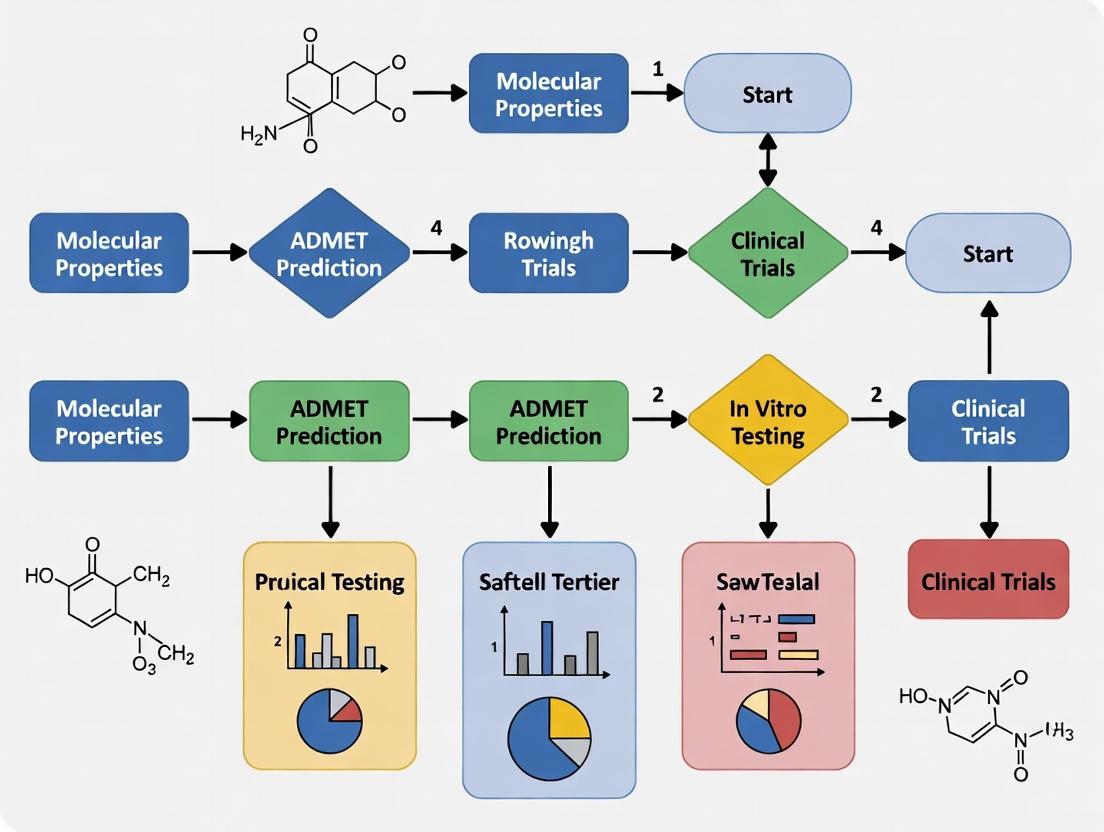
The following workflow diagram illustrates a modern strategy for leveraging computational predictions to guide experimental testing, creating a more efficient discovery cycle.
The Scientist's Toolkit: Key Research Reagents & Materials
Table: Essential Materials for In Vitro DMPK and ADMET Assays
| Tool / Reagent | Function / Application | Key Consideration |
|---|---|---|
| Human Liver Microsomes (HLM) | A subcellular fraction used for high-throughput assessment of CYP450-mediated metabolic stability and metabolite identification [2]. | Does not capture non-microsomal enzymes or transporter effects. |
| Primary Human Hepatocytes | Gold-standard cell system for predicting hepatic clearance, enzyme induction, and metabolite profiling; contains full complement of hepatic enzymes and transporters [2] [1]. | Donor variability can be a factor; cryopreserved formats improve accessibility. |
| Caco-2 Cell Line | A human colon carcinoma cell line that, upon differentiation, forms a monolayer mimicking the intestinal epithelium. Used to predict passive transcellular absorption and efflux transporter effects (e.g., P-gp) [2] [3]. | Levels of expressed CYP enzymes are generally lower and more variable than in human intestine [1]. |
| Recombinant CYP Enzymes | Individually expressed human CYP isoforms (e.g., CYP3A4, CYP2D6). Used to identify which specific enzyme is responsible for metabolizing a drug candidate [3]. | Essential for reaction phenotyping and understanding the risk of drug-drug interactions. |
| Transporters (e.g., P-gp, OATP) | Cell-based or vesicle assays expressing specific uptake or efflux transporters. Used to evaluate a drug's potential for transporter-mediated DDIs, tissue distribution, and excretion [2]. | Critical for understanding complex pharmacokinetics beyond metabolism. |
| Organ-on-a-Chip (OOC) / MPS | Advanced microphysiological systems that culture primary human cells under perfused flow to recreate organ-level function (e.g., gut, liver). Used for complex ADME assays like integrated gut-liver bioavailability [1]. | Provides more physiologically relevant human data but can be more complex to operate than traditional assays. |
Important Note: The selection of the appropriate tool depends on the specific ADMET property being investigated, the stage of the drug discovery project, and the balance between throughput and physiological relevance.
In early drug discovery, the evaluation of Absorption, Distribution, Metabolism, Excretion, and Toxicity (ADMET) properties is fundamental for determining a drug candidate's clinical success. Conventional approaches, including traditional experimental assays and static Quantitative Structure-Activity Relationship (QSAR) models, have long been used for this purpose. However, these methods are fraught with limitations, from being resource-intensive to lacking robustness and generalizability. This technical support document outlines the common challenges faced with these conventional approaches and provides troubleshooting guidance to help scientists navigate and overcome these issues, thereby improving the efficiency and predictive power of ADMET evaluation in early research.
Frequently Asked Questions (FAQs)
1. Why do conventional ADMET assays contribute to high drug attrition rates? Conventional experimental ADMET assays are often conducted later in the drug design process and can struggle to accurately predict human in vivo outcomes. Suboptimal pharmacokinetic profiles and unforeseen toxicity, which are frequently not identified until these resource-intensive assays are run, remain major contributors to clinical failure. Their high cost and labor requirements often mean they are not used exhaustively early on, allowing molecules with poor ADMET properties to advance [5] [6].
2. What is the primary limitation of traditional QSAR and in silico ADMET models? The primary limitation is a lack of robustness and generalizability. Many conventional computational models are trained on limited or homogeneous datasets, causing their performance to degrade significantly when making predictions for novel molecular scaffolds or compounds outside the distribution of their training data. They often operate as "black boxes" with poor interpretability, hindering mechanistic understanding [4] [6].
3. How does data scarcity impact the development of reliable ADMET models? Data scarcity is a fundamental challenge. Experimental ADMET data is often heterogeneous and low-throughput. When models are trained on small or non-diverse datasets that capture only limited sections of the relevant chemical space, they fail to learn the broad structure-property relationships needed for accurate predictions on new compound classes. This data limitation is often a greater bottleneck than the model architecture itself [4].
4. What are the common technical pitfalls in running molecular assays for ADMET? Common pitfalls include achieving insufficient sensitivity (leading to false negatives) or specificity (leading to false positives and cross-contamination), often exacerbated by inaccurate liquid handling. Manual workflows introduce human error and inconsistencies, compromising reproducibility. Furthermore, assays are often difficult to scale efficiently without compromising precision [7].
5. How can I improve the reliability of my in silico ADMET predictions? To improve reliability, ensure your model's Applicability Domain (AD) is well-defined and that predictions are interpreted with caution for compounds falling outside it. Leveraging models trained on larger and more diverse datasets, such as through federated learning, can significantly enhance generalizability. Additionally, employing multi-task architectures that learn from overlapping signals across multiple ADMET endpoints can boost overall performance and robustness [4] [8].
Troubleshooting Guides
Problem 1: Poor Generalizability of In-House QSAR Models
Symptoms: Your model performs well on your internal training set but shows significantly degraded accuracy when predicting properties for novel compound series or external datasets.
Possible Causes and Solutions:
| Cause | Solution |
|---|---|
| Limited Data Diversity: The training data covers too narrow a region of chemical space. | Utilize Federated Learning: Participate in or build models using federated learning networks. This approach allows for collaborative training on distributed proprietary datasets from multiple pharmaceutical partners, dramatically expanding the chemical space and diversity the model learns from without sharing raw data [4]. |
| Incorrect Applicability Domain (AD) Assessment: Predictions are made for compounds structurally distant from the training set. | Implement Rigorous AD Checks: Define and apply a strict applicability domain for your models. Use tools like scaffold-based cross-validation during model development to realistically estimate performance on new scaffolds. Always report the AD alongside predictions [8]. |
| Outdated or Simple Model Architecture: Reliance on single-task models or simple QSAR methods. | Adopt Advanced ML Frameworks: Transition to state-of-the-art methods like Graph Neural Networks (GNNs) and multi-task learning (MTL). GNNs better capture complex molecular structures, while MTL allows knowledge from related ADMET tasks to improve prediction accuracy [6]. |
Recommended Experimental Protocol: Model Validation with Scaffold Splitting
- Data Preparation: Curate your dataset and standardize molecular structures.
- Scaffold-Based Splitting: Use a tool like RDKit to identify molecular Bemis-Murcko scaffolds. Split the data into training and test sets such that compounds in the test set have scaffolds not present in the training set.
- Model Training: Train your model on the training set.
- Performance Assessment: Evaluate the model on the scaffold-held-out test set. This provides a more realistic estimate of its performance on truly novel chemotypes [4].
Problem 2: Resource Intensiveness of Experimental ADMET Assays
Symptoms: The ADMET screening process is creating a bottleneck due to high consumption of precious reagents, long timelines, and reliance on animal studies, making it expensive and slow for early-stage lead optimization.
Possible Causes and Solutions:
| Cause | Solution |
|---|---|
| Low-Throughput Experimental Designs: Manual workflows and large-volume assays. | Implement Assay Miniaturization: Use automated, non-contact liquid handlers capable of dispensing nanoliter volumes. This can reduce reagent consumption by up to 50%, conserve precious samples, and significantly lower costs while maintaining data quality [7]. |
| High Compound Requirements: Traditional assays require a non-negligible amount of synthetic material. | Shift to In Silico Triage: Integrate computational ADMET prediction tools at the very beginning of the drug design process. Use platforms for virtual screening to prioritize compounds with a higher probability of favorable ADMET properties before they are synthesized, reducing the wet-lab burden [9] [10]. |
| Lengthy Timelines for In Vivo Toxicity Studies: Animal studies are time-consuming and raise ethical concerns. | Adopt Advanced In Vitro Mechanistic Assays: Incorporate functionally relevant, human-based in vitro assays earlier. For example, use Cellular Thermal Shift Assays (CETSA) to confirm direct target engagement in a physiologically relevant cellular context, de-risking candidates before proceeding to animal studies [9]. |
Recommended Experimental Protocol: Automated High-Throughput Solubility Screening
- Sample Preparation: Use an acoustic or piezo-electric non-contact liquid handler (e.g., I.DOT) to transfer nanoliter volumes of compound DMSO stock solutions into assay plates.
- Buffer Addition: Use the same automated system to add aqueous buffer to induce precipitation.
- Incubation and Reading: Incubate the plates and use an integrated microplate reader to measure turbidity or UV absorption.
- Data Analysis: Automate data processing to classify compounds based on solubility. This miniaturized, automated workflow drastically increases throughput and reduces reagent use compared to manual, milliter-scale methods [7].
Problem 3: Lack of Interpretability in Complex ML Models
Symptoms: Your deep learning model provides accurate ADMET predictions, but you cannot understand the reasoning behind them, making it difficult to gain scientific insight or guide medicinal chemistry efforts.
Possible Causes and Solutions:
| Cause | Solution |
|---|---|
| "Black-Box" Nature of Models: Complex models like deep neural networks lack inherent interpretability. | Employ Explainable AI (XAI) Techniques: Integrate post-hoc interpretation methods such as SHAP (SHapley Additive exPlanations) or LIME (Local Interpretable Model-agnostic Explanations) to highlight which molecular substructures or features most influenced the model's prediction for a specific compound [6]. |
| Focus Solely on Prediction Accuracy: The model was developed and selected based only on its numerical accuracy, not its ability to provide insights. | Prioritize Mechanistic Interpretability: During model selection, favor architectures that offer a balance between performance and interpretability. When possible, use models that provide confidence scores or uncertainty estimates for their predictions to guide decision-making [6]. |
Comparative Analysis of Conventional vs. Modern Approaches
The table below summarizes key limitations of conventional approaches and contrasts them with modern solutions.
| Aspect | Conventional Approach & Limitations | Modern Solution & Key Benefits |
|---|---|---|
| Data Foundation | Isolated, limited datasets leading to poor generalization [4]. | Federated Learning across multiple organizations. Expands chemical space coverage without centralizing data [4]. |
| Model Architecture | Static QSAR models and single-task learning [6]. | Graph Neural Networks (GNNs) & Multi-Task Learning (MTL). Captures complex structure and improves accuracy via shared learning [6]. |
| Experiment Throughput | Manual, low-throughput, high-volume assays [7]. | Automation & Miniaturization. Enables high-throughput screening with nanoliter volumes, saving reagents and time [7]. |
| Target Engagement | Indirect or biochemical measures lacking cellular context. | Cellular Thermal Shift Assay (CETSA). Confirms target engagement in a physiologically relevant cellular environment [9]. |
| Model Interpretability | "Black-box" models with little insight [6]. | Explainable AI (XAI) and Applicability Domain (AD). Provides reasoning for predictions and defines model boundaries [6] [8]. |
Workflow and Relationship Visualizations
ADMET Model Improvement Pathway
This diagram illustrates the strategic pathway for transitioning from limited, conventional ADMET models to robust, next-generation predictive tools.
Experimental ADMET Workflow Optimization
This workflow contrasts the traditional, resource-intensive ADMET screening process with an optimized, AI-integrated modern approach.
The Scientist's Toolkit: Key Research Reagent Solutions
The following table details essential tools and technologies for implementing modernized ADMET prediction and screening workflows.
| Tool / Technology | Function in ADMET Research |
|---|---|
| Automated Non-Contact Liquid Handler (e.g., I.DOT) | Enables assay miniaturization by precisely dispensing nanoliter volumes, reducing reagent use and increasing throughput while minimizing cross-contamination [7]. |
| Cellular Thermal Shift Assay (CETSA) | Investigates target engagement by measuring the thermal stabilization of a protein target upon ligand binding in a physiologically relevant cellular or tissue context, bridging the gap between biochemical potency and cellular efficacy [9]. |
| Graph Neural Networks (GNNs) | A class of deep learning models that directly operate on molecular graph structures, superiorly capturing the complex relationships between atoms and bonds for improved ADMET property prediction [6]. |
| Federated Learning Platform (e.g., Apheris) | Provides a secure framework for multiple institutions to collaboratively train machine learning models on distributed private datasets without data sharing, overcoming data scarcity and improving model generalizability [4]. |
| Applicability Domain (AD) Assessment Tools | Methods and software (e.g., in VEGA, ADMETLab) that evaluate whether a new compound is within the chemical space a QSAR/ML model was trained on, crucial for assessing prediction reliability [8]. |
Frequently Asked Questions
Q1: Why do my ADMET models perform well in validation but fail on new compound series? This is a classic symptom of the data diversity problem. Models are often trained on public datasets that have limited chemical structural diversity or are biased toward specific chemotypes. When you introduce a new scaffold that is not well-represented in the training data, the model operates outside its "applicability domain," and predictions become unreliable [11] [12]. The model literally has no good reference points for making a prediction.
Q2: How can I quickly check if a compound is within my model's applicability domain? A common and effective method is to calculate the Tanimoto similarity between your query compound and the nearest neighbor in the model's training set. The versatile Nearest Neighbor (vNN) method, for instance, uses a predefined similarity threshold (e.g., based on ECFP4 fingerprints). If no compound in the training set meets this similarity criterion, the model should refrain from making a prediction, thus alerting you to the coverage issue [11].
Q3: What are the main sources of data variability that harm model performance? The primary sources of variability that create a "noisy" dataset include [12]:
- Experimental Conditions: The same property (e.g., aqueous solubility) can yield different results under different buffer conditions, pH levels, or laboratory procedures.
- Data Origin: Merging data from different sources (e.g., ChEMBL, PubChem) without accounting for systematic differences in experimental protocols.
- Structural Bias: Historical datasets are often over-represented with certain successful drug-like scaffolds and lack diversity, providing poor coverage of novel chemical space.
Q4: Are there public benchmarks that address the data diversity problem? Yes, next-generation benchmarks are being developed to tackle this. PharmaBench is one such effort, created by using a large-language-model (LLM) based system to meticulously extract and standardize experimental conditions from over 14,000 bioassays. This process results in a larger and more consistent dataset designed to be more representative of compounds used in real drug discovery projects [12].
Troubleshooting Guides
Problem: Inconsistent Predictions for Structurally Similar Compounds
| Potential Cause | Diagnostic Steps | Solution |
|---|---|---|
| Inconsistent training data due to merged results from different experimental assays [12]. | 1. Check the source of the experimental data for your compounds.2. Trace back the original publications or assay descriptions for methodological details. | Use data curation pipelines, like the one used for PharmaBench, that identify and standardize experimental conditions before model training [12]. |
| Model operating at the edge of its applicability domain [11]. | Calculate the similarity distance of the problematic compounds to the model's training set. You will likely find they are on the periphery. | Use a model with a defined applicability domain that warns you when a prediction is not reliable. Consider generating new experimental data for these chemotypes to expand the training set [11]. |
Problem: Model Fails to Generalize to Novel Scaffolds
| Potential Cause | Diagnostic Steps | Solution |
|---|---|---|
| Training set lacks structural diversity and is clustered in specific regions of chemical space [13]. | Perform a principal component analysis (PCA) or t-SNE visualization of your training set versus the novel scaffolds you are testing. | Integrate data from multiple consolidated sources like PharmaBench or use the vNN platform to rapidly update your model with new assay data without full retraining [11] [12]. |
| Over-reliance on small, legacy benchmark datasets like ESOL (n=1,128) which have low molecular weight and differ from modern drug discovery compounds [12]. | Compare the molecular weight and other properties of your compounds to the training set's average. | Switch to larger, more modern benchmarks. For example, PharmaBench contains 52,482 entries with molecular weights more typical of drug discovery projects (300-800 Dalton) [12]. |
Data and Experimental Protocols
Table 1: Comparison of ADMET Dataset Scales and Properties This table highlights the scale and scope of different data resources, underscoring the data diversity challenge.
| Dataset Name | Key ADMET Properties Covered | Number of Entries | Key Characteristics & Limitations |
|---|---|---|---|
| PharmaBench [12] | 11 key properties (e.g., Solubility, Permeability, CYP inhibition) | 52,482 | Created by processing 14,401 bioassays; designed for industrial drug discovery (MW 300-800). |
| MoleculeNet [12] | 17 properties across physical chemistry and physiology | >700,000 | A broad collection, but some specific datasets (e.g., ESOL) are small (n=1,128) and contain lighter compounds (avg. MW 203.9). |
| admetSAR 2.0 Models [14] | 18 binary and continuous endpoints (e.g., Ames, HIA, P-gp) | Varies by endpoint (e.g., 8,348 for Ames mutagenicity) | A widely used web server; the associated ADMET-score integrates these 18 properties into a single drug-likeness index. |
Table 2: The ADMET-Score Components and Weights This scoring function helps evaluate the overall drug-likeness of a compound by integrating multiple ADMET predictions [14].
| Endpoint | Property Type | Dataset Size (Positive/Negative) | Model Accuracy |
|---|---|---|---|
| Ames mutagenicity | Toxicity | 4866 / 3482 | 0.843 |
| Human Intestinal Absorption (HIA) | Absorption | 500 / 78 | 0.965 |
| P-glycoprotein Inhibitor (P-gpi) | Distribution | 1172 / 771 | 0.861 |
| CYP2D6 Inhibitor | Metabolism | 3060 / 11681 | 0.855 |
| hERG Inhibitor | Toxicity | 717 / 261 | 0.804 |
| Caco-2 Permeability | Absorption | 303 / 371 | 0.768 |
| Acute Oral Toxicity | Toxicity | — | 0.832 |
Experimental Protocol: Implementing a vNN-based ADMET Prediction
The following methodology details how to use the versatile Nearest Neighbor (vNN) approach for making reliable predictions within a defined applicability domain [11].
- Input Molecule Preparation: Provide the query molecule(s) by drawing the structure, entering the canonical SMILES string, or uploading a file in
.csvor.txtformat with columns labeledNAMEandSMILES[11]. - Fingerprint Generation: The system will automatically compute the ECFP4 (Extended-Connectivity Fingerprints with a diameter of 4 bonds) for the query molecule. These fingerprints capture meaningful molecular features and are used for similarity calculations [11].
- Similarity Calculation & Neighbor Selection: For the query molecule, the system calculates the Tanimoto distance to every molecule in the model's training set. The Tanimoto distance is defined as:
d = 1 - [n(P ∩ Q) / (n(P) + n(Q) - n(P ∩ Q))]wheren(P ∩ Q)is the number of common features in molecules p and q, andn(P)andn(Q)are the total features for each molecule. All neighbors with a distanced_iless than or equal to a pre-optimized thresholdd_0are selected [11].
- Applicability Domain Check: If no neighbors are found within the
d_0threshold, the model returns no prediction, ensuring reliability. The proportion of test molecules that pass this check is the model's coverage [11]. - Weighted Prediction: For molecules within the applicability domain, a weighted average of the neighbors' experimental activities is computed. The weight for each neighbor
iis given bye^(-(d_i/h)^2), wherehis a smoothing factor. The final predicted activityyis [11]:y = [ Σ (y_i * e^(-(d_i/h)^2) ) ] / [ Σ e^(-(d_i/h)^2) ]for alliwhered_i ≤ d_0.
The Scientist's Toolkit
Table 3: Key Research Reagent Solutions for ADMET Modeling
| Tool / Resource | Function in Addressing Data Diversity |
|---|---|
| ECFP4 Fingerprints | A method to convert molecular structure into a numerical fingerprint, enabling quantitative similarity searches and defining the applicability domain [11]. |
| Tanimoto Distance | A standard metric for quantifying the structural similarity between two molecules based on their fingerprints, crucial for the vNN method [11]. |
| Multi-Agent LLM System | An advanced data curation tool (e.g., using GPT-4) that automatically extracts and standardizes experimental conditions from thousands of assay descriptions, enabling the creation of robust datasets like PharmaBench [12]. |
| ADMET-Score | A comprehensive scoring function that integrates 18 predicted ADMET properties into a single value, providing a holistic view of a compound's drug-likeness and helping to triage candidates [14]. |
Workflow Diagrams
Diagram Title: Data Curation to Reliable Prediction Workflow
Diagram Title: vNN Applicability Domain Logic
Technical Support Center: Troubleshooting ML-Driven ADMET Prediction
Frequently Asked Questions (FAQs)
Q1: My ML model for toxicity prediction performs well on internal data but fails on novel chemical scaffolds. How can I improve its generalizability?
A: This is a common issue known as model degradation, often caused by limited chemical diversity in your training set. To address this:
- Utilize Federated Learning: Participate in or establish a federated learning network. This approach allows you to collaboratively train models with other institutions, expanding the chemical space your model learns from without sharing proprietary data. Federation has been shown to systematically improve model robustness and expand applicability domains [4].
- Implement Rigorous Data Curation: Before training, slice your data by scaffold and assay type to understand modelability. Use scaffold-based cross-validation, not random splits, to better simulate performance on truly novel compounds [4].
- Adopt Advanced Architectures: Move beyond simple QSAR models. Use graph neural networks (GNNs) or multi-task learning frameworks that can capture complex structure-property relationships more effectively, leading to better generalization [6] [15].
Q2: How can I address the "black box" problem of deep learning models to gain insights for lead optimization?
A: Improving model interpretability is crucial for scientific validation and guiding chemistry efforts.
- Leverage Explainable AI (XAI) Techniques: Employ methods like SHAP or LIME to attribute predictions to specific molecular features or substructures. This helps you understand which chemical groups contribute to a favorable or unfavorable ADMET profile [6].
- Incorporate Interpretable Representations: Use models that combine learned representations (like Mol2Vec embeddings) with a curated set of known physicochemical descriptors (e.g., molecular weight, logP). This blends the power of deep learning with the intuitiveness of classical descriptors [15].
- Explore Symbolic Regression: Emerging methods like Deep Generative Symbolic Regression aim to discover concise, closed-form mathematical equations from data, offering inherent interpretability [16].
Q3: Our experimental ADMET data is heterogeneous and low-throughput. How can we build reliable models with such sparse data?
A: Sparse, heterogeneous data is a key challenge in pharmacology. Modern ML offers several strategies:
- Apply Multi-Task Learning (MTL): Train a single model to predict multiple ADMET endpoints simultaneously. MTL allows the model to learn shared representations across related tasks, which acts as a form of regularization and improves performance on tasks with limited data [6] [15].
- Use Pre-trained Models and Fine-Tuning: Start with a model pre-trained on a large, public chemical database. Fine-tune this model on your smaller, proprietary dataset. This transfer learning approach can significantly boost performance with limited data [4] [15].
- Integrate Expert Knowledge: Hybrid models that combine neural networks with expert-defined ordinary differential equations can perform well in small-sample regimes. This incorporates established pharmacological principles to guide the learning process [16].
Troubleshooting Guides
Issue: Model Performance is Poor or Unreliable
| Step | Action & Description | Key Transaction/Code (if applicable) |
|---|---|---|
| 1 | Audit Data Quality & Diversity : Check for data imbalance, assay consistency, and sufficient coverage of the chemical space relevant to your project. | Use internal data sanity checks and chemical clustering tools. |
| 2 | Validate Model Generalization : Ensure you are not overfitting. Use scaffold-based splits for cross-validation, not random splits. | from sklearn.model_selection import PredefinedSplit or similar. |
| 3 | Benchmark Against Null Models : Compare your model's performance against simple baselines (e.g., predicting the mean) to confirm it has learned meaningful patterns [4]. | Implement statistical significance tests (e.g., t-test) on performance distributions. |
| 4 | Check Feature Representation : Experiment with different molecular featurization methods (e.g., ECFP fingerprints, graph representations, Mordred descriptors) to find the most informative one for your endpoint [15]. | from rdkit.Chem import AllChemfrom mordred import Calculator, descriptors |
Issue: Model is Not Accepted by Regulatory or Internal Safety Standards
| Step | Action & Description | Key Transaction/Code (if applicable) |
|---|---|---|
| 1 | Enhance Interpretability : Integrate model explanation tools to provide mechanistic insights and justify predictions. | Use libraries like SHAP or LIME to generate feature importance plots. |
| 2 | Ensure Rigorous Validation : Follow regulatory-endorsed validation principles. Perform extensive external validation on held-out compounds that are structurally distinct from your training set. | Refer to FDA/EMA guidelines on computational model validation. |
| 3 | Document the Workflow Meticulously : Maintain a clear record of data provenance, model architecture, hyperparameters, and all validation results to build a compelling case for model credibility. | - |
Experimental Protocols & Data Presentation
Protocol 1: Implementing a Multi-Task Deep Learning Model for ADMET Prediction
This protocol outlines the steps for building a model that predicts multiple ADMET endpoints simultaneously, improving data efficiency and prediction consistency [6] [15].
- Data Collection & Curation:
- Gather datasets for the desired ADMET endpoints (e.g., solubility, CYP450 inhibition, hERG liability).
- Standardize molecular structures (e.g., using RDKit) and handle missing values.
- Crucially, slice data by molecular scaffold and perform a "modelability" analysis to assess the inherent predictability of each endpoint [4].
- Molecular Featurization:
- Convert each molecule into a numerical representation. We recommend a hybrid approach:
- Model Architecture & Training:
- Architecture: Design a neural network with shared hidden layers (for common feature learning) and task-specific output heads (for individual endpoint prediction).
- Training: Use a combined loss function (e.g., weighted sum of mean squared error for regression tasks and cross-entropy for classification tasks). Train with mini-batch stochastic gradient descent.
- Model Validation:
- Employ scaffold-based cross-validation: Split data so that molecules with the same Bemis-Murcko scaffold are in the same fold. This tests generalization to new chemotypes [4].
- Benchmarking: Compare your multi-task model against single-task models and established baselines. Use multiple random seeds and folds to report a distribution of results, not just a single score [4].
Diagram: Multi-Task Learning Workflow for ADMET Prediction
Protocol 2: Setting Up a Federated Learning Cycle for Cross-Organizational Model Training
This protocol enables collaborative model improvement on distributed private datasets [4].
- Network Initialization:
- Each participant (e.g., a pharma company) is a node in the network with its own private ADMET dataset.
- A central coordinator initializes a global ML model (e.g., a GNN) and defines the training protocol.
- Federated Learning Cycle:
- Step 1 - Distribution: The coordinator sends the current global model to a subset of participants.
- Step 2 - Local Training: Each participant trains the model on their local data for a set number of epochs.
- Step 3 - Aggregation: Participants send their model updates (e.g., weight gradients) back to the coordinator. Crucially, raw data never leaves the local site.
- Step 4 - Averaging: The coordinator aggregates these updates (e.g., using Federated Averaging) to create an improved global model.
- Iteration and Validation:
- Repeat the cycle for multiple rounds.
- Periodically evaluate the performance of the updated global model on held-out validation sets provided by the participants.
Diagram: Federated Learning Process
Quantitative Performance Data
Table 1: Comparative Performance of ML Approaches on Key ADMET Endpoints [6] [4]
| ADMET Endpoint | Traditional QSAR | Single-Task Deep Learning | Multi-Task / Federated Deep Learning | Key Benefit |
|---|---|---|---|---|
| Human Liver Microsomal Clearance | Limited generalizability | Improved accuracy | 40-60% reduction in prediction error [4] | Better in vitro-in vivo extrapolation |
| Solubility (KSOL) | Struggles with complex scaffolds | Good with sufficient data | Higher accuracy on novel chemotypes [4] | Improved formulation guidance |
| hERG Cardiotoxicity | High false negative rate | More sensitive | Increased robustness & applicability domain [6] [4] | Reduced late-stage cardiac attrition |
| CYP450 Inhibition | Based on static descriptors | Captures complex patterns | Superior in predicting drug-drug interactions [15] | Enhanced clinical safety profile |
The Scientist's Toolkit: Research Reagent Solutions
Table 2: Essential Tools for ML-Driven ADMET Research
| Tool / Resource Name | Type | Primary Function |
|---|---|---|
| Therapeutics Data Commons (TDC) [17] | Software/Database | Provides curated, unified datasets and benchmarks for various ADMET and drug discovery tasks. |
| Chemprop [15] | Software | A message-passing neural network specifically designed for molecular property prediction, supporting multi-task learning. |
| RDKit [15] | Software | Open-source cheminformatics toolkit used for molecule standardization, descriptor calculation, and fingerprint generation. |
| Apheris Federated ADMET Network [4] | Platform | A commercial platform enabling pharmaceutical companies to collaboratively train ADMET models using federated learning. |
| Mol2Vec [15] | Algorithm | An unsupervised method for learning vector representations of molecular substructures, analogous to Word2Vec in NLP. |
| Receptor.AI ADMET Model [15] | Service/Model | A commercial ADMET prediction service using a multi-task model with Mol2Vec embeddings and curated descriptors. |
| SHAP (SHapley Additive exPlanations) | Library | A game-theoretic approach to explain the output of any machine learning model, crucial for interpreting "black box" models. |
| Federated Averaging Algorithm [4] | Algorithm | The core algorithm used in federated learning to aggregate model updates from distributed clients into a central model. |
A Practical Guide to Modern ML Techniques for ADMET Prediction
Frequently Asked Questions (FAQs)
Q1: Why should I use a Graph Neural Network over traditional descriptors for ADMET prediction? Traditional models rely on pre-calculated molecular descriptors, which can be a simplified representation and may not capture all features relevant to complex ADMET properties [18]. GNNs directly learn from the molecular graph structure (atoms as nodes, bonds as edges), inherently capturing important topological information that can lead to more accurate predictions and bypass the need for computationally expensive descriptor retrieval and selection [18].
Q2: My ensemble model is not performing better than my single best model. What could be wrong? Ensemble methods, including bagging and boosting, do not always guarantee better performance [19]. This can happen if the base models in your ensemble lack diversity and make correlated errors, if you are using the wrong ensemble method for your problem (e.g., using bagging with consistently biased models), or if the ensemble is overfitting the training data despite techniques like bootstrap sampling [20] [19]. Ensuring model diversity and selecting the appropriate ensemble strategy is crucial.
Q3: In Multi-Task Learning, how do I decide the weights for combining losses from different tasks? There is no one-size-fits-all answer. A simple start is a weighted sum of losses, where weights can be fixed based on domain knowledge or task importance [21]. More advanced, automated methods include uncertainty weighting, where the weight for each task's loss is dynamically learned based on the task's inherent uncertainty [22]. Another strategy is to adjust weights dynamically based on validation performance, reducing the weight for tasks where accuracy is high to focus the model on harder tasks [21].
Q4: What does "task relatedness" mean in Multi-Task Learning, and why is it important? Task relatedness implies that the tasks you are training on simultaneously share some common underlying factors or features that the model can learn and leverage [22]. For example, predicting the inhibition of different cytochrome P450 enzymes (CYP2C9, CYP2C19, etc.) are related tasks as they all involve metabolic clearance [18]. Training on related tasks acts as a form of regularization, improving the model's generalization. Using unrelated tasks can lead to negative transfer, where the performance on one or more tasks degrades due to interference from other tasks [22].
Troubleshooting Guides
Graph Neural Networks for Molecular Property Prediction
| Problem | Possible Cause | Solution |
|---|---|---|
| Poor generalization to new molecular scaffolds | Overfitting on small training datasets or over-smoothing where node features become too similar after many GNN layers. | Incorporate regularization like dropout (e.g., 50%) within GNN layers [18] [23]. Reduce the number of GNN layers to capture a more local neighborhood instead of the entire graph. |
| Model fails to capture key functional groups | The GNN's message-passing range is too limited, or node features lack crucial chemical information. | Increase the number of GNN layers to allow information to propagate from more distant atoms. Enrich node feature vectors with atomic properties like hybridization, formal charge, and whether the atom is in a ring [18]. |
| High computational cost and long training times | The molecular graphs are large or the GNN architecture is complex. | Utilize mini-batching of graphs during training. Consider simplifying the model architecture or using sampling techniques to neighbor nodes during message passing. |
Ensemble Methods in ADMET Modeling
| Problem | Possible Cause | Solution |
|---|---|---|
| High computational and memory resources | Ensemble methods require training and storing multiple models. | Use weaker but faster base models (e.g., shallow decision trees). For inference, use model distillation to compress the ensemble into a single, smaller model. |
| No significant improvement over a single model | Lack of diversity among base models; they all make similar errors. | Introduce diversity by using different algorithms (e.g., SVM, RF, NNET), different subsets of features, or different subsets of training data (bagging) [20] [24]. |
| Ensemble performance is biased or unfair | Bias in the training data can be amplified and perpetuated by the ensemble. | Apply fairness-aware metrics and preprocessing techniques to the training data before building the ensemble models [20]. |
Multi-Task Learning for Joint ADMET Endpoint Prediction
| Problem | Possible Cause | Solution |
|---|---|---|
| One task dominates the training, hurting performance on others | The loss magnitude of one task is much larger than others, causing the optimizer to prioritize it. | Implement a dynamic loss balancing strategy, such as uncertainty weighting, to automatically scale the contribution of each task's loss [22] [25]. |
| Negative transfer: Performance is worse than single-task models | The tasks are not sufficiently related and are interfering with each other. | Conduct a pre-training analysis of task relationships. Architectures with soft parameter sharing (separate models with regularized parameters) can be more robust to unrelated tasks than hard parameter sharing [22]. |
| Difficulty in interpreting which features are important for which task | The shared layers in MTL make it non-trivial to attribute predictions to specific tasks. | Use model interpretability techniques like attention mechanisms to identify which molecular substructures the model deems important for each specific ADMET task [26]. |
Experimental Protocols & Data Presentation
Protocol 1: Implementing an Attention-based GNN for ADMET Prediction
This protocol is based on a study that used an attention-based GNN to predict properties like lipophilicity and CYP450 inhibition [18].
- Molecular Graph Construction: Convert SMILES strings into molecular graphs. Each atom is a node, and each bond is an edge.
- Node Features: Create a feature vector for each atom. Include atomic number, formal charge, hybridization, and whether it is in a ring (see Table 1) [18].
- Adjacency Matrices: Create multiple adjacency matrices to represent different bond types: single (
A2), double (A3), triple (A4), and aromatic (A5), in addition to the total bond matrix (A1) [18].
- Model Architecture:
- Use Graph Attention (GAT) layers to update node representations. These layers allow a node to assign different importance to its neighbors [18].
- After several message-passing layers, perform a global pooling (e.g., sum or mean) to get a graph-level representation for the entire molecule.
- Pass this representation through fully connected layers to produce the final prediction (regression or classification).
- Training: Use a five-fold cross-validation strategy to robustly evaluate model performance. Use task-appropriate loss functions (Mean Squared Error for regression, Cross-Entropy for classification) [18].
Protocol 2: Building an Adaptive Ensemble for ADMET Classification
This protocol is inspired by the Adaptive Ensemble Classification Framework (AECF) designed for unbalanced ADME data [24].
- Data Balancing: Given a dataset with a high imbalance ratio (IR), first apply a sampling method (e.g., SMOTE for oversampling, or random undersampling) to create multiple balanced training subsets [24].
- Generate Individual Models: On each balanced subset, train a diverse set of base classifiers (e.g., Support Vector Machine, Random Forest, Artificial Neural Networks). A Genetic Algorithm (GA) can be used to select optimal features for each model [24].
- Combine Models: Instead of simple majority voting, use an optimized ensemble rule. The AECF framework uses an adaptive procedure that selects individual models based on both their accuracy and diversity to create a final, robust ensemble model [24].
Table 1: Performance Comparison of Ensemble Methods on ADMET Datasets Table based on the evaluation of the AECF framework against bagging and boosting on five ADMET classification tasks [24].
| ADMET Property | Dataset Size (Compounds) | Single Best Model (Avg. AUC) | Bagging (Avg. AUC) | Boosting (Avg. AUC) | Adaptive Ensemble (AECF) (Avg. AUC) |
|---|---|---|---|---|---|
| Caco-2 Permeability (CacoP) | 1,387 | ~0.82 | ~0.83 | ~0.84 | 0.857 - 0.860 |
| Human Intestinal Absorption (HIA) | Information missing | ~0.86 | ~0.87 | ~0.88 | 0.897 - 0.918 |
| Oral Bioavailability (OB) | Information missing | ~0.75 | ~0.76 | ~0.77 | 0.782 - 0.798 |
| P-glycoprotein Substrates (PS) | Information missing | ~0.79 | ~0.80 | ~0.81 | 0.814 - 0.831 |
| P-glycoprotein Inhibitors (PI) | Information missing | ~0.86 | ~0.87 | ~0.88 | 0.887 - 0.890 |
Protocol 3: Setting Up a Multi-Task Learning Model with Dynamic Loss Weighting
- Model Architecture (Hard Parameter Sharing):
- Shared Encoder: A series of layers common to all tasks. For molecular data, this could be a GNN or a set of dense layers processing molecular descriptors.
- Task-Specific Heads: Separate output layers for each ADMET task (e.g., one for solubility, one for CYP2C9 inhibition) [22].
- Dynamic Loss Function: Implement a loss function that automatically balances the contribution of each task. The following wrapper can be used with PyTorch, as described in research on quantum-enhanced MTL [25] and other guides [22].
- Training Loop: In each training step, compute the loss for each task, pass these losses to the
MultiTaskLossWrapperto get the total loss, and then run the backward pass [21].
Workflow Visualization
GNN, Ensemble, and MTL Relationship
The Scientist's Toolkit: Research Reagent Solutions
Table 2: Essential Computational Tools for Advanced ADMET Modeling
| Item | Function | Example Use Case |
|---|---|---|
| Therapeutics Data Commons (TDC) | A platform providing curated benchmarks and datasets for drug discovery, including standardized ADMET tasks [18]. | For training and fairly evaluating GNN, MTL, and ensemble models on a level playing field [18] [25]. |
| PyTorch Geometric (PyG) | A library built upon PyTorch for deep learning on graphs and other irregular structures [23]. | Implementing GNN architectures like GCN or GAT for molecular graph processing [23]. |
| RDKit | An open-source cheminformatics toolkit that allows for the computation of molecular descriptors and conversion of SMILES to molecular graphs [25]. | Generating node and edge features from SMILES strings to feed into a GNN [18] [25]. |
| XGBoost | An optimized library for implementing gradient boosting, a powerful sequential ensemble method [20]. | Creating a high-performance ensemble model for ADMET classification or regression. |
| Chemprop | A message-passing neural network specifically designed for molecular property prediction, often used as a strong baseline [25]. | Serves as a backbone model for more advanced frameworks, such as those integrating quantum descriptors for MTL [25]. |
Performance Benchmarking and Quantitative Outcomes
Federated learning has demonstrated significant, quantifiable benefits for ADMET prediction, where model performance is often limited by the availability of diverse chemical data. The table below summarizes key performance metrics from recent large-scale implementations.
Table 1: Measured Performance Benefits of Federated Learning for ADMET Prediction
| Study / Implementation | Performance Improvement | Scope and Data Diversity | Key ADMET Endpoints Validated |
|---|---|---|---|
| MELLODDY Project [4] [27] | Consistent, systematic outperformance of local baseline models. | Unprecedented scale across multiple pharmaceutical companies. | Quantitative Structure-Activity Relationship (QSAR) models. |
| Polaris ADMET Challenge [4] | 40–60% reduction in prediction error. | Broad collaborative benchmarking initiative. | Human & mouse liver microsomal clearance, solubility (KSOL), permeability (MDR1-MDCKII). |
| Cross-Pharma Research [4] | Performance gains scaled with the number and diversity of participants. | Multiple participating organizations with heterogeneous data. | Expanded applicability domains and robustness across unseen molecular scaffolds. |
Frequently Asked Questions (FAQs) & Troubleshooting
General Concepts
Q1: What is federated learning in the context of drug discovery? Federated Learning (FL) is a decentralized machine learning approach that enables multiple parties (e.g., pharmaceutical companies, research institutions) to collaboratively train a model without sharing their raw data. Instead of centralizing datasets, each participant trains a model locally on their private data, and only the model updates (like gradients or weights) are sent to a central server for aggregation into an improved global model. This preserves data privacy and intellectual property [4] [28].
Q2: How does federated learning specifically help with ADMET prediction? Accurate ADMET prediction requires learning from a vast and diverse chemical space. Individual organizations possess limited data, causing models to perform poorly on novel compounds. Federated learning overcomes this by creating a global model that learns from the combined chemical diversity of all participants. This leads to models with broader applicability domains and significantly reduced prediction errors, especially for pharmacokinetic and safety endpoints [4].
Q3: Does federated learning guarantee data privacy? Federated learning significantly enhances privacy by keeping raw data localized. However, for robust privacy protection, it is typically combined with additional techniques like differential privacy (adding calibrated noise to model updates) and secure multi-party computation (encrypting updates during aggregation) to prevent potential reconstruction of raw data from the shared model parameters [28] [29].
Technical Implementation & Troubleshooting
Q4: We are experiencing slow convergence of the global model. What can we do? Slow convergence is a common challenge. Consider the following solutions:
- Increase Local Epochs: Allow more training passes on local datasets before aggregation [30].
- Adaptive Learning Rates: Implement learning rate schedules that decrease over time to stabilize training [30].
- Client Sampling: Instead of aggregating updates from all nodes every round, select a subset of nodes with more representative or higher-quality data [30].
- Advanced Algorithms: Use algorithms like FedProx, which handles statistical heterogeneity (non-IID data) more effectively by adding a proximal term to the local loss function, preventing local updates from drifting too far from the global model [29].
Q5: How do we handle participants with different data formats, assay protocols, or computational resources? This heterogeneity is a key technical barrier.
- Model Heterogeneity: Use frameworks like TensorFlow Federated or PySyft that support standardized protocols and can accommodate some level of heterogeneity [28].
- Data Heterogeneity: The federated averaging process is designed to learn from non-identically distributed data. Techniques like stratification and careful evaluation can mitigate bias [4].
- Resource Constraints: For participants with limited computational power, use techniques like gradient compression or allow for smaller model architectures. Asynchronous aggregation protocols can also prevent the system from waiting for the slowest node [30] [31].
Q6: What are the best practices for validating a federated model for ADMET prediction? Rigorous validation is critical for trust in the models. Best practices include:
- Scaffold-Based Splitting: Partition data by molecular scaffold during training and testing to evaluate performance on truly novel chemotypes, preventing over-optimistic results [4].
- Multiple Seed and Fold Evaluation: Run experiments across multiple random seeds and cross-validation folds to report a distribution of results, not just a single score [4].
- Benchmark Against Null Models: Compare the federated model's performance against simple baseline models and established noise ceilings to confirm that improvements are statistically significant and practically useful [4].
Q7: How can we protect the federated learning process from security threats like model poisoning? Malicious actors could submit bad updates to degrade the global model.
- Anomaly Detection: Implement statistical outlier detection to identify and reject suspicious model updates before aggregation. AI agents can be tasked with evaluating each update for anomalies [30].
- Byzantine-Robust Aggregation: Use aggregation algorithms that are inherently robust to a certain fraction of malicious clients, instead of a simple averaging (FedAvg) strategy [30].
- Secure Aggregation: Employ cryptographic protocols that allow the server to aggregate model updates without being able to decipher any single participant's update, enhancing privacy and security [29].
Experimental Protocol: Implementing a Federated Learning Workflow for ADMET
The following workflow diagram and detailed protocol outline the key stages for setting up a federated learning experiment for ADMET property prediction.
Federated Learning Workflow for ADMET Prediction.
Protocol Steps:
Project Setup and Governance
- Define Objectives: Clearly state the ADMET endpoint to be predicted (e.g., metabolic clearance, hERG inhibition) [28].
- Form Consortium & Establish Agreement: Select participating organizations. A critical step is to establish a legal and technical framework covering data usage, intellectual property (IP) rights, and model ownership. Using a trusted third-party coordinator can streamline this [27].
- Implement Privacy Safeguards: Decide on and configure privacy-enhancing technologies (e.g., differential privacy parameters, secure aggregation protocols) [28] [29].
Technical Configuration and Initialization
- Select an FL Framework: Choose a framework like TensorFlow Federated or PySyft [28].
- Define Model Architecture: Agree upon a common neural network architecture (e.g., multi-task deep learning model) that all participants will use for local training [4].
- Initialize Global Model: The central server initializes a global model with random weights or pre-trained on public data [29].
Federated Training Loop
- Model Distribution: The central server sends the current global model to all or a sampled subset of participating clients [29].
- Local Training: Each client trains the model on its local, private ADMET dataset. The number of local epochs is a key hyperparameter [28].
- Update Transmission: Clients send their model updates (weight differences or gradients) back to the server. These updates are encrypted or noise-perturbed as per the agreed privacy protocol [29].
- Secure Aggregation: The server collects the updates. Using a secure aggregation protocol, it combines them—typically via a weighted average based on the sample size of each client—to produce a new, improved global model [4] [29].
Model Evaluation and Deployment
- Convergence Check: The process repeats from Step 3a until the global model's performance on a held-out validation set plateaus or meets a predefined target [29].
- Final Validation: The final global model is rigorously evaluated using scaffold-based cross-validation and benchmarked against internal models to quantify performance gains [4].
- Deployment and Inference: The validated global model can be deployed for inference. Participants can use it internally or set up a private inference service that respects data privacy [30].
Research Reagent Solutions: Key Tools and Frameworks
The successful implementation of a federated learning system requires a stack of software tools and libraries. The table below lists essential "research reagents" for building an FL platform for drug discovery.
Table 2: Essential Tools and Frameworks for Federated Learning in Drug Discovery
| Tool/Framework Name | Type | Primary Function | Relevance to ADMET Research |
|---|---|---|---|
| TensorFlow Federated (TFF) [28] | Open-Source Framework | Provides libraries for implementing decentralized computation and federated learning on top of TensorFlow. | Ideal for building and simulating FL workflows for large-scale chemical data. |
| PySyft [28] | Open-Source Library | A library for secure and private deep learning that works with PyTorch and TensorFlow. | Enables advanced privacy-preserving techniques like secure multi-party computation. |
| kMoL [4] | Open-Source Library | A machine and federated learning library specifically designed for drug discovery. | Offers cheminformatics-specific functionalities tailored to molecular data. |
| Differential Privacy Libraries | Software Library | Libraries (e.g., TensorFlow Privacy) that implement algorithms for adding calibrated noise to data or model updates. | Critical for providing mathematical guarantees of data privacy in the FL pipeline. |
| Secure Aggregation Protocols [28] | Cryptographic Protocol | Protocols that allow a server to aggregate model updates from multiple clients without decrypting any individual update. | Protects participant confidentiality from the central coordinator itself. |
ADMET prediction platforms are categorized into open-source and commercial suites, each with distinct advantages for early drug discovery. These tools help scientists prioritize compounds by predicting Absorption, Distribution, Metabolism, Excretion, and Toxicity properties.
Open-source platforms like Admetica provide transparency and customization, allowing researchers to build and validate their own models [32]. Commercial suites such as ADMET Predictor offer extensively validated, enterprise-ready solutions with integrated workflows and support [33].
Comparative Platform Specifications
Table 1: Key Features of ADMET Prediction Platforms
| Platform | Type | Key Features | Primary Use Cases | Installation Method |
|---|---|---|---|---|
| Admetica [32] | Open-Source | Comprehensive pre-built models; CLI & REST APIs; Visual results exploration | Academic research; Proof-of-concept studies; Custom model development | pip install admetica==1.4.1 |
| ADMET Predictor [33] | Commercial | 175+ property predictions; AI/ML platform; Integrated HT-PBPK simulations | Industrial drug discovery; Regulatory decision support; Risk assessment | Enterprise installation on Windows systems [34] |
Troubleshooting Guides
Common Installation Issues
Problem: Dependency conflicts during Admetica installation.
- Solution: Create a clean Python virtual environment before installation. This isolates package dependencies and prevents version clashes with existing libraries [32].
Problem: License activation failure for ADMET Predictor.
- Solution: Verify your system meets requirements (Windows 10/11 64-bit, 16GB RAM recommended). Contact your organization's license administrator to confirm Reprise license server configuration or RLMCloud activation [34].
Problem: Docker container for Admetica web interface fails to start.
- Solution: Ensure Docker daemon is running. Use the provided setup script from the
admetica_webdirectory, which automates image building and container deployment [32].
Data Processing and Prediction Errors
Problem: SMILES string parsing errors.
- Solution: Validate SMILES format using a cheminformatics library like RDKit before submitting to the prediction pipeline. Check for invalid characters or syntax.
Problem: Low prediction confidence scores.
- Solution: Check if your query compound falls within the model's applicability domain. Predictions for structurally novel compounds outside the training data domain have higher uncertainty [33] [35].
Problem: Inconsistent results between different platforms.
- Solution: Recognize that models are trained on different datasets using various algorithms. Consistent, high-quality experimental data is crucial for reliable benchmarking, as literature data often shows poor correlation between sources [35].
Experimental Protocols and Workflows
Standardized ADMET Prediction Workflow
The diagram below outlines a robust methodology for running and validating ADMET predictions, incorporating best practices from open and commercial platforms.
Core Experimental Methodology
Dataset Preparation and Curation
- Data Source Identification: Utilize high-quality, consistently generated experimental data. Public datasets like those in Admetica's
Datasetsfolder provide starting points [32]. - Data Preprocessing: Apply rigorous curation: remove duplicates, standardize measurement units (e.g., convert IC50 to µM), and classify binary outcomes (e.g., inhibition >50% = 1) [32].
- Train-Test Splitting: Implement time-split or structural-cluster splits to mimic real-world predictive scenarios, avoiding random splits that overestimate performance [35].
Model Training and Validation (Admetica)
- Model Selection: Choose algorithm based on data size and endpoint type. Admetica uses Chemprop for multiple endpoints [32].
- Hyperparameter Optimization: Use cross-validation on training data to optimize learning rate, hidden layer size, and other architecture choices.
- Performance Assessment: Evaluate using multiple metrics: MAE, RMSE, R² for regression; accuracy, balanced accuracy, ROC AUC for classification [32].
Prospective Validation Framework
- Blind Challenge Paradigm: Participate in community blind challenges to objectively assess model performance on unseen data [35].
- Experimental Correlation: Select key predictions for experimental verification to establish ground truth and iteratively improve models.
Frequently Asked Questions (FAQs)
Q: How do I choose between open-source and commercial ADMET platforms?
- A: Consider open-source for academic research, method development, and when customization is needed. Choose commercial solutions for regulated environments, enterprise integration, and when relying on extensively validated models with support [33] [32].
Q: What is the typical accuracy I can expect from ADMET predictions?
- A: Performance varies by endpoint. For example, Admetica reports ROC AUC of 0.87 for CYP3A4 inhibition and 0.885 for hERG inhibition [32]. Commercial tools may offer higher accuracy through proprietary datasets and ensemble methods.
Q: How can I assess if a prediction is reliable for my compound?
- A: Use the model's applicability domain assessment and confidence estimates. Be cautious with compounds structurally different from the training data. Consider consensus predictions from multiple models [33].
Q: What are the most common pitfalls in ADMET prediction?
- A: Key issues include: overreliance on single predictions, ignoring uncertainty estimates, extrapolating beyond applicability domains, and using models trained on irrelevant chemical space [35].
Q: Can I integrate these tools into our existing drug discovery workflow?
- A: Yes. Admetica offers REST APIs and CLI integration [32]. ADMET Predictor provides enterprise-ready automation through REST APIs, Python wrappers, and connectors for platforms like Certara D360 and Schrödinger LiveDesign [33].
Essential Research Reagent Solutions
Table 2: Key Resources for ADMET Prediction Research
| Resource | Function | Example/Format |
|---|---|---|
| Chemical Databases | Provide structures & experimental data for training | ChEMBL, ZINC, PROTAC-DB [32] |
| Descriptor Calculation | Generates molecular features for ML | Molecular weight, logP, hydrogen bond donors/acceptors [33] |
| Validation Assays | Experimental verification of predictions | CYP inhibition, Caco-2 permeability, hERG binding [32] |
| Visualization Tools | Results interpretation & exploration | 2D/3D scatter plots, property distribution charts [33] [32] |
| Workflow Platforms | Pipeline orchestration & automation | KNIME, Datagrok, Python scripting environments [33] [32] |
Troubleshooting Guides and FAQs
Frequently Asked Questions
Q1: Our ML model for solubility prediction performs well on the training set but fails on new chemical series. What could be the issue?
This is a classic problem of the Applicability Domain (AD). Models can fail when new compounds are structurally different from those in the training set [36]. To address this:
- Define Your Model's Applicability Domain: Use chemical similarity measures or descriptor ranges to establish the chemical space where your model is reliable [36].
- Use Diverse Training Data: Ensure your training set encompasses a broad chemical space, including various scaffolds and property ranges relevant to your project [36].
- Retrain with Local Data: Frequently retrain your model with new experimental data ("local data") from your project to improve its performance on relevant chemical series [36].
Q2: What are the best practices for curating data to build a reliable ML model for ADMET prediction?
Data quality is the most critical factor. The principle of "garbage in, garbage out" applies fully here [37].
- Ensure Data Provenance: Know the origin of your data, the experimental protocols used to generate it, and how it has been cleaned and harmonized [37].
- Check for Consistency: For classification models, ensure consistent activity thresholds across all data sources. For regulatory endpoints like hERG inhibition, use a biologically relevant threshold (e.g., IC50 < 10 µM) [38].
- Embrace FAIR Principles: Curate data to be Findable, Accessible, Interoperable, and Reusable to enhance model reproducibility and utility [39].
Q3: How can we improve the interpretability of a "black box" ML model like a deep neural network for CYP inhibition?
Model interpretability is essential for building trust and guiding chemical design [36] [37].
- Use Interpretable Features: Employ molecular fingerprints (like ECFP_8) or descriptors (like logP, TPSA) that have a clear chemical meaning. Naïve Bayesian models, for instance, can highlight structural fragments favorable or unfavorable for activity [38].
- Implement Model Transparency: Document the model's strengths, limitations, specific purpose, and the assumptions inherent in its design. Provide context around its decision-making process [37].
- Leverage Domain Expertise: Collaborate with medicinal chemists and toxicologists to validate model interpretations and translate predictions into actionable chemical design strategies [36] [37].
Troubleshooting Common Experimental Issues
Problem: Low Cell Attachment Efficiency in Hepatocyte Assays Hepatocytes are critical for experimental validation of metabolism and toxicity, but poor attachment can compromise assays [40].
| Possible Cause | Recommendation |
|---|---|
| Improper Thawing | Thaw cells rapidly (<2 mins at 37°C) and use recommended thawing medium (e.g., HTM Medium) [40]. |
| Rough Handling | Mix cells slowly and use wide-bore pipette tips to avoid shearing. Ensure a homogenous mixture before counting [40]. |
| Poor-Quality Substratum | Use high-quality coated plates (e.g., Gibco Collagen I-Coated Plates) to improve cell adhesion [40]. |
| Incorrect Seeding Density | Check the lot-specific specification sheet for the optimal seeding density and observe cells under a microscope after plating [40]. |
Case Studies & Experimental Protocols
Case Study 1: Predicting hERG Toxicity with Naïve Bayesian Classification
Objective: To develop a robust classification model to identify compounds with a high risk of inhibiting the hERG potassium channel, a major cause of drug-induced cardiotoxicity [38].
Experimental Protocol/Methodology:
- Data Set Curation: A diverse data set of 806 compounds with reliable hERG inhibition data (IC50) was assembled. Compounds were categorized as blockers or non-blockers using a threshold of IC50 < 10 µM [38].
- Data Splitting: The data set was split into a training set (620 molecules) and an external test set (120 molecules). Two additional external test sets from WOMBAT-PK and PubChem were used for validation [38].
- Descriptor Calculation: Fourteen molecular descriptors critical for ADMET prediction were calculated, including ALogP, molecular weight (MW), hydrogen bond donors/acceptors (nHBD/nHBA), topological polar surface area (TPSA), and number of rotatable bonds [38].
- Fingerprint Generation: Extended-connectivity fingerprints (ECFP_8) were generated to capture key structural features [38].
- Model Building & Validation: A Naïve Bayesian classifier was built using the molecular descriptors and fingerprints. The model was validated using leave-one-out cross-validation on the training set and, most importantly, on the held-out external test sets [38].
Results Summary: The model demonstrated high and consistent predictive accuracy across all test sets, confirming its robustness and ability to generalize to new data [38].
| Model | Training Set Accuracy (LOO-CV) | Test Set I Accuracy | WOMBAT-PK Test Set Accuracy | PubChem Test Set Accuracy |
|---|---|---|---|---|
| Naïve Bayesian Classifier | 84.8% | 85.0% | 89.4% | 86.1% |
Case Study 2: Analyzing Property Trends of Protein-Protein Interaction (PPI) Inhibitors
Objective: To computationally analyze the physicochemical (PC) and ADMET properties of PPI inhibitors (iPPIs) compared to other drug target classes to guide the design of compounds with improved developability profiles [41].
Experimental Protocol/Methodology:
- Data Set Assembly: Eight distinct datasets were compiled: iPPIs, enzyme inhibitors, GPCR ligands, ion channel modulators, nuclear receptor ligands, allosteric modulators, oral marketed drugs (OMD), and oral natural product-derived drugs (NPD) [41].
- Property Calculation: A wide range of PC and ADMET properties were calculated for all compounds, including MW, logP, logD, TPSA, HBD, HBA, solubility, and predicted toxicity risks [41].
- Statistical Analysis: The mean, median, and 95th percentile values for each property were computed and compared across the different datasets using statistical methods to identify significant differences [41].
Results Summary: The analysis confirmed that iPPIs occupy a distinct and challenging chemical space, characterized by higher molecular weight and lipophilicity compared to many other target classes and marketed drugs [41].
| Property | iPPIs (Mean) | Oral Marketed Drugs (Mean) | Key Implication |
|---|---|---|---|
| Molecular Weight (MW) | 521 Da | ~ | Can impact absorption, bile elimination, and off-target interactions [41]. |
| logP (Lipophilicity) | 4.8 | ~ | High lipophilicity is linked to poor solubility, promiscuity, and toxicity risks (e.g., hERG, CYP inhibition) [41]. |
| Hydrogen Bond Donors (HBD) | 2.1 | 1.7 | A lower HBD count in OMD suggests this property is critical for good permeability and bioavailability [41]. |
| Topological Polar Surface Area (TPSA) | 101 Ų | ~ | Higher TPSA can be a limiting factor for passive permeability, especially for CNS targets [41]. |
General Workflow for Developing ML-based ADMET Models
The following diagram outlines a consensus workflow for building and deploying reliable ML models in drug discovery, integrating principles from multiple case studies.
The Scientist's Toolkit: Research Reagent Solutions
The following table lists key materials and tools referenced in the successful deployment of ADMET prediction models.
| Item | Function in Research | Example/Reference |
|---|---|---|
| Cryopreserved Hepatocytes | In vitro cell-based systems for experimental validation of metabolic stability, drug-drug interactions, and toxicity [40]. | Human hepatocytes, HepaRG cells [36] [40]. |
| Specialized Cell Culture Media | Supports the growth, plating, and maintenance of functional primary cells and cell lines in vitro. | Williams' Medium E with Plating and Incubation Supplement Packs [40]. |
| Collagen I-Coated Plates | Provides a suitable extracellular matrix for culturing sensitive cells like hepatocytes to ensure proper attachment and function [40]. | Gibco Collagen I-Coated Plates [40]. |
| Molecular Simulation Package | Software used to calculate essential molecular descriptors and fingerprints for QSAR/QSPR modeling. | Discovery Studio [38]. |
| Extended-Connectivity Fingerprints (ECFP) | A circular topological fingerprint that captures molecular features and is widely used in ML-based activity prediction [38]. | ECFP_8 [38]. |
| High-Quality, Curated Data Sets | The foundation for training any reliable ML model. Data must be consistent, well-annotated, and from reliable sources. | Public databases (PubChem), commercial databases (WOMBAT-PK), and proprietary corporate data [38] [37]. |
Overcoming Critical Hurdles: Data Quality, Interpretability, and Real-World Implementation
In the field of early drug discovery, the principle of "Garbage In, Garbage Out" (GIGO) is a critical concern, especially for the machine learning (ML) models used in Absorption, Distribution, Metabolism, Excretion, and Toxicity (ADMET) prediction [42] [43]. The quality of your training data directly dictates the reliability of your predictions. Poor data quality leads to flawed models, wasted resources, and ultimately, costly late-stage drug failures [6] [44]. This guide provides actionable troubleshooting strategies to help researchers and scientists overcome common data quality challenges, ensuring your ADMET models are built on a foundation of consistent, high-quality data.
FAQs: Troubleshooting Common Data Quality Issues
How can I identify and prevent data quality issues in my training set?
Data quality issues are often invisible but can severely corrupt your results [42]. To identify and prevent them, implement a multi-layered quality control (QC) strategy.
- Symptoms: The model's performance is poor or inconsistent, or it produces biologically implausible predictions [42] [44].
- Solutions:
- Establish QC Metrics: Define and monitor standardized metrics at every stage of data generation. In next-generation sequencing, this includes Phred scores, read length distributions, and GC content. Tools like FastQC can automate this initial assessment [42].
- Implement Data Validation: Check that the data makes biological sense. Look for expected patterns, such as gene expression profiles matching known tissue types or protein interaction networks aligning with established pathways [42].
- Conduct Cross-Validation: Use alternative experimental methods (e.g., qPCR, targeted PCR) to confirm key findings from your primary data source (e.g., RNA-seq, whole-genome sequencing) and rule out technical artifacts [42].
- Perform Regular Data Audits: Systematically review datasets for inconsistencies, missing values, and representation gaps, similar to code reviews in software development [45].
What are the best practices for handling inconsistent or missing data from high-throughput screens?
High-throughput screening (HTS) technologies generate vast amounts of complex data, making consistency a major challenge [46] [47]. Inconsistent labeling and missing data points can create blind spots in your model's understanding [45] [47].
- Symptoms: Inability to reproduce findings, high variability in model outputs, and significant gaps in the dataset.
- Solutions:
- Automate Data Processing: Use automated pipelines to apply analysis parameters consistently across all data. For example, automated systems for Surface Plasmon Resonance (SPR) can triage raw sensorgrams and classify binding models with over 90% accuracy, eliminating subjective manual annotation [47].
- Standardize Protocols: Implement detailed, validated Standard Operating Procedures (SOPs) for data handling, from sample collection to data analysis. The Global Alliance for Genomics and Health (GA4GH) provides standards that can be adopted to reduce lab-to-lab variability [42].
- Address Missing Data Proactively: During data collection, ensure completeness by using robust sample tracking systems and barcode labeling to prevent sample mix-ups [42]. In data preprocessing, techniques like data imputation can be used, but their application and potential impact on the model must be carefully documented.
How can I ensure my training data is diverse enough to avoid biased model predictions?
A lack of diversity in training data is a primary cause of systemic bias in AI models, leading to poor performance and unfair outcomes [45].
- Symptoms: The model performs well on a subset of data but fails when applied to new compound classes or different biological contexts.
- Solutions:
- Audit for Representation: Regularly audit your datasets to identify and fix representation gaps. Intentionally source data that covers the full spectrum of real-world variations, including edge cases [45].
- Utilize Synthetic Data: When real-world data is scarce, expensive, or sensitive, use algorithmically generated synthetic data. It can mimic real data patterns and help model rare events without compromising privacy. Always validate synthetic data against real-world outcomes to ensure its credibility [45].
- Apply Feature Selection: Use filter, wrapper, or embedded methods to identify the most relevant molecular descriptors for your specific prediction task. This helps reduce redundant information and can improve model generalizability [44].
My model is overfitting. Could this be caused by the training data?
Yes, overfitting is often a symptom of problems with the training data, not just the model architecture.
- Symptoms: The model performs exceptionally well on the training data but poorly on unseen validation or test data.
- Solutions:
- Ensure Data Relevance: Curate your training set so it is directly relevant to the model's intended use case. Irrelevant data points can cause the model to learn noise instead of the underlying signal [45].
- Increase Data Diversity: A dataset that lacks diversity in molecular structures or biological endpoints can lead the model to overspecialize. Expanding the diversity of your training compounds can help the model learn more generalizable patterns [44].
- Implement Data-Centric Validation: Use techniques like k-fold cross-validation during model development to assess how the model performs on different subsets of your data, helping to identify overfitting [44].
Experimental Protocols for Data Curation
Protocol 1: Building a Robust Machine Learning Model for ADMET Prediction
This workflow outlines the key steps for developing an ML model, with an emphasis on the data curation and preprocessing stages that are critical for success [44].
Table: Key Stages in ML Model Development for ADMET
| Stage | Key Activities | Tools & Techniques |
|---|---|---|
| 1. Raw Data Collection | Gather data from public repositories (e.g., ChEMBL, PubChem) and proprietary sources. | Databases tailored for drug discovery [44]. |
| 2. Data Preprocessing | Clean data, handle missing values, normalize features, and perform feature selection. | Filter/Wrapper/Embedded methods, data sampling [44]. |
| 3. Feature Engineering | Represent molecules using numerical descriptors (e.g., fingerprints, graph convolutions). | Software for calculating molecular descriptors (e.g., Dragon, RDKit) [44]. |
| 4. Model Training & Validation | Split data into training/test sets. Train ML algorithms (e.g., Random Forest, GNN). Use k-fold cross-validation. | Scikit-learn, TensorFlow, PyTorch [6] [44]. |
| 5. Model Evaluation | Test the optimized model on an independent dataset using classification/regression metrics. | Metrics: Accuracy, Precision, Recall, AUC-ROC [44]. |
ML Model Development Workflow
Protocol 2: Automated Workflow for Complex Assay Data Analysis
This protocol is adapted from successful industry implementations for automating the analysis of complex, high-throughput data, such as biochemical kinetic assays [47]. Automating this process ensures consistency, reduces manual effort from days to minutes, and minimizes human error.
Procedure:
- Automated Data Upload: Capture raw data directly from instruments (e.g., FLIPR Tetra, SPR systems) into an analysis platform to eliminate manual transfer and transcription errors [47].
- Real-Time Quality Control: The system automatically applies user-defined standards.
- Determine the optimal analysis window based on control data.
- Verify that raw data (e.g., progress curves, sensorgrams) fall within a reliable signal detection range.
- Exclude statistical outliers to improve data integrity [47].
- Model Selection and Annotation: The system uses statistical evaluation or AI-driven classification to:
- Select the optimal mechanistic model from a validated set of options.
- Annotate each compound with its respective model.
- Flag any unreliable or ambiguous results for further review [47].
- Reporting: Automatically generate standardized reports with visual summaries, statistical outputs, and key metrics for documentation and regulatory compliance [47].
Automated Assay Analysis Workflow
Table: Key Research Reagent Solutions for ADMET Data Generation and Analysis
| Tool Category | Example Products/Platforms | Function |
|---|---|---|
| HTS Instruments | FLIPR Tetra, SPR Systems, BD COR PX/GX System, iQue 5 HTS Cytometer | Automated platforms for high-throughput biochemical, biophysical, and cell-based screening [46] [47]. |
| Automated Data Analysis | Genedata Screener, Genedata Imagence | Software to automate the analysis of complex data from kinetic assays, SPR, HCS, and MS, ensuring consistency and scalability [47]. |
| Molecular Descriptor Software | Dragon, RDKit | Programs to calculate thousands of numerical descriptors from molecular structures for use in ML model feature engineering [44]. |
| AI/ML Modeling | Graph Neural Networks (GNNs), Ensemble Methods, Multitask Learning | Advanced algorithms that decipher complex structure-property relationships to enhance ADMET prediction accuracy [6]. |
| Quality Control Tools | FastQC, SAMtools, Qualimap | Tools for generating quality metrics and visualizing data quality for sequencing and other biological data [42]. |
FAQs: Core Concepts of XAI in ADMET Prediction
FAQ 1: What is the "black box" problem in AI-driven drug discovery?
The "black box" problem refers to the inherent opacity of complex AI models, particularly deep learning networks. While these models can make highly accurate predictions, their internal decision-making processes are often inscrutable, even to their creators. In the context of ADMET prediction, this means a model might accurately flag a compound as toxic but provide no understandable rationale—such as which molecular substructures or physicochemical properties led to this conclusion. This lack of transparency raises significant challenges for trust, validation, and regulatory acceptance in safety-critical drug development [48] [49] [50].
FAQ 2: Why is Explainable AI (XAI) critical specifically for ADMET prediction?
XAI is crucial for ADMET (Absorption, Distribution, Metabolism, Excretion, and Toxicity) prediction because it transforms AI from a pure prediction tool into a reliable decision-support system. It provides insights that help researchers:
- Understand Model Reasoning: Identify which molecular features (e.g., a specific functional group, high lipophilicity) contribute to a predicted poor absorption or metabolic instability [51] [52].
- Build Trust and Facilitate Adoption: Offers medicinal chemists and DMPK (Drug Metabolism and Pharmacokinetics) scientists interpretable reasons to trust and act upon AI-generated predictions [51].
- Accelerate Optimization: Provides actionable feedback for chemists to rationally prioritize or structurally modify lead compounds to improve their ADMET profiles [51] [52].
- Ensure Regulatory Compliance: As regulatory scrutiny of AI/ML-enabled tools increases, explainability provides a necessary layer of transparency and auditability [49] [51].
FAQ 3: What is the difference between global and local explainability?
- Global Explainability provides an overall understanding of how the AI model behaves across the entire dataset. It reveals general patterns and identifies which features are most important on average for the model's predictions [53] [49]. For example, a global explanation might show that molecular weight and topological polar surface area are the top-two most influential features for a solubility prediction model.
- Local Explainability focuses on explaining a single, specific prediction made by the AI model [53] [49]. It answers the question, "Why did the model make this particular decision for this specific input?" For instance, for one specific compound predicted to have low metabolic stability, a local explanation can highlight the exact substructure that the model identified as a potential metabolic soft spot.
Troubleshooting Guides: Common XAI Implementation Issues
Issue 1: Discrepancy between XAI output and established domain knowledge
- Problem: The explanations provided by an XAI technique (e.g., SHAP) suggest that a model's prediction is based on a molecular feature that a domain expert knows is biologically irrelevant.
- Diagnosis: This often indicates that the model has learned a spurious correlation from the training data rather than a true causal relationship. The model may be using an artifact of the dataset as a shortcut for prediction.
- Solution:
- Audit Your Data: Closely examine the training data for biases, confounders, or data leakage that could be influencing the model.
- Incorporate Domain Expertise: Use the XAI output as a starting point for a dialogue between data scientists and domain experts to validate the explanations.
- Feature Re-engineering: Consider refining your molecular descriptors or features to better represent the underlying biology and chemistry.
- Model Retraining: Retrain the model with a cleaned dataset or using constraints that guide it toward more physiologically relevant features [51].
Issue 2: Inconsistent explanations from different XAI techniques
- Problem: When you apply multiple XAI methods (e.g., LIME and SHAP) to the same prediction, they yield different or conflicting explanations.
- Diagnosis: This is a known challenge in XAI because different techniques are based on different underlying principles and approximation methods. LIME creates a local surrogate model, while SHAP is based on coalitional game theory.
- Solution:
- Understand the Methods: Do not treat XAI techniques as black boxes themselves. Understand the theoretical basis of each method to interpret its results correctly.
- Triangulate Explanations: Use multiple techniques to get a more comprehensive view. Look for consistent patterns across different methods rather than relying on a single output.
- Context is Key: Choose the XAI technique that best fits your specific goal. Use SHAP for a robust analysis of feature contributions across the dataset, and use LIME for quick, instance-level explanations [53] [51].
- Prioritize Biological Plausibility: Weigh the explanation that is most consistent with established biological and chemical principles more heavily.
Issue 3: The trade-off between model performance and explainability
- Problem: The most interpretable models (e.g., linear models, decision trees) are not accurate enough for your complex ADMET endpoint, while the highly accurate models (e.g., deep neural networks) are opaque.
- Diagnosis: This is a fundamental tension in machine learning. Simpler models are more transparent but may lack the capacity to capture complex, non-linear relationships in molecular data.
- Solution:
- Start Simple: Begin with an interpretable model as a baseline. This provides a benchmark and an initial understanding of the problem.
- Apply Post-hoc XAI: Use a complex, high-performance model and then apply post-hoc explanation techniques (like SHAP or LIME) to interpret its predictions.
- Use Hybrid Approaches: Explore intrinsically interpretable models that have been enhanced for performance or use global surrogate models. A surrogate model is an interpretable model trained to approximate the predictions of a black-box model, providing a global, approximate explanation of its behavior [53] [51].
- Define Requirements: Clearly define the required level of explainability for your specific application. Regulatory submissions may require a higher degree of interpretability than internal screening tools.
Key XAI Techniques & Performance Data
The table below summarizes the core XAI techniques relevant to ADMET prediction, comparing their explanation scope and primary advantages.
Table 1: Core XAI Techniques for Model Interpretability
| Technique | Type | Scope | Key Advantage |
|---|---|---|---|
| SHAP (SHapley Additive exPlanations) [54] [53] [51] | Model-Agnostic, Post-hoc | Local & Global | Provides a unified, theoretically robust measure of feature importance based on game theory. |
| LIME (Local Interpretable Model-agnostic Explanations) [54] [53] [51] | Model-Agnostic, Post-hoc | Local | Creates simple, local surrogate models that are easy for humans to understand for a single prediction. |
| Counterfactual Explanations [53] [50] | Model-Agnostic, Post-hoc | Local | Provides actionable insights by showing how to change the input to achieve a desired output (e.g., "To reduce toxicity, modify this substructure."). |
| Feature Importance Analysis [48] [53] | Model-Specific or Agnostic | Global | Ranks features by their overall influence on the model's predictions, often using methods like permutation importance. |
| Decision Trees [53] [49] | Intrinsically Interpretable | Global & Local | The model itself is a flowchart of simple rules, making its decision logic fully transparent. |
Bibliometric data shows a significant rise in the application of XAI within drug research. The annual number of publications remained below 5 before 2017 but grew to an average of over 100 per year from 2022 to 2024, demonstrating a rapidly increasing adoption of these techniques [54].
Table 2: Top Countries/Regions in XAI for Pharmaceutical Research (Bibliometric Analysis)
| Rank | Country | Total Publications | Total Citations | Citations per Publication |
|---|---|---|---|---|
| 1 | China | 212 | 2949 | 13.91 |
| 2 | USA | 145 | 2920 | 20.14 |
| 3 | Germany | 48 | 1491 | 31.06 |
| 4 | United Kingdom | 42 | 680 | 16.19 |
| 5 | Switzerland | 19 | 645 | 33.95 |
Experimental Protocol: Implementing SHAP for an ADMET Toxicity Model
This protocol provides a step-by-step guide for using SHAP to interpret a trained machine learning model that predicts compound toxicity.
Objective: To explain the predictions of a toxicity classification model and identify the molecular features that most contribute to a compound being classified as toxic.
Materials & Computational Tools:
- A trained classification model (e.g., Random Forest, Gradient Boosting, or a Neural Network).
- The preprocessed test dataset (e.g., ~20% of the original data held out from training).
- Python programming environment (Jupyter Notebook recommended).
- Necessary libraries:
shap,pandas,numpy,matplotlib,seaborn.
Procedure:
- Model Training and Preparation: Train your toxicity model on your training dataset and ensure it is saved and can be loaded for inference. Evaluate its performance on the test set to confirm it meets your predictive accuracy standards.
SHAP Explainer Initialization: Select and initialize the appropriate SHAP explainer for your model. For tree-based models, use the optimized
shap.TreeExplainer. For other model types,shap.KernelExplainerorshap.DeepExplainer(for neural networks) can be used.Calculate SHAP Values: Compute the SHAP values for the instances in your test set. SHAP values represent the contribution of each feature to the prediction for each instance.
Visualize and Interpret Results:
- Summary Plot: This plot provides a global view of feature importance and the impact of feature values on the model's output.
- Force Plot (for Local Explanations): To understand a single prediction, generate a force plot. This shows how the features pushed the model's output from the base value (average model output) to the final prediction for a specific compound.
- Dependence Plot: To investigate the interaction effect of a feature and its impact on the prediction, use a dependence plot.
Expected Outcome: The summary plot will rank molecular descriptors (e.g., "Molecular Weight," "Number of Aromatic Rings," "Presence of a Reactive Ester") by their overall importance in predicting toxicity. The force plot for a specific toxic compound will visually display which features were the largest contributors to its "toxic" classification, offering a clear, interpretable rationale for the model's decision.
Workflow Visualization: XAI in ADMET Prediction
The diagram below illustrates a typical workflow for integrating XAI into an ADMET prediction pipeline, from data preparation to actionable insight.
Diagram 1: XAI-Enhanced ADMET Prediction Workflow. This workflow integrates explainability to create a closed-loop for rational compound design.
Research Reagent Solutions: The XAI Toolkit for ADMET
This table lists key software and data resources essential for implementing XAI in ADMET prediction projects.
Table 3: Essential "Reagents" for an XAI-Enabled ADMET Research Pipeline
| Tool / Resource | Type | Primary Function | Application in ADMET/XAI |
|---|---|---|---|
| SHAP Library [54] [53] [51] | Software Library | Model interpretation | The primary Python library for computing SHAP values to explain output from any ML model. |
| LIME Package [54] [53] [51] | Software Library | Model interpretation | Used to create local, surrogate explanations for individual predictions. |
| RDKit | Software Library | Cheminformatics | Generates molecular descriptors and fingerprints from chemical structures, which are used as features for models and interpreted by XAI. |
| ADMETlab 2.0 [52] | Online Platform / Database | ADMET Prediction & Data | Provides a curated source of ADMET data and pre-trained models; can be used as a benchmark or for generating explanations. |
| Deep-PK / DeepTox [55] | AI Platform | PK/Tox Prediction | Examples of specialized AI platforms for pharmacokinetics and toxicology that can benefit from integrated XAI for interpretation. |
| VOSviewer / CiteSpace [54] | Software Tool | Bibliometric Analysis | Used for analyzing and visualizing the scientific literature landscape, such as research trends and collaborations in XAI for drug discovery. |
Frequently Asked Questions (FAQs)
Q1: What is an Applicability Domain (AD) and why is it critical for ADMET prediction?
An Applicability Domain is a theoretical region in chemical space defined by the properties of the compounds used to train a predictive model. It determines the scope within which the model can make reliable predictions. Defining the AD is crucial for ADMET prediction because it helps researchers identify when a model is making a prediction on a compound that is structurally different from its training data, which can lead to inaccurate and misleading results. Using models outside their AD can compromise drug discovery projects, leading to poor candidate selection and late-stage failures [35].
Q2: What are the primary methods for defining the Applicability Domain of a model?
Several methods are commonly used, often in combination:
- Descriptor-Based Ranges: This method defines the AD based on the range of molecular descriptor values (e.g., molecular weight, logP) present in the training set. A new compound is considered within the domain if its descriptors fall within these ranges.
- Distance-Based Methods: These methods, such as k-Nearest Neighbors, calculate the distance between a new compound and the compounds in the training set. If the distance exceeds a certain threshold, the compound is considered outside the AD.
- Leverage-Based Methods: Often used with linear models, this approach uses Hat matrix to identify compounds whose predictions might be unreliable due to their position in the descriptor space.
- Model-Specific Confidence Scores: Some advanced models, including certain deep learning architectures, can output an internal confidence or uncertainty metric alongside the prediction, which can be used to define their AD [56].
Q3: How can I assess my model's performance on compounds outside its Applicability Domain?
Rigorous evaluation requires splitting your dataset in ways that simulate real-world challenges, moving beyond simple random splits. The table below summarizes key data splitting strategies used in contemporary benchmarks to stress-test model generalizability.
| Splitting Strategy | Methodology | What It Tests | Key Insight from Benchmarking |
|---|---|---|---|
| Random Split | Compounds are randomly assigned to training and test sets. | Model's ability to interpolate within familiar chemical space. | Serves as a performance baseline; often yields overly optimistic results [56]. |
| Scaffold Split | Separates molecules based on their core chemical structure (Bemis-Murcko scaffolds). All molecules sharing a scaffold are placed in the same set. | Model's ability to generalize to entirely new core chemical structures. | A more realistic and challenging test; model performance typically drops significantly, highlighting AD limitations [56]. |
| Perimeter Split | An advanced method that intentionally creates a test set of compounds that are highly dissimilar to the training set. | Model's extrapolation capabilities under extreme out-of-distribution conditions. | Further stress-tests the model; crucial for identifying absolute boundaries of the AD [56]. |
Q4: Our team works on specific chemical series. Should we use a global model or train a local model for our project?
This is a fundamental question in lead optimization. Global models, trained on large and diverse public datasets, have a broad AD but may lack precision for your specific chemical series. Local models, trained exclusively on your project's data, have a very narrow AD but can be highly accurate within that series. The OpenADMET initiative has identified the systematic comparison between global and local models as an unresolved core issue and is generating datasets to help answer this question definitively. A practical approach is to use a global model for initial screening and a local model for fine-tuned optimization within your series [35].
Q5: What are the current limitations and future directions for Applicability Domain research?
Key limitations include the lack of standardized methods for defining AD and the difficulty in prospectively validating domain estimates. Future research, fueled by community efforts and high-quality data generation, is focused on:
- Developing more robust, model-agnostic methods for uncertainty quantification.
- Integrating AD assessment directly into model architectures, especially for complex deep learning models.
- Creating benchmarks and blind challenges, like those from OpenADMET and Polaris, to fairly compare different AD methods on real-world drug discovery data [35] [56] [57].
Troubleshooting Guides
Issue: Model Performs Well on Validation Set but Fails in Prospective Testing
Problem: Your ADMET model showed excellent performance during cross-validation but makes poor predictions when used prospectively on newly synthesized compounds.
Solution: This is a classic sign of an ill-defined Applicability Domain. The validation set was likely too similar to the training data. Follow this workflow to diagnose and address the issue.
Diagnosis Steps:
- Re-split Your Data: Apply a Scaffold Split to your existing dataset. This will rigorously test the model's ability to generalize to new chemotypes [56].
- Re-evaluate Performance: Train your model on the scaffold-based training set and evaluate it on the scaffold-based test set. A significant drop in performance (e.g., decrease in R² or increase in RMSE) confirms the model struggles with novel structures.
- Analyze Discrepancies: Compare the molecular descriptors (e.g., molecular weight, logP, polar surface area) of the prospectively failed compounds to the training set. You will likely find they fall on the outskirts or outside the descriptor space of the training data.
Resolution Steps:
- Formalize the AD: Implement an Applicability Domain definition. A simple start is to use a descriptor-based method or a distance-based method like k-NN to quantify how "close" a new compound is to the training set.
- Integrate AD into Workflow: Before making a prediction, calculate whether the new compound is within the model's AD. If it is outside, flag the prediction as unreliable.
- Acquire More Data: If possible, supplement your training data with compounds that bridge the chemical space gap to the failed compounds, then retrain the model.
Issue: Inconsistent Predictions Between Different ADMET Platforms
Problem: You receive conflicting ADMET predictions (e.g., for CYP450 inhibition or Caco-2 permeability) for the same compound when using different software platforms.
Solution: Inconsistencies often arise from differences in the training data and the inherent Applicability Domain of each platform-specific model. Follow this logical guide to resolve conflicts.
Diagnosis Steps:
- Interrogate the Training Data: Investigate the source and composition of the training data used by each model. A model trained on a large, diverse dataset like ADMETlab 3.0 may have a different AD than a model from a specialized publication [15].
- Check for Consensus on "Easy" Compounds: Input a few compounds that are very similar to your project's known compounds. If the models agree on these but disagree on your novel compound, it strongly suggests your compound is at the edge of or outside the AD for some models.
- Leverage Model Confidence Scores: If available, use the platform's built-in confidence or uncertainty estimates. A prediction with low confidence is less reliable.
Resolution Steps:
- Trust the Most Specific Model: Prioritize the prediction from the model whose training data most closely resembles your chemical series in terms of scaffold and physicochemical properties.
- Perform an Experimental Check: If the ADMET property is critical, the most reliable solution is to run a targeted in vitro assay (e.g., Caco-2 for permeability) to obtain ground-truth data for the disputed compound [58]. This single data point can validate which model is more accurate for your chemical space.
- Consult Model Documentation: Review the documentation for information on the model's validated AD or its performance on scaffold-split tests, which can guide your decision on which prediction to trust.
The Scientist's Toolkit: Research Reagent Solutions
The following table details key resources for developing and validating ADMET models with robust Applicability Domains.
| Tool / Resource | Type | Function & Relevance to Applicability Domain |
|---|---|---|
| RDKit | Open-source Cheminformatics Toolkit | Provides essential functions for calculating molecular descriptors, generating fingerprints, and standardizing structures, which are the foundational inputs for most AD definitions [56]. |
| Chemprop | Deep Learning Framework | A message-passing neural network that uses molecular graphs as input. Its architecture is well-suited for capturing complex structure-property relationships and can be extended to include uncertainty quantification [56]. |
| OpenADMET Community Data | Curated Datasets | Provides high-quality, consistently generated experimental ADMET data. Essential for training robust models and for creating challenging scaffold-split benchmarks to test AD boundaries [35]. |
| Polaris Benchmarking Platform | Evaluation Platform | A platform purpose-built for rigorous, blinded benchmarking of drug discovery models. It facilitates robust evaluation of model performance and generalizability, directly testing the real-world utility of an AD [57]. |
| Matched Molecular Pair Analysis (MMPA) | Analytical Technique | Used to extract chemical transformation rules from data. Helps understand how small structural changes affect a property, providing actionable insights for chemical optimization within a defined AD [58]. |
| Scaffold Split Function (e.g., in DeepChem) | Data Splitting Algorithm | Critical for moving beyond random splits. This function groups molecules by their Bemis-Murcko scaffold, enabling the creation of test sets that truly challenge a model's generalizability and help define its AD [56]. |
Frequently Asked Questions (FAQs)
General PBPK Concepts
Q1: What is the core difference between traditional PK and PBPK modeling? Traditional pharmacokinetic (PK) modeling typically uses a "top-down" approach, relying heavily on experimental data to characterize a drug's behavior in abstract central and peripheral compartments. In contrast, Physiologically Based Pharmacokinetic (PBPK) modeling uses a "bottom-up" approach. It integrates drug-specific physicochemical properties with independent, species-specific physiological parameters (e.g., organ volumes, blood flow rates) to mechanistically predict drug absorption, distribution, metabolism, and excretion (ADME) in specific tissues and organs [59]. This provides a higher degree of physiological realism.
Q2: In which areas of drug discovery is PBPK modeling most impactful? PBPK modeling is a versatile tool with several critical applications in early drug discovery and development:
- Lead Optimization: It helps predict human PK from preclinical data, allowing for better candidate selection and prioritization before costly clinical trials [59] [60].
- Formulation Simulation: It can optimize bioavailability and predict the performance of oral and modified-release formulations from in vitro data [59].
- Predicting Drug-Drug Interactions (DDIs): The model can mechanistically predict DDIs, supporting dose adjustments and potentially reducing the number of clinical DDI trials required [59] [61].
- Special Populations: It enables virtual simulations for pediatric, geriatric, or organ-impaired populations, enabling efficient and ethical dosage determination [59] [62].
- Animal-Free Risk Assessment: PBPK models are increasingly used to translate in vitro results to human exposure levels, supporting the reduction of animal testing [63] [64].
Q3: What is the "middle-out" approach in PBPK modeling? The "middle-out" approach is a practical strategy that integrates both "bottom-up" (mechanistic prediction from first principles) and "top-down" (parameter estimation from experimental data) methodologies. This is often employed to parameterize models when there are scientific knowledge gaps, as purely bottom-up predictions may not always perfectly fit observed data [59].
High-Throughput and AI Integration
Q4: What is High-Throughput PBPK (HT-PBPK) and what are its benefits? HT-PBPK refers to the application of PBPK modeling in a high-throughput screening manner during early discovery. It assesses the PK parameters for a large library of structurally diverse compounds (e.g., hundreds) by combining in vitro and in silico inputs [60]. The key benefit is a massive reduction in simulation time—from hours to seconds per compound—while maintaining prediction accuracy comparable to full PBPK modeling. This allows for rapid compound prioritization and informs medicinal chemistry design [60].
Q5: How is Artificial Intelligence (AI) being integrated with PBPK modeling? AI-PBPK models represent a cutting-edge advancement. Machine Learning (ML) and Deep Learning (DL) are used to predict key ADME parameters and physicochemical properties directly from a compound's structural formula (e.g., its SMILES code). These predicted parameters are then fed into a classical PBPK model to simulate PK and pharmacodynamic (PD) profiles. This integration is particularly valuable at the drug discovery stage when experimental data is scarce, as it allows for the efficient screening of a vast number of virtual compounds [65].
Validation and Confidence
Q6: How accurate are bottom-up PBPK predictions? Studies have shown that bottom-up PBPK modeling can predict key rat PK parameters (like clearance and volume of distribution) within a 2- to 3-fold error range for the majority of compounds, provided high-quality in vitro assay data is used for critical parameters like clearance [60]. For human DDI predictions, recent models for CYP3A4 induction have demonstrated high performance, with up to 89% of predictions for the area under the curve (AUC) ratio falling within an acceptable 0.5 to 2-fold range [61].
Q7: What is the Modeling Uncertainty Factor (MUF)? The MUF is a novel concept proposed for animal-free risk assessment. It is a factor applied to PBPK model predictions to account for inherent uncertainty, particularly when in vivo validation data is unavailable. Based on analyses of prediction accuracy for many compounds, an MUF of 10 for AUC and 6 for Cmax (the maximum plasma concentration) has been suggested to provide a conservative safety margin for risk assessment [63].
Troubleshooting Guides
Issue 1: Poor Prediction Accuracy in Bottom-Up PBPK Models
| Symptom | Possible Cause | Recommended Action |
|---|---|---|
| Systematic under-prediction of in vivo clearance. | Under-performance of in vitro hepatocyte clearance assays; trend towards underestimation [60]. | Use a dilution method for clearance predictions in addition to direct scaling. Verify the predictive quality of your in vitro hepatocyte lot and assay conditions [60]. |
| Poor prediction of oral absorption and bioavailability. | Incorrect inputs for solubility, permeability, or failure to account for complex interplay of dissolution, permeation, and first-pass metabolism [60]. | Ensure the use of mechanistic absorption models (e.g., ACAT or ADAM). Perform sensitivity analysis on the input parameters to identify which have the largest impact [60]. |
| General lack of fit between simulated and observed plasma concentrations. | Over-reliance on in silico-predicted inputs without verification; "miss-predictions" of clearance from structure [60]. | Prioritize high-quality in vitro data for key parameters (clearance, permeability) over purely in silico predictions. Adopt a "middle-out" approach by refining key parameters with available in vivo data from a similar species [59] [60]. |
Issue 2: Low Viability or Functionality in Cryopreserved Hepatocytes
Problem: Low cell viability after thawing.
- Causes & Solutions:
- Improper Thawing Technique: Thaw cells rapidly (<2 minutes) in a 37°C water bath. Use specialized hepatocyte thawing medium (HTM) to remove cryoprotectant [40].
- Rough Handling: Use wide-bore pipette tips and mix the cell suspension gently to ensure a homogenous mixture without damaging cells [40].
- Improper Counting: Do not let cells sit in trypan blue for more than 1 minute. Count cells promptly after preparation [40].
- Causes & Solutions:
Problem: Low attachment efficiency.
- Causes & Solutions:
- Insufficient Time: Allow more time for cells to attach before overlaying with matrix.
- Poor-Quality Substratum: Use quality collagen I-coated plates.
- Incorrect Cell Lot: Check the lot-specific characterization sheet to ensure the hepatocytes are qualified for plating [40].
- Causes & Solutions:
Problem: Sub-optimal monolayer confluency.
- Causes & Solutions:
Issue 3: Challenges in PBPK Model Development for Natural Products
- Problem: Dietary phytochemicals and other natural products often exist as complex mixtures with low oral bioavailability and limited human ADME data [59].
- Solution: PBPK is well-suited for this complexity. The workflow involves:
- Prioritize Key Components: Focus on the primary bioactive constituents of the mixture.
- Leverage IVIVE: Use in vitro to in vivo extrapolation for metabolism and permeability parameters.
- Build and Validate Individual Models: Develop a PBPK model for each major bioactive component, validating against any available pre-clinical or clinical PK data.
- Simulate Interactions: Use the validated models to simulate potential interactions (e.g., inhibition/induction of enzymes) between components and their overall impact on PK profiles in diverse populations [59].
Experimental Protocols & Data Presentation
Protocol 1: High-Throughput PBPK Workflow for Lead Optimization
This protocol outlines a validated method for predicting rat PK parameters in early discovery [60].
- Data Curation: Compile a library of compounds with available single-dose IV and PO PK studies in rats. Collect necessary in vitro data.
- Input Parameter Generation:
- Measured Inputs: Obtain octanol/water partition coefficient (LogD), aqueous solubility, passive cellular permeability (e.g., in LLC-PK1 cells), metabolic stability in suspension hepatocytes (CLint,he's), and plasma protein binding [60].
- In Silico Inputs: Use machine learning models to predict required parameters if measured data is unavailable (noting potential for reduced accuracy [60]).
- PBPK Model Setup: Use a PBPK software platform (e.g., GastroPlus, Simcyp). Input rat physiological parameters from the software's database. For each compound, input the collected drug-specific parameters.
- Clearance Scaling: Apply both direct scaling and dilution methods for intrinsic clearance from hepatocyte data to predict in vivo clearance.
- Simulation and Analysis: Run IV and PO simulations for each compound. Extract predicted PK parameters (CL, Vss, AUCinf, Cmax, Foral).
- Validation: Compare predicted vs. observed parameters. A successful prediction is typically within 2- to 3-fold of the observed value [60].
Quantitative Performance of PBPK Predictions
Table 1: Summary of PBPK Model Prediction Accuracy from Literature
| Study Focus | Number of Compounds | Key Prediction | Accuracy Metric | Result | Citation |
|---|---|---|---|---|---|
| Rat PK Prediction | >240 | IV & PO PK parameters | % within 2-3 fold error | Majority of compounds | [60] |
| CYP3A4 Induction DDI | 28 victim drugs | AUC ratio (with/without inducer) | % within 0.5-2.0 fold | 89% | [61] |
| CYP3A4 Induction DDI | 28 victim drugs | Cmax ratio (with/without inducer) | % within 0.5-2.0 fold | 93% | [61] |
| Animal-Free Risk Assessment | 150 compounds | AUC and Cmax | 97.5th percentile of prediction error | MUF of 10 (AUC) and 6 (Cmax) | [63] |
The Scientist's Toolkit: Essential Research Reagent Solutions
Table 2: Key Reagents and Software for PBPK and ADMET Research
| Item | Function/Application | Example/Note |
|---|---|---|
| Cryopreserved Hepatocytes | In vitro assessment of metabolic stability and clearance (IVIVE). | Ensure lots are transporter-qualified if studying transporter effects. Use HTM Medium for thawing [40]. |
| Collagen I-Coated Plates | Provides the necessary extracellular matrix for hepatocyte attachment and culture. | Essential for maintaining hepatocyte morphology and function in plateable cultures [40]. |
| Williams' E Medium with Supplements | Specialized medium for the culture and maintenance of primary hepatocytes. | Used with Plating and Incubation Supplement Packs to support cell viability and function [40]. |
| PBPK Software Platforms (GastroPlus, Simcyp, PK-Sim) | Integrated platforms for building, simulating, and validating PBPK models. | Include built-in physiological databases, PK/PD modeling tools, and DDI modules [59] [62] [61]. |
| ADMET Prediction Tools (SwissADME, ADMETlab 3.0) | Web-based tools that use AI/ML to predict key ADMET parameters from chemical structure. | Useful for initial screening when experimental data is limited; can provide inputs for PBPK models [65]. |
Workflow and Pathway Visualizations
High-Throughput PBPK Validation
Benchmarking, Blind Challenges, and the Path to Regulatory Acceptance
Frequently Asked Questions (FAQs) and Troubleshooting Guide
This guide addresses common challenges researchers face when implementing rigorous model evaluation for ADMET prediction.
FAQ 1: Why does my model perform well during validation but fails to predict my new compound series?
- Problem: This is a classic sign of model overfitting and a lack of generalizability, often because your training and test sets contain compounds that are structurally too similar.
- Solution: Implement scaffold-based splitting for cross-validation. This method ensures that molecules sharing a core Bemis-Murcko scaffold are grouped together and placed entirely in either the training or test set. This tests the model's ability to predict properties for truly novel chemotypes, more closely mimicking real-world discovery challenges [4].
- Troubleshooting: If performance drops drastically after scaffold splitting, your model's applicability domain is likely limited. Focus on increasing the structural diversity of your training data or investigate federated learning to collaboratively learn from distributed datasets without sharing proprietary data [4].
FAQ 2: How can I be sure that one model is genuinely better than another, and the difference isn't just random noise?
- Problem: A single performance metric (e.g., R²) or a "dreaded bold table" is insufficient to confirm a statistically significant improvement [66].
- Solution: Use rigorous statistical testing on the results from your cross-validation folds. Best practices include:
- Multiple Runs: Perform 5x5-fold cross-validation to generate a distribution of performance metrics (e.g., 25 R² values per model) [66].
- Statistical Tests: Apply tests like Tukey's Honest Significant Difference (HSD) to compare multiple models simultaneously. This test controls for family-wise error and provides confidence intervals, clearly identifying which models are statistically equivalent to the best-performing one and which are significantly worse [66].
- Troubleshooting: Avoid simply highlighting the best result in a table. Use visualizations that combine performance distributions with statistical significance annotations to make the comparisons clear and defensible [66].
FAQ 3: My dataset is heavily imbalanced. How do I perform meaningful scaffold-splitting without creating biased splits?
- Problem: In tasks like toxicity prediction, active compounds may be rare. Random scaffold splitting could place all active compounds in a single fold.
- Solution: Explore stratified scaffold-based splitting. This technique aims to preserve the distribution of the target variable (e.g., the ratio of active to inactive compounds) across the different folds created by the scaffold split. While not always perfectly possible, it helps maintain a representative balance in each training and test set.
- Troubleshooting: If stratification is too difficult due to high imbalance, consider using alternative metrics like Precision-Recall curves or Matthews Correlation Coefficient (MCC) instead of accuracy, as they provide a more reliable assessment of performance on imbalanced data.
FAQ 4: What is the single most common mistake to avoid in cross-validation?
- Problem: Data leakage during the preprocessing stage, which invalidates your performance estimates.
- Solution: Always perform any scaling, normalization, or feature selection after splitting the data within the cross-validation loop, and fit these transformations only on the training fold. If you preprocess the entire dataset before splitting, information from the test set leaks into the training process, leading to over-optimistic and unreliable results [67].
- Troubleshooting: Use machine learning pipelines that bundle the preprocessing and model training steps together. This ensures that when the model is trained on a fold, the correct preprocessing is learned and applied without peeking at the test data.
Experimental Protocols for Rigorous Evaluation
Protocol 1: Implementing Scaffold-Based Cross-Validation
This protocol outlines the steps for a robust scaffold-based cross-validation workflow, crucial for evaluating ADMET models.
1. Objective: To assess the generalizability of a predictive model to novel chemical scaffolds. 2. Materials: A curated dataset of compounds with associated experimental ADMET endpoints. 3. Methodology: * Step 1 - Scaffold Generation: Calculate the Bemis-Murcko scaffold for every molecule in your dataset. This scaffold represents the core molecular framework by removing side chains [4]. * Step 2 - Data Partitioning: Group all molecules that share an identical Bemis-Murcko scaffold. * Step 3 - Splitting: Assign entire scaffold groups into K different folds. This ensures that all molecules from a single scaffold are contained within one fold. * Step 4 - Cross-Validation: For K iterations, use one fold as the test set and the remaining K-1 folds as the training set. Train the model and evaluate its performance on the held-out test fold. * Step 5 - Analysis: Collect the performance metric (e.g., R², MSE) from each of the K test folds. The average of these scores provides a robust estimate of performance on novel scaffolds [4].
The following diagram illustrates this workflow:
Scaffold-Based Cross-Validation Workflow
Protocol 2: Statistical Comparison of Machine Learning Models
This protocol describes a method for determining if performance differences between models are statistically significant.
1. Objective: To compare the performance of multiple machine learning models and identify the best-performing one with statistical confidence. 2. Materials: The distributions of performance metrics (e.g., from 5x5-fold CV) for each model to be compared. 3. Methodology: * Step 1 - Generate Performance Distributions: For each model, execute a repeated K-fold cross-validation (e.g., 5 repetitions of 5-fold CV). This yields a robust distribution of performance metrics (e.g., 25 R² values per model) [66]. * Step 2 - Perform Tukey's HSD Test: Apply Tukey's Honest Significant Difference test to the collected results. This statistical test compares all models simultaneously and adjusts confidence intervals to account for multiple comparisons, controlling the family-wise error rate [66]. * Step 3 - Interpret Results: The output of the test will classify models into groups: * Models that are not statistically different from the best-performing model. * Models that are statistically significantly worse than the best-performing model. * Step 4 - Visualization: Create a plot showing the mean performance and adjusted confidence intervals for each model, using color coding to indicate the statistical groupings (e.g., blue for the best, grey for equivalent, red for significantly worse) [66].
Research Reagents and Computational Tools
The table below lists key software and resources essential for implementing these rigorous evaluation practices.
| Research Reagent / Tool | Function in Evaluation | Explanation / Best Use Case |
|---|---|---|
| RDKit | Scaffold Generation & Molecular Descriptors | An open-source cheminformatics toolkit used to calculate Bemis-Murcko scaffolds and generate molecular fingerprints and descriptors [66]. |
| scikit-learn | Cross-Validation & Statistical Modeling | A core Python library for machine learning. Provides utilities for K-fold splitting, pipeline creation, and basic model training [68] [69]. |
| Chemprop | Deep Learning for Molecules | A message-passing neural network specifically designed for molecular property prediction, often used as a state-of-the-art benchmark in ADMET modeling [66] [70]. |
| Polaris ADMET Datasets | Benchmarking | Publicly available, high-quality ADMET datasets used for rigorous benchmarking and model comparison [4] [66]. |
| statsmodels | Statistical Testing | A Python module that provides classes and functions for statistical analysis, including the implementation of Tukey's HSD test [66]. |
Workflow for Comprehensive Model Evaluation and Selection
The following diagram provides a high-level overview of the complete process, from data preparation to final model selection, integrating the protocols above.
Complete Model Evaluation and Selection Workflow
Troubleshooting Guides & FAQs
This technical support center addresses common challenges in ADMET prediction, drawing on community insights from recent blind challenges and open-science initiatives.
Troubleshooting Guide: Common ADMET Modeling Issues
Q1: My ADMET model performs well on validation splits but fails on prospective test compounds. What could be wrong?
- Potential Cause: The model may be overfitting to the chemical space of your training set and lacks generalization capability.
- Solution:
- Incorporate diverse, task-specific ADMET data from public sources to broaden chemical space coverage [71].
- Implement a temporal split instead of random/scaffold splits during validation to better simulate real-world performance [72] [71].
- Use techniques like Gaussian Process models for better uncertainty estimation, which can identify when the model is making predictions outside its applicability domain [73].
Q2: How should I handle inconsistent experimental data from different sources when building ADMET models?
- Potential Cause: Variability in experimental conditions (e.g., buffer composition, pH, assay protocols) can significantly impact measured values [12].
- Solution:
- Implement rigorous data cleaning and standardization protocols, including salt removal, tautomer standardization, and duplicate compound handling [73].
- Leverage multi-agent LLM systems to extract experimental conditions from assay descriptions and standardize data accordingly [12].
- Filter datasets based on drug-likeness and experimental relevance to your specific project needs [12].
Q3: Which molecular representation should I choose for ADMET prediction?
- Potential Cause: No single representation performs best across all ADMET endpoints, and inappropriate feature selection limits model performance.
- Solution:
- Systematically evaluate multiple representations (descriptors, fingerprints, and deep-learned embeddings) for your specific dataset [73].
- Consider combining complementary representations, as this often outperforms single-representation approaches [73].
- For program-specific models, traditional fingerprints and descriptors can be highly competitive with deep learning approaches [71].
Q4: How can I improve model performance with limited program-specific data?
- Potential Cause: Insufficient training data for the specific chemical series of interest.
- Solution:
- Leverage transfer learning by pre-training on large, diverse ADMET datasets, then fine-tuning on program-specific data [71].
- Use ensemble methods that combine global models (trained on broad chemical space) with local, program-specific models [71].
- Incorporate external ADMET data during training, which was a key differentiator for top performers in the Polaris challenge [71].
Frequently Asked Questions
Q: What were the key ADMET endpoints in the Polaris Antiviral Challenge? The 2025 challenge focused on five critical ADMET endpoints essential for antiviral development [72]:
Table: Key ADMET Endpoints in the Polaris Challenge
| Endpoint | Units | Description | Significance |
|---|---|---|---|
| Human Liver Microsomal (HLM) stability | µL/min/mg | Metabolic breakdown rate in human liver microsomes | Predicts human pharmacokinetics and clearance |
| Mouse Liver Microsomal (MLM) stability | µL/min/mg | Metabolic breakdown rate in mouse liver microsomes | Informs preclinical animal studies |
| Kinetic Solubility (KSOL) | µM | Solubility in aqueous solution | Affects bioavailability and formulation |
| LogD | Unitless | Octanol-water distribution coefficient | Measures lipophilicity; affects membrane permeability |
| MDR1-MDCKII permeability | 10⁻⁶ cm/s | Cell-based permeability assay | Predicts blood-brain barrier penetration |
Q: Which modeling approaches performed best in the Polaris ADMET challenge? The competition revealed that [71]:
- Top-performing teams extensively used additional ADMET training data beyond the provided competition data
- Traditional machine learning methods remained highly competitive, especially when combined with appropriate feature engineering
- Massive non-task-specific pretraining (e.g., on quantum mechanics data) showed limited benefits compared to targeted ADMET data
- Model performance varied significantly across different chemical series, highlighting the importance of program-specific evaluation
Table: Performance Comparison of Modeling Approaches
| Approach | Relative Error | Key Characteristics | Rank/Performance |
|---|---|---|---|
| External ADMET data + traditional ML | Baseline (lowest) | Combined internal and external ADMET datasets | 1st place in competition |
| Self-supervised learning (MolMCL) | +23% higher error | Unsupervised pretraining on chemical structures | 5th place |
| Traditional ML (local data only) | +41% higher error | Used only provided competition data | 12th place |
| Descriptor baseline (local data) | +53% higher error | Simple RDKit descriptors | ~20th place |
Q: What data cleaning steps are essential for robust ADMET modeling? Based on benchmark studies, effective data cleaning should include [73]:
- Salt removal and parent compound extraction to ensure consistent molecular representation
- Tautomer standardization to normalize functional group representation
- Duplicate removal with consistency checks (within 20% IQR for regression tasks)
- Visual inspection of cleaned datasets using tools like DataWarrior
- Handling of inorganic salts and organometallic compounds
Q: How does OpenADMET support community-driven ADMET model development? OpenADMET provides [35] [74]:
- Open-source model building tools with traditional and deep learning architectures
- Regular blind challenges for prospective model validation
- High-quality, consistently generated experimental data specifically designed for ML model development
- Structural insights from X-ray crystallography and cryoEM to interpret ADMET outcomes
- Publicly available models and tutorials to democratize access to state-of-the-art predictions
Experimental Protocols & Methodologies
Protocol: Building a Competitive ADMET Model
Based on analysis of top-performing approaches in community challenges, here is a methodology for developing robust ADMET prediction models [73] [71]:
Step 1: Data Collection and Curation
- Gather relevant ADMET data from public sources (ChEMBL, PubChem, PharmaBench)
- Apply rigorous data cleaning: standardize SMILES, remove salts, handle duplicates
- Extract and standardize experimental conditions using multi-agent LLM systems where needed [12]
Step 2: Feature Engineering and Selection
- Generate multiple molecular representations: RDKit descriptors, Morgan fingerprints, and deep-learned embeddings
- Systematically evaluate representation combinations using cross-validation with statistical testing
- Select optimal feature set based on dataset size and endpoint characteristics
Step 3: Model Architecture Selection and Training
- Evaluate both traditional (Random Forests, Gradient Boosting) and deep learning (Message Passing Neural Networks) approaches
- Implement appropriate data splits (temporal splits preferred over random/scaffold for realistic evaluation)
- Apply hyperparameter optimization in a dataset-specific manner
Step 4: Validation and Prospective Testing
- Use statistical hypothesis testing to compare model variants
- Participate in blind challenges for prospective validation
- Analyze performance across different chemical series to identify applicability domain limitations
Protocol: Data Cleaning for ADMET Datasets
This protocol details the essential data cleaning steps identified in benchmarking studies [73]:
Step 1: Molecular Standardization
- Remove inorganic salts and organometallic compounds
- Extract organic parent compounds from salt forms using standardized tools
- Adjust tautomers to consistent functional group representation
- Canonicalize SMILES strings
Step 2: Duplicate Handling
- Identify duplicate molecular representations
- For consistent duplicates (identical values for classification, within 20% IQR for regression), keep first entry
- For inconsistent duplicates, remove entire compound group
Step 3: Assay-Specific Filtering
- For solubility assays, remove salt complexes and standardize experimental conditions
- Log-transform highly skewed distributions where appropriate
- Filter based on drug-likeness criteria relevant to your project
Step 4: Quality Assessment
- Visual inspection of cleaned datasets using tools like DataWarrior
- Statistical analysis of value distributions before and after cleaning
- Assessment of chemical space coverage
Research Reagent Solutions
Table: Essential Tools for ADMET Model Development
| Tool/Resource | Type | Function | Source/Availability |
|---|---|---|---|
| OpenADMET Models | Software Library | Building, training, and evaluating ADMET ML models | Open source [74] |
| PharmaBench | Benchmark Dataset | Curated ADMET data with standardized experimental conditions | Publicly available [12] |
| RDKit | Cheminformatics Toolkit | Molecular descriptors, fingerprints, and cheminformatics utilities | Open source [73] |
| Chemprop | Deep Learning Framework | Message Passing Neural Networks for molecular property prediction | Open source [73] |
| Polaris Hub | Benchmarking Platform | Hosts blind challenges for prospective model validation | Accessible online [72] |
| Multi-agent LLM System | Data Curation Tool | Extracts experimental conditions from assay descriptions | Methodology described [12] |
| BCT CheckIt | Data Quality Tool | Early error detection and clear error message generation | Commercial solution [75] |
Key Experimental Insights
Critical Success Factors from Community Challenges
Analysis of the Polaris ADMET challenge and related initiatives reveals several critical factors for successful ADMET prediction [71]:
1. Data Quality Over Quantity
- Consistently generated experimental data from standardized assays outperforms larger, heterogeneous datasets
- Careful data cleaning and standardization significantly impact model performance
- Experimental condition consistency is more important than dataset size
2. Appropriate Validation Strategies
- Temporal splits more accurately reflect real-world performance than random or scaffold splits
- Prospective validation through blind challenges provides the most reliable performance assessment
- Multi-program evaluation is essential as performance varies across chemical series
3. Strategic Use of External Data
- Incorporating external ADMET data consistently improves performance
- Non-task-specific pretraining provides limited benefits compared to targeted ADMET data
- Hybrid approaches combining global and local data perform best
4. Model Selection Considerations
- Traditional machine learning remains highly competitive with deep learning for many ADMET endpoints
- The optimal molecular representation varies by dataset and endpoint
- Ensemble methods often provide more robust predictions than single models
These insights, derived from rigorous community benchmarking, provide a roadmap for improving ADMET prediction in early drug discovery research.
Comparative Analysis of Predictive Performance Across Different Algorithms and Endpoints
FAQ: Algorithm Selection and Performance
FAQ 1: Which machine learning algorithms are most commonly used for ADMET prediction and how do they compare?
The selection of an algorithm depends on the specific ADMET endpoint, data size, and desired balance between interpretability and predictive power. The table below summarizes the performance and common applications of frequently used algorithms.
Table 1: Common ML Algorithms in ADMET Prediction
| Algorithm | Common ADMET Applications | Reported Performance & Characteristics |
|---|---|---|
| Random Forest (RF) | Toxicity (e.g., Ames mutagenicity), metabolic stability, solubility [44] [76]. | Handles high-dimensional data well; provides feature importance; robust to outliers and noise [44] [76]. |
| Support Vector Machines (SVM) | Blood-brain barrier penetration, CYP450 inhibition, toxicity classification [44] [76]. | Effective in high-dimensional spaces; performance is sensitive to kernel and hyperparameter selection [76]. |
| Graph Neural Networks (GNN) | Multi-task learning for diverse ADMET endpoints, molecular property prediction [4] [77]. | Directly learns from molecular graph structure; has demonstrated state-of-the-art accuracy in comprehensive platforms [77]. |
| k-Nearest Neighbor (k-NN) | Metabolic stability, qualitative classification tasks [76]. | Simple, interpretable; performance can degrade with high-dimensional data [76]. |
| Federated Learning | Cross-pharma collaborative QSAR models for a wide range of ADMET endpoints [4]. | Systematically outperforms isolated models; expands model applicability domain without sharing proprietary data [4]. |
FAQ 2: What are the key considerations when choosing an algorithm for a new ADMET endpoint?
When selecting an algorithm, consider these factors guided by recent research:
- Data Diversity over Architecture: For predictive accuracy and generalization, data diversity and representativeness are often more critical than the model architecture itself. Federated learning, which increases chemical space coverage, has been shown to achieve 40–60% reductions in prediction error for endpoints like solubility and clearance [4].
- Endpoint Nature: Use tree-based methods (e.g., Random Forest) or SVMs for classification tasks like toxicity. For complex, multi-faceted properties, multi-task deep learning architectures can leverage overlapping signals between endpoints [4] [44].
- Model Interpretability: If understanding the structural features driving a prediction is crucial (e.g., for lead optimization), RF with feature importance or more interpretable models may be preferable over complex deep learning models.
Troubleshooting Common Experimental Issues
Scenario 1: Poor Model Generalization to Novel Compound Scaffolds
- Symptoms: Your model performs well on validation splits from your training dataset but shows significant performance degradation when predicting compounds with unfamiliar scaffolds or from external datasets.
- Diagnosis: The model has likely learned a limited representation of chemical space and operates outside its applicability domain for the novel scaffolds [4].
- Solution:
- Increase Data Diversity: Incorporate federated learning approaches to train models across distributed datasets from multiple partners, which systematically expands the model's effective domain and improves robustness [4].
- Implement Rigorous Validation: Always use scaffold-based cross-validation (splitting data by molecular scaffold) rather than random splits to get a realistic estimate of performance on truly new chemotypes [4].
- Leverage Pre-trained Models: Use platforms that offer pre-trained models on large, diverse chemical datasets, which have broader applicability domains [4] [77].
Scenario 2: Inconsistent and Unreliable Predictions Across Datasets
- Symptoms: Model predictions are erratic, and results cannot be consistently reproduced, making it difficult to prioritize compounds.
- Diagnosis: The underlying data is likely "messy." In ADMET modeling, approximately 80% of the effort is data curation [78]. Common issues include:
- Solution:
- Standardize Data: Implement a rigorous data preprocessing pipeline to convert all values to consistent units and scales.
- Validate Metadata: Before modeling, ensure critical experimental conditions (pH, cell line, etc.) are documented and consistent.
- Clean Chemical Structures: Use tools like RDKit to standardize molecular structures, remove duplicates, and correct errors in representations [78] [77].
- Apply Data Sanity Checks: Follow best practices from benchmarks, including assay consistency checks and normalization, to establish a reliable foundation for modeling [4].
Detailed Experimental Protocol: Building a Robust ADMET Prediction Model
This protocol outlines the steps for developing a predictive ADMET model, incorporating best practices for data handling, model training, and validation.
Objective: To create a machine learning model for predicting a specific ADMET endpoint (e.g., human liver microsomal clearance) with validated generalizability.
Workflow Overview:
The following diagram illustrates the end-to-end workflow for building a reliable ADMET model, from data collection to deployment.
Materials and Reagents:
Table 2: Research Reagent Solutions for ADMET Modeling
| Item | Function/Description | Example Tools / Sources |
|---|---|---|
| Public ADMET Databases | Provide experimental data for model training and validation. | ChEMBL [77], DrugBank [77], PKKB [77], ECOTOX [77] |
| Cheminformatics Toolkits | Calculate molecular descriptors, standardize structures, and handle chemical data. | RDKit [78] [77], Open Babel [77] |
| ML Frameworks | Provide environments for building, training, and evaluating machine learning models. | Scikit-learn (for RF, SVM), PyTorch/TensorFlow (for DNN/GNN) [77], DGL-LifeSci [77] |
| ADMET Prediction Platforms | Offer pre-trained models, custom modeling capabilities, and standardized prediction services. | ADMET Predictor [33], admetSAR3.0 [77], SwissADME [77] |
Step-by-Step Methodology:
Data Collection and Curation:
- Gather data from public and/or proprietary sources.
- Critical Step - Data Cleaning: Perform the data curation steps outlined in the workflow diagram (C1-C4). This includes converting all values to consistent units, verifying metadata, and using RDKit to standardize molecular structures (e.g., neutralizing salts, removing duplicates) [78] [77].
- Calculate molecular descriptors or generate molecular graphs for model input.
Data Splitting:
- Split the dataset into training, validation, and test sets using scaffold-based splitting. This ensures that molecules with similar core structures are grouped together, providing a more challenging and realistic assessment of the model's ability to generalize to new chemotypes [4].
Model Training and Hyperparameter Tuning:
- Train multiple algorithm types (e.g., RF, SVM, GNN) on the training set.
- Use the validation set and techniques like k-fold cross-validation to optimize model hyperparameters and prevent overfitting [44].
Model Evaluation:
- Evaluate the final model on the held-out test set using appropriate metrics (e.g., ROC-AUC, RMSE, precision-recall).
- Critical Step - Applicability Domain: Assess the model's applicability domain. Report confidence estimates or uncertainty measures for predictions to inform users when the model is extrapolating [33].
Deployment and Monitoring:
- Deploy the model via an API or integrate it into a discovery platform (e.g., using REST APIs as in ADMET Predictor) [33].
- Continuously monitor model performance as new data becomes available and retrain periodically.
Decision Guide: Selecting a Modeling Strategy
The following flowchart provides a logical pathway for researchers to select the most appropriate modeling strategy based on their project's data and goals.
Regulatory Frameworks for AI in Drug Development
What are the key FDA guidance documents for AI-enabled drug development tools?
The U.S. Food and Drug Administration (FDA) has released several key guidance documents to help sponsors navigate the use of Artificial Intelligence (AI) in drug development [79] [80]:
Table 1: Key FDA Guidance Documents for AI in Drug Development
| Document Title | Release Date | Key Focus Areas |
|---|---|---|
| Considerations for the Use of Artificial Intelligence To Support Regulatory Decision-Making for Drug and Biological Products | January 2025 (Draft) | Risk-based credibility assessment framework for AI models; context of use evaluation [80] |
| Artificial Intelligence and Machine Learning Software as a Medical Device (SaMD) Action Plan | January 2021 | Overall strategy for AI/ML in medical devices [79] |
| Good Machine Learning Practice for Medical Device Development: Guiding Principles | October 2021 | Development and implementation best practices [79] |
| Marketing Submission Recommendations for a Predetermined Change Control Plan | December 2024 (Final) | Managing modifications to AI/ML-enabled devices [79] |
| Transparency for Machine Learning-Enabled Medical Devices: Guiding Principles | June 2024 | Ensuring clarity and understanding of AI/ML capabilities [79] |
The FDA's approach emphasizes that AI technologies have the potential to transform healthcare by deriving insights from vast amounts of data generated during healthcare delivery. The agency acknowledges that its traditional regulatory paradigm wasn't designed for adaptive AI and machine learning technologies, prompting these new frameworks [79].
How is the European Medicines Agency (EMA) approaching AI regulation?
The European Medicines Agency (EMA) has developed a comprehensive approach to AI in the medicinal product lifecycle [81]:
Reflection Paper: In September 2024, EMA adopted a reflection paper on the use of AI in the medicinal product lifecycle to help medicine developers use AI and machine learning safely and effectively at different stages of a medicine's lifecycle [81].
AI Workplan: The Network Data Steering Group has a workplan for 2025-2028 focusing on four key areas:
- Guidance, policy and product support
- Tools and technology
- Collaboration and change management
- Experimentation [81]
Large Language Model Principles: EMA published guiding principles in September 2024 for regulatory network staff on using large language models, emphasizing safe data input, critical thinking, and cross-checking outputs [81].
AI Observatory: EMA has established an AI Observatory to capture and share experiences and trends in AI, including a horizon scanning report to identify gaps, challenges, and opportunities [81].
What is the FDA's risk-based framework for assessing AI credibility?
The FDA's draft guidance from January 2025 provides a risk-based credibility assessment framework for establishing and evaluating the credibility of an AI model for a particular context of use (COU). This framework helps sponsors determine the level of evidence needed to demonstrate that an AI model is fit for its intended purpose in regulatory decision-making [80].
AI Applications in ADMET Prediction and Drug Discovery
How can AI transform ADMET prediction in early drug discovery?
AI and machine learning technologies are revolutionizing ADMET (Absorption, Distribution, Metabolism, Excretion, and Toxicity) prediction, which remains a critical bottleneck in drug discovery [52]:
Table 2: AI Applications in ADMET Prediction
| Application Area | AI Capabilities | Reported Benefits |
|---|---|---|
| Toxicity Prediction | DeepTox platform and MoleculeNet for evaluating compound toxicity [82] | Outperforms traditional QSAR models; provides rapid, cost-effective alternatives [52] |
| Drug-Target Interactions | Molecular docking to predict binding affinity and complex formation [82] | Enhances accuracy of identifying potential drug candidates [82] |
| Pharmacokinetic Modeling | Predictive modeling of compound properties including solubility and permeability [52] | Accelerates decision-making in early development stages [52] |
| Biomarker Discovery | Analysis of large sample sets to identify reproducible markers [82] | Enables more targeted therapies and patient stratification [82] |
AI techniques, particularly machine learning and deep learning, can analyze large datasets, predict molecular properties, and identify potential drug candidates more efficiently than traditional methods. These approaches help reduce late-stage failures by providing better early assessment of compound viability [82] [52].
What are the real-world examples of AI success in drug discovery?
Several pharmaceutical companies have successfully implemented AI in their drug discovery processes:
Verge Genomics: Developed an algorithm in 2018 to identify pathogenic genes and select drugs to target them all, particularly for neurodegenerative diseases like Alzheimer's and Parkinson's [82].
Bayer and Merck: Received FDA approval to use AI algorithms to support clinical decision-making for chronic thromboembolic pulmonary hypertension, a rare condition difficult to diagnose [82].
Novartis: Uses AI algorithms to classify digital images of cells treated with different experimental molecules, speeding up the screening process [82].
Cyclica and Bayer Collaboration: Created Ligand Express, an AI-enhanced platform that determines polypharmacological profiles of small molecules to develop more affordable drugs [82].
Experimental Protocols for AI-Enhanced ADMET Prediction
What is the recommended workflow for developing AI models for ADMET prediction?
The following diagram illustrates the complete workflow for developing and validating AI models for ADMET prediction, from data collection through to regulatory submission:
AI-ADMET Development Workflow
What are the essential research reagents and computational tools for AI-driven ADMET studies?
Table 3: Research Reagent Solutions for AI-Enhanced ADMET Studies
| Tool/Resource | Type | Function in AI-ADMET Research |
|---|---|---|
| ChEMBL | Public Database | Machine-readable database containing information on millions of molecules for various disease targets [82] |
| PubChem | Public Database | Chemical and biological data repository used for drug discovery models [82] |
| DeepTox | AI Platform | Toxicity prediction model for evaluating compound safety [82] |
| MoleculeNet | AI Platform | Translates molecular structures and predicts toxicity [82] |
| ADMETlab 2.0 | Online Platform | Integrated platform for accurate and comprehensive ADMET property predictions [52] |
| Ligand Express | AI Platform | Determines polypharmacological profiles of small molecules for enhanced drug design [82] |
Troubleshooting Common Challenges in AI Regulatory Submissions
How should we address data quality and documentation requirements for AI models?
Challenge: Insufficient data quality documentation and lack of transparency in AI model development.
Solution:
- Implement rigorous data provenance tracking throughout the model development lifecycle
- Document all data preprocessing steps, including handling of missing data and outliers
- Maintain comprehensive records of data sources, including public databases like ChEMBL and PubChem [82]
- Follow FDA's Good Machine Learning Practice principles for medical device development [79]
- Adhere to EMA's transparency requirements for AI tools in the medicinal product lifecycle [81]
What are the common pitfalls in validating AI models for regulatory submission?
Challenge: Inadequate validation strategies that fail to demonstrate model credibility for the intended context of use.
Solution:
- Apply the FDA's risk-based credibility assessment framework early in development [80]
- Use appropriate validation metrics specific to the model's context of use
- Conduct external validation using independent datasets
- Implement the "human-in-the-loop" approach as demonstrated in EMA's first qualified AI methodology (AIM-NASH), where the AI tool assists human pathologists [81]
- Document model limitations and boundary conditions comprehensively
How can we effectively manage modifications to AI models post-approval?
Challenge: Implementing necessary improvements to AI models while maintaining regulatory compliance.
Solution:
- Develop a Predetermined Change Control Plan (PCCP) as recommended in FDA's guidance [79]
- Establish robust version control and model monitoring protocols
- Plan for periodic updates and retraining with new data
- Follow EMA's guidance on lifecycle management for AI-based methodologies [81]
- Maintain detailed change documentation for all model modifications
What are the electronic submission requirements for AI-related components?
Challenge: Proper formatting and organization of AI-related data in regulatory submissions.
Solution:
- Submit all regulatory information electronically using the Electronic Common Technical Document (eCTD) format [83] [84]
- Use the FDA Electronic Submissions Gateway (ESG) for all submissions [83]
- Include complete documentation of AI models, training data, and validation protocols
- Follow technical specifications for standardized study data as outlined in FDA guidance [85]
- Ensure all electronic submissions comply with section 745A(a) of the FD&C Act [84]
Emerging Trends and Future Directions
What recent advancements signal future regulatory directions for AI in drug development?
Recent developments provide insights into evolving regulatory expectations:
EMA's First Qualification Opinion: In March 2025, EMA's human medicines committee (CHMP) accepted its first qualification opinion for an AI methodology (AIM-NASH) for analyzing liver biopsy scans in clinical trials, setting an important precedent [81].
FDA's Coordinated Approach: The FDA published "Artificial Intelligence and Medical Products: How CBER, CDER, CDRH, and OCP are Working Together" in March 2024, demonstrating a coordinated approach across centers [79].
AI-Enabled Knowledge Mining: EMA introduced the Scientific Explorer tool in March 2024, an AI-enabled knowledge mining tool for EU regulators, indicating acceptance of AI in regulatory operations [81].
These developments suggest that regulators are becoming increasingly comfortable with AI technologies when supported by robust validation and appropriate human oversight.
Conclusion
The integration of machine learning into ADMET prediction marks a pivotal advancement in drug discovery, directly addressing the high attrition rates that have long plagued the industry. The key takeaways from this analysis reveal that data diversity and quality, rather than algorithmic complexity alone, are the primary drivers of robust model performance. Methodologies like federated learning and graph neural networks are systematically expanding the applicability domains of models, enabling more accurate predictions for novel chemical scaffolds. Furthermore, the community's growing emphasis on rigorous benchmarking, blind challenges, and explainable AI is building the foundation for regulatory trust and broader adoption. Looking ahead, the continued generation of high-quality, standardized datasets and the development of transparent, validated models will be crucial. These efforts promise to further compress drug discovery timelines, enhance the success of lead optimization, and ultimately deliver safer and more efficacious medicines to patients faster.
References
- 1. Addressing 6 Major Challenges in ADME Drug Development [https://cn-bio.com/6-challenges-in-adme-drug-development/]
- 2. How In Vitro DMPK Studies Can Prevent Late-Stage Drug ... [https://blog.crownbio.com/how-in-vitro-dmpk-studies-can-prevent-late-stage-drug-development-failures]
- 3. ADMET prediction | Medicinal Chemistry Class Notes [https://fiveable.me/medicinal-chemistry/unit-11/admet-prediction/study-guide/Nxye5LI32z7cqP8k]
- 4. Federated Learning for ADMET Prediction [https://www.apheris.com/resources/blog/federated-learning-for-admet-prediction-expanding-model-applicability]
- 5. ADMET tools in the digital era: Applications and limitations [https://pubmed.ncbi.nlm.nih.gov/40175055/]
- 6. Machine learning approaches for next-generation ADMET ... [https://www.sciencedirect.com/science/article/abs/pii/S1359644625002004]
- 7. 5 Key Challenges of Molecular Assay Development & How ... [https://dispendix.com/blog/5-key-challenges-of-molecular-assay-development-how-to-overcome-them]
- 8. Comparative Study of (Q)SAR Models for Predicting the ... [https://www.sciencedirect.com/science/article/pii/S3050620425000491]
- 9. Top 5 Drug Discovery Trends 2025 Driving Breakthroughs [https://www.pelagobio.com/cetsa-drug-discovery-resources/blog/drug-discovery-trends-2025/]
- 10. ADMET Prediction - Rowan Scientific [https://www.rowansci.com/tools/admet]
- 11. vNN Web Server for ADMET Predictions - PMC [https://pmc.ncbi.nlm.nih.gov/articles/PMC5722789/]
- 12. PharmaBench: Enhancing ADMET benchmarks with large ... [https://www.nature.com/articles/s41597-024-03793-0]
- 13. Effect of diverse datasets on the predictive capability of ... [https://www.sciencedirect.com/science/article/abs/pii/S1359644601001507]
- 14. ADMET-score – a comprehensive scoring function for ... [https://pmc.ncbi.nlm.nih.gov/articles/PMC6350845/]
- 15. Advanced ADMET Modeling Using Deep Learning and AI [https://www.technologynetworks.com/drug-discovery/blog/beyond-black-box-models-advances-in-data-driven-admet-modeling-403114]
- 16. Machine Learning meets Pharmacology ... [https://www.vanderschaar-lab.com/machine-learning-meets-pharmacology/]
- 17. Machine Learning for Drug Development - Zitnik Lab [https://zitniklab.hms.harvard.edu/drugml/]
- 18. Properties from Molecule SMILE: A Bottom-Up... Predicting ADMET [https://pmc.ncbi.nlm.nih.gov/articles/PMC11207804/]
- 19. Why not always use ensemble learning? - Cross Validated [https://stats.stackexchange.com/questions/109831/why-not-always-use-ensemble-learning]
- 20. What is ensemble learning? [https://www.ibm.com/think/topics/ensemble-learning]
- 21. A Practical and Intuitive Guide to Building Multi-task ... [https://blog.dailydoseofds.com/p/a-practical-and-intuitive-guide-to]
- 22. A Guide to Multi-Task Learning in Machine Learning [https://medium.com/data-scientists-diary/a-guide-to-multi-task-learning-in-machine-learning-768d22b88715]
- 23. The Complete Beginner's Guide to Graph Neural Networks ... [https://ikala.ai/blog/ai-trends/the-complete-beginners-guide-to-graph-neural-networks-gnns/]
- 24. A novel adaptive ensemble classification framework for ... [https://pmc.ncbi.nlm.nih.gov/articles/PMC9079056/]
- 25. Quantum-Enhanced Multi-Task Learning with Learnable ... [https://www.arxiv.org/abs/2509.04601]
- 26. ADMET property prediction via multi-task graph learning ... [https://www.sciencedirect.com/science/article/pii/S2589004223023623]
- 27. Federated Learning for Drug Discovery: DDIF 2024 [https://www.apheris.com/resources/blog/federation-drug-discovery]
- 28. Federated Learning In Drug Discovery [https://www.meegle.com/en_us/topics/federated-learning/federated-learning-in-drug-discovery]
- 29. Federated Learning Guide 2025: Complete Technical ... [https://blog.deyvos.com/posts/federated-learning-guide-2025-complete-technical-overview-and-implementation/]
- 30. Federated Learning in 2025: What You Need to Know [https://dev.to/lofcz/federated-learning-in-2025-what-you-need-to-know-3k2j]
- 31. Open problems and challenges in federated learning for IoT [https://www.sciencedirect.com/science/article/pii/S0045790625004586]
- 32. datagrok-ai/admetica [https://github.com/datagrok-ai/admetica]
- 33. ADMET Predictor® Modules [https://www.simulations-plus.com/software/admetpredictor/]
- 34. Software Installation [https://www.simulations-plus.com/support/software-installation/]
- 35. Time For a New Adventure - Practical Cheminformatics [https://patwalters.github.io/Time-For-a-New-Adventure/]
- 36. Machine Learning for Toxicity Prediction Using Chemical ... [https://pmc.ncbi.nlm.nih.gov/articles/PMC12093382/]
- 37. Best Practices for AI and ML in Drug Discovery ... [https://clarivate.com/life-sciences-healthcare/blog/best-practices-for-ai-and-ml-use-across-the-drug-discovery-and-development-lifecycle/]
- 38. ADMET Evaluation in Drug Discovery. 12. Development of ... [https://pmc.ncbi.nlm.nih.gov/articles/PMC3324100/]
- 39. Best practices for machine learning in antibody discovery ... [https://www.sciencedirect.com/science/article/pii/S1359644624001508]
- 40. ADME/Tox Support—Troubleshooting [https://www.thermofisher.com/us/en/home/technical-resources/technical-reference-library/drug-discovery-development-support-center/adme-tox-support/adme-tox-support-troubleshooting.html]
- 41. Computational analysis of calculated physicochemical and ... [https://www.nature.com/articles/srep46277]
- 42. Garbage In, Garbage Out: Dealing with Data Errors ... [https://blog.omni-inc.com/blog/garbage-in-garbage-out-dealing-with-data-errors-bioinformatics]
- 43. Garbage In, Garbage Out? Trust In The Data Behind AI Is ... [https://www.forbes.com/sites/joemckendrick/2025/04/22/garbage-in-garbage-out-trust-in-the-data-behind-ai-is-vanishing/]
- 44. Leveraging machine learning models in evaluating ADMET ... [https://pmc.ncbi.nlm.nih.gov/articles/PMC12205928/]
- 45. Why high-quality training data powers AI success in 2025? [https://www.luminadatamatics.com/resources/blog/fueling-ai-in-2025-why-high-quality-training-data-is-the-backbone-of-machine-learning-success/]
- 46. High Throughput Screening Market Forecast, 2025-2032 [https://www.coherentmarketinsights.com/industry-reports/high-throughput-screening-market]
- 47. Automating Lab Data Analysis to Accelerate Biopharma R&D [https://www.genedata.com/resources/learn/details/blog/innovation-through-automation-of-lab-data-analysis]
- 48. The Importance of Explainable AI (XAI) in Machine Learning [https://medium.com/@shreyanth98/demystifying-the-black-box-the-importance-of-explainable-ai-xai-in-machine-learning-b45898c3558a]
- 49. Demystifying the Black Box: An Introduction to Explainable ... [https://dev.to/vaib/demystifying-the-black-box-an-introduction-to-explainable-ai-xai-5dgi]
- 50. Demystifying the Black Box: The Rise of Explainable AI (xAI) [https://www.linkedin.com/pulse/demystifying-black-box-rise-explainable-ai-xai-justin-seeley-53khe]
- 51. Explainable Artificial Intelligence: A Perspective on Drug ... [https://www.mdpi.com/1999-4923/17/9/1119]
- 52. Leveraging machine learning models in evaluating ADMET ... [https://pubmed.ncbi.nlm.nih.gov/40585410/]
- 53. Explainable AI: Demystifying the Black Box Models [https://www.analyticsvidhya.com/blog/2023/10/explainable-ai-demystifying-the-black-box-models/]
- 54. Explainable Artificial Intelligence in the Field of Drug Research [https://pmc.ncbi.nlm.nih.gov/articles/PMC12129466/]
- 55. Revolutionizing pharmacology: AI-powered approaches in ... [https://www.sciencedirect.com/science/article/pii/S259009862500020X]
- 56. GitHub - DonghaiZHAO-ZJU/Benchmark-ADMET-2025 [https://github.com/DonghaiZHAO-ZJU/Benchmark-ADMET-2025]
- 57. Pan-Coronavirus Drug Discovery Gets a Boost from ... [https://globalbiodefense.com/2025/07/28/pan-coronavirus-ai-drug-discovery-blind-challenge-results/]
- 58. ADMET evaluation in drug discovery: 21. Application and industrial validation of machine learning algorithms for Caco-2 permeability prediction | Journal of Cheminformatics | Full Text [https://jcheminf.biomedcentral.com/articles/10.1186/s13321-025-00947-z]
- 59. Application of Physiologically-Based Pharmacokinetic (PBPK ... [https://pmc.ncbi.nlm.nih.gov/articles/PMC12334468/]
- 60. Evaluation of the Success of High-Throughput Physiologically ... [https://pmc.ncbi.nlm.nih.gov/articles/PMC9257750/]
- 61. High-performance PBPK model for predicting CYP3A4 ... [https://www.frontiersin.org/journals/pharmacology/articles/10.3389/fphar.2025.1521068/full]
- 62. Applied Concepts in PBPK Modeling: How to Build a PBPK ... [https://pmc.ncbi.nlm.nih.gov/articles/PMC5080648/]
- 63. Investigating the uncertainty of prediction accuracy for ... [https://www.sciencedirect.com/science/article/pii/S0273230022001490]
- 64. Integrating PBPK models with cell-based assays [https://www.sciencedirect.com/science/article/pii/S0041008X2500211X]
- 65. Prediction of pharmacokinetic/pharmacodynamic ... [https://www.frontiersin.org/journals/pharmacology/articles/10.3389/fphar.2025.1578117/full]
- 66. Even More Thoughts on ML Method Comparisons [http://practicalcheminformatics.blogspot.com/2025/03/even-more-thoughts-on-ml-method.html]
- 67. Using Validation Dataset and Cross - validation Techniques [https://www.deepchecks.com/evaluating-model-performance-using-validation-dataset-splits-and-cross-validation-techniques/]
- 68. - Cross Techniques Validation [https://daehnhardt.com/blog/2025/03/13/cross-validation/]
- 69. in Machine Learning: Techniques and Cross Validation Best Practices [https://www.udacity.com/blog/2025/05/cross-validation-in-machine-learning-techniques-and-best-practices.html]
- 70. Advancing ADMET prediction through multiscale fragment ... [https://pmc.ncbi.nlm.nih.gov/articles/PMC12478026/]
- 71. Lessons from the Polaris ADMET competition [https://www.inductive.bio/blog/lessons-from-the-polaris-admet-competition]
- 72. antiviral-admet-2025 - Polaris Hub [https://polarishub.io/competitions/asap-discovery/antiviral-admet-2025]
- 73. Benchmarking ML in ADMET predictions: the practical impact ... [https://jcheminf.biomedcentral.com/articles/10.1186/s13321-025-01041-0]
- 74. Welcome to OpenADMET Models documentation ... [https://docs.openadmet.org/]
- 75. Comprehensive Error Messages in Teamcenter Workflows [https://bct-technology.com/en/blog/clear-and-comprehensive-error-messages]
- 76. ADMET modeling approaches in drug discovery [https://www.sciencedirect.com/science/article/pii/S1359644618303301]
- 77. admetSAR3.0: a comprehensive platform for exploration ... [https://pmc.ncbi.nlm.nih.gov/articles/PMC11223829/]
- 78. Cleaning Data for Reliable ADMET Models [https://drzinph.com/taming-the-chaos-cleaning-data-for-reliable-admet-models/]
- 79. Artificial Intelligence in Software as a Medical Device [https://www.fda.gov/medical-devices/software-medical-device-samd/artificial-intelligence-software-medical-device]
- 80. Considerations for the Use of Artificial Intelligence [https://www.fda.gov/regulatory-information/search-fda-guidance-documents/considerations-use-artificial-intelligence-support-regulatory-decision-making-drug-and-biological]
- 81. Artificial intelligence | European Medicines Agency (EMA) [https://www.ema.europa.eu/en/about-us/how-we-work/data-regulation-big-data-other-sources/artificial-intelligence]
- 82. Artificial intelligence as a tool in drug discovery and ... [https://pmc.ncbi.nlm.nih.gov/articles/PMC11372739/]
- 83. Electronic Regulatory Submission and Review [https://www.fda.gov/drugs/forms-submission-requirements/electronic-regulatory-submission-and-review]
- 84. Providing Regulatory Submissions in Electronic Format — ... [https://www.fda.gov/regulatory-information/search-fda-guidance-documents/providing-regulatory-submissions-electronic-format-certain-human-pharmaceutical-product-applications]
- 85. Providing Regulatory Submissions in Electronic Format [https://www.fda.gov/regulatory-information/search-fda-guidance-documents/providing-regulatory-submissions-electronic-format-standardized-study-data]