Molecular Docking for Virtual Screening: A Comprehensive Guide to Protocols, AI Advances, and Best Practices in Drug Discovery
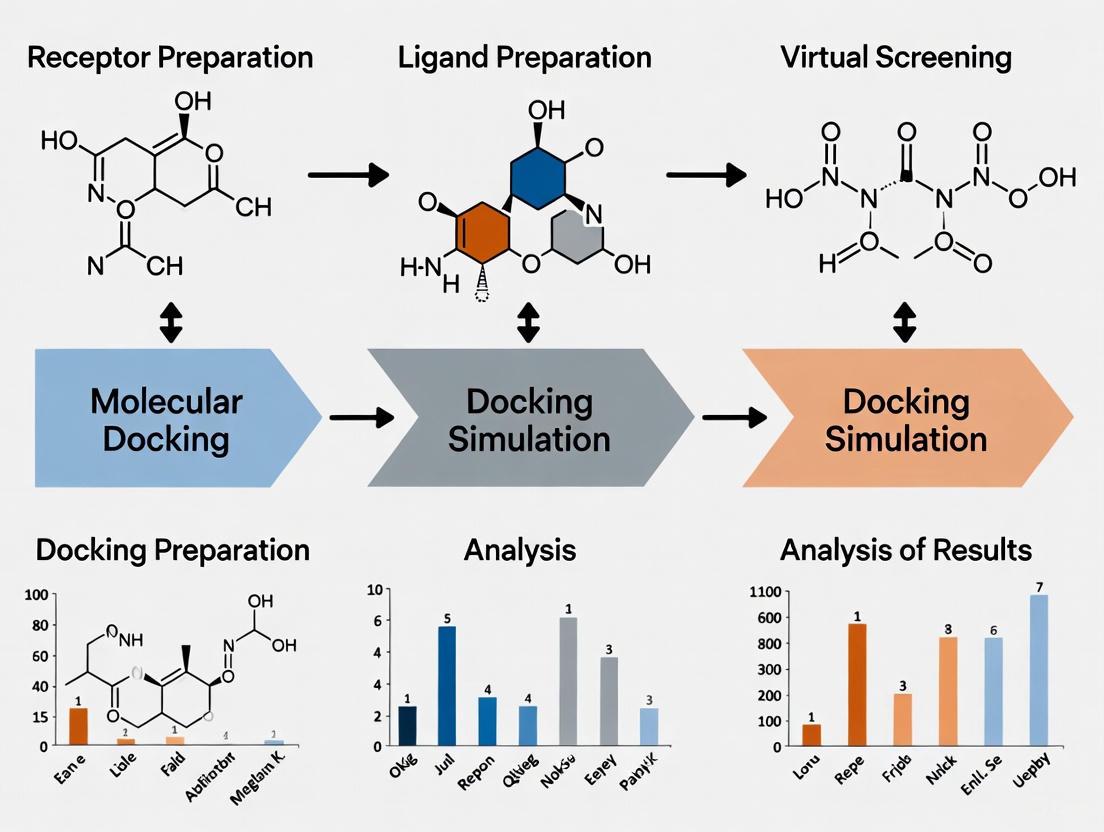
This article provides a comprehensive guide to molecular docking protocols for virtual screening, tailored for researchers and drug development professionals.
Molecular Docking for Virtual Screening: A Comprehensive Guide to Protocols, AI Advances, and Best Practices in Drug Discovery
Abstract
This article provides a comprehensive guide to molecular docking protocols for virtual screening, tailored for researchers and drug development professionals. It covers the foundational principles of docking, including key components like conformational search algorithms and scoring functions. The guide details step-by-step methodologies for setting up automated screening pipelines, from compound library preparation to results ranking. It addresses common challenges and offers optimization strategies, including the integration of artificial intelligence and receptor flexibility. Finally, it presents a critical evaluation of current docking tools, comparing traditional and deep learning-based methods across multiple performance metrics to ensure biologically relevant and reproducible results in lead discovery and drug repurposing.
Understanding Molecular Docking: Core Concepts and Components for Virtual Screening
Defining Molecular Docking and Its Role in Modern Drug Discovery
Molecular docking is a computational technique that predicts the preferred orientation and binding conformation of a small molecule (ligand) when bound to a target protein or receptor. By simulating this molecular interaction, docking aims to predict the stability of the resulting complex and estimate the binding affinity, which is crucial for understanding biological function and accelerating drug discovery [1].
The efficacy of a drug is often dependent on specific interactions with its protein target. Effective drug-target interaction requires close proximity and appropriate orientation, allowing key molecular surface regions to fit precisely and form a stable complex conformation to exert the expected biological effect [2]. Molecular docking computationally simulates this process to find the stable complex conformation and quantitatively evaluate the binding affinity through scoring functions [2].
# Key Concepts and Classifications of Docking Methods
Molecular docking methodologies have evolved significantly from rigid body approaches to sophisticated algorithms accounting for molecular flexibility. The table below summarizes the primary classifications.
Table 1: Classifications of Molecular Docking Approaches
| Classification Basis | Type | Key Characteristic | Implication |
|---|---|---|---|
| System Flexibility [1] | Rigid Docking | Treats both ligand and protein as rigid structures. | Low computational cost but may miss key interactions due to flexibility. |
| Flexible Docking | Accounts for conformational flexibility of the ligand, and sometimes the receptor. | More accurate representation of binding but demands significantly more computational power and time. | |
| Computational Approach [2] | Traditional Physics-Based (e.g., Glide, AutoDock Vina) | Relies on empirical rules, heuristic search algorithms, and physics-based scoring functions. | Can be computationally intensive and sometimes limited by the precision of the scoring function. |
| Deep Learning (DL) Regression-Based | Uses DL models to directly predict binding conformations and energies from input data. | High speed but often fails to produce physically valid poses [2]. | |
| Deep Learning Generative Models (e.g., Diffusion Models) | Generates binding poses through a generative process, like diffusion. | Excels in pose accuracy but can have high steric tolerance, leading to physical implausibilities [2]. | |
| Hybrid Methods (e.g., AI scoring with traditional search) | Integrates traditional conformational searches with AI-driven scoring functions. | Often provides the best balance between accuracy and physical validity [2]. |
# Quantitative Performance of Docking Methods
The performance of docking tools is typically benchmarked across several dimensions, including pose prediction accuracy, physical plausibility, and utility in virtual screening. A comprehensive 2025 study evaluated various methods across three benchmark datasets: the Astex diverse set (known complexes), the PoseBusters benchmark set (unseen complexes), and the DockGen dataset (novel protein binding pockets) [2]. The results reveal a clear performance stratification.
Table 2: Docking Performance Across Benchmark Datasets (Success Rates %)
| Docking Method | Category | Astex Diverse Set | PoseBusters Benchmark | DockGen (Novel Pockets) | |||
|---|---|---|---|---|---|---|---|
| RMSD ≤2Å | PB-Valid | RMSD ≤2Å | PB-Valid | RMSD ≤2Å | PB-Valid | ||
| Glide SP | Traditional | 81.18 | 97.65 | 68.22 | 97.20 | 52.63 | 94.74 |
| SurfDock | Generative DL | 91.76 | 63.53 | 77.34 | 45.79 | 75.66 | 40.21 |
| DiffBindFR (SMINA) | Generative DL | 75.30 | 58.93 | 47.66 | 46.73 | 35.98 | 45.50 |
| Interformer | Hybrid | 82.35 | 89.41 | 59.81 | 85.98 | 49.12 | 82.46 |
| KarmaDock | Regression DL | 51.76 | 50.00 | 31.78 | 40.19 | 21.05 | 42.11 |
Table Notes: RMSD ≤2Å represents the percentage of predictions with a root-mean-square deviation ≤ 2 Å, indicating high pose accuracy. PB-Valid is the percentage of predictions deemed physically plausible by the PoseBusters toolkit, checking for chemical and geometric consistency [2]. The combined success rate (RMSD ≤2Å & PB-Valid) highlights a key trade-off; for example, while SurfDock has superior pose accuracy, Glide SP and hybrid methods like Interformer consistently achieve better physical validity and a more balanced overall performance [2].
# A Protocol for Structure-Based Virtual Screening
The following workflow outlines a generalized protocol for a large-scale docking screen, synthesizing best practices for hit identification [3].
Target and Library Preparation
- Protein Structure Preparation: Begin with a high-resolution 3D structure of the target protein, typically from the Protein Data Bank (PDB) [3]. The quality of the receptor structure significantly influences docking calculations, with better results often observed from higher-resolution crystal structures [1]. Protonation states and missing residues should be addressed.
- Compound Library Curation: Select a screening library, such as the publicly available ZINC database of commercially available compounds [3]. For benchmarking, use a directory of useful decoys (DUD), which includes decoy molecules physically similar but topologically distinct from known ligands, providing a more stringent test by reducing enrichment factor bias [4].
Docking Configuration and Control Calculations
- Control Docking: Before the full screen, dock a set of known active ligands and decoys against the target [3]. This step is critical to validate the docking setup and assess its ability to discriminate binders from non-binders, a process known as enrichment [4].
- Parameter Optimization: Based on the control results, refine docking parameters such as the search space and scoring function weights to ensure they are suitable for your specific target [3].
Large-Scale Docking and Hit Prioritization
- Execution: Run the docking program against the entire prepared compound library. With modern computational resources, screening hundreds of millions of compounds is feasible [3].
- Analysis: Rank the output compounds based on their predicted binding affinity (docking score). Visually inspect the predicted binding poses of the top-ranking compounds to check for sensible interactions (e.g., hydrogen bonds, hydrophobic contacts) and physical plausibility [2]. The prioritized hit list should proceed to experimental validation.
Table 3: Key Research Reagents and Computational Tools
| Item Name | Function / Application | Relevant Details |
|---|---|---|
| Directory of Useful Decoys (DUD) [4] | A bias-corrected benchmarking set for evaluating virtual screening performance. | Contains 2,950 ligands for 40 targets, each with 36 property-matched decoys to provide a stringent test for docking enrichment. |
| ZINC Database [4] [3] | A public database of commercially available compounds for virtual screening. | A primary source for "drug-like" molecules to build screening libraries. |
| PoseBusters [2] | A validation toolkit to evaluate the physical plausibility of docking predictions. | Systematically checks predicted poses for chemical and geometric consistency, including bond lengths, angles, and protein-ligand clashes. |
| AutoDock Vina [2] [1] | A widely used molecular docking program. | An example of a traditional physics-based method with a hybrid scoring function and efficient optimization. |
| Glide [2] [1] | A high-performance docking tool from Schrödinger. | Noted for its exceptional performance in maintaining physical validity (e.g., >94% PB-valid rates across benchmarks) [2]. |
| Deep Learning Docking (e.g., SurfDock) [2] | Next-generation docking using generative or regression models. | Offers superior pose accuracy (e.g., >90% on known complexes) but may produce physically implausible structures, requiring careful validation [2]. |
# Application Note: Docking in Hit Discovery and Optimization
Molecular docking transforms drug discovery by enabling the predictive screening of vast chemical libraries, prioritizing lead compounds for synthesis, and optimizing drug candidates based on their interaction with target proteins [1]. A practical application is identifying natural product ligands for therapeutic targets, such as using flavonol glycosides from Eruca sativa as potential peroxisome proliferator-activated receptor-alpha (PPAR-α) agonists to improve skin barrier function [5]. In such studies, molecular docking simulations can predict how these flavonols bind to the PPAR-α ligand-binding domain, providing a structural basis for their observed agonistic activity and guiding the rational design of more potent analogs [5].
While powerful, molecular docking alone is insufficient to ensure the safety and efficacy of a drug candidate. It predicts binding affinity and interaction but does not account for pharmacokinetics, toxicity, off-target effects, or in vivo behavior [6]. Therefore, experimental validation through molecular dynamics simulation, ADMET profiling, and in vitro and in vivo studies remains essential [6].
Molecular docking is an indispensable tool in modern computational drug discovery, enabling researchers to predict how a small molecule ligand interacts with a protein target at the atomic level. The reliability of docking predictions hinges on two fundamental computational components: sampling algorithms, which explore possible ligand conformations and orientations within the protein's binding site, and scoring functions, which evaluate and rank these potential binding modes to predict the most biologically relevant complex [7] [8]. In the context of virtual screening, where thousands to millions of compounds are evaluated in silico, the balanced performance of these components directly impacts the success rate of identifying true hits while managing computational resources [9] [10]. This application note details the core principles, current methodologies, and practical protocols for these essential elements, providing a framework for their effective implementation in structure-based drug discovery pipelines.
Core Component I: Sampling Algorithms
Sampling algorithms address the challenge of exploring the vast conformational and positional space available to a ligand within a protein's binding site. The goal is to generate a set of plausible binding modes, or "poses," that includes near-native configurations resembling the experimentally determined structure.
Classification and Foundations
Sampling algorithms can be broadly categorized by their search strategy and how they handle molecular flexibility. The earliest methods treated both ligand and protein as rigid bodies, searching only six degrees of translational and rotational freedom [7]. While fast, this "lock-and-key" approach has largely been superseded by methods that account for ligand flexibility, and more recently, partial or full receptor flexibility, in line with the "induced-fit" theory of binding [7].
Table 1: Major Classes of Sampling Algorithms in Molecular Docking
| Algorithm Class | Key Principle | Representative Software | Advantages | Limitations |
|---|---|---|---|---|
| Matching Algorithms | Maps ligand into active site based on shape complementarity and chemical features [7]. | DOCK [7], FLOG [7], LibDock [7] | High computational speed, suitable for virtual screening [7]. | Limited handling of flexibility, risk of overlooking valid poses. |
| Incremental Construction | Divides ligand into fragments; docks base fragment and rebuilds ligand incrementally [7]. | FlexX [7], DOCK 4.0 [7] | Efficient handling of ligand flexibility. | Performance can depend on choice of base fragment. |
| Monte Carlo (MC) | Generates new poses via random transformations; accepts or rejects based on energy criteria [7]. | AutoDock (early versions) [7], ICM [7] | Ability to escape local energy minima. | May require many iterations for convergence. |
| Genetic Algorithms (GA) | Encodes poses as "chromosomes"; evolves populations using mutation and crossover [7]. | AutoDock [7], GOLD [7] | Effective search of high-dimensional space. | Computationally intensive; many parameters to tune. |
| Molecular Dynamics (MD) | Simulates physical movements of atoms over time under classical mechanics [7]. | Various (often for refinement) [7] | Most accurate physical model, can model full flexibility. | Extremely high computational cost, poor at crossing energy barriers. |
Practical Considerations for Algorithm Selection
The choice of a sampling algorithm involves trade-offs between computational speed, accuracy, and the biological system's complexity. For large-scale virtual screening, matching algorithms or incremental construction methods offer a favorable balance of speed and accuracy [7]. For more precise pose prediction, especially for ligands with high flexibility, stochastic methods like Genetic Algorithms are often preferred [11] [7]. A powerful modern approach is algorithm selection, which uses machine learning to choose the best algorithm for a specific protein-ligand pairing, acknowledging that no single algorithm is optimal for all systems [11].
Core Component II: Scoring Functions
Once a set of candidate poses is generated, scoring functions are used to evaluate and rank them. Their primary roles are pose prediction (identifying the correct binding mode) and binding affinity prediction (estimating the strength of the interaction) [8] [10].
Types of Scoring Functions
Scoring functions are typically classified into four main categories, each with a distinct theoretical foundation.
Table 2: Categories of Scoring Functions for Protein-Ligand Docking
| Function Type | Fundamental Principle | Typical Energy Terms | Advantages | Disadvantages |
|---|---|---|---|---|
| Physics-Based | Based on classical molecular mechanics force fields [12] [8]. | Van der Waals, electrostatic interactions, implicit solvation [12] [13]. | Strong physical basis, transferable. | Computationally expensive; sensitive to inaccuracies in force fields and solvation models. |
| Empirical | Fits weighted energy terms to experimental binding affinity data [12] [8]. | Hydrogen bonds, hydrophobic contacts, rotatable bond penalty, clash term [12]. | Fast calculation, optimized for known data. | Risk of overfitting; limited transferability to novel target classes. |
| Knowledge-Based | Derives potentials from statistical analysis of atom-pair frequencies in structural databases [12] [8]. | Pairwise atomic contact potentials [11] [12]. | Good balance of speed and accuracy [13]. | Quality depends on database size and diversity; physical interpretation is indirect. |
| Machine Learning (ML)-Based | Learns complex relationship between structural features and binding affinity without a pre-defined functional form [12] [10]. | Various structural and chemical descriptors (e.g., intermolecular contacts) [10]. | High predictive accuracy on diverse test sets; ability to capture complex patterns [12]. | Black-box nature; requires large, high-quality training data; potential for overfitting [12]. |
Advancements in Machine Learning Scoring Functions
ML-based scoring functions represent a significant shift from classical functions. They consistently outperform classical functions in binding affinity prediction and virtual screening tasks [12] [10]. For example, the OnionNet-SFCT model uses an AdaBoost random forest trained on protein-ligand intermolecular contacts and serves as a correction term to the empirical Vina score, significantly improving pose prediction and virtual screening enrichment [10]. A key to robust ML-scoring functions is training them on diverse docking poses rather than only on crystal structures, which improves their ability to discriminate between native and non-native poses [10].
Integrated Docking Workflow
A typical molecular docking protocol integrates both sampling and scoring into a cohesive workflow, often implemented in automated pipelines for virtual screening [9]. The diagram below illustrates the logical flow and decision points in a standard docking experiment.
Diagram 1: Standard molecular docking workflow, illustrating the sequential steps from system preparation to result analysis.
Application Notes & Experimental Protocol
This protocol outlines the steps for performing a virtual screening experiment using AutoDock Vina, a widely used docking program that employs a hybrid stochastic search and an empirical scoring function [9] [10].
Protocol: Virtual Screening of a Compound Library
Objective: To identify potential hit compounds from a library of natural products against a target protein (e.g., New Delhi metallo-β-lactamase-1, NDM-1) [14].
Software Requirements: Unix-like command line environment, AutoDock Vina, Python with RDKit and sklearn libraries, and visualization software (e.g., PyMOL) [9] [14].
Step-by-Step Methodology:
Protein Preparation:
Ligand Library Preparation:
- Source a library of compounds (e.g., 4,561 natural products from ChemDiv) [14].
- Generate 3D structures for each compound and minimize their energy using a force field (e.g., MMFF94 with OpenBabel) [14].
- For each ligand, generate multiple probable tautomers and ionization states at physiological pH.
- Convert all prepared ligands to PDBQT format.
Grid Box Configuration:
- Define the docking search space. If the binding site is known, center the grid box on the native ligand's position.
- Use AutoDockTools to set the grid box center and size. Example for NDM-1: center (x=2.19, y=-40.58, z=2.22) with size (20Å × 16Å × 16Å) [14].
- Save the configuration to a text file.
Docking Execution:
- Run AutoDock Vina in batch mode for the entire library using the prepared configuration.
- Use an
exhaustivenessvalue of 10-20 to balance speed and accuracy [14]. - Generate multiple poses (e.g., 10) per ligand to capture a range of binding modes.
- Command example:
vina --config config.txt --ligand ligand.pdbqt --out docked_ligand.pdbqt --log log.txt.
Post-Docking Analysis:
- Pose Ranking: Rank all generated poses from the entire library based on the normalized Vina score (binding affinity in kcal/mol) [14].
- Cluster Analysis: Perform Tanimoto similarity-based clustering on top-ranked compounds using RDKit and k-means clustering to prioritize chemotypes [14].
- Visual Inspection: Visually inspect the top-ranked poses of promising candidates for key interactions (e.g., hydrogen bonds, hydrophobic contacts, metal coordination).
The Scientist's Toolkit: Key Research Reagents and Software
Table 3: Essential Computational Tools for Molecular Docking
| Tool / Resource | Type | Primary Function | Application Note |
|---|---|---|---|
| AutoDock Vina [10] [14] | Docking Software | Performs sampling and scoring of ligands. | Balances speed and accuracy; ideal for virtual screening. |
| Glide (Schrödinger) [15] | Docking Software | Uses hierarchical filters and empirical scoring. | High pose prediction accuracy; suitable for lead optimization. |
| GOLD [7] | Docking Software | Uses Genetic Algorithm for sampling. | Robust handling of ligand flexibility. |
| RDKit [14] | Cheminformatics Library | Handles ligand preparation, descriptor calculation, and clustering. | Essential for preprocessing and post-analysis in Python scripts. |
| PDBbind [10] | Database | Curated database of protein-ligand complexes with binding affinities. | Used for training and benchmarking scoring functions. |
| DUD-E / DUD-AD [10] | Benchmark Dataset | Datasets for evaluating virtual screening enrichment. | Used to validate the screening power of a docking protocol. |
| OpenBabel [14] | Chemical Toolbox | Converts file formats and performs ligand energy minimization. | Prepares ligand structures for docking. |
The synergistic performance of sampling algorithms and scoring functions dictates the success of molecular docking in drug discovery. While classical methods remain robust and widely used, the field is increasingly leveraging machine learning to enhance both sampling efficiency—through per-instance algorithm selection—and scoring accuracy—via models trained on large, diverse structural datasets [11] [10]. For researchers, the optimal docking strategy involves careful consideration of the biological question, the available computational resources, and the known limitations of each method. Validating protocols against systems with known experimental outcomes is crucial. The continued integration of more sophisticated ML models and the inclusion of full receptor flexibility promise to further elevate docking from a valuable predictive tool to an even more reliable cornerstone of structure-based drug design.
In the realm of molecular modelling and structure-based drug design, molecular docking predicts the preferred orientation of one molecule to another when bound to form a stable complex [16]. The universe of all possible spatial arrangements of a molecule is its conformational space. Exhaustively exploring this space is a fundamental challenge, as its size grows exponentially with the number of degrees of freedom [17]. Among the various strategies developed, systematic search methods represent a rigorous, grid-based approach that, in principle, can identify all sterically allowed conformations within the resolution of a defined grid, free from the path-dependency and local minima entrapment that can plague stochastic methods [18].
This article details the application of systematic search protocols within the context of virtual screening campaigns. We provide a foundational overview of the method, present quantitative data comparing different search strategies, and offer a detailed protocol for implementing a systematic conformational search using the Z Module in CHARMM, illustrated with a specific application to protein structure prediction.
Theoretical Foundation and Key Concepts
Systematic search operates by dividing the variables governing molecular conformation—typically torsion angles—into a regular grid [18]. Each point on this multi-dimensional grid is evaluated in a defined sequence. This "parallel-generation" approach, where many trial structures are generated from a common starting point, ensures unbiased and even sampling of the conformational space [17]. This is a key advantage over "serial-generation" procedures like Monte Carlo simulations, where uneven sampling can introduce systematic errors [17].
The method is particularly powerful in hierarchical build-up procedures, where the conformations of smaller molecular fragments are determined first and then combined to model larger structures [17]. Furthermore, systematic search frameworks can seamlessly integrate statistical information, such as rotamer libraries for protein side chains, to improve efficiency and biological relevance [17].
Table 1: Core Concepts in Conformational Space Exploration.
| Concept | Description | Implication for Docking |
|---|---|---|
| Conformational Space | The set of all possible spatial arrangements (conformations) of a molecule. | The search space for docking is vast; exhaustive exploration is often computationally infeasible for large systems [17]. |
| Systematic Search | A method that samples conformation space by evaluating structures at regular intervals (a grid) across torsional degrees of freedom [18]. | Provides unbiased, complete sampling within grid resolution; avoids missing low-energy regions [17]. |
| Hierarchical Build-up | A strategy where larger structures are assembled from pre-determined low-energy conformations of smaller fragments [17]. | Makes large conformational search problems tractable by breaking them into smaller, manageable sub-problems. |
| Rotamer Libraries | Databases of statistically favored side-chain conformations derived from known protein structures. | Can be integrated into systematic searches to constrain the search to biologically probable states, enhancing efficiency [17]. |
Comparative Analysis of Search Methodologies
While systematic search is powerful, it is one of several strategies for conformational analysis. The choice of method often involves a trade-off between sampling completeness and computational cost.
Table 2: Comparison of Conformational Space Search Methodologies.
| Method | Principle | Advantages | Limitations |
|---|---|---|---|
| Systematic Search | Regular, grid-based sampling of dihedral angles [18]. | Unbiased, comprehensive sampling; not prone to missing minima; deterministic results [17]. | Computational cost grows exponentially with number of rotatable bonds (curse of dimensionality) [17]. |
| Molecular Dynamics (MD) | Simulates physical motions of atoms over time based on classical mechanics. | Accounts for true dynamics and thermodynamics; uses physical force fields [16]. | Computationally expensive; sampling is time-dependent and may be slow to escape local minima. |
| Monte Carlo / Stochastic | Random changes to conformation; acceptance based on energy criteria [17]. | Can overcome energy barriers; more efficient than MD for some problems. | Sampling can be uneven and path-dependent; may miss important regions; results can vary between runs [17]. |
| Genetic Algorithms | Uses evolutionary principles (mutation, crossover) to evolve populations of conformations [16]. | Effective for exploring large, complex search spaces; allows for ligand and limited protein flexibility. | Requires multiple runs; can be slower than shape-based methods for high-throughput virtual screening [16]. |
The following workflow diagram illustrates the logical decision process for selecting and applying a systematic search method, highlighting its role in a broader structure prediction pipeline.
Application Notes: Protocol for a Systematic Conformational Search
This section provides a detailed protocol for performing a systematic conformational search, exemplified by the Z Method as implemented in the CHARMM program [17]. The following case study demonstrates a specific application.
Case Study: 36-Dimensional Prediction of the CheY Protein Structure
The Z Method was applied to predict the tertiary structure of the signal transduction protein CheY (128 residues), comprising 5 α-helices and 5 β strands [17].
- Objective: To predict the native structure of CheY starting from its amino acid sequence and known secondary structure elements (SSEs).
- Challenge: The conformational space was defined by 36 dihedral angles (4 per loop × 9 loops), making an exhaustive grid search at a high resolution computationally prohibitive (e.g., a 10° grid spacing would result in ~10⁴² points) [17].
- Solution: A hierarchical build-up procedure was employed to make the problem tractable [17].
Experimental Protocol
Step 1: System Setup and Parameterization
- Software: CHARMM molecular simulation program with the Z Module [17].
- Atomic Model: A polar hydrogen representation was used.
- Energy Function: The EEF1 implicit solvation energy function was used to evaluate the energy of each trial conformation [17].
- Initial Structure: The internal coordinates of the ten SSEs were held fixed. The conformational search focused on the dihedral angles in the nine loops connecting these SSEs.
Step 2: Hierarchical Build-up Procedure
- Fragment Generation: The protein was divided into smaller fragments, each containing a subset of the SSEs.
- Systematic Search on Fragments: For each fragment, a systematic search was performed over its relevant subset of dihedral angles. The Z Method was used to generate trial structures by applying grid-based changes to the torsion angles.
- Conformer Selection: For each fragment, a library of low-energy conformations was retained for the next stage.
- Fragment Assembly: Larger fragments were constructed by combining the low-energy conformers of smaller fragments, followed by another round of systematic search and minimization to optimize the interface between them.
- Final Assembly: This process was repeated iteratively until the complete protein structure was assembled.
Step 3: Final Refinement and Analysis
- A final energy minimization was performed on the fully assembled structure.
- The predicted structure was compared to the experimentally determined native structure by calculating the Root-Mean-Square Deviation (RMSD) of atomic positions.
Key Outcomes
- Accuracy: The final predicted structure was within 1.56 Å RMSD of the native CheY structure [17].
- Computational Cost: The entire prediction was completed in approximately two-and-a-half days on AMD Opteron processors [17].
- Performance vs. Other Methods: In the same study, Monte Carlo and simulated annealing trials on smaller versions of the problem using the same energy model resulted in less accurate predictions, highlighting the utility of unbiased systematic sampling [17].
The Scientist's Toolkit: Essential Research Reagents and Software
Table 3: Key Software and Computational Resources for Systematic Conformational Searches.
| Tool / Resource | Type | Primary Function in Systematic Search |
|---|---|---|
| CHARMM / Z Module | Molecular Simulation Software | Provides a versatile platform for implementing systematic, grid-based conformational search protocols; enables hierarchical build-up and use of conformer libraries [17]. |
TINKER / scan |
Molecular Modeling Suite | Performs systematic conformational searches by combining large torsional motion with local geometry optimization; allows manual or automatic selection of dihedral angles to rotate [19]. |
| EEF1 | Implicit Solvation Energy Function | An efficient energy function used to evaluate trial conformations, accounting for solvation effects without the cost of explicit water molecules [17]. |
| Rotamer Libraries | Database | Libraries of statistically favored side-chain conformations that can be used to constrain or guide the systematic search, improving biological relevance and computational efficiency [17]. |
Workflow Visualization of the Z Method Protocol
The following diagram details the specific workflow of the Z Method protocol as applied in the CheY case study, from initialization to the final predicted structure.
Molecular docking is a cornerstone technique in computer-aided drug design (CADD) that predicts the preferred orientation and binding affinity of a small molecule (ligand) when bound to a target macromolecule (receptor), such as a protein [20] [1]. The primary challenge in molecular docking is efficiently searching the vast conformational space of the ligand within the receptor's binding site to find the optimal binding pose, a problem that is computationally complex due to the numerous degrees of freedom involved [21]. Stochastic search methods provide powerful solutions to this challenge by using probabilistic algorithms to explore the search space efficiently without requiring an exhaustive, and often infeasible, systematic search [22] [23].
Two of the most prominent stochastic methods employed in docking programs are Genetic Algorithms (GAs) and Monte Carlo (MC) simulations. These methods are particularly valued for their ability to handle flexible ligand docking and their robust global search capabilities, which help in avoiding local minima during optimization [22] [21]. Their integration into docking software has been crucial for the virtual screening of ultra-large chemical libraries, a practice that has become increasingly important in modern drug discovery [24].
Theoretical Foundations of Genetic Algorithms and Monte Carlo Methods
Genetic Algorithms (GAs)
Genetic Algorithms are a class of evolutionary algorithms inspired by the process of natural selection [22] [25]. In the context of molecular docking, a GA treats the ligand's conformation and orientation as an individual's "genetic code." This code typically includes translational, rotational, and torsional degrees of freedom [21]. The algorithm operates through an iterative process of selection, crossover, and mutation to evolve a population of potential solutions toward an optimal binding pose.
The core steps of a GA in molecular docking are:
- Initialization: A population of random ligand poses is generated within the receptor's binding site.
- Evaluation: Each pose is scored using a fitness function, typically the docking scoring function that estimates binding affinity.
- Selection: Poses with better fitness scores are preferentially selected for reproduction.
- Crossover: Genetic material from two parent poses is combined to create offspring poses.
- Mutation: Random changes are introduced to poses to maintain population diversity.
- Generational Replacement: The old population is replaced with the new generation of offspring, and the process repeats.
GAs are particularly effective for docking problems with highly flexible ligands, as they can efficiently explore complex energy landscapes [21]. The Lamarckian Genetic Algorithm used in AutoDock represents a notable variant, where local search is integrated to refine solutions within generations [21].
Monte Carlo (MC) Simulations
Monte Carlo methods rely on random sampling to explore the conformational space [22] [26]. The fundamental principle involves generating random changes to the ligand's pose and accepting or rejecting these changes based on a probabilistic criterion.
The Metropolis criterion is the most common acceptance rule in MC-based docking [26]. A newly generated pose is always accepted if it has a more favorable energy (or score) than the previous pose. If the new pose has a less favorable energy, it may still be accepted with a probability proportional to the Boltzmann factor, ( e^{(-\Delta E/RT)} ), where ( \Delta E ) is the energy difference, ( R ) is the gas constant, and ( T ) is the temperature parameter [22] [26]. This controlled acceptance of energetically unfavorable moves helps the algorithm escape local minima and conduct a thorough exploration of the search space.
MC methods are often combined with simulated annealing, where the "temperature" parameter is gradually decreased during the simulation. This allows for broad exploration initially and finer tuning as the simulation progresses, improving the likelihood of finding the global minimum [21].
Quantitative Comparison of Stochastic Search Methods
The table below summarizes the key characteristics, advantages, and disadvantages of Genetic Algorithms and Monte Carlo methods as applied to molecular docking.
Table 1: Comparison of Genetic Algorithms and Monte Carlo Methods in Molecular Docking
| Feature | Genetic Algorithms (GAs) | Monte Carlo (MC) Methods |
|---|---|---|
| Core Principle | Population-based evolution inspired by natural selection [22] [25] | Stochastic sampling based on random moves and probabilistic acceptance [22] [26] |
| Key Operators | Selection, Crossover, Mutation [21] | Random Move Generation, Metropolis Criterion [26] |
| Handling of Flexibility | Excellent for handling highly flexible ligands via torsion angle encoding [21] | Effective for ligand flexibility through random torsional changes [22] |
| Search Capability | Strong global search due to population diversity and crossover [21] | Good global search, especially when combined with simulated annealing [21] |
| Primary Advantage | Efficiently explores complex search spaces and recombines good solution features [24] [21] | Simpler to implement; Metropolis criterion helps escape local minima [22] [26] |
| Primary Disadvantage | Can be computationally intensive due to population management; may require parameter tuning [21] | May require many iterations for convergence; sequential nature can limit parallelization [22] |
| Example Docking Software | GOLD [25], AutoDock [21], REvoLd [24] | AutoDock Vina [21], MCDOCK [21] [23] |
Performance Benchmarking and Application Data
The efficacy of stochastic search methods is demonstrated through their performance in real-world docking benchmarks and applications. The following table quantifies the performance of several algorithm implementations.
Table 2: Performance Benchmarking of Docking Algorithms Utilizing Stochastic Methods
| Algorithm/Software | Core Search Method | Reported Performance | Application Context |
|---|---|---|---|
| REvoLd [24] | Evolutionary Algorithm (EA) | Hit rate improvements by factors of 869 to 1622 vs. random screening; docks 49,000-76,000 molecules for a target screen. | Ultra-large library screening (e.g., Enamine REAL space with >20 billion molecules) [24] |
| GOLD [25] | Genetic Algorithm (GA) | Widely validated and trusted for pose prediction accuracy over >20 years; handles ligand and partial protein flexibility. | Lead identification and optimization in virtual screening [25] |
| MSCA [21] | Multi-Swarm Competitive Algorithm (EA variant) | Competitive performance on CASF-2016 benchmark (285 complexes); improved accuracy with highly flexible ligands. | Novel docking program for challenging flexible ligand problems [21] |
| AutoDock Vina [21] | Monte Carlo & Simulated Annealing | Improved speed and accuracy over AutoDock; widely used for its balance of performance and usability. | General-purpose protein-ligand docking [27] [21] |
Protocol for Virtual Screening Using an Evolutionary Algorithm
This protocol details the use of the REvoLd (RosettaEvolutionaryLigand) algorithm for screening ultra-large make-on-demand combinatorial libraries, such as the Enamine REAL space [24].
Pre-docking Preparation
Receptor Preparation:
- Obtain the three-dimensional structure of the target protein, preferably from high-resolution X-ray crystallography or Cryo-EM. Correct any structural issues (missing atoms, sidechains, loops). Structures prepared with tools like those in Discovery Studio are suitable [25].
- Calculate pKa values and assign protonation states to residues in the binding site.
- Generate the receptor file in PDBQT format for docking, ensuring the correct assignment of flexible residues if required.
Define the Search Space:
- The algorithm exploits the combinatorial nature of make-on-demand libraries, which are constructed from lists of substrates and chemical reactions [24]. No pre-enumeration of all molecules is required.
- The ligand's conformational space is defined by its rotatable bonds, which are encoded within the algorithm.
REvoLd Docking Procedure
Initialization:
- Generate a random start population of 200 ligand individuals. This size provides sufficient variety to initiate the optimization process effectively [24].
Evolutionary Optimization Cycle:
- Evaluation: Dock all ligands in the current generation against the prepared receptor using the RosettaLigand flexible docking protocol, which accounts for full ligand and receptor flexibility [24]. The docking score serves as the fitness function.
- Selection: Select the top 50 fittest individuals to advance to the next generation. This elitist selection strategy preserves the best solutions.
- Reproduction:
- Crossover: Perform crossovers between the fit molecules to recombine favorable structural motifs and enforce variance.
- Mutation: Apply multiple mutation steps:
- Fragment Switch: Switch single fragments to low-similarity alternatives to maintain well-performing parts while introducing significant local changes.
- Reaction Switch: Change the reaction of a molecule and search for similar fragments within the new reaction group to explore different regions of the combinatorial space.
- Secondary Optimization Round: Introduce a second round of crossover and mutation that excludes the fittest molecules. This allows lower-scoring ligands with potentially useful molecular information to improve and contribute to the gene pool [24].
Termination:
- Run the evolutionary optimization for 30 generations. This number strikes a good balance between convergence and exploration, with good solutions often appearing after 15 generations and discovery rates flattening after 30 [24].
- For a comprehensive screen, conduct multiple independent runs (e.g., 20 runs per target). The random starting seeds lead to different exploration paths and yield diverse high-scoring motifs [24].
Post-docking Analysis
- Ranking: Rank the final population of ligands from all runs based on their docking scores (binding affinity estimates).
- Cluster Analysis: Cluster the top-ranked hits by molecular scaffold to assess the diversity of the discovered compounds.
- Interaction Analysis: Visually inspect the predicted binding poses of the top hits, analyzing key protein-ligand interactions (hydrogen bonds, ionic bonds, van der Waals forces, and hydrophobic interactions) [20].
Workflow Visualization of a Genetic Algorithm for Docking
The following diagram illustrates the iterative workflow of a Genetic Algorithm as applied to the molecular docking process.
The Scientist's Toolkit: Essential Reagents and Software
Table 3: Key Research Reagent Solutions for Stochastic Docking
| Item Name | Function / Purpose | Example Use Case |
|---|---|---|
| REvoLd (Rosetta) [24] | Evolutionary algorithm for screening ultra-large combinatorial libraries without full enumeration. | Targeted exploration of billions of compounds in make-on-demand spaces like Enamine REAL. |
| GOLD [25] | Genetic algorithm-based docking suite for predicting ligand binding with high accuracy. | Lead identification and optimization in structure-based drug design projects. |
| AutoDock Vina [27] [21] | Docking program using a hybrid of Monte Carlo and Simulated Annealing for search. | General-purpose virtual screening and binding pose prediction. |
| QuickVina 2 [27] | A faster variant of AutoDock Vina, optimized for speed. | Accelerating virtual screening workflows on local machines or clusters. |
| jamdock-suite [27] | A protocol of Bash scripts automating a virtual screening pipeline from setup to ranking. | Lowering the access barrier for researchers setting up local virtual screening. |
| RosettaLigand [24] | A flexible docking protocol within Rosetta that allows for full ligand and receptor flexibility. | Used as the docking engine within the REvoLd algorithm for accurate pose scoring. |
| FPocket [27] | Open-source software for detecting and characterizing protein-ligand binding pockets. | Identifying potential binding sites on a protein target before docking. |
| ZINC Database [27] | A public repository of commercially available compounds for virtual screening. | Sourcing ready-to-dock molecular structures for library generation. |
Physics-Based, Empirical, and Knowledge-Based Scoring Functions
Molecular docking is a cornerstone computational method in structural biology and drug discovery, aimed at predicting the three-dimensional structure of a protein-ligand or protein-protein complex and estimating the strength of their interaction [28]. A critical component of the docking pipeline is the scoring function, a mathematical model used to predict the binding affinity of a complex by evaluating the interactions between the molecules [28] [22]. The accuracy of scoring functions is paramount for successful virtual screening, as it directly influences the ability to identify true binding poses and distinguish active compounds from inactive ones [28] [29]. Scoring functions can be broadly categorized into three classical types—physics-based, empirical, and knowledge-based—each with distinct theoretical foundations, advantages, and limitations [28]. This article provides a detailed overview of these scoring function classes, supported by comparative data and experimental protocols, to guide researchers in selecting and applying these tools within virtual screening workflows.
Classification and Theoretical Foundations of Scoring Functions
The table below summarizes the core principles, representative methods, and key characteristics of the three main classes of classical scoring functions.
Table 1: Classification and Characteristics of Classical Scoring Functions
| Function Class | Theoretical Basis | Representative Methods | Key Advantages | Inherent Limitations |
|---|---|---|---|---|
| Physics-Based | Calculates binding energy based on physical force fields (e.g., van der Waals, electrostatics); may include solvation and entropy terms [28] [29]. | MMFF94S-based functions, DockTScore [29] | Strong theoretical foundation; detailed description of molecular interactions [29]. | High computational cost; accuracy depends on force field parameterization [28] [29]. |
| Empirical | Estimates binding affinity as a weighted sum of energy terms, with coefficients fit to experimental binding affinity data [28]. | FireDock, RosettaDock, ZRANK2 [28] | Faster computation; simpler interpretation of energy terms [28] [22]. | Risk of overfitting to training data; performance dependent on dataset quality and diversity [28] [29]. |
| Knowledge-Based | Derives statistical potentials from the observed frequencies of atom or residue pairwise distances in known protein structures via Boltzmann inversion [28]. | AP-PISA, CP-PIE, SIPPER [28] | Good balance between accuracy and computational speed [28]. | Potentials may lack direct physical meaning; performance relies on the size and quality of the structural database [28]. |
The following diagram illustrates the logical relationship between the input data, the core principles, and the output for each class of scoring function.
Quantitative Comparison of Scoring Function Performance
Evaluating scoring functions requires standardized benchmarks. The table below summarizes the performance of various classical and deep learning-based scoring functions across key public datasets, focusing on pose prediction accuracy and virtual screening success.
Table 2: Performance Comparison of Classical and Deep Learning-Based Scoring Functions on Public Benchmarks
| Scoring Method | Type | Pose Prediction Success Rate (RMSD ≤ 2 Å) | Virtual Screening Efficacy (AUC/EF) | Key Strengths / Weaknesses |
|---|---|---|---|---|
| FireDock | Empirical | Varies by dataset and complex [28] | Varies by dataset and complex [28] | Strength: Incorporates flexible refinement and various energy terms. Weakness: Performance can be heterogeneous [28]. |
| RosettaDock | Empirical | Varies by dataset and complex [28] | Varies by dataset and complex [28] | Strength: Comprehensive energy function. Weakness: Computationally intensive [28]. |
| PyDock | Hybrid | Varies by dataset and complex [28] | Varies by dataset and complex [28] | Strength: Balances electrostatics and desolvation energy [28]. |
| AP-PISA | Knowledge-Based | Varies by dataset and complex [28] | Varies by dataset and complex [28] | Strength: Uses multiple potentials for better discrimination [28]. |
| SurfDock | Deep Learning (Generative) | 91.76% (Astex), 77.34% (PoseBusters), 75.66% (DockGen) [2] | Varies by dataset and complex [2] | Strength: Exceptional pose accuracy. Weakness: Suboptimal physical validity (e.g., steric clashes) [2]. |
| Glide SP | Traditional (Physics-Empirical) | Lower than SurfDock [2] | Varies by dataset and complex [2] | Strength: Excellent physical validity (≥94% PB-valid rate). Weakness: Lower pose accuracy than top DL methods [2]. |
| KarmaDock / QuickBind | Deep Learning (Regression) | Low (e.g., ~20-30% on PoseBusters) [2] | Varies by dataset and complex [2] | Strength: Fast prediction. Weakness: Often produces physically invalid poses; poor generalization [2]. |
Experimental Protocols for Scoring Function Evaluation
Protocol for Benchmarking Scoring Functions using CCharPPI
Objective: To objectively evaluate and compare the performance of different scoring functions on a standardized dataset of protein-protein complexes, independent of the docking sampling algorithm [28].
Materials:
- CCharPPI Server: A web-based platform for the comprehensive assessment of scoring functions [28].
- Benchmark Dataset: A curated set of protein-protein complexes with known native structures (e.g., from CAPRI benchmarks) [28].
Procedure:
- Dataset Preparation: Compile a set of candidate docking decoys and their native reference structure for the complexes to be evaluated.
- Server Submission: Submit the ensemble of complex structures to the CCharPPI server.
- Function Selection: On the server, select the scoring functions to be evaluated (e.g., FireDock, ZRANK2, SIPPER).
- Analysis of Results: The server returns a ranked list of models for each scoring function. Key metrics to analyze include:
- Success Rate: The percentage of cases where a near-native structure is ranked within the top N positions.
- Scoring Time: Record the computational time required by each function, as runtime impacts large-scale applications [28].
Protocol for Developing a Target-Specific Scoring Function
Objective: To create a customized scoring function for a specific protein target class (e.g., proteases, protein-protein interactions) to improve binding affinity prediction accuracy [29].
Materials:
- Training Set: High-quality protein-ligand complex structures with experimental binding affinity data, curated for the specific target class (e.g., from PDBbind) [29].
- Software: Tools for structure preparation (e.g., Maestro Protein Preparation Wizard) and model training (e.g., Scikit-learn for SVM/Random Forest) [29].
Procedure:
- Data Curation:
- Select complexes from databases like PDBbind based on specific criteria (e.g., EC Number for enzymes).
- Manually prepare structures: assign correct protonation/tautomeric states using tools like Epik, optimize hydrogen bonding, and remove water molecules [29].
- Feature Calculation: For each complex, compute physics-based and structural descriptors. Essential features include:
- Van der Waals and electrostatic interaction energies (e.g., using MMFF94S force field).
- Solvation and lipophilic interaction terms.
- Ligand torsional entropy contribution.
- Surface area and contact-based terms [29].
- Model Training:
- Split the curated dataset into training (e.g., 75%) and test (e.g., 25%) sets.
- Employ regression algorithms to correlate the calculated features with experimental binding affinity. Start with Multiple Linear Regression (MLR) for interpretability, then progress to non-linear methods like Support Vector Machine (SVM) or Random Forest (RF) for potentially higher accuracy [29].
- Validation: Assess the trained model on the independent test set and public benchmarks (e.g., DUD-E datasets) to evaluate its predictive power and virtual screening utility [29].
The workflow for this protocol is visualized below.
Table 3: Key Software and Data Resources for Scoring Function Development and Application
| Resource Name | Type | Primary Function in Research |
|---|---|---|
| CCharPPI Server [28] | Web Server | Allows assessment of scoring functions independent of the docking process, enabling direct comparison on standardized datasets [28]. |
| PDBbind Database [29] | Curated Database | Provides a large, high-quality collection of protein-ligand complexes with experimentally measured binding affinities for training and testing scoring functions [29]. |
| DUD-E Datasets [29] | Benchmarking Set | Contains benchmark structures for evaluating virtual screening performance, including known actives and decoy molecules for various targets [29]. |
| Maestro (Schrödinger) [29] | Software Suite | Used for comprehensive protein and ligand structure preparation, including protonation state assignment, hydrogen bonding optimization, and energy minimization [29]. |
| MMFF94S Force Field [29] | Molecular Mechanics Model | Provides the fundamental physics-based terms (van der Waals, electrostatics) used as descriptors in modern, physics-informed scoring functions like DockTScore [29]. |
| Scikit-learn / SVM / Random Forest [29] | Machine Learning Library | Offers implementations of robust regression algorithms (SVM, Random Forest) for developing non-linear scoring functions from physics-based and empirical descriptors [29]. |
Application Notes and Best Practices
- Address Data Bias: Be aware that scoring functions may perform well on "in-distribution" data but poorly on "out-of-distribution" complexes. Always test functions on datasets relevant to your specific target [28].
- Consider Trade-offs: Deep learning-based scoring functions can show superior pose accuracy but often produce physically implausible structures (e.g., incorrect bond lengths, steric clashes). Traditional methods like Glide SP consistently demonstrate high physical validity [2].
- Incorporate Solvation and Entropy: A common limitation of many scoring functions is the inadequate treatment of solvation effects and entropic contributions. Prioritize functions that explicitly account for these terms, as they are critical for an accurate description of the binding process [29].
- Validate with Experimental Data: Computational predictions must be validated experimentally. Use techniques like Surface Plasmon Resonance (SPR) or Isothermal Titration Calorimetry (ITC) to confirm binding affinities of top-ranked compounds.
The Critical Role of Public Compound Databases like ZINC
The ZINC database (ZINC Is Not Commercial) is a cornerstone resource in computational drug discovery, providing a free and publicly accessible collection of commercially available or synthesizable small molecules specifically curated for virtual screening [30]. Developed and maintained by the Irwin and Shoichet Laboratories at the University of California, San Francisco (UCSF), ZINC originated in 2005 to bridge the gap between computational predictions and experimental validation by providing researchers with tangible, purchasable compounds [31] [30]. The database has undergone significant evolution, with ZINC20 (released in 2020) offering over 230 million purchasable compounds in ready-to-dock, 3D formats, and an additional 750 million searchable analogs [31]. The most recent iteration, ZINC-22, has expanded dramatically to include over 37 billion 2D-searchable compounds, with more than 4.5 billion available in 3D formats, primarily from make-on-demand libraries [30].
ZINC's core value lies in its meticulous curation and organization. Compounds are annotated with vendor information, physicochemical properties, and biologically relevant states, including protomers and tautomers generated for physiological pH (~7.4) using ChemAxon's JChem suite [30]. The database is organized into "tranches" based on properties such as heavy atom count, lipophilicity (logP), and charge, enabling efficient subset selection for targeted virtual screens [30]. By prioritizing purchasability and synthesizability, ZINC ensures that hits identified through virtual screening can be rapidly procured for experimental validation, significantly accelerating the early stages of drug discovery [30].
Table 1: Key Specifications of Major ZINC Database Versions
| Database Version | Total Compounds | 3D Ready-to-Dock Compounds | Key Features |
|---|---|---|---|
| ZINC (2005) | ~728,000 [30] | ~728,000 [30] | Initial launch with purchasable compounds. |
| ZINC12 (2012) | ~35 million [30] | ~20 million [30] | Continuous catalog updates; property-based subsets. |
| ZINC15 (2015) | >100 million [30] | >100 million [30] | Includes in-stock and make-on-demand compounds. |
| ZINC20 (2020) | 1.4 billion searchable [30] | 230 million purchasable [31] | Integrated analog searching (SmallWorld, Arthor). |
| ZINC-22 (2023) | 54.9 billion (2D) [30] | 5.9 billion [30] | Focus on massive make-on-demand libraries. |
Application in Virtual Screening: Case Studies
The utility of the ZINC database is best demonstrated through its successful application in diverse virtual screening campaigns targeting various diseases. The following case studies illustrate its critical role in identifying novel therapeutic leads.
Identification of SARS-CoV-2 3CL Protease Inhibitors
In response to the COVID-19 pandemic, researchers performed a molecular docking-based virtual screening of 2,000 compounds from the ZINC database against the SARS-CoV-2 3CL protease (3CLpro), a key enzyme responsible for viral replication [32]. The protocol involved preparing the protein structure (PDB ID: 6LU7) by removing water molecules and adding hydrogens, while ZINC compounds were converted to PDBQT format for docking. The screening identified four top compounds—ZINC32960814, ZINC12006217, ZINC03231196, and ZINC33173588—which exhibited high binding affinity with free energy of binding (FEB) values ranging from -12.3 to -11.2 kcal/mol, outperforming the co-crystallized ligand N3 (FEB: -7.5 kcal/mol) [32]. These compounds also showed stable interactions with the catalytic dyad residues (Cys145 and His41) of 3CLpro and fulfilled Lipinski's Rule of Five, indicating promising drug-like properties for further development as anti-COVID-19 agents [32].
Discovery of ROCK2 Inhibitors
A comprehensive study integrated pharmacophore modeling, virtual screening, molecular docking, and molecular dynamics (MD) simulations to discover novel inhibitors for Rho-associated protein kinase 2 (ROCK2), a therapeutic target for cancer, cardiovascular, and neurodegenerative disorders [33]. The initial virtual screening of over 13 million molecules from the ZINC database using a pharmacophore model based on the co-crystal ligand (5YS) of ROCK2 yielded 4,809 hits [33]. Subsequent molecular docking refined this set to compounds with binding affinities between -11.55 and -9.91 kcal/mol. ADMET profiling and MD simulations further identified two promising lead compounds that demonstrated stable binding with the ROCK2 protein, highlighting the power of ZINC in facilitating a multi-tiered computational pipeline for lead identification [33].
Screening for B-Cell Lymphoma 2 (Bcl-2) Inhibitors
Researchers screened 151,837 natural products from the ZINC Natural Product database to find inhibitors of Bcl-2, a target protein overexpressed in small cell lung cancer [34]. The workflow employed pharmacophore-based virtual screening followed by molecular docking validation. The pharmacophore model reduced the initial compound pool by approximately 85.64% to 6,615 candidates [34]. Molecular docking further narrowed this list, identifying a lead compound (tc259) with a binding energy of -11.02 kcal/mol and an inhibition constant of 8.33 nM [34]. This case underscores the value of ZINC's specialized subsets, such as natural products, for exploring specific chemical spaces in oncology drug discovery.
Table 2: Summary of Virtual Screening Case Studies Using the ZINC Database
| Therapeutic Target | Disease Context | ZINC Subset Screened | Key Findings | Citation |
|---|---|---|---|---|
| SARS-CoV-2 3CL Protease | COVID-19 | 2,000 compounds | 4 hits with FEB -12.3 to -11.2 kcal/mol; interactions with catalytic dyad. | [32] |
| ROCK2 Kinase | Cancer, Neurodegenerative Diseases | ~13 million compounds | 2 stable leads identified via pharmacophore screening, docking, and MD simulations. | [33] |
| Bcl-2 Protein | Small Cell Lung Cancer | 151,837 natural products | Lead compound tc259: binding energy -11.02 kcal/mol, Ki 8.33 nM. | [34] |
Experimental Protocols
This section provides detailed, step-by-step protocols for key virtual screening methodologies that leverage the ZINC database, formatted as application notes for laboratory use.
Application Note: Virtual Screening Protocol for Protein Target Using AutoDock Vina
Objective: To identify potential lead compounds from the ZINC database against a protein target of interest using molecular docking. Materials:
- Protein Data Bank (PDB) structure of target
- ZINC database compounds (e.g., in MOL2 or SDF format)
- Software: AutoDock Tools, AutoDock Vina, Open Babel (if needed for format conversion)
Procedure:
- Protein Preparation: a. Obtain the 3D crystal structure of the target protein from the PDB (e.g., PDB ID: 6LU7). b. Remove all non-essential molecules (water, co-factors, native ligands) using AutoDock Tools (ADT). c. Add polar hydrogen atoms and assign Gasteiger charges. d. Save the prepared structure in PDBQT format.
Ligand Preparation: a. Download a compound subset from ZINC in a ready-to-dock format like MOL2 or SDF. b. Convert the ligand files to PDBQT format using a tool like Open Babel or the functionality within ADT.
Grid Box Configuration: a. In ADT, define the docking grid box (e.g., 60 Å x 60 Å x 60 Å) centered on the protein's active site. b. Set the grid spacing parameter to 0.375 Å. c. Save the grid configuration parameters in a
config.txtfile.Virtual Screening Execution: a. Use AutoDock Vina via the command line with the prepared PDBQT files and configuration file.
b. For high-throughput screening, script the process to iterate over all ligand files.
Analysis of Results: a. Extract the binding affinity (in kcal/mol) from the output log files for each compound. b. Rank all screened compounds based on their binding affinity. c. Visually inspect the docking poses of the top-ranking compounds in molecular visualization software (e.g., PyMOL, UCSF Chimera) to analyze key interactions (hydrogen bonds, hydrophobic contacts, etc.) with the active site residues.
Application Note: Pharmacophore-Based Virtual Screening Protocol
Objective: To rapidly filter large sections of the ZINC database using a pharmacophore model prior to molecular docking. Materials:
- Protein-ligand co-crystal structure or a set of known active compounds.
- Software: Pharmit server or equivalent pharmacophore modeling software.
- ZINC database access.
Procedure:
- Pharmacophore Model Generation: a. Analyze the interactions between a co-crystallized ligand (e.g., 5YS in PDB: 7P6N) and the protein's binding pocket. b. Define critical chemical features, such as hydrogen bond donors, hydrogen bond acceptors, hydrophobic regions, and aromatic rings. c. Use a tool like the Pharmit server to generate the pharmacophore hypothesis based on these features [33].
Database Screening: a. Input the pharmacophore model into the Pharmit server. b. Set search filters based on Lipinski's Rule of Five (Molecular Weight < 500, HBD < 5, HBA < 10, logP < 5) to focus on drug-like molecules. c. Execute the search against the ZINC database. The server will return a list of compounds that match the pharmacophore query.
Hit Selection and Downstream Processing: a. Download the list of matching compounds (hits). b. This refined list of hits then serves as the input for the more computationally intensive molecular docking protocol described in Application Note 3.1.
The Scientist's Toolkit: Research Reagent Solutions
Table 3: Essential Computational Tools and Resources for Virtual Screening with ZINC
| Resource Name | Type | Primary Function in Workflow | Key Features / Notes |
|---|---|---|---|
| ZINC Database | Compound Library | Source of purchasable/synthesizable small molecules for screening. | Offers pre-filtered subsets (drug-like, lead-like, natural products); ready-to-dock 3D formats [31] [30]. |
| AutoDock Vina | Docking Software | Performs molecular docking to predict ligand binding pose and affinity. | Fast, widely used; command-line interface suitable for screening [32]. |
| Pharmit | Pharmacophore Server | Enables pharmacophore-based virtual screening of large databases. | Web-based; integrates directly with ZINC for real-time screening [33]. |
| Protein Data Bank (PDB) | Data Repository | Source of 3D structural data for the biological target protein. | Essential for preparing the receptor structure for docking. |
| AutoDock Tools (ADT) | Utility Software | Prepares protein and ligand files for docking with AutoDock/Vina. | Used to add hydrogens, assign charges, and define the docking grid box [32]. |
| Schrödinger Maestro | Modeling Suite | Integrated platform for protein prep, ligand prep, docking (Glide), and MD. | Commercial software with a comprehensive toolset for advanced workflows [33]. |
Workflow and Pathway Visualizations
Virtual Screening Workflow
Implementing a Virtual Screening Pipeline: From Setup to Execution
Step-by-Step Guide to Building a Fully Local, Automated Screening Pipeline
Virtual screening has become a cornerstone of modern computational drug discovery, enabling researchers to rapidly identify potential hit compounds from vast chemical libraries. This Application Note provides a detailed, step-by-step protocol for establishing a fully local, automated virtual screening pipeline using exclusively free and open-source software. The protocol is designed to lower the access barrier for researchers new to structure-based drug discovery while improving efficiency for experienced users [35] [27]. By implementing this pipeline, researchers can perform automated virtual screening—from compound library preparation to docking evaluation—entirely within their local computing environment, ensuring data privacy and computational reproducibility without reliance on commercial software or cloud services.
The jamdock-suite presented here exemplifies the trend toward modular, script-based workflows that enhance reproducibility and scalability in virtual screening campaigns. This approach is particularly valuable for drug repurposing studies, where screening libraries of existing drugs (such as FDA-approved compounds) against new biological targets can significantly accelerate therapeutic development [27] [36].
The Scientist's Toolkit: Essential Materials and Reagents
Table 1: Key Research Reagent Solutions for Virtual Screening Pipeline
| Resource Name | Type | Primary Function | Source/Identifier |
|---|---|---|---|
| ZINC Database | Chemical Database | Provides chemical and structural information for millions of commercially available compounds | https://zinc.docking.org/ [27] |
| AutoDock Vina/QuickVina 2 | Docking Software | Performs molecular docking simulations with scoring function optimization | https://github.com/QVina/qvina [27] |
| Open Babel | Chemical Toolbox | Handles chemical format conversion and manipulation | Installed via package manager [27] |
| MGLTools (AutoDockTools) | Molecular Graphics | Prepares receptor and ligand files in PDBQT format | https://ccsb.scripps.edu/mgltools/ [27] |
| fpocket | Binding Site Detection | Identifies and characterizes potential ligand-binding pockets | https://github.com/Discngine/fpocket [27] |
| jamdock-suite | Automation Scripts | Orchestrates the complete virtual screening workflow | https://github.com/jamanso/jamdock-suite [27] |
System Configuration and Installation Protocol
Initial System Setup
The protocol is designed for Unix-like operating systems. Windows 11 users should install Windows Subsystem for Linux (WSL) before proceeding.
Experimental Protocol: WSL Installation for Windows Users
- Open Windows PowerShell as administrator (right-click and select "Run as administrator").
- Execute the command:
wsl --install. - Restart the system if required to complete the installation.
- Click on the Ubuntu icon and create a default user account [27].
Experimental Protocol: Software Dependency Installation
- Update and upgrade system packages:
- Install essential packages and software:
- Install AutoDockTools (MGLTools):
- Install fpocket for binding pocket detection:
- Install QuickVina 2 (AutoDock Vina variant):
- Install and configure the jamdock-suite scripts:
The entire installation process requires approximately 35 minutes to complete. After installation, researchers can invoke jamlib, jamreceptor, jamqvina, jamresume, and jamrank directly from any terminal window [27].
Automated Screening Pipeline: Workflow and Execution
The automated virtual screening pipeline consists of five modular programs that work in sequence to transform raw chemical and receptor data into ranked docking hits. This modular approach provides flexibility, allowing researchers to customize each stage according to their specific research needs [27].
Diagram 1: Automated screening pipeline workflow showing the sequence of five modular programs that transform raw data into ranked docking hits.
Experimental Protocols for Pipeline Execution
Experimental Protocol: Compound Library Generation with jamlib
- Generate a library of FDA-approved drugs:
- Create a custom compound library from specific ZINC subsets:
- Generate a diverse library based on structural similarity:
The jamlib script automatically retrieves compound structures, performs energy minimization, and converts all molecules to PDBQT format required for docking with Vina. This addresses the critical bottleneck of preparing large compound libraries, particularly for FDA-approved drugs whose PDBQT formats are not readily available in ZINC [27].
Experimental Protocol: Receptor Preparation with jamreceptor
- Prepare the receptor structure and identify binding pockets:
- Select the desired binding pocket from the fpocket analysis output.
- The script automatically generates the PDBQT file and defines the grid box coordinates based on the selected pocket [27].
The jamreceptor script utilizes fpocket for binding site detection and characterization. Fpocket not only identifies potential binding cavities but also provides druggability scores to facilitate selection of the most relevant docking sites [27].
Experimental Protocol: Automated Docking with jamqvina
- Execute the docking campaign across the entire compound library:
- For large libraries, monitor progress and resume if interrupted:
The jamqvina script supports execution on local machines, cloud servers, and HPC clusters, offering better scalability than GUI-based tools. The jamresume function ensures robustness during long-running docking processes that may span days [27].
Experimental Protocol: Results Ranking with jamrank
- Rank docking results using two scoring methods:
- Generate a prioritized list of top hits for further investigation:
The jamrank script evaluates docking outcomes using two scoring methods to help identify the most promising hits, providing researchers with a prioritized list for further experimental validation [27].
Performance Considerations and Technical Specifications
Computational Requirements and Optimization
Table 2: Performance Characteristics and Resource Requirements
| Pipeline Stage | Time Estimate | Computational Load | Key Dependencies |
|---|---|---|---|
| System Setup | 35 minutes | Low | Internet connection, sudo privileges |
| Library Generation (1000 compounds) | 1-2 hours | Medium | ZINC database access, Open Babel |
| Receptor Preparation | 5-10 minutes | Low | PDB file, fpocket, AutoDockTools |
| Docking (1000 compounds) | 4-24 hours | High | CPU cores, sufficient RAM |
| Results Ranking | 5-15 minutes | Low | Docking output files |
The pipeline is designed to handle libraries of varying sizes, from focused sets of FDA-approved drugs to large custom collections. For ultra-large chemical libraries exceeding one billion molecules, researchers can implement advanced AI-enabled screening approaches like Deep Docking, which can accelerate virtual screening by up to 100-fold through iterative docking of library subsets synchronized with ligand-based prediction of remaining docking scores [37].
The modular nature of the jamdock-suite allows researchers to adapt the pipeline to their specific computational resources. For high-throughput screening, the pipeline can be deployed on high-performance computing clusters, while smaller-scale drug repurposing projects can run effectively on standalone workstations [27].
Applications in Drug Discovery Research
Case Study: Virtual Screening for Antibiotic Resistance
A recent study demonstrated the application of virtual screening approaches to address the critical challenge of antibiotic resistance. Researchers employed molecular docking and molecular dynamics simulations to screen 192 FDA-approved drugs against New Delhi Metallo-β-lactamase-1 (NDM-1), a bacterial enzyme that confers resistance to β-lactam antibiotics [36].
The study identified four repurposed drugs—zavegepant, ubrogepant, atogepant, and tucatinib—as top candidates with favorable binding affinities for NDM-1. Subsequent molecular dynamics simulations confirmed the structural stability of these interactions over time, validating the docking predictions [36]. This case study exemplifies how automated virtual screening pipelines can rapidly identify promising therapeutic candidates for urgent public health threats.
Integration with Downstream Validation
While virtual screening provides valuable computational predictions, hit compounds typically require experimental validation through biochemical assays, structural biology approaches (such as X-ray crystallography), and further medicinal chemistry optimization. The ranked hit list generated by the jamrank script serves as the starting point for these downstream validation studies, prioritizing the most promising candidates for further investigation [27] [36].
This protocol provides researchers with a comprehensive, fully local solution for automated virtual screening that leverages exclusively free and open-source software. The jamdock-suite significantly lowers the barrier to entry for structure-based drug discovery while offering the robustness and flexibility required for production-scale virtual screening campaigns. By implementing this automated pipeline, research teams can accelerate their early drug discovery and repurposing efforts, efficiently transforming chemical libraries into prioritized hit lists for experimental validation.
Within the framework of molecular docking protocols for virtual screening, the initial and crucial step of compound library curation fundamentally determines the quality and efficiency of the entire research pipeline. Structure-based virtual screening is a powerful computational approach for drug discovery, allowing researchers to predict how large libraries of small molecules will interact with a biological target [27]. The success of this method hinges on the availability of properly formatted chemical compounds. The PDBQT file format, essential for popular docking tools like AutoDock Vina, stores molecular structures, atomic coordinates, partial charges, and atom types necessary for docking calculations [38]. However, the absence of PDBQT-format files in major public databases like ZINC can hinder the generation of large compound libraries, making their preparation an arduous and time-consuming task, particularly for users without extensive experience [27]. This application note details standardized protocols for generating both FDA-approved and custom compound libraries in PDBQT format, providing researchers with a robust methodology to lower the access barrier to high-quality virtual screening.
Available Compound Libraries for Virtual Screening
Researchers can curate libraries from various sources, ranging from focused sets of clinically approved drugs to ultra-large collections of commercially available compounds. The table below summarizes key libraries relevant to drug discovery and repurposing projects.
Table 1: Selected Compound Libraries for Virtual Screening
| Library Name | Number of Compounds | Description | Relevant Research Example |
|---|---|---|---|
| NCATS Pharmaceutical Collection (NPC) | 2,807 (v2.1) | Contains all drugs approved by the U.S. FDA and related international agencies [39]. | Drug repurposing for Polycystic Kidney Disease [39]. |
| Genesis Collection | 126,400 | A novel modern chemical library emphasizing high-quality chemical starting points and core scaffolds for derivatization [39]. | Target class profiling of small molecule methyltransferases [39]. |
| Pubchem Collection | 45,879 | A retired Pharma screening collection with a diversity of novel, medicinally-tractable small molecules [39]. | Advancing therapies for Charcot-Marie-Tooth disease type 1A [39]. |
| Mechanism Interrogation PlatEs (MIPE) | 2,803 (v6.0) | An oncology-focused library with equal representation of approved, investigational, and preclinical compounds [39]. | Identifying vulnerabilities in GNAQ-driven uveal melanoma [39]. |
| Anti-infective Library | 752 | Compounds approved for or in clinical trials for various infectious diseases [39]. | Inhibiting the cytopathic effect of SARS-CoV-2 [39]. |
| HEAL Initiative Library | 2,816 | Compounds modulating targets related to pain perception, designed to omit controlled substances [39]. | Research on pain management is ongoing [39]. |
| ZINC Database | Millions | A free, publicly accessible resource hosting chemical and structural information for millions of commercially available compounds [27] [40]. | Widely used as a source for generating custom PDBQT libraries for docking [27]. |
| ChemDiv Screening Libraries | Over 1.6 million | A commercial collection of diverse, drug-like compounds, including specialized sets like macrocycles and covalent inhibitors [41]. | Targeted screening for various therapeutic areas and target families [41]. |
The Scientist's Toolkit: Essential Research Reagents and Software
The following tools are fundamental for executing the library curation and docking protocols described in this document.
Table 2: Key Research Reagents and Software Solutions
| Tool Name | Category | Function in Library Curation and Docking |
|---|---|---|
| jamdock-suite | Software Suite | A collection of five Bash scripts that automate the entire virtual screening pipeline, from library generation to result ranking [27] [40]. |
| AutoDock Vina/QuickVina 2 | Docking Engine | A widely used, turnkey docking program that requires input files in PDBQT format [27] [42]. |
| Open Babel | Chemical Toolbox | An open-source program used for chemical file format conversion and manipulation [40]. |
| AutoDockTools (MGLTools) | Preparation Software | A graphical tool used for preparing receptor and ligand coordinates, adding polar hydrogens, and defining torsional degrees of freedom to generate PDBQT files [27] [42]. |
| Fpocket | Binding Site Detection | An open-source software for ligand-binding pocket detection and characterization, providing druggability scores [27] [40]. |
| ZINC Database | Compound Repository | A free public database that hosts the chemical and structural information of millions of commercially-available compounds, serving as a primary source for library generation [27] [40]. |
| FDA-Approved Drugs (ZINC) | Compound Subset | A catalog of FDA-approved drugs within ZINC, which can be processed into a ready-to-dock PDBQT library [27]. |
Protocol: Generating a Ready-to-Dock PDBQT Library
This protocol utilizes the jamlib script from the jamdock-suite to automate the process of generating a compound library in the required PDBQT format [27] [40].
Experimental Procedures
System Setup and Dependency Installation
Timing: Approximately 35 minutes
- Operating System: This protocol is designed for Linux- or Unix-based systems. Windows 11 users can utilize the Windows Subsystem for Linux (WSL).
- To install WSL, open Windows PowerShell as an administrator and execute:
wsl --install[27].
- To install WSL, open Windows PowerShell as an administrator and execute:
- Install Software Dependencies: Open a Bash terminal (WSL for Windows users) and execute the following commands to update the system and install essential packages [27]:
- Install AutoDockTools (MGLTools): This is required for preparing receptor files and is used by the
jamreceptorscript [27]. - Install fpocket: Used for binding pocket detection [27].
- Install QuickVina 2: A fast and accurate variant of AutoDock Vina [27].
- Download and Configure the jamdock-suite: This provides the core scripts for the protocol [27] [40].
Generating an FDA-Approved Drug Library in PDBQT Format
Timing: Variable, depending on library size and internet connection.
- Execute
jamlib: Thejamlibscript automates the download and conversion of compounds from the ZINC database into PDBQT format. To generate a library of FDA-approved drugs, run [27]: - Process Description: This command will [27] [40]:
- Connect to the ZINC database and download the list of FDA-approved drugs.
- Retrieve the 3D structural data for these compounds.
- Perform energy minimization on each molecule to ensure stable conformations.
- Convert each molecule into the PDBQT format, which includes adding polar hydrogens and assigning atomic types required by AutoDock Vina.
- Output the ready-to-dock library into a specified directory.
Critical Note: The compounds downloaded from ZINC and related databases are for personal, academic, and non-commercial use only. Redistribution of these files is limited and must comply with the original license terms [40].
Generating a Custom Compound Library
To screen a custom set of purchasable compounds beyond FDA-approved drugs, you can use the jamlib script without the -fda flag. The script will download compounds from ZINC based on default or user-specified criteria related to drug-likeness and commercial availability [40].
Workflow Visualization
The following diagram illustrates the complete automated virtual screening pipeline, from compound library curation to the identification of top hits, as enabled by the jamdock-suite.
Figure 1: Automated Virtual Screening Workflow. This diagram outlines the five key stages of the automated pipeline, facilitated by the modular Bash scripts in the jamdock-suite.
Application in Drug Repurposing
The methodology described here directly enables efficient drug repurposing studies. For example, a recent study successfully repurposed FDA-approved drugs against the RNA-dependent RNA polymerase (RdRp) of dengue virus serotypes 2 and 3. Researchers screened an FDA-approved library using molecular docking, identifying drugs like Lumacaftor for DENV-2 and Empagliflozin for DENV-3 as top candidates with high predicted binding affinity [43]. Similarly, another study identified potential for the FDA-approved drugs zavegepant and tucatinib to be repurposed as inhibitors of the New Delhi metallo-β-lactamase (NDM-1), a bacterial enzyme that confers antibiotic resistance [36]. These examples underscore the practical impact of having a readily available, properly formatted library of approved compounds for rapid virtual screening.
The curation of compound libraries in PDBQT format is a foundational step in structure-based virtual screening. The application of automated, script-based protocols, such as those provided by the jamdock-suite, significantly lowers the technical barrier for researchers. By streamlining the process of generating both FDA-approved and custom libraries, these protocols enhance the efficiency and accessibility of early-stage drug discovery and repurposing campaigns, allowing scientists to focus more on the analysis of results and the translation of computational predictions into biological insights.
Protein Setup
The initial step in any molecular docking protocol involves the meticulous preparation of the receptor structure to ensure computational accuracy and biological relevance.
Protocol 1.1: Standard Receptor Preparation Workflow
- Source and Retrieve Structure: Obtain the high-resolution 3D structure of the target protein from the Protein Data Bank (PDB). Prioritize structures with high resolution (<2.5 Å), a complete binding site, and co-crystallized ligands.
- Remove Non-Essential Molecules: Delete all water molecules, ions, and non-native ligands. Exceptions include crystallographic waters that form crucial bridging hydrogen bonds or catalytic ions.
- Add Hydrogen Atoms: Protonate the protein structure using molecular modeling software. The protonation states of histidine, aspartic acid, glutamic acid, and lysine residues must be carefully assigned based on their local pH environment and hydrogen-bonding network.
- Assign Bond Orders and Correct Residues: For structures from the PDB, verify and correct bond orders for ligands and any non-standard residues. Fix missing side chains or loops using homology modeling or rotamer libraries.
- Optimize Hydrogen Bonding Network: Tools like the
Protonate3Dalgorithm (in MOE) or theH-bond assignmenttool (in Schrödinger Suite) can be used to optimize the orientation of rotatable polar hydrogens and resolve conflicts. - Energy Minimization: Perform a restrained minimization (e.g., using the OPLS4 or CHARMM36 force field) to relieve steric clashes introduced during hydrogen addition, while keeping heavy atoms close to their crystallographic positions.
Table 1: Common Software for Receptor Preparation
| Software | Key Features | Typical Force Field |
|---|---|---|
| Schrödinger Protein Preparation Wizard | Automated workflow, integrated H-bond optimization, pKa prediction | OPLS4 |
| Molecular Operating Environment (MOE) | Structure correction, protonation state assignment, energy minimization | AMBER10:EHT |
| UCSF Chimera | Structure analysis, basic addition of hydrogens, DockPrep tool | AMBER ff14SB |
| AutoDock Tools (ADT) | Preparation of PDBQT files for AutoDock Vina, Gasteiger charges | Gasteiger-Marsili |
Binding Site Analysis
Accurate identification and characterization of the binding site are critical for successful virtual screening.
Protocol 2.1: Binding Site Identification and Characterization
- Ligand-Based Site Definition: If a co-crystallized ligand is present, define the binding site as a box or sphere centered on this ligand's centroid.
- Structure-Based Site Prediction: Use computational tools to predict potential binding pockets in the absence of a known ligand. Common algorithms include:
- FPocket: An open-source tool that predicts binding pockets based on Voronoi tessellation and alpha spheres.
- SiteMap: (Schrödinger) Identifies and scores binding sites based on size, enclosure, hydrophobicity, and hydrogen bonding potential.
- MOE Site Finder: Uses geometric and energetic methods to locate putative binding cavities.
- Literature and Mutagenesis Data Correlation: Cross-reference predicted sites with known experimental data (e.g., site-directed mutagenesis) to confirm biological relevance.
- Characterization: Analyze the physicochemical properties of the confirmed binding site, including:
- Surface Mapping: Generate hydrophobic, hydrogen-bond donor/acceptor, and electrostatic potential maps.
- Residue Composition: List key amino acids involved in binding.
Table 2: Comparative Analysis of Binding Site Prediction Tools
| Tool | Method | Output Metrics | Best For |
|---|---|---|---|
| SiteMap | Geometric and energetic grid-based search | SiteScore, Dscore, volume, enclosure, hydrophobicity | High-accuracy scoring & characterization |
| FPocket | Voronoi tessellation & alpha spheres | Pocket score, druggability score, number of alpha spheres | Fast, high-throughput screening of multiple pockets |
| CASTp | Computational Atlas of Surface Topography of proteins | Area, volume, mouth openings, surface accessibility | Detailed topological analysis |
Grid Box Definition
The grid box defines the 3D space in which the docking algorithm will search for favorable ligand poses.
Protocol 3.1: Defining a Docking Grid
- Center Selection: Set the grid box center on the centroid of the known ligand or the geometric center of the defined binding site.
- Box Size Determination:
- The box must be large enough to accommodate ligand flexibility and translational/rotational sampling.
- A common default is a box with dimensions of 20-25 Å per side. For highly flexible ligands or uncertain binding sites, a larger box (e.g., 30-40 Å) may be necessary.
- Ensure the box encompasses all key binding residues identified in the analysis phase.
- Grid Point Spacing: Set the resolution of the grid. A spacing of 0.375 Å is recommended for Glide Standard-Precision (SP) docking, while 0.25 Å is used for Extra-Precision (XP) docking. For AutoDock Vina, a default of 1.0 Å is standard, but finer spacing (0.5 Å) can be used for increased accuracy at a computational cost.
- Validation: Validate the grid setup by re-docking the native co-crystallized ligand. A successful grid will reproduce the native pose with a Root-Mean-Square Deviation (RMSD) of less than 2.0 Å.
Table 3: Typical Grid Parameters for Different Docking Software
| Software | Default Spacing (Å) | Recommended Box Size (Å) | Key Parameter |
|---|---|---|---|
| AutoDock Vina | 1.0 | 20x20x20 (adjustable) | size_x, size_y, size_z, center_x, center_y, center_z |
| Glide (Schrödinger) | 0.375 (SP), 0.25 (XP) | Inner box: 10x10x10, Outer box: defined by user | Van der Waals scaling factor, partial charge cutoff |
| GOLD | N/A (Genetic Algorithm) | Defined by a 10-15 Å radius from a point | Binding site radius, genetic algorithm parameters |
Diagram 1: Receptor Preparation Workflow
Diagram 2: Site Analysis & Grid Definition
The Scientist's Toolkit: Research Reagent Solutions
| Item | Function in Receptor Preparation |
|---|---|
| Molecular Modeling Suite (e.g., Schrödinger Maestro, MOE) | Integrated platform for structure preparation, visualization, analysis, and running docking simulations. |
| Protein Data Bank (PDB) | Primary repository for 3D structural data of proteins and nucleic acids. Source of the initial receptor file. |
| Force Field (e.g., OPLS4, CHARMM36, AMBER) | A set of parameters and equations used to calculate the potential energy of a molecular system during minimization. |
| Structure Visualization Tool (e.g., UCSF Chimera, PyMOL) | Specialized software for visualizing, analyzing, and rendering molecular structures and their properties. |
| Binding Site Prediction Server (e.g., FPocket, DoGSiteScorer) | Web-based or standalone tools for the de novo prediction and analysis of potential ligand-binding pockets. |
Strategies for Ranking Docking Results and Identifying Top Hits
Molecular docking is a cornerstone computational technique in structure-based drug discovery, primarily employed to predict the binding conformation and affinity of small molecules within a target's binding site [22]. The ultimate success of a virtual screening (VS) campaign hinges not just on the docking simulation itself, but on the robust strategies used to rank the millions of resulting poses and identify the few promising hit compounds worthy of experimental validation [3]. This application note provides a detailed protocol for ranking docking results and selecting top hits, framed within the context of a comprehensive molecular docking thesis for virtual screening research. It synthesizes traditional best practices with emerging artificial intelligence (AI)-driven approaches to offer a multi-faceted guide for researchers and drug development professionals.
Core Concepts and Ranking Challenges
The fundamental challenge in analyzing docking results lies in the inherent approximations of the method. Docking programs use scoring functions to estimate binding affinity, but these functions often struggle to accurately predict absolute binding energies due to the complexity of molecular recognition [22] [3]. A pose with a favorable score may not always represent the biologically relevant binding mode, a problem exacerbated by the limited sampling of conformational space and the common treatment of the receptor as a rigid body [22] [2].
Ranking strategies must therefore move beyond a naive reliance on a single docking score. A successful strategy integrates multiple criteria to prioritize compounds that are not only predicted to bind strongly but also exhibit physical plausibility, chemical tractability, and a high potential for optimization into lead compounds [44].
The Scientist's Toolkit: Essential Research Reagents and Software
Table 1: Key research reagents and computational tools for ranking docking hits.
| Category | Item/Software | Primary Function in Hit Ranking | Example/Note |
|---|---|---|---|
| Docking Software | AutoDock Vina [14] | Performs docking and provides initial binding affinity scores. | Free, widely used; good balance of speed and accuracy. |
| Glide (Schrödinger) [15] | High-accuracy docking and scoring with hierarchical filters. | Commercial; offers HTVS, SP, and XP modes for different needs. | |
| DOCK3.7 [3] | Docking program for large-scale virtual screening. | Free for academic research. | |
| Post-Docking Analysis | RDKit [14] | Cheminformatics toolkit for ligand-based filtering and clustering. | Used for calculating molecular descriptors and Tanimoto similarity. |
| PoseBusters [2] | Validates physical plausibility of docking poses. | Checks for geometric and chemical inconsistencies. | |
| Molecular Dynamics | GROMACS, AMBER, NAMD | Refines docked poses and assesses complex stability via MD simulations. | Post-docking refinement to account for flexibility and solvation. |
| Free Energy Calculations | MM/GBSA, MM/PBSA | Calculates binding free energies for top-ranked poses from MD trajectories. | More rigorous than docking scores but computationally expensive [14]. |
| AI-Accelerated Platforms | OpenVS, RosettaVS [45] | Integrates active learning and advanced scoring for ultra-large libraries. | Platforms that combine multiple ranking strategies for efficiency. |
A Multi-Stage Workflow for Ranking and Hit Identification
A tiered approach, moving from fast, coarse-grained filters to more rigorous and computationally expensive evaluations, is the most efficient way to manage the vast datasets generated by virtual screening.
Figure 1. A multi-stage workflow for ranking docking results and identifying top hits. This process progresses from basic filtering to advanced analysis to efficiently prioritize the most promising candidates.
Stage 1: Initial Pose Filtering and Validation
The first step is to eliminate poses that are physically implausible, regardless of their docking score.
- Physical Plausibility Checks: Use tools like PoseBusters to automatically flag poses with incorrect bond lengths, angles, steric clashes (van der Waals overlaps), or unrealistic chiralities [2]. Even state-of-the-art AI docking methods can produce high-accuracy poses (low RMSD) that fail these basic chemical checks [2].
- Critical Interaction Assessment: Manually, or via scripts, verify the formation of key interactions known to be critical for biological activity. This may include specific hydrogen bonds, salt bridges, or hydrophobic contacts with key residues in the binding pocket. Applying constraints during docking (e.g., requiring a hydrogen bond to a specific residue) can ensure these interactions are present [15].
Stage 2: Consensus Ranking and Ligand-Based Clustering
Relying on a single scoring function is a common source of failure. This stage adds robustness to the ranking process.
- Consensus Scoring: Rank compounds based on multiple scoring functions or algorithms. A compound that consistently ranks highly across different programs (e.g., AutoDock Vina, Glide, and a deep learning-based scorer) is more likely to be a true hit [3] [46]. Normalize scores from different functions before combining them, for example, by using the equation:
NormalizedScore = TopBindingEnergy * Average(BindingEnergy/TopBindingEnergy)[14]. - Chemical Clustering: To maximize structural diversity and avoid over-representing similar compounds, cluster the top-ranked ligands based on molecular similarity. The Tanimoto similarity index with molecular fingerprints is commonly used for this purpose [14]. Subsequently, select a representative compound (e.g., the top-scoring one) from each cluster for further analysis. This ensures that the final hit list explores diverse chemical space.
Stage 3: Advanced Scoring and Interaction Analysis
The final stage involves more computationally intensive methods to validate and refine the top candidates.
- Molecular Dynamics (MD) Simulations: Run short (nanosecond-scale) MD simulations on the top protein-ligand complexes. This assesses the stability of the binding pose over time and accounts for receptor flexibility, which is a major limitation of static docking [22] [14]. Analyze the root mean square deviation (RMSD) of the ligand to confirm it remains bound in a stable conformation.
- Binding Free Energy Calculations: Employ more rigorous methods like Molecular Mechanics with Generalized Born and Surface Area solvation (MM/GBSA) on frames extracted from the MD trajectory. While expensive, these methods provide a better estimate of binding free energy than docking scores alone and have been shown to significantly improve hit identification [14] [45].
- Interaction Fingerprinting: Quantitatively analyze the protein-ligand interactions (e.g., with tools like Schrodinger's Interaction Fingerprint) and compare them to known active compounds or a crystal structure reference. A candidate that recapitulates key interaction patterns is highly desirable.
Quantitative Criteria and Experimental Design
Establishing clear, quantitative criteria for a "hit" before commencing experimental testing is crucial for a successful project.
Table 2: Quantitative hit identification criteria for virtual screening [44].
| Criterion | Typical Range for a Hit | Rationale and Notes |
|---|---|---|
| Binding Affinity/Potency | IC50/Ki < 25-50 µM | Low micromolar activity is a common and realistic goal for an initial VS hit [44]. |
| Ligand Efficiency (LE) | ≥ 0.3 kcal/mol per heavy atom | Normalizes affinity by size, ensuring binders are not merely large. Critical for optimization [44]. |
| Tanimoto Similarity | < 0.7 (for in-cluster selection) | Ensures selected hits from the same cluster are structurally diverse [14]. |
| Molecular Weight | < 500 Da | Part of assessing drug-likeness and keeping compounds within a optimizable range. |
| Number of Rotatable Bonds | < 10 | A proxy for molecular flexibility; lower flexibility can improve binding entropy. |
Protocol: Implementing a Control Docking Evaluation
Prior to launching a large-scale virtual screen, it is essential to validate your docking protocol and establish baseline ranking parameters for your specific target [3].
Materials:
- A high-resolution crystal structure of your target, preferably in a closed/conformation.
- A set of known active ligands and decoy molecules (inactive but chemically similar compounds). Databases like DUD-E can provide these sets.
Procedure:
- Prepare the protein and ligand files using standard tools (e.g., Protein Preparation Wizard in Maestro, AutoDockTools).
- Dock the known actives and decoys into the binding site using your chosen docking program and parameters.
- Rank the results based on the docking score.
- Calculate the Enrichment Factor (EF). The EF measures the method's ability to prioritize active compounds over decoys.
- Formula: EF = (Hitssampled / Nsampled) / (Hitstotal / Ntotal)
Hitssampled: Number of known actives found in the top X% of the ranked list.Nsampled: Total number of compounds in the top X%.Hitstotal: Total number of known actives in the entire database.Ntotal: Total number of compounds in the entire database.- A higher EF (>>1) indicates better early enrichment and a well-validated protocol [3] [45].
The Role of AI in Modern Ranking Strategies
Deep learning is rapidly transforming pose ranking and selection. AI-based scoring functions, often implemented as Graph Neural Networks (GNNs) or Convolutional Neural Networks (CNNs), can learn complex patterns from large structural datasets beyond the scope of traditional empirical functions [2] [46].
- Performance: In comprehensive benchmarks, traditional methods like Glide SP still excel in producing physically valid poses (PB-valid rates >94%), while generative AI models like SurfDock can achieve superior pose accuracy (RMSD ≤ 2 Å success rates >75%) [2]. Hybrid methods that combine traditional conformational searches with AI-driven scoring are emerging as a balanced approach [2] [45].
- Limitations and Best Practices: A critical limitation of many pure AI docking models is their tendency to generate physically implausible structures or poor generalization to novel protein targets outside their training data [2] [45]. Therefore, it is recommended to use AI ranking as part of a consensus approach and to always follow it with physical validation checks as outlined in Stage 1.
Effective ranking of docking results is a multi-dimensional problem that requires a strategic blend of computational techniques. By adhering to a tiered workflow—progressing from physical validation and consensus scoring to advanced simulations and AI-enhanced ranking—researchers can significantly enhance the probability of identifying true, optimizable hit compounds from virtual screening campaigns. The integration of quantitative hit criteria and rigorous pre-screening control calculations further ensures that the transition from in silico predictions to experimental validation is built on a solid foundation.
The global rise of antimicrobial resistance (AMR), particularly among Gram-negative pathogens, represents one of the most severe public health threats of our time [47]. The COVID-19 pandemic has significantly exacerbated this crisis, leading to increased use of broad-spectrum antibiotics and disruptions in infection control protocols that have facilitated the spread of carbapenem-resistant organisms (CROs) [48]. Among the most challenging resistance mechanisms is the emergence of New Delhi metallo-β-lactamase (NDM-1) and its variants, enzymes that deactivate a broad spectrum of β-lactam antibiotics, including carbapenems, which are often reserved as last-line treatments [36].
Traditional antibiotic development pipelines struggle to keep pace with emerging resistant strains due to their slow, costly nature [47]. In this context, computational drug repurposing has emerged as a strategic approach to identify new therapeutic uses for existing approved drugs, offering a rapid and cost-effective alternative to de novo drug development [47]. This application note details a case study on the application of molecular docking protocols for virtual screening to identify FDA-approved drugs with potential activity against NDM-1-producing bacterial pathogens.
Background and Epidemiological Context
The Impact of the COVID-19 Pandemic on AMR
The COVID-19 pandemic has inadvertently created conditions favorable for the acceleration of antimicrobial resistance through several mechanisms:
- Increased Antibiotic Consumption: Early in the pandemic, concerns about bacterial co-infections led to extensive empirical antibiotic prescribing. Studies reported bacterial co-infection rates of only 7-15% among hospitalized COVID-19 patients, yet antibiotic prescribing rates exceeded 70% in some settings [48]. Carbapenems and other broad-spectrum agents were commonly used, particularly in intensive care units [48].
- Disruption of Stewardship Programs: Antimicrobial stewardship programs (ASPs) were often deprioritized or suspended due to reallocation of healthcare personnel to COVID-19 care [48]. A nationwide survey of UK antimicrobial stewardship pharmacists reported that 65% of facilities perceived a negative impact on routine AMS activities [48].
- Infection Control Challenges: Overwhelmed healthcare systems, PPE shortages, and reduced focus on infection prevention and control (IPC) measures created favorable conditions for the spread of resistant organisms [48]. Documented outbreaks of carbapenem-resistant Acinetobacter baumannii (CRAB) and carbapenem-resistant Enterobacterales (CRE) were directly linked to IPC lapses in COVID-19 care units [48].
Surveillance data from the CDC showed concerning trends, with infections caused by CRAB rising by 78% between 2019 and 2020, while CRE rates surged by 35% in 2020 after several years of decline [48]. A hospital-based study in Slovenia confirmed these trends, showing increased consumption of reserve antibiotics including carbapenems (+57.21%), polymyxins (+1,030%), and glycopeptides (+66.32%) during the pandemic, alongside increased incidence of CRAB (+106.06%) and CRE (+50%) [49].
The Rationale for Drug Repurposing
Drug repurposing offers distinct advantages over traditional drug development for addressing the urgent threat of AMR:
- Accelerated Timeline: Existing drugs have well-characterized pharmacokinetics and safety profiles, potentially shortening the timeline from discovery to clinical application [47].
- Cost-Effectiveness: Utilizing compounds that have already passed Phase I clinical trials significantly reduces development costs [47].
- Diverse Mechanisms: Approved drugs exhibit diverse mechanisms that may include direct antibacterial activity, enhancement of existing antibiotic efficacy, or host-directed therapeutic effects [47].
Successful examples of this approach include the discovery that fendiline, a former calcium channel blocker, selectively kills carbapenem-resistant Acinetobacter baumannii by targeting the essential lipoprotein trafficking pathway [50].
Computational Methodology
Molecular Docking Fundamentals
Molecular docking is a computational technique that predicts the binding affinity and orientation of a small molecule (ligand) within a target protein's binding site [23]. The process involves two main components:
- Search Algorithm: Explores possible conformations, orientations, and positions of the ligand within the binding site.
- Scoring Function: Evaluates and ranks the generated poses based on predicted binding affinity [23].
Scoring functions are typically classified into three main categories [51]:
- Force field-based: Sum energy terms from classical force fields.
- Empirical: Use weighted physicochemical parameters trained on experimental affinity data.
- Knowledge-based: Derive statistical potentials from structural databases of protein-ligand complexes.
Table 1: Classification of Scoring Functions in Molecular Docking
| Type | Basis | Examples | Strengths | Limitations |
|---|---|---|---|---|
| Empirical | Experimental binding affinity data | ChemScore, GlideScore | Fast calculation, good for ranking | Limited transferability |
| Force Field-based | Molecular mechanics principles | DOCK, DockThor | Physically meaningful terms | Limited accuracy, solvation challenges |
| Knowledge-based | Statistical analysis of complex structures | DrugScore, PMF | No training set required | Dependent on database quality |
Virtual Screening Platforms and Protocols
Recent advances in virtual screening have led to the development of sophisticated platforms capable of screening ultra-large compound libraries:
- OpenVS: An open-source AI-accelerated platform that integrates RosettaVS protocols, combining physics-based docking with active learning techniques to efficiently screen billion-compound libraries [45]. The platform employs two docking modes: Virtual Screening Express (VSX) for rapid initial screening and Virtual Screening High-Precision (VSH) for final ranking of top hits [45].
- Jamdock-Suite: A fully local, script-based protocol for Unix-like systems that automates the entire virtual screening pipeline using free software [27]. This modular suite includes tools for compound library generation (jamlib), receptor preparation (jamreceptor), automated docking (jamqvina), and results ranking (jamrank) [27].
These platforms address critical challenges in large-scale virtual screening, including the need for scalable computing resources, efficient compound library management, and accurate pose prediction and ranking.
Case Study: Repurposing FDA-Approved Drugs as NDM-1 Inhibitors
This case study examines a research effort that employed pharmaco-informatics approaches to identify potential NDM-1 inhibitors from FDA-approved drugs [36]. The primary objective was to discover compounds capable of restoring the activity of existing β-lactam antibiotics against NDM-1-producing bacterial strains, using a combination of molecular docking and molecular dynamics (MD) simulations [36].
Experimental Protocol
Virtual Screening Workflow
The following diagram illustrates the comprehensive virtual screening workflow used in the case study:
Step-by-Step Protocol
Step 1: Compound Library Preparation
- Source: Curated set of 192 FDA-approved drugs [36].
- Format Conversion: Generate 3D structures and convert to PDBQT format using tools like Open Babel or the jamlib script from the jamdock-suite [27].
- Energy Minimization: Optimize ligand geometries using molecular mechanics force fields (e.g., AM1BCC) [36].
- Conformer Generation: For flexible ligands, generate multiple low-energy conformers using OMEGA (FRED) or similar tools, with an RMS threshold of 0.1Å between conformers [52].
Step 2: Receptor Preparation
- Source: Obtain 3D structure of NDM-1 from Protein Data Bank (PDB).
- Protonation: Add hydrogen atoms using tools like MolProbity or AutoDockTools, carefully correcting bonds and protonation states [52].
- Grid Definition: Define the binding site and create a grid box for docking. This can be done manually based on known binding sites or using pocket detection tools like fpocket in the jamdock-suite [27].
Step 3: Molecular Docking
- Software: AutoDock Vina or QuickVina 2 [27].
- Parameters: Use default parameters with exhaustiveness setting adjusted based on library size (higher for larger libraries).
- Execution: Run docking simulations for each compound in the library. For large libraries, utilize high-performance computing clusters or the jamqvina script for parallelization [27].
Step 4: Pose Ranking and Analysis
- Evaluation: Rank compounds based on binding affinity (kcal/mol).
- Visual Inspection: Manually inspect top-ranking poses for appropriate binding interactions.
- Consensus Scoring: Consider using multiple scoring functions to reduce false positives [51].
Step 5: Molecular Dynamics Simulations
- Software: Use packages like GROMACS or AMBER.
- Parameters: Run simulations for 50-100 ns in explicit solvent.
- Analysis: Calculate RMSD, RMSF, hydrogen bond occupancy, and other stability metrics to confirm binding pose stability [36].
Table 2: Essential Research Reagents and Computational Tools
| Category | Item/Software | Specification/Version | Function/Purpose |
|---|---|---|---|
| Target Structure | NDM-1 Protein Structure | PDB ID: (e.g., 5ZGE) | Receptor for docking studies |
| Compound Library | FDA-Approved Drugs | ZINC/FDA database subset (192 compounds) | Source of repurposing candidates |
| Docking Software | AutoDock Vina | Version 1.1.2 or higher | Primary docking engine |
| QuickVina 2 | - | Faster variant of Vina | |
| Scripting Toolkit | Jamdock-Suite | - | Automated virtual screening pipeline |
| Structure Preparation | AutoDockTools (MGLTools) | Version 1.5.7 | PDBQT file generation |
| Open Babel | - | Chemical file format conversion | |
| Pocket Detection | fpocket | Version 3.0 | Binding site identification |
| Dynamics Software | GROMACS/AMBER | - | Molecular dynamics simulations |
| Visualization | PyMOL | - | Structure visualization and analysis |
Results and Key Findings
The virtual screening and molecular dynamics analysis identified several promising FDA-approved drugs as potential NDM-1 inhibitors [36]:
- Top Candidates: Docking analysis identified meropenem (control) and four repurposed drugs - zavegepant, ubrogepant, atogepant, and tucatinib - as the top candidates with favorable binding affinities for NDM-1 [36].
- Binding Stability: Molecular dynamics simulations confirmed the structural stability of these drug-protein complexes over time, with trajectory analyses (RMSD, RMSF, hydrogen bonding) supporting stable binding interactions [36].
- Mechanistic Insight: The binding modes suggested that these compounds potentially act as competitive inhibitors, occupying the active site and preventing β-lactam antibiotics from accessing the catalytic zinc ions [36].
Table 3: Quantitative Results from Virtual Screening of FDA-Approved Drugs Against NDM-1
| Compound Name | Original Indication | Docking Score (kcal/mol) | RMSD (Å) | Hydrogen Bonds | MD Stability |
|---|---|---|---|---|---|
| Meropenem (control) | Antibiotic | -7.8 | 1.2 | 4 | Stable |
| Zavegepant | Migraine | -8.1 | 1.5 | 5 | Stable |
| Ubrogepant | Migraine | -7.9 | 1.8 | 3 | Stable |
| Atogepant | Migraine | -7.7 | 1.6 | 4 | Stable |
| Tucatinib | Breast Cancer | -8.3 | 2.1 | 6 | Stable |
Discussion
Significance of Findings
The identification of FDA-approved drugs with potential NDM-1 inhibitory activity represents a significant advancement in addressing carbapenem resistance. The top candidates - zavegepant, ubrogepant, atogepant (CGRP receptor antagonists for migraine), and tucatinib (a kinase inhibitor for breast cancer) - originate from diverse pharmacological classes, highlighting the potential for discovering novel antibacterial activities in unexpected drug categories [36].
This computational approach successfully demonstrates how structure-based drug repurposing can rapidly generate viable candidates for experimental validation, potentially shortening the traditional drug development timeline by years. The combination of molecular docking with molecular dynamics simulations provides a robust framework for evaluating both binding affinity and binding stability, reducing the likelihood of false positives in virtual screening hits [36].
Integration with Broader Molecular Docking Research
This case study exemplifies several key principles in modern virtual screening research:
- Multi-step Validation: The transition from docking poses to molecular dynamics simulations represents a best-practice approach in computational drug discovery, allowing for evaluation of both static binding and dynamic stability [36].
- Leveraging Existing Resources: Utilizing FDA-approved compounds and freely available computational tools like AutoDock Vina and the jamdock-suite makes this protocol accessible to a broad research community [27].
- Addressing Urgent Health Threats: The focus on NDM-1, a high-priority resistance mechanism, demonstrates how computational methods can be directed toward pressing public health challenges [48] [36].
Pathway to Experimental Validation
The following diagram outlines the potential mechanism of action for repurposed NDM-1 inhibitors and a pathway toward experimental validation:
Limitations and Future Directions
While this case study demonstrates a robust computational approach, several limitations should be acknowledged:
- Accuracy of Scoring Functions: Empirical scoring functions have known limitations in accurately predicting binding affinities, particularly for metal-containing enzymes like NDM-1 [51].
- Compound Availability: Not all FDA-approved drugs may be readily available for research purposes, particularly those still under patent protection.
- Bacterial Permeability: Computational models may not adequately account for challenges in compound penetration through bacterial cell walls.
Future research directions should include:
- Experimental Validation: Top computational hits require validation through in vitro enzymatic assays, minimum inhibitory concentration (MIC) determinations, and synergy studies with β-lactam antibiotics [36].
- Structure-Activity Relationship (SAR) Studies: For promising hits, SAR studies could optimize potency and selectivity.
- Expanded Screening Libraries: Including more diverse compound collections, such as natural products or specialized antibacterial libraries.
This case study demonstrates the powerful application of molecular docking protocols for virtual screening in the urgent task of identifying repurposed drugs against antibiotic-resistant pathogens. By combining docking with molecular dynamics simulations, researchers can rapidly identify promising FDA-approved drugs with potential activity against NDM-1, a significant carbapenem resistance mechanism.
The identification of zavegepant, ubrogepant, atogepant, and tucatinib as potential NDM-1 inhibitors highlights the value of computational approaches in addressing the growing threat of antimicrobial resistance, particularly in the context of the COVID-19 pandemic which has exacerbated AMR trends globally [48] [49]. These findings provide a starting point for experimental validation and potential clinical development of novel combination therapies to restore the efficacy of existing antibiotics against resistant strains.
As virtual screening methodologies continue to advance with more sophisticated scoring functions, AI-accelerated platforms [45], and improved handling of receptor flexibility, computational drug repurposing will play an increasingly vital role in addressing public health threats like antimicrobial resistance.
Overcoming Docking Challenges: Optimization Strategies for Reliable Results
Addressing Limitations in Pose Accuracy and Physical Plausibility
Molecular docking is a cornerstone of computational drug discovery, enabling the prediction of how small molecule ligands interact with protein targets. The recent integration of deep learning (DL) has catalyzed a paradigm shift in this field, offering the potential for unprecedented speed and accuracy [53]. However, the transition from traditional methods to AI-driven docking has unveiled significant challenges, particularly concerning the pose accuracy and physical plausibility of predicted structures [54] [2].
While modern DL models, especially generative diffusion approaches, can achieve low root-mean-square deviation (RMSD) values, this metric alone is insufficient. Predictions often suffer from steric clashes, improper bond lengths and angles, and a failure to recapitulate key biochemical interactions, despite favorable RMSD scores [2] [55]. Furthermore, a concerning lack of generalization to novel protein structures or binding pockets limits their practical application in virtual screening (VS) campaigns [54]. This application note delineates a structured, multi-faceted framework for researchers to identify, evaluate, and mitigate these limitations, thereby enhancing the reliability of molecular docking protocols within a virtual screening pipeline.
A Multi-Dimensional Framework for Evaluating Docking Poses
A robust evaluation strategy must extend beyond a single metric. The following framework assesses predicted poses across five critical dimensions, providing a comprehensive view of performance and potential failure modes.
Pose Accuracy: This is the foundational metric, typically measured by the RMSD of the ligand's heavy atoms relative to an experimentally determined reference structure (e.g., from X-ray crystallography). A common threshold for a successful prediction is an RMSD ≤ 2.0 Å. Generative diffusion models have demonstrated superior performance in this area, with methods like SurfDock achieving success rates exceeding 70% on diverse benchmark sets [2].
Physical Plausibility: A pose must be chemically and physically realistic. Tools like the PoseBusters toolkit systematically evaluate docking predictions against consistency criteria, including:
- Structural Validity: Checking for correct bond lengths, bond angles, and stereochemistry.
- Steric Clashes: Identifying unrealistic overlaps between ligand and protein atoms.
- Aromatic Ring Planarity: Ensuring predicted ring structures are physically feasible [2]. Studies reveal that while traditional methods like Glide SP consistently achieve high physical validity (e.g., >94% PB-valid rate), many DL methods, particularly regression-based models, often produce physically invalid poses [2].
Interaction Recovery: A physically plausible pose is not necessarily biologically relevant. The recovery of key protein-ligand interaction fingerprints (PLIFs) is crucial. PLIFs catalog specific, directional interactions such as hydrogen bonds, halogen bonds, and π-stacking [55]. Classical docking methods, whose scoring functions are explicitly designed to reward such interactions, often outperform ML methods in PLIF recovery, even when RMSD values are comparable [55].
Virtual Screening Efficacy: The ultimate test for a docking method in drug discovery is its ability to enrich true hits from a large library of decoys in a VS experiment. Performance in pose prediction does not always correlate directly with screening utility, as this requires not only accurate poses but also a scoring function capable of reliably ranking them by binding affinity [2].
Generalization: A method's performance on known complexes can be misleading. Its utility is truly tested on novel protein folds, unseen binding pockets, and diverse ligand chemotypes. Benchmarking on datasets like DockGen reveals that most DL methods experience a significant performance drop when encountering novel protein binding pockets, highlighting a critical challenge for the field [2].
Table 1: Performance Comparison of Docking Method Types
| Method Type | Example Methods | Pose Accuracy (RMSD ≤ 2Å) | Physical Plausibility (PB-Valid Rate) | Interaction Recovery | Generalization to Novel Pockets |
|---|---|---|---|---|---|
| Traditional | Glide SP, AutoDock Vina | Moderate | Very High (>94%) [2] | High [55] | Moderate |
| Generative Diffusion | SurfDock, DiffDock, Matcha [56] | High (>75%) [2] | Moderate | Variable | Moderate to Low |
| Regression-Based | KarmaDock, QuickBind | Low | Low (Often produces invalid poses) [2] | Low | Low |
| Hybrid | Interformer | High | High | High | Best Balance [2] |
Experimental Protocols for Rigorous Validation
To implement the evaluation framework, the following detailed protocols are recommended.
Protocol for Pose Accuracy and Physical Plausibility Assessment
Objective: To determine the geometric accuracy and chemical realism of a predicted protein-ligand complex.
Materials:
- Input Data: Experimentally determined protein-ligand complex structures (e.g., from the PDB) for a benchmark set like Astex Diverse Set or PoseBusters Benchmark Set.
- Software:
- Docking software (e.g., DiffDock, Glide).
- PoseBusters Python package [2].
- RDKit or Open Babel for ligand structure handling.
Method:
- Data Preparation: Curate a benchmark dataset. For a rigorous test, ensure complexes are not in the training data of the DL method being evaluated.
- Pose Prediction: Run the docking algorithm for each complex in the benchmark set.
- RMSD Calculation:
- Align the predicted protein-ligand complex to the experimental reference structure using the protein's alpha carbons.
- Calculate the heavy-atom RMSD of the ligand between the predicted and reference poses.
- Record the success rate (percentage of cases with RMSD ≤ 2.0 Å).
- Physical Plausibility Check:
- Use the PoseBusters package to validate the top-ranked predicted pose.
- The tool will check for clashes, bond lengths, ring planarity, etc., returning a pass/fail result.
- Report the PB-valid rate (percentage of cases that pass all checks) [2].
Protocol for Protein-Ligand Interaction Fingerprint (PLIF) Analysis
Objective: To quantify the recovery of critical biochemical interactions in the predicted pose.
Materials:
- Input Data: The same set of experimental and predicted protein-ligand complexes.
- Software: ProLIF (Protein-Ligand Interaction Fingerprints) Python package [55].
Method:
- Structure Preparation:
- Add explicit hydrogen atoms to both the experimental and predicted protein and ligand structures using a tool like PDB2PQR and RDKit.
- Perform a brief energy minimization of the added hydrogens while keeping heavy atoms fixed to optimize the hydrogen-bond network [55].
- Interaction Calculation:
- Use ProLIF to compute the interaction fingerprints for the experimental structure (ground truth) and the predicted structure.
- Focus on key directional interactions: hydrogen bonds, halogen bonds, ionic, π-stacking, and π-cation.
- Recovery Metric:
- For each complex, calculate the percentage of ground-truth interactions that are successfully reproduced in the predicted pose.
- A high recovery rate indicates the model captures the essential binding chemistry, even if the RMSD is slightly elevated [55].
Diagram 1: A sequential workflow for evaluating docking poses across three key dimensions: accuracy, plausibility, and interaction recovery.
Optimization Strategies and Practical Solutions
Based on the identified limitations, researchers can adopt several strategies to improve the quality of their docking predictions.
Leverage Hybrid Methods: Hybrid approaches that combine AI-driven scoring functions with traditional conformational search algorithms have been shown to offer the best balance between high pose accuracy and physical plausibility [2]. This leverages the sampling strength of classical methods with the pattern recognition of DL.
Incorporate Physical Validity Filtering: Newer models like Matcha directly address the physical plausibility problem by applying unsupervised physical validity filters to eliminate unrealistic poses after the initial prediction stage [56]. Integrating such post-processing steps into any DL docking pipeline is highly recommended.
Account for Protein Flexibility: A major cause of poor generalization is the inherent flexibility of proteins. DL models trained primarily on static, holo (ligand-bound) structures struggle with apo (unbound) docking and cross-docking tasks [53]. Emerging methods like FlexPose and DynamicBind use geometric deep learning to model protein backbone and sidechain flexibility, which is crucial for handling realistic docking scenarios [53].
Implement a Multi-Stage Refinement Pipeline: Instead of relying on a single model, a multi-stage approach can progressively refine a pose. For example, Matcha uses sequential flow matching models operating on different geometric spaces (3D translation, rotation, torsion angles) to refine the pose step-by-step, leading to more accurate and valid predictions [56].
Diagram 2: A proposed multi-stage docking pipeline that iteratively refines initial predictions to enhance both accuracy and physical plausibility.
Table 2: The Scientist's Toolkit: Key Research Reagents and Software
| Item Name | Type | Function/Benefit in Protocol |
|---|---|---|
| PoseBusters | Software Package | Provides automated checks for the physical plausibility and chemical validity of predicted molecular complexes [2]. |
| ProLIF | Software Package | Generates protein-ligand interaction fingerprints to quantify the recovery of key biochemical interactions like H-bonds and π-stacking [55]. |
| PDBbind | Database | A curated database of protein-ligand complexes with binding affinity data, used for training and benchmarking docking algorithms [53]. |
| RDKit | Software Toolkit | Open-source cheminformatics library used for molecule manipulation, force field minimization, and basic molecular analysis [55]. |
| DiffDock / SurfDock | Docking Software | State-of-the-art deep learning docking tools based on diffusion models, noted for high pose prediction accuracy [2]. |
| Matcha | Docking Software | A novel multi-stage flow matching pipeline that incorporates physical validity filtering for more realistic predictions [56]. |
The integration of deep learning into molecular docking presents both tremendous opportunities and significant challenges for virtual screening. By moving beyond a singular focus on RMSD and adopting the multi-dimensional evaluation framework outlined here—encompassing pose accuracy, physical plausibility, interaction recovery, and generalization—researchers can make more informed decisions in their computational drug discovery efforts. The implementation of robust experimental protocols and the strategic adoption of hybrid methods, physical filters, and flexible docking approaches will be key to translating the promise of AI-driven docking into tangible advances in lead identification and optimization.
Ten Quick Tips for Meaningful and Reproducible Docking Studies
Molecular docking is a cornerstone computational technique in structure-based drug discovery, used to predict how a small molecule (ligand) binds to a biological target (receptor) and to estimate the strength of that interaction [57]. Its primary applications include lead optimization, where the binding affinity of a chemical entity is improved, and virtual screening, where large chemical databases are searched to identify new potential drug candidates [57] [58]. However, the predictive power and reliability of docking studies hinge on careful execution and rigorous validation. Misleading results can arise from improper setup, a lack of validation, or over-interpretation of computational predictions. This application note distills ten essential tips to guide researchers in performing molecular docking calculations that are both biologically meaningful and reproducible, ensuring they provide a solid foundation for subsequent experimental work [57] [59].
Ten Quick Tips for Success
Know Your Biological Target Thoroughly
A comprehensive understanding of the drug target is the foundation of a meaningful docking study. Before beginning computational work, research the target's biological function, key residues for activity, and any known active site mutations. If available, always use a high-resolution crystal structure of the target protein, preferably in complex with a native ligand. This provides a reliable map of the binding pocket and serves as a critical reference for validation [57].
Prepare Structures with Meticulous Care
The initial preparation of receptor and ligand structures is a critical step that can determine the success or failure of a docking experiment.
- Receptor Preparation: Use specialized protein preparation tools to add missing hydrogen atoms, correct protonation states, assign appropriate bond orders, and remove crystallographic water molecules unless they are part of a conserved water network crucial for binding [58].
- Ligand Preparation: Generate accurate, energy-minimized 3D structures for all ligands. Ensure correct tautomeric states and stereochemistry. Tools like LigPrep in the Schrödinger suite or OpenBabel can automate this process, generating multiple valid conformations for each molecule [14] [58].
Validate Your Docking Protocol
Always validate your docking protocol by reproducing a known experimental result. If the crystal structure of your target with a bound ligand is available, extract the native ligand, re-dock it into the binding site, and calculate the root-mean-square deviation (RMSD) between the docked pose and the original crystallized pose. An RMSD of ≤ 2.0 Å is generally considered a successful reproduction, confirming that your chosen parameters and scoring function are appropriate for the system [58].
Select a Docking Program Suited to Your Task
Choose a docking program whose algorithmic strengths match your research goal. Docking software employs different conformational search algorithms and scoring functions [57]. The table below summarizes common approaches.
Table 1: Common Conformational Search Algorithms in Molecular Docking
| Algorithm Type | Description | Example Docking Programs |
|---|---|---|
| Systematic Search | Rotates all rotatable bonds by fixed intervals to exhaustively explore conformations. | Glide, FRED [57] |
| Incremental Construction | Fragments the ligand, docks rigid fragments, and systematically rebuilds the linker. | FlexX, DOCK [57] |
| Monte Carlo | Makes random changes to conformations, accepting or rejecting them based on a probabilistic function. | Glide [57] |
| Genetic Algorithm | Evolves populations of ligand conformations using principles of natural selection. | AutoDock, GOLD [57] |
Set the Docking Grid Precisely
The docking grid defines the spatial region within which the ligand's conformational search will be performed. Center the grid box on the binding site of interest, often using the coordinates of a co-crystallized native ligand as a guide. The box must be large enough to accommodate ligand flexibility but not so large that it drastically increases computational time or introduces irrelevant regions. For example, a study on New Delhi metallo-β-lactamase-1 (NDM-1) used a grid box with dimensions of 20 Å x 16 Å x 16 Å, centered on the native ligand with a 6 Å margin [14].
Understand and Critically Evaluate Scoring Functions
Scoring functions are mathematical models used to predict the binding affinity of a ligand pose. No single scoring function is perfect, and they can sometimes yield false positives or negatives. Be aware of the limitations:
- Traditional functions rely on physics-based force fields or empirical data [2].
- Deep learning-based scoring functions are emerging, which can learn complex patterns from large datasets but may produce physically implausible poses despite favorable scores [2]. Treat docking scores as a relative, not absolute, measure of binding affinity. Use scores to rank compounds within a single study, but do not over-interpret the precise energy values.
Incorporate Receptor Flexibility When Necessary
Standard molecular docking typically treats the protein receptor as a rigid body, which can be a significant limitation. Many proteins undergo induced fit upon ligand binding, where the binding site changes shape. To account for this:
- Use multiple receptor conformations (e.g., from different crystal structures or molecular dynamics snapshots) for docking.
- Employ advanced docking methods that allow for side-chain or backbone flexibility.
- Use molecular dynamics (MD) simulations as a post-docking refinement step to relax the complex and sample more realistic conformations [57] [14].
Prioritize Pose Analysis and Interaction Fingerprinting
A low docking score alone is insufficient. Always visually inspect the top-ranked poses to ensure they make biologically sensible interactions. Look for specific interactions known to be critical for binding, such as:
- Hydrogen bonds with key residues
- Hydrophobic contacts
- π-π stacking
- Salt bridges For example, a study on BACE1 inhibitors highlighted interactions with the catalytic dyad residues Asp32 and Asp228 as crucial for inhibitory activity [58].
Ensure Reproducibility Through Detailed Reporting
Reproducibility is a cornerstone of scientific research. Document every parameter and step in your docking workflow with enough detail for another researcher to replicate the study. This includes:
- Software versions and key settings
- Precize grid box center and dimensions
- Ligand preparation parameters (e.g., force field, ionization method)
- The specific scoring function used
- Any post-processing scripts applied [57]
Integrate Docking into a Broader Workflow
Molecular docking is rarely a standalone proof. For robust results, integrate it into a broader computational and experimental workflow. A typical virtual screening pipeline combines multiple techniques to triage compounds effectively, as illustrated below.
Diagram 1: Integrated Virtual Screening Workflow. A comprehensive pipeline often starts with a large compound library, which is filtered using machine learning QSAR models before docking. Top-ranked hits are then validated with more computationally intensive MD simulations and ADMET profiling before final experimental testing [9] [14] [58].
The Scientist's Toolkit: Essential Research Reagents & Software
A successful docking project relies on a suite of software tools and databases. The table below lists key resources, their primary functions, and example applications from recent literature.
Table 2: Key Resources for Molecular Docking and Virtual Screening
| Resource Name | Type | Primary Function | Example Use Case |
|---|---|---|---|
| AutoDock Vina | Docking Software | Performs molecular docking and scoring with a fast search algorithm. | Used for virtual screening of 4,561 natural products against NDM-1 [14]. |
| Glide (Schrödinger) | Docking Software | Offers HTVS, SP, and XP precision modes for flexible ligand docking. | Identified BACE1 inhibitors from 80,617 natural compounds in ZINC [58]. |
| ZINC Database | Compound Library | A free public repository of commercially available compounds for virtual screening. | Sourced natural products for screening against Hsp90 and BACE1 [58] [60]. |
| ChEMBL Database | Bioactivity Database | A manually curated database of bioactive molecules with drug-like properties. | Provided data for training a QSAR model for T. cruzi inhibitors [61]. |
| RDKit | Cheminformatics | A toolkit for cheminformatics and machine learning, including descriptor calculation. | Used for calculating molecular descriptors and Tanimoto similarity clustering [14]. |
| OpenBabel | Chemical Toolbox | A chemical file format converter and manipulator. | Used for energy minimization of 3D ligand structures [14]. |
| Desmond (Schrödinger) | MD Simulation | Performs molecular dynamics simulations to study complex stability over time. | Used to validate the stability of the top BACE1 hit over a 100 ns simulation [58]. |
Experimental Protocol: A Standard Virtual Screening Pipeline
This protocol outlines the key steps for running a virtual screening campaign to identify potential hit compounds against a protein target, using a combination of free software tools as described in recent studies [9] [14].
Compound Library Generation and Preparation
- Source a Library: Download a library of compounds (e.g., FDA-approved drugs, natural products) from a database like ZINC [9] [58].
- Filter and Prepare: Filter compounds based on drug-likeness rules (e.g., Lipinski's Rule of Five). Prepare the ligands by generating 3D structures, assigning correct ionization states at physiological pH (e.g., using
LigPreporOpenBabel), and performing energy minimization with a force field like MMFF94 [14] [58].
Target Receptor Preparation
- Obtain Structure: Retrieve the high-resolution 3D crystal structure of your target protein from the Protein Data Bank (PDB). Structures with a resolved co-crystallized ligand are preferable.
- Prepare Protein: Using a protein preparation workflow (e.g., in Maestro's Protein Preparation Wizard or AutoDockTools):
- Add missing hydrogen atoms.
- Assign correct protonation states to residues, especially those in the active site.
- Remove all water molecules except those involved in key binding interactions.
- Perform energy minimization to relieve atomic clashes [58].
Docking Grid Generation
- Define the Site: Using the coordinates of the native ligand or known binding site residues, define the center of the docking grid.
- Set Box Size: Create a grid box that is large enough to accommodate the largest ligand in your library while allowing for conformational flexibility. A common approach is to add a margin of 6-10 Å around the native ligand in all dimensions [14].
Execution of Molecular Docking
- Run Docking: Execute the docking simulation using a program like AutoDock Vina. Use an appropriate
exhaustivenesssetting (e.g., 10-32) to balance accuracy and computational time. Generate multiple poses (e.g., 10-20) per ligand to sample different binding modes [14]. - Command Example:
Post-Docking Analysis and Hit Selection
- Rank by Score: Rank all docked compounds based on their normalized docking score (binding affinity in kcal/mol).
- Visual Inspection: Visually inspect the top-ranked poses (e.g., top 50-100) to verify that the binding mode is sensible and makes key interactions with the protein.
- Cluster and Prioritize: Use cheminformatics tools (e.g., RDKit) to perform Tanimoto similarity-based clustering on the top hits to select a diverse set of compounds for further analysis [14].
Validation with Molecular Dynamics (Optional but Recommended)
- System Setup: Solvate the top protein-ligand complexes in an explicit water box and add ions to neutralize the system.
- Run Simulation: Perform MD simulations (e.g., for 100-300 ns) using a package like Desmond, GROMACS, or AMBER.
- Analyze Stability: Calculate metrics such as Root Mean Square Deviation (RMSD), Root Mean Square Fluctuation (RMSF), and Radius of Gyration (rGyr) to assess the stability of the complex over time. Use MM/GBSA to compute binding free energies for a more robust affinity estimate [14] [58].
Molecular docking is a powerful but nuanced tool in computational drug discovery. By adhering to these ten tips—from rigorous target analysis and protocol validation to critical result interpretation and integration with broader workflows—researchers can significantly enhance the biological relevance and reproducibility of their studies. A meticulous and thoughtful approach to docking ensures that computational predictions provide a reliable and valuable guide for the subsequent design and experimental validation of new therapeutic agents.
Incorporation of Receptor Flexibility and Induced Fit Effects
Molecular docking is a cornerstone of structure-based drug design, enabling researchers to predict how small molecules interact with biological targets at the atomic level. Traditional docking approaches often treat the receptor as a rigid body, which fails to capture the dynamic nature of protein-ligand interactions. The induced fit theory, introduced by Koshland, revolutionized our understanding by recognizing that the active site of a protein is continually reshaped by interactions with ligands [7]. This paradigm shift necessitates computational methods that account for both ligand and receptor flexibility to accurately predict binding modes and affinities, ultimately leading to higher enrichment factors in virtual screening [62]. This article details advanced protocols and application notes for incorporating receptor flexibility and induced fit effects within the context of modern molecular docking pipelines for virtual screening.
Key Concepts and Quantitative Performance
Incorporating receptor flexibility is particularly critical in scenarios involving diverse chemotypes dissimilar to known crystallographic ligands, such as during the hit-to-lead phase [63]. Failure to account for induced fit effects can significantly reduce pose prediction reliability and the identification of true active compounds.
Performance Comparison of Docking Methods
The table below summarizes the quantitative performance of various docking approaches that handle receptor flexibility.
Table 1: Performance of Flexible Receptor Docking Methods
| Method Name | Key Feature | Reported Performance Improvement | Primary Application |
|---|---|---|---|
| Induced Fit Docking (General) [62] | Models ligand-induced receptor movement | Higher enrichment factors in virtual screening | Virtual database screening |
| Adaptive BP-Dock [64] | Integrates Perturbation Response Scanning with RosettaLigand | Better correlation with experimental binding affinities | Difficult unbound docking cases (e.g., HIV-1 reverse transcriptase) |
| OpenEye's Induced-Fit Posing (IFP) [63] | Uses short-trajectory MD simulations post-docking | >20% improvement in successful prediction rates | Hit-to-lead pose prediction for diverse chemotypes |
Sampling Algorithms for Flexibility
Various sampling algorithms have been developed to tackle the computational challenge of flexible docking.
Table 2: Sampling Algorithms for Flexible Molecular Docking
| Sampling Algorithm | Characteristic | Example Software |
|---|---|---|
| Monte Carlo (MC) [7] | Stochastic search using random modifications; can cross energy barriers | AutoDock (earlier versions), ICM, QXP, Affinity |
| Genetic Algorithms (GA) [7] | Evolves poses via mutation and crossover based on Darwinian evolution | AutoDock, GOLD, DIVALI, DARWIN |
| Molecular Dynamics (MD) [7] | Moves atoms in small steps in the force field; effective for full flexibility but can have sampling issues | Often used for further refinement after docking |
| Incremental Construction (IC) [7] | Divides ligand into fragments and docks incrementally | FlexX, DOCK 4.0, Hammerhead |
Experimental Protocols
This section provides detailed, step-by-step methodologies for key induced fit docking experiments cited in the literature.
Protocol for Adaptive BP-Dock
Adaptive BP-Dock is an induced fit approach that integrates Perturbation Response Scanning (PRS) with the flexible docking protocol of RosettaLigand in an adaptive manner [64].
Detailed Workflow:
System Preparation:
- Obtain the initial receptor structure (e.g., from the Protein Data Bank) and the 3D structure of the ligand.
- Prepare the structures using standard molecular mechanics protocols: add hydrogen atoms, assign partial charges, and resolve any missing atoms or residues.
Perturbation Response Scanning (PRS):
- Perturb the binding pocket residues of the receptor structure.
- Calculate the residue response fluctuation profile resulting from the perturbation.
- Generate a new receptor conformation based on this fluctuation profile.
Flexible Docking with RosettaLigand:
- Dock the ligand into the new receptor conformation generated in the previous step using the RosettaLigand protocol, which allows for ligand and receptor side-chain flexibility.
Iterative Adaptation:
- Repeat steps 2 and 3 for several iterations. This iterative process allows for the simultaneous sampling of protein and ligand conformations, effectively capturing binding-induced conformational changes.
Analysis:
- Analyze the top-ranked poses based on their energy scores.
- Correlate the predicted binding affinities with experimental data to validate the protocol.
Protocol for OpenEye's Induced-Fit Posing (IFP)
OpenEye's IFP uses short-trajectory molecular dynamics simulations post-docking to model protein flexibility during induced-fit, providing an automated, off-the-shelf solution [63].
Detailed Workflow:
Receptor Pruning:
- The binding site residues are automatically pruned to create more space for docked molecules in the initial step.
Permissive Docking:
- Binding hypotheses (poses) are generated in both the pruned and the original, unpruned receptors using standard docking protocols. This maximizes pose reliability.
Short-Trajectory Molecular Dynamics (STMD):
- High-scoring poses from the docking step undergo a short-trajectory MD simulation.
- This simulation allows for side chain adjustments and minor ligand repositioning within the binding pocket.
Clustering and Consensus Scoring:
- The trajectories from the STMD are clustered to yield representative, low-energy poses with associated binding site conformations.
- These final poses are scored using a consensus method that integrates:
- MM-PBSA (Molecular Mechanics Poisson-Boltzmann Surface Area) for binding free energy estimation.
- Standard docking scores.
- Knowledge-based assessments of protein-ligand interactions.
Workflow Visualization
The following diagram illustrates the logical workflow of a typical induced fit docking protocol, integrating concepts from the described methods.
Induced Fit Docking Workflow
The Scientist's Toolkit: Research Reagent Solutions
Successful implementation of induced fit docking protocols relies on a suite of software tools and computational resources. The table below details key research reagents and their functions in this field.
Table 3: Essential Research Reagents and Software for Induced Fit Docking
| Reagent Solution / Software | Function / Application | Key Feature for Flexibility |
|---|---|---|
| RosettaLigand [64] | Flexible protein-ligand docking | Integrated into Adaptive BP-Dock for sampling ligand and protein conformations. |
| OpenEye's Induced-Fit Posing (IFP) [63] | Automated induced-fit docking workflow | Uses short-trajectory MD simulations to model protein reorganization post-docking. |
| AutoDock [7] | Molecular docking software | Employs Genetic Algorithms (GA) for ligand flexibility; earlier versions used Monte Carlo. |
| GOLD [7] | Molecular docking software | Uses Genetic Algorithms (GA) for ligand and partial receptor flexibility. |
| ICM [7] | Integrated computational modeling | Utilizes Monte Carlo (MC) methods for stochastic conformational sampling. |
| Perturbation Response Scanning (PRS) [64] | Computational method to probe protein flexibility | Generates new receptor conformations based on residue fluctuation profiles. |
Optimizing Protocols for Docking Highly Flexible Ligands
Molecular docking is a cornerstone computational technique in structure-based drug discovery, enabling the prediction of how small molecule ligands interact with biological macromolecules [1]. A significant challenge in the field is the accurate docking of highly flexible ligands, molecules with multiple rotatable bonds that can adopt numerous conformational states. The high dimensionality of the conformational space for flexible ligands makes exhaustive sampling computationally demanding, often forcing traditional methods to sacrifice accuracy for speed [53]. Recent advances, particularly in deep learning (DL) and hybrid methodologies, are transforming the docking landscape for these difficult cases. This Application Note provides detailed protocols for optimizing docking procedures for highly flexible ligands, framed within the broader context of virtual screening research. We present a structured comparison of method performance, detailed executable protocols for state-of-the-art approaches, and a curated toolkit to empower researchers in selecting and implementing the most effective strategies.
Performance Benchmarking of Docking Methods
Selecting an appropriate docking method requires a clear understanding of the strengths and limitations of different computational paradigms. The following table summarizes the performance of various docking methods across critical metrics relevant to flexible ligand docking, based on recent multi-dimensional benchmarks [2].
Table 1: Comparative Performance of Docking Methods for Flexible Ligands
| Method Class | Example Software | Pose Accuracy (RMSD ≤ 2Å) | Physical Plausibility (PB-Valid Rate) | Computational Speed | Key Strengths | Key Limitations |
|---|---|---|---|---|---|---|
| Generative Diffusion | SurfDock, DiffDock | High (e.g., >70% on diverse sets) [2] | Moderate to Low (e.g., ~40-63%) [2] | Fast (post-training) | Superior pose accuracy; efficient conformational sampling [53] [2] | Often produces steric clashes; mispredicts bond angles/lengths [53] [2] |
| Traditional Physics-Based | Glide SP, AutoDock Vina | Moderate | Very High (e.g., >94%) [2] | Slow | High physical realism and chemical validity; reliable [2] [45] | Computationally intensive; limited search space exploration [53] |
| Regression-based DL | EquiBind, KarmaDock | Low to Moderate | Low [2] | Very Fast | Extremely fast prediction | High rate of physically unrealistic predictions; poor generalization [53] [2] |
| Hybrid (AI Scoring + Traditional Search) | Interformer, RosettaVS | High | High [2] [45] | Moderate | Best balance of accuracy and physical plausibility [2] [45] | Search efficiency can be a bottleneck for ultra-large libraries [45] |
A critical insight from recent evaluations is that no single method excels in all dimensions. While generative diffusion models like SurfDock achieve top-tier pose accuracy, they frequently generate structures with steric clashes or incorrect bond geometries [2]. Conversely, traditional physics-based methods like Glide SP produce highly physically plausible structures but can struggle with the computational complexity of sampling conformations for highly flexible ligands [53] [2]. Hybrid methods, which combine traditional conformational searches with AI-driven scoring functions, currently offer the most balanced performance for practical applications requiring both accuracy and reliability [2] [45].
Detailed Experimental Protocols
Protocol 1: Flexible Ligand Docking with a Traditional Physics-Based Workflow (Using RosettaVS)
This protocol uses RosettaVS, which has demonstrated state-of-the-art performance in virtual screening by incorporating receptor flexibility and an improved physics-based force field [45].
System Preparation
- Protein Preparation: Obtain the 3D structure of the target protein (e.g., from PDB, AF2, or NMR). Remove water molecules and co-crystallized ligands. Add hydrogen atoms and assign protonation states using tools like
MolProbityor theReducetool. Generate a PDB file of the prepared receptor. - Ligand Preparation: Obtain the 3D structure of the flexible ligand (e.g., in SDF or MOL2 format). Assign correct bond orders, add hydrogens, and generate possible tautomers and protonation states at physiological pH (e.g., using
Open BabelorLigPrep). Output the ligand in MOL2 format.
- Protein Preparation: Obtain the 3D structure of the target protein (e.g., from PDB, AF2, or NMR). Remove water molecules and co-crystallized ligands. Add hydrogen atoms and assign protonation states using tools like
Binding Site Definition
- If the binding site is known, define it using the centroid coordinates of the known ligand or key residues. For example, using
OpenEye's FREDrequires a pre-calculated grid file based on the binding site location [65].
- If the binding site is known, define it using the centroid coordinates of the known ligand or key residues. For example, using
Two-Stage Docking with RosettaVS
- Stage 1 - Virtual Screening Express (VSX): Perform rapid initial docking to screen a large compound library. This mode uses restricted receptor flexibility for speed.
- Command:
rosettaVS -s receptor.pdb -l ligand.mol2 -mode VSX -out:file:o VSX_results
- Command:
- Stage 2 - Virtual Screening High-Precision (VSH): Re-dock the top-ranked hits from VSX (e.g., top 1-5%) using a more accurate protocol that models full receptor side-chain flexibility and limited backbone movement.
- Command:
rosettaVS -s receptor.pdb -l top_hits.mol2 -mode VSH -out:file:o VSH_final_results[45]
- Command:
- Stage 1 - Virtual Screening Express (VSX): Perform rapid initial docking to screen a large compound library. This mode uses restricted receptor flexibility for speed.
Pose Analysis and Validation
- Analyze the output PDB files for predicted poses. Calculate the Root-Mean-Square Deviation (RMSD) of the predicted ligand pose against a known experimental structure (if available) to assess accuracy.
- Use validation tools like
PoseBustersto check for physical plausibility, including bond lengths, angles, and the absence of steric clashes [2].
Figure 1: Workflow for traditional physics-based flexible docking with RosettaVS, highlighting the two-stage docking process for efficiency and accuracy.
Protocol 2: Deep Learning-Assisted Docking for Enhanced Conformational Sampling
This protocol leverages deep learning models, such as diffusion models, to efficiently sample plausible binding poses, which can then be refined using physics-based methods.
Data Preprocessing for DL Models
- Input Generation: Format the protein structure as a PDB file and the ligand as an SDF or MOL2 file. Most DL models require specific input feature extraction, such as atom types, partial charges, and interaction fingerprints.
- Binding Site Specification: Even for "blind" docking models, providing a rough binding site location (as a 3D box) can improve accuracy and reduce computational cost.
Pose Generation with a Diffusion Model
- Employ a pre-trained diffusion model like
DiffDockorSurfDockto generate initial pose predictions. - Command (DiffDock Example):
python -m diffdock --protein_path receptor.pdb --ligand_path ligand.sdf --complex_path ./results[53] - The model iteratively denoises a random initial pose to produce a stable, low-energy conformation. Run the model multiple times (e.g., 10-20) per ligand to generate an ensemble of potential poses.
- Employ a pre-trained diffusion model like
Pose Refinement with Physics-Based Methods
- DL-predicted poses often have minor steric issues. To correct these, perform a quick energy minimization of the top DL-predicted poses using a physics-based force field.
- Command (Using a Hybrid Tool): Tools like
InterformerorRosettaVSin high-precision mode can be used for this refinement step. This hybrid approach combines the superior sampling of DL with the physical realism of force fields [2] [45].
Validation and Ensemble Analysis
- Cluster the refined poses based on RMSD to identify representative binding modes.
- Use
PoseBustersto validate the final refined structures and ensure physical plausibility [2]. Analyze key protein-ligand interactions to select the most biologically relevant pose.
Figure 2: Deep learning-guided docking workflow, showing the hybrid protocol that leverages diffusion models for sampling and physics-based methods for refinement.
The Scientist's Toolkit: Essential Research Reagents and Software
Successful docking of flexible ligands relies on a suite of software tools and databases. The table below catalogs key resources cited in this protocol.
Table 2: Key Research Reagent Solutions for Flexible Ligand Docking
| Tool Name | Type | Primary Function in Protocol | Access |
|---|---|---|---|
| RosettaVS [45] | Software Toolkit | Physics-based docking & scoring with receptor flexibility. Core of Protocol 1. | Open Source |
| DiffDock [53] | Deep Learning Model | Fast, generative pose prediction for initial sampling. Core of Protocol 2. | Open Source |
| PoseBusters [2] | Validation Tool | Checks docking poses for physical plausibility and geometric correctness. Used in post-analysis. | Open Source |
| AutoDock Vina [2] [1] | Docking Software | Widely-used traditional docking program for flexible ligands. | Open Source |
| Glide [2] [1] | Docking Software | High-accuracy traditional docking program, often used as a benchmark. | Commercial |
| Open Babel | Cheminformatics Tool | File format conversion and ligand preparation. | Open Source |
| PDBBind [53] | Database | Curated database of protein-ligand complexes for method training and benchmarking. | Open Access |
| ZINC [1] [66] | Database | Publicly accessible library of commercially available compounds for virtual screening. | Open Access |
Docking highly flexible ligands remains a complex challenge, but the integration of new computational paradigms offers powerful solutions. The protocols outlined herein provide a clear path for researchers. Protocol 1, centered on RosettaVS, offers a robust, physics-based approach that explicitly models limited receptor flexibility, which is often crucial for accommodating flexible ligands [45]. Protocol 2 presents a cutting-edge hybrid strategy that leverages the rapid conformational sampling of deep learning diffusion models like DiffDock with the physical fidelity of subsequent physics-based refinement [53] [2]. The choice between them depends on the project's specific needs: for high-throughput virtual screening where speed is paramount, the deep learning-assisted Protocol 2 is advantageous; for lead optimization where precise, physically realistic poses are critical, the traditional physics-based Protocol 1 or its use as a refinement step in Protocol 2 is recommended. As the field evolves, the synergy between physical modeling and deep learning continues to be the most promising avenue for reliably docking the most conformationally challenging ligands.
The Role of Molecular Dynamics Simulations in Post-Docking Refinement
Molecular docking stands as a pivotal element in computer-aided drug design (CADD), consistently contributing to advancements in pharmaceutical research by predicting how small molecule ligands interact with protein targets [20]. However, docking methodologies possess significant limitations that necessitate post-docking refinement. The process of molecular docking employs computational algorithms to identify the "best" match between two molecules, akin to solving intricate three-dimensional jigsaw puzzles [20]. Despite remarkable improvements in docking software over the years, two major Achilles' heels remain: the use of approximated scoring functions and limited sampling of ligand-target complexes [67].
The inherent approximations in docking algorithms result in inevitably approximate results that require careful post-docking analysis [67]. Traditional docking approaches typically treat proteins as rigid or semi-rigid entities, ignoring the dynamic nature of biological systems. This oversimplification frequently leads to false positives and false negatives in virtual screening campaigns. Molecular Dynamics (MD) simulations have emerged as a powerful solution to these limitations, providing a mechanism to account for full flexibility, solvation effects, and critical thermodynamic properties that govern molecular recognition and binding [68] [69].
The integration of MD simulations in post-docking workflows has fundamentally transformed the field of computational drug discovery, bridging the gap between virtual predictions and experimental reality [70]. By simulating the actual physical movements of atoms over time, researchers can now validate docking poses, assess complex stability, and obtain more reliable binding affinity estimates – moving beyond the static snapshot provided by docking toward a dynamic understanding of drug-receptor interactions that more accurately reflects biological conditions [71].
Theoretical Foundations
Limitations of Standard Docking Approaches
Standard molecular docking methods suffer from several fundamental limitations that necessitate post-docking refinement. The scoring function problem represents one of the most significant challenges, as the functions used to rank potential ligands are often simplified approximations that may not accurately reflect true binding affinities [67]. These scoring functions typically neglect important thermodynamic components, including entropy and desolvation penalties, which are crucial for accurate binding affinity prediction [20]. The rigid receptor approximation in many docking protocols fails to capture protein flexibility and induced-fit effects that frequently occur upon ligand binding [71]. As noted in recent literature, "It is very difficult to provide complete molecular flexibility to the protein as this increases the space and time complexity of the computation dramatically" [71].
The limited conformational sampling in docking algorithms represents another critical shortcoming. While ligands are typically allowed flexibility during docking, the exploration of their conformational space is often restricted due to computational constraints [3]. Furthermore, solvation effects are frequently oversimplified in standard docking, with water molecules either treated implicitly or as static entities, despite their recognized importance in mediating ligand-protein interactions [70]. These limitations collectively contribute to high false-positive rates in virtual screening, necessitating additional refinement steps to improve prediction accuracy.
Physical Principles of Molecular Recognition
Molecular recognition between proteins and ligands is governed by complex physical interactions that MD simulations can capture with higher fidelity than docking alone. Non-covalent interactions represent the fundamental forces driving binding events and include several key types [20]:
- Hydrogen bonds: Polar electrostatic interactions between electron donors and acceptors, with a strength of about 5 kcal/mol [20]
- Van der Waals interactions: Weak nonspecific forces (approximately 1 kcal/mol) arising from transient dipoles in electron clouds [20]
- Hydrophobic interactions: Entropically driven associations between nonpolar molecules that exclude water [20]
- Ionic interactions: Electrostatic attractions between oppositely charged groups [20]
The thermodynamics of binding is governed by the Gibbs free energy equation (ΔGbind = ΔH - TΔS), where both enthalpic (ΔH) and entropic (ΔS) contributions determine binding affinity [20]. Molecular dynamics simulations excel at capturing these complex thermodynamic relationships by sampling conformational states and calculating interaction energies over time, providing a more comprehensive picture of the binding process than single-conformation docking studies.
Table 1: Key Non-Covalent Interactions in Protein-Ligand Recognition
| Interaction Type | Strength (kcal/mol) | Characteristics | Role in Binding |
|---|---|---|---|
| Hydrogen bonds | ~5 | Directional, dependent on donor/acceptor atoms | Specificity and affinity |
| Van der Waals | ~1 | Non-specific, distance-dependent | Shape complementarity |
| Hydrophobic | Variable | Entropy-driven, solvent-related | Burial of non-polar surfaces |
| Ionic | 3-8 | Long-range, charge-dependent | Strong directional attraction |
Molecular Recognition Models
The understanding of molecular recognition has evolved significantly from early simplistic models to more sophisticated dynamic representations [20]:
- Lock-and-key model: Theorizes complementary rigid interfaces between protein and ligand without conformational changes [20]
- Induced-fit model: Proposes conformational changes in the protein during binding to accommodate the ligand [20]
- Conformational selection: Suggests ligands selectively bind to pre-existing conformational states from an ensemble of protein structures [20]
Modern MD simulations support the conformational selection model as the predominant mechanism, where proteins exist as dynamic ensembles of interconverting structures, and ligands stabilize specific conformations from this ensemble [71]. This understanding has profound implications for drug discovery, as multiple protein conformational states may represent druggable targets.
MD Refinement Methodologies
Standard MD Refinement Protocols
Molecular dynamics refinement of docking poses typically follows a structured workflow designed to gradually relax and evaluate the predicted complexes. The BEAR (Binding Estimation After Refinement) methodology represents a well-established protocol for post-docking processing that refines docking poses through MD simulations and rescores ligands using more accurate scoring functions [67]. The standard workflow encompasses several key stages:
The initial pre-processing phase involves preparing the protein-ligand complex for simulation. This includes adding hydrogen atoms to the protein structure, calculating atomic charges (such as AM1-BCC) for docked molecules, and assigning missing force-field parameters [67]. Topologies for the ligand, protein, and the combined complex are built, typically using specialized force fields like GAFF (Generalized Amber Force Field) for ligands and Amber ff03 for proteins [67].
The core refinement process employs an iterative approach combining molecular mechanics and molecular dynamics [67]:
- Energy minimization: Initial MM minimization of the entire protein-ligand complex (typically 2000 steps without restraints)
- Short MD simulation: A brief molecular dynamics run (e.g., 100 ps) at 300 K where the ligand is allowed to move while protein atoms may be restrained
- Re-minimization: Final energy minimization of the refined complex
This protocol evaluates docking complex reliability and identifies potential additional ligand-protein interactions resulting from structural refinement [67].
Binding Free Energy Calculations
Following conformational refinement, more accurate binding free energy calculations are performed using methods that incorporate solvation effects and entropy considerations [67]:
MM-PBSA and MM-GBSA (Molecular Mechanics Poisson-Boltzmann/Generalized Born Surface Area) methods represent popular approaches for estimating binding free energies from MD trajectories. These methods calculate binding free energy using the formula:
ΔGbind = Gcomplex - Greceptor - Gligand
Where each term is computed as: G = EMM + Gsolv - TS
The EMM term represents molecular mechanics energy in vacuum, Gsolv accounts for solvation free energy, and TS represents entropy contributions [67]. While these methods provide improved accuracy over docking scores, their results are dependent on the parameters and receptor structures used in calculations [67].
Advanced free energy methods like Free Energy Perturbation (FEP) and funnel-metadynamics provide even greater accuracy but at significantly higher computational cost [67]. These methods are typically reserved for lead optimization stages rather than initial virtual screening due to their computational intensity.
Table 2: Comparison of Binding Affinity Estimation Methods
| Method | Accuracy | Computational Cost | Application Scope |
|---|---|---|---|
| Docking scoring functions | Low | Low | Initial virtual screening |
| MM-PB/GBSA | Medium | Medium | Post-docking refinement |
| Free Energy Perturbation | High | High | Lead optimization |
| Funnel-metadynamics | High | High | Binding pathway analysis |
Practical Implementation Protocols
Workflow Integration
Implementing MD refinement within a virtual screening pipeline requires careful planning and execution. The following workflow represents a robust approach for integrating MD simulations into post-docking analysis:
This workflow generates a diagram titled "MD Refinement Protocol," illustrating the sequential steps from initial docking through to experimental validation.
System Preparation and Simulation Parameters
Proper system setup is crucial for obtaining reliable MD refinement results. The following parameters represent standard practices in the field:
Force field selection should be appropriate for the system under study. Common choices include:
Solvation and ionization protocols involve placing the protein-ligand complex in an appropriate water box (typically rectangular or octahedral) with a minimum 10-12 Å buffer between the complex and box edges. Physiological ion concentration (0.15 M NaCl) should be added to neutralize system charge and mimic biological conditions [69].
Simulation parameters must be carefully set to ensure stability and adequate sampling:
- Temperature: 300 K maintained using thermostats (Berendsen, Nosé-Hoover)
- Pressure: 1 bar maintained using barostats (Parrinello-Rahman, Berendsen)
- Time step: 1-2 fs, with constraints on bonds involving hydrogen (SHAKE/SETTLE)
- Non-bonded interactions: 8-12 Å cutoff for short-range, PME for long-range electrostatics
- Simulation length: 10-100 ns for standard refinement, depending on system size and complexity [69]
Analysis Metrics and Validation
Comprehensive trajectory analysis is essential for validating refined poses and identifying stable binding modes. Key metrics include:
Structural stability measures assess the overall integrity of the simulated complex:
- RMSD (Root Mean Square Deviation): Measures structural stability over time; ligand RMSD ≤2 Å relative to docking pose suggests stability [70]
- RMSF (Root Mean Square Fluctuation): Identifies flexible regions in protein and ligand [36]
- Radius of gyration: Assesses compactness of protein structure [69]
Interaction persistence evaluates the maintenance of critical binding contacts:
- Hydrogen bond occupancy: Persistent contacts (>60-70% of simulation time) indicate stable interactions [36]
- Hydrophobic contact maintenance: Assesses stability of non-polar interactions [70]
- Salt bridge stability: Monitors charged interaction persistence [69]
Energy decomposition analyses provide insights into specific residue contributions:
- Per-residue energy decomposition identifies hot-spot residues [67]
- Interaction fingerprints visualize contact patterns [70]
Case Studies and Applications
NDM-1 Inhibitor Discovery
The application of MD refinement in identifying New Delhi metallo-β-lactamase-1 (NDM-1) inhibitors exemplifies its utility in addressing antibiotic resistance. In one study, researchers employed pharmaco-informatics approaches to screen FDA-approved drugs for NDM-1 inhibition [36]. Initial docking of 192 approved compounds identified meropenem and four repurposed drugs (zavegepant, ubrogepant, atogepant, and tucatinib) as top candidates with favorable binding affinities [36].
MD refinement was crucial for validating these docking predictions. Researchers conducted molecular dynamics simulations to gain deeper understanding of the drug-protein complexes [36]. Trajectory analyses, including RMSD, RMSF, and hydrogen bond monitoring, confirmed the structural stability of these interactions over time [36]. The findings demonstrated that zavegepant, tucatinib, atogepant, and ubrogepant were promising candidates for repurposing as NDM-1 inhibitors, highlighting MD's role in confirming docking predictions [36].
In a separate study on NDM-1, natural product screening identified compound S904-0022, which demonstrated consistent RMSD values throughout MD simulation and considerable affinity with key residues including Gln123, His250, Trp93, and Val73 [14]. The strength of this interaction was further validated by significantly favorable binding free energy of -35.77 kcal/mol, markedly better than the control compound (-18.90 kcal/mol) [14].
Protein Flexibility and Cryptic Pocket Identification
MD simulations have proven particularly valuable in studying targets with high flexibility or cryptic binding sites not apparent in crystal structures. The Relaxed Complex Method (RCM) represents a systematic approach that uses representative target conformations from MD simulations, often including novel cryptic binding sites, for docking studies [71].
This methodology addresses a fundamental limitation of static structure-based docking: "Proteins and ligand molecules possess high flexibility in solution and undergo frequent conformational changes. However, most molecular docking tools allow for high flexibility of the ligand, but the protein is kept fixed or provided with only limited flexibility" [71]. By employing RCM, researchers can identify and target cryptic pockets that emerge during dynamics, expanding the druggable landscape of challenging targets.
Research Reagent Solutions
Successful implementation of MD refinement requires access to specialized software tools and computational resources. The following table outlines essential components of the MD refinement toolkit:
Table 3: Essential Research Reagent Solutions for MD Refinement
| Tool Category | Specific Solutions | Function | Key Features |
|---|---|---|---|
| MD Software | GROMACS [69], AMBER [69], NAMD [69], CHARMM [69] | Molecular dynamics simulation | Force field implementation, trajectory propagation |
| Docking Software | AutoDock Vina [14], DOCK3.7 [3] | Initial pose generation | Ligand conformational sampling, scoring |
| Analysis Tools | MDTraj, VMD, PyMol | Trajectory analysis | RMSD/RMSF calculation, visualization |
| Free Energy | MM-PBSA/GBSA [67], FEP [67] | Binding affinity estimation | Thermodynamic integration, perturbation |
| Force Fields | AMBER [68], CHARMM [68], GROMOS [68] | Interaction potentials | Parameterization for proteins, ligands, solvents |
| Enhanced Sampling | aMD [71], Metadynamics [67] | Accelerated conformational sampling | Bias potentials, collective variables |
Molecular dynamics simulations have transformed post-docking refinement from a simple scoring exercise to a sophisticated analysis of dynamic binding processes. By accounting for protein flexibility, solvation effects, and accurate thermodynamics, MD refinement significantly reduces false positive rates in virtual screening and provides more reliable binding mode predictions [70]. The integration of MD into standard docking workflows has become increasingly accessible with advancements in computational hardware and automated protocols [69].
Future developments in this field will likely focus on several key areas. Machine learning integration promises to accelerate pose prediction and free energy estimation, potentially reducing the need for extensive sampling [71]. Advanced sampling techniques like accelerated MD (aMD) and Markov state models will enhance conformational exploration, particularly for targets with slow dynamics [71]. Quantum-mechanical/molecular-mechanical (QM/MM) methods will provide more accurate treatment of catalytic sites and electronic effects in drug binding [68].
As these methodologies continue to evolve, the role of MD simulations in post-docking refinement will expand, further strengthening its position as an indispensable tool in structure-based drug discovery. The convergence of improved force fields, specialized hardware, and advanced algorithms will make microsecond-to-millisecond simulations routine, potentially capturing complete binding processes and opening new avenues for rational drug design.
Leveraging AI and Machine Learning to Enhance Scoring and Sampling
Molecular docking is a cornerstone of computational drug discovery, aimed at predicting the binding pose and affinity of a small molecule ligand within a target protein's binding site [20]. The process fundamentally involves two core components: sampling, the exploration of the ligand's conformational and orientational space within the protein, and scoring, the evaluation and ranking of these generated poses based on predicted binding affinity [2]. Traditional docking methods, which rely on empirical scoring functions and physics-based search algorithms, often face limitations in accuracy and computational efficiency, particularly when dealing with large chemical libraries or flexible protein targets [2] [72].
The integration of Artificial Intelligence (AI) and Machine Learning (ML) is driving a paradigm shift in molecular docking. AI-native frameworks are overcoming traditional constraints by leveraging deep learning models to directly predict binding conformations and affinities from structural and chemical data [73] [72]. These approaches enhance both sampling and scoring by learning complex patterns from vast datasets of protein-ligand complexes, leading to more accurate and efficient virtual screening pipelines [2]. This document details contemporary AI-driven protocols and applications, providing researchers with actionable methodologies to enhance their structure-based drug discovery efforts.
AI-Enhanced Docking Frameworks: A Quantitative Comparison
The landscape of molecular docking tools has expanded to include traditional, generative, regression-based, and hybrid AI models. The table below summarizes the performance of various state-of-the-art methods across key benchmarks, highlighting their distinct strengths and weaknesses.
Table 1: Performance Comparison of Traditional and AI-Powered Docking Methods across Different Benchmark Datasets. Performance is measured by the percentage of successful docking cases where the root-mean-square deviation (RMSD) of the predicted ligand pose is ≤ 2 Å from the crystallographic pose and the pose is physically plausible (PB-valid). Data sourced from a comprehensive evaluation study [2].
| Method Category | Example Method | Astex Diverse Set (Known Complexes) | PoseBusters Benchmark (Unseen Complexes) | DockGen (Novel Pockets) |
|---|---|---|---|---|
| Traditional | Glide SP | 97.65% PB-valid, High Combined Success | 97% PB-valid, High Combined Success | >94% PB-valid, High Combined Success |
| Generative Diffusion | SurfDock | 91.76% RMSD ≤2Å, 63.53% PB-valid | 77.34% RMSD ≤2Å, 45.79% PB-valid | 75.66% RMSD ≤2Å, 40.21% PB-valid |
| Regression-Based | KarmaDock, QuickBind | Low PB-valid and Combined Success Rates | Low PB-valid and Combined Success Rates | Low PB-valid and Combined Success Rates |
| Hybrid (AI Scoring) | Interformer | High Combined Success | High Combined Success | High Combined Success |
Key insights from benchmarking reveal that:
- Traditional methods like Glide SP excel in producing physically plausible poses (PB-valid rates >94%) across all datasets, demonstrating their reliability [2].
- Generative diffusion models, such as SurfDock, show superior pose prediction accuracy (RMSD ≤ 2 Å rates >75%) but often generate poses with steric clashes or incorrect bond angles, limiting their physical validity [2].
- Regression-based models currently struggle to produce physically valid poses, while hybrid methods that combine traditional conformational searches with AI-driven scoring functions offer a robust balance between accuracy and physical plausibility [2].
Application Notes & Experimental Protocols
Protocol 1: Machine Learning-Guided Virtual Screening of Ultralarge Libraries
Screening multi-billion-molecule make-on-demand libraries is computationally prohibitive with docking alone. This protocol uses a machine learning classifier to pre-filter the vast chemical space, reducing the number of compounds that require explicit docking by more than 1,000-fold [74].
Workflow Overview:
Detailed Methodology:
Step 1: Prepare Training Set
- Randomly sample 1 million compounds from the ultralarge library (e.g., Enamine REAL Space) [74].
- Perform molecular docking of these compounds against the target protein using a standard tool (e.g., AutoDock Vina). Use a high-performance computing cluster to manage the workload.
- Label each compound as "virtual active" (top 1% of scores) or "virtual inactive" (remaining 99%) based on docking scores to create a binary classification dataset [74].
Step 2: Train Machine Learning Classifier
- Molecular Representation: Encode the chemical structures of the training set compounds using Morgan fingerprints (ECFP4). This representation has been shown to provide an optimal balance between speed and predictive accuracy [74].
- Algorithm Selection: Train a CatBoost classifier using the binary labels. CatBoost is a gradient-boosting algorithm that effectively handles categorical features and has demonstrated superior performance in this context compared to deep neural networks or transformer models [74].
- Model Calibration: Split the 1-million compound set into an 80% proper training set and a 20% calibration set. The calibration set is crucial for the next step.
Step 3: Apply Conformal Prediction for Selection
- Utilize the Mondrian Conformal Prediction (CP) framework on the trained model. CP assigns a p-value to each prediction, allowing control over the error rate [74].
- Apply the model and CP to the entire multi-billion-compound library. Based on a chosen significance level (ε), the framework divides compounds into "virtual active," "virtual inactive," or ambiguous sets.
- Select the "virtual active" set for subsequent docking. For a 3.5 billion-compound library, this step can reduce the set to ~20-25 million compounds (a >99% reduction) while retaining ~88% of the true top-scoring compounds [74].
Step 4: Docking and Experimental Validation
- Perform explicit molecular docking on the greatly reduced "virtual active" set.
- Select top-ranking compounds from the docking results for experimental testing to validate the workflow and identify true binders [74].
Protocol 2: AI-Native Unified Docking with TriDS
This protocol uses the TriDS framework, which unifies binding site identification, conformational sampling, and scoring into a single, end-to-end AI-native process, moving away from the traditional docking-then-rescoring paradigm [73].
Workflow Overview:
Detailed Methodology:
Step 1: Input Preparation and Binding Site Identification
- Prepare protein and ligand input files in standard formats (e.g., PDB, MOL2). TriDS is designed for user-friendliness and compatibility with multiple formats [73].
- Use the integrated ML-based model within TriDS to predict potential binding sites on the protein surface if the binding site is unknown [73].
Step 2: Differentiable Conformational Sampling
- Unlike traditional search algorithms, TriDS uses the gradient of an analytic, ML-based scoring function to guide conformational sampling [73].
- This approach allows the sampling process to be directly informed by the learned patterns of the scoring function, leading to more efficient and accurate pose generation, particularly for large ligands [73].
Step 3: Scoring and Pose Ranking
- The differentiable ML scoring model evaluates the generated poses. The unified nature of the framework means sampling and scoring are not separate steps but are intrinsically linked [73].
- The final output is a set of ranked poses with their corresponding scores. The implementation is optimized for computational efficiency and reduced GPU memory requirements [73].
Protocol 3: Consensus Blind Docking with CoBDock
Predicting ligand binding when the binding site is unknown (blind docking) is challenging. CoBDock enhances accuracy by leveraging a machine learning consensus across multiple docking and cavity detection tools [75].
Detailed Methodology:
Step 1: Input Preparation
- Target Preparation: Provide the protein structure in PDB format. CoBDock automates the removal of water molecules, ions, and existing ligands using PyMOL, followed by protonation at pH 7.4 using Pdb2Pqr with an AMBER force field [75].
- Ligand Preparation: Provide the ligand structure in SMILES, PDB, MOL, or SDF format. CoBDock uses Open Babel to add hydrogens at physiological pH and convert the file into the required formats for subsequent steps [75].
Step 2: Parallel Blind Docking and Cavity Detection
- Execute four blind docking methods in parallel: AutoDock Vina, GalaxyDock3, ZDOCK, and PLANTS. This leverages the diverse search strategies and scoring functions of each tool to generate a wide array of potential poses across the entire protein surface [75].
- Simultaneously, run two cavity detection tools: P2Rank and Fpocket, to identify potential binding pockets [75].
Step 3: Voxelization and ML-Based Consensus Scoring
- Superimpose a 10 Å-resolution grid over the entire protein structure. Assign each predicted pose and binding site to its closest grid box (voxel) [75].
- A pre-trained machine learning model scores and ranks each voxel based on the aggregated predictions from all docking and cavity detection programs. This consensus approach mitigates the weaknesses of any single tool [75].
- The top-ranked voxel location is selected and mapped back to the closest binding site identified by the cavity detectors.
Step 4: Final Local Docking
- Perform a final, high-accuracy local docking calculation using the PLANTS algorithm focused on the predicted binding site to produce the ultimate binding mode prediction [75].
The Scientist's Toolkit: Essential Research Reagents & Solutions
The following table lists key computational tools and their functions in AI-enhanced docking protocols.
Table 2: Key Research Reagent Solutions for AI-Enhanced Docking Workflows
| Tool/Solution | Type | Primary Function in Workflow | Application Example |
|---|---|---|---|
| CatBoost [74] | Machine Learning Library | Gradient-boosting classifier for rapid compound activity prediction. | Pre-filtering ultralarge libraries in ML-guided screening. |
| Morgan Fingerprints (ECFP4) [74] | Molecular Descriptor | Substructure-based representation of small molecules for ML models. | Featurization of chemical structures for the CatBoost classifier. |
| Conformal Prediction Framework [74] | Statistical Framework | Provides valid confidence measures for ML predictions, controlling error rates. | Defining the "virtual active" set with a guaranteed error rate. |
| TriDS [73] | AI-Native Docking Software | Unified framework for binding site identification, sampling, and scoring. | End-to-end docking without separate sampling and scoring steps. |
| CoBDock [75] | Consensus Docking Pipeline | Integrates multiple docking and cavity detection tools via ML for blind docking. | Predicting binding sites and poses when no prior site information exists. |
| PyRx [76] | Docking Software | Platform for virtual screening and running docking simulations. | Screening a library of propolis-derived compounds against a target. |
| Open Babel [75] | Chemical Toolbox | Handles chemical format conversion and molecular preparation. | Preparing ligand input files for various docking programs in CoBDock. |
| PLANTS [75] | Docking Software | Molecular docking algorithm for pose sampling and scoring. | Used within CoBDock for the final, high-accuracy local docking step. |
The integration of AI and ML into molecular docking represents a fundamental advancement in computational drug discovery. The protocols outlined—ML-guided screening for ultralibrary traversal, AI-native unified docking with TriDS, and consensus blind docking with CoBDock—provide researchers with powerful, validated strategies to significantly enhance the accuracy and efficiency of both scoring and sampling. As these AI-driven methods continue to evolve, addressing challenges such as physical plausibility and generalization, they are poised to become the new standard in structure-based virtual screening, accelerating the identification of novel therapeutic agents.
Benchmarking Docking Tools: Accuracy, Performance, and Real-World Efficacy
Molecular docking is a cornerstone of computational drug discovery, enabling the prediction of how small molecule ligands interact with biological targets. The reliability of these predictions, however, hinges on rigorous validation using three principal classes of metrics: pose prediction accuracy, which assesses the geometric correctness of the predicted ligand conformation; physical validity, which evaluates the chemical and structural plausibility of the complex; and screening power, which measures the method's ability to identify true binders from a pool of decoys in virtual screening [77] [1]. These metrics collectively determine the practical utility of a docking protocol in a virtual screening campaign, guiding researchers in selecting and optimizing computational tools for lead discovery [78]. This document outlines standardized protocols and application notes for the comprehensive evaluation of molecular docking methods within a virtual screening research framework.
Core Evaluation Metrics and Quantitative Benchmarks
Pose Prediction Accuracy
Pose prediction accuracy measures the deviation between a computationally predicted ligand pose and an experimentally determined reference structure, typically from X-ray crystallography.
- Primary Metric: The most common metric is the Root-Mean-Square Deviation (RMSD) of the atomic coordinates of the ligand heavy atoms after optimal superposition of the receptor structures [78] [79]. A lower RMSD indicates a more accurate prediction.
- Success Criterion: A predicted pose is traditionally considered successful if its RMSD is ≤ 2.0 Å from the native crystallographic pose [2] [80]. The success rate for a docking method is the percentage of complexes in a test set for which the top-ranked pose meets this threshold.
Recent benchmarking studies reveal significant performance variations across docking methods. The following table summarizes pose accuracy success rates (RMSD ≤ 2.0 Å) for various state-of-the-art tools.
Table 1: Comparative Pose Prediction Accuracy (RMSD ≤ 2.0 Å) Across Docking Methods
| Docking Method | Category | Astex Diverse Set | PoseBusters Benchmark | DockGen (Novel Pockets) |
|---|---|---|---|---|
| Glide SP [2] | Traditional | 81.2% | 78.5% | 75.9% |
| SurfDock [2] | Generative Diffusion | 91.8% | 77.3% | 75.7% |
| PocketVina [80] | Search-based (Multi-pocket) | ~85%* | ~80%* | ~78%* |
| DiffBindFR (SMINA) [2] | Generative Diffusion | 75.3% | 47.7% | 36.0% |
| AutoDock Vina [81] [2] | Traditional | Information Missing | Information Missing | Information Missing |
| rDock [81] | Traditional | Information Missing | Information Missing | Information Missing |
Note: Values for PocketVina are approximate (*) based on graphical data in the source publication [80].
Physical Validity
A low RMSD does not guarantee a physically realistic model. Physical validity checks the chemical and structural rationality of the predicted pose.
- Primary Tool: The PoseBusters toolkit is a recently developed standard for this purpose, performing a battery of checks including bond lengths, bond angles, steric clashes, and protein-ligand atom distances [2] [80]. A "PB-valid" pose passes all these tests.
- The Performance Gap: Many deep learning models, despite high pose accuracy, generate a substantial fraction of physically invalid structures. Traditional force-field based methods often excel in this dimension.
The data below highlights the critical discrepancy between geometric accuracy and physical validity, underscoring the necessity of using both metrics in tandem.
Table 2: Physical Validity (PB-Valid Rate) of Docking Methods
| Docking Method | Category | Astex Diverse Set | PoseBusters Benchmark | DockGen (Novel Pockets) |
|---|---|---|---|---|
| Glide SP [2] | Traditional | 97.7% | 97.2% | 94.1% |
| PocketVina [80] | Search-based (Multi-pocket) | >94%* | >94%* | >94%* |
| SurfDock [2] | Generative Diffusion | 63.5% | 45.8% | 40.2% |
| DiffBindFR (SMINA) [2] | Generative Diffusion | ~47%* | ~47%* | ~45%* |
Note: Values are approximate (*) where exact figures were not available in the text and were interpreted from graphs.
Screening Power
Screening power, or enrichment, evaluates a docking program's ability to prioritize known active compounds over inactive decoys in a virtual screening simulation, which is the core task in early drug discovery.
- Primary Metrics:
- Enrichment Factor (EF): Measures the concentration of active compounds in the top X% of the ranked database compared to a random selection [78] [79] [45]. It is calculated as EF = (Hitssampled / Nsampled) / (Hitstotal / Ntotal).
- Area Under the ROC Curve (AUC-ROC): Represents the overall ability of the method to discriminate actives from inactives [78] [79]. A value of 1.0 indicates perfect discrimination, while 0.5 signifies random performance.
- BedROC: A metric that assigns more weight to early enrichment (top-ranked compounds) [79].
The screening performance can vary significantly with the target and method. The table below provides benchmark results for several methods.
Table 3: Virtual Screening Performance benchmarks
| Docking Method | Target / Benchmark | EF1% | AUC-ROC | BedROC |
|---|---|---|---|---|
| RosettaGenFF-VS [45] | CASF-2016 (Screening Power) | 16.72 | Information Missing | Information Missing |
| Consensus (Vina + DOCK6) [79] | DNA Minor Groove (1VZK) | Information Missing | 0.99 | 0.83 |
| AutoDock Vina [79] | DNA Minor Groove (1VZK) | Information Missing | 0.98 | 0.60 |
| DOCK 6 (Amber Score) [79] | DNA Minor Groove (1VZK) | Information Missing | 0.88 | 0.52 |
| rDock / Vina [81] | RNA-Ligand (Large Search Space) | Information Missing | Information Missing | Information Missing |
Experimental Protocols for Metric Evaluation
Protocol 1: Assessing Pose Prediction Accuracy
Objective: To determine the ability of a docking program to reproduce the native binding pose of a ligand from a crystal structure.
Workflow Overview:
Step-by-Step Procedure:
Curate a Benchmark Dataset:
Prepare Protein and Ligand Structures:
- Protein: Remove all water molecules and non-essential heteroatoms (ions, cofactors). Add hydrogen atoms using a tool like
reduceor the docking suite's internal preparation tool. Assign correct protonation states for residues like His, Asp, and Glu at the target pH. - Ligand: Extract the 3D coordinates of the native ligand from the PDB file. Use a tool like Open Babel or Schrödinger's LigPrep to assign correct bond orders, add hydrogens, and generate low-energy 3D conformations.
- Protein: Remove all water molecules and non-essential heteroatoms (ions, cofactors). Add hydrogen atoms using a tool like
Define the Docking Search Space:
- The search space should be centered on the centroid of the crystallographic ligand.
- Define a grid box sufficiently large to accommodate ligand flexibility (e.g., 20 Å × 20 Å × 20 Å). This ensures the docking algorithm can adequately sample conformational space around the known binding site.
Perform Self-Docking:
- Using the docking program of choice (e.g., AutoDock Vina, Glide, GOLD), execute the docking run. For initial validation, use the default parameters.
- Request multiple output poses per ligand (e.g., 5-10) to assess the best achievable RMSD.
Calculate RMSD and Success Rate:
- Align the protein atoms of the receptor from the docking output to the protein atoms of the crystal structure.
- Calculate the RMSD between the heavy atoms of the docked ligand pose and the crystal structure ligand.
- For a given test set, the pose prediction success rate is the percentage of complexes where the top-ranked pose has an RMSD ≤ 2.0 Å.
Protocol 2: Evaluating Physical Validity
Objective: To validate the chemical and structural realism of docked poses beyond simple geometric accuracy.
Step-by-Step Procedure:
Generate Docked Poses: Follow Protocol 1 to generate a set of docked poses for your benchmark.
Run PoseBusters Validation:
- Input the original crystal structure protein and the docked ligand pose into the PoseBusters tool [2].
- Execute the analysis. PoseBusters will check for:
- Atom and bond sanity: Plausible bond lengths and angles.
- Protein-ligand steric clashes: Unphysical overlaps between protein and ligand atoms.
- Internal ligand strain: High-energy conformations.
- Aromatic ring planarity: Deviation from ideal planar geometry.
- Protein-ligand atom distances: Specifically for hydrogen bonds and metal coordination.
Interpret Results:
- A pose is classified as "PB-valid" only if it passes all checks.
- The physical validity rate is the percentage of docked complexes in the test set that are PB-valid.
- Critical Analysis: Compare the RMSD success rate with the PB-valid rate. A method with high RMSD success but low PB-valid rate may be producing geometrically close but physically implausible poses, limiting its utility in drug discovery.
Protocol 3: Measuring Screening Power (Enrichment)
Objective: To quantify the ability of a docking program's scoring function to identify true active compounds seeded in a large library of decoy molecules.
Workflow Overview:
Step-by-Step Procedure:
Prepare the Test Library:
- Actives: Curate a set of known active compounds for a specific protein target from databases like ChEMBL or BindingDB.
- Decoys: Generate a set of presumed inactive molecules that are chemically similar but topologically distinct from the actives to avoid artificial enrichment. Standard databases like DUD-E (Directory of Useful Decoys: Enhanced) [45] or ZINC [3] provide pre-generated decoy sets. Decoys should match the molecular weight, logP, and number of rotatable bonds of the actives.
Perform Virtual Screening:
- Prepare the 3D structures of the protein target and all ligands (actives and decoys).
- Define the docking grid around the known binding site.
- Dock the entire combined library (actives + decoys) using the docking program under evaluation.
Rank Compounds and Calculate Metrics:
- Rank all docked compounds based on their docking score (e.g., from most negative, predicted strong binding, to least negative).
- Enrichment Factor (EF):
- Count the number of known active compounds found in the top X% (typically 1% or 5%) of the ranked list.
- EF = (Number of actives in top X% / Total number of compounds in top X%) / (Total number of actives / Total number of compounds in database).
- AUC-ROC:
- Plot the True Positive Rate (sensitivity) against the False Positive Rate (1-specificity) at all ranking thresholds.
- Calculate the area under this curve. An AUC of 0.5 is random, >0.7 is good, and >0.9 is excellent.
- BedROC: Use available scripts to calculate the BedROC metric, which emphasizes early enrichment [79].
Table 4: Key Software, Databases, and Tools for Docking Evaluation
| Resource Name | Type | Primary Function in Evaluation | Access / Reference |
|---|---|---|---|
| PDBbind [2] [80] | Database | Curated database of protein-ligand complexes with binding affinity data; used for benchmarking. | http://www.pdbbind.org.cn/ |
| DUD-E [45] | Database | Provides benchmark sets for enrichment calculations, with actives and matched decoys. | http://dude.docking.org/ |
| CASF Benchmark [45] | Benchmark Set | Standardized benchmark for scoring, docking, ranking, and screening power evaluation. | Included with PDBbind |
| PoseBusters [2] | Software Tool | Validates the physical plausibility and chemical correctness of docked molecular structures. | https://github.com/posebusters/posebusters |
| Astex Diverse Set [2] [80] | Benchmark Set | A high-quality set of 85 protein-ligand structures for validating pose prediction accuracy. | https://www.ccdc.cam.ac.uk/ |
| ZINC [3] | Database | Publicly accessible database of commercially available compounds for virtual screening. | https://zinc.docking.org/ |
| ChEMBL [82] | Database | Database of bioactive molecules with drug-like properties and binding affinities. | https://www.ebi.ac.uk/chembl/ |
| Open Babel | Software Tool | Converts chemical file formats, assigns bond orders, and performs energy minimization. | http://openbabel.org/ |
Comparative Analysis of Traditional Docking Programs (AutoDock Vina, Glide)
Molecular docking is a cornerstone technique in structure-based drug design, enabling researchers to predict how small molecules interact with biological targets at the atomic level. The accuracy and efficiency of docking programs directly impact the success of virtual screening campaigns in early drug discovery. Among the numerous available tools, AutoDock Vina and Schrödinger's Glide have emerged as widely used solutions, representing contrasting approaches in the field. AutoDock Vina offers an accessible, open-source platform, while Glide provides a comprehensive, commercial-grade suite with sophisticated algorithms. This application note provides a detailed comparative analysis of these two programs, presenting structured performance data and experimental protocols to guide researchers in selecting and implementing appropriate docking methodologies for virtual screening research.
Performance Benchmarking and Comparative Analysis
Pose Prediction Accuracy
The fundamental requirement for any docking program is its ability to reproduce experimentally observed binding modes, typically measured by calculating the root-mean-square deviation (RMSD) between predicted and crystallographic ligand poses. An RMSD value ≤ 2.0 Å is generally considered successful prediction [83].
Table 1: Comparative Pose Prediction Accuracy (RMSD ≤ 2.0 Å)
| Docking Program | Performance Tier | Test Set | Success Rate | Reference |
|---|---|---|---|---|
| Glide | Top Tier | COX-1/COX-2 complexes | 100% | [83] |
| Glide | Top Tier | PDBBind Clean Set | 67-73% | [84] |
| AutoDock Vina | Competitive | General benchmarking | ~60-80% | [84] |
| Surflex-Dock | Top Tier | PDBBind Clean Set | 68-81% | [84] |
| GNINA (CNN-based) | Emerging | Heterogeneous targets | High (VS) | [85] |
Glide demonstrates exceptional performance in pose prediction, achieving perfect reproduction (100%) of binding modes for COX-1 and COX-2 enzyme complexes in controlled benchmarking studies [83]. In broader testing across diverse protein families using the PDBBind clean set, Glide maintains robust performance with 67-73% success rates for top-ranked poses [84]. AutoDock Vina shows competitive accuracy in general assessments, typically achieving 60-80% success rates depending on the target system [84] [2].
Virtual Screening Efficacy
Beyond pose prediction, virtual screening requires effective discrimination of active compounds from inactive molecules in large chemical libraries. Performance is typically evaluated using enrichment factors (EF) and area under the receiver operating characteristic curve (AUC-ROC).
Table 2: Virtual Screening Performance Metrics
| Docking Program | Enrichment Factor (EF1%) | AUC-ROC Range | Best Application Context |
|---|---|---|---|
| Glide | High | 0.61-0.92 [83] | Hydrophilic binding sites [86] |
| AutoDock Vina | Moderate | Varies by target | Standard screening workflows |
| GNINA | High | Superior to Vina [85] | Metalloenzymes, kinases, GPCRs [85] |
| RosettaGenFF-VS | Exceptional (16.72) | High [45] | Targets requiring flexibility |
In virtual screening benchmarks against cyclooxygenase enzymes, Glide and other top performers achieved AUC values ranging from 0.61 to 0.92 with enrichment factors of 8-40 folds [83]. GNINA, an AutoDock Vina derivative incorporating convolutional neural networks, demonstrates enhanced screening capabilities compared to standard Vina, particularly for challenging targets including metalloenzymes, kinases, and GPCRs [85].
Target-Dependent Performance Variations
Docking performance significantly depends on the physicochemical properties of target binding sites. Glide excels for hydrophilic targets like factor Xa, Cdk2 kinase, and Aurora A kinase [86]. Hydrophobic targets such as COX-2 present challenges for most scoring functions [86]. AutoDock Vina shows variable performance across different target classes, with reasonable accuracy for standard applications but potential limitations for specialized systems like metal-containing complexes [87].
Experimental Protocols
AutoDock Vina Standard Protocol
AutoDock Vina Docking Workflow
System Preparation
- Protein Preparation: Obtain protein structure from PDB database. Remove water molecules, cofactors, and redundant chains using molecular visualization software. Add polar hydrogens and assign partial charges using MGLTools. Save final structure in PDBQT format [88].
- Ligand Preparation: Draw or extract ligand structure. Assign proper bond orders and protonation states at physiological pH. Minimize energy using molecular mechanics force field. Convert to PDBQT format using MGLTools or Open Babel [88].
Configuration File Setup
Create a configuration file (conf.txt) with the following parameters:
- Search Space Definition: The center coordinates should encompass the binding site of interest. The size parameters (in Angstroms) should be large enough to accommodate ligand flexibility but minimized for efficiency. Volumes exceeding 27,000 ų may require increased exhaustiveness [88].
- Exhaustiveness: Higher values (default 8) improve accuracy but increase computational time. For virtual screening, balance between throughput and precision is essential [88].
Execution and Analysis
- Run docking:
vina --config conf.txt --log log.txt --out output.pdbqt - Analyze results: Extract binding modes and scores from output file. Visualize poses in molecular viewers. Calculate RMSD relative to experimental structures if available [88].
Glide Standard Protocol
Glide Docking Workflow
System Preparation
- Protein Preparation (Protein Prep Wizard): Import protein structure. Preprocess to assign bond orders, add hydrogens, fill missing side chains. Optimize hydrogen bonding network. Perform restrained minimization to relieve steric clashes [83] [45].
- Ligand Preparation (LigPrep): Generate realistic 3D geometries. Explore possible tautomers, protonation states, and stereoisomers at target pH range (typically 7.0±2.0). Apply OPLS4 force field for energy minimization [83] [45].
Grid Generation
- Define the binding site using centroid of known ligand or residues. Set inner box (10-20 Å) for precise ligand placement and outer box for sampling. Enable receptor flexibility options if needed. Generate grid files for docking simulations [83].
Docking Execution
- Standard Precision (SP): Balanced accuracy and speed for virtual screening.
- Extra Precision (XP): Higher accuracy for lead optimization, more demanding computationally.
- Virtual Screening (VS): Optimized for high-throughput applications. Select appropriate precision mode based on research objective. For most virtual screening applications, SP mode provides optimal balance [83] [45].
Virtual Screening Workflow
Virtual Screening Protocol
The Scientist's Toolkit
Table 3: Essential Research Reagents and Computational Tools
| Category | Item | Function/Application | Examples/Availability |
|---|---|---|---|
| Software Tools | Molecular Visualization | Structure analysis and result visualization | PyMOL, Chimera, Maestro |
| Structure Preparation | Protein and ligand preprocessing | MGLTools, Protein Prep Wizard, LigPrep | |
| Force Fields | Energy calculation and minimization | OPLS4, AMBER, CHARMM | |
| Databases | Protein Structures | Source of 3D macromolecular structures | RCSB PDB (https://www.rcsb.org/) |
| Compound Libraries | Source of small molecules for screening | ZINC, PubChem, Enamine | |
| Benchmark Sets | Validation and performance assessment | PDBBind, CASF, DUD, Astex diverse set | |
| Computational Resources | High-Performance Computing | Handling large-scale virtual screening | HPC clusters, Cloud computing |
| GPUs | Accelerating deep learning approaches | NVIDIA GPUs for GNINA, DiffDock |
Discussion and Recommendations
Performance Considerations
The comparative analysis reveals distinct strengths and optimal application contexts for each docking program. Glide consistently demonstrates superior performance in both pose prediction and virtual screening enrichment across diverse target classes [83] [84]. This performance advantage comes with increased computational demands and commercial licensing requirements. AutoDock Vina provides a robust, accessible alternative with competitive accuracy for standard applications and active development of enhanced versions like GNINA that incorporate machine learning approaches [85].
Method Selection Guidelines
Choose Glide when:
- Maximum accuracy in binding pose prediction is critical
- Screening targets with hydrophilic binding sites [86]
- Resources permit commercial licensing and computational demands
- Project requires robust handling of receptor flexibility [45]
Choose AutoDock Vina when:
- Open-source solution is required
- Rapid screening of large compound libraries
- Standard accuracy requirements are sufficient
- Integration with custom workflows or modifications is needed
Emerging Approaches: Recent advances in deep learning-based docking methods, particularly diffusion models like DiffDock and SurfDock, show exceptional pose accuracy but may produce physically implausible structures with steric clashes [2]. Hybrid methods that combine traditional conformational searches with AI-driven scoring functions represent promising directions for future development [2] [45].
Best Practices for Virtual Screening
- Always validate docking protocols for specific targets using known active compounds before large-scale screening [83].
- Account for receptor flexibility through ensemble docking or explicit sidechain flexibility when possible [45].
- Use consensus approaches combining multiple scoring functions to improve hit rates [86].
- Consider hybrid workflows that leverage the speed of Vina for initial filtering and the accuracy of Glide for refinement.
- Incorporate experimental data whenever possible to constrain and validate docking predictions.
AutoDock Vina and Glide represent complementary tools in the computational drug discovery pipeline. Glide offers premium performance for demanding applications where accuracy is paramount, while AutoDock Vina provides accessible, efficient docking for standard virtual screening workflows. The rapid advancement of machine learning approaches promises to further transform the docking landscape, but traditional physics-based methods remain essential components of robust structure-based drug design. Researchers should select docking tools based on specific project requirements, considering factors of accuracy, computational resources, target complexity, and integration with existing workflows.
Molecular docking, a cornerstone of computational drug discovery, is undergoing a paradigm shift driven by deep learning (DL). These innovations promise to overcome the computational intensity and inherent inaccuracies of traditional physics-based methods like Glide SP and AutoDock Vina [2]. Modern DL-based docking methods can be broadly categorized into three core paradigms: generative models that sample potential binding poses, regression-based approaches that directly predict ligand coordinates, and hybrid frameworks that integrate AI with traditional conformational searches [2] [89].
Selecting the appropriate paradigm is crucial for the success of virtual screening (VS) campaigns. This application note provides a structured, evidence-based guide to benchmarking these DL docking methods. We synthesize performance metrics across critical dimensions—including pose accuracy, physical validity, and virtual screening efficacy—and provide detailed protocols for their evaluation, enabling researchers to make informed decisions tailored to their specific drug discovery pipelines.
Performance Benchmarking and Quantitative Comparison
A comprehensive multidimensional evaluation reveals distinct performance trade-offs between DL docking paradigms. Benchmarking across diverse datasets (Astex diverse set, PoseBusters, DockGen) is essential to assess performance on known complexes, unseen complexes, and novel protein binding pockets [2].
Table 1: Comparative Performance of Docking Paradigms Across Key Metrics
| Docking Paradigm | Representative Methods | Pose Accuracy (RMSD ≤ 2Å) | Physical Validity (PB-valid rate) | Virtual Screening Enrichment | Inference Speed |
|---|---|---|---|---|---|
| Generative Models | DiffDock [90], SurfDock [2] | High (~38% [90] to 91.8% [2]) | Moderate to Low (e.g., 40-64% [2]) | Good (EF 1% improvements with ML re-scoring [91]) | Moderate (Sampling overhead) |
| Regression-Based Models | EquiBind, FABind+ [89] | Moderate, improving with sampling [89] | Often Low (High steric clashes [2]) | Variable | Very High [89] |
| Hybrid Models | Interformer [2], CoBdock-2 [92] | Consistently High | High (Balanced performance [2]) | Good (e.g., 79.8% site identification [92]) | High |
| Traditional Methods | Glide SP, AutoDock Vina [2] | Moderate | Highest (>94% [2]) | Established performance | Low |
Key insights from benchmarking studies include:
- Generative diffusion models, such as SurfDock, achieve superior pose prediction accuracy (e.g., >75% success rate across datasets) but often produce physically implausible structures with steric clashes or incorrect bond angles, leading to suboptimal physical validity [2].
- Regression-based models offer the fastest inference times but frequently fail to produce physically valid poses and can exhibit lower pose accuracy, though methods like FABind+ are closing this gap by incorporating sampling techniques [2] [89].
- Hybrid methods that integrate AI with traditional search algorithms demonstrate the most balanced performance, excelling in physical validity and robust generalization [2]. CoBdock-2, for instance, achieves 79.8% binding site identification accuracy through hybrid feature selection [92].
Experimental Protocols for Benchmarking
Protocol 1: Evaluating Pose Prediction Accuracy
Objective: Quantify a method's ability to predict a ligand's binding pose close to its experimentally determined crystallographic structure.
Materials:
- Benchmark Datasets: Curated sets of protein-ligand complexes with high-quality crystal structures.
- Software:
Procedure:
- Data Preparation: Prepare protein and ligand structures from your chosen dataset. Proteins should have hydrogen atoms added and charges assigned. Ligands should be extracted from the crystal structures and converted to a suitable format (e.g., PDBQT, SDF).
- Pose Prediction: Run the docking methods (Generative, Regression, Hybrid) for each complex in the benchmark set.
- Pose Comparison: For each predicted pose, calculate the Root-Mean-Square Deviation (RMSD) between the heavy atoms of the docked ligand and its position in the crystal structure after optimal superposition of the protein structures.
- Success Rate Calculation: Determine the percentage of complexes for which the top-ranked pose has an RMSD ≤ 2.0 Å, which is considered a successful prediction.
Protocol 2: Assessing Virtual Screening Efficacy
Objective: Evaluate a method's ability to prioritize true active compounds over inactive decoys in a large library, a critical capability for lead discovery.
Materials:
- Benchmark Sets: Datasets containing known active molecules and decoys for a specific target.
- Software:
Procedure:
- Library Preparation: Prepare a virtual screening library comprising known actives and decoys for your target (e.g., a protein from DUD-E or DEKOIS 2.0).
- Docking and Ranking: Dock the entire library using the methods under evaluation. Rank all compounds based on their predicted binding affinity or docking score.
- Enrichment Analysis: Calculate enrichment metrics to assess performance:
- Enrichment Factor at 1% (EF1%): Measures the fraction of actives found in the top 1% of the ranked list compared to a random distribution.
- ROC-AUC Analysis: Evaluates the overall ability to distinguish actives from decoys.
- Re-scoring (Optional): Extract the top poses from a traditional docking tool and re-score them using a pretrained ML scoring function like CNN-Score, which has been shown to significantly improve enrichment [91].
Protocol 3: Testing Generalization to Novel Targets
Objective: Gauge model performance on proteins or binding pockets not represented in the training data, simulating real-world discovery projects.
Materials:
- Datasets:
Procedure:
- Dataset Curation: Select a benchmark set containing protein targets with low sequence or structural similarity to those used in training the DL models.
- Blind Docking: Perform blind docking (where the search space is the entire protein surface) using methods designed for this task, such as DynamicBind [2] or CoBdock-2 [92].
- Performance Assessment: Evaluate the methods using Pose Prediction Accuracy (Protocol 1) and Binding Site Identification Accuracy (the percentage of cases where the predicted binding site is within a defined distance, e.g., 8 Å, of the true site) [92].
Workflow Visualization
Core DL Docking Paradigms
Performance Benchmarking Workflow
The Scientist's Toolkit: Research Reagent Solutions
Table 2: Essential Software and Databases for Docking Benchmarking
| Tool Name | Type | Primary Function in Benchmarking |
|---|---|---|
| PDBBind [89] | Database | Curated database of protein-ligand complexes with binding affinity data; used as a primary benchmark for pose prediction. |
| DUD-E [93] | Database | Contains active molecules and matched decoys for multiple targets; essential for virtual screening enrichment evaluation. |
| DEKOIS 2.0 [91] | Database | Provides benchmarking sets with challenging decoys for specific targets like PfDHFR and SARS-CoV-2 Mpro. |
| PoseBusters [2] | Software | Validates the physical plausibility and geometric correctness of predicted docking poses. |
| RDKit [14] | Software | Cheminformatics toolkit for calculating molecular descriptors, processing structures, and similarity analysis. |
| smina/AutoDock Vina [2] [93] | Software | Traditional docking programs used for baseline performance comparison and generating poses for ML re-scoring. |
| RF-Score-VS/CNN-Score [91] | Software | Machine Learning Scoring Functions (ML SFs) used to re-score docking poses, improving virtual screening enrichment. |
ASSESSING GENERALIZATION ACROSS NOVEL PROTEIN SEQUENCES AND BINDING POCKETS
Application Notes and Protocols
The efficacy of structure-based virtual screening (SBVS) hinges on the ability of computational models to make accurate predictions for novel biological targets, a capability formally known as generalization. In practice, a significant challenge is the performance degradation of many state-of-the-art Machine-Learning Scoring Functions (MLSFs) when applied to protein targets or binding pockets that are not represented in their training data [94]. This application note provides a detailed framework and corresponding protocols for the rigorous assessment of generalization capabilities in SBVS methodologies. We focus specifically on evaluating performance across novel protein sequences and unexplored binding pockets, which is critical for de novo drug discovery campaigns where prior structural information is scarce.
The core of our proposed methodology is a standardized Pocket Pfam-based clustering (Pfam-Cluster) approach [94]. This method moves beyond simplistic random cross-validation by grouping proteins based on the evolutionary and structural similarities of their ligand-binding pockets, thereby enabling a more realistic and challenging assessment of a model's ability to generalize to truly novel target classes.
Key Concepts and Challenges
The Generalization Problem in Virtual Screening
Generalization in machine learning refers to a model's ability to maintain predictive accuracy on new, previously unseen data [95]. In the context of SBVS, this translates to accurately predicting the binding affinity or pose of a ligand for a protein target that was not part of the model's training set. Standard evaluation practices, such as random cross-validation (Random-CV), often create an over-optimistic performance estimate because proteins with similar binding pockets can end up in both the training and test sets, allowing the model to "memorize" target-specific patterns rather than learn generalizable principles of binding [96] [94].
- Over-reliance on Target-Specific Features: Models may learn to depend on features that are only relevant to specific targets in the training set, such as unique patterns of buried solvent-accessible surface area (SASA), rather than fundamental physicochemical interaction principles [94].
- Sequence and Structure Redundancy in Training Data: If the training dataset contains multiple proteins with highly similar sequences or pocket geometries, the model may not learn a broad enough representation of protein-ligand interactions [97].
- Inadequate Representation of Protein and Ligand Space: Models trained primarily on 3D structural data can struggle when protein sequences are more readily available than high-resolution structures. Furthermore, sparse and biased training data remains a fundamental limitation [96] [97].
Experimental Protocols for Assessing Generalization
This section outlines a standardized protocol to benchmark the generalization capacity of virtual screening methods.
Protocol 1: Cross-Validation for Generalization Assessment
This protocol details the Pfam-Cluster cross-validation method, which provides a stringent test for generalization.
- Objective: To evaluate the generalization ability of a scoring function across evolutionarily related but distinct binding pockets.
Materials:
- A curated dataset of protein-ligand complexes with known binding affinities (e.g., PDBbind [98]).
- Pfam domain database and associated clustering tools.
- Computational resources for running the virtual screening model.
Procedure:
- Dataset Curation: Compile a dataset of protein-ligand complexes. Ensure manageable computational loads by applying reasonable filters, such as limiting protein sequence length and ligand atom count [98].
- Pocket Identification and Pfam Annotation:
- For each protein structure, identify and extract the binding pocket residues.
- Annotate each binding pocket with its corresponding Pfam domain classification.
- Pfam-Based Clustering: Cluster all binding pockets in the dataset based on their Pfam annotations. Pockets belonging to the same Pfam family are grouped into the same cluster.
- Cross-Validation Splits: Partition the dataset into training and test sets using the following strategies, in order of increasing difficulty:
- Random-CV: Randomly split the complexes into training and test sets. This serves as a baseline.
- Sequence Similarity-based CV (Seq-CV): Split the data such that proteins in the test set have low sequence similarity to those in the training set.
- Pfam-Cluster CV (Pfam-CV): Hold out entire Pfam clusters as the test set. This ensures that the model is evaluated on entirely novel types of binding pockets not encountered during training [94].
- Model Training and Evaluation: Train the model on the training set and evaluate its performance (e.g., using Pearson's R for affinity prediction or AUC for active/inactive classification) on each of the test sets.
Protocol 2: A Workflow for Evaluating Generalization on a Novel Target
This protocol describes a practical workflow for applying and validating a model on a specific target of interest, such as a therapeutically relevant protein with known drug-resistance mutations.
- Objective: To identify novel ligands for a specific novel protein target and validate predictions experimentally.
Materials:
- Amino acid sequence or 3D structure of the target protein.
- A database of small molecules for screening (e.g., TargetMol, ChemBridge).
- Access to a virtual screening platform (e.g., Prithvi [99] or custom models like Ligand-Transformer [98]).
- Experimental facilities for binding affinity validation (e.g., IC50 determination).
Procedure:
- Data Curation and Model Fine-Tuning:
- Collect a dataset of known inhibitors for the target, if available. For example, for the mutant EGFRLTC kinase, a set of 290 inhibitors with IC50 values was assembled [98].
- Fine-tune a pre-trained model on this specific dataset. Employ tenfold cross-validation to obtain an ensemble of models, which increases prediction robustness [98].
- Large-Scale Virtual Screening:
- Use the fine-tuned model to screen a large compound library.
- Apply stringent selection criteria; for instance, select only candidates predicted to have high binding affinity by all models in the ensemble [98].
- Pose and Conformational Analysis:
- Analyze the predicted binding poses of top candidates.
- Examine structural indicators of binding mode. For kinases, this could include measuring distances between key residues (e.g., E762 and G857 in EGFR) to predict if a compound is orthosteric or allosteric [98].
- Experimental Validation:
- Procure or synthesize the top-ranked virtual hits.
- Determine experimental binding affinity (e.g., IC50) using biochemical assays.
- Compare experimental results with computational predictions to validate the model's performance on the novel target.
- Data Curation and Model Fine-Tuning:
The following workflow diagram illustrates the key steps in this protocol for evaluating a novel target.
Workflow for Novel Target Evaluation
Quantitative Assessment and Data Presentation
A critical component of generalization assessment is the quantitative comparison of model performance across different validation schemes. The following table summarizes the typical performance drop observed for MLSFs when evaluated under increasingly stringent conditions, as demonstrated in a study of 12 typical MLSFs [94].
Table 1: Performance Comparison of MLSFs Under Different Cross-Validation Schemes
| Model Type | Random-CV Performance (Pearson's R / AUC) | Seq-CV Performance (Pearson's R / AUC) | Pfam-CV Performance (Pearson's R / AUC) | Generalization Assessment |
|---|---|---|---|---|
| Model A (Baseline) | 0.75 / 0.90 | 0.65 / 0.85 | 0.55 / 0.75 | Poor (Large Performance Drop) |
| Model B (Advanced) | 0.78 / 0.92 | 0.72 / 0.88 | 0.68 / 0.85 | Moderate |
| Ligand-Transformer [98] | 0.88* | 0.57* | N/R | Good (After Fine-Tuning) |
| S²Drug [97] | N/R | N/R | Improved vs. Structure-Only | Good (Designed for Generalization) |
Note: *Performance metric is Pearson's R for affinity prediction on the EGFRLTC-290 dataset. N/R = Not explicitly reported in the searched literature.
The performance trends clearly indicate that all tested models show decreased performance from Random-CV to Seq-CV to the most challenging Pfam-CV, with many failing to show satisfactory generalization capacity [94].
The Scientist's Toolkit: Essential Research Reagents and Materials
The following table lists key computational tools, datasets, and resources essential for conducting robust generalization assessments in virtual screening.
Table 2: Key Research Reagents and Computational Tools
| Item Name | Type / Category | Key Functionality | Application in Generalization Assessment |
|---|---|---|---|
| PDBbind [98] | Database | Curated database of protein-ligand complexes with binding affinity data. | Provides standardized datasets for training and benchmarking models. |
| Pocketome [100] | Database | Collection of flexible binding pocket ensembles with co-crystallized ligands. | Source of multiple pocket conformations for multi-pocket docking (mPockDock). |
| Pfam-Cluster [94] | Method/Protocol | Standardized approach for clustering binding pockets based on Pfam domains. | Enables the creation of challenging train/test splits (Pfam-CV) to evaluate true generalization. |
| Ligand-Transformer [98] | Software/Model | Transformer-based model for predicting affinity from protein sequence and ligand topology. | A state-of-the-art sequence-based model whose generalization can be assessed using the provided protocols. |
| AutoDock Vina / Gnina [99] | Software/Tool | Molecular docking engines for pose generation and scoring. | Widely used baselines for comparison against machine learning-based scoring functions. |
| Prithvi Platform [99] | Software/Platform | No-code platform for running docking workflows and virtual screening. | Facilitates accessible execution of docking protocols without custom scripting. |
| ChEMBL [100] | Database | Database of bioactive molecules with drug-like properties and bioactivities. | Source for extracting active compounds and decoys to build benchmarking sets. |
Advanced Methods and Future Directions
To overcome generalization limitations, researchers are developing novel architectures and learning paradigms. The following diagram illustrates the architecture of S²Drug, a framework designed to improve generalization by bridging protein sequence and 3D structure information [97].
S²Drug Sequence-Structure Fusion
Other promising approaches include:
- Principle-Guided Multi-Task Learning: Frameworks like MotifScreen force the model to rationalize predictions by understanding underlying principles in a step-by-step manner: 1) receptor pocket analyses, 2) ligand-pocket chemical compatibility, and 3) ligand binding probability. This approach has been shown to significantly outperform classification-only baselines [96].
- Integrating Mechanistic Features: Incorporating domain-knowledge features, such as mRNA secondary structure properties or codon usage, has been shown to improve the generalization of sequence-based models, even though raw one-hot encodings might offer higher local accuracy [95].
Generalization to novel protein sequences and binding pockets remains a central challenge for the widespread adoption of machine learning in virtual screening. This application note has outlined rigorous experimental protocols, centered on the Pfam-Cluster cross-validation method, to quantitatively assess this capability. By adopting these standardized evaluation practices, researchers can more reliably benchmark their methods, avoid over-optimistic performance estimates, and guide the development of more robust and generalizable virtual screening tools. The future of generalizable SBVS lies in architectures that effectively integrate diverse data modalities—including sequence, structure, and mechanistic features—and learning paradigms that emphasize fundamental interaction principles over memorization of training set patterns.
Structure-based virtual screening (SBVS) is a cornerstone of modern computational drug discovery, enabling researchers to rapidly identify potential hit compounds from libraries containing billions of molecules by predicting how strongly they bind to a therapeutic target [1]. The success of any virtual screening campaign hinges on the accuracy of the molecular docking process, which predicts the three-dimensional pose of a small molecule within a target's binding site and scores its binding affinity [22]. Consequently, robust and meaningful performance metrics are essential for evaluating and selecting optimal docking protocols, ultimately guiding resource allocation in experimental validation.
This application note details the critical performance metrics—with a focus on enrichment factors and success rates—methodologies for their calculation, and protocols for their application within virtual screening workflows. The content is framed within a broader thesis on advancing molecular docking protocols to enhance the efficiency and success of virtual screening research.
Key Performance Metrics in Virtual Screening
Virtual screening models are primarily assessed by their ability to distinguish active compounds (true binders) from inactive compounds (decoys) in retrospective screens [101] [102]. While overall accuracy metrics like the Area Under the Receiver Operating Characteristic Curve (ROC-AUC) are informative, the primary goal in VS is early enrichment—the ability to identify a high proportion of true actives within the top-ranked fraction of a screened library [103]. The most common metrics for this purpose are summarized below.
The Enrichment Factor (EF)
The Enrichment Factor is the most intuitive and widely used metric for early enrichment [103]. It measures the concentration of active compounds in a selected top fraction compared to a random selection.
- Formula: EFχ = (Number of actives in top χ% / Total number of actives) / χ%
- Interpretation: An EFχ of 1 indicates performance equivalent to random selection. Higher values indicate better enrichment. For example, an EF1% of 20 means the model found active compounds in the top 1% of the list at 20 times the rate expected by chance.
- Limitation: The maximum achievable EF is capped at 1/χ, which can lead to a "saturation effect" where models cannot be distinguished once all actives are recovered early in the ranking [101] [103].
The Bayes Enrichment Factor (EFB)
To address the limitations of the traditional EF, the Bayes Enrichment Factor has been proposed [101] [102]. This metric does not assume that decoys are truly inactive and is not dependent on the ratio of actives to inactives in the benchmark set.
- Formula: EFχB = (Fraction of actives above score threshold Sχ) / (Fraction of random molecules above score threshold Sχ)
- Advantages:
- It uses random compounds from the same chemical space instead of carefully curated decoys, simplifying benchmark creation.
- It can theoretically achieve values up to 1/χ, providing a better dynamic range for evaluating performance on very large libraries where the inactive-to-active ratio is immense.
- Application: The maximum EFB value observed across the measurable χ interval (EFmaxB) is a robust estimator of how a model will perform in a real-life, ultra-large virtual screen [101].
Success Rate and Other Complementary Metrics
While enrichment factors are crucial, other metrics provide a more holistic view of performance.
- Success Rate: This measures the probability that the true native binding pose of a ligand is ranked among the top predictions. It is a key metric for evaluating "docking power" [45].
- Power Metric: A statistically robust metric defined as the True Positive Rate (TPR) divided by the sum of TPR and False Positive Rate (FPR) at a given cutoff. It is less sensitive to the saturation effect and has well-defined boundaries [103].
- ROC Enrichment (ROCE): The fraction of actives found when a given fraction of inactives has been found [103].
Table 1: Summary of Key Virtual Screening Performance Metrics
| Metric | Formula | Interpretation | Advantages | Limitations |
|---|---|---|---|---|
| Enrichment Factor (EFχ) | (nₛ / n) / χ | Fold enrichment over random selection in top χ%. | Intuitive, widely used. | Max value is 1/χ; suffers from saturation. |
| Bayes Enrichment Factor (EFχB) | [P(S>Sχ|A)] / [P(S>Sχ)] | Estimates true enrichment using random compounds. | Better for large libraries; no decoy bias. | Less established; requires confidence intervals. |
| Success Rate (Pose) | (Number of targets with correct top pose) / (Total targets) | Evaluates pose prediction accuracy. | Directly measures docking power. | Dependent on the quality of the native complex. |
| Power Metric | TPR / (TPR + FPR) | Statistically robust early recognition metric. | Robust to cutoff and dataset changes. | Less common in literature. |
Performance Benchmarks and State-of-the-Art Results
Rigorous benchmarking on standardized datasets is essential for comparing different virtual screening methods. Common benchmarks include the Directory of Useful Decoys (DUD) and the Comparative Assessment of Scoring Functions (CASF) [45] [101].
Recent advances in physics-based and machine-learning scoring functions have demonstrated significant improvements in performance.
Performance of RosettaVS
The RosettaVS platform, which uses an improved physics-based force field (RosettaGenFF-VS) and models receptor flexibility, has shown state-of-the-art results on the CASF-2016 benchmark [45].
- Docking Power: It achieved a leading success rate in identifying native-like binding poses.
- Screening Power: It significantly outperformed other methods, with a top 1% enrichment factor (EF1%) of 16.72, compared to 11.9 for the second-best method [45]. It also excelled at identifying the best binder within the top 1% of ranked molecules.
Performance of Machine Learning Methods
Machine learning-based scoring functions are increasingly setting new performance standards.
- SCORCH: A machine learning scoring function that uses multiple ligand poses and RMSD-based labeling for training. On independent benchmarks, it achieved an EF1% of 13.78, outperforming equivalent models trained on single poses [104].
- Industry Performance (Schrödinger): By integrating machine learning-guided docking with absolute binding free energy calculations (ABFEP+), researchers have reported a dramatic increase in experimental hit rates, frequently achieving double-digit hit rates (e.g., 44% for NaV1.7) compared to the traditional 1-2% [105].
Table 2: Exemplary Virtual Screening Performance from Recent Studies
| Method / Platform | Benchmark / Target | Reported Performance | Key Innovation |
|---|---|---|---|
| RosettaVS [45] | CASF-2016 | EF1% = 16.72 | Improved physics-based force field with receptor flexibility. |
| SCORCH [104] | DEKOIS 2.0 | EF1% = 13.78 | Machine learning with multi-pose augmentation and consensus models. |
| Schrödinger's AL-Glide + ABFEP+ [105] | Prospective screens (multiple targets) | Hit rates up to 44% | Machine learning docking combined with rigorous free energy calculations. |
| Dense (Pose) Model [101] | DUD-E (Median) | EF1% = 21; EFmaxB = 160 | Deep learning-based scoring function. |
Diagram 1: Performance Metric Calculation Workflow. This flowchart outlines the key steps in a virtual screening campaign leading to the calculation of key performance metrics like Enrichment Factor (EF), Bayes Enrichment Factor (EFB), and Success Rate.
A Protocol for Evaluating Virtual Screening Performance
This protocol provides a standardized procedure for evaluating the performance of a virtual screening method using retrospective benchmarks, based on established practices in the field [45] [3].
Stage 1: Benchmark Preparation
- Step 1: Select a Benchmark Dataset. Choose a standard benchmark such as DUD-E or a dataset from CASF. Ensure it contains known active compounds and decoys or experimentally confirmed inactives.
- Step 2: Prepare Structures. Prepare the protein target structure(s) by adding hydrogen atoms, assigning partial charges, and defining the binding site. For ligands, generate 3D structures and minimize their energy using a molecular mechanics force field.
- Step 3: Define the Validation Split. If evaluating a machine learning model, ensure that the benchmark targets are not present in the model's training data to prevent data leakage [101] [102].
Stage 2: Docking and Scoring
- Step 4: Perform Molecular Docking. Dock every compound in the benchmark set (actives and decoys/inactives) into the defined binding site of the target. Use a conformational search algorithm (e.g., Genetic Algorithm, Monte Carlo) to sample possible ligand poses.
- Step 5: Score and Rank. Score each generated pose using the chosen scoring function. For each compound, retain its best (top-scoring) pose. Generate a final ranked list of all compounds based on this top score, from best (most favorable) to worst.
Stage 3: Performance Calculation
- Step 6: Calculate Enrichment Factor (EF). For a given early recognition threshold (e.g., χ = 1%):
- Count the number of known active compounds (nₛ) found within the top χ% of the total ranked list.
- Calculate EFχ using the standard formula.
- Step 7: Calculate Bayes Enrichment Factor (EFB). Score a separate set of random compounds from a relevant chemical library (e.g., ZINC). Determine the score threshold Sχ that corresponds to the top χ% of the random distribution. Then, calculate the fraction of known actives that score better than Sχ to compute EFχB [101].
- Step 8: Calculate Pose Success Rate. For each target-ligand complex with a known crystal structure, determine if the root-mean-square deviation (RMSD) of the top predicted pose from the native pose is below a threshold (e.g., 2.0 Å). The success rate is the percentage of complexes for which this is true [45].
The Scientist's Toolkit: Essential Research Reagents and Software
Table 3: Key Research Reagent Solutions for Virtual Screening
| Tool / Resource | Type | Primary Function in VS | Access |
|---|---|---|---|
| ZINC/Enamine REAL [3] | Compound Library | Provides ultra-large libraries of commercially available compounds for screening. | Public / Commercial |
| Protein Data Bank (PDB) [1] | Structure Database | Source of 3D protein structures for target preparation and benchmark creation. | Public |
| RosettaVS [45] | Docking & Scoring Platform | Physics-based virtual screening with receptor flexibility and high accuracy. | Open-source |
| Glide (Schrödinger) [105] | Docking Software | Industry-standard molecular docking and scoring for virtual screening. | Commercial |
| AutoDock Vina [45] | Docking Software | Widely used open-source program for molecular docking. | Open-source |
| DOCK [3] | Docking Software | One of the original docking programs, continually updated for large-scale screens. | Open-source (academic) |
| CASF, DUD-E [45] [101] | Benchmarking Set | Standardized datasets for the comparative assessment of scoring functions. | Public |
| FEP+ [105] | Free Energy Calculator | Calculates absolute binding free energies for high-accuracy rescoring of top hits. | Commercial |
The accurate assessment of virtual screening performance using robust metrics like the Enrichment Factor, its Bayesian variant, and Success Rates is fundamental to advancing the field of computer-aided drug discovery. As virtual screening campaigns increasingly target multi-billion compound libraries, the development and adoption of more statistically sound metrics and rigorous benchmarking protocols become paramount. The integration of machine learning with physics-based methods, as exemplified by recent state-of-the-art tools, is pushing the boundaries of performance, enabling researchers to achieve unprecedented hit rates and accelerate the discovery of new therapeutic agents.
In modern drug discovery, the integration of molecular dynamics (MD) simulations and X-ray crystallography has emerged as a powerful paradigm for understanding ligand-protein recognition processes and validating molecular docking outcomes. While X-ray crystallography provides high-resolution static snapshots of protein-ligand complexes, MD simulations reveal the dynamic behavior and conformational flexibility that underlie molecular recognition [106]. This complementary approach addresses a fundamental limitation of structure-based drug design: the static nature of traditional computational methods that often overlook the pharmacological relevance of protein dynamics [107] [108]. Proteins are not static entities but exist as ensembles of conformations, and ligands may selectively bind to and stabilize specific conformational states [108]. The integration of MD and crystallography enables researchers to capture this dynamic dimension, leading to more accurate virtual screening predictions and optimized drug candidates.
Quantitative Validation: Benchmarking Computational Predictions Against Experimental Data
The accuracy of MD simulations and molecular docking protocols is quantitatively assessed through specific metrics that compare computational predictions with experimentally determined structures. Table 1 summarizes key validation metrics and their interpretation.
Table 1: Key Metrics for Validating MD Simulations and Docking Poses Against Crystallographic Data
| Validation Metric | Computational Method | Experimental Benchmark | Optimal Value/Range | Structural Interpretation |
|---|---|---|---|---|
| Root-Mean-Square Deviation (RMSD) | MD Trajectories, Docked Poses | Crystal Structure | ≤ 2.0 Å (Successful docking) [2] | Measures positional accuracy of atomic coordinates |
| Ligand RMSD | MD Simulation | Crystal Structure Ligand | < 1.0 Å (Stable binding) [109] | Indicates ligand stability within binding pocket |
| Protein Backbone RMSD | MD Simulation | Crystal Structure Backbone | 2.0-3.0 Å (Stable fold) [109] | Measures overall protein structural stability |
| RMS Fluctuation (RMSF) | MD Simulation | Crystallographic B-factors | Residue-specific variability | Quantifies local flexibility of protein regions |
| PB-Valid Rate | Docking Pose Prediction | Geometric & Chemical Checks | >90% (High physical validity) [2] | Assesses physical plausibility of interactions |
Recent comprehensive evaluations of docking methods reveal critical insights for virtual screening protocols. Table 2 compares the performance of different docking approaches across multiple benchmarks, highlighting the trade-offs between physical accuracy and computational efficiency.
Table 2: Performance Comparison of Docking Methodologies Across Benchmark Datasets
| Docking Method | Type | Pose Accuracy (RMSD ≤ 2Å) | Physical Validity (PB-Valid) | Combined Success (RMSD ≤ 2Å & PB-Valid) | Key Applications |
|---|---|---|---|---|---|
| Glide SP | Traditional physics-based | High (Consistent across datasets) | >94% across all datasets [2] | Highest tier performance [2] | High-precision virtual screening |
| SurfDock | Generative diffusion model | 91.76% (Astex), 75.66% (DockGen) [2] | 63.53% (Astex), 40.21% (DockGen) [2] | Moderate (61.18% Astex, 33.33% DockGen) [2] | Rapid pose generation |
| Regression-based models | Deep learning | Variable, often lower accuracy | Often produce physically invalid poses [2] | Lowest tier performance [2] | Preliminary screening |
| RosettaVS | Hybrid (Physics+AI) | State-of-the-art performance [45] | High (Physics-based force field) [45] | Leading enrichment factors (EF1% = 16.72) [45] | Ultra-large library screening |
Integrated Workflow: From Dynamic Simulations to Experimental Validation
The synergy between MD simulations and X-ray crystallography follows a logical progression that enhances the virtual screening pipeline. The diagram below illustrates this integrated workflow.
Integrated Workflow for MD and X-ray Crystallography in Drug Discovery
Protocol 1: Conformational Ensemble Generation via MD Simulations
Objective: To generate diverse, physiologically relevant protein conformations for enhanced virtual screening.
Step-by-Step Methodology:
System Preparation
- Obtain initial protein structure from PDB (e.g., 4EYL for NDM-1 studies) [14].
- Process structure using molecular modeling software (OpenBabel, AutoDockTools) [14]: add hydrogen atoms, assign partial charges, and parameterize missing residues.
- Solvate the protein in explicit water molecules (TIP3P water model) within a periodic boundary box with 10-12 Å buffer distance from protein surface.
- Neutralize system by adding counterions (Na+, Cl-) to physiological concentration (0.15 M).
Equilibration Protocol
- Perform energy minimization (5,000-10,000 steps) using steepest descent algorithm to remove steric clashes.
- Gradually heat system from 0K to 300K over 100 ps under NVT ensemble with position restraints on protein heavy atoms (force constant: 1000 kJ/mol/nm²).
- Equilibrate density over 100 ps under NPT ensemble at 1 atm pressure with same position restraints.
- Release restraints and equilibrate entire system for additional 1-5 ns until density and temperature stabilize.
Production MD Simulation
- Run unrestrained production simulation for timescales relevant to biological process (typically 100 ns to 1 μs) [107].
- Maintain temperature at 300K using Nosé-Hoover thermostat and pressure at 1 atm using Parrinello-Rahman barostat.
- Employ 2 fs integration time step with LINCS constraints on all bonds involving hydrogen atoms.
- Save trajectory coordinates every 10-100 ps for analysis.
Trajectory Analysis and Clustering
- Calculate root-mean-square deviation (RMSD) of protein backbone and ligand to monitor stability.
- Analyze root-mean-square fluctuation (RMSF) of residues to identify flexible regions.
- Perform clustering analysis (GROMOS algorithm) on MD trajectories using Cα atomic positions with 1.5-2.0 Å cutoff.
- Select representative structures from largest clusters for ensemble docking.
Technical Specifications: Simulations performed using GPU-accelerated MD packages (AMBER, GROMACS, NAMD). Specialized hardware (Anton supercomputers) enables microsecond-to-millisecond simulations [108]. Enhanced sampling techniques (replica exchange, metadynamics) improve efficiency for exploring conformational space [108].
Protocol 2: Ensemble Docking and Binding Affinity Prediction
Objective: To leverage MD-generated conformational ensembles for improved virtual screening accuracy.
Step-by-Step Methodology:
Receptor Preparation
- Select 5-10 representative structures from MD clustering analysis.
- Prepare protein structures for docking: assign correct protonation states of ionizable residues (His, Asp, Glu), optimize hydrogen bonding networks.
- Define binding site using grid box centered on crystallographic ligand or known active site with sufficient margin (≥6 Å) to accommodate ligand flexibility [14].
Ligand Preparation
- Prepare compound library using standardized protocol: generate 3D conformations, assign correct tautomers and stereochemistry, minimize structures using MMFF94 force field [14].
- For virtual screening of ultra-large libraries (>1 billion compounds), employ active learning approaches to prioritize compounds for docking [45].
Ensemble Docking Execution
- Dock each compound against all representative receptor conformations using programs like AutoDock Vina, Glide, or RosettaVS [45].
- For each protein-ligand pair, generate multiple binding poses (typically 10-20 poses per ligand) to explore different binding modes.
- Employ scoring functions (RosettaGenFF-VS, GlideScore) to rank poses by predicted binding affinity [45].
Binding Affinity Refinement
- For top-ranked hits, perform more accurate binding free energy calculations using molecular mechanics/generalized Born surface area (MM/GBSA) or free energy perturbation (FEP) methods [107].
- Run brief MD simulations (10-20 ns) of top protein-ligand complexes to validate pose stability and identify key interacting residues.
Validation Checkpoint: Compare docking poses with known crystallographic complexes to assess predictive accuracy. Successful methods should achieve <2.0 Å RMSD from experimental structures for known binders [2].
Protocol 3: Experimental Validation via X-ray Crystallography
Objective: To experimentally verify computational predictions by determining high-resolution structures of protein-ligand complexes.
Step-by-Step Methodology:
Protein Production and Crystallization
- Express and purify target protein using standardized protocols (typically recombinant expression in E. coli or insect cells).
- Concentrate protein to 5-20 mg/mL in appropriate buffer conditions.
- Set up crystallization trials using commercial screens (sitting drop or hanging drop vapor diffusion).
- Optimize initial crystal hits by fine-tuning pH, precipitant concentration, and additives.
Ligand Soaking/Co-crystallization
- Soaking Method: Transfer native crystals to stabilization solution containing concentrated ligand (2-10 mM), incubate for several hours to days.
- Co-crystallization Method: Mix protein with ligand at appropriate molar ratio (typically 1:2-1:5 protein:ligand) before crystallization setup.
- Test both methods to maximize chances of obtaining high-quality diffraction crystals.
X-ray Data Collection and Processing
- Flash-cool crystals in liquid nitrogen using appropriate cryoprotectant.
- Collect X-ray diffraction data at synchrotron beamlines or home sources.
- Process diffraction data (indexing, integration, scaling) using HKL-3000, XDS, or similar software.
- Solve structure by molecular replacement using apo protein as search model.
Model Building and Refinement
- Build ligand into unambiguous electron density observed in Fo-Fc difference maps.
- Refine atomic coordinates and B-factors iteratively using phenix.refine or REFMAC5.
- Validate final model geometry using MolProbity; ensure Ramachandran statistics >95% favored regions.
Key Analysis: Compare crystallographically determined binding mode with computational predictions. Quantify accuracy using ligand RMSD between predicted and experimental poses. Identify conserved interaction patterns and any conformational changes induced by ligand binding [110].
Essential Research Reagents and Computational Tools
Successful integration of MD simulations and X-ray crystallography requires specialized computational and experimental resources. The table below details essential research reagents and tools.
Table 4: Essential Research Reagents and Computational Tools for Integrated Structural Biology
| Category | Specific Tools/Reagents | Function/Application | Key Features |
|---|---|---|---|
| MD Software | GROMACS, AMBER, NAMD | Molecular dynamics simulations | GPU acceleration, Enhanced sampling algorithms [107] |
| Docking Programs | AutoDock Vina, Glide, RosettaVS, GOLD | Molecular docking and virtual screening | Flexible docking, High scoring accuracy [45] [1] |
| Specialized Hardware | GPU clusters, Anton supercomputers | Accelerated MD simulations | Microsecond-to-millisecond timescales [108] |
| Crystallography Software | HKL-3000, PHENIX, CCP4 | X-ray data processing and structure solution | Automated model building, Ligand fitting [110] |
| Validation Tools | MolProbity, PoseBusters | Structure validation | Geometric checks, Physical plausibility assessment [2] |
| Chemical Libraries | ChemDiv, ZINC, ChEMBL | Compound sources for screening | 4,000+ natural products [14], Ultra-large libraries [45] |
The integration of MD simulations and X-ray crystallography represents a powerful framework for structure-based drug discovery, enabling researchers to account for protein flexibility and improve virtual screening outcomes. This synergistic approach moves beyond static structural models to capture the dynamic nature of ligand-receptor interactions, leading to more accurate prediction of binding modes and affinities. As both computational and experimental methodologies continue to advance—with improvements in GPU acceleration, deep learning algorithms, and micro-crystallography techniques—this integrated pipeline will become increasingly essential for tackling challenging drug targets and accelerating the development of novel therapeutics. The validation cycle between simulation and experiment creates a robust feedback loop that enhances our fundamental understanding of molecular recognition while simultaneously advancing drug discovery efforts.
Conclusion
Molecular docking remains an indispensable tool in the drug discovery pipeline, with its effectiveness hinging on the careful selection and implementation of protocols tailored to specific research goals. The integration of AI and deep learning presents a paradigm shift, offering superior pose accuracy in some cases but also introducing new challenges in physical plausibility and generalization. A hybrid approach, combining the strengths of traditional physics-based methods with AI-driven insights, currently offers the most balanced path forward. Future directions should focus on developing more robust and generalizable deep learning frameworks, improving the modeling of full receptor flexibility, and validating docking predictions with orthogonal computational and experimental techniques. As virtual screening continues to evolve, these advances will be crucial for translating in silico predictions into successful biomedical and clinical outcomes, accelerating the discovery of novel therapeutics.
References
- 1. Assessing molecular docking tools: understanding drug ... [https://fjps.springeropen.com/articles/10.1186/s43094-025-00862-y]
- 2. Decoding the limits of deep learning in molecular docking for ... [https://pubs.rsc.org/en/content/articlehtml/2025/sc/d5sc05395a]
- 3. A practical guide to large-scale docking [https://www.nature.com/articles/s41596-021-00597-z]
- 4. Benchmarking Sets for Molecular Docking - PMC [https://pmc.ncbi.nlm.nih.gov/articles/PMC3383317/]
- 5. Quantitative Analysis and Molecular Docking Simulation of ... [https://www.mdpi.com/1467-3045/46/1/25]
- 6. Recent Advances in Molecular Docking Techniques [https://pubmed.ncbi.nlm.nih.gov/40696555/]
- 7. Molecular Docking: A powerful approach for structure-based ... [https://pmc.ncbi.nlm.nih.gov/articles/PMC3151162/]
- 8. An Overview of Scoring Functions Used for Protein–Ligand ... [https://link.springer.com/article/10.1007/s12539-019-00327-w]
- 9. Protocol for an automated virtual screening pipeline ... [https://www.sciencedirect.com/science/article/pii/S2666166725005672]
- 10. Improving protein–ligand docking and screening ... [https://pmc.ncbi.nlm.nih.gov/articles/PMC9116214/]
- 11. Algorithm selection for protein–ligand docking: strategies ... [https://www.nature.com/articles/s41598-023-35132-5]
- 12. Scoring functions for docking [https://en.wikipedia.org/wiki/Scoring_functions_for_docking]
- 13. A comprehensive survey of scoring functions for protein ... [https://bmcbioinformatics.biomedcentral.com/articles/10.1186/s12859-024-05991-4]
- 14. Structure-based virtual screening, molecular docking, and MD ... [https://pmc.ncbi.nlm.nih.gov/articles/PMC12312920/]
- 15. Docking and scoring - Schrödinger [https://www.schrodinger.com/life-science/learn/white-papers/docking-and-scoring/]
- 16. Searching the conformational space for docking [https://en.wikipedia.org/wiki/Searching_the_conformational_space_for_docking]
- 17. A Versatile Method for Systematic Conformational Searches [https://pmc.ncbi.nlm.nih.gov/articles/PMC3298744/]
- 18. Systematic search in conformational analysis [https://www.sciencedirect.com/science/article/pii/S0166128096045654]
- 19. Searching the conformational space [http://cmschem.skku.edu/Lecture/compchem/tink/tink3.html]
- 20. Docking strategies for predicting protein-ligand interactions ... [https://pmc.ncbi.nlm.nih.gov/articles/PMC11583305/]
- 21. A novel molecular docking program based on a multi- ... [https://www.sciencedirect.com/science/article/abs/pii/S2210650223000652]
- 22. Ten quick tips to perform meaningful and reproducible ... [https://pmc.ncbi.nlm.nih.gov/articles/PMC12064015/]
- 23. Molecular docking as a tool for the discovery ... [https://www.nature.com/articles/s41598-023-40160-2]
- 24. Ultra-large library screening with an evolutionary algorithm ... [https://www.nature.com/articles/s42004-025-01758-x]
- 25. GOLD Virtual Screening on the 3DEXPERIENCE [https://blog.3ds.com/brands/biovia/gold-virtual-screening-on-the-3dexperience/]
- 26. Monte Carlo Simulation on Adiabatic Ensembles and a ... [https://pmc.ncbi.nlm.nih.gov/articles/PMC12192357/]
- 27. Protocol for an automated virtual screening pipeline including ... [https://pmc.ncbi.nlm.nih.gov/articles/PMC12639438/]
- 28. A comprehensive survey of scoring functions for protein ... [https://pmc.ncbi.nlm.nih.gov/articles/PMC11755896/]
- 29. New machine learning and physics-based scoring ... [https://www.nature.com/articles/s41598-021-82410-1]
- 30. ZINC database [https://grokipedia.com/page/ZINC_database]
- 31. ZINC [https://zinc.docking.org/]
- 32. Identification of Potential Inhibitors of 3CL Protease of... [https://pmc.ncbi.nlm.nih.gov/articles/PMC7773842/]
- 33. Discovery of ROCK2 inhibitors through computational screening of... [https://journals.plos.org/plosone/article?id=10.1371/journal.pone.0323781]
- 34. (PDF) Pharmacophore and Molecular -Based Docking ... Virtual [https://www.academia.edu/124844682/Pharmacophore_and_Molecular_Docking_Based_Virtual_Screening_of_B_Cell_Lymphoma_2_BCL_2_Inhibitor_from_Zinc_Natural_Database_as_Anti_Small_Cell_Lung_Cancer]
- 35. Protocol for an automated including library... virtual screening pipeline [https://pubmed.ncbi.nlm.nih.gov/41206870/]
- 36. Virtual screening and molecular dynamics simulations ... [https://www.sciencedirect.com/science/article/pii/S1570180825001617]
- 37. Artificial intelligence–enabled virtual of... | Nature Protocols screening [https://www.nature.com/articles/s41596-021-00659-2?error=cookies_not_supported&code=db477968-7ef1-46f7-be3e-b9876701e69f]
- 38. PDBQT format: Significance and symbolism [https://www.wisdomlib.org/concept/pdbqt-format]
- 39. Compound Management [http://ncats.nih.gov/research/research-activities/compound-management]
- 40. A collection of bash scripts for a virtual screening pipeline [https://zenodo.org/records/17611905]
- 41. Screening Libraries. [https://www.chemdiv.com/catalog/screening-libraries/]
- 42. Computational protein-ligand docking and virtual drug ... [https://pmc.ncbi.nlm.nih.gov/articles/PMC4868550/]
- 43. Repurposing FDA-approved drugs and natural compounds ... [https://www.nature.com/articles/s41598-025-96284-0]
- 44. Hit Identification and Optimization in Virtual Screening [https://pmc.ncbi.nlm.nih.gov/articles/PMC3772997/]
- 45. An artificial intelligence accelerated virtual screening ... [https://www.nature.com/articles/s41467-024-52061-7]
- 46. Addressing docking pose selection with structure-based ... [https://www.sciencedirect.com/science/article/pii/S2001037024001727]
- 47. New Frontiers for Old Medications: Repurposing Approved ... [https://www.mdpi.com/2076-2607/13/9/2115]
- 48. The Impact of COVID-19 on the Epidemiology of Carbapenem ... [https://pmc.ncbi.nlm.nih.gov/articles/PMC12466860/]
- 49. Impact of the COVID-19 pandemic on the consumption ... [https://www.frontiersin.org/journals/public-health/articles/10.3389/fpubh.2025.1584574/full]
- 50. A repurposed drug shows promise in killing antibiotic resistant ... [https://news.emory.edu/stories/2025/06/hs_antibiotic_resistant_bacteria_10-06-2025/story.html]
- 51. Empirical Scoring Functions for Structure-Based Virtual ... [https://www.frontiersin.org/journals/pharmacology/articles/10.3389/fphar.2018.01089/full]
- 52. Evaluation of Different Virtual Screening Programs for ... [https://pmc.ncbi.nlm.nih.gov/articles/PMC2761750/]
- 53. Beyond rigid docking: deep learning approaches for fully ... [https://pmc.ncbi.nlm.nih.gov/articles/PMC12406700/]
- 54. Decoding the limits of deep learning in molecular docking for ... [https://pubs.rsc.org/en/content/articlelanding/2025/sc/d5sc05395a]
- 55. Assessing interaction recovery of predicted protein-ligand poses [https://jcheminf.biomedcentral.com/articles/10.1186/s13321-025-01011-6]
- 56. Multi-Stage Riemannian Flow Matching for Accurate and ... [https://arxiv.org/abs/2510.14586]
- 57. Ten quick tips to perform meaningful and reproducible ... [https://journals.plos.org/ploscompbiol/article?id=10.1371/journal.pcbi.1013030]
- 58. Virtual screening, ADMET prediction, molecular docking ... [https://www.nature.com/articles/s41598-024-75292-6]
- 59. Ten quick tips to perform meaningful and reproducible ... [https://pubmed.ncbi.nlm.nih.gov/40344147/]
- 60. Virtual Screening and Molecular Docking Characterization of ... [https://ojs.bonviewpress.com/index.php/MEDIN/article/view/5019]
- 61. Two-dimensional QSAR-driven virtual screening for ... [https://www.frontiersin.org/journals/chemistry/articles/10.3389/fchem.2025.1600945/full]
- 62. Use of an induced fit receptor structure in virtual screening [https://pubmed.ncbi.nlm.nih.gov/16492153/]
- 63. Induced Fit Posing [https://www.eyesopen.com/induced-fit-posing]
- 64. An Induced Fit Docking Approach for Full Receptor Flexibility [https://pubmed.ncbi.nlm.nih.gov/26971620/]
- 65. Molecular Docking Software for Virtual Screening [https://www.eyesopen.com/oedocking]
- 66. Virtual Screening of a Chemically Diverse “Superscaffold ... [https://pmc.ncbi.nlm.nih.gov/articles/PMC12034570/]
- 67. Refinement and Rescoring of Virtual Screening Results [https://pmc.ncbi.nlm.nih.gov/articles/PMC6637856/]
- 68. Molecular dynamics simulations and drug discovery | Full Text [https://bmcbiol.biomedcentral.com/articles/10.1186/1741-7007-9-71]
- 69. Molecular Dynamics Simulations in Drug Discovery and ... [https://www.mdpi.com/2227-9717/9/1/71]
- 70. Post-Docking Analysis and it's importance. [https://www.adventinformatics.com/post-docking-analysis-and-its-importance]
- 71. Structure and dynamics in drug discovery [https://www.nature.com/articles/s44386-024-00001-2]
- 72. Recent advances in AI-driven protein-ligand interaction ... [https://www.sciencedirect.com/science/article/pii/S0959440X25000387]
- 73. TriDS: AI-native molecular docking framework unified with ... [https://arxiv.org/abs/2510.24186]
- 74. Rapid traversal of vast chemical space using machine ... [https://www.nature.com/articles/s43588-025-00777-x]
- 75. Cobdock: an accurate and practical machine learning-based ... [https://jcheminf.biomedcentral.com/articles/10.1186/s13321-023-00793-x]
- 76. Exploring propolis-derived compounds as quorum sensing ... [https://www.nature.com/articles/s41598-025-18001-1]
- 77. Key Topics in Molecular Docking for Drug Design - PMC [https://pmc.ncbi.nlm.nih.gov/articles/PMC6769580/]
- 78. Validation of Molecular Docking Programs for Virtual ... [https://pmc.ncbi.nlm.nih.gov/articles/PMC2788795/]
- 79. Evaluation of Docking Machine Learning and Molecular ... [https://pmc.ncbi.nlm.nih.gov/articles/PMC8874395/]
- 80. PocketVina Enables Scalable and Highly Accurate ... [https://arxiv.org/html/2506.20043]
- 81. Comparative Assessment of Pose Prediction Accuracy in ... [https://pubmed.ncbi.nlm.nih.gov/37972310/]
- 82. Glide WS: Methodology and Initial Assessment of ... [https://chemrxiv.org/engage/chemrxiv/article-details/68848821fc5f0acb5215026e]
- 83. Benchmarking different docking protocols for predicting the ... [https://pmc.ncbi.nlm.nih.gov/articles/PMC10945300/]
- 84. Fair Comparisons to Conventional Docking Workflows [https://arxiv.org/html/2412.02889v1]
- 85. Benchmarking GNINA and AutoDock Vina for Precision ... [https://pubmed.ncbi.nlm.nih.gov/40871514/]
- 86. Comparing sixteen scoring functions for predicting ... [https://www.sciencedirect.com/science/article/abs/pii/S1093326315000285]
- 87. Comparing the Suitability of Autodock, Gold and Glide for ... [https://pmc.ncbi.nlm.nih.gov/articles/PMC6270031/]
- 88. AutoDock Vina Manual [https://vina.scripps.edu/manual/]
- 89. FABind+: Enhancing Molecular Docking through Improved Pocket Prediction and Pose Generation [https://arxiv.org/html/2403.20261]
- 90. [2210.01776] DiffDock: Diffusion Steps, Twists, and Turns for Molecular Docking [https://arxiv.org/abs/2210.01776]
- 91. Benchmarking the Structure-Based Virtual Screening ... [https://pmc.ncbi.nlm.nih.gov/articles/PMC12363558/]
- 92. CoBdock-2: enhancing blind docking performance through ... [https://pubmed.ncbi.nlm.nih.gov/40652425/]
- 93. Using Machine Learning Surrogate Models to Increase ... [https://nhsjs.com/2025/using-machine-learning-surrogate-models-to-increase-throughput-of-virtual-screening-with-docking/]
- 94. Assessment of the Generalization Abilities of Machine- ... [https://pubmed.ncbi.nlm.nih.gov/36268980/]
- 95. Improving the generalization of protein expression models ... [https://pmc.ncbi.nlm.nih.gov/articles/PMC11773361/]
- 96. Generalizing Virtual Screening through Learning Protein ... [https://openreview.net/forum?id=1EGfgGkHFY]
- 97. S$^2$Drug: Bridging Protein Sequence and 3D Structure ... [https://arxiv.org/abs/2511.07006]
- 98. Sequence-based virtual screening using transformers [https://www.nature.com/articles/s41467-025-61833-8]
- 99. No-Code Molecular Docking with Prithvi - Deep into the Forest [https://deepforest.substack.com/p/no-code-molecular-docking-with-prithvi]
- 100. Docking to multiple pockets or ligand fields for screening ... [https://pmc.ncbi.nlm.nih.gov/articles/PMC4285145/]
- 101. An Improved Metric and Benchmark for Assessing the ... [https://pmc.ncbi.nlm.nih.gov/articles/PMC10980085/]
- 102. An Improved Metric and Benchmark for Assessing the ... [https://arxiv.org/html/2403.10478v1]
- 103. The power metric: a new statistically robust enrichment-type ... [https://jcheminf.biomedcentral.com/articles/10.1186/s13321-016-0189-4]
- 104. SCORCH: Improving structure-based virtual screening with ... [https://www.sciencedirect.com/science/article/pii/S2090123222001552]
- 105. Dramatically improving hit rates with a modern virtual ... [https://www.schrodinger.com/life-science/learn/white-papers/dramatically-improving-hit-rates-modern-virtual-screening-workflow/]
- 106. Bridging Molecular Docking to Molecular Dynamics in ... [https://www.frontiersin.org/journals/pharmacology/articles/10.3389/fphar.2018.00923/full]
- 107. From byte to bench to bedside: molecular dynamics ... [https://bmcbiol.biomedcentral.com/articles/10.1186/s12915-023-01791-z]
- 108. Molecular Dynamics Simulations and Drug Discovery - PMC [https://pmc.ncbi.nlm.nih.gov/articles/PMC10705576/]
- 109. Integrating Molecular Dynamics, Molecular Docking, and ... [https://www.mdpi.com/1420-3049/30/14/2985]
- 110. Protein X-ray Crystallography in Drug Discovery [https://www.creative-biostructure.com/resource-x-ray-crystallography-in-drug-discovery.htm?srsltid=AfmBOopKjo2txdPhFpxQ3Fjyuq4juPdQTaGUzUBXDSA1EMx3k3fJcrYP]