Mastering Solvation Effects in Structure-Based Drug Design: From Theory to Clinical Application
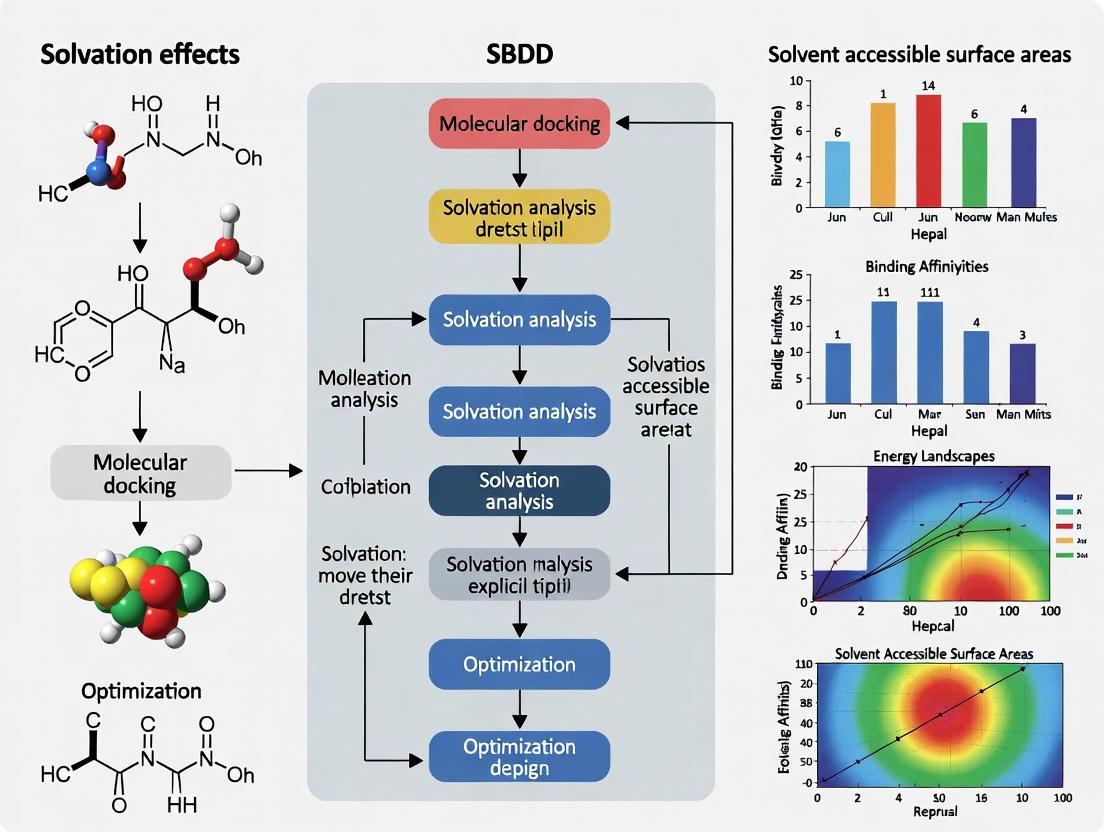
This article provides a comprehensive guide for researchers and drug development professionals on handling solvation effects in Structure-Based Drug Design (SBDD).
Mastering Solvation Effects in Structure-Based Drug Design: From Theory to Clinical Application
Abstract
This article provides a comprehensive guide for researchers and drug development professionals on handling solvation effects in Structure-Based Drug Design (SBDD). Solvation is a critical but often overlooked factor that significantly influences protein-ligand binding affinity, prediction accuracy, and ultimately drug efficacy. We explore the fundamental principles of solvation, covering both traditional implicit/explicit models and cutting-edge machine learning approaches. The content delves into practical methodologies for implementation, addresses common troubleshooting scenarios, and offers validation frameworks for comparing computational predictions with experimental results. By synthesizing foundational knowledge with advanced applications, this resource aims to bridge the gap between theoretical models and real-world drug discovery challenges, enabling more accurate and efficient development of therapeutic candidates.
The Critical Role of Water: Foundational Principles of Solvation in SBDD
Conceptual Foundations: Frequently Asked Questions (FAQs)
FAQ 1: Why is explicitly accounting for solvation so critical for accurate binding affinity predictions in Structure-Based Drug Design (SBDD)?
Predicting binding affinity is notoriously difficult because binding occurs in the presence of a solvent, and predictions will always fall short if this is not fully accounted for [1]. A protein's binding sites in the unbound state are not empty; they are occupied mainly by water molecules that do not behave as a homogeneous solvent but have well-defined hydration spots and regions where water density is much lower than in bulk solvents [1]. The thermodynamics of the subsequent solvent reorganization process—whereby these water molecules are displaced or retained to bridge interactions—is a key contribution to the complex formation free energy and thus to the ligand's binding affinity [1].
FAQ 2: What are the fundamental thermodynamic components of solvation?
The solvation free energy can be conceptually broken down into two primary steps, each with enthalpic and entropic contributions [2]:
- ΔG₁: Cavity Formation. This is the free energy required to open a cavity in the water. It involves breaking the strong cohesive intermolecular interactions in water (an unfavorable, positive ΔH₁) and reducing the configurational entropy of the water hydrogen-bond network (an unfavorable, negative TΔS₁). Consequently, ΔG₁ is large and positive, and this term dominates the hydrophobic effect [2].
- ΔG₂: Solute Insertion. This is the free energy gained from inserting the solute into the cavity and turning on the interactions between the solute and solvent. For ions and polar solutes, this term is usually dominated by favorable electrostatic and hydrogen-bond interactions (a favorable, negative ΔH₂) [2].
The overall solvation free energy is the sum: ΔG_sol = ΔG₁ + ΔG₂ = (ΔH₁ - TΔS₁) + (ΔH₂ - TΔS₂) [2]. These terms are often large and opposing, leading to a high degree of uncertainty if not properly evaluated.
FAQ 3: My lead compound shows excellent shape complementarity and electrostatic potential with the target's binding pocket, yet its measured binding affinity is weak. What solvation-related factors could be the cause?
This common issue can often be traced to incomplete analysis of the solvent. Key factors to investigate include:
- Displacement of High-Energy Water: The binding site may contain one or more highly stable, tightly bound water molecules. The thermodynamic cost of displacing these waters may outweigh the energetic benefit gained from the direct protein-ligand interactions [1]. These waters can have residence times ranging from 1 ns to 106 ns [1].
- Poor Solvent-Shell Disruption: Your compound might be insufficiently disrupting the ordered solvent shell around hydrophobic regions of the binding site, thereby failing to capitalize on the entropic gain (the hydrophobic effect) that drives binding [2].
- Ignored Water-Mediated Interactions: The compound's binding mode might fail to preserve key water molecules that act as crucial bridges for hydrogen-bonding networks between the protein and the ligand [1].
Troubleshooting Guide: Common Problems and Solutions
Problem 1: Inconsistent or Inaccurate Binding Free Energy Estimates from Computational Docking
| Symptom | Potential Root Cause | Recommended Solution |
|---|---|---|
| Low hit rates in virtual screening; poor correlation between docking scores and experimental binding affinities. | The scoring function uses an implicit solvent model that fails to capture key features of explicit water, such as the energetic cost of displacing specific water molecules or the entropic gain from releasing others. | Incorporate explicit solvent information. Perform MD simulations to identify Water Sites (WS)—regions with a high probability of finding a water molecule—and their properties (residence time, interactions). Use this data to inform or post-process docking poses [1]. |
Problem 2: Difficulty Identifying Viable Binding Pockets or Hot Spots on a Protein Target
| Symptom | Potential Root Cause | Recommended Solution |
|---|---|---|
| A seemingly flat protein surface with no obvious deep pockets; known active-site inhibitors cannot be rationalized. | Traditional surface analysis may miss regions that are key for binding but are only revealed by solvent behavior. These "hot spots" are regions on the protein surface that provide most of the binding affinity [1]. | Employ Mixed-Solvent Molecular Dynamics (MDmix). Simulate the protein in an aqueous solution containing small organic solvent probes (e.g., isopropanol, which captures hydrophobic and H-bond properties). The probes will preferentially bind to and reveal these hot spots, identifying key interaction sites for drug-like molecules [1]. |
Problem 3: Failure to Explain Potency Differences in a Congeneric Series of Inhibitors
| Symptom | Potential Root Cause | Recommended Solution |
|---|---|---|
| Small chemical modifications in a lead series lead to drastic, unexplained changes in potency that cannot be rationalized by static protein-ligand structures. | Cryo-cooled crystallography may trap the protein-ligand complex in a single, non-representative low-energy conformation, masking critical conformational dynamics and solvation differences [3]. | Utilize Room-Temperature Serial Crystallography. This technique can capture conformational dynamics and flexibility in the binding site that are lost at cryogenic temperatures. It can reveal alternative ligand binding modes, disrupted hydrogen bonds, and flexible regions that explain potency differences [3]. |
Key Experimental and Computational Protocols
Protocol 1: Identification of Binding Hot Spots Using Mixed-Solvent MD (MDmix)
Objective: To systematically identify and characterize preferential binding sites ("hot spots") on a protein surface using molecular dynamics simulations with mixed solvents [1].
Detailed Workflow:
- System Setup:
- Place the protein structure (e.g., from the PDB) in a simulation box.
- Solvate the system with water mixed with a low concentration (1-5%) of organic probe molecules. Isopropanol is a common choice as it contains both hydrophobic and hydrogen-bond donor/acceptor moieties common in drugs [1].
- Simulation Run: Perform a long-timescale MD simulation (modern workstations can handle this). Ensure the simulation runs for a sufficient duration (e.g., 20-50 ns for good convergence of water sites) to allow for adequate sampling of probe binding events [1].
- Trajectory Analysis: Analyze the simulation trajectory to identify regions where the probe molecules accumulate preferentially.
- These regions of high probe density correspond to binding hot spots.
- The chemical nature of the interactions (hydrophobic, H-bond donor, H-bond acceptor) can be inferred from the behavior of the probe.
- Application: Use the identified hot spots to guide molecular docking, virtual screening, and lead optimization by ensuring designed compounds target these energetically favorable regions [1].
The logical flow of this protocol is summarized in the diagram below:
Protocol 2: Mapping Hydration Sites Using Explicit Solvent MD
Objective: To determine the positions, stability, and thermodynamic properties of water molecules within a protein's binding site to inform ligand design [1].
Detailed Workflow:
- System Setup & Simulation: Place the protein in a box of explicit water molecules and run a standard MD simulation.
- Identify Water Sites (WS): Apply a clustering algorithm to the positions of water oxygen atoms from the simulation trajectory to define discrete Water Sites [1].
- Characterize WS Properties:
- Water Finding Probability (WFP): The probability of finding a water molecule in the site.
- Residence Time: How long a water molecule remains in the site (can range from 10 ps to >1 μs) [1].
- Energetics: Use methods like the Inhomogeneous Fluid Solvation Theory (IFST) to characterize the thermodynamics of each site [1].
- Ligand Design Strategy:
- Displace: Design ligand functional groups to displace water sites with low WFP and/or unfavorable energies (positive ΔG), as this is thermodynamically favorable.
- Mimic or Keep: If a water site has a high WFP, very negative ΔG (tightly bound), or acts as a critical bridge in an H-bond network, consider designing ligand groups that mimic its position or leave it undisturbed [1].
The following diagram illustrates the decision-making process for designed ligands based on water site properties:
The following table details key materials and tools used in the experiments and methods cited in this guide.
| Research Reagent / Resource | Function in Experiment / Analysis |
|---|---|
| Organic Probe Solvents (e.g., Isopropanol) | Used in MDmix simulations to identify protein surface "hot spots" by mimicking diverse chemical features of drug-like molecules [1]. |
| Microcrystals (10+ microns) | Essential for serial room-temperature crystallography, enabling the collection of high-quality, damage-free diffraction data that captures protein dynamics [3]. |
| Gas Dynamic Virtual Nozzle (GDVN) | Creates a thin liquid jet (<10 µm) to deliver a continuous stream of fresh microcrystals for X-ray diffraction at XFELs, preventing radiation damage [3]. |
| Fixed Target Chips (e.g., Silicon) | Sample supports for serial synchrotron crystallography onto which microcrystals are pipetted; allows high-throughput raster scanning for data collection [3]. |
| Water Map Software (e.g., WaterMap) | Computational tool used to analyze MD trajectories and identify hydration sites, calculating their thermodynamics (entropy, enthalpy) to guide ligand design [4]. |
| Protein Preparation Software (e.g., PDB2PQR, PROPKA) | Prepares protein structures from the PDB for simulation or docking by adding H atoms, assigning protonation states, and optimizing H-bond networks [4]. |
Thermodynamics Reference Data
The table below summarizes key thermodynamic parameters and concepts relevant to solvation and binding.
| Parameter / Concept | Symbol / Term | Typical Range / Value | Relevance to Binding Affinity |
|---|---|---|---|
| Free Energy of Solvation | ΔGsol | Varies by solute (e.g., -237 kJ/mol for liquid water [5]) | Determines solute solubility; contributes to the overall binding free energy cycle. |
| Cavity Formation Free Energy | ΔG1 | Large and positive [2] | Major driver of the hydrophobic effect; favors binding that releases ordered water. |
| Solute-Solvent Interaction Energy | ΔG2 | Large and negative for polar/charged solutes [2] | Favors solvation; must be overcome by strong protein-ligand interactions upon binding. |
| Water Residence Time | τ | 10 ps to >1 μs [1] | Indicates stability of a hydration site; long residence times suggest costly displacement. |
| Binding Affinity Constant | KA / KD | KA = 1/KD = exp(-ΔGBIND/RT) [1] | The primary experimental measure of ligand potency, directly related to the binding free energy. |
Conceptual Foundations in SBDD
In Structure-Based Drug Design (SBDD), accurately modeling the solvent environment is not a peripheral concern but a central challenge. The binding affinity between a drug candidate and its protein target is profoundly influenced by the surrounding water and ions, as binding occurs in a condensed state with numerous configurational possibilities [1]. Solvent reorganization during ligand binding is a key thermodynamic contribution to the free energy of complex formation [1]. The following models provide different frameworks for capturing these critical effects.
Explicit Solvation Models
Explicit solvent models treat solvent molecules as individual entities with defined coordinates and degrees of freedom [6]. This approach provides a physically realistic, atomistic picture of the solvent environment.
- Core Principle: The solute is immersed in a bath of explicit solvent molecules, often water. Molecular Dynamics (MD) or Monte Carlo simulations are then used to sample the system's configurations [6] [1].
- Key Features: These models can capture specific solute-solvent interactions, such as hydrogen bonding, and solvent ordering phenomena like the formation of hydration shells around a solute [6]. They are particularly valuable for revealing preferential interaction sites, or "hot spots," on protein surfaces [1].
- Common Implementations: Simplified, parametrized models are common for efficiency. For water, these include the TIPnP and Simple Point Charge (SPC) families, which use a fixed number of interaction sites with point charges and repulsion/dispersion parameters [6]. A new generation of polarizable force fields, such as AMOEBA, is also emerging to account for changes in molecular charge distribution [6].
Implicit Solvation Models
Implicit solvent models, also known as continuum models, replace the explicit solvent molecules with a homogeneously polarizable medium characterized by macroscopic properties like the dielectric constant (ε) [6] [7].
- Core Principle: The solute is placed inside a cavity within a continuous dielectric medium. The solvent's response to the solute's charge distribution is modeled as a reaction field, which is included as a perturbation to the solute's Hamiltonian [6].
- Key Features: This approach is computationally efficient and avoids the need to simulate numerous solvent molecules. The solvation free energy is typically decomposed into contributions from cavity formation, electrostatic polarization, and dispersion-repulsion interactions [6].
- Common Implementations:
- CPCM/COSMO: The Conductor-like Polarizable Continuum Model (CPCM) treats the bulk solvent as a conductor-like continuum and is invoked with keywords like
CPCM(solvent)in computational software such as ORCA [7]. - SMD: The Solvation Model based on Density (SMD) is an extension that uses the full solute electron density to compute the non-electrostatic (cavity-dispersion) contribution, making it more parametrized but potentially more accurate [6] [7].
- Recent Advances: Methods like the Analytical Linearized Poisson–Boltzmann (ALPB) model are being combined with semiempirical quantum methods (e.g., GFN2-xTB) to efficiently add solvation corrections to calculations from neural network potentials [8].
- CPCM/COSMO: The Conductor-like Polarizable Continuum Model (CPCM) treats the bulk solvent as a conductor-like continuum and is invoked with keywords like
Hybrid Solvation Models
Hybrid models aim to strike a balance between the computational efficiency of implicit models and the physical realism of explicit models [6] [9].
- Core Principle: A small number of explicit solvent molecules are included in the primary region of interest (e.g., the first solvation shell of a solute or a protein's active site), while the bulk solvent is treated as an implicit continuum [6] [9].
- Key Features: This setup ensures bulk solvent behavior at the boundary with the continuum while retaining specific, local solvent interactions [9]. It is particularly useful in QM/MM (Quantum Mechanics/Molecular Mechanics) simulations, where the core region (QM) and its immediate solvation shell can be treated with explicit solvent, while the outer environment is handled with a cheaper MM or implicit model [6].
- Validation: Studies have shown that such hybrid models can describe dynamical and solvent effects with an accuracy comparable to conventional approaches using periodic boundary conditions [9].
Table 1: Comparison of Solvation Model Characteristics
| Feature | Explicit Models | Implicit Models | Hybrid Models |
|---|---|---|---|
| Computational Cost | High [6] | Low [6] | Moderate [6] |
| Treatment of Solvent | Individual molecules with degrees of freedom [6] | Continuum dielectric medium [6] | Explicit molecules near solute + continuum bulk [6] [9] |
| Description of Solvent Shells | Spatially resolved, captures local fluctuations [6] | Averaged, isotropic; misses local structure [6] | Captures local structure in explicit region only [6] |
| Common Use Cases in SBDD | MD simulations to find water sites/hot spots [1] | Quick scoring in docking, initial geometry optimizations [6] | QM/MM MD simulations of reaction mechanisms [6] |
Troubleshooting Guides & FAQs
Frequently Asked Questions
Q1: My implicit solvent calculations on a protein-ligand system are yielding poor binding affinity predictions. What could be wrong? Implicit models struggle with specific solvent effects. If the binding site contains tightly bound water molecules that mediate protein-ligand interactions (e.g., through bridging hydrogen bonds), an implicit model will fail to capture their contribution [1]. Consider using a hybrid explicit/implicit approach or post-processing your results with tools like WaterMap that characterize the thermodynamics of crystallographic water molecules [1] [4].
Q2: Why does my gas-phase neural network potential (NNP) fail to model a simple thia-Michael addition reaction? Unsolved anions are highly unstable and reactive in the gas phase, leading to a confused potential-energy surface with an unclear barrier [8]. The fundamental problem is the lack of a solvent environment to stabilize the ions. You must incorporate solvation effects, for instance, by adding an implicit-solvent correction (e.g., ALPB) to the NNP calculations [8].
Q3: My MD simulations with explicit solvent are computationally expensive and slow to converge. Are there alternatives for identifying binding hot spots? Yes, consider Mixed Solvent MD (MDmix). This method involves simulating the protein in an aqueous solution containing a low concentration of organic solvent probes (e.g., isopropanol) [1]. The probes will preferentially bind to favorable interaction sites on the protein surface, efficiently revealing "hot spots" without requiring the simulation of full drug-like molecules [1].
Q4: When calculating solution-phase thermodynamics using an implicit model, my results are consistently off by about 1.9 kcal/mol. What is the likely cause? You are likely forgetting the concentration correction term, ( \Delta G^o_{conc} ), when transitioning from a gas-phase standard state (1 atm) to a solution standard state (1 mol/L) [7]. This term is calculated as ( RTln(24.5) = 1.89 ) kcal/mol at 298 K and must be added to your computed free energy of solvation [7].
Troubleshooting Common Problems
Problem: Unphysical distortions in AI-generated drug candidates from 3D-SBDD models.
- Explanation: Advanced 3D-SBDD generative models sometimes produce molecules with distorted substructures (e.g., unreasonable ring formations) to optimize docking scores, compromising drug-likeness and stability [10].
- Solution: Implement a collaborative framework like CIDD that refines initial 3D-SBDD outputs with a Large Language Model (LLM). The LLM can identify and correct chemically unreasonable structures while preserving key interactions, improving both the Reasonable Ratio and binding affinity [10].
Problem: Inaccurate solvation free energies for charged molecules in implicit solvation.
- Explanation: Traditional implicit models use a fixed set of atomic radii to define the cavity, which does not account for the changing electronic environment of an atom (e.g., a neutral vs. a charged oxygen) [7].
- Solution: Use a model with dynamic radii adjustment, such as the DRACO model available in ORCA for CPCM and SMD. DRACO scales atomic radii based on partial charges and coordination numbers, significantly improving the description of charged systems [7].
Problem: Difficulty predicting solubility for novel drug-like molecules.
- Explanation: Traditional methods like the Abraham Solvation Model have limited accuracy, and older machine learning models were hampered by a lack of comprehensive training data [11].
- Solution: Utilize the latest machine learning models trained on large, diverse datasets like BigSolDB. The FastSolv model, for example, provides highly accurate solubility predictions across a wide range of organic solvents and temperatures, aiding in solvent selection for synthesis [11].
Table 2: Troubleshooting Guide for Solvation Models in SBDD
| Problem | Root Cause | Recommended Solution |
|---|---|---|
| Poor prediction of binding affinity with key water-mediated interactions. | Implicit models cannot account for specific, structured water molecules [1]. | Use MD to identify conserved "water sites" or apply a hybrid QM/MM-explicit/implicit model [6] [1]. |
| Long, computationally expensive MD simulations to observe binding. | The timescale of binding events increases exponentially with ligand size [1]. | Use cosolvent MD (MDmix) with small probe molecules to rapidly map interaction hot spots [1]. |
| Instabilities in solvation energy during geometry optimization. | Sharp changes in the solvent-accessible surface area with small atomic displacements [7]. | Switch to a solvation model that uses a Gaussian smearing of surface charges (e.g., SURFACETYPE VDW_GAUSSIAN in ORCA's CPCM) for a smoother potential energy surface [7]. |
| High false-positive rate in virtual screening with ML models. | Model bias from training datasets like DUD-E, and neglect of solvation thermodynamics [12]. | Thoroughly validate models and integrate solvation thermodynamics tools like Grid Inhomogeneous Solvation Theory (GIST) into the analysis pipeline [12]. |
Experimental Protocols & Methodologies
Protocol: Mapping Hydration Sites with Explicit-Solvent MD
This protocol uses explicit water molecules to identify structurally and thermodynamically important water molecules on a protein surface, which are critical for understanding ligand binding [1].
- System Setup: Prepare the protein structure in a solvated box using a tool like PDB2PQR. Assign protonation states using software like PROPKA or H++ [4].
- Force Field Selection: Choose an appropriate force field. For standard simulations, use non-polarizable force fields (e.g., TIP3P water model). For higher accuracy, especially with ions, consider a polarizable force field like AMOEBA [6].
- Simulation Run: Perform a molecular dynamics simulation. Good convergence for water site identification is typically achieved in 20-50 ns [1].
- Trajectory Analysis: Apply a clustering algorithm (e.g., in CPPTRAJ) to the snapshots of water oxygen positions to identify high-occupancy sites, known as Water Sites (WS) or hydration sites [1].
- Characterization: For each WS, calculate:
- Water Finding Probability (WFP): The probability of finding a water molecule in that site.
- R90 Value: The radius containing a water molecule 90% of the time, describing the site's size [1].
- Thermodynamics: Use methods like Inhomogeneous Fluid Solvation Theory (IFST) to calculate entropy and enthalpy contributions [1].
Protocol: Running a Single-Point Energy Calculation with Implicit Solvent in ORCA
This is a fundamental protocol for obtaining the energy of a molecule in solution using a continuum model [7].
- Input File Preparation: Create an input file for your molecule.
- Keyword Selection: Specify the computational method and the implicit solvent model. For a single-point energy calculation with the SMD model in water, the input block would be:
For CPCM with water, use
CPCM(WATER)[7]. - Execution: Run the ORCA calculation.
- Output Interpretation: In the output, locate the "TOTAL SCF ENERGY" section. The solvation free energy components are:
- Electrostatic (ΔGENP): Listed as "CPCM Dielectric."
- Cavity-Dispersion (ΔGCDS): For SMD, this is listed as "SMD CDS (Gcds)." Note that for regular CPCM, this term is often not calculated by default [7].
- Standard State Correction: For solution-phase thermodynamics, remember to add the concentration correction term, ( \Delta G^o_{conc} = 1.89 ) kcal/mol, to the final Gibbs free energy [7].
Protocol: Identifying Binding Hot Spots with Mixed-Solvent MD (MDmix)
This protocol efficiently finds ligandable sites on a protein surface by simulating it in the presence of organic solvent probes [1].
- Probe Selection: Choose an organic solvent probe that mimics common drug motifs. Isopropanol is a common choice as it contains both hydrophobic and hydrogen-bond donor/acceptor moieties [1].
- System Setup: Prepare the protein in an aqueous buffer. Replace a small percentage (e.g., 1-5%) of the water molecules with the probe solvent molecules, ensuring the protein remains stable at this concentration [1].
- Simulation Run: Perform a relatively long MD simulation (timescale depends on system size and desired convergence) to allow adequate sampling of probe binding events.
- Density Analysis: Analyze the resulting trajectory to compute the 3D density map of the probe molecules around the protein.
- Site Identification: Regions with high probe density correspond to preferential binding sites or "hot spots." These sites are prime targets for functional groups in drug design [1].
Visualizing Solvation Model Workflows
Model Selection Workflow for SBDD
Solvation-Aware SBVS Workflow
The Scientist's Toolkit: Essential Research Reagents & Software
Table 3: Key Computational Tools for Solvation Modeling in SBDD
| Tool / Reagent | Type | Primary Function in SBDD | Example Use Case |
|---|---|---|---|
| MD Software (e.g., GROMACS, AMBER) | Simulation Engine | Runs explicit-solvent molecular dynamics simulations. | Simulating a protein in a water box to identify high-occupancy water sites (WS) in a binding pocket [1]. |
| ORCA | Quantum Chemistry Package | Performs electronic structure calculations with built-in implicit solvation models. | Calculating the solvation-free energy of a ligand or optimizing its geometry in water using CPCM or SMD [7]. |
| Grid Inhomogeneous Solvation Theory (GIST) | Analysis Tool | Calculates thermodynamic properties of water molecules from MD trajectories. | Post-processing MD data to compute the entropy and enthalpy of water molecules displaced by a ligand [12]. |
| FastSolv / ChemProp | Machine Learning Model | Predicts solubility of molecules in various organic solvents. | Screening potential solvent systems for the synthesis or formulation of a new drug candidate [11]. |
| Cosolvent Probes (e.g., Isopropanol) | Computational Reagent | Used in MDmix simulations as a proxy for drug fragments. | Efficiently mapping hydrophobic and H-bonding hot spots on a protein surface without simulating full ligands [1]. |
| PDB2PQR / PROPKA | Pre-processing Tool | Prepares protein structures for simulation by adding H atoms and assigning protonation states. | Critical first step in ensuring a realistic protein structure before any MD or docking study [4]. |
The Physical Chemistry of Water-Mediated Protein-Ligand Interactions
Troubleshooting Guides and FAQs
Frequently Asked Questions
FAQ 1: Why is explicitly modeling water molecules critical for accurate binding affinity predictions in SBDD?
Implicit solvent models, while computationally efficient, often fail to capture critical, specific water-mediated interactions that significantly influence ligand binding. Over 85% of protein-ligand complexes have one or more water molecules bridging the protein and ligand, with a mean of 3.5 molecules per complex [13]. The thermodynamics of solvent reorganization is a key contribution to the complex formation free energy. Accurately predicting the role of these water molecules—whether they are displaced, retained, or form ordered networks during binding—is essential for reliable affinity predictions [1] [13].
FAQ 2: My molecular docking results are inconsistent with experimental binding data. Could solvation effects be the cause?
Yes, this is a common issue. Classical docking often falls short because it does not fully account for the solvent's contribution. The binding site in an unbound protein is not empty; it is occupied by water molecules with well-defined structures and dynamics [1]. Displacing a tightly bound water molecule with a high free energy cost can be unfavorable, even if the ligand forms good direct interactions with the protein. Incorporating explicit water positions and their free energy penalties or gains into the scoring function can dramatically improve the predictive capability of docking [1] [13].
FAQ 3: What is the difference between the first and second hydration shells, and why does the second shell matter?
The first hydration shell refers to water molecules directly interacting with the protein surface. The second hydration shell consists of water molecules that interact with the first shell water molecules and can also influence protein-ligand recognition [13]. The free energy contribution from the water network, including the second shell, is significant but challenging to study. Recent research shows that the second shell of water molecules can be critical for binding affinity and kinetics, and fully considering these effects is vital for accurate predictions in drug discovery [13].
FAQ 4: How can I identify "hot spots" or key interaction sites on my protein target?
Mixed-solvent Molecular Dynamics (MDmix) is a powerful method for this. By simulating the protein in an aqueous solution containing small organic solvent molecules (e.g., isopropanol), you can identify surface regions where these probe molecules bind preferentially [1]. These sites correspond to "hot spots" that provide most of the binding affinity. These probes effectively capture hydrophobic and hydrogen-bonding motifs common in drug-like molecules, revealing crucial interaction sites for ligand design [1].
Troubleshooting Common Experimental Issues
Issue 1: Poor Correlation Between Calculated and Experimental Binding Free Energies
- Problem: Binding free energy calculations using methods like MM/PBSA result in poor correlation with experimental data.
- Solution: Include explicit water free energy corrections. Research has demonstrated that when MM/PBSA alone was used for systems like CDK2 and Factor Xa, the computed binding free energy showed poor to moderate correlation. However, including a free energy correction for key water molecules greatly improved the calculation's accuracy [13].
- Protocol (MM/PBSA with Water Correction):
- Run a molecular dynamics simulation of the protein-ligand complex with explicit water molecules.
- Identify stable, ordered water molecules at the protein-ligand interface.
- Calculate the free energy of moving these key water molecules from their binding sites to the bulk solvent using a method like VM2 or similar [13].
- Integrate this water free energy term as a correction into your MM/PBSA calculation.
Issue 2: Inability to Identify Stable Water Positions in a Binding Site
- Problem: Crystallographic data may be missing water molecules, or their positions may be unreliable due to low resolution. You need to predict stable hydration sites computationally.
- Solution: Use a hydration site-locating algorithm via molecular dynamics or a grid-based method.
- Protocol (Hydration Sites Locating Algorithm):
- Start with a protein structure (from a crystal structure or homology model) and remove all water molecules and cofactors.
- Define a grid box with a fine spacing (e.g., 0.2 Å) centered on the binding site [13].
- Probe all vacant grid points with a water probe, calculating interaction energies (non-polar, electrostatic, and hydrogen-bonding) between the probe and the protein.
- Identify regions with high probability of finding a water molecule (Water Finding Probability, WFP). These are your hydration sites, which can predict key hydrophilic interaction points for ligands [1] [13].
Issue 3: High Computational Cost of Simulating Ligand Binding/Unbinding
- Problem: Directly simulating the binding of a drug-sized ligand is computationally expensive and time-consuming.
- Solution: Utilize cosolvent molecular dynamics (MDmix) as a more efficient alternative for fragment-based screening and hot spot identification.
- Protocol (MDmix Simulations):
- Simulate the protein in an explicit aqueous solution containing 1-5% of organic solvent probes (e.g., isopropanol, which captures both hydrophobic and hydrogen-bonding properties) [1].
- Run a sufficiently long MD simulation (convergence is often achieved in 20-50 ns for water sites) to ensure adequate sampling [1].
- Analyze the simulation trajectories to identify regions with high density and long residence times for the probe molecules. These preferential interaction sites are the "hot spots" for ligand binding [1].
Quantitative Data and Method Comparison
The table below summarizes key quantitative data and properties for analyzing hydration sites from Molecular Dynamics simulations [1].
Table 1: Key Properties and Metrics for Characterizing Hydration Sites from MD Simulations
| Property | Description | Typical Range/Values | Significance in SBDD |
|---|---|---|---|
| Water Finding Probability (WFP) | Probability of finding a water molecule at a specific site. | Varies between sites | High WFP sites are often displaced by ligand hydrophilic groups to form key interactions [1]. |
| Residence Time | The average time a water molecule remains in a specific site. | 10 ps to > 1 µs [1] | Longer residence times indicate tightly bound waters; displacing them may be energetically costly. |
| Radius (R₉₀) | The radius that contains a water molecule 90% of the time. | Measured in Ångstroms [1] | Defines the spatial extent and size of the hydration site, informing ligand design to fit the site. |
The table below compares different computational methods used for evaluating water effects in protein-ligand recognition.
Table 2: Comparison of Methods for Evaluating Water Effects in Protein-Ligand Recognition
| Method | Description | Key Advantages | Key Limitations |
|---|---|---|---|
| Explicit Solvent MD | Simulates protein, ligand, and water molecules with atomic detail. | Captures full dynamics and entropic effects; identifies hydration sites (WS) [1]. | Computationally expensive; slow convergence for buried water exchange [13]. |
| Mixed-Solvent MD (MDmix) | MD with explicit water and organic solvent probes. | Systematically identifies binding hot spots; more efficient than simulating large ligands [1]. | Uses small probes; binding free energy is non-additive for larger molecules [1]. |
| Free Energy Perturbation (FEP) | Alchemically transforms molecules to compute free energy differences. | Rigorous and theoretically sound for absolute binding free energy of water [13]. | Very computationally expensive and can be labor-intensive to set up [13]. |
| VM2 Method | A predominant states method using implicit solvent and statistical thermodynamics. | Balanced accuracy and efficiency; can handle multiple water molecules [13]. | Relies on identifying stable conformations; uses implicit solvent model [13]. |
| Geometry-Based Methods (e.g., WarPP) | Uses algorithms to predict water positions from static structures. | Very fast computation. | Often lacks entropy contributions, which are critical for binding [13]. |
Experimental Protocols and Workflows
Detailed Protocol 1: MM/PBSA Binding Free Energy Calculation with Water Correction
Purpose: To improve the accuracy of binding free energy calculations by incorporating the contribution of explicit water molecules.
Workflow Diagram:
Methodology:
- System Preparation: Obtain the 3D structure of the protein-ligand complex. Parameterize the protein and ligand using appropriate force fields (e.g., AMBER) [13].
- Explicit Solvent MD Simulation: Run a molecular dynamics simulation of the solvated complex to sample conformational states. Ensure the simulation is long enough for the relevant water molecules to exchange or stabilize.
- Identify Key Waters: Analyze the trajectory to locate stable, ordered water molecules at the protein-ligand interface. Look for waters with high residence times and those that form hydrogen-bond bridges.
- Calculate Water Displacement Free Energy: Use a method like the VM2 water-removal algorithm to compute the free energy (ΔG) of moving each key water molecule from its binding site to the bulk solvent [13]. VM2 computes the standard chemical potential of the system with and without the water molecule.
- Standard MM/PBSA: Perform a traditional MM/PBSA calculation on the MD trajectory to get the initial binding free energy estimate (ΔG_MMPBSA).
- Apply Correction: The final, corrected binding free energy (ΔGCorrected) is obtained by summing the initial estimate and the free energy contributions from the displaced water molecules: ΔGCorrected = ΔGMMPBSA + Σ ΔGWater.
Detailed Protocol 2: Hydration Site Analysis via Inhomogeneous Fluid Solvation Theory (IFST)
Purpose: To characterize the structure, dynamics, and thermodynamics of water molecules around a protein binding site.
Workflow Diagram:
Methodology:
- Apo-Protein MD Simulation: Run a long MD simulation of the protein (without ligand) solvated in a box of explicit water molecules.
- Trajectory Analysis: Extract the positions of water oxygen atoms from thousands of simulation snapshots.
- Clustering for Water Sites: Apply a clustering algorithm (e.g, density-based clustering) to the collected water positions. Each cluster defines a "water site" (WS) or "hydration site," characterized by its 3D coordinates [1].
- Property Calculation:
- Water Finding Probability (WFP): The probability of the site being occupied by a water molecule.
- R₉₀: The radius containing a water molecule 90% of the time, defining the site's size.
- Residence Time: The average time a water molecule stays in the site, indicating its stability [1].
- IFST Thermodynamics: Use Inhomogeneous Fluid Solvation Theory to decompose the solvation free energy into energetic and entropic contributions for each water site, providing deep thermodynamic insight [1] [13].
- Ligand Design Application: Use the map of water sites to inform ligand design. Favor ligand functional groups that can displace unstable water sites (high free energy) and maintain or incorporate groups that interact favorably with stable water sites.
The Scientist's Toolkit: Research Reagent Solutions
Table 3: Essential Computational Tools and Resources for Studying Water-Mediated Interactions
| Item/Resource | Function in Research | Example Applications |
|---|---|---|
| MD Software (e.g., GROMACS, NAMD, AMBER) | Simulate the dynamic behavior of proteins, ligands, and explicit water molecules over time. | Sampling conformational ensembles, calculating residence times of water, running MDmix simulations [1] [13]. |
| Free Energy Calculation Tools (e.g., VM2, FEP) | Compute the binding free energy of a ligand or the free energy cost of displacing a water molecule. | Predicting absolute binding affinities, calculating the stability of key hydration sites [13]. |
| Water Analysis Software (e.g., WaterMap, MobyWat, HydraMap) | Identify and characterize hydration sites from MD simulations or static structures. | Mapping "hot spots" and dehydration sites on protein surfaces; guiding ligand optimization [13]. |
| Molecular Docking Software (e.g., AutoDock Vina) | Predict the binding pose and affinity of a small molecule within a protein's binding site. | Initial virtual screening of compound libraries; can be improved by incorporating pre-calculated water sites [14]. |
| Implicit Solvent Models (e.g., PBSA, GBSA) | Approximate the solvent as a continuous dielectric medium for faster energy calculations. | Used in MM/PBSA and as a component in methods like VM2; efficient but misses specific water effects [13]. |
| Cosolvent Probes (in MDmix) | Small organic molecules (e.g., isopropanol, acetonitrile) used to mimic chemical features of drugs. | Experimentally mapping protein surface hot spots by identifying preferential binding locations [1]. |
| Protein Data Bank (PDB) | Repository of experimentally determined 3D structures of proteins and nucleic acids. | Source of initial protein structures for simulations; provides experimental data on crystallographic water positions [13]. |
FAQs: Understanding and Troubleshooting Solvation Analysis
What are the key thermodynamic descriptors for quantifying solvation effects in SBDD?
The table below summarizes the key computational descriptors and parameters used to quantify solvation effects, along with the methods used to obtain them.
| Descriptor/Parameter | Computational Method | Significance in SBDD |
|---|---|---|
| Solvation Free Energy (ΔGsolv) | 3D-RISM, MD Free Energy Perturbation, QM/Continuum Models [15] | Predicts solubility, permeability, and binding affinity [15]. |
| Partial Solvation Parameters (PSPs) | Quantum Mechanics & QSPR/LSER approaches [16] | Molecular descriptors for predicting solvation properties and phase equilibria [16]. |
| Water Finding Probability (WFP) | Explicit Solvent MD Simulations [1] | Identifies high-occupancy hydration sites on a protein surface; spots likely for displacement by ligand [1]. |
| Enthalpy (ΔH) & Entropy (ΔS) of Hydration | Inhomogeneous Fluid Solvation Theory (IFST) applied to MD trajectories [1] | Decomposes free energy into energetic (ΔH) and disorder (ΔS) components for a detailed view of solvation [1]. |
| Preferential Interaction Sites | Mixed-Solvent MD (MDmix) [1] | Identifies "hot spots" on a protein surface that preferentially bind organic solvent probes, indicating where drug-like fragments might bind [1]. |
How do I choose the right method for predicting pKain drug-like molecules?
Selecting a pKa prediction method involves trade-offs between accuracy, speed, and chemical space coverage. The table below compares the primary approaches.
| Method | Typical Applications | Strengths | Weaknesses |
|---|---|---|---|
| Quantum Mechanics (QM) | Novel/Exotic functional groups; high-accuracy studies [17] | High physical rigor; good extrapolation to new chemistries [17] | Computationally expensive; slower [17] |
| Explicit-Solvent Free-Energy Simulations | Protein residue pKa; cases where solvent effects are dominant [17] | Explicitly models solvent; high accuracy for complex environments [17] | Very computationally expensive; requires significant expertise [17] |
| Data-Driven & Machine Learning (ML) | High-throughput virtual screening of drug-like molecules [17] | Very fast; high accuracy for well-represented chemical classes [17] | Unreliable for exotic structures; data-hungry [17] |
| Fragment/Group-Based | Rapid estimation for standard functional groups [17] | Extremely fast and accurate within domain [17] | Poor generalization; misses through-space effects [17] |
| Hybrid Approaches | Balancing speed and physical insight [17] | Incorporates physical bias; more robust than pure ML [17] | Speed depends on underlying physical model [17] |
My MD simulations of ligand binding are not converging. What could be wrong?
Insufficient simulation time is a common cause. Observing full binding/unbinding events is computationally expensive and has an exponential relationship with molecular size [1]. Furthermore, using a single, static protein structure from a cryogenic crystal might not capture the necessary flexibility. Consider these steps:
- Extended Sampling: Run multiple, longer simulations or use enhanced sampling techniques.
- Incorporating Flexibility: Use methods like induced-fit docking or ensemble docking from MD snapshots to account for protein motion [4].
- Solvent Representation: The use of explicit solvent is crucial, but also computationally demanding. For some properties, a well-validated implicit solvent model can be a useful alternative [8].
Why do my computational binding affinity predictions disagree with experimental data?
This is a common challenge, often stemming from an incomplete treatment of solvation. Key factors to check include:
- Displacement of Key Water Molecules: The thermodynamics of binding are heavily influenced by the displacement of water molecules from the binding site. Failure to identify and account for high-energy ("unhappy") waters can lead to significant errors [1]. Using tools like WaterMap or 3D-RISM can help characterize these sites [4].
- Protonation States: The protonation states of key protein residues and the ligand itself can change between solvated and bound states. Use tools like PROPKA [4] to predict pKa values and ensure states are appropriate for the binding context.
- Entropic Contributions: Binding involves complex trade-offs in entropy from the ligand, protein, and solvent. Methods like Molecular Dynamics with Mixed Solvents (MDmix) can help probe these contributions [1].
Experimental Protocols
Protocol 1: Identifying Binding Hot Spots Using Mixed-Solvent Molecular Dynamics (MDmix)
Purpose: To identify key interaction sites ("hot spots") on a protein surface by simulating the system in the presence of organic solvent probes, which mimic functional groups of drug-like molecules [1].
Workflow Overview:
Step-by-Step Methodology:
- System Setup:
- Obtain a high-resolution structure of the protein target (e.g., from X-ray crystallography or cryo-EM).
- Prepare the protein using a standard workflow (e.g., with Maestro's Protein Preparation Wizard or a similar tool). This includes adding hydrogen atoms, assigning partial charges, and optimizing hydrogen bonds [4].
- Solvate the protein in a pre-equilibrated box containing a mixed solvent, typically water with 1-5% of an organic probe like isopropanol. Isopropanol is a common choice as it captures both hydrophobic and hydrogen-bonding interactions [1].
- Simulation:
- Run an extended molecular dynamics simulation (often tens to hundreds of nanoseconds) using a package like AMBER, GROMACS, or OpenMM.
- Ensure the simulation is long enough for the organic probes to adequately sample the protein surface. Good convergence for solvent structure is often achieved in 20–50 ns [1].
- Trajectory Analysis:
- Analyze the resulting trajectory to identify regions on the protein surface where the organic solvent probes accumulate preferentially.
- Calculate the spatial density of the probe molecules around the protein. These high-density regions are the "hot spots" [1].
- Application to Drug Discovery:
- Use the identified hot spots to guide fragment-based drug discovery (FBDD) or to inform molecular docking. The hot spots indicate where chemical functional groups from a potential drug molecule are likely to form favorable interactions.
Protocol 2: Calculating Solvation Free Energy Using 3D-RISM
Purpose: To predict the solvation free energy (SFE) of a small molecule in various solvents, a key property for predicting solubility, logP, and membrane permeability [15].
Workflow Overview:
Step-by-Step Methodology:
- Ligand Preparation:
- Generate a 3D structure of the solute (drug-like molecule) and optimize its geometry using quantum chemistry (e.g., DFT) or molecular mechanics.
- 3D-RISM Calculation:
- Set up the 3D-RISM calculation by defining the solute molecule and the solvent (e.g., water, octanol). The 3D-RISM theory is an integral equation theory that computes the 3D structure of the liquid around the solute [15].
- Run the 3D-RISM simulation to obtain the spatial density distributions of the solvent sites (e.g., oxygen and hydrogen for water) around the solute.
- SFE Calculation:
- Calculate the SFE by integrating the solute-solvent interaction energy over the solvent distribution. The Kovalenko-Hirata (KH) closure is a common approximation used for this purpose [15].
- Multi-Solvent Prediction (Optional):
- The SFE in water, or a set of hydration thermodynamic descriptors from 3D-RISM, can be used as input features for a machine learning (ML) model. This ML model can then be trained to predict SFEs in a wide range of organic solvents, increasing efficiency [15].
The Scientist's Toolkit: Key Research Reagents & Software
| Reagent / Software Solution | Function in Solvation Analysis |
|---|---|
| Molecular Dynamics Engines (AMBER, GROMACS, CHARMM, OpenMM) | Simulate the motion of protein-ligand systems in explicit solvent, providing atomic-level detail of solvation dynamics [1] [17]. |
| 3D-RISM Software | Calculates the 3D structure of a liquid solvent around a solute, enabling efficient computation of solvation free energies and other thermodynamic descriptors [15]. |
| Continuum Solvation Models (e.g., ALPB, GB/SA, COSMO-RS) | Provide a faster, approximate method for calculating solvation effects by treating the solvent as a continuous dielectric medium, rather than explicit molecules [8] [17]. |
| pKa Prediction Tools (e.g., Jaguar, Epik, ACD/pKa) | Determine the acid dissociation constant, which is critical for predicting the correct protonation state and charge of a ligand in solution, dramatically affecting solvation and binding [17]. |
| Protein Preparation Suites (e.g., Maestro Protein Prep Wizard, WebPDB) | Prepare protein structures from the PDB for simulation or docking, including assigning bond orders, adding H atoms, and optimizing protonation states [4]. |
Frequently Asked Questions
1. How does neglecting solvation specifically impact virtual screening results in drug discovery? In Structure-Based Virtual Screening (SBVS), solvation effects are critical during the binding event as a ligand must first displace water molecules from the protein's binding pocket. Neglecting this desolvation process can lead to a significant overestimation of binding affinity. This is because the energetic penalty for dehydrating the ligand and the protein binding site is not accounted for. Accurate prediction requires estimating the free energy changes that accompany this desolvation [4] [18].
2. What are "non-additive solvation effects" and why are they a pitfall? A common assumption is that a molecule's total solvation free energy is the sum of its individual parts. However, this additivity often fails. When two substituent groups on a molecule are close together, their solvation shells can overlap and interact, leading to non-additive behavior. For instance, if two -OH groups are adjacent, they might form an intramolecular hydrogen bond, making the molecule behave as if it only has one -OH group from a solvation perspective. The error from assuming additivity can be as large as 1.4 kcal/mol or more, which is enough to render predictions quantitatively useless [18].
3. What is the key difference between implicit and explicit solvent models, and when is each appropriate? The choice between implicit and explicit models is a fundamental one.
- Implicit Models (e.g., PCM, GB/SA): Treat the solvent as a continuous dielectric medium. They are computationally efficient and good for estimating electrostatic contributions to solvation and performing high-throughput screening [19] [20].
- Explicit Models: Treat each solvent molecule individually. They are computationally expensive but are essential for capturing specific, directional interactions like hydrogen bonding, shared solvation shells, and the role of key water molecules in active sites. They are necessary for modeling reaction mechanisms and accurate binding kinetics [19] [20] [18].
4. How can solvation affect the binding kinetics of a drug candidate? Solvation and desolvation are key drivers of binding kinetics (kon and koff). Molecular dynamics simulations show that the transition state for unbinding can be located in two key areas:
- Near the bound state: The barrier is enthalpic, requiring the breaking of strong interactions with the protein.
- In the vestibule area: The barrier is entropic, linked to solvent reorganization and the cost of (re)hydrating the ligand and protein. Neglecting explicit water dynamics makes predicting residence time (1/koff) very difficult [21].
5. Why is modeling "mutual polarization" between solute and solvent so important? Polarization is not a one-way street. When a solute's electron density changes (e.g., upon photoexcitation), it polarizes the surrounding solvent. This rearranged solvent, in turn, repolarizes the solute. This mutual polarization is a dominating factor for accurately predicting properties like absorption spectra. Standard non-polarizable force fields cannot capture this effect, leading to inaccurate predictions of spectral peaks and shapes [20].
Experimental Protocols & Troubleshooting
Protocol 1: Incorporating Solvation in Structure-Based Virtual Screening
This protocol outlines the key steps for preparing a protein target for SBVS, highlighting where solvation is most critical [4].
Protein Structure Preparation:
- Obtain the 3D structure from X-ray, NMR, or homology modeling.
- Assign Protonation States: Use software like PROPKA or H++ to determine the correct protonation states of amino acid residues at physiological pH. Incorrect states will distort electrostatics.
- Handle Water Molecules: This is a critical decision point. Use methods like WaterMap, 3D-RISM, or JAWS to identify structurally important "water molecules" that should be retained in the binding site as part of the protein structure.
- Relieve Steric Clashes: Perform a gentle energy minimization of the protein structure while restraining heavy atoms to fix any unrealistic clashes.
Ligand Library Preparation:
- Generate accessible tautomeric and ionization states for each compound in the library.
- Assign proper stereochemistry and formal charges.
Docking and Post-Processing:
- Perform molecular docking with a program that can account for, or be parameterized for, solvent effects.
- During post-processing, visually inspect top-scoring hits to check if key water-mediated interactions are present or if the pose suggests unfavorable desolvation.
Protocol 2: Assessing Solvation Contributions to Binding Kinetics using suMetaD
This protocol uses advanced molecular dynamics to simulate the role of solvation in ligand unbinding/binding [21].
System Setup:
- Start with a ligand-protein complex embedded in an explicit solvent box.
- Equilibrate the system using standard MD.
Define Collective Variables (CVs):
- Select CVs that describe the unbinding path. A common choice is the distance between the ligand and the protein's binding site center of mass. Crucially, a second CV should be a measure of solvation, such as the number of water molecules in the binding site or around the ligand.
Run Supervised MD (SuMD) and Metadynamics (MetaD):
- Use the SuMD method to simulate the ligand unbinding and binding events, guiding the process along the pre-defined CVs.
- Employ Well-Tempered Metadynamics to reconstruct the free energy surface of the entire process.
Analysis:
- Identify the transition state (the highest energy barrier).
- Analyze the conformation and, most importantly, the solvation structure at this state. A transition state in the vestibule is often characterized by an entropic barrier linked to solvent behavior.
Quantitative Data on Solvation Effects
Table 1: Experimental Evidence of Non-Additive Solvation Free Energies
| Molecular System | Observed Phenomenon | Energetic Impact | Physical Cause |
|---|---|---|---|
| Xylenol Isomers [18] | Different spatial arrangement of identical groups (methyl and hydroxyl) | ΔΔG~solv~ = 1.4 kcal/mol | Steric hindrance prevents optimal H-bonding with water for one isomer. |
| Dihydroxybenzene [18] | Two adjacent -OH groups vs. two separated -OH groups | The adjacent groups contribute ~0 kcal/mol vs. -5.7 kcal/mol each for separated groups | Intramolecular H-bonding prevents favorable interaction with water. |
| Dinitrate Alkyl Chain [18] | Two nitrate groups close together vs. far apart | Each nitrate contributes less than its individual solvation energy | Crowding and sharing of solvation shells between the two groups. |
Table 2: Comparison of Solvation Modeling Approaches
| Method | Key Principle | Advantages | Limitations | Best Use Cases |
|---|---|---|---|---|
| Implicit (Continuum) [19] [18] | Solvent as dielectric continuum | Computationally fast; Good for electrostatic effects | Misses specific H-bonds, non-additivities, and solvent structure | High-throughput screening; Initial pose generation |
| Explicit (Classical FF) [19] [20] | Every solvent molecule modeled | Captulates H-bonding and solvent structure; Allows for dynamics | Computationally expensive; Force field dependence | MD simulations; Binding kinetics studies |
| Explicit (Polarizable FF) [20] | Explicit solvent with polarizable sites | Captures mutual polarization | Even more computationally expensive; Parameterization is complex | Modeling spectroscopy; Systems with strong polarization |
| QM/MM [20] | QM for solute, MM for solvent | High accuracy for solute electronic structure | Costly; Limited time/length scales | Studying reaction mechanisms in solution |
| Machine-Learned Potentials (MLPs) [19] | ML surrogate for quantum methods | Near-quantum accuracy; lower cost | Data-intensive training; Transferability challenges | Accurate free energy calculations; Complex reactive systems |
The Scientist's Toolkit
Table 3: Key Software and Methods for Solvation Modeling
| Tool / Reagent | Function in Solvation Modeling |
|---|---|
| PROPKA / H++ [4] [22] | Predicts pK~a~ and protonation states of protein residues for proper electrostatic setup. |
| WaterMap / 3D-RISM [4] [22] | Identifies the location and thermodynamic properties of ordered water molecules in binding sites. |
| Polarizable Continuum Model (PCM) [20] [22] | An implicit solvation model for efficient calculation of electrostatic solvent effects in QM. |
| Generalized Born (GB) [18] | A faster, approximate implicit model often used in molecular mechanics. |
| AMOEBA Force Field [20] | A polarizable force field for explicit solvent simulations that captures mutual induction. |
| Effective Fragment Potential (EFP) [20] | A quantum-mechanically derived method for explicitly modeling solvent molecules with high accuracy without empirical parameters. |
| Metadynamics [21] | An enhanced sampling MD technique to simulate rare events like ligand (un)binding and map the free energy landscape. |
Workflow Visualization
Computational Strategies for Solvation: From Continuum Models to AI
Frequently Asked Questions (FAQs)
Q1: What is the fundamental difference between the PCM and GB-SA implicit solvent models? The Polarizable Continuum Model (PCM) and the Generalized Born-Surface Area (GB-SA) model are both implicit solvent models but employ different physical approaches. PCM treats the solvent as a polarizable continuum characterized by its dielectric constant and solves the Poisson-Boltzmann equation numerically to compute electrostatic solvation energies [23]. In contrast, the GB-SA model is an approximation to the Poisson-Boltzmann theory. It uses a Generalized Born equation to calculate the electrostatic component of solvation, which is then combined with a non-polar contribution estimated from the solvent-accessible surface area (SASA) [23]. GB-SA is generally computationally faster, while PCM can be more accurate but demands greater computational resources.
Q2: In what scenarios is it particularly crucial to account for solvation free energy in binding affinity calculations? Calculating solvation free energy becomes absolutely essential in cases involving ionized fragments or charged molecules [23]. The transfer of a ligand from an aqueous solvent to a protein binding pocket involves significant desolvation penalties, especially for charged groups. Neglecting these effects can lead to severe inaccuracies in predicting binding affinity. Furthermore, the solvent plays a critical role in the kinetics of binding and unbinding; for instance, transition states located in protein vestibules can have kinetic bottlenecks dominated by entropic effects linked to solvent behavior [21].
Q3: My FMO/PCM binding affinity predictions are inconsistent with experimental data. Which energy terms should I investigate? The Fragment Molecular Orbital (FMO) method reliably calculates gas-phase potential energy, but binding affinity is influenced by additional terms [23]. We recommend you systematically check the following components:
- Solvation Free Energy: Ensure your PCM (or other implicit solvent model) calculations are configured correctly for your system, particularly regarding the dielectric constants for the solvent and solute.
- Deformation Energy: This is the energy penalty required for the ligand to adopt its bioactive conformation from its lowest-energy free state. Incorporating this term has been shown to enhance the precision of FMO predictions [23].
- Entropy: Although often computationally expensive to include (e.g., via the Interaction Entropy method), the entropy contribution to binding can be significant. While sometimes omitted for efficiency, its inclusion can provide a performance boost [23].
Q4: Are there modern, efficient alternatives to traditional QM/MM solvent models for large-scale virtual screening? Yes. For scenarios requiring high throughput, such as screening massive compound libraries, structure-free approaches are emerging. For instance, models like BIND use protein language models and molecular graphs to achieve screening power comparable to state-of-the-art structure-based models but with dramatically reduced computational time and without requiring 3D protein structures [24]. Similarly, hybrid AI frameworks that combine 3D-SBDD with Large Language Models (LLMs) can refine molecules to improve drug-likeness while maintaining binding affinity [10].
Troubleshooting Common Experimental Issues
Problem: Inaccurate Solvation Energy Calculation for Charged Ligands
- Symptoms: Systematic overestimation or underestimation of binding affinity for charged molecules; poor correlation with experimental results for a series of ionizable compounds.
- Investigation & Resolution:
- Verify Model Parameters: Confirm that the internal and external dielectric constants used in your PCM or GB-SA calculation are appropriate for your protein-ligand system. Typical values are 1-4 for the solute and ~80 for the solvent (water).
- Check Cavity Definition: In PCM, the results are sensitive to the definition of the molecular cavity. Ensure the cavity is neither too small (underestimating solvation) nor too large (overestimating it). Experiment with different cavity definitions (e.g., using different atomic radii sets).
- Cross-validate with a Different Model: Run the same system using a different implicit solvent model (e.g., compare PCM with GB-SA or the PM7/COSMO model [23]). If both models show the same large deviation, it strengthens the evidence that the solvation term is the source of error.
- Consider Explicit Solvent: For highly charged systems, a hybrid QM/MM molecular dynamics (MD) simulation with explicit water molecules might be necessary to capture specific solvent effects, such as tightly bound water molecules in the active site, though this is computationally expensive [21].
Problem: High Computational Cost of PCM in FMO Calculations
- Symptoms: FMO calculations with PCM become prohibitively slow for large protein-ligand systems, hindering research progress.
- Investigation & Resolution:
- Explore Semi-Empirical Methods: Consider using a lower level of theory for the PCM calculation. The semi-empirical PM7 method combined with the COSMO solvation model has demonstrated good performance in calculating solvation energy changes during binding and offers a favorable compromise between speed and accuracy [23].
- Leverage Linear Scaling Methods: Investigate if your computational software supports linear-scaling algorithms for the PCM computation itself. Modern implementations are designed to handle large systems more efficiently.
- Evaluate the Necessity: For initial screening or less critical calculations, a well-parameterized GB-SA model might provide a sufficiently accurate solvation energy estimate at a fraction of the computational cost, allowing you to reserve full PCM for final, high-accuracy predictions on top candidates [23].
Problem: Discrepancy Between Predicted and Experimental Binding Kinetics
- Symptoms: Your model accurately predicts binding affinity (KD) but fails to replicate experimental association (kon) or dissociation (koff) rates.
- Investigation & Resolution:
- Focus on the Unbinding Pathway: Binding kinetics are determined by the energy landscape along the entire binding/unbinding pathway, not just the bound state. Implicit models focused on a single snapshot are limited here.
- Implement Enhanced Sampling MD: Use methods like metadynamics or supervised MD (suMetaD) to simulate the ligand unbinding process [21]. These techniques can identify transition states and the role of water in creating enthalpic or entropic barriers.
- Analyze Solvent Bottlenecks: These MD simulations can reveal if the kinetic bottleneck is an enthalpic barrier (e.g., breaking strong ligand-protein interactions) near the bound state or an entropic barrier (e.g., linked to solvent ordering/disordering) in a vestibule or channel [21].
Performance Data and Methodologies
Comparative Performance of Implicit Solvent Methods in FMO
The table below summarizes the performance of various implicit solvent methods when integrated into the FMO framework for binding affinity prediction on a benchmarked dataset [23].
Table 1: Performance of FMO-based binding affinity calculation methods incorporating different implicit solvent and energy terms.
| Method Name | Linear Fit Form Description | Key Solvation Model | Additional Terms | Pearson Correlation (R) |
|---|---|---|---|---|
| FMO | Gas-phase potential energy only | None | None | 0.62 |
| FMO_PBSA | Adds solvation free energy | PBSA | - | [Data from citation:1] |
| FMO_GBSA | Adds solvation free energy | GBSA | - | [Data from citation:1] |
| FMO_COSMO | Adds solvation free energy | PM7/COSMO | - | [Data from citation:1] |
| FMO_PCM | Adds solvation free energy | PCM | - | [Data from citation:1] |
| FMO_SMD | Adds solvation free energy | SMD | - | [Data from citation:1] |
| FMOCOSMOSE | Adds solvation and deformation | PM7/COSMO | Ligand Strain | Improved performance [23] |
| FMOScore | Optimized linear combination | PM7/COSMO | Ligand Strain | Good performance vs. FEP+, MM/PB(GB)SA [23] |
Detailed Protocol: FMOScore for Binding Affinity Prediction
The following workflow outlines the methodology for the FMOScore, which integrates FMO with implicit solvation and other key energy terms [23].
System Preparation:
- Obtain the 3D structure of the protein-ligand complex, ideally from a reliable crystal structure or a well-validated docking pose.
- Perform standard structure preparation steps: add hydrogen atoms, assign protonation states for ionizable residues (considering the pH and binding site environment), and optimize hydrogen bonding networks.
FMO Calculation:
- Fragment Partitioning: Divide the entire protein-ligand system into smaller fragments. The ligand is typically treated as a single fragment.
- Quantum Mechanical Calculation: Perform ab initio QM calculations (e.g., at the HF/STO-3G level) on the fragmented system using the FMO method to obtain the gas-phase interaction energy (ΔE_int).
Solvation Free Energy (ΔG_solv):
- Calculate the solvation free energy for the complex, the protein alone, and the ligand alone using an implicit solvent model. The FMOScore method recommends the PM7/COSMO model for its efficiency and performance [23].
- The change in solvation upon binding is computed as: ΔΔGsolv = ΔGsolv(complex) - ΔGsolv(protein) - ΔGsolv(ligand).
Ligand Deformation Energy (ΔE_def):
- Geometry optimize the ligand in its free state (unbound) to find its minimum energy conformation.
- Calculate the single-point energy of the ligand in its free-state conformation and its bound-state conformation (extracted from the complex).
- The deformation energy is the difference: ΔEdef = Eligand(bound conformation) - E_ligand(free conformation).
Entropy Contribution (-TΔS):
- This term is often calculated using methods like Interaction Entropy (IE) or normal mode analysis. However, due to high computational cost, it may be omitted in some implementations, with the understanding that this may limit accuracy [23].
Linear Regression & Scoring:
- The final binding free energy (ΔGpred) is computed using a linearly fitted function of the calculated terms [23]: *ΔGpred = a * ΔEint + b * ΔΔGsolv + c * ΔE_def + d * (-TΔS) + ...*
- The coefficients (a, b, c, d) are obtained by fitting the model to a dataset of known binding affinities.
FMOScore Calculation Workflow
Research Reagent Solutions
The table below lists key computational tools and resources used in modern SBDD for handling solvation effects.
Table 2: Essential computational tools and resources for implementing implicit solvation models.
| Tool / Resource Name | Type | Primary Function in SBDD | Relevance to Solvation |
|---|---|---|---|
| FMO Software | Quantum Mechanical Method | Enables ab initio QM calculations on large biomolecules by dividing them into fragments. | Provides accurate gas-phase interaction energies; can be coupled with implicit solvent models like PCM. |
| Implicit Solvent Modules | Computational Model | Calculate the free energy of solvation for molecules. | Core implementations of models like PCM, GB-SA, and SMD within QM or MD software packages. |
| Molecular Dynamics Engines | Simulation Software | Simulates the physical movements of atoms and molecules over time. | Allows for explicit solvent simulations and advanced sampling (e.g., metadynamics) to study solvation/desolvation. |
| DUD-E / DEKOIS 2.0 | Benchmark Dataset | Provides decoy molecules and known binders for specific protein targets. | Used for validating the screening power and accuracy of scoring functions, including solvation models. |
| PDBBind | Curated Database | A comprehensive collection of protein-ligand complex structures and binding affinities. | Serves as a primary source for training and testing empirical scoring functions and machine learning models. |
Frequently Asked Questions (FAQs)
Q1: What is the advantage of using an explicit solvent model over an implicit one in molecular dynamics simulations? Explicit solvent models, which represent individual water molecules, compute more accurate results compared to implicit models, which treat the solvent as a continuous medium. Implicit models are less accurate because they cannot capture specific, atomic-level interactions like hydrogen bonding between water and the solute. Explicit solvents are crucial for studying processes where water structure and dynamics play a direct role, such as ligand binding and protein folding [25].
Q2: My GROMACS simulation fails with an "Out of memory" error. What are the most common causes and solutions? This error occurs when the program attempts to allocate more memory than is available. Common causes and solutions include [26]:
- Cause: The simulation system is too large (e.g., due to an error in box size definition).
- Solution: Check the system size, particularly when using
gmx solvate, as confusion between Ångström (Å) and nanometers (nm) can lead to a box 10³ times larger than intended. - Cause: The analysis involves too many atoms or too long a trajectory.
- Solution: Reduce the number of atoms selected for analysis or the length of the trajectory being processed.
- Cause: Insufficient physical memory.
- Solution: Use a computer with more RAM or install more memory.
Q3: How can cryogenic-temperature protein structures distort water networks, and what tools can correct this? Techniques like X-ray crystallography and cryo-electron microscopy use freezing temperatures, which can distort how water molecules appear in protein structures. These "structural artifacts" artificially increase the number of observed water molecules. The ColdBrew computational tool addresses this by leveraging data on protein-water networks to predict the likelihood of water molecule positions at higher, more physiologically relevant temperatures. This is particularly valuable for identifying key waters within drug-binding sites [27].
Q4: What are the key steps in preparing a system for an explicit solvent MD simulation? A standard protocol involves [25]:
- System Setup: Placing the solute (e.g., a protein-ligand complex) in an explicit solvent box (e.g., TIP4P water model) with a defined buffer size (e.g., 10 Å).
- Ionic Conditions: Adding ions to mimic physiological conditions (e.g., 0.15 M salt) and adding counter-ions to neutralize the system's total charge.
- Energy Minimization: Running an energy minimization to relieve any steric clashes or unrealistic geometry in the initial structure, using a convergence threshold (e.g., 1.0 kcal/mol/Å).
- Production MD: Running the simulation with a specific force field (e.g., OPLS-2005) for the desired time (e.g., 100 ns) while saving trajectory frames at set intervals (e.g., every 10 ps).
Q5: How do I resolve the "Residue not found in residue topology database" error in GROMACS's pdb2gmx?
This error means the force field you selected does not contain a definition for the residue 'XXX' in its database. Solutions include [26]:
- Check if the residue name in your PDB file matches the name used in the force field's database and rename it if necessary.
- If the residue is truly missing, you cannot use
pdb2gmxdirectly. You will need to parameterize the molecule yourself (a complex task), find a pre-existing topology file, or use a different force field that includes parameters for this residue.
Troubleshooting Guides
Problem: Simulation Crashes Due to "Long Bonds and/or Missing Atoms"
- Description: During the
pdb2gmxstep, the program encounters impossibly long bond lengths, often leading to a failure in generating the topology. - Diagnosis: This is frequently caused by missing atoms in the initial PDB file. The screen output from
pdb2gmxwill typically indicate which specific atom is missing [26]. - Solution: Check your input PDB file for missing atoms. Many PDB files from experiments contain
REMARK 465andREMARK 470entries, which explicitly list missing atoms. These atoms must be modeled back in using specialized software before runningpdb2gmx, as GROMACS itself does not have a tool for this [26].
Problem: "Invalid order for directive" Error in grompp
- Description: The molecular dynamics preprocessor
gromppfails because the directives in your topology (.top) or include (.itp) files are in an incorrect sequence. - Diagnosis: The topology file has a strict required order. A common error is placing a
[ position_restraints ]directive or an#includestatement for a position restraint file in the wrong location [26]. - Solution: Ensure the directives in your topology files follow the correct hierarchy. For position restraints, the
#includestatement for a restraint file must be placed immediately after the[ moleculetype ]directive for that specific molecule. Do not cluster all restraint includes at the top or bottom of the topology file [26].
Diagram 1: Fixing an "Invalid order for directive" error in grompp.
Problem: Instability in Simulations Involving Covalent Probes
- Description: Simulations of covalent protein-ligand complexes become unstable, or the reaction mechanism is not accurately captured.
- Diagnosis: Covalent binding involves multiple distinct states (non-covalent complex, near-attack conformation, transition state, product), each with different energy and geometry requirements. Standard force fields and simulation setups may not handle these transitions correctly [28].
- Solution: Consider using advanced sampling methods or multi-scale approaches. Quantum Mechanics/Molecular Mechanics (QM/MM) simulations are particularly valuable as they can model the making and breaking of covalent bonds by treating the reactive region with quantum mechanics while the rest of the system is handled with classical molecular mechanics [28].
Research Reagent Solutions
The table below details key computational tools and parameters essential for setting up and analyzing explicit solvation simulations.
| Item Name | Function / Purpose | Example / Key Parameters |
|---|---|---|
| Explicit Water Models [25] [29] | Represents water as discrete molecules to capture specific solvent-solute interactions. | TIP3P/TIP4P: 3-point and 4-point transferable intermolecular potential models. TIP4P generally provides a more accurate description of water's thermodynamic and structural properties [25] [29]. |
| Force Fields [25] [30] [31] | Defines the potential energy function and parameters for all atoms in the system. | OPLS-2005 & AMBER99SB-ILDN: Parameter sets for proteins, nucleic acids, and small molecules. Do not mix parameters from different force fields [25] [30] [31]. |
| Solvation & Neutralization [25] | Embeds the solute in a periodic box of water and adds ions to mimic physiological conditions and achieve charge neutrality. | Orthorhombic Box (10x10x10 Å buffer). 0.15 M Salt concentration (e.g., Na⁺/Cl⁻). Counter-ions placed at a distance (e.g., 20 Å) from the ligand [25]. |
| Energy Minimization [25] | Relieves steric clashes and bad contacts in the initial structure before dynamics. | Maximum iterations: 2000. Convergence threshold: 1.0 kcal/mol/Å [25]. |
| ColdBrew [27] | A computational tool that predicts the likelihood of water molecule positions in protein structures at non-cryogenic temperatures, correcting for artifacts from freezing. | Used to analyze water networks in binding sites from the Protein Data Bank. Publicly available pre-calculated datasets exist for over 100,000 predictions [27]. |
| StreaMD [31] | A Python-based toolkit that automates the setup, execution, and analysis of MD simulations, reducing the required user expertise. | Automates GROMACS commands, supports cofactors, and allows for easy continuation of simulations. Default: AMBER99SB-ILDN forcefield and TIP3P water [31]. |
Workflow for Explicit Solvent MD Simulation
The following diagram outlines a generalized workflow for setting up and running an explicit solvent molecular dynamics simulation, integrating key steps from the cited protocols.
Diagram 2: Workflow for explicit solvent MD set up and run.
Incorporating Bridging and Displaced Water Molecules in Affinity Prediction
Frequently Asked Questions
1. Why is explicitly considering water molecules critical for accurate binding affinity prediction in Structure-Based Drug Design (SBDD)?
Water molecules mediate protein-ligand interactions in several key ways. Bridging water molecules can form hydrogen bond networks that stabilize the protein-ligand complex. Conversely, the displacement of poorly ordered water molecules from hydrophobic binding pockets into bulk solvent can result in a significant favorable entropy gain, driving binding. Ignoring these effects leads to an incomplete thermodynamic picture and reduces the accuracy of affinity predictions [32] [33].
2. What are the main experimental techniques for locating water molecules in protein structures, and what are their limitations?
The primary techniques are X-ray crystallography and NMR spectroscopy.
- X-ray Crystallography is most common but has a key limitation: approximately 20% of protein-bound waters are not observable because they are highly mobile or occupy disordered regions that don't diffract well. Furthermore, X-ray crystallography is "blind" to hydrogen atoms, making it impossible to directly determine hydrogen bonding networks [34].
- NMR Spectroscopy provides a solution-state, dynamic picture of protein-ligand complexes and can detect interactions involving hydrogen atoms. It is not dependent on crystallization and can reveal multiple bound states, making it a powerful complementary technique [34].
3. What computational tools can predict the location and thermodynamics of water molecules?
Several tools are available:
- WaterMap and GIST use explicit solvent molecular dynamics simulations to map locations and thermodynamic properties of water molecules in binding sites [33].
- 3D-RISM is an approximate statistical mechanics method that calculates an average solvent distribution and hydration free energy around a rigid solute [33].
- WaterDock is a protocol that uses the docking tool AutoDock Vina to predict probable binding sites for water molecules [33].
4. Our structure-based virtual screening yields hits that fail in potency assays. Could neglected solvation effects be a cause?
Yes. A common issue is the desolvation penalty. If a ligand introduces a polar group into a hydrophobic region of the binding site, the energetic cost of stripping away the water molecules that solvate that polar group can outweigh the benefit of any new interactions formed. This can explain why sometimes "smaller polar substituents were not tolerated" while larger lipophilic ones are [33]. Incorporating solvation models like FACTS or GBMV2 into docking calculations can help mitigate this problem [35].
Troubleshooting Guides
Issue 1: Poor Correlation Between Predicted and Experimental Binding Affinity
Potential Cause: The scoring function or model does not account for the energetic contributions of key water molecules.
Solutions:
- Integrate Implicit Solvation Models: Use scoring functions that incorporate solvation energy, such as SPA-SE (Specificity and Affinity with Solvation Effect), which combines knowledge-based potentials with an atomic solvation energy model. This has been shown to improve performance in binding affinity prediction and native pose identification [36].
- Implement Explicit Water Models: Consider advanced machine learning models like GraphWater-Net, which incorporates water molecules directly into a topological graph of the protein-ligand complex. This model has demonstrated a superior Pearson correlation coefficient (Rp), exceeding state-of-the-art methods by a margin of 0.022 to 0.129 on standard benchmarks [32].
- Identify and Model Key Waters: Use computational tools (e.g., WaterMap, 3D-RISM) to identify conserved, high-energy ("unhappy") water molecules in the binding site. Design ligands to displace these waters to gain entropy or to incorporate functional groups that mimic stabilizing bridging waters [33].
Issue 2: Introducing a Polar Group to Form a Hydrogen Bond Weakened Binding
Potential Cause: High desolvation penalty for the polar group or the protein's interacting residue.
Solutions:
- Evaluate the Binding Site Environment: Assess whether the polar group is entering a hydrophobic region. If so, the desolvation cost is likely too high. Consider using a less polar or hydrophobic group instead [33].
- Target Water-Displacing Groups: In hydrophobic pockets, use non-polar groups designed to displace ordered water molecules, resulting in a favorable entropy gain. A classic example is the use of a nitrile group in scytalone dehydratase inhibitors, which displaced a key water and increased potency 100- to 30,000-fold [33].
- Consider Weaker Interactions: Weaker interactions, such as halogen bonds or C-H hydrogen bonds, may incur a lower desolvation penalty while still providing a favorable enthalpic contribution [33].
Issue 3: Difficulty Resolving Key Water Molecules Experimentally
Potential Cause: Limitations of a single structural biology technique, particularly with mobile or disordered water networks.
Solutions:
- Employ Complementary Techniques: Combine X-ray crystallography with solution-state NMR. NMR is particularly powerful for detecting hydrogen bonds and observing the dynamic behavior of water molecules and protein-ligand complexes that are invisible to crystallography [34].
- Use Computational Prediction: When experimental data is ambiguous or unavailable, use tools like WaterDock or MD simulations to generate hypotheses about the probable locations of functionally important water molecules for further experimental validation [33].
Experimental & Computational Data
Table 1: Performance of Binding Affinity Prediction Methods Incorporating Solvation Effects
| Method / Model | Type | Key Solvation Feature | Performance Metric (on CASF-2016) | Key Advantage |
|---|---|---|---|---|
| GraphWater-Net [32] | Machine Learning (Graph Neural Network) | Explicit water molecules in graph topology | Rp = 0.868, RMSE = 1.27 | Significantly outperforms methods that ignore water. |
| SPA-SE [36] | Knowledge-Based Scoring Function | Atomic solvation energy (implicit model) | Outperformed 20 other scoring functions in affinity prediction & pose ID. | Optimized for binding affinity and specificity. |
| EADock/FACTS [35] | Docking Algorithm | Fast Analytical Continuum Treatment of Solvation (FACTS) | ~75% success rate (local docking). | Accurate solvation at a much lower computational cost (4x faster). |
Table 2: Energetic Impact of Different Interaction Types After Desolvation
| Interaction Type | Energetic Contribution | Impact of Desolvation |
|---|---|---|
| Charge-Reinforced H-Bond | Strongly Favorable (Enthalpic) | High Penalty; can significantly reduce net binding energy gain [33]. |
| Halogen Bond | Moderately Favorable (Enthalpic) | Low Penalty; bonding partners may require minimal desolvation [33]. |
| Hydrophobic Interaction | Favorable (Entropic) | The Driving Force; driven by the release of ordered water into bulk solvent [33]. |
| C-H Hydrogen Bond | Weakly Favorable (Enthalpic) | Lower Penalty; less compromised by desolvation than strong H-bonds [33]. |
Detailed Experimental Protocols
Protocol 1: Identifying Key Waters via Crystallography and NMR
Objective: To experimentally determine the positions and roles of water molecules in a protein-ligand binding site.
Methodology:
- X-ray Crystallography:
- Generate high-quality, diffraction-grade crystals of the protein-ligand complex.
- Collect high-resolution X-ray diffraction data (ideally <2.0 Å).
- During structural refinement, carefully add water molecules into positive difference density (Fo-Fc map) that show reasonable hydrogen-bonding geometry to the protein or ligand. Avoid adding waters in disordered regions simply to reduce the R-factor [33] [34].
- Solution-State NMR Spectroscopy (Complementary):
- Prepare a stable, isotopically labeled (15N, 13C) protein sample for ligand-binding studies.
- Acquire NMR spectra (e.g., 1H-15N HSQC) to monitor chemical shift perturbations upon ligand binding.
- Protons involved in hydrogen bonding often show characteristic downfield chemical shifts (higher ppm values). This provides direct, solution-state evidence for water-mediated or direct hydrogen bonds that may be missed or inferred in crystal structures [34].
Protocol 2: Computational Prediction of Hydration Sites Using WaterDock
Objective: To predict the most probable locations of water molecules within a protein binding site.
Methodology:
- System Preparation:
- Obtain the protein structure (e.g., from a PDB file) and remove all crystallographic waters.
- Prepare the protein file by adding polar hydrogens and assigning Gasteiger charges, as required by AutoDock Vina.
- Docking Simulation:
- Define a grid box that encompasses the entire binding site of interest.
- Use a single water molecule (e.g., TIP3P model) as the "ligand" to be docked.
- Run the WaterDock protocol, which performs multiple docking runs to identify low-energy hydration sites.
- Analysis:
- Cluster the resulting water poses and rank them by binding energy. The most stable, conserved sites are candidates for mediating protein-ligand interactions or for displacement in ligand design [33].
The Scientist's Toolkit: Key Research Reagents & Solutions
| Item | Function in Research | Application Context |
|---|---|---|
| GraphWater-Net Model | A Graph Neural Network model that incorporates explicit water molecules into its topology for superior binding affinity prediction [32]. | Computational affinity prediction. |
| FACTS Solvation Model | A fast, implicit solvation model used in docking calculations to approximate desolvation effects without the cost of explicit water [35]. | Molecular docking & scoring. |
| WaterMap Software | Identifies and calculates the thermodynamic properties (entropy, enthalpy) of hydration sites in a protein binding site using MD simulations [33]. | Identifying displaceable "unhappy" waters. |
| Isotopically Labeled Proteins (13C, 15N) | Enables detailed NMR studies by resolving signals and allowing for the assignment of protein structure and dynamics in solution [34]. | Solution-state NMR analysis. |
| Fragment Library with Experimental Solubility | Provides chemically diverse, soluble fragments for screening, ensuring compounds are suitable for aqueous assay conditions [37]. | Fragment-Based Drug Discovery (FBDD). |
Workflow Diagrams
Water-Centric SBDD Workflow
Ligand Design Hypothesis Testing
Machine-Learned Potentials (MLPs) and SOAP Descriptors for Solvation
Frequently Asked Questions (FAQs)
Q1: What are the most common causes of poor transferability in a solvation MLP, and how can I diagnose them? Poor model transferability often stems from an insufficient or non-diverse training dataset that fails to capture the full range of solvent-solute configurations and interactions, such as various hydrogen-bonding patterns or polarization effects [19]. To diagnose this, perform a conformational stability test: run a molecular dynamics (MD) simulation using your MLP and check for unrealistic energy spikes or structural collapse in regions of configuration space not represented in your training data [38].
Q2: My SOAP descriptor calculation for a solvated system is computationally expensive. What key parameters can I adjust to optimize performance?
The computational cost of SOAP descriptors is primarily controlled by the hyperparameters n_max (number of radial basis functions) and l_max (maximum degree of spherical harmonics). You can reduce these values, but this trades off descriptor accuracy [39]. For solvation, where longer-range interactions may be important, consider first reducing n_max before significantly lowering l_max. Additionally, employing the "mu2" compression mode can create an element-agnostic descriptor, dramatically reducing the size of the final feature vector and computational cost [39].
Q3: How can I determine if my MLP's inaccurate forces are due to poor descriptors or insufficient quantum mechanical (QM) reference data? To isolate the issue, follow this diagnostic protocol:
- Descriptor Check: Use your MLP to predict energies and forces for a small set of configurations from your QM training set. If the error is high even on these training points, the issue likely lies with the model's ability to fit the data, potentially due to inadequate descriptors [19].
- Data Quality Check: Calculate the SOAP kernel similarity between your problematic simulation geometries and your training set structures. If the new geometries have low similarity to the training data, the problem is likely insufficient QM data coverage. If the similarity is high, the underlying QM data or the model's fitting may be the source of error [39] [40].
Q4: When building a QSPR model for solubility prediction, how do I choose between simple 2D descriptors and more complex 3D descriptors like SOAP? The choice involves a trade-off between computational cost, interpretability, and performance. A recent comparative study on predicting solubility in lipid excipients found that while 2D/3D descriptors and SOAP both achieved high predictive accuracy (RMSE = 0.50), SOAP descriptors offered a significant advantage in atom-level interpretability [40]. This allows researchers to identify which specific molecular motifs (e.g., a particular functional group) contribute positively or negatively to solubility. Simple 2D descriptors are faster but may not capture the intricate 3D structural effects crucial for solvation [40].
Troubleshooting Guides
Issue 1: Handling of Long-Range Interactions in MLPs
Problem: Your MLP fails to accurately capture electrostatic or polarization effects in a solvated system, leading to inaccurate properties like solvation free energy or dielectric constant.
Solution: MLPs are inherently local models, meaning they typically have a finite cutoff radius. To address this:
- Hybrid Solvation Approaches: Combine the MLP for short-range interactions with an implicit solvation model for the long-range bulk electrostatic effects. This hybrid explicit/implicit framework maintains atomistic detail where needed while capturing the macroscopic solvent response [19].
- Incorporating Long-Range Physics: Explore MLP architectures that explicitly incorporate physical terms for electrostatics, such as using learnable atomic charges or integrating with a Poisson-Boltzmann solver [19].
Issue 2: Inconsistent Wave Function Labels for Transition Metal Systems
Problem: When training an MLP on data from multireference quantum chemistry methods (crucial for accurate transition metal catalysts), the wave function labels can be inconsistent for similar geometries, leading to noisy training data and a failed MLP [41].
Solution: Implement the Weighted Active Space Protocol (WASP).
- Reference Database: Generate a database of molecular structures and their consistently computed multireference wave functions (e.g., using MC-PDFT).
- Wave Function Assignment: For a new geometry, WASP calculates its weighted similarity to structures in the reference database.
- Wave Function Blending: It generates a consistent wave function for the new geometry as a weighted combination of the nearest neighbors' wave functions [41].
- MLP Training: Use these consistently labeled energies and forces to train a robust MLP.
Protocol Table: Key Steps for WASP Implementation
| Step | Description | Key Consideration |
|---|---|---|
| 1. Reference Data Generation | Perform MC-PDFT calculations on a diverse set of molecular conformations. | Ensure coverage of all relevant reaction pathways and spin states [41]. |
| 2. Similarity Calculation | For a new geometry, calculate its similarity (e.g., based on SOAP descriptors) to all points in the reference database. | The choice of descriptor critically impacts the quality of the similarity metric. |
| 3. Weight Assignment & Blending | Assign weights based on similarity and blend the reference wave functions. | Weights are typically inversely proportional to the structural distance [41]. |
| 4. Validation | Check the MLP's performance on a held-out test set of multireference calculations. | Compare forces and energies against direct MC-PDFT results, not just the training error. |
Issue 3: SOAP Descriptor Configuration for Solvation Shells
Problem: Your SOAP descriptors are not sensitive enough to distinguish between different, structurally similar solvation environments, such as a water molecule in the first versus second solvation shell.
Solution: Optimize the SOAP hyperparameters to enhance sensitivity for solvation.
- Radial Cutoff (
r_cut): Set this to at least the diameter of two solvation shells to capture the relevant local environment. For water, a cutoff of 6.0–7.0 Å is often a good starting point [39]. - Radial vs. Angular Resolution: The
n_maxandl_maxparameters control the descriptor's resolution.- Increase
n_maxto better distinguish between different radial distances (e.g., 1st vs. 2nd solvation shell). - Increase
l_maxto better capture angular dependencies of hydrogen bonds [39].
- Increase
- Atomic Smearing (
sigma): This Gaussian width parameter controls the tolerance for atomic displacements. A smallersigma(e.g., 0.5 Å) makes the descriptor more sensitive to precise atomic positions, which is critical for defining hydrogen-bonding patterns [39].
Reference SOAP Configuration for Aqueous Solvation
| Parameter | Recommended Value | Rationale |
|---|---|---|
species |
["H", "O"] |
Focus on the key atoms for water-solute interactions. |
r_cut |
6.0 (or larger) |
Captures the first and second solvation shell around a solute atom [39]. |
n_max |
8 |
Provides sufficient radial resolution to distinguish solvation shells [39]. |
l_max |
6 |
Provides sufficient angular resolution to capture hydrogen-bonding geometries [39]. |
sigma |
0.5 |
Increases sensitivity to the precise location of hydrogen-bonded atoms. |
average |
"off" |
Essential to retain information about the specific local environment of each atom. |
Experimental Protocols
Protocol 1: Building a Robust Solvation MLP with SOAP Descriptors
This protocol details the workflow for creating a machine-learned potential (MLP) tailored for simulating solvated systems, using SOAP descriptors to represent the atomic environment.
Workflow Diagram: MLP Development for Solvation
Step-by-Step Methodology:
Configuration Sampling:
- Generate a diverse set of molecular configurations for the solute and explicit solvent molecules. This can be achieved by running classical MD simulations at various temperatures or using enhanced sampling techniques to ensure coverage of different solvation structures and reaction pathways [19].
Quantum Mechanical Reference Calculations:
- For each sampled configuration, perform high-level QM calculations to obtain the reference potential energy and atomic forces.
- For organic solutes: Density Functional Theory (DFT) with a dispersion correction is often sufficient [19].
- For transition metal complexes or systems with strong electron correlation: Use multireference methods like MC-PDFT. Employ the WASP protocol to ensure consistent wave function labels across geometries [41].
SOAP Descriptor Computation:
- For every atom in each configuration, compute its SOAP descriptor. Use the optimized parameters listed in the troubleshooting section (e.g.,
r_cut=6.0,n_max=8,l_max=6). - Code Snippet:
- For every atom in each configuration, compute its SOAP descriptor. Use the optimized parameters listed in the troubleshooting section (e.g.,
MLP Training:
- Use the SOAP descriptors as input and the QM energies/forces as target values to train a machine learning model. Common choices include kernel-based methods like Gaussian Approximation Potentials (GAP) or neural network potentials [19].
- The dataset must be split into training, validation, and test sets to monitor for overfitting.
Validation:
- Internal Validation: Check the MLP's accuracy on the held-out test set of QM data (low error in energy and forces).
- External Validation: The most critical step is to validate against experimental observables. Run an MD simulation with your trained MLP and compute properties such as radial distribution functions, solvation free energies, or spectroscopic signatures, and compare these directly with experimental results [19] [38].
Protocol 2: Predicting Solubility with a SOAP-Based QSPR Model
This protocol applies SOAP descriptors to build a Quantitative Structure-Property Relationship (QSPR) model for predicting drug solubility in solvents or lipid excipients, a key task in preformulation profiling [40].
Step-by-Step Methodology:
Data Curation:
- Collect a dataset of experimental solubility values (e.g., logS) for a series of drug-like molecules in your solvent of interest. The dataset should be as large and structurally diverse as possible. Ensure data consistency (e.g., temperature, measurement method) [40].
Molecular Geometry Optimization:
- Generate a representative 3D conformation for each molecule in the dataset. This is typically done using molecular mechanics force fields or semi-empirical quantum chemistry methods. Conformational stability is important for 3D descriptors.
Descriptor Calculation:
- Calculate the SOAP descriptor for each molecule. In this context, you can use the
average="outer"option to obtain a single, global descriptor vector for the entire molecule by averaging the atomic SOAP power spectra [39].
- Calculate the SOAP descriptor for each molecule. In this context, you can use the
Model Training and Interpretation:
- Train a regularized linear regression model (e.g., Ridge or Lasso) using the SOAP descriptors to predict the solubility value.
- Key Advantage: The SOAP-based model is interpretable. The regression weights correspond to specific atomic environments. You can identify which local chemical motifs (e.g., a carbonyl group, an aromatic ring) contribute positively or negatively to solubility by examining the highest-weighted components of the model [40].
Uncertainty Estimation:
- Implement uncertainty quantification for your predictions. This helps define the model's applicability domain. Molecules whose SOAP descriptors lie far from the training set data should be assigned higher prediction uncertainty, signaling that the result may be unreliable [40].
The Scientist's Toolkit: Essential Research Reagents & Materials
Table: Key Computational Tools for MLP and Solvation Modeling
| Item | Function | Example / Note |
|---|---|---|
| Quantum Chemistry Software | Generates high-accuracy reference data (energies, forces) for training. | ORCA, Gaussian, GAMESS; Use MC-PDFT for transition metals [41]. |
| Descriptor Library | Computes structural descriptors that represent atomic environments for the ML model. | DScribe (for SOAP descriptors) [39], QUIP, Rascal. |
| ML Potential Framework | Provides the architecture and training algorithms for building the interatomic potential. | SchNetPack, AMPTorch, TensorMol, NequIP. |
| Molecular Dynamics Engine | Runs simulations using the trained MLP to study dynamics and compute properties. | LAMMPS, GROMACS (with PLUMED plugin), OpenMM. |
| Solubility Dataset | Curated experimental data for training and validating predictive solubility models. | BigSolDB was used to train models like fastsolv [42]. |
| Hybrid Solvation Model | Combines an MLP for explicit, short-range solvent with a continuum model for long-range electrostatics. | A key strategy to overcome the finite cutoff of most MLPs [19]. |
Structure-based drug design (SBDD) uses the three-dimensional structure of biological targets to design therapeutic molecules [43]. A critical challenge in this process is accurately accounting for solvation effects—the role of water and solvent in mediating interactions between a drug and its target. When a ligand binds to a protein, it displaces water molecules from the binding site; the thermodynamics of this solvent reorganization is a key contribution to the binding free energy and thus the drug's efficacy [1]. This guide provides practical solutions for integrating solvation corrections into your SBDD workflow to improve the predictive accuracy of binding affinities.
Frequently Asked Questions (FAQs)
1. Why are solvation corrections necessary in molecular docking? Docking scores are inherent approximations of the true binding constant [44]. Without solvation corrections, the calculated energies may not reflect the reality of the aqueous biological environment, leading to poor predictions of binding affinity and false positives in virtual screening [44] [1].
2. What are the common types of solvation corrections I can apply? The main approaches, in order of increasing accuracy and computational cost, are [44]:
- Using a simple, fixed, or distance-dependent dielectric constant to mimic the solvent environment.
- Implicit solvation models, which treat the solvent as a continuous medium.
- Explicit solvation models, which simulate individual water molecules and are considered the most accurate but also the most computationally demanding.
3. How do I handle water molecules present in my protein's crystal structure? This requires a case-by-case decision. Ordered water molecules that form a integral part of the hydrogen-bonding network in the binding site should typically be kept in the model. If the ligand you are designing is intended to displace a water molecule, you should remove it from the structure [44]. Molecular dynamics simulations can help identify conserved, high-occupancy water sites that are critical for binding [1].
4. My docked ligands show good shape complementarity but poor binding affinity in assays. Could solvation be the issue? Yes. A ligand might fit sterically but fail to account for the high energetic cost of displacing a tightly bound ("unhappy") water molecule or the benefit of displacing a mobile one. Using mixed-solvent molecular dynamics can help identify these "hot spots" on the protein surface [1].
Troubleshooting Guides
Problem: Poor Pose Prediction in Docking
Symptoms: The predicted binding mode of a ligand from docking software does not match the pose observed in experimental structures (e.g., from X-ray crystallography).
| Potential Cause | Diagnostic Steps | Recommended Solution |
|---|---|---|
| Incorrect protonation states | Calculate the pKa of key ligand and protein residues (e.g., His, Asp, Glu) using a reliable method [17]. | Use a tool like Schrödinger's Epik or a quantum mechanics (QM) workflow to set correct protonation states at the target pH prior to docking [17]. |
| Neglecting key water molecules | Inspect the experimental structure for water molecules bridging protein-ligand interactions. Check their conservation via short MD simulations. | Retain critical bridging water molecules in the docking setup. Some docking software allows you to define these as part of the receptor [44]. |
| Overly simplistic solvent model | Check if your docking software uses an implicit solvent model and if it's parameterized for your target class. | Switch to a docking program that incorporates a more advanced implicit solvation model. For critical leads, refine poses using explicit solvent MD simulations [1]. |
Problem: Overestimation of Binding Affinity
Symptoms: Docking scores suggest strong binding (highly negative score), but experimental results show weak or no activity (e.g., high IC50).
| Potential Cause | Diagnostic Steps | Recommended Solution |
|---|---|---|
| Inadequate scoring function | Re-score your top hits using a consensus scoring approach with multiple different scoring algorithms [44]. | Select compounds that rank highly across several different scoring functions. This reduces the bias of any single method. |
| Poor desolvation penalty | The scoring function may underestimate the energy cost of desolvating polar ligand atoms. | Apply a post-docking solvation correction or use a scoring function that includes a more rigorous treatment of the desolvation penalty [44]. |
| Limited sampling of bound water | The model fails to capture the thermodynamic properties of water in the binding site. | Run MD simulations to map water sites (WS) and their probabilities. Design ligands that displace low-occupancy, mobile waters or incorporate groups that interact with high-occupancy sites [1]. |
Experimental Protocols
Protocol 1: Consensus Scoring with Solvation Corrections
This protocol refines virtual screening results by combining multiple scoring metrics to improve the selection of true hits [44].
- Docking: Perform molecular docking of your compound library against the prepared protein target using your standard protocol.
- Rescoring: Take the top 5-10% of ranked compounds and re-score them using at least two additional scoring functions with different theoretical bases.
- Ranking: Create a new consensus ranking based on the average rank or a weighted score from the different functions.
- Solvation Analysis: For the final shortlist, analyze the binding poses for desolvation effects. Pay attention to:
- Exposed polar groups in a hydrophobic environment.
- Displacement of predicted high-energy water molecules.
- Selection: Prioritize compounds that rank highly in consensus scoring and show favorable solvation properties for experimental testing.
Protocol 2: Mapping Hydration Sites with Molecular Dynamics
This protocol identifies key water interaction sites on a protein surface to guide ligand design [1].
- System Setup:
- Prepare the protein structure in a simulation box with explicit water molecules (e.g., TIP3P model) and necessary ions.
- Energy-minimize the system and equilibrate under the desired temperature and pressure.
- Production Simulation: Run an unrestrained MD simulation for a sufficient time to achieve convergence (often 20-50 ns for well-defined water sites) [1].
- Trajectory Analysis:
- Use a clustering algorithm (e.g.,
gmx clusterin GROMACS) on the positions of water oxygen atoms. - Identify water sites (WS) as regions with a high probability of containing a water molecule.
- Use a clustering algorithm (e.g.,
- Characterization: For each WS, calculate:
- Water Finding Probability (WFP): The fraction of simulation time the site is occupied.
- Residence Time: How long a water molecule remains in the site.
- Energetics (optional): Use methods like Inhomogeneous Fluid Solvation Theory (IFST) to estimate enthalpic and entropic contributions.
- Ligand Design: Use the map of high-WFP sites to position ligand functional groups (e.g., hydroxyl, carbonyl) to either displace unfavorable waters or form bridging interactions.
The following diagram illustrates the logical workflow for integrating these solvation analysis techniques into a standard SBDD cycle.
Research Reagent Solutions
The following table lists key computational tools and resources used for implementing solvation corrections in SBDD.
| Item Name | Function/Application | Key Features |
|---|---|---|
| Molecular Dynamics Engines (OpenMM, AMBER, GROMACS) [17] | Running explicit-solvent simulations for hydration site mapping and binding free energy calculations. | Explicit solvent handling, constant-pH MD, free energy perturbation (FEP). |
| DOCK 6 [44] | Molecular docking software that can include solvent effects. | Available to academic users without charge; includes solvent models. |
| ZINC Database [44] | A curated database of commercially available compounds for virtual screening. | Contains millions of molecules in ready-to-dock 3D formats. |
| Fragalysis Cloud [45] | A platform for sharing, exploring, and analyzing SBDD data in a FAIR manner. | Provides tools for collective annotation and analysis of protein-ligand complexes. |
| pKa Prediction Tools (e.g., Rowan's Starling, Schrödinger's Jaguar) [17] | Determining the protonation states of ligands and protein residues. | Uses QM, MD, or data-driven methods to predict micro- and macroscopic pKa values. |
Overcoming Practical Challenges: Optimizing Solvation Models for Real-World Accuracy
Addressing Target Flexibility and Dynamic Solvation Shells
Troubleshooting Guides
FAQ: How can I account for protein flexibility in molecular docking?
Answer: Traditional rigid docking can yield inaccurate results if the protein's conformation changes upon ligand binding. To address this, employ advanced sampling and simulation techniques that model protein flexibility explicitly.
- Recommended Strategy: Utilize Induced-Fit Docking (IFD) and Molecular Dynamics (MD) simulations [46]. IFD allows the protein binding site to adjust to the ligand's geometry, while MD simulations can capture a wider range of natural protein motions and conformational states over time, providing a more dynamic view of the binding process [47] [46].
- Experimental Protocol for MD Simulations:
- System Preparation: Obtain a protein-ligand complex structure (e.g., from X-ray crystallography or homology modeling). Parameterize the ligand using appropriate tools and embed the complex in a solvation box with explicit water molecules.
- Equilibration: Perform energy minimization to remove steric clashes. Gradually heat the system to the target physiological temperature (e.g., 310 K) and apply restraints to protein and ligand atoms, which are subsequently released during a short equilibration run at constant pressure and temperature.
- Production Run: Run a long, unrestrained MD simulation (timescales of nanoseconds to microseconds) to sample protein and ligand conformations.
- Analysis: Analyze the trajectories for root-mean-square deviation (RMSD) to assess stability, root-mean-square fluctuation (RMSF) to identify flexible regions, and monitor specific protein-ligand interactions like hydrogen bonds and hydrophobic contacts [47].
FAQ: My ligand's binding affinity predictions are inaccurate. How do solvation effects contribute, and how can I model them better?
Answer: Water molecules play a crucial role in mediating protein-ligand interactions. Inaccurate modeling of the dynamic solvation shell, particularly the displacement of ordered water molecules upon ligand binding, is a major source of error in affinity predictions [48].
- Recommended Strategy: Incorporate explicit solvation models into your workflow. Techniques like WaterMap and Grand Canonical Monte Carlo (GCMC) simulations can predict the locations and thermodynamic properties of water molecules within a binding pocket [48]. Additionally, Free Energy Perturbation (FEP) calculations, which often use explicit solvent models, can provide more accurate binding affinity estimates by computing the free energy difference of binding [48] [17].
- Experimental Protocol for Benchmarking Solvation Effects:
- Target Selection: Select protein structures with known, impactful water molecules buried in their binding pockets [48].
- Simulation Setup: Run long MD simulations using different solvation protocols (e.g., with and without WaterMap or GCMC analysis) [48].
- Analysis: Compare the stability of the bound ligand and the behavior (residence time, hydrogen-bonding network) of water molecules in the binding pocket across the different protocols.
- Validation: Use the improved solvation model in downstream tasks like FEP predictions and compare the accuracy of calculated binding affinities against experimental data [48].
FAQ: How can I determine the correct protonation and tautomeric states of my ligand for docking?
Answer: The protonation state of a ligand and its protein binding site can significantly impact interaction geometry and predicted binding affinity. Standard docking preparations may assign incorrect states.
- Recommended Strategy: Use quantum mechanical/molecular mechanical (QM/MM)-based refinement tools. These methods, such as those implemented with the DivCon engine, can be integrated into crystallographic refinement to automate structure preparation, including protonation state assignment [49]. Tools like XModeScore can then determine the most likely protonation states and tautomers by evaluating how well each state fits the experimental electron density, even at lower resolutions [49].
- Experimental Protocol for Tautomer/Protomer Analysis:
- Structure Preparation: Start with the protein-ligand complex from X-ray or Cryo-EM data.
- QM/MM Refinement: Perform density-driven structure preparation and refinement using a QM/MM method. This process reduces ligand strain and improves the chemical accuracy of the model without relying solely on geometric restraints [49].
- State Sampling & Scoring: Systematically enumerate possible tautomeric and protomeric states of the ligand in the binding site environment. Use a scoring function like XModeScore to rank these states based on their agreement with the experimental data [49].
- Model Selection: Select the highest-ranking protonation/tautomeric state for use in subsequent SBDD workflows like docking or free-energy calculations [49].
Workflow and Methodology Visualization
SBDD Troubleshooting Workflow
Research Reagent Solutions
The table below summarizes key computational tools and methods for addressing flexibility and solvation challenges in SBDD.
Table: Key Reagents and Tools for Advanced SBDD
| Tool/Method Category | Example Software/Method | Primary Function in SBDD |
|---|---|---|
| Protein Flexibility | Induced-Fit Docking (IFD), Molecular Dynamics (MD) [46] | Models protein side-chain and backbone movements upon ligand binding. |
| Explicit Solvation | WaterMap, GCMC Simulations [48] | Maps and simulates the behavior of explicit water molecules in binding pockets. |
| Binding Affinity | Free Energy Perturbation (FEP+) [48] [17] | Calculates relative binding free energies using explicit solvent simulations. |
| Protonation State | XModeScore, QM/MM Refinement [49] | Determines correct ligand and residue protonation/tautomeric states. |
| Structure Refinement | DivCon (QM/MM) [49] | Refines X-ray/Cryo-EM structures with quantum mechanics for chemical accuracy. |
Strategies for Handling Conserved Water Molecules in Binding Sites
Frequently Asked Questions (FAQs)
FAQ 1: Why are conserved water molecules so critical to account for in Structure-Based Drug Design?
Water molecules in protein binding sites are not just a passive medium; they actively participate in molecular recognition. Their handling directly influences the accuracy of predicting binding affinity and pose. When a ligand binds, it displaces water molecules from the binding site. The thermodynamics of this process—the energy penalty for desolvating the binding site and the ligand, versus the energy gain from new interactions—is a major driver of binding affinity. Furthermore, water molecules can act as bridges, forming crucial hydrogen-bonding networks between the protein and ligand. Neglecting these effects can lead to poor predictions of binding mode and strength [50] [51] [1].
FAQ 2: What are the main computational challenges in accurately modeling water networks?
A significant challenge is the correlation effect within water networks. The stability of a particular water molecule often depends on its neighboring waters. Replacing a single water might be unfavorable, but displacing an entire cluster simultaneously could be energetically favorable. Methods that evaluate water sites in isolation miss this critical effect [50]. Furthermore, experimental methods like X-ray crystallography often occur at cryogenic temperatures, which can create artifacts and over-represent the number of ordered water molecules compared to physiological conditions [27].
FAQ 3: How can I identify which water molecules in my crystal structure are important to retain?
Tools like ColdBrew have been developed to address this. They analyze protein structures and predict the likelihood of water molecules being present at higher, more physiologically relevant temperatures, as opposed to being artifacts of the freezing process. This helps filter out less reliable water molecules. Importantly, such tools often show high prediction confidence precisely within protein-ligand binding sites, guiding researchers on which waters are critical to include in their models [27].
FAQ 4: My lead compound has good shape complementarity but poor binding affinity. Could water be a factor?
Yes, this is a classic scenario. The compound may be failing to displace one or more high-energy, unstable water molecules from the binding site. Although the direct interactions appear good, the energetic cost of desolvation outweighs the benefits. Conversely, your compound might be displacing a stable, low-energy water molecule that forms a strong hydrogen-bonding network, resulting in an unfavorable entropy change. Analyzing the hydration site thermodynamics of the apo protein structure can reveal these opportunities for optimization [51] [52].
Troubleshooting Guides
Issue 1: Poor Pose Prediction and Ranking in Molecular Docking
Problem: Docking runs produce ligand poses that are incorrect or rank non-native poses highest, potentially because the scoring function mishandles solvation.
Solution: Integrate explicit hydration data into the scoring process.
- Recommended Protocol: Use the DeepWATsite framework [51].
- Input Preparation: For your target protein, generate hydration site data. This involves running molecular dynamics (MD) simulations on the ligand-free (apo) protein structure using a tool like WATsite. This calculation identifies locations of water sites and their thermodynamic properties (occupancy, enthalpy, entropy) [51].
- Model Integration: Instead of using a standard scoring function, employ a deep learning model (like a Convolutional Neural Network) that takes as input not only the protein and ligand atom-type densities but also 3D grids of the hydration site data.
- Pose Scoring & Ranking: The model learns to weigh the importance of water displacement and water-mediated interactions, leading to more accurate pose ranking. This method has been shown to improve the identification of native poses (RMSD <2 Å) from 61% (with Vina) to 77% in top-1 rankings on a large test set [51].
Issue 2: Inaccurate Binding Affinity Prediction During Lead Optimization
Problem: During the optimization of a lead series, changes to the ligand structure do not result in the expected improvements in binding affinity, likely because solvation effects are not captured quantitatively.
Solution: Employ methods that explicitly calculate the contribution of water displacement to binding free energy.
Recommended Protocol 1: Use the DOX_BDW method [53].
- Methodology: This is a first-principles, non-fitting method that simultaneously accounts for the solvation and desolvation effects of Bridging and Displaced Water (BDW) molecules. It is particularly effective for predicting binding affinities in hit and lead compound optimization (HLO) scenarios.
- Application: When evaluating hundreds of similar derivatives, DOX_BDW can provide more reliable affinity predictions. It has demonstrated strong correlation with experimental data (Pearson R = 0.66–0.85) across various test sets, outperforming heavily parameterized empirical scoring functions. It is also highly effective for covalent ligands [53].
Recommended Protocol 2: Use WaterMap or similar IST-based analyses [52].
- Methodology: These methods use MD simulations and inhomogeneous solvation theory (IST) to locate hydration sites in a binding pocket and characterize each site's thermodynamic stability relative to bulk water.
- Application: High-energy hydration sites are unstable and are prime targets for ligand atoms to displace, which can yield a favorable entropy gain. Low-energy sites are stable and should be preserved or replaced with a ligand group that can form equal or better interactions. Integrating this information with docking tools like Glide WS can significantly improve affinity predictions and guide synthetic efforts [52].
Issue 3: Generating Unrealistic or Low-Affinity Molecules in De Novo Design
Problem: AI-based molecular generation models produce molecules with good docking scores but poor drug-likeness, synthetic accessibility, or real-world binding affinity, often due to distorted structures that poorly handle solvation.
Solution: Utilize next-generation generative models that incorporate bonding and property guidance.
- Recommended Protocol: Use the DiffGui model [54].
- Model Selection: DiffGui is an equivariant diffusion model that concurrently generates atoms and bonds, preventing ill-conformations that plague models that assign bonds after atom placement.
- Property Guidance: The model's sampling process is explicitly guided by key properties, including predicted binding affinity (Vina Score) and drug-likeness (QED). This ensures the generated molecules are not just tight binders but also realistic drug candidates.
- Output: This approach has been shown to generate molecules with high binding affinity, rational chemical structures, and desirable properties, effectively bridging the gap between binding prediction and drug-likeness [54].
Quantitative Data on Water-Centric Methods
The table below summarizes the performance of several advanced methods that incorporate water effects.
Table 1: Performance Metrics of Selected Water-Sensitive Computational Methods
| Method Name | Primary Function | Key Metric | Reported Performance | Reference |
|---|---|---|---|---|
| DOX_BDW | Non-fitting binding affinity prediction | Pearson correlation (R) with experimental affinity | R = 0.66 - 0.85 across multiple test sets | [53] |
| DeepWATsite | Binding pose ranking | Success rate in ranking native pose <2 Å as #1 | 77% (vs. 61% for Vina) on 2046 test systems | [51] |
| ColdBrew | Predicting water presence at non-cryogenic temps | Scale of pre-calculated predictions | >100,000 predictions for ~46 million water molecules in the PDB | [27] |
| GraphWater-Net | Binding affinity prediction | Pearson correlation (Rp) on CASF-2016 | Rp = 0.922 (with waters), exceeding state-of-the-art methods | [55] |
Experimental Protocols
Protocol 1: Building Hydrated Complexes from Scratch with HydroDock
This protocol is useful when you have a ligand and an apo protein structure without resolved waters, and you need a realistic model of the hydrated complex [56].
Ligand and Target Preparation:
- Ligand: Energy-minimize the ligand structure using a quantum chemistry package (e.g., MOPAC with PM7 parametrization). Calculate partial charges (e.g., using RESP charges).
- Target: Take the apo protein structure. Cap the terminal ends if necessary. Add hydrogen atoms and assign partial charges (e.g., Gasteiger-Marsili charges).
Dry Docking:
- Perform initial molecular docking (e.g., using AutoDock) with a rigid protein and a fully flexible ligand. Use a "blind docking" setup where the docking box covers the entire protein surface to explore all possible binding regions.
- Run ~100 docking simulations. Cluster the resulting poses and select the representative pose with the lowest calculated binding free energy for the next step.
Hydration with Explicit Waters:
- Place the selected "dry" ligand-protein complex into a pre-equilibrated water box.
- Run a molecular dynamics simulation of the entire system to allow water molecules to relax around the complex.
- Analyze the trajectory to identify conserved water molecules at the protein-ligand interface.
Protocol 2: Characterizing Water Networks with Mixed-Solvent MD (MDmix)
This protocol helps identify key interaction "hot spots" on a protein surface by simulating it in the presence of organic solvent probes [1].
System Setup:
- Prepare the protein structure in a water box.
- Replace a fraction of water molecules (e.g., 5-10%) with molecules of a small organic solvent probe, such as isopropanol (which contains both hydrophobic and hydrogen-bonding functionalities).
Simulation and Analysis:
- Run a long molecular dynamics simulation (e.g., tens to hundreds of nanoseconds) of the protein in this mixed solvent.
- Analyze the resulting trajectory to calculate the probe finding probability (PFP). This identifies 3D regions on the protein surface where the probe molecules preferentially bind.
- Regions with high PFP are "hot spots" that are prime targets for ligand functional groups to interact with, informing fragment-based design and lead optimization.
Workflow Diagram
The diagram below illustrates a generalized, integrated workflow for incorporating water considerations into the SBDD pipeline, synthesizing concepts from the various methods discussed.
The Scientist's Toolkit: Key Research Reagents & Solutions
Table 2: Essential Computational Tools for Handling Water in SBDD
| Tool / Resource | Type / Category | Primary Function in Water Handling |
|---|---|---|
| WaterMap | Software Module | Uses MD and IST to find and characterize the thermodynamics of hydration sites in binding pockets, identifying high-energy targets for displacement [52]. |
| Glide WS | Docking Scorer | A docking scoring function that incorporates WaterMap data to evaluate the energetic impact of explicit desolvation events during binding [52]. |
| GIST / Grid-IST | Analysis Tool | Applies Inhomogeneous Solvation Theory to MD trajectories to map water thermodynamic properties (energy, entropy, density) onto a 3D grid [51]. |
| 3D-RISM | Solvation Theory | A statistical mechanics-based approach to predict the 3D distribution of water around a solute, often used for initial solvation structure [51]. |
| HydroDock | Protocol | A comprehensive protocol for building hydrated protein-ligand complex structures from scratch, combining dry docking with explicit solvent MD [56]. |
| AutoDock | Docking Software | A widely used molecular docking suite that can be used within protocols like HydroDock for the initial "dry docking" phase [56]. |
| ColdBrew | Algorithm | Predicts the likelihood of water molecules in experimental protein structures being present at physiological temperatures, helping to filter cryo-artifacts [27]. |
Balancing Computational Cost and Accuracy in Solvation Modeling
Frequently Asked Questions
Q1: Why is explicitly modeling solvent molecules so computationally expensive, and when is it absolutely necessary? Explicitly modeling solvents requires simulating the behavior of thousands of individual water molecules around a solute, dramatically increasing the number of particles and interactions in the system. This is computationally demanding because it requires solving equations of motion for all atoms over many small time steps to capture realistic dynamics [1]. It is absolutely necessary when studying specific solvent-mediated interactions, such as the displacement of tightly bound water molecules from a protein's binding pocket or the role of water bridges in stabilizing a protein-ligand complex, as these phenomena are dictated by the precise structure and dynamics of water [1].
Q2: What are the main limitations of implicit solvation models, and in which scenarios might they fail? Implicit models approximate the solvent as a continuous medium, which fails to capture discrete, specific solvent effects. Their main limitations include the inability to model individual water molecules that form bridging hydrogen bonds or are trapped in hydrophobic pockets [1]. They often struggle with predicting the thermodynamics of solvent reorganization, a key contributor to binding free energy, which can lead to inaccuracies in binding affinity predictions for drug-like molecules [1] [57].
Q3: Our binding free energy calculations are inconsistent with experimental data. Could the solvation model be a primary source of error? Yes, the solvation model is a likely source of error. Accurate binding free energy predictions must account for the free energy cost of displacing water molecules from the binding site and the associated solvent reorganization [1]. Using an implicit solvent model that doesn't capture these effects, or an explicit solvent simulation that is too short to properly sample water configurations, can lead to significant inaccuracies. Ensuring convergence in explicit solvent simulations, typically requiring 20–50 ns for water sites to stabilize, is crucial [1].
Q4: How can we reduce the high computational cost of our explicit solvent molecular dynamics (MD) simulations? Consider a multi-fidelity approach:
- Mixed-Solvent MD (MDmix): Simulate the protein in a mixed solvent (e.g., water with a low concentration of organic probes like isopropanol). This is less expensive than simulating full drug-like ligands and can efficiently identify binding "hot spots" by observing where probe molecules congregate [1].
- Hybrid Methods: Use faster, less accurate methods for initial screening and conformational sampling, then apply high-accuracy, expensive methods only to the most promising candidates or configurations [58].
- Surrogate Models: Develop machine learning-based surrogate models trained on data from explicit solvent simulations. These can provide rapid predictions after the initial computational investment [58].
Q5: What is MDmix, and how does it help balance cost and accuracy in identifying binding sites? MDmix is a molecular dynamics simulation where the protein is solvated in a mixture of water and small organic solvent molecules (probes). It is less computationally expensive than simulating the binding of large, drug-like compounds [1]. The method helps identify binding "hot spots" on the protein surface by revealing where the probe molecules bind preferentially. This information, which captures the contribution of explicit solvent, can then be used to guide and improve the predictive capability of molecular docking, offering a favorable cost-accuracy trade-off for early-stage drug discovery [1].
Troubleshooting Guides
Problem: Inaccurate Prediction of Ligand Binding Poses in Docking
- Symptoms: Docking simulations produce ligand poses that clash with crystallographic water molecules or fail to form key hydrogen bonds observed in experimental structures.
- Potential Cause: The docking protocol uses an implicit solvation model that does not account for structured water molecules in the binding site.
- Solution Steps:
- Identify Conserved Waters: Run an explicit solvent MD simulation of the protein alone (apo form) for at least 20-50 ns to identify high-probability water sites (WS) with high water-finding probability (WFP) [1].
- Incorporate Waters in Docking: Manually place explicit water molecules at the identified WS coordinates in your docking software.
- Use Flexible Docking: Employ docking methods that allow these placed water molecules to be displaced or to form part of the binding interaction network.
Problem: Poor Convergence in Solvation Free Energy Calculations
- Symptoms: Calculated solvation free energies for a set of small molecules show high variance and do not correlate well with experimental values, even with long simulation times.
- Potential Cause: Inefficient sampling of solvent configurations around the solute, often due to high energy barriers or the use of an inadequate method for the specific chemical moieties.
- Solution Steps:
- Method Selection: Consult the table below to choose an appropriate method based on your accuracy requirements and computational budget.
- Enhanced Sampling: For explicit solvent methods, implement enhanced sampling techniques (e.g., Hamiltonian Replica Exchange, Metadynamics) to improve the sampling of solvent degrees of freedom.
- Validation: Always calculate solvation free energies for a small set of molecules with known experimental values to validate your protocol before proceeding to novel compounds [57].
Problem: Extremely Long Simulation Times for Spontaneous Ligand Binding
- Symptoms: Running an explicit solvent MD simulation to observe a ligand spontaneously bind to its protein target is infeasible, as the event may occur on timescales much longer than can be practically simulated.
- Potential Cause: The binding/unbinding events have an exponential relationship with molecular size, making direct observation computationally prohibitive for drug-sized molecules [1].
- Solution Steps:
- Use MDmix: As a proactive measure, use mixed-solvent MD simulations with small molecular probes to identify binding hotspots and key interaction sites without simulating the full ligand [1].
- Apply Specialized Methods: Utilize advanced sampling methods specifically designed to accelerate binding events, such as weighted ensemble methods or Markov State Models, which require significant expertise and computational resources.
Quantitative Data for Method Selection
The table below summarizes key solvation modeling methods, helping you make an informed decision based on your project's accuracy requirements and computational constraints.
| Method | Computational Cost | Typical Applications | Key Advantages | Key Limitations |
|---|---|---|---|---|
| Continuum Solvent (Implicit) [57] | Low | High-throughput virtual screening, initial pose prediction in docking. | Fast; suitable for screening large compound libraries. | Fails to model specific, discrete solvent effects like water bridges [1]. |
| Explicit Solvent MD [1] | Very High | Calculating accurate binding free energies, studying solvent structure and dynamics, validating simpler models. | Atomistic detail; captures specific water interactions and full system dynamics. | Computationally prohibitive for many-query tasks or slow biological processes [1]. |
| Mixed-Solvent MD (MDmix) [1] | Medium | Mapping protein surface hot spots, guiding fragment-based drug design. | Provides explicit solvent information at a fraction of the cost of simulating drug-sized ligands. | Probes are not the actual drug molecule; binding free energy is non-additive [1]. |
| Inhomogeneous Fluid Solvation Theory (IFST) [1] | High (requires explicit solvent MD) | Characterizing water sites, calculating entropy contributions to binding. | Provides a rigorous thermodynamic breakdown of solvation effects. | Derived from MD simulations, so it inherits their cost and convergence requirements. |
| Free Energy Perturbation (FEP) [57] | Very High | Lead optimization, predicting relative binding affinities of similar compounds. | Considered a gold standard for accurate relative free energy predictions. | Computationally intensive; requires careful setup and significant expertise [57]. |
Experimental Protocols
Protocol 1: Identifying Critical Water Sites Using Explicit Solvent MD
Objective: To identify structurally conserved and thermodynamically stable water sites (WS) on a protein surface or within a binding pocket. Materials:
- Software: A molecular dynamics package (e.g., GROMACS, NAMD, AMBER).
- Initial Structure: A high-resolution crystal structure of the protein.
- Force Field: A suitable protein and water force field (e.g., CHARMM36, AMBER ff19SB, TIP3P water model).
Methodology:
- System Preparation: Solvate the protein in a periodic box of explicit water molecules. Add ions to neutralize the system's charge.
- Energy Minimization: Minimize the energy of the system to remove any steric clashes.
- Equilibration: Run short simulations with position restraints on the protein backbone to equilibrate the solvent and ions around the protein.
- Production MD: Run an unrestrained MD simulation for a sufficient duration (typically 20-50 ns is needed for water site convergence [1]).
- Trajectory Analysis:
- Superimpose all trajectory frames onto the protein's reference structure.
- Apply a clustering algorithm (e.g, grid-based) to the positions of water oxygen atoms to identify regions with high water-finding probability (WFP). These are the water sites.
- Characterize each WS by its 3D coordinates (center of mass), WFP, and size (e.g., R90 radius).
Protocol 2: Mapping Binding Hot Spots with Mixed-Solvent MD (MDmix)
Objective: To identify regions on a protein surface that have a high propensity to bind drug-like functional groups using organic solvent probes. Materials:
- Software: A molecular dynamics package.
- Probe Molecules: Small organic molecules like isopropanol (capable of acting as both hydrogen bond donor and acceptor) or other relevant fragments.
Methodology:
- System Preparation: Solvate the protein in a mixed solvent box containing ~90% water and ~5-10% of the organic probe molecule(s).
- Equilibration and Production: Follow steps similar to Protocol 1 for energy minimization, equilibration, and production MD. A simulation length of 10-100 ns is typical.
- Probe Analysis:
- Analyze the MD trajectory to compute the 3D density distribution of the probe molecules around the protein.
- Regions with high probe density indicate "hot spots"—preferred interaction sites for that specific functional group.
- This map of hot spots can be used to guide the design of new ligands or to optimize existing ones to target these specific interactions [1].
The Scientist's Toolkit: Research Reagent Solutions
| Item / Reagent | Function in Solvation Modeling |
|---|---|
| Explicit Water Models (e.g., TIP3P, SPC, TIP4P) | Provides an atomistic representation of water molecules to simulate specific protein-water and ligand-water interactions [1]. |
| Organic Solvent Probes (e.g., Isopropanol, Acetone) | Used in MDmix simulations to mimic the behavior of common drug fragments and identify favorable interaction sites on the protein surface [1]. |
| Implicit Solvent Models (e.g., GB, PB) | Approximates the solvent as a continuous dielectric medium to estimate solvation effects rapidly, enabling the screening of large compound libraries [43]. |
| Force Fields (e.g., CHARMM, AMBER, OPLS) | Provides the set of parameters defining the potential energy of the system, governing the interactions between all atoms in explicit and mixed-solvent simulations [1]. |
| Enhanced Sampling Software (e.g., PLUMED) | Facilitates the use of advanced sampling algorithms to overcome energy barriers and achieve better convergence in free energy calculations within feasible simulation times. |
Workflow and Relationship Visualizations
The following diagrams, generated using DOT language, illustrate key workflows and logical relationships in solvation modeling for SBDD.
Diagram 1: A workflow to guide the selection of a solvation modeling method based on the specific objective in a Structure-Based Drug Design (SBDD) project.
Diagram 2: The fundamental trade-off in solvation modeling, showing how common methods are positioned on the spectrum of computational cost versus achievable accuracy.
Correcting for Entropy-Enthalpy Compensation in Binding Free Energy
FAQs on Entropy-Enthalpy Compensation
1. What is entropy-enthalpy compensation and why is it problematic in drug design? Entropy-enthalpy compensation refers to the phenomenon where favorable changes in binding enthalpy (ΔH) are counterbalanced by unfavorable changes in entropy (ΔS), or vice versa, resulting in a minimal net change in the binding free energy (ΔG) [59]. This compensation is a fundamental and inevitable problem in rational drug design because it obscures the underlying thermodynamic drivers of binding [34]. Optimizing a ligand to form stronger enthalpic interactions (e.g., hydrogen bonds) often rigidifies the system, leading to a entropy loss. Similarly, targeting hydrophobic desolvation for entropic gain can weaken specific enthalpic contacts. This subtle interplay between conformational entropy and differential hydration makes it difficult to predict how molecular modifications will improve overall binding affinity [34].
2. How can I determine if observed compensation in my data is statistically significant? A statistical test can determine if observed linear compensation is significant or an artifact of experimental error [59]. For a ΔS versus ΔH plot, the correlation is not significant at the 95% confidence level if the experimental temperature T lies within the confidence interval of the compensation temperature T_c (the slope from the linear regression). Specifically, if |T_c - T| / σ < 2, where σ is the standard error in T_c, the compensation pattern is likely not significant [59]. Many published examples of compensation fail this test, showing that the observed correlations can be better explained by experimental constraints or random error rather than a true extra-thermodynamic relationship [59].
3. What role does solvation play in entropy-enthalpy compensation? Solvation is a central player. The binding process involves displacing water molecules from the protein's binding site and the ligand's surface [1]. The thermodynamics of this solvent reorganization is a key contribution to the binding free energy [1]. Tightly bound water molecules within the binding site can have long residence times, and their displacement can be entropically favorable but enthalpically costly [1]. Furthermore, approximately 20% of protein-bound waters are not observable by X-ray crystallography, creating a gap in understanding the complete hydration network [34]. Accurately capturing the energetic cost of this desolvation is therefore critical for disentangling compensation [60].
4. Which computational methods are best suited to account for solvation and entropy?
- Alchemical Free Energy Methods: Techniques like Free Energy Perturbation (FEP) and Thermodynamic Integration (TI) use non-physical pathways to rigorously compute free energy differences, including solvation free energies [60] [61]. They are considered a gold standard but are computationally intensive [60].
- End-Point Methods: Methods like Linear Interaction Energy (LIE) and MM/PBSA offer a balance between speed and accuracy by sampling only the bound and unbound states [60]. A powerful approach is to combine LIE with alchemical solvation free energy calculations for the unbound ligand, which explicitly and rigorously includes the entropic contribution of desolvation [60].
- Molecular Dynamics with Mixed Solvents (MDmix): This method simulates the protein in aqueous solution with organic solvent probes. It helps identify binding "hot spots" and can reveal the protein's interaction preferences by observing where solvent molecules bind preferentially, accounting for explicit solvation and entropic factors [1].
Troubleshooting Guides
Issue 1: Poor Correlation Between Calculated and Experimental Binding Affinities
Potential Cause: Inadequate treatment of ligand desolvation entropy, leading to a poor balance between enthalpy and entropy terms in the calculation [60] [1].
Solution Steps:
- Compute Alchemical Solvation Free Energies: Replace the implicit treatment of the unbound state in methods like LIE with an explicit, alchemical calculation of the ligand's solvation free energy using FEP [60]. This directly incorporates the entropic penalty of desolvation.
- Validate with a Benchmark Set: Use a series of ligands with known experimental binding data and solvation properties to parameterize and validate your combined LIE/FEP model [60].
- Check for Convergence: Ensure the alchemical transformation in FEP is sufficiently sampled by running multiple independent simulations and confirming that the free energy estimate has converged [61].
Issue 2: Observed Entropy-Enthalpy Compensation is Masking Ligand Optimization
Potential Cause: The compensation may be real, but it could also be a statistical artifact, or the system may have a constrained range of observable ΔG values due to experimental or biological selection [59].
Solution Steps:
- Apply Statistical Significance Test: Perform the test described in FAQ #2 on your ΔS-ΔH data. If the compensation is not statistically significant, focus on improving the precision of your thermodynamic measurements (e.g., via better calorimetry) [59].
- Analyze the Range of ΔG: If the range of observed binding free energies (ΔG) in your data set is small compared to the range of ΔH values, a linear correlation between ΔS and ΔH can arise spuriously. Consider if biological function or experimental design is artificially restricting the ΔG window [59].
- Investigate Solvent Networks: Use Molecular Dynamics (MD) simulations to map the water sites (hydration sites) in the unliganded protein binding site [1]. This can identify highly ordered waters which, if displaced, provide a favorable entropy gain that may be offsetting your engineered enthalpic gains [1] [34].
Issue 3: Inability to Resolve Key Water Molecules in the Binding Site
Potential Cause: X-ray crystallography may not resolve highly mobile or disordered water molecules, which can be critical for understanding the full thermodynamic profile of binding [34].
Solution Steps:
- Use MD Simulations to Map Hydration Sites: Run explicit-solvent MD simulations of the apo protein. Apply clustering algorithms to identify regions with a high probability of finding water molecules (water sites). These sites are characterized by their position, water-finding probability (WFP), and size (R90 radius) [1].
- Employ NMR Spectroscopy: Use solution-state NMR, particularly with selective side-chain labeling, to obtain experimental data on water interactions and protein-ligand dynamics that are invisible to crystallography [34].
- Incorporate Waters into Design: In the next design cycle, design ligands that either displace unfavorable waters (for entropy gain) or maintain a favorable water-bridging interaction (for enthalpy gain) based on the MD and NMR-derived hydration map [1].
Experimental Protocols
Detailed Methodology: Combined LIE and Alchemical Solvation Free Energy Calculation
This protocol outlines a method to improve binding free energy calculations by explicitly including the entropy of ligand desolvation [60].
1. System Preparation
- Protein: Obtain a crystal structure (e.g., from the PDB). Prepare the protein by adding missing hydrogen atoms, optimizing hydrogen bond networks, and assigning correct protonation states using tools like MolProbity and Chimera [60].
- Ligands: Collect or prepare the 2D/3D structures of the ligand series. Generate 3D coordinates and assign protonation states at physiological pH (e.g., 7.4). Ligand topologies are created using a tool like AmberTools with the GAFF force field and AM1-BCC charges [60].
2. Simulation of the Bound State
- Docking and Pose Selection: Dock each ligand into the protein's active site. Use principal component analysis (PCA) and k-means clustering on the docking solutions to select 2-3 representative binding poses (medoids) for subsequent MD simulations [60].
- Molecular Dynamics (MD): For each selected protein-ligand pose:
- Solvate the system in a water box (e.g., TIP3P water molecules).
- Neutralize the system with counterions.
- Run energy minimization and equilibration.
- Perform multiple short (e.g., 1 ns) production MD simulations.
- Energy Extraction: From the MD trajectories, calculate the average van der Waals (ΔVvdw,bound) and electrostatic (ΔVele,bound) interaction energies between the ligand and its surrounding (protein, solvent, ions) for each simulation [60].
3. Calculation of the Unbound State via Alchemical FEP
- Ligand in Solvent: Simulate the ligand free in solution (e.g., in a water box).
- Alchemical Transformation: Perform an alchemical free energy calculation (e.g., using FEP or TI) to compute the solvation free energy (ΔGsolv) by gradually decoupling the ligand from its solvent environment. This requires the use of soft-core potentials to avoid singularities [61]. This ΔGsolv represents the free energy cost of transferring the ligand from solution to the gas phase.
4. Binding Free Energy Calculation and Parameterization
- The binding free energy is calculated using a modified LIE equation that incorporates the alchemically computed solvation energy [60]: ΔGbind,calc = α · ΔVvdw,bound + β · ΔVele,bound + ΔGsolv + γ
- The parameters α, β, and γ (offset) are calibrated by fitting the calculated ΔGbind,calc values to the experimental binding free energies for a training set of ligands [60].
Workflow: Tackling Entropy-Enthalpy Compensation
The diagram below illustrates a logical workflow for diagnosing and addressing entropy-enthalpy compensation in a drug discovery project.
The Scientist's Toolkit
Key Research Reagent Solutions
Table: Essential computational and experimental reagents for studying compensation.
| Research Reagent / Tool | Function / Explanation |
|---|---|
| Isotope-Labeled Proteins ( [34]) | Proteins labeled with 13C or 15N at specific side chains are essential for NMR-SBDD, enabling detailed study of protein-ligand interactions and dynamics in solution. |
| Molecular Dynamics Software (e.g., GROMACS) ( [60]) | Software to run MD simulations for sampling protein-ligand conformations, mapping hydration sites, and calculating interaction energies for end-point methods. |
| Alchemical Free Energy Software ( [60] [61]) | Specialized software (e.g., for FEP, TI) to perform rigorous calculations of solvation free energies and relative binding free energies. |
| Cosolvent Probes ( [1]) | Small organic molecules (e.g., isopropanol, acetonitrile) used in MDmix simulations to identify binding "hot spots" on the protein surface by mimicking various functional groups of drugs. |
| Machine Learned Potentials (MLPs) ( [61]) | A more accurate alternative to empirical forcefields. MLPs can be used in free energy calculations to improve the description of molecular interactions, including polarization effects. |
| Statistical Analysis Scripts ( [59]) | Custom scripts (e.g., in Python or R) to perform the statistical significance test for entropy-enthalpy compensation, as defined by Krug et al. |
Key Parameters for Statistical Test of Compensation
Table: Variables and criteria for assessing the significance of entropy-enthalpy compensation. [59]
| Parameter | Symbol | Description & Interpretation |
|---|---|---|
| Compensation Temperature | T_c | The slope from the linear regression of ΔH vs. ΔS. |
| Experimental Temperature | T | The temperature (in K) at which the measurements were taken. |
| Standard Error of Slope | σ | The standard error in T_c obtained from the linear regression fit. |
| Test Statistic | |T_c - T| / σ | If this value is less than 2, the compensation is not significant at the 95% confidence level. |
Optimizing Scoring Functions with Solvation-Based Corrections
Frequently Asked Questions (FAQs)
1. What are the primary limitations of traditional scoring functions that solvation corrections address? Traditional scoring functions, such as the classic Piecewise-Linear Potential (PLP), often lack an explicit solvation model and do not properly account for formally charged atoms. This limits their accuracy for modern docking programs, as they fail to describe the crucial role of water in ligand binding, including dielectric screening, hydrophobic effects, and the energetic cost of desolvation [62] [63]. Solvation-based corrections, like the Solvation-Corrected PLP (SCPLP), address these issues by adding robust yet computationally efficient terms for protein and ligand solvation, formal charges, and the specialized handling of crystallographic water molecules [62].
2. How do knowledge-based scoring functions incorporate solvation and entropy?
Knowledge-based scoring functions have traditionally not explicitly included solvation and configurational entropy due to difficulties in deriving the corresponding pair potentials. A developed method, exemplified by ITScore/SE, integrates these effects by adding a solvent-accessible surface area (SASA)-based energy term to the pairwise potentials. The binding energy score is calculated as ΔGbind = Σuij(r) + ΣσiΔSAi, where uij(r) is the pair potential and ΣσiΔSAi represents the solvation term based on the change in SASA for atom type i. The effective potentials and atomic solvation parameters (σi) are simultaneously derived using an iterative method that compares experimental and predicted structures to circumvent the reference state problem [63].
3. What experimental and simulation methods can improve water molecule placement in binding pockets? Experimental methods like X-ray crystallography can contain errors in the placement of water molecules or lack this information entirely. To address this, simulation protocols such as WaterMap and Grand Canonical Monte Carlo (GCMC) can be used to improve the solvation of challenging targets. These are often part of a benchmark study that involves running long Molecular Dynamics (MD) simulations with different parameters to analyze the stability of the bound ligand and the behavior of water molecules in the binding pocket, thereby providing more accurate hydration structures for modeling tasks [48].
4. Why is it a challenge to balance scoring performance with drug-likeness, and how can it be improved? Advanced generative models for Structure-Based Drug Design (SBDD) often focus intensely on optimizing docking scores, which can lead to molecules with distorted substructures (like unreasonable ring formations) that fit the target pocket but have poor drug-likeness (e.g., low aqueous solubility). This creates a trade-off between binding affinity and molecular reasonability. A proposed solution is the Collaborative Intelligence Drug Design (CIDD) framework, which combines the structural precision of 3D-SBDD models with the chemical knowledge of Large Language Models (LLMs) to refine initial molecules, enhancing both interaction capabilities and drug-like properties [10].
Troubleshooting Guide
Common Issues and Solutions
| Problem | Possible Cause | Recommended Solution |
|---|---|---|
| Poor pose prediction accuracy | Inadequate treatment of protein/ligand desolvation penalty [63]. | Implement a solvation-corrected scoring function (e.g., SCPLP) that includes a SASA-based term [62]. |
| Low success rate in virtual screening | Scoring function fails to account for hydrophobic/hydrophilic effects and formal charges [62]. | Use a scoring function with explicit solvation and formal charge corrections, and validate on a benchmark set [62] [64]. |
| Inaccurate binding affinity prediction | Neglect of configurational entropy and solvation effects in knowledge-based functions [63]. | Employ a scoring function like ITScore/SE that explicitly incorporates entropy and solvation via an iterative method [63]. |
| Unrealistic water molecule placement | Reliance on experimental structures with erroneous or missing water data [48]. | Use simulation protocols like WaterMap or GCMC/MD to refine the solvation structure of the binding pocket [48]. |
| Generated molecules have poor drug-likeness | Over-optimization for docking score at the expense of chemical reasonability [10]. | Integrate an LLM-based refinement step to correct distorted structures and improve synthetic accessibility and solubility [10]. |
Issue 1: Correcting for Solvation and Entropy in Knowledge-Based Scoring Functions
Problem: Your knowledge-based scoring function is yielding inaccurate binding affinities because it does not explicitly account for solvation and configurational entropy.
Solution: Implement a computational model that adds these effects explicitly.
Experimental Protocol (Based on ITScore/SE development): [63]
Energy Formulation: Modify the scoring function to include a solvation term. The total binding energy score is given by:
ΔGbind = Σ uij(r) + Σ σi ΔSAiwhereΔSAiis the change in Solvent-Accessible Surface Area (SASA) for atom typeiupon binding.Parameter Derivation: Use an iterative method to simultaneously derive the pair potentials
uij(r)and atomic solvation parametersσi.- Initialization: Set initial pair potentials
uij(0)(r)and set allσi(0)to zero. - Iteration: For a training set of protein-ligand complexes, iteratively update the parameters using:
uij(n+1)(r) = uij(n)(r) + λkBT [gij(n)(r) - gijobs(r)]for pair potentials.σi(n+1) = σi(n) + λkBT [fΔSAi(n) - fΔSAiobs]for solvation parameters.
- Convergence: Repeat until the calculated pair distribution functions
gij(n)(r)converge to the experimentally observed functionsgijobs(r).
- Initialization: Set initial pair potentials
Validation: Test the refined scoring function (ITScore/SE) on standard benchmarks for binding mode prediction and affinity correlation.
Issue 2: Handling Crystallographic Water Molecules in Docking
Problem: The placement of key water molecules in your protein's binding site is uncertain, leading to unreliable docking results.
Solution: Use advanced simulation protocols to model the behavior and stability of water molecules in the binding pocket.
Experimental Protocol (Based on Schrödinger's benchmark study): [48]
System Preparation: Select protein structures with binding pockets known to contain buried, impactful water molecules. Prepare the protein and ligand structures using standard preparation tools (e.g., Protein Preparation Wizard in Maestro).
Simulation Setup:
- Choose a set of simulation protocols to compare, which may include WaterMap (for explicit water thermodynamics) and Grand Canonical Monte Carlo (GCMC) (for water placement and sampling).
- Set up long Molecular Dynamics (MD) simulations (e.g., hundreds of nanoseconds to microseconds) for each protocol. Ensure the simulations incorporate the chosen water modeling technique.
Execution and Analysis:
- Run the simulations and analyze the trajectories.
- Key metrics: Monitor the stability of the bound ligand (RMSD) and, crucially, the behavior and residence times of water molecules within the binding pocket.
- Identify stable, high-occupancy water sites that are likely to mediate protein-ligand interactions.
Application to Modeling: Use the refined solvation structure from the simulations to inform subsequent modeling tasks, such as setting up more accurate MD simulations or Free Energy Perturbation (FEP) calculations by including stable waters explicitly [48].
Experimental Protocols & Data
Quantitative Comparison of Scoring Function Performance
The table below summarizes key quantitative findings from the search results on the performance of solvation-corrected scoring functions.
| Scoring Function / Method | Key Improvement | Test Set / Metric | Performance Result |
|---|---|---|---|
| Solvation-Corrected PLP (SCPLP) [62] | Adds solvation corrections & formal charge handling. | N/A | Robust solvation corrections without significant computational burden. |
| ITScore/SE [63] | Explicitly includes solvation & configurational entropy. | Binding Mode Prediction (100 complexes) | 91% success rate in identifying near-native binding modes. |
| ITScore/SE [63] | Explicitly includes solvation & configurational entropy. | Binding Affinity Prediction (77 complexes) | Correlation of R² = 0.76 with experimental binding affinities. |
| Collaborative Intelligence Drug Design (CIDD) [10] | Combines 3D-SBDD with LLMs for drug-likeness. | Success Ratio (CrossDocked2020 dataset) | Increased success ratio from 15.72% to 37.94%. |
| CIDD Framework [10] | Combines 3D-SBDD with LLMs for drug-likeness. | Docking Score & SA Score Improvement | Up to 16.3% better Docking Score and 20.0% better Synthetic Accessibility (SA) Score. |
Protocol: Implementing a Solvation-Corrected Scoring Function (SCPLP)
Aim: To extend a traditional scoring function by incorporating solvation and formal charge effects for more accurate molecular docking. [62]
Methodology:
- Identify Limitations: Begin with a standard scoring function like the Piecewise-Linear Potential (PLP), which lacks an explicit solvation model.
- Model Extension: Develop the Solvation-Corrected PLP (SCPLP) by adding the following components:
- Solvation Effects: Incorporate terms for both protein and ligand desolvation.
- Formal Charges: Add support for formally charged groups on the protein and ligand.
- Water Handling: Implement specialized logic for treating crystallographic water molecules.
- Electrostatic Scaling: Scale protein-ligand electrostatic interactions based on their solvent exposure.
- Optimization: Ensure the added corrections are computationally efficient and do not impose a significant burden over the original function.
- Validation: Apply the SCPLP in docking and virtual screening studies to assess improvements in pose prediction and hit identification.
Workflow Visualization
Diagram: Solvation Correction Implementation Workflow
The diagram below outlines the general workflow for implementing and applying solvation-based corrections in scoring functions, integrating steps from SCPLP and knowledge-based approaches.
Diagram: SCPLP Correction Integration
This diagram details the specific correction components integrated into the SCPLP (Solvation-Corrected Piecewise-Linear Potential) scoring function.
The Scientist's Toolkit: Research Reagent Solutions
The table below lists key computational tools, methods, and concepts essential for working with solvation-based corrections in SBDD.
| Tool / Method | Type | Primary Function in Solvation Correction |
|---|---|---|
| SCPLP [62] | Scoring Function | Extends PLP with solvation, formal charge, and specialized water handling. |
| ITScore/SE [63] | Scoring Function | Knowledge-based function with explicit solvation and entropy terms. |
| WaterMap [48] | Simulation/Analysis Tool | Models the structure and thermodynamics of water molecules in binding sites. |
| GCMC/MD [48] | Simulation Protocol | Grand Canonical Monte Carlo used with MD for improved water sampling. |
| SASA-based Term [63] | Computational Model | Estimates solvation free energy change based on surface area upon binding. |
| CIDD Framework [10] | AI Design Framework | Uses LLMs to correct SBDD-generated molecules for better drug-likeness. |
| Hansen Solubility Parameters [42] | Solubility Model | Predicts solubility using dispersion, dipolar, and hydrogen-bonding parameters. |
Benchmarking Success: Validation and Comparative Analysis of Solvation Methods
Frequently Asked Questions
FAQ 1: Why is there a discrepancy between a compound's excellent computational docking score and its poor experimental binding affinity? This is a common challenge often rooted in the over-reliance on a single scoring metric and the inadequate treatment of solvation effects. The Vina docking score, a popular metric, can be inflated by simply increasing molecular size, leading to overfitting and overly optimistic predictions that do not translate to wet-lab results [65]. Furthermore, scoring functions often fail to properly account for the thermodynamic cost of displacing water molecules from the binding pocket, a critical factor in binding affinity [1].
FAQ 2: How can we better integrate experimental data to improve the reliability of computational models? Integrating sparse or low-resolution experimental data directly into computational modeling pipelines can significantly enhance their accuracy. This integrative approach, often called integrative modeling, can incorporate data from techniques such as Cryo-EM, NMR, mass spectrometry, and small-angle X-ray scattering (SAXS) [66]. These data provide restraints on protein folding, protein-protein docking, and molecular dynamics simulations, leading to more physically realistic and reliable models [66].
FAQ 3: Our team generated a potent inhibitor computationally, but it is synthetically intractable. How can we avoid this? This highlights a significant gap between theoretical design and practical application. To address this, shift the evaluation paradigm. Instead of focusing solely on docking scores, assess the similarity of generated molecules to known active compounds or FDA-approved drugs [65]. A high similarity score indicates that the molecule can be more easily modified or optimized by medicinal chemists into a viable, synthesizable drug candidate, bridging the gap between computational output and practical synthesis [65].
FAQ 4: What are the best practices for handling water molecules in our structure-based drug design (SBDD) workflow? Water molecules are not merely solvent; they form a structured network at the protein binding site. Best practices include:
- Identifying Key Water Sites: Use Molecular Dynamics (MD) simulations in explicit solvent to identify conserved "water sites" (hydration sites) with high water-finding probability. These often correspond to key interaction points for ligand hydrophilic groups [1].
- Mixed-Solvent MD (MDmix): Simulate the protein in mixed solvents (e.g., water with small organic probes) to identify binding "hot spots" and the protein's interaction preferences, effectively mapping the pharmacophore [1].
- Informed Decision-Making: Decide on a case-by-case basis whether a crystallographic water molecule should be displaced or retained as a bridge in the final ligand complex, based on its stability and interaction network [1].
Troubleshooting Guides
Problem: Low hit rate from a structure-based virtual screening (SBVS) campaign. Potential Causes and Solutions:
| Problem Area | Specific Issue | Solution |
|---|---|---|
| Protein Model | Using a single, rigid protein conformation that does not reflect the dynamic nature of the binding site. | Solution: Use ensemble docking. Create an ensemble of multiple receptor conformations derived from MD simulations, NMR ensembles, or structures of the same protein with different ligands. Dock your library against this ensemble to account for side chain and backbone flexibility [4]. |
| Solvation Effects | Treating the binding site as empty and ignoring the energetic contribution of displacing water molecules. | Solution: Perform solvent analysis. Use MD simulations or tools like WaterMap to characterize the binding site's water structure. Identify and displace unstable, high-energy water molecules to achieve a significant gain in binding affinity [1]. |
| Library Design | Screening a library of molecules with poor drug-likeness or synthetic feasibility. | Solution: Apply strict filtering rules during library pre-processing. Use lead-like filters, remove compounds with undesirable chemical moieties, and assess synthetic feasibility to ensure your virtual hits are viable starting points [4] [65]. |
Problem: An AI-predicted protein model (e.g., from AlphaFold2) performs poorly in docking. Potential Causes and Solutions:
| Problem Area | Specific Issue | Solution |
|---|---|---|
| Global vs. Local Accuracy | The model has high overall accuracy (low RMSD) but poor side-chain conformations in the binding pocket. | Solution: Perform local refinement. Use molecular dynamics (MD) simulations with explicit solvent to relax the binding site region. This can correct non-physical contacts and improve side-chain rotamer states [67]. |
| Functional State | The model is biased toward a single conformational state (e.g., inactive) that is not relevant for your ligand. | Solution: Generate state-specific models. Use tools like AlphaFold-MultiState with activation state-annotated templates to generate models of the desired functional state (e.g., active) for docking [67]. |
| Physical Validity | The initial AI model may contain steric clashes or non-physical bond geometries. | Solution: Always run a model relaxation step. This is often part of the standard prediction routine (e.g., in AlphaFold2) and helps remove minor clashes and improve the physical realism of the model [67]. |
Experimental Protocols for Key Validation Methodologies
Protocol 1: Mapping Solvation and Hot Spots Using Mixed-Solvent Molecular Dynamics (MDmix)
1. Principle: This protocol uses MD simulations of the protein in a solution containing organic solvent probes (e.g., isopropanol, acetonitrile) to identify regions on the protein surface that have a high propensity to interact with specific chemical functionalities. This identifies "hot spots" crucial for binding [1].
2. Methodology:
- System Setup: Place the protein structure (e.g., from XRD, Cryo-EM, or a refined model) in a simulation box. Solvate it with a mixed solvent, typically 90% water and 10% organic probe.
- Simulation Run: Perform an MD simulation (typically tens to hundreds of nanoseconds) under controlled temperature and pressure.
- Density Analysis: After the simulation, analyze the 3D density maps of the solvent probes around the protein. Regions with high density of the organic probe indicate favorable interaction sites.
- Data Integration: The resulting hot spot map can be used to guide fragment-based drug design, prioritize compounds from virtual screening that engage these spots, or design linkers between fragments [1].
Protocol 2: Establishing a QSAR-SBDD Integrated Validation Framework
1. Principle: This hybrid methodology combines the predictive power of Quantitative Structure-Activity Relationship (QSAR) models with the structural insights from Structure-Based Drug Design (SBDD) to create a robust framework for lead optimization [68].
2. Methodology:
- Develop the QSAR Model: Use a set of compounds with known biological activity and calculated molecular descriptors to build a predictive QSAR model.
- Integrate Structural Data: Incorporate key structural parameters from docking and MD studies into the QSAR model. These can be indicator variables for specific ligand-target interactions (e.g., presence of a hydrogen bond with Glu65) or energetic terms [68].
- External Validation: Validate the integrated model using a structurally heterogeneous external dataset. A strong correlation coefficient (e.g., ~0.79) between predicted and experimental activity indicates robust predictive performance [68].
- Iterative Use: Use the validated model to predict the activity of newly designed compounds before synthesis, prioritizing those with high predicted activity and favorable interaction profiles with the target [68].
The Scientist's Toolkit: Essential Research Reagents & Materials
Table: Key computational tools and resources for SBDD validation.
| Item Name | Function/Brief Explanation |
|---|---|
| Molecular Dynamics (MD) Software (e.g., GROMACS, NAMD, AMBER) | Simulates the physical movements of atoms and molecules over time, used for studying protein flexibility, solvation effects, and ligand binding pathways [66] [1]. |
| Mixed-Solvent MD (MDmix) | A specific MD application that uses organic solvent probes to experimentally map binding hot spots and interaction preferences on a protein surface [1]. |
| Docking Software (e.g., AutoDock Vina) | Predicts the preferred orientation (pose) of a small molecule when bound to a protein target and provides an estimated binding affinity (score) [4] [65]. |
| Water Analysis Tools (e.g., WaterMap, 3D-RISM) | Computational methods to characterize the structure, stability, and thermodynamics of water molecules within a protein's binding site [1] [4]. |
| AI-Based Structure Predictors (e.g., AlphaFold2) | Generates highly accurate 3D models of protein structures from amino acid sequences, especially useful when experimental structures are unavailable [67]. |
| Integrative Modeling Platforms (e.g., Rosetta) | Software that combines computational modeling with sparse experimental data from various sources to determine protein structures and complexes [66]. |
Workflow Visualization
SBDD Validation Workflow with Solvation Integration
AI Model Refinement for Docking
Comparative Performance of Leading Solvation Methods and Scoring Functions
Troubleshooting Guides
Guide 1: Addressing Poor Solubility Predictions
Problem: Computational solubility predictions do not match experimental results.
- Check Method Applicability: Confirm that your solute and solvent are within the model's trained chemical space. Machine learning models like
fastsolvperform best for molecules similar to those in their training data (e.g., organic solvents and drug-like molecules) [42]. - Verify Input Features: For traditional methods like Hansen Solubility Parameters (HSP), ensure parameters (δD, δP, δH) are appropriate. Small, strongly hydrogen-bonding molecules like water or methanol may require using empirically corrected parameter sets [42].
- Incorporate Temperature Dependence: If predicting solubility across temperatures, use models that explicitly include temperature as an input variable, as solubility can have non-linear temperature dependence [42].
- Actionable Step: Compare predictions from multiple methods. For instance, use both a machine learning model (
fastsolv) and a traditional parameter approach (HSP). Significant discrepancies often indicate problematic molecules or need for experimental verification [42].
Guide 2: Handling Inaccurate Protein-Ligand Binding Poses
Problem: Docking software produces ligand poses with unrealistic binding geometries or poor scoring.
- Evaluate Scoring Function Performance: Use a multi-criterion approach like InterCriteria Analysis (ICrA) to compare scoring functions. In studies,
Alpha HBandLondon dGhave shown high comparability and performance. Prioritize the pose with the lowest Root Mean Square Deviation (RMSD) from a known experimental structure when available [69]. - Account for Solvation Effects: Enable solvation corrections in your docking software. Options include using a distance-dependent dielectric constant or an explicit solvation model to improve binding affinity estimates, which is especially important for highly solvated ligands [44].
- Incorporate Target Flexibility: If the receptor binding site is rigid, use induced-fit docking or molecular dynamics (MD) simulations to generate multiple receptor conformations for docking, helping capture realistic binding pocket shapes [46] [64].
- Actionable Step: Perform a post-docking complex refinement using short MD simulations to relieve atomic clashes and achieve a more physiologically probable conformation [64].
Guide 3: Resolving Molecular "Drug-Likeness" Issues in SBDD
Problem: Molecules generated by Structure-Based Drug Design (SBDD) models have good docking scores but poor chemical reasonability or synthetic accessibility.
- Implement Collaborative Frameworks: Use a framework like Collaborative Intelligence Drug Design (CIDD) that combines 3D-SBDD models with the chemical knowledge of Large Language Models (LLMs). The LLM component can identify and correct uncommon substructures (e.g., distorted aromatic rings) that hurt stability [10].
- Apply Rule-Based Metrics: Evaluate generated molecules using metrics like Molecular Reasonability Ratio (MRR) and Atom Unreasonability Ratio (AUR) to automatically flag molecules with chemically implausible ring systems or conjugation patterns [10].
- Actionable Step: After generating molecules with an SBDD model, run them through an LLM-powered analysis module that proposes modifications to enhance drug-likeness while preserving key protein-ligand interactions [10].
Frequently Asked Questions (FAQs)
Q1: What is the most significant limitation of current AI-based solubility prediction methods?
The primary limitation is explainability. While machine learning models like fastsolv can predict solubility values and temperature dependence accurately, they function as "black boxes." Unlike traditional Hansen Parameters, which provide physical insight into the contributions of dispersion, polarity, and hydrogen bonding, ML models do not easily explain why a particular solubility value is predicted [42].
Q2: When should I use a traditional method like Hansen Solubility Parameters over a machine learning model? HSPs are particularly valuable when you need intuitive, explainable guidance for formulating solvent mixtures, as the HSP of a mixture is a simple volume-weighted average. They are also well-established in polymer chemistry for predicting swelling, stress-cracking, and pigment dispersion. ML models are superior for predicting precise, quantitative solubility values (e.g., in g/L) and their dependence on temperature [42].
Q3: How reliable are AI-predicted protein structures (like AlphaFold2) for Structure-Based Drug Design? AI-predicted structures are a major advancement, especially for targets with no experimental structure. However, they have limitations. The mean error in side chain conformations in the binding site can be significant, which may prevent successful native-like ligand docking. They also often represent a single "average" conformational state, which may not be the specific state relevant for your drug binding [67]. Best practice is to use them with caution, ideally refining the binding site with MD simulations or using state-specific modeling tools if available [67].
Q4: What is a quick way to improve the biological relevance of my docking results? Do not rely on a single scoring function. Use consensus scoring, where you rank your top hits using several different scoring algorithms. Compounds that consistently appear at the top of multiple lists are more likely to be true binders. This approach significantly increases the predictive accuracy and reduces the risk of false positives [44].
Data Presentation
Table 1: Quantitative Comparison of Solvation Prediction Methods
| Method | Key Principle | Key Performance Metrics | Strengths | Limitations |
|---|---|---|---|---|
| Hildebrand Parameter [42] | Single parameter (δ) based on cohesive energy density; "like dissolves like". | Useful for non-polar molecules. | Simple, easily derived from thermodynamic data. | Cannot account for hydrogen bonding or dipolar interactions. |
| Hansen Solubility Parameters (HSP) [42] | Three parameters (δD, δP, δH) for dispersion, polar, and H-bonding interactions. | Popular in polymer science; predicts solvent mixtures. | Accounts for multiple interaction types; guides solvent mixture formulation. | Struggles with strong H-bonders (e.g., water); requires empirical corrections. |
| Machine Learning (e.g., fastsolv) [42] | Data-driven model using molecular descriptors (e.g., Mordred) and neural networks. | Trained on >54,000 measurements; predicts log10(Solubility) & temperature effects. | High accuracy; predicts quantitative solubility & temperature dependence. | "Black-box" nature; less explainable than traditional methods. |
Table 2: Comparison of Docking Scoring Functions and Performance
| Scoring Function | Docking Program | Search Algorithm Type | Key Reported Performance Findings [69] |
|---|---|---|---|
| London dG | MOE | Varies (Systematic/Stochastic) | High comparability and performance, especially when using the lowest RMSD as an output metric. |
| Alpha HB | MOE | Varies (Systematic/Stochastic) | High comparability and performance, often paired with London dG for consensus. |
| Genetic Algorithm | AutoDock, GOLD | Stochastic [64] | Performance depends on the fitness function and the number of generations. |
| Monte Carlo | Glide | Stochastic [64] | Performance relies on the number of iterations and the energy evaluation function. |
Experimental Protocols
Protocol 1: Evaluating Scoring Functions using InterCriteria Analysis (ICrA)
Purpose: To objectively compare the performance of different scoring functions available in docking software.
- Prepare the Benchmark Set: Curate a set of high-quality protein-ligand complexes from a reliable database like PDBbind [69].
- Run Docking Simulations: Dock each ligand into its native receptor using the scoring functions to be evaluated (e.g., all functions within MOE software).
- Collect Docking Outputs: For each scoring function, record:
- The best docking score (affinity prediction).
- The RMSD between the top-scoring pose and the native co-crystallized ligand (pose accuracy).
- The RMSD of the pose with the lowest RMSD to the native structure.
- The docking score of the pose with the lowest RMSD [69].
- Perform InterCriteria Analysis (ICrA): Apply this multi-criterion decision-making approach to establish the degrees of similarity between the performance of the different scoring functions based on the collected outputs [69].
- Interpret Results: Identify which scoring functions show the highest consistency and performance. The "lowest RMSD" metric is a strong indicator of a function's pose prediction reliability [69].
Protocol 2: Virtual Screening Workflow for Hit Identification
Purpose: To identify potential hit compounds from a large chemical library for a given protein target.
- Target Preparation:
- Obtain the 3D structure from PDB or generate a homology/AI model.
- Add hydrogen atoms and calculate partial charges.
- Define the binding pocket (e.g., a 5-6 Å radius around a native ligand).
- Decide on the treatment of water molecules and cofactors—remove them if the ligand is intended to displace them [44].
- Ligand Library Preparation:
- Source a library (e.g., ZINC database of commercially available compounds).
- Convert 2D structures to 3D and minimize their geometry.
- Filter for drug-likeness (e.g., using rules like Lipinski's Rule of Five) [44].
- Assign proper protonation states for physiological pH.
- Docking Execution:
- Select a docking program (see Table 2) and its conformational search algorithm.
- Run the docking simulation, allowing for ligand flexibility.
- Post-Docking Analysis:
- Rescoring: Apply consensus scoring by re-ranking the top hits with multiple scoring functions [44].
- Visual Inspection: Manually examine the top-ranked poses for correct binding mode, key interactions (H-bonds, hydrophobic contacts), and sensible geometry [44].
- Selection: Choose a diverse set of high-ranking compounds for experimental testing.
Mandatory Visualization
Diagram 1: Solvation Method Selection Workflow
Diagram 2: SBDD Collaborative Intelligence Framework
The Scientist's Toolkit
Table 3: Essential Research Reagents and Computational Tools
| Item Name | Function/Benefit in Solvation & SBDD |
|---|---|
| ZINC Database [44] | A curated collection of commercially available chemical compounds for virtual screening and lead identification. |
| PDBbind Database [69] | A benchmark database of protein-ligand complexes with binding affinity data, essential for validating and testing docking/scoring methods. |
| COSMO-RS / COSMOtherm [42] | A quantum chemistry-based method that uses the electron density to predict solvation energies and solubility, can be used for feature engineering in ML. |
| Guard Column [70] [71] | A small, disposable column placed before the analytical HPLC column to protect it from particulates and contaminants, extending its lifespan during solubility assays. |
| Triethylamine (TEA) [70] | A mobile phase additive used in HPLC to act as a silanol masker, reducing peak tailing for basic compounds by blocking undesirable interactions with the stationary phase. |
| AlphaFold2 Models [67] | AI-predicted protein structures, useful for SBDD when experimental structures are unavailable. Requires caution regarding binding site conformation accuracy. |
In structure-based drug design (SBDD), accurately predicting binding affinity is notoriously difficult, with solvent effects being a primary compounding factor. Designing an effective ligand is not merely a matter of finding a molecule with good shape or chemical complementarity to its protein target. Binding occurs in the presence of solvent, and predictions will always fall short if this is not fully accounted for [1]. Molecular dynamics (MD) simulations are uniquely suited to address this challenge by simulating proteins and ligands as part of a condensed system, identifying true ensembles that can be related to macroscopic observables [1]. This technical support center provides targeted FAQs and troubleshooting guides to help researchers navigate the specific challenges introduced by solvation effects when designing both covalent and non-covalent inhibitors.
FAQs: Solvation in Inhibitor Design
Q1: How does solvation differentially impact the binding mechanisms of covalent versus non-covalent inhibitors?
The binding mechanisms differ significantly. For a non-covalent inhibitor, the binding process is an equilibrium between bound and unbound states, heavily influenced by the thermodynamics of solvent reorganization at the protein's binding site [1]. For a covalent inhibitor, the process is more complex, involving an initial non-covalent binding event followed by a chemical reaction to form a covalent bond. This process traverses a multi-state free-energy landscape including the non-covalently bound state, near-attack conformations (NACs), transition states, and the final product state [72]. Solvation plays a critical role in stabilizing each of these distinct states.
Q2: What are "water sites" and how can they guide inhibitor design?
Water sites (WS), or hydration sites, are confined regions near the protein surface with a high probability of hosting a water molecule. They are characterized by their position, water-finding probability (WFP), and dynamics [1]. In inhibitor design, these sites are critical. High-occupancy WS often need to be displaced by the incoming ligand for favorable binding. The pattern of WS in an unbound protein's active site can even mimic the framework of polar groups in a native ligand, providing a blueprint for designing inhibitors that make key hydrophilic interactions [1].
Q3: Why is explicit solvent modeling particularly important for the rational design of covalent inhibitors?
Covalent inhibition involves the formation and breaking of chemical bonds, a process highly sensitive to the local dielectric environment and the precise positioning of reactants. Explicit solvent models in methods like Quantum Mechanics/Molecular Mechanics (QM/MM) can simulate the participation of water molecules in the reaction mechanism itself [72]. For instance, a study on the covalent ligation of EGFR by a sulfuryl fluoride probe revealed a complicated landscape involving intermediate states and the participation of binding site waters in the reaction mechanism [72]. Implicit solvent models cannot reliably capture these specific, structured solvent effects on reaction kinetics.
Q4: What are the key solvation-related advantages of reversible covalent inhibitors?
Reversible covalent inhibitors offer a balance between the prolonged target engagement of irreversible inhibitors and the reduced toxicity risks of non-covalent inhibitors. From a solvation perspective, their development often hinges on fine-tuning the reactivity of the warhead, which is directly influenced by the local protein environment and solvent accessibility [72]. Furthermore, in applications like Proteolysis Targeting Chimeras (PROTACs), the reversible nature allows for catalyst-like turnover of the degrader, whereas an irreversible covalent probe would be consumed stoichiometrically [72].
Troubleshooting Guide: Solvation-Related Experimental Issues
| Problem Area | Specific Issue | Potential Solvation-Related Cause | Recommended Solution |
|---|---|---|---|
| Compound Solubility & Handling | Inhibitor precipitates from aqueous buffer [73]. | Poor water solubility of organic compound; rapid de-solvation upon transfer from DMSO stock. | Perform serial dilutions in DMSO first before adding to aqueous medium. Ensure final DMSO concentration is tolerated (e.g., ≤0.1%) [73]. |
| Inconsistent potency between assay runs. | Hydrolysis of covalent warhead (e.g., ester) in aqueous solution or buffer [74]. | Check stability of warhead in buffer. Consider switching to a more stable warhead or non-covalent analog [74]. Use fresh, dry DMSO for stock solutions [73]. | |
| Binding & Affinity | Weaker-than-expected binding affinity despite good shape complementarity. | Failure to account for the high energetic cost of displacing a tightly bound, ordered water molecule from a binding site [1]. | Use MD simulations or crystallographic data to identify high-occupancy water sites. Design ligands to displace unfavorable waters or incorporate groups that mimic favorable, structured waters. |
| Lack of reaction progress for a covalent inhibitor. | Warhead is not properly oriented for reaction due to solvation/desolvation effects in the binding pocket, preventing formation of the Near-Attack Conformation (NAC) [72]. | Utilize covalent docking and QM/MM simulations to assess the geometry and energy of the reactant state and NAC. Redesign the linker/scaffold to optimize warhead positioning. | |
| Cellular Activity | Good biochemical potency but poor cellular activity. | Cellular environment (pH, solvation, competing nucleophiles) affects warhead reactivity or compound permeability [72] [74]. | For covalent inhibitors, tune warhead electrophilicity. For non-covalent inhibitors, optimize logP and other physicochemical properties. Consider prodrug strategies. |
Experimental Protocols & Methodologies
Protocol: Identifying Ligandable Sites Using Mixed-Solvent Molecular Dynamics (MDmix)
Purpose: To identify "hot spot" regions on a protein surface that have a high propensity to bind drug-like chemical fragments, accounting for full explicit solvation.
Methodology:
- System Setup: Place the protein structure of interest in a simulation box with explicit water molecules. A percentage of water molecules (e.g., 5-10%) is replaced with small organic solvent probes, such as isopropanol (which captures hydrophobic, H-bond donor, and acceptor properties), acetonitrile, or others [1].
- Simulation Run: Perform a long-scale molecular dynamics simulation (typically tens to hundreds of nanoseconds) allowing the system to reach equilibrium. The simulation timescale must be sufficient for the probes to adequately sample the protein surface [1].
- Density Analysis: Analyze the resulting simulation trajectories to compute 3D density maps of the solvent probes. Regions with high density for organic probes indicate "hot spots" or preferential binding sites [1].
- Validation: The identified sites are validated by their coincidence with known binding sites for substrates or inhibitors, or through subsequent experimental fragment screening [1].
Application: This method can be applied to both covalent and non-covalent target discovery. For covalent targets, it helps identify pockets near nucleophilic residues that can accommodate a warhead and its associated scaffold [72].
Protocol: Characterizing Solvent Structure with Water Site (WS) Analysis
Purpose: To map the structure and thermodynamics of hydration water on a protein surface to guide the design of polar interactions in inhibitors.
Methodology:
- Explicit Solvent MD: Run an MD simulation of the protein solvated in a box of explicit water molecules.
- Trajectory Clustering: Apply a clustering algorithm (e.g., in software like
cpptrajorMDTraj) to snapshots of water oxygen positions from the simulation trajectory to define discrete Water Sites (WS) [1]. - Site Characterization: For each WS, calculate:
- Position: The 3D coordinates (center of mass of visiting water oxygens).
- Water-Finding Probability (WFP): The probability of finding a water molecule in that site.
- R90 Value: The radius containing the water molecule 90% of the time, indicating the site's spatial confinement [1].
- Energetics: Using theories like the Inhomogeneous Fluid Solvation Theory (IFST), estimate the enthalpy and entropy of hydration for each site [1].
- Informer Design: Use the map of high-WFP, energetically unfavorable WS as targets for displacement by ligand functional groups. Use the map of stable, bridging WS as potential motifs to incorporate into the ligand design [1].
Case Study: Switching from Covalent to Non-Covalent Inhibition in Notum
A study on the serine hydrolase Notum provides a clear example of structure-based design that inherently accounts for solvation during the switch from a covalent to a non-covalent scaffold [74].
- Initial Covalent Hit: A virtual screen identified a covalent hit, ester 2a, which formed a covalent adduct with the catalytic Ser232.
- Non-Covalent Design Hypothesis: The carboxylic acid analog 2b was a weak, non-covalent inhibitor. An X-ray structure showed its pendant chain was disordered, likely due to a steric clash with Ser232. The hypothesis was that a truncated, more rigid N-acyl indoline scaffold could avoid this clash and maintain binding through optimal non-covalent interactions, including those with solvent [74].
- Result: The designed N-acyl indoline 3a was a 7-fold more potent inhibitor than 2b. An X-ray structure confirmed its binding mode was nearly identical to the covalent inhibitor's indoline core, validating the design. Key interactions included aromatic stacking with protein residues and a critical water-mediated hydrogen bond to the oxyanion hole, a classic example of a solvent-bridged interaction stabilizing a non-covalent complex [74].
Diagram 1: Structure-based design workflow for covalent to non-covalent switch.
The Scientist's Toolkit: Key Research Reagents & Materials
| Item | Function in Solvation-Focused Research | Example Application / Note |
|---|---|---|
| Molecular Dynamics (MD) Software (e.g., GROMACS, AMBER, NAMD) | Simulate proteins in explicit solvent to study water dynamics, identify water sites, and run mixed-solvent (MDmix) simulations [1]. | Foundation for all atomistic simulations of solvation effects. |
| Covalent Docking Software (e.g., DOCKovalent, AutoDock, FITTED) | Predict binding modes and reactivity of covalent inhibitors by modeling the reaction mechanism, often incorporating solvation models [72]. | Used for initial screening and pose prediction of covalent probes. |
| QM/MM Software | Model the electronic changes during covalent bond formation/breaking in the realistic, solvated protein environment [72]. | Essential for studying the reaction mechanism and the role of specific water molecules. |
| Organic Solvent Probes (e.g., Isopropanol, Acetonitrile) | Used in MDmix simulations as molecular probes to map protein surface hot spots by mimicking various chemical features of drug fragments [1]. | Isopropanol is a versatile probe due to its amphiphilic nature. |
| Anhydrous DMSO | A standard solvent for preparing inhibitor stock solutions. Must be kept free of moisture to prevent hydrolysis and degradation of sensitive covalent warheads (e.g., esters, acrylamides) [73] [74]. | Critical for maintaining the integrity of covalent probes in storage. |
| Protein Stabilizers & Blockers (e.g., Surmodics products) | Used in biochemical assays to reduce non-specific binding and background, effectively modulating the solvation environment at the protein surface to improve assay signal-to-noise [75]. | Helps mitigate spurious results from solvation-related artifacts in assays. |
Assessing Model Applicability Domain and Uncertainty Estimation
Troubleshooting Guides
Guide 1: High Prediction Error on New Compounds
Problem: Your machine learning model, which performed well during validation, is now producing high errors on new chemical compounds.
Explanation: This typically occurs when new compounds fall outside the model's Applicability Domain (AD), meaning they are chemically dissimilar to the training data. The model is attempting to extrapolate rather than interpolate, which reduces reliability [76] [77].
Solution:
- Quantify Dissimilarity: Calculate the Kernel Density Estimation (KDE) dissimilarity score for the new compound against your training dataset. A high score indicates the compound is in a sparse region of your model's chemical space [76].
- Check Domain Threshold: Compare the KDE score to your pre-defined AD threshold. Predictions for compounds with scores above this threshold should be considered Out-of-Domain (OD) and treated as unreliable [76].
- Retrain or Expand AD: If a significant portion of your target compounds are OD, consider expanding your training set with diverse, representative data. Note that intentionally expanding the AD is complex and may not always improve performance [78].
Guide 2: Unreliable Uncertainty Estimates
Problem: The uncertainty estimates from your model do not correlate with prediction errors. For example, a prediction with low uncertainty might have a high error.
Explanation: This indicates poor calibration of the model's uncertainty quantification (UQ). The model is overconfident in its predictions, which is dangerous for decision-making in drug discovery [77].
Solution:
- Diagnose Uncertainty Type: Identify the source of poor UQ.
- High Epistemic Uncertainty: Caused by a lack of training data in a specific region of chemical space. This can be reduced by collecting more data in the underrepresented region [77].
- High Aleatoric Uncertainty: Caused by inherent noise in the experimental data used for training. This cannot be reduced by collecting more data but reflects the maximum possible performance of the model [77].
- Implement Robust UQ Methods: Move beyond simple models that provide only point estimates. Use methods that explicitly quantify uncertainty, such as:
Guide 3: Accounting for Solvation Effects in Predictions
Problem: Your structure-based predictions are inaccurate because they fail to account for the role of water and solvent in protein-ligand binding.
Explanation: Binding affinity is not solely determined by protein-ligand complementarity. Solvent reorganization and displacement of water molecules from the binding site are key thermodynamic contributors that, if ignored, lead to poor predictions [1].
Solution:
- Identify Hydration Sites: Use explicit solvent Molecular Dynamics (MD) simulations to identify "water sites" (WS)—regions on the protein surface with a high probability of finding water molecules. These sites, especially those with high water-finding probability, often predict key hydrophilic interaction points for ligands [1].
- Incorporate Solvent Data into Models: Use the information from MD simulations (e.g., locations and thermodynamic properties of water sites) as additional features in your machine learning models. This integrates critical solvation effects into the predictive framework [1].
- Leverage Mixed-Solvent MD (MDmix): Simulate the protein in aqueous solutions with small organic solvent probes. This can reveal "hot spots" on the protein surface that are preferential binding sites, providing crucial information for docking and design [1].
Frequently Asked Questions (FAQs)
FAQ 1: What is the difference between Applicability Domain and Uncertainty Quantification?
Both concepts aim to assess the reliability of a model's prediction, but they approach it from different angles. The Applicability Domain (AD) is primarily input-oriented. It defines the region of chemical space where the model was trained and is expected to make reliable predictions, based on the training data's features [77]. Uncertainty Quantification (UQ), however, is a broader concept that includes any method used to determine the confidence or reliability of a specific prediction, often considering both the input data and the model's internal structure [77]. In practice, AD methods are a subset of UQ techniques.
FAQ 2: My model has high accuracy on the test set, but I am unsure if I can trust it for a new chemical series. What should I do?
You should perform an Applicability Domain analysis before trusting the new predictions. Use a method like Kernel Density Estimation (KDE) to compute a dissimilarity score between the new chemical series and your training data [76]. Establish a safe threshold for this score based on cross-validation. If the new compounds have a score above this threshold, their predictions are likely unreliable, even if the test set accuracy was high.
FAQ 3: What is the practical consequence of ignoring epistemic uncertainty in drug discovery?
Ignoring epistemic uncertainty can lead to wasted resources and patient risk. If a model makes a prediction with high epistemic uncertainty (meaning it is in an unfamiliar part of chemical space) but this is not flagged, researchers may proceed with expensive experimental validation of a compound that is destined to fail [77]. Furthermore, in the context of solvation effects, a model might confidently predict a ligand's binding mode without accounting for the energetic cost of displacing a tightly-bound water molecule, leading to a false positive [1].
FAQ 4: How can I use uncertainty to guide my experiments more efficiently?
You can use a technique called Active Learning (AL). In AL, you start with a small training set and use your model to predict on a large, unlabeled compound library. You then prioritize for experimental testing those compounds for which the model has the highest epistemic uncertainty [77]. These compounds are the most informative for the model. By testing them and adding the results to the training set, you improve the model's performance most efficiently with minimal experimental cost.
Key Experimental Protocols & Methodologies
Protocol 1: Determining Applicability Domain using Kernel Density Estimation (KDE)
This protocol outlines the method for establishing the domain of applicability for a machine learning model, as described in [76].
Principle: ID regions of feature space are those close to significant amounts of training data. KDE measures the "distance" of a new sample from the training data distribution in feature space, accounting for data sparsity and complex region geometries [76].
Procedure:
- Feature Representation: Represent your training and test compounds using a consistent set of molecular descriptors or fingerprints.
- KDE Model Fitting: Fit a Kernel Density Estimation model to the feature space of your training data. This model will estimate the probability density function of your training data.
- Define Threshold: Calculate the KDE likelihood for all training data points. Establish a threshold likelihood, below which a compound is considered Out-of-Domain (OD). This threshold can be defined based on a percentile of the training distribution or by relating KDE likelihood to prediction errors [76].
- Evaluate New Compounds: For any new compound, compute its KDE likelihood using the fitted model. If the likelihood is above the threshold, it is In-Domain (ID); if below, it is OD.
Protocol 2: Implementing Ensemble-based Uncertainty Quantification
This protocol details the use of model ensembles to quantify predictive uncertainty [77].
Principle: The variance in predictions from multiple models for the same input serves as a measure of confidence. High variance indicates high uncertainty.
Procedure:
- Model Generation: Create an ensemble of models (e.g., neural networks) using techniques like:
- Bootstrapping: Training each model on a different random subset (with replacement) of the training data.
- Varying Architectures/Initializations: Training models with different hyperparameters or random seeds.
- Prediction and Uncertainty Calculation: For a new input compound, obtain predictions from all models in the ensemble.
- For regression, the final prediction is the mean of the ensemble, and the uncertainty (epistemic) can be the variance or standard deviation.
- For classification, the final prediction is the average probability vector, and the uncertainty can be measured by the entropy of this vector or the variance across models.
Data Presentation
Table 1: Categorization of Uncertainty Quantification Methods in Drug Discovery
This table summarizes the core classes of UQ methods, their principles, and applications as defined in [77].
| UQ Method | Core Principle | Representative Techniques | Example Application in Drug Discovery |
|---|---|---|---|
| Similarity-Based | A test sample too dissimilar to training data is likely to have an unreliable prediction. | - Bounding Box [77]- Convex Hull [77]- Kernel Density Estimation (KDE) [76] | Virtual screening; Toxicity prediction; Prioritizing compounds within a known chemical space [77]. |
| Bayesian | Model parameters and outputs are treated as random variables. Predictive uncertainty is derived from Bayesian inference. | - Bayesian Neural Networks [77]- Gaussian Processes | Molecular property prediction; Protein-ligand interaction prediction; Provides well-calibrated uncertainty estimates [77]. |
| Ensemble-Based | The disagreement (variance) in predictions from multiple base models is a measure of uncertainty. | - Bootstrap Aggregating (Bagging) [77]- Deep Ensembles | Improving model accuracy and robustness; Reliable activity prediction for novel compounds [77]. |
Table 2: Key Research Reagents and Computational Tools
This table lists essential materials and software used in experiments related to AD and UQ in SBDD, as compiled from the search results.
| Item Name | Function / Purpose | Example Use Case |
|---|---|---|
| Kernel Density Estimation (KDE) | A statistical method to estimate the probability density function of a dataset. Used as a dissimilarity measure for Applicability Domain assessment [76]. | Determining if a new drug candidate is within the chemical space of a model's training data [76]. |
| Molecular Dynamics (MD) Software | Simulates the physical movements of atoms and molecules over time in explicit solvent. | Identifying structured water molecules and their residence times in a protein's binding pocket [1]. |
| Mixed-Solvent MD (MDmix) | A specific MD protocol simulating proteins in water mixed with organic solvent probes. | Mapping "hot spots" and key interaction sites on a protein surface to guide ligand design [1]. |
| PaDEL-Descriptor | Software to calculate molecular descriptors and fingerprints from chemical structures. | Generating numerical features for machine learning models from compound structures [14]. |
| Directory of Useful Decoys - Enhanced (DUD-E) | A server that generates decoy molecules with similar physicochemical properties but different topologies to active compounds. | Creating robust training datasets for machine learning models to avoid bias [14]. |
Methodology & Workflow Visualizations
AD Assessment via KDE
UQ Method Decision
Conclusion
Effectively handling solvation effects is no longer an optional refinement but a fundamental requirement for success in modern Structure-Based Drug Design. This synthesis demonstrates that integrating accurate solvation models—from well-established continuum methods to emerging machine-learning approaches—directly addresses critical challenges in predicting binding affinity and optimizing lead compounds. The future of SBDD lies in developing more integrated and physically grounded models that seamlessly combine explicit and implicit solvation treatments, fully account for entropy contributions, and leverage AI to predict complex solvent-mediated interactions. By adopting these advanced solvation strategies, researchers can significantly improve the predictive power of computational models, thereby accelerating the discovery of novel, high-efficacy therapeutics and reducing late-stage attrition in the drug development pipeline.
References
- 1. Solvents to Fragments to Drugs: MD Applications in Drug ... [https://pmc.ncbi.nlm.nih.gov/articles/PMC6321499/]
- 2. 4.2: Solvation Thermodynamics [https://chem.libretexts.org/Bookshelves/Biological_Chemistry/Concepts_in_Biophysical_Chemistry_(Tokmakoff)/01%3A_Water_and_Aqueous_Solutions/04%3A_Solvation/4.02%3A_Solvation_Thermodynamics]
- 3. Evolving Experimental Techniques for Structure-Based Drug ... [https://pmc.ncbi.nlm.nih.gov/articles/PMC10161966/]
- 4. Structure-Based Virtual Screening for Drug Discovery [https://pmc.ncbi.nlm.nih.gov/articles/PMC4443793/]
- 5. Thermodynamics: Problems and Solutions [https://www.sparknotes.com/chemistry/electrochemistry/thermo/problems/]
- 6. Solvent model - Wikipedia [https://en.wikipedia.org/wiki/Solvent_model]
- 7. Implicit Solvation Models - ORCA 6.0 TUTORIALS [https://www.faccts.de/docs/orca/6.0/tutorials/prop/cpcm.html]
- 8. Using Implicit Solvent With Neural Network Potentials - Rowan [https://www.rowansci.com/blog/using-implicit-solvent-with-nnps]
- 9. A hybrid explicit/implicit solvation method for first-principle molecular dynamics simulations - PubMed [https://pubmed.ncbi.nlm.nih.gov/18412453/]
- 10. Pushing the boundaries of Structure-Based Drug Design ... [https://arxiv.org/html/2503.01376v1]
- 11. A new model predicts how molecules will dissolve in ... [https://news.mit.edu/2025/new-model-predicts-how-molecules-will-dissolve-in-different-solvents-0819]
- 12. Machine Learning and Solvation Theory for Drug Discovery [https://academicworks.cuny.edu/gc_etds/4544/]
- 13. Uncovering Water Effects in Protein–Ligand Recognition [https://pmc.ncbi.nlm.nih.gov/articles/PMC9970846/]
- 14. Structure based drug design and machine learning ... [https://www.nature.com/articles/s41598-025-17708-5]
- 15. (PDF) Multi-Solvent Models for Solvation Free Energy Predictions... [https://www.academia.edu/78259337/Multi_Solvent_Models_for_Solvation_Free_Energy_Predictions_Using_3D_RISM_Hydration_Thermodynamic_Descriptors]
- 16. Partial solvation and mixture parameters thermodynamics [https://pubmed.ncbi.nlm.nih.gov/22642662/]
- 17. How to Predict pKa - Rowan Scientific [https://www.rowansci.com/blog/how-to-predict-pka]
- 18. Physical Modeling of Aqueous Solvation - PMC [https://pmc.ncbi.nlm.nih.gov/articles/PMC4136392/]
- 19. Machine-Learned Potentials for Solvation Modeling [https://arxiv.org/html/2505.22402v3]
- 20. Modeling solvation effects on absorption and fluorescence ... [https://pmc.ncbi.nlm.nih.gov/articles/PMC7878019/]
- 21. Impact of protein–ligand solvation and desolvation on ... [https://pmc.ncbi.nlm.nih.gov/articles/PMC5755719/]
- 22. Recent Developments of Computational Methods for pKa ... [https://www.mdpi.com/2571-8800/4/4/58]
- 23. Binding Free Energy Calculation Based on the Fragment ... [https://pmc.ncbi.nlm.nih.gov/articles/PMC10779950/]
- 24. Protein language models are performant in structure-free ... [https://pmc.ncbi.nlm.nih.gov/articles/PMC11427677/]
- 25. System setup and explicit solvent molecular dynamics ... [https://bio-protocol.org/exchange/minidetail?id=9594103&type=30]
- 26. Common errors when using GROMACS [https://manual.gromacs.org/2025.0/user-guide/run-time-errors.html]
- 27. St. Jude algorithm puts water to work in drug discovery [https://www.stjude.org/media-resources/news-releases/2025-medicine-science-news/stjude-algorithm-puts-water-to-work-in-drug-discovery.html]
- 28. Structure-based rational design of covalent probes - PMC [https://pmc.ncbi.nlm.nih.gov/articles/PMC12343802/]
- 29. Decades later, a Yale chemist's water simulations continue to ... [https://news.yale.edu/2025/11/18/decades-later-yale-chemists-water-simulations-continue-make-waves]
- 30. Computational BioPhysics Tutorials - 2025/2026 [https://cbp-unitn.gitlab.io/QCB/tutorial2_gromacs.html]
- 31. StreaMD: the toolkit for high-throughput molecular dynamics ... [https://jcheminf.biomedcentral.com/articles/10.1186/s13321-024-00918-w]
- 32. Incorporating Water Molecules into Highly Accurate Binding ... [https://pmc.ncbi.nlm.nih.gov/articles/PMC11641296/]
- 33. Solvation and desolvation [https://www.cambridgemedchemconsulting.com/resources/solvation.html]
- 34. NMR-driven structure-based drug discovery by unveiling ... [https://www.nature.com/articles/s42004-025-01542-x]
- 35. Use of the FACTS solvation model for protein-ligand ... [https://pubmed.ncbi.nlm.nih.gov/20101644/]
- 36. Optimizing the Affinity and Specificity of Ligand Binding ... [https://pubmed.ncbi.nlm.nih.gov/26111900/]
- 37. Compound solubility prediction in medicinal chemistry and ... [https://lifechemicals.com/blog/computational-chemistry/505-compound-solubility-prediction-in-medicinal-chemistry-and-drug-discovery]
- 38. Machine Learning Potentials Advance Solvation Modelling ... [https://quantumzeitgeist.com/machine-learning-potentials-advance-solvation-modelling-for-complex-systems/]
- 39. Smooth Overlap of Atomic Positions — DScribe 2.1.x ... [https://singroup.github.io/dscribe/latest/tutorials/descriptors/soap.html]
- 40. Comparative Analysis of Chemical Descriptors by Machine ... [https://pmc.ncbi.nlm.nih.gov/articles/PMC11220795/]
- 41. New method improves the accuracy of machine-learned ... [https://pme.uchicago.edu/news/new-method-improves-accuracy-machine-learned-potentials-simulating-catalysts]
- 42. The Evolution of Solubility Prediction Methods - Rowan Scientific [https://rowansci.com/blog/solubility-prediction-methods]
- 43. Structure-Based Drug Design - Rowan Scientific [https://rowansci.com/topics/structure-based-drug-design]
- 44. Structure-Based Functional Design of Drugs: From Target ... [https://pmc.ncbi.nlm.nih.gov/articles/PMC3644978/]
- 45. Implementing FAIRness in structure-based drug design ... [https://oscars-project.eu/projects/implementing-fairness-structure-based-drug-design-through-fragalysis-cloud]
- 46. Structure based drug discovery ( SBDD ) | HitGen [https://www.hitgen.com/en/capabilities-details-47.html]
- 47. Structure-based drug design | Medicinal Chemistry Class... | Fiveable [https://fiveable.me/medicinal-chemistry/unit-7/structure-based-drug-design/study-guide/FV1Ph3cqTdxIjQtF]
- 48. Structure-Based Drug Design Conference 2025 - Schrödinger [https://www.schrodinger.com/life-science/resources/event/structure-based-drug-design-conference-2025/]
- 49. Conference (CECAM): Quantum Chemistry for Drug Design [https://www.quantumbioinc.com/cecam2025/]
- 50. Accounting for Solvation Correlation Effects on the ... [https://pubmed.ncbi.nlm.nih.gov/36917685/]
- 51. Elucidating the multiple roles of hydration for accurate ... [https://www.nature.com/articles/s42004-020-0261-x]
- 52. Water matters: Enhancing early drug discovery with insights ... [https://www.schrodinger.com/life-science/learn/webinar/water-matters-enhancing-early-drug-discovery-with-insights-from-water-energetics/]
- 53. Incorporating Solvation and Desolvation Effects of Cavity ... [https://pubmed.ncbi.nlm.nih.gov/37539963/]
- 54. Target-aware 3D molecular generation based on guided ... [https://www.nature.com/articles/s41467-025-63245-0]
- 55. Incorporating Water Molecules into Highly Accurate ... [https://www.mdpi.com/1422-0067/25/23/12676]
- 56. Determination of Ligand Binding Modes in Hydrated Viral ... [https://pmc.ncbi.nlm.nih.gov/articles/PMC8389532/]
- 57. A review of methods for the calculation of solution free energies and... [https://pubs.rsc.org/en/Content/ArticleLanding/2015/CP/C5CP00288E#!divAbstract]
- 58. [2203.13181] The Cost - Accuracy - Trade In Operator Learning... Off [https://arxiv.org/abs/2203.13181]
- 59. Entropy—enthalpy compensation: Fact or artifact? - PMC [https://pmc.ncbi.nlm.nih.gov/articles/PMC2374136/]
- 60. Combined Linear Interaction Energy and Alchemical ... [https://pmc.ncbi.nlm.nih.gov/articles/PMC7017367/]
- 61. Computing solvation free energies of small molecules with ... [https://arxiv.org/html/2405.18171v4]
- 62. Solvation and formal charge corrections to the Piecewise ... [https://pubmed.ncbi.nlm.nih.gov/40471446/]
- 63. Inclusion of Solvation and Entropy in the Knowledge-based ... [https://pmc.ncbi.nlm.nih.gov/articles/PMC3199178/]
- 64. Ten quick tips to perform meaningful and reproducible ... [https://pmc.ncbi.nlm.nih.gov/articles/PMC12064015/]
- 65. Reframing SBDD Model Evaluation via Practical Metrics [https://arxiv.org/html/2406.08980v1]
- 66. Hybrid methods for combined experimental and computational ... [https://pmc.ncbi.nlm.nih.gov/articles/PMC7773420/]
- 67. AI meets physics in computational structure-based drug ... [https://www.nature.com/articles/s44386-025-00019-0]
- 68. Validation of the Novel QSAR-SBDD Integrated ... [https://www.jneonatalsurg.com/index.php/jns/article/view/7827]
- 69. Pairwise Performance Comparison of Docking Scoring ... [https://pubmed.ncbi.nlm.nih.gov/40649292/]
- 70. Advanced Guide to HPLC Troubleshooting: Solve common ... [https://pharmacores.com/advanced-guide-to-hplc-troubleshooting/]
- 71. Troubleshooting Common HPLC Issues [https://www.labcompare.com/10-Featured-Articles/617988-Troubleshooting-Common-HPLC-Issues/]
- 72. Structure-based rational design of covalent probes [https://www.nature.com/articles/s42004-025-01606-y]
- 73. FAQs on Inhibitor Preparation [https://www.sigmaaldrich.com/US/en/technical-documents/technical-article/protein-biology/interrogation-protein-pathways/faqs-inhibitor-preparation?srsltid=AfmBOoqr3nT1zAz9n3bGwX8MZkQjaESJEzHZj-IIyD3BZRF5RIDNR75z]
- 74. Designed switch from covalent to non-covalent inhibitors of ... [https://pmc.ncbi.nlm.nih.gov/articles/PMC10626578/]
- 75. Elisa Troubleshooting -Technical Issues | Surmodis [https://shop.surmodics.com/elisa-troubleshooting-guide]
- 76. A general approach for determining applicability domain of ... [https://www.nature.com/articles/s41524-025-01573-x]
- 77. Uncertainty quantification: Can we trust artificial ... [https://pmc.ncbi.nlm.nih.gov/articles/PMC9391523/]
- 78. Applicability domain-expansion studies for machine ... [https://pubmed.ncbi.nlm.nih.gov/41061300/]