Lipophilicity in Uric Acid Lowering Drugs: A Comparative Analysis for Enhanced Drug Design and Development
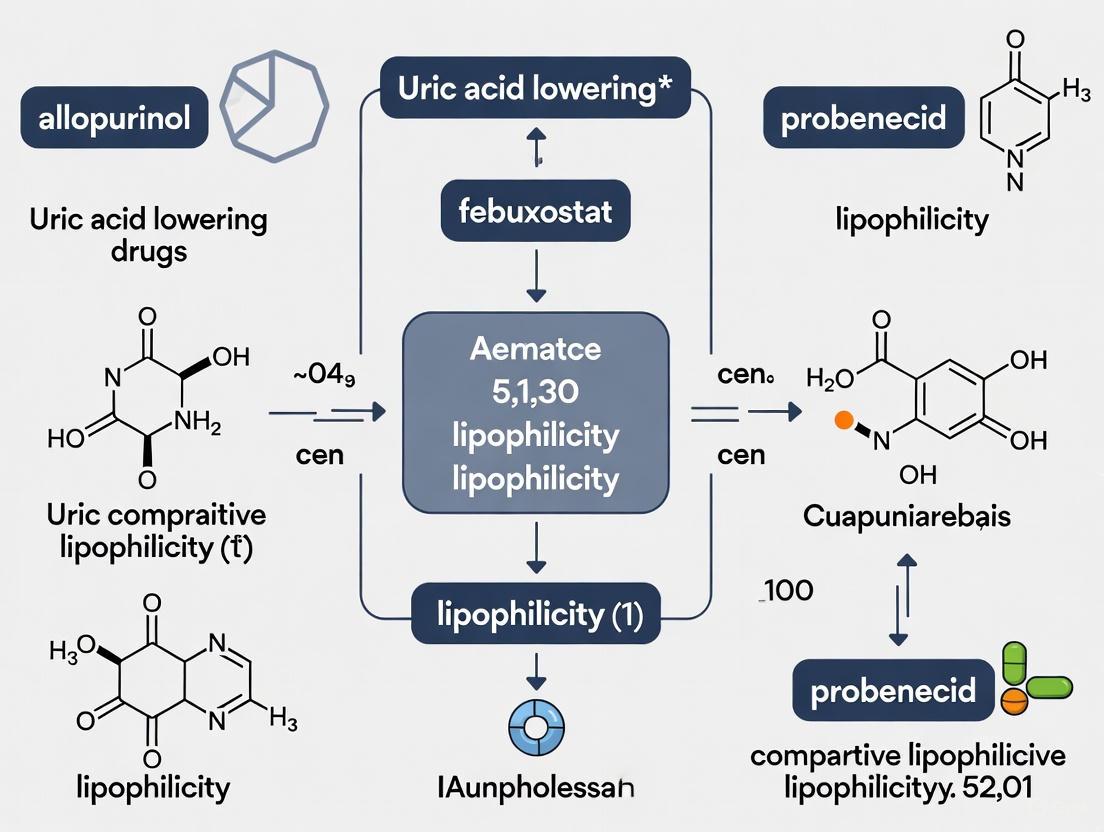
This article provides a comprehensive comparative analysis of the lipophilicity of uric acid-lowering drugs, a critical physicochemical property governing their absorption, distribution, metabolism, elimination, and toxicity (ADMET).
Lipophilicity in Uric Acid Lowering Drugs: A Comparative Analysis for Enhanced Drug Design and Development
Abstract
This article provides a comprehensive comparative analysis of the lipophilicity of uric acid-lowering drugs, a critical physicochemical property governing their absorption, distribution, metabolism, elimination, and toxicity (ADMET). Aimed at researchers and drug development professionals, it explores the foundational role of lipophilicity for xanthine oxidase inhibitors like allopurinol, oxypurinol, and febuxostat. The scope extends to established and experimental methodologies for lipophilicity determination, including reversed-phase chromatographic techniques (RP-TLC/HPTLC) and in silico computational models. It further addresses strategies for optimizing lipophilic efficiency (LipE) to improve drug-like properties and validates these approaches through chemometric analyses and case studies, offering a holistic resource for rational drug design in hyperuricemia and gout treatment.
Lipophilicity Fundamentals: Why It's a Critical Determinant for Uric Acid Drug Efficacy and Safety
Lipophilicity, most frequently quantified as the logarithm of the n-octanol-water partition coefficient (LogP), stands as one of the most critical physicochemical parameters in modern pharmaceutical research [1] [2]. It represents a compound's preference to dissolve in non-polar solvents (like n-octanol) versus water, thereby providing a fundamental measure of molecular hydrophobicity or hydrophilicity. In the context of drug discovery and development, lipophilicity is not merely a chemical descriptor but a pivotal determinant of a compound's behavior within biological systems, directly influencing its absorption, distribution, metabolism, excretion, and toxicity (ADMET) profile [3] [1]. The central role of LogP stems from its profound impact on a drug candidate's ability to traverse lipid bilayer membranes, access intracellular targets, and interact with enzymes and receptors, thereby ultimately dictating its pharmacokinetic fate and therapeutic efficacy.
The importance of lipophilicity is enshrined in seminal drug design principles such as Lipinski's Rule of Five, which stipulates that for a compound to possess likely oral bioavailability, its LogP should not exceed 5 [1] [2]. An optimal LogP range, generally considered to be between 1 and 3, is essential for balancing membrane permeability with adequate aqueous solubility [2]. Excessively high lipophilicity (LogP > 5) is frequently associated with undesirable properties, including poor aqueous solubility, rapid metabolic turnover, pronounced plasma protein binding, and an increased risk of tissue accumulation and toxicity [1]. Consequently, accurate determination and intelligent optimization of lipophilicity are indispensable for the successful development of viable drug candidates, particularly in specialized therapeutic areas such as the treatment of hyperuricemia, where achieving the correct balance of properties is paramount.
Experimental and Computational Methodologies for Determining Lipophilicity
The accurate determination of lipophilicity is achieved through a combination of experimental techniques and computational modeling, each offering distinct advantages and limitations. A comparative overview of these methods is provided below.
Key Experimental Methods
Reversed-Phase Thin-Layer Chromatography (RP-TLC/RP-HPTLC): This method is widely valued for its simplicity, low cost, and high throughput capability, allowing for the simultaneous analysis of multiple compounds [3] [1]. The chromatographic parameter of lipophilicity (RMW) is determined by extrapolating the experimental RM value to zero concentration of the organic modifier in the mobile phase. Common stationary phases include RP18F254, RP18WF254, and RP2F254, with mobile phases often consisting of binary mixtures like ethanol-water, propan-2-ol-water, and acetonitrile-water in varying volume compositions [3] [4]. This technique has been successfully applied to determine the lipophilicity of various bioactive compounds, including uric acid-lowering drugs and anti-androgens, and is particularly useful for compounds lacking experimentally determined LogP values in databases [3].
Shake-Flask Method: Regarded as a benchmark technique, the traditional shake-flask method involves dissolving the compound in a system of n-octanol and water, followed by vigorous shaking to reach partitioning equilibrium [5]. The concentration of the compound in each phase is then measured, typically using high-performance liquid chromatography (HPLC), and the LogP is calculated. A modern, efficient variant of this technique enables the simultaneous measurement of distribution coefficients for mixtures of up to 10 compounds using LC-MS/MS, significantly increasing throughput for drug discovery screening [5].
Computational Prediction of LogP
Advances in in silico methods have provided researchers with a suite of fast and cost-effective tools for LogP prediction. These computational programs utilize diverse mathematical algorithms to estimate lipophilicity based on molecular structure. Commonly used software packages include AClogP, AlogPs, ALOGP, MlogP, XlogP2, XlogP3, ACD/logP, and logPKOWWIN [3] [1]. The SwissADME and VCCLAB servers provide integrated platforms for accessing many of these prediction tools [1]. While these computational methods are invaluable for rapid screening and initial design, their predictions should be validated against experimental data whenever possible to ensure reliability, as different algorithms can yield varying results for the same compound [3].
Table 1: Comparison of Key Methodologies for Lipophilicity Determination
| Method | Key Principle | Advantages | Limitations |
|---|---|---|---|
| RP-TLC/HPTLC | Chromatographic retention in reversed-phase systems | Low cost, high throughput, simultaneous analysis of multiple compounds | Indirect measure; requires calibration and extrapolation |
| Shake-Flask | Direct partitioning between n-octanol and water phases | Considered a gold standard, direct measurement | Lower throughput, more labor-intensive, potential for ion-pair effects in mixtures |
| Computational (in silico) | Algorithmic prediction based on molecular structure | Very fast, inexpensive, no reagents required | Accuracy varies by algorithm; requires experimental validation |
The following diagram illustrates the typical workflow integrating these methodologies in drug research.
Lipophilicity of Uric Acid-Lowering Drugs: A Comparative Case Study
The critical influence of lipophilicity on drug efficacy and safety is powerfully illustrated in the class of uric acid-lowering drugs, particularly xanthine oxidase (XO) inhibitors used to treat hyperuricemia and gout [3] [6]. Gout is a common inflammatory arthritis characterized by hyperuricemia, an excessively high concentration of uric acid in the blood, which can lead to the deposition of monosodium urate crystals in joints and tissues [3] [7]. Xanthine oxidase is the key enzyme responsible for the production of uric acid during purine metabolism, making it a primary therapeutic target [6].
A comparative study of the lipophilicity of selected anti-androgenic and blood uric acid-lowering compounds utilized RP-TLC/HPTLC on three stationary phases (RP18F254, RP18WF254, RP2F254) with different mobile phases to determine experimental lipophilicity parameters (RMW) [3] [4]. This research provided crucial experimental lipophilicity data for several compounds, including febuxostat and oxypurinol (the active metabolite of allopurinol), for which such data were previously lacking or poorly described in available databases [3]. The chromatographically obtained lipophilicity parameters were systematically compared with LogP values calculated using various software packages (AClogP, AlogPs, XlogP2, etc.), revealing that both experimental and calculated values yielded similar results and could be effectively applied to estimate the lipophilicity of these heterocyclic compounds [3] [4].
Table 2: Experimental and Computational Lipophilicity Data for Selected Uric Acid-Lowering and Related Compounds
| Compound Name | Therapeutic Class | Key Experimental Lipophilicity Findings (RMW) | Reported Computational LogP (Example) |
|---|---|---|---|
| Allopurinol | XO Inhibitor | Lipophilicity determined via RP-TLC with multiple mobile phases [3] | LogP ~ -0.5 (calculated) [8] |
| Oxypurinol | XO Inhibitor (Metabolite) | Experimental lipophilicity parameter determined; previously lacking in databases [3] | Information missing from sources |
| Febuxostat | XO Inhibitor | Experimental lipophilicity parameter determined; previously lacking in databases [3] | Information missing from sources |
| Uric Acid | Endogenous Product | Not the primary focus of the comparative study [3] | -1.5 (Chemaxon prediction) [8] |
The lipophilicity of a drug candidate is inextricably linked to its broader ADMET profile, which governs its journey through the body. The following diagram summarizes the central role of LogP in these processes.
The Scientist's Toolkit: Essential Reagents and Materials for Lipophilicity Studies
The experimental determination of lipophilicity, particularly using chromatographic methods, relies on a specific set of reagents and materials. The following table details key solutions and their functions based on the protocols cited in the comparative studies [3] [1].
Table 3: Essential Research Reagents and Materials for Lipophilicity Assessment via RP-TLC
| Reagent/Material | Function in Experiment | Specific Example from Research |
|---|---|---|
| Stationary Phases | Provides the non-polar surface for interaction with analytes. The chemical nature of the phase influences retention. | RP18F254, RP18WF254 (C18-modified silica); RP2F254 (C2-modified silica) [3] |
| Organic Modifiers | Component of the mobile phase that controls its elution strength and selectivity. | Ethanol, Propan-2-ol, Acetonitrile [3] |
| Mobile Phase Systems | The liquid medium that carries the analyte through the stationary phase. Composition is critical for achieving separation. | Binary mixtures like Ethanol-Water, Propan-2-ol-Water, Acetonitrile-Water in varying volume compositions [3] |
| Reference Compounds | Substances with known lipophilicity used to calibrate or validate the chromatographic system. | Used in method development and validation, though specific compounds not listed in sources [3] [5] |
| n-Octanol and Water | The two-phase partitioning system used in the shake-flask method to directly measure the partition coefficient. | Used in the benchmark shake-flask technique [5] |
The LogP parameter remains an indispensable metric in rational drug design, serving as a cornerstone for predicting and optimizing the ADMET properties of new chemical entities. As demonstrated by the comparative research on uric acid-lowering drugs, the integration of robust experimental techniques like RP-TLC/HPTLC with modern in silico prediction tools provides a powerful strategy for obtaining reliable lipophilicity data [3] [4]. This integrated approach is crucial for guiding the structural modification of lead compounds, such as novel xanthine oxidase inhibitors, to achieve a balance between permeability and solubility, thereby enhancing the likelihood of developing successful therapeutic agents [9] [6].
Future directions in lipophilicity research will continue to be shaped by technological advancements. The application of artificial intelligence and more sophisticated machine learning models is poised to further improve the accuracy of LogP predictions [2]. Furthermore, the adoption of high-throughput versions of traditional methods, such as the multi-compound shake-flask technique coupled with LC-MS/MS, will accelerate data generation in early discovery [5]. For complex therapeutic areas like hyperuricemia management, where current treatments like allopurinol and febuxostat can suffer from adverse effects [6], a deepened understanding of the interplay between lipophilicity, target binding, and overall pharmacokinetics will be vital for designing safer and more effective next-generation drugs. The enduring central role of LogP in defining a compound's destiny in the body ensures that its precise determination and intelligent application will remain a fundamental practice in pharmaceutical science for the foreseeable future.
Xanthine oxidase (XO) is a molybdenum-containing metalloenzyme that serves as the critical catalyst in the final steps of purine metabolism in humans [6]. It functions as a homodimer, with each 290 kDa subunit containing a molybdenum pterin center, two iron-sulfur clusters (2Fe–2S), and a flavin adenine dinucleotide (FAD) cofactor [6]. The enzyme sequentially oxidizes hypoxanthine to xanthine and then to uric acid, the end product of human purine catabolism [6] [10]. When serum uric acid levels exceed the limit of solubility (approximately 6.8 mg/dL), a condition known as hyperuricemia develops, creating the pathophysiological foundation for gout [11]. This sustained hyperuricemia leads to deposition of monosodium urate crystals in joints and other tissues, triggering intensely painful inflammatory arthritis flares that characterize gout [12].
Xanthine oxidase inhibitors represent a cornerstone of urate-lowering therapy (ULT) by targeting the enzymatic source of uric acid production [6]. By competitively or non-competitively inhibiting XO, these drugs effectively reduce the synthesis of uric acid, thereby lowering serum urate concentrations and preventing the complications of hyperuricemia [6] [10]. The clinical importance of XO inhibition extends beyond gout management, as elevated XO activity contributes to oxidative stress through generation of reactive oxygen species during the catalytic process, implicating it in various cardiovascular and metabolic disorders [6] [10].
Established Xanthine Oxidase Inhibitors: Mechanism and Kinetics
First-Generation Inhibitor: Allopurinol
Allopurinol, an analog of hypoxanthine, was the first XO inhibitor approved by the FDA in 1966 and remains the most widely prescribed urate-lowering agent globally [6] [13]. As a purine-like inhibitor, allopurinol undergoes metabolism by XO to its active metabolite, oxypurinol, which then rotates within the enzyme's active site and reduces the molybdenum center from Mo(VI) to Mo(IV), effectively inhibiting further urate production [14]. This mechanism involves tight binding to the molybdopterin cofactor, essentially rendering the enzyme temporarily inactive [14].
Despite its long history of use, allopurinol has significant limitations. The drug demonstrates highly variable potency (IC~50~: 0.2–50 μM) and often requires high dosages (800–900 mg/day) to achieve therapeutic effect [6]. Furthermore, it is associated with potentially severe adverse effects, including hypersensitivity reactions that can be life-threatening, particularly in patients carrying the HLA-B*5801 allele [6] [13]. This risk has led to recommendations for genetic testing before initiating allopurinol in patients of Southeast Asian or African American descent, though race alone is considered an imperfect predictor of risk [13].
Recent research has revealed intriguing differences between allopurinol and its active metabolite. Oxypurinol demonstrates weaker inhibition than the parent compound both in vitro and in vivo, and upon reoxidation of the molybdenum center to Mo(VI), oxypurinol binding is significantly weakened [14]. This finding suggests that the common practice of once-daily dosing may result in unnecessarily high allopurinol levels, and that multiple, smaller doses throughout the day might maintain effective enzyme inhibition while reducing total drug exposure [14].
Second-Generation Inhibitors: Febuxostat and Topiroxostat
Febuxostat and topiroxostat represent a class of non-purine, selective XO inhibitors developed to address the limitations of allopurinol [6]. Febuxostat exhibits a mixed-type inhibition mechanism, forming tight bonds with the molybdopterin cofactor of XO and hampering substrate entry into the active site [10]. Topiroxostat displays a hybrid-type inhibition mechanism, forming covalent linkages with the enzyme's active site [10].
Table 1: Pharmacological Comparison of Established Xanthine Oxidase Inhibitors
| Parameter | Allopurinol | Febuxostat | Topiroxostat |
|---|---|---|---|
| Inhibitor Type | Purine analog | Non-purine | Non-purine |
| Mechanism | Metabolized to oxypurinol which reduces Mo-center | Mixed-type inhibition, tight binding | Hybrid-type inhibition, covalent binding |
| IC~50~ Range | 0.2–50 μM [6] | 0.028 μM [6] | Not specified in sources |
| Typical Dosage | 100-800 mg/day [6] [13] | 40-80 mg/day [15] [13] | Not specified in sources |
| Key Adverse Effects | Hypersensitivity reactions, hepatotoxicity [6] | Cardiovascular risks, hepatotoxicity [6] [13] | Not specified in sources |
| Metabolic Pathway | Renal excretion [6] | Hepatic metabolism with renal and intestinal excretion [15] | Not specified in sources |
Clinical studies have demonstrated that febuxostat at 80 mg/day produces a higher percentage of patients achieving target serum urate levels (<6.0 mg/dL) compared to allopurinol at 200-300 mg/day [15]. However, this enhanced efficacy comes with concerns about potential cardiovascular risks, leading to recommendations to avoid febuxostat in patients with history of cardiovascular disease [13]. A network meta-analysis of randomized controlled trials found that febuxostat had the best efficacy and safety profile among available urate-lowering drugs, with febuxostat 120 mg daily being both more effective (OR: 0.17, 95% CI: 0.12–0.24) and safer (OR: 0.72, 95% CI: 0.56–0.91) than allopurinol [11].
Experimental Assessment of XO Inhibition
Standardized Enzyme Inhibition Assays
The determination of xanthine oxidase inhibitory activity follows well-established experimental protocols centered around monitoring the enzyme-catalyzed conversion of xanthine to uric acid [16]. The standard reaction mixture typically consists of XO (0.04 U/mL) and xanthine (0.1 mmol/L) in phosphate buffered solution (PBS, pH 7.4) at 298 K [16]. Test compounds are dissolved in DMSO and appropriately diluted before addition to the reaction system.
Enzyme activity is determined by measuring the increase in absorbance at 290 nm corresponding to uric acid formation using a UV spectrometer, with readings typically taken every 60 seconds [16]. The relative activity (RA) of XO is calculated as RA (%) = R~i~/R~c~ × 100%, where R~i~ and R~c~ represent the reaction rates with and without inhibitors, respectively [16]. The IC~50~ value (concentration required for 50% enzyme inhibition) is then determined from the plot of RA versus inhibitor concentration.
For kinetic characterization of inhibition mechanism, researchers determine reaction rates at various concentrations of both inhibitor and substrate (xanthine, typically ranging from 6.25 to 50 μmol/L) [16]. Analysis using Lineweaver-Burk plots and secondary plots of slope versus inhibitor concentration allows determination of inhibition constants K~i~ and K~is~, which represent the inhibitor's binding affinity with free enzyme and enzyme-substrate complex, respectively [16].
Diagram 1: Xanthine Oxidase Inhibition Mechanism. This diagram illustrates the competitive inhibition process where inhibitors bind to the enzyme's active site, preventing substrate conversion.
Advanced Analytical Techniques
Beyond basic enzymatic assays, advanced biophysical and computational methods provide deeper insights into inhibition mechanisms. Fluorescence quenching experiments analyze the interaction between inhibitors and XO by measuring changes in protein fluorescence upon ligand binding [16]. These studies can determine binding constants and thermodynamic parameters, establishing whether complex formation is spontaneous and exothermic [16].
Molecular docking simulations utilize crystal structures of XO (e.g., PDB ID: 1FIQ or 1N5X) to predict binding modes and interactions at atomic resolution [16] [10]. Standard protocols involve preparing protein structures through optimization of hydrogen bonding networks and generating ligand conformations at physiological pH [10]. Docking grids typically encompass the entire XO catalytic center (90×90×120 Å) with flexible ligand sampling to identify optimal binding conformations [10].
Table 2: Key Reagents and Materials for XO Inhibition Studies
| Research Reagent | Specification/Source | Experimental Function |
|---|---|---|
| Xanthine Oxidase | Bovine milk, 0.5-35.7 U/mL [16] [10] | Enzyme source for inhibition assays |
| Xanthine | >99.5% purity [16] | Natural substrate for activity measurement |
| Allopurinol | Pharmaceutical reference standard [16] | Positive control inhibitor |
| Febuxostat | Pharmaceutical reference standard [15] | Positive control inhibitor |
| Ellagic Acid | >98.0% purity [16] | Natural product inhibitor reference |
| Dimethyl Sulfoxide (DMSO) | Analytical grade [16] | Solvent for test compounds |
| Phosphate Buffered Saline (PBS) | 0.2 mol/L, pH 7.4 [16] | Reaction buffer for enzymatic assays |
Emerging and Investigational XO Inhibitors
Novel Synthetic Compounds
Recent drug discovery efforts have identified promising non-purine XO inhibitors with diverse structural scaffolds. A virtual screening study identified four competitive inhibitors (ALS-1, -8, -15, and -28) with K~i~ values ranging from 2.7 to 41 μM [10]. The most potent compound, ALS-28 (K~i~ 2.7 ± 1.5 μM), obstructs the cavity channel for substrate entry, consistent with a competitive inhibition mechanism [10]. Docking studies revealed that these structurally unrelated compounds occupy the enzyme active site while lacking the purine-like structure of allopurinol, potentially offering improved selectivity and reduced side effects [10].
Chalcone derivatives have demonstrated exceptional potency, with compounds 1 and 2 exhibiting IC~50~ values of 0.102 and 0.064 μM respectively, surpassing allopurinol (IC~50~ 2.588 μM) and approaching the potency of febuxostat (IC~50~ 0.028 μM) [6]. Molecular docking of these chalcone derivatives revealed formation of hydrogen bonds between carboxyl and hydroxyl groups with key amino acid residues Arg880, Thr1010, and Glu802 in the XO active site [6]. In vivo studies demonstrated that compound 1 at 40 mg/kg showed efficacy comparable to allopurinol without causing liver or kidney impairment in the short term [6].
Benzaldehyde thiosemicarbazone derivatives represent another promising class, with compound 3 ((E)-2-(3,4-dihydroxy-5-nitrobenzylidene)-N-phenylhydrazine-1-carbothioamide) exhibiting remarkable potency in the nanomolar range (IC~50~ 0.0437 μM) [6]. This activity represents a 734-fold improvement over its analog DHNB and 173-fold greater potency than allopurinol [6]. The compound demonstrated a mixed competitive inhibition effect on XO and significantly reduced uric acid concentrations in animal models at moderate doses without acute toxicity [6].
Natural Product-Derived Inhibitors
Natural products continue to provide inspiration for new XO inhibitor designs. Ellagic acid, a natural polyphenol found in strawberries, raspberries, pomegranates, and walnuts, has demonstrated XO inhibitory activity, though reported IC~50~ values vary considerably across studies (3.1 to 165.6 μmol/L) [16]. Detailed kinetic studies have established that ellagic acid acts as a reversible mixed-type inhibitor, entering the XO catalytic center and forming a spontaneous complex with the enzyme [16]. In vivo verification using hyperuricemic mouse models has confirmed the anti-hyperuricemia effect of this natural compound [16].
Diagram 2: XO Inhibitor Discovery Workflow. This diagram outlines the multi-stage process from initial compound identification to mechanistic validation employed in developing novel xanthine oxidase inhibitors.
Comparative Clinical Efficacy and Combination Approaches
Head-to-Head Clinical Comparisons
Direct comparisons of XO inhibitors in clinical settings have provided valuable insights for treatment selection. A comprehensive meta-analysis of 11 randomized controlled trials demonstrated that febuxostat at 80 mg/day resulted in a higher percentage of patients achieving target serum urate levels (<6.0 mg/dL) compared to allopurinol at 200-300 mg/day (RR=1.79, 95% CI: 1.55-2.08, P<0.00001) [15]. However, no statistically significant difference was observed between febuxostat 40 mg/day and allopurinol 200-300 mg/day (RR=1.10, 95% CI: 0.93-1.31, P=0.25) [15].
Importantly, despite superior urate-lowering efficacy, febuxostat 80 mg/day did not demonstrate better performance in reducing gout flare incidence compared to allopurinol (RR=1.13, 95% CI: 0.81-1.58, P=0.48) [15]. This highlights the complex relationship between serum urate reduction and clinical outcomes, potentially reflecting the paradoxical increase in flare risk during initial treatment phases due to mobilization of urate crystal deposits [12].
Safety analyses revealed no statistically significant differences in major adverse reactions between febuxostat 40 mg/day and allopurinol (RR=1.16, 95% CI: 0.43-3.16, P=0.77) or between febuxostat 80 mg/day and allopurinol (RR=1.06, 95% CI: 0.79-1.42, P=0.70) [15]. Similarly, cardiovascular event rates did not differ significantly between these treatment groups, though numerical trends toward increased cardiovascular risk with febuxostat 80 mg/day were observed (RR=1.79, 95% CI: 0.74-4.32, P=0.20) [15].
Combination Therapy Strategies
For patients failing to achieve target serum urate levels with XO inhibitor monotherapy, combination approaches incorporating uricosuric agents offer enhanced urate-lowering efficacy [17]. Evidence from studies spanning the 1960s to recent well-designed clinical trials consistently demonstrates that combining a uricosuric (e.g., benzbromarone, probenecid, lesinurad) with an XOI provides substantially greater serum urate reduction than either monotherapy approach [17].
The combined use of lesinurad with allopurinol or febuxostat represents the most extensively studied modern combination regimen, with phase III clinical trials demonstrating significantly improved target achievement rates compared to XOI monotherapy [17]. This combination approach leverages complementary mechanisms—reducing uric acid production while enhancing renal excretion—to overcome the physiological limitations of single-mechanism interventions [17].
Recent proteomic analyses have shed light on additional benefits of effective XOI therapy, demonstrating that 48 weeks of treat-to-target urate-lowering therapy remodels inflammatory networks in gout patients, affecting complement activation and other inflammatory pathways [12]. These findings suggest that XO inhibitors may exert anti-inflammatory effects beyond urate reduction, potentially contributing to long-term reduction in gout flare frequency independent of crystal clearance [12].
Xanthine oxidase inhibitors remain fundamental to the management of hyperuricemia and gout, with allopurinol continuing as first-line therapy despite the introduction of newer agents. The development of febuxostat and topiroxostat has provided alternatives for patients unresponsive or intolerant to allopurinol, though cardiovascular safety concerns warrant careful patient selection. Emerging synthetic compounds show remarkable potency improvements over existing therapies, while natural product-derived inhibitors offer templates for novel drug designs.
Future directions in XO inhibitor development include structure-based drug design leveraging advanced computational methods, optimization of combination therapies with uricosuric agents, and exploration of the anti-inflammatory potential of XO inhibition beyond urate lowering. The ongoing elucidation of the relationships between urate reduction, inflammatory pathway modulation, and clinical outcomes will continue to refine targeted therapeutic approaches for gout and hyperuricemia, ultimately improving patient care in these prevalent metabolic conditions.
1 Introduction
Uric acid-lowering therapy is the cornerstone of long-term gout management, aiming to dissolve monosodium urate crystals and prevent flares and tophi formation [18]. The structural diversity of these therapeutic compounds is a critical determinant of their mechanism of action, efficacy, and safety profile. Existing medications primarily fall into two mechanistic classes: xanthine oxidase inhibitors (XOIs), which reduce uric acid production, and uricosuric agents (e.g., URAT1 inhibitors), which enhance its renal excretion [19] [20]. Lipophilicity, a key physicochemical property, significantly influences a drug's absorption, distribution, metabolism, and toxicity [3]. This guide provides a comparative analysis of established and emerging uric acid-lowering agents, focusing on their structural classes, quantitative lipophilicity, and supporting experimental data, to inform researchers and drug development professionals.
2 Established Uric Acid-Lowering Drug Classes
2.1 Xanthine Oxidase Inhibitors (XOIs)
Xanthine oxidase (XO) is a key enzyme in uric acid production, catalyzing the oxidation of hypoxanthine to xanthine and then to uric acid [21]. XOIs are a first-line urate-lowering therapy.
- Allopurinol and Oxypurinol: Allopurinol, a purine analogue, and its active metabolite oxypurinol, inhibit XO by competing with its natural substrates [22]. They are considered hydrophilic compounds, with an experimental chromatographic lipophilicity parameter (RMW) of 0.32 for allopurinol and 0.16 for oxypurinol [3].
- Febuxostat: As a non-purine inhibitor, febuxostat inhibits both oxidized and reduced forms of XO and is often used when allopurinol is contraindicated [22]. It is significantly more lipophilic, with an RMW value of 1.83 [3].
2.2 Uricosuric Agents (URAT1 Inhibitors)
Uricosuric agents target urate transporter 1 (URAT1) on the apical membrane of renal proximal tubule cells, blocking uric acid reabsorption and promoting its excretion [19]. Over 90% of hyperuricemia cases involve under-excretion of uric acid, making URAT1 a key therapeutic target [19].
- Benzbromarone: A potent URAT1 inhibitor, benzbromarone has been associated with a risk of fatal fulminant hepatitis, limiting its use [23] [20].
- Lesinurad: This previously approved URAT1 inhibitor carried a black-box warning for severe nephrotoxicity and is no longer commercially available [23] [20].
Table 1: Established Uric Acid-Lowering Medications
| Drug Name | Mechanistic Class | Key Structural Features | Reported Lipophilicity (RMW) [3] | Clinical Efficacy (SUA Reduction) | Notable Safety Concerns |
|---|---|---|---|---|---|
| Allopurinol | XO Inhibitor | Purine analogue | 0.32 | Effective in long-term management [24] | Severe cutaneous adverse reactions (SCARs), associated with HLA-B*5801 allele [22] |
| Oxypurinol | XO Inhibitor | Metabolite of allopurinol | 0.16 | Contributes to allopurinol's efficacy | Same as allopurinol |
| Febuxostat | XO Inhibitor | Non-purine, thiazolecarboxamide | 1.83 | Most effective for SUC reduction (120 mg dose) [24] | Cardiovascular risks [21] |
| Benzbromarone | URAT1 Inhibitor | Benzofuran derivative | Information Missing | Effective uricosuric | Fulminant hepatitis [20] |
| Lesinurad | URAT1 Inhibitor | Triazole derivative | Information Missing | Effective uricosuric | Nephrotoxicity [23] |
3 Emerging Compounds and Novel Strategies
Current research focuses on overcoming the limitations of existing drugs by developing safer, multi-target agents.
3.1 Natural Product-Inspired Dual-Target Agents
A promising strategy is the development of single molecules that simultaneously lower uric acid and exert anti-inflammatory effects [23] [20]. Inspired by the natural product β-carboline-1-propionic acid from Eurycoma longifolia Jack, researchers have designed and synthesized a series of derivatives [20]. Compound 32, a leading candidate, demonstrated:
- Uric Acid-Lowering: Potent activity in hyperuricemic mouse models, with efficacy comparable to febuxostat and superior to lesinurad and benzbromarone, achieved by inhibiting key urate transporters [20].
- Anti-Inflammatory Action: Mitigation of NLRP3 inflammasome-mediated inflammation in a rat model of acute gouty arthritis [20].
- Enhanced Safety Profile: Showed improved safety compared to control drugs in preclinical assessments [20].
3.2 Food-Derived Xanthine Oxidase Inhibitors
There is growing interest in food-derived compounds as potentially safer, alternative XO inhibitors [21]. An integrated machine learning and molecular dynamics workflow identified several promising candidates:
- Luteolin-7-glucuronide, 5,4′-Dihydroxyflavone, and Uralenol: These compounds showed stable binding to XO in simulations and demonstrated XO inhibition in vitro with IC₅₀ values of 26.15, 39.06, and 34.64 µM, respectively, and negligible cytotoxicity [21].
3.3 The Expanding Landscape of URAT1 Inhibitors
Patent analytics reveal highly active global research into novel URAT1 inhibitors [19]. Molecular docking of 1,056 patented novel compounds showed ideal binding affinities, and scaffold diversity analysis identified core structures distinct from marketed drugs, indicating significant potential for new drug development [19].
Table 2: Emerging Uric Acid-Lowering Compounds
| Compound / Class | Source / Strategy | Mechanism of Action | Reported Experimental Efficacy | Key Advantage |
|---|---|---|---|---|
| Compound 32 | Natural product derivative | Dual URAT1 inhibition & NLRP3 inflammasome inhibition [20] | Superior to lesinurad & benzbromarone in mice; reduces inflammation in rats [20] | Integrated urate-lowering and anti-inflammatory activity; enhanced safety [20] |
| Food-Derived Flavonoids | Medicine-food homology | Xanthine Oxidase Inhibition [21] | IC₅₀ values of 26-40 µM in vitro [21] | Abundant sources; anticipated low toxicity and high tolerability [21] |
| Novel URAT1 Inhibitors | Patent-based drug design | URAT1 Inhibition [19] | High binding affinity in molecular docking studies [19] | Structural novelty; potential for improved safety and efficacy over existing uricosurics [19] |
4 Experimental Methodologies for Comparison
4.1 Determining Lipophilicity via Reversed-Phase Chromatography
Lipophilicity is a crucial parameter in drug design. The reversed-phase thin-layer chromatography (RP-TLC/HPTLC) method provides an experimental measure [3].
- Methodology: Compounds are analyzed on stationary phases (e.g., RP18F254, RP2F254) using mobile phases of ethanol-water, propan-2-ol-water, or acetonitrile-water in varying compositions. The RM value is determined for each mobile phase composition [3].
- Data Analysis: The chromatographic lipophilicity parameter (RMW) is calculated by extrapolating the RM value to zero concentration of the organic modifier. This experimental RMW can be compared with various software-calculated logP values (e.g., AClogP, XlogP3) [3].
4.2 Virtual Screening and Binding Affinity Assessment
Computational methods are vital for prioritizing candidate compounds.
- Machine Learning (ML): Classifiers trained on known active and inactive compounds can screen large libraries. For instance, a topological-torsion Random Forest model achieved high precision in identifying XO inhibitors [21].
- Molecular Docking: This technique predicts the binding orientation and affinity of a small molecule within a protein's binding site (e.g., URAT1 or XO). Software like AutoDock Vina is used to compute binding scores, with lower (more negative) values indicating stronger binding [19].
- Molecular Dynamics (MD) Simulations: Following docking, MD simulations (e.g., 200-ns runs) assess the stability of the protein-ligand complex under near-physiological conditions. Stable complexes with low root-mean-square deviation (RMSD) fluctuations support a promising binding profile [21].
4.3 In Vivo Phenotypic Screening
For holistic assessment, compounds are tested in animal models of hyperuricemia or gout.
- Acute Hyperuricemic Mouse Model: Mice are administered a uricase inhibitor (e.g., potassium oxonate) to induce hyperuricemia. Test compounds are administered, and serum uric acid (SUA) levels are measured to determine the uric acid-lowering effect (often reported as a decrease ratio, DR%) [20].
- Acute Gouty Arthritis Rat Model: Monosodium urate (MSU) crystals are injected into the joint to induce inflammation. The anti-inflammatory effect of a candidate drug is evaluated by measuring reduction in joint swelling and inflammatory markers [20].
The following diagram illustrates the multi-target mechanism of emerging agents and the experimental workflow for their evaluation.
Multi-Target Inhibition in Gout Management
5 The Scientist's Toolkit: Key Research Reagents and Solutions
Table 3: Essential Reagents for Uric Acid-Lowering Compound Research
| Reagent / Solution | Function in Research |
|---|---|
| RP-TLC/HPTLC Plates (e.g., RP18F254, RP2F254) | Stationary phase for experimental determination of chromatographic lipophilicity (RMW) [3]. |
| Xanthine Oxidase Enzyme | Target protein for in vitro inhibition assays to determine IC₅₀ values of potential inhibitors [21]. |
| URAT1 Transfected Cell Lines | Cellular models (e.g., HEK293T cells expressing hURAT1) for evaluating compound activity on urate transport [20]. |
| Potassium Oxonate | Uricase inhibitor used to induce hyperuricemia in mouse models for phenotypic screening [20]. |
| Monosodium Urate (MSU) Crystals | Used to induce acute gouty arthritis in rodent models for testing anti-inflammatory efficacy [20]. |
| Molecular Docking Software (e.g., AutoDock Vina) | Computational tool for predicting binding affinity and pose of compounds against target proteins like URAT1 or XO [19]. |
| Molecular Dynamics Software (e.g., GROMACS) | For simulating the dynamic behavior and stability of protein-ligand complexes over time [21]. |
6 Conclusion
The landscape of uric acid-lowering compounds is evolving from single-target, established drugs towards structurally diverse, multi-target, and often natural product-inspired agents. Established drugs like allopurinol and febuxostat show clear differences in lipophilicity that correlate with their chemical class. Emerging strategies focus on addressing the dual pathophysiology of gout by combining urate-lowering with anti-inflammatory action in a single molecule, as exemplified by Compound 32. Furthermore, computational approaches and patent mining are accelerating the discovery of novel scaffolds, particularly for URAT1 inhibition. The continued application of robust experimental protocols for assessing lipophilicity, binding affinity, and efficacy in disease models is essential for translating this structural diversity into safer and more effective gout therapies.
Lipophilicity, often quantified as the partition coefficient (LogP), is a fundamental physicochemical property that measures a molecule's affinity for a lipophilic environment over an aqueous one [25]. It represents the equilibrium concentration of a compound between two immiscible phases, typically n-octanol and water [25]. This parameter profoundly influences a drug's absorption, distribution, metabolism, and excretion (ADME) profile, thereby bridging its physicochemical characteristics with its pharmacological behavior in the body [25] [26]. For drug development professionals, understanding and optimizing lipophilicity is crucial for designing effective therapeutic agents with desirable pharmacokinetic properties [26].
The significance of lipophilicity extends across the entire drug discovery pipeline. It affects a compound's ability to permeate biological membranes, interact with target receptors, and avoid metabolic degradation [25] [26]. While increased lipophilicity generally enhances membrane permeability, excessive lipophilicity can impair aqueous solubility and lead to undesirable outcomes like promiscuous binding and toxicity [25] [26]. This review provides a comprehensive comparison of experimental and computational approaches for lipophilicity assessment, with specific application to uric acid-lowering therapeutics, offering researchers a practical framework for optimizing this critical molecular descriptor.
Fundamental Concepts and Biological Implications
The Lipophilicity Parameter (LogP/LogD)
The partition coefficient (LogP) describes the ratio of a compound's concentration in an organic phase (typically n-octanol) to its concentration in an aqueous phase at equilibrium, expressed logarithmically [25]. For ionizable compounds, the distribution coefficient (LogD) provides a more physiologically relevant measure as it accounts for the compound's ionization state at a specific pH [25]. These parameters serve as key indicators of a molecule's hydrophobic/hydrophilic balance, directly influencing its behavior in biological systems.
Lipophilicity in ADME Profiling
The influence of lipophilicity on pharmacokinetic properties is multifaceted and follows well-established relationships in drug disposition [25] [26]:
Absorption: Lipophilicity governs passive diffusion across biological membranes, including the gastrointestinal epithelium. Optimal LogP values (typically 1-3) enhance cellular permeability while maintaining sufficient solubility for dissolution [25] [26].
Distribution: Higher lipophilicity increases volume of distribution, tissue penetration, and potential for blood-brain barrier crossing. It also promotes plasma protein binding, which can reduce free drug concentrations [26].
Metabolism: Lipophilic compounds are more susceptible to cytochrome P450-mediated oxidation, potentially leading to faster clearance and shorter half-lives [26].
Excretion: Highly lipophilic compounds undergo extensive reabsorption in the kidneys, prolonging their elimination half-life [26].
The relationship between lipophilicity and key drug properties follows a parabolic pattern, where both excessively low and high values can compromise drug-like characteristics. This understanding informs the implementation of design rules such as Lipinski's Rule of Five, which recommends LogP values <5 for optimal oral bioavailability [26].
Table 1: Impact of Lipophilicity on Drug Properties
| Property | Low Lipophilicity | High Lipophilicity | Optimal Range |
|---|---|---|---|
| Solubility | High aqueous solubility | Poor aqueous solubility | Balanced |
| Permeability | Limited membrane penetration | Enhanced membrane penetration | Adequate for absorption |
| Metabolic Clearance | Reduced metabolism | Increased metabolic susceptibility | Moderate half-life |
| Tissue Distribution | Limited volume of distribution | Extensive tissue distribution | Target-specific |
| Protein Binding | Low plasma protein binding | High plasma protein binding | Moderate free fraction |
Methodological Approaches for Lipophilicity Assessment
Experimental Determination Methods
Chromatographic Techniques
Reversed-phase thin-layer chromatography (RP-TLC) and reversed-phase high-performance thin-layer chromatography (RP-HPTLC) provide efficient, low-cost approaches for experimental lipophilicity determination [27]. These methods utilize hydrophobic stationary phases (RP-18, RP-8, or RP-2) with binary mobile phases containing water and organic modifiers such as acetone, acetonitrile, methanol, or 1,4-dioxane [27] [28].
The fundamental protocol involves:
- Stationary Phase Selection: RP-18F254, RP-18WF254, or RP-2F254 plates [27]
- Mobile Phase Preparation: Binary mixtures with varying ratios of organic modifier and water (e.g., ethanol-water, propan-2-ol-water, acetonitrile-water) [27]
- Chromatographic Development: Samples applied to plates and developed in ascending mode [27]
- Retardation Factor (Rf) Measurement: Distance traveled by compound divided by distance traveled by solvent front [27]
- Lipophilicity Parameter Calculation: Rf values converted to RM values using the equation RM = log(1/Rf - 1) [27]
- Extrapolation: RM values plotted against organic modifier concentration to determine RMW (lipophilicity index) by extrapolation to zero organic modifier [27]
This methodology has been successfully applied to diverse compound classes, including uric acid-lowering drugs (allopurinol, oxypurinol, febuxostat) and anti-androgen medications (bicalutamide, flutamide, nilutamide) [27].
Shake-Flask Method
The traditional shake-flask method represents the gold standard for LogP determination, involving direct measurement of compound distribution between n-octanol and aqueous buffer phases [25]. While highly accurate, this approach is time-consuming and requires relatively large amounts of purified compound, making it less suitable for high-throughput screening in early discovery stages [25].
Computational Prediction Approaches
In silico methods offer rapid lipophilicity estimation for virtual compounds and high-throughput screening [27] [25]. Multiple software packages employ different algorithms for LogP prediction:
- AClogP: Atom-based contribution method [27]
- AlogPs: Neural network-based approach trained on experimental data [27]
- XLOGP2/XLOGP3: Atomic contribution method with correction factors [27]
- MLOGP: Moriguchi LogP based on linear regression with topological parameters [27]
- ILOGP: Inductive logic programming method [1]
These computational tools enable rapid screening of compound libraries and structural modifications during lead optimization phases [27] [25]. However, prediction accuracy varies across chemical classes, necessitating experimental validation for critical compounds [27].
Table 2: Comparison of Lipophilicity Determination Methods
| Method | Principle | Throughput | Cost | Key Applications |
|---|---|---|---|---|
| Shake-Flask | Direct partitioning between n-octanol/water | Low | High | Reference method for validation |
| RP-TLC/RP-HPTLC | Chromatographic retention on hydrophobic stationary phases | Medium | Low | Early screening of compound series |
| Computational Programs | Algorithm-based prediction from molecular structure | Very High | Low | Virtual screening, design phase |
Comparative Lipophilicity of Uric Acid-Lowering Drugs
Experimental Lipophilicity Assessment
Comprehensive lipophilicity assessment of uric acid-lowering drugs reveals significant differences between compounds within this therapeutic class [27]. Chromatographic studies employing RP-TLC/RP-HPTLC methodologies have generated experimental lipophilicity parameters (RMW) for key xanthine oxidase inhibitors:
Table 3: Experimental Lipophilicity Parameters of Uric Acid-Lowering Drugs [27]
| Compound | Stationary Phase | Mobile Phase | RMW Value | Relative Lipophilicity Rank |
|---|---|---|---|---|
| Febuxostat | RP-18F254 | Acetonitrile-water | 2.42 | High |
| Allopurinol | RP-2F254 | Ethanol-water | 0.15 | Low |
| Oxypurinol | RP-18WF254 | Propan-2-ol-water | -0.87 | Very Low |
The data demonstrates substantial lipophilicity variation within this drug class. Febuxostat exhibits significantly higher lipophilicity compared to allopurinol and its metabolite oxypurinol [27]. These differences correlate with their distinct pharmacokinetic profiles, including absorption characteristics, distribution patterns, and elimination pathways.
Computational Predictions and Correlation
Theoretical LogP values for uric acid-lowering compounds calculated using various software packages show reasonable agreement with experimental results, though algorithm-dependent variations exist [27]. Comparative analysis of eight different computational methods (AClogP, AlogPs, AlogP, MlogP, XlogP2, XlogP3, ACD/logP, logPKOWWIN) confirms the consistent lipophilicity ranking: febuxostat > allopurinol > oxypurinol [27].
Chemometric approaches, including principal component analysis (PCA) and cluster analysis (CA), have been applied to evaluate the similarity and differences between experimental and computational lipophilicity descriptors [27]. These multivariate analyses facilitate method comparison and highlight the most reliable computational approaches for specific chemical classes [27].
Lipophilicity Optimization Strategies in Drug Design
Structural Modification Approaches
Medicinal chemists employ various strategies to optimize lipophilicity during lead optimization [26]:
- Bioisosteric Replacement: Substituting hydrophobic groups with isosteres having improved polarity (e.g., replacing phenyl with pyridine) [26]
- Alkyl Chain Modification: Shortening, branching, or introducing heteroatoms in aliphatic chains [26]
- Polar Group Incorporation: Adding hydrogen bond donors/acceptors to reduce excessive lipophilicity [26]
- Ring System Variation: Modifying aromatic ring number, size, or heteroatom content [26]
These structural adjustments aim to achieve an optimal lipophilicity range (typically LogP 1-3) that balances membrane permeability with aqueous solubility [26].
Formulation Strategies for Problematic Compounds
For compounds with suboptimal lipophilicity profiles, formulation approaches can mitigate bioavailability challenges [26]:
- Lipid-Based Drug Delivery Systems (LBDDS): Improving solubility and absorption of highly lipophilic compounds [26]
- Nanoemulsions and Nanocrystals: Enhancing dissolution rates for poorly soluble drugs [26]
- Prodrug Design: Temporarily modifying lipophilicity to improve absorption [26]
- Amorphous Solid Dispersions: Stabilizing high-energy forms with enhanced solubility [26]
These enabling formulations expand the developability space for compounds with less-than-ideal lipophilicity characteristics [26].
Experimental Protocols for Lipophilicity Assessment
Detailed RP-TLC Protocol for Lipophilicity Screening
The following standardized protocol enables reliable determination of chromatographic lipophilicity parameters [27]:
Materials and Equipment:
- HPTLC plates: RP-18F254, RP-18WF254, and RP-2F254 (10 × 20 cm)
- Organic modifiers: HPLC-grade ethanol, propan-2-ol, acetonitrile, acetone, 1,4-dioxane
- Water: Ultrapure deionized water
- Sample solutions: 1 mg/mL in appropriate solvent (e.g., chloroform, methanol)
- Application device: Semi-automatic applicator with 5 μL capillary
- Chromatographic chamber: Twin-through glass chamber, saturation pad
- Detection system: UV lamp (254 nm) or appropriate visualization reagent
Procedure:
- Mobile Phase Preparation: Prepare binary mixtures of organic modifier and water in varying volume compositions (e.g., 40:60, 50:50, 60:40, 70:30, 80:20 organic:water)
- Sample Application: Apply 5 μL of sample solution as spots 10 mm from bottom edge of plate
- Chromatographic Development: Develop plates in saturated chambers with mobile phase ascent distance of 80 mm
- Detection: Visualize spots under UV light (254 nm) or using appropriate detection reagent
- Rf Measurement: Precisely measure distance traveled by each spot and solvent front
- Data Processing: Calculate RM values for each mobile phase composition: RM = log(1/Rf - 1)
- Linear Regression: Plot RM values against organic modifier concentration (C)
- Lipophilicity Parameter Determination: Obtain RMW (y-intercept) and slope (b) from regression equation: RM = RMW + bC
Validation:
- Include reference compounds with known LogP values to validate method performance
- Perform triplicate determinations to ensure reproducibility
- Calculate correlation statistics (r² > 0.95 typically indicates acceptable linearity)
Method Selection Guidelines
The optimal lipophilicity assessment strategy depends on the development stage and available resources [27] [25]:
- Early Discovery/Virtual Screening: Computational methods (multiple algorithms recommended)
- Hit-to-Lead/Lead Optimization: RP-TLC/RP-HPTLC for experimental verification
- Candidate Selection/Preclinical Development: Shake-flask validation for critical compounds
Research Reagent Solutions for Lipophilicity Studies
Table 4: Essential Research Reagents for Lipophilicity Assessment
| Reagent/Category | Specific Examples | Function in Lipophilicity Studies |
|---|---|---|
| Stationary Phases | RP-18F254, RP-8F254, RP-2F254 plates | Hydrophobic surfaces for reversed-phase chromatography separation |
| Organic Modifiers | Acetonitrile, methanol, ethanol, 1,4-dioxane, acetone | Mobile phase components that modulate retention behavior |
| Computational Tools | ALOGPs, AClogP, XLOGP3, MLOGP, SwissADME | In silico prediction of partition coefficients from molecular structure |
| Reference Compounds | Compounds with known LogP values (e.g., caffeine, hydrocortisone) | Method validation and standardization |
| Partitioning Solvents | n-Octanol, buffer solutions at physiological pH | Direct measurement of partition coefficients in shake-flask method |
Lipophilicity represents a critical molecular descriptor that fundamentally connects physicochemical properties with pharmacological behavior. The comparative analysis of uric acid-lowering drugs demonstrates how systematic lipophilicity assessment, employing both chromatographic and computational methods, provides valuable insights for rational drug design. As drug discovery increasingly addresses challenging targets requiring specific physicochemical profiles, the intelligent optimization of lipophilicity will continue to play a central role in developing successful therapeutic agents. The methodologies and comparative data presented herein offer researchers a practical framework for incorporating lipophilicity considerations throughout the drug development process.
Lipophilicity Optimization Workflow
Lipophilicity Impact on Pharmacokinetics
Bench to Browser: Experimental and Computational Methods for Profiling Drug Lipophilicity
In modern drug discovery and development, lipophilicity stands as one of the most critical physicochemical properties, profoundly influencing a compound's absorption, distribution, metabolism, elimination, and toxicity (ADMET) profile [3]. Lipophilicity is typically quantified through the partition coefficient (logP), representing the ratio of a compound's concentration in octanol to its concentration in water at equilibrium. Traditionally determined using the shake-flask method, this approach has increasingly been supplemented by chromatographic techniques that offer enhanced precision, throughput, and cost-effectiveness [3]. Among these, reversed-phase thin-layer chromatography (RP-TLC) and reversed-phase high-performance thin-layer chromatography (RP-HPTLC) have emerged as powerful tools for determining the experimental lipophilicity parameter known as RMW [3].
The parameter RMW is a chromatographically-derived lipophilicity index calculated by extrapolating experimental RM values to zero concentration of organic modifier in the mobile phase, following the Wachtmeister–Soczewiński methodology [3]. This approach has proven particularly valuable for studying heterocyclic compounds with pharmaceutical relevance, including uric acid-lowering drugs and anti-androgenic agents, where understanding lipophilicity is crucial for optimizing therapeutic efficacy [3] [4]. The flexibility of RP-TLC and RP-HPTLC systems allows researchers to analyze numerous compounds simultaneously under consistent conditions, providing reliable lipophilicity data that correlates well with both calculated logP values and biological activity [3].
Fundamental Principles of RP-TLC and RP-HPTLC
Core Technological Differences
RP-TLC and RP-HPTLC share the same fundamental principle of separating compounds based on their differential partitioning between a stationary phase and a mobile phase. However, HPTLC represents an advanced evolution of conventional TLC, offering enhanced performance through several key improvements [29]. HPTLC plates are coated with finer particle sizes (typically 5-7 μm compared to 10-12 μm in TLC), which significantly improves resolution and separation efficiency. The sorbent layer is also more homogeneous and thinner, typically 100-200 μm compared to 200-250 μm for conventional TLC plates [29]. These improvements allow for better resolution, lower limits of detection, and more precise quantitative analysis compared to standard TLC [29].
The reversed-phase mechanism in both techniques involves a non-polar stationary phase and a polar mobile phase, opposite to normal-phase chromatography. Compounds separate based on their relative affinity for these phases, with more lipophilic substances exhibiting stronger retention on the stationary phase and less migration, while hydrophilic compounds move more readily with the mobile phase [3] [30]. This separation mechanism directly correlates with lipophilicity, making it ideal for RMW determination. The planar, open-bed configuration of both TLC and HPTLC provides unique advantages over column-based chromatographic methods, including simultaneous analysis of multiple samples and the ability to employ multiple detection methods on the same separation [30].
The RMW Lipophilicity Parameter
The chromatographic parameter RMW serves as an experimental measure of lipophilicity derived from the relationship between the RM value and the concentration of organic modifier in the mobile phase [3]. The RM value is calculated using the formula: RM = log(1/RF - 1), where RF represents the retention factor measuring how far a compound migrates relative to the solvent front [3]. By developing chromatograms with mobile phases containing different concentrations of organic modifier (e.g., methanol, acetonitrile, or propan-2-ol) and plotting RM values against modifier concentration, researchers can extrapolate to zero organic modifier concentration to obtain RMW [3].
This RMW parameter has demonstrated excellent correlation with traditional shake-flask logP values while offering several practical advantages. The methodology is particularly valuable for compounds where experimental partition coefficients are not well-described in available databases, such as newer drug candidates including febuxostat, oxypurinol, ailanthone, abiraterone, and teriflunomide [3] [4]. The ability to determine reliable lipophilicity parameters for such compounds makes RP-TLC and RP-HPTLC indispensable tools in modern pharmaceutical research.
Experimental Protocols for RMW Determination
Standardized Methodology
The determination of RMW via RP-TLC/RP-HPTLC follows a systematic experimental workflow that ensures reproducibility and reliability. The process begins with selection of appropriate stationary phases. Research has demonstrated that using multiple stationary phases provides more comprehensive lipophilicity assessment, with common choices including RP18F254, RP18WF254, and RP2F254 plates [3]. These reversed-phase plates vary in their carbon load and endcapping, offering complementary selectivity for different compound classes.
The mobile phase selection is equally critical, with typical systems employing binary mixtures of water with organic modifiers such as ethanol, propan-2-ol, or acetonitrile in varying volume compositions [3]. A standard protocol involves preparing mobile phases with organic modifier concentrations ranging from 40% to 70% (v/v) in 5-10% increments to establish the relationship between RM and modifier concentration. Sample solutions are applied to the plates as bands (typically 6 mm wide) using automated sample applicators, with development occurring in twin-trough glass chambers presaturated with mobile phase vapor for 10-30 minutes [3] [31].
Following chromatographic development, plates are dried thoroughly, and compound detection is performed using appropriate methods. For UV-absorbing compounds, densitometric scanning at selected wavelengths (e.g., 254 nm) provides quantitative data for RF calculation [31]. The resulting RF values are converted to RM values, which are then plotted against organic modifier concentration to enable extrapolation to RMW [3].
Experimental Workflow
The following diagram illustrates the comprehensive workflow for RMW determination using RP-TLC/RP-HPTLC:
Research Reagent Solutions
Table 1: Essential Materials for RP-TLC/RP-HPTLC RMW Determination
| Reagent/Material | Specification | Function in Experiment |
|---|---|---|
| HPTLC Plates | RP18F254, RP18WF254, RP2F254, 10×10 cm, 250 μm layer thickness | Stationary phase providing the non-polar surface for reversed-phase separation |
| Organic Modifiers | HPLC grade ethanol, propan-2-ol, acetonitrile | Mobile phase components that establish the partitioning environment |
| Sample Applicator | Automated Linomat system with 100 μL syringe | Precise application of samples as uniform bands for quantitative analysis |
| Development Chamber | Twin-trough glass chamber, 10×10 cm | Controlled environment for chromatographic development with vapor saturation |
| Densitometer | TLC Scanner with deuterium lamp, 200-400 nm range | Quantitative measurement of compound migration distances for RF calculation |
| Data Analysis Software | WinCATS or equivalent chromatography software | Calculation of RM values and extrapolation to RMW |
Comparative Performance Analysis
Technique Capabilities and Limitations
Table 2: Performance Comparison of RP-TLC vs. RP-HPTLC for Lipophilicity Screening
| Parameter | RP-TLC | RP-HPTLC |
|---|---|---|
| Sample Throughput | High (10-20 samples/plate) | Very High (20-30 samples/plate) |
| Separation Efficiency | Moderate resolution | High resolution due to finer particle size |
| Analysis Time | 30-90 minutes for development | 20-60 minutes for development |
| Limit of Detection | Moderate | Lower (improved sensitivity) |
| Data Reproducibility | Good (RSD 3-5%) | Excellent (RSD 1-3%) |
| Instrumentation Cost | Lower | Higher (specialized applicators/scanners required) |
| Mobile Phase Consumption | Low (10-25 mL per run) | Very Low (5-15 mL per run) |
| Validation Compliance | Suitable for research methods | Meets cGMP/cGLP requirements |
When applied specifically to the analysis of uric acid-lowering drugs and anti-androgenic compounds, both RP-TLC and RP-HPTLC have demonstrated excellent performance in lipophilicity assessment [3]. In a comparative study of compounds including allopurinol, oxypurinol, febuxostat, abiraterone, bicalutamide, flutamide, nilutamide, ailanthone, leflunomide, and teriflunomide, chromatographically-derived RMW values showed strong correlation with computational logP values obtained from multiple software packages (AClogP, AlogPs, AlogP, MlogP, XlogP2, XlogP3, ACD/logP, logPKOWWIN) [3]. This confirms the reliability of these chromatographic approaches for experimental lipophilicity determination in pharmaceutical research.
Application in Uric Acid-Lowering Drug Research
The utility of RP-TLC/RP-HPTLC for lipophilicity assessment is particularly evident in studies of uric acid-lowering medications such as allopurinol, its metabolite oxypurinol, and febuxostat [3]. These xanthine oxidase inhibitors represent important therapeutic options for gout treatment, and their lipophilicity directly influences their pharmacokinetic behavior and tissue distribution. Research has demonstrated that RP-TLC/RP-HPTLC systems can successfully determine RMW values for these compounds, including those like febuxostat and oxypurinol for which experimental partition coefficients are not well-established in literature databases [3].
For anti-androgenic compounds used in prostate cancer treatment, including abiraterone, bicalutamide, flutamide, nilutamide, and the investigational agent ailanthone, RP-TLC/RP-HPTLC has provided valuable experimental lipophilicity data that supports drug development efforts [3]. The ability to obtain reliable RMW values for such chemically diverse compounds highlights the versatility of these chromatographic approaches. Furthermore, chemometric methods including principal component analysis (PCA) and cluster analysis (CA) applied to the chromatographic data have revealed similarities and differences between tested compounds, providing additional insights for drug design [3].
Advanced Applications and Hyphenated Techniques
Effect-Directed Analysis and Hyphenation
Modern RP-TLC and RP-HPTLC have evolved beyond simple separation techniques to become components of sophisticated hyphenated systems that provide comprehensive compound characterization. The combination of HPTLC with effect-directed assays (EDA) and high-resolution mass spectrometry (HRMS) represents a particularly powerful approach for identifying bioactive compounds in complex mixtures [32]. This "super-hyphenation" allows researchers to not only separate compounds but also simultaneously characterize their biological effects and chemical structures [32].
In such integrated systems, the chromatographic separation is combined with effect-directed detection using enzymatic or biological assays, enabling selective identification of compounds with specific pharmacological activities [32]. This approach is especially valuable for natural product research and drug discovery from complex matrices, where it helps prioritize compounds for further investigation based on both chemical and biological properties. Subsequent characterization by high-resolution mass spectrometry provides structural information that facilitates compound identification [32]. The minimal sample preparation requirements of HPTLC make it particularly suitable for such hyphenated applications, preserving labile compounds that might be degraded or lost during extensive extraction procedures [32].
Method Validation Considerations
For pharmaceutical applications, proper method validation is essential to ensure that RP-TLC and RP-HPTLC methods produce reliable, accurate, and reproducible results [33] [34]. The validation process typically assesses several key parameters, including accuracy, precision, specificity, limit of detection (LOD), limit of quantitation (LOQ), and robustness [34]. For lipophilicity determination, special attention should be paid to the linearity of the RM versus organic modifier concentration relationship, as this forms the basis for RMW extrapolation [3].
In pharmaceutical analysis, HPTLC methods must meet strict regulatory requirements for controlled products, with two main validation approaches commonly employed: the classic approach and the alternative approach using accuracy profiles [33]. The validation process confirms that the method is fit for its intended purpose, whether for research use or regulatory submission. For botanical identification and natural product analysis, validation parameters must demonstrate the method's ability to correctly identify plant species and their chemical constituents through comparison with authenticated reference standards [34].
RP-TLC and RP-HPTLC have firmly established themselves as gold standard techniques for experimental RMW determination in pharmaceutical research. Their unique combination of high sample throughput, method flexibility, cost efficiency, and excellent correlation with traditional lipophilicity parameters makes them invaluable tools for drug discovery and development, particularly in the study of uric acid-lowering agents and anti-androgenic compounds. The ability to analyze numerous samples simultaneously under identical conditions provides significant advantages over column-based chromatographic methods, while the minimal sample preparation requirements preserve compound integrity and simplify analytical workflows.
As hyphenated techniques continue to evolve, combining RP-TLC/RP-HPTLC with effect-directed assays and high-resolution mass spectrometry, these methodologies will likely play an increasingly important role in comprehensive compound characterization. For researchers investigating the lipophilicity of pharmaceutical compounds, particularly those with limited existing experimental data, RP-TLC and RP-HPTLC offer robust, reliable approaches for obtaining the critical RMW values needed to understand and optimize drug-like properties.
Lipophilicity, quantified as the partition coefficient (logP) of a solute in a neutral state between octanol and water, represents one of the most fundamental physicochemical properties in pharmaceutical research and development [35]. It serves as a key determinant in a molecule's absorption, distribution, metabolism, and excretion (ADME) profile, influencing passive membrane permeability, bioavailability, and ultimately, the therapeutic efficacy of drug candidates [35] [36]. The accuracy of logP predictions is therefore not merely an academic exercise but a practical necessity in rational drug design, enabling medicinal chemists to optimize lead compounds and prioritize synthetic efforts toward candidates with favorable pharmacokinetic properties.
The challenge of predicting lipophilicity has spawned the development of numerous computational approaches, each with distinct theoretical foundations and methodological frameworks. These methods can be broadly categorized into additive atom-based methods, which assume logP is a sum of individual atomic contributions; fragment-based methods, which utilize predefined fragment constants and correction factors; topology-based methods, which employ molecular descriptors derived from 2D structures; and property-based machine learning models, which learn the relationship between molecular structures and logP from experimental data [35] [37]. This review provides a comparative analysis of prominent logP prediction software, including ALOGPS, XLOGP3, ClogP, and emerging machine learning approaches, with a specific focus on their application in the design of uric acid-lowering drugs.
Methodological Frameworks for logP Prediction
Fundamental Computational Approaches
- Fragment-Based Methods (e.g., ClogP): These methods operate by dividing a molecule into recognizable fragments or functional groups whose hydrophobic contributions have been pre-determined from experimental data. The overall logP is calculated by summing these fragment values and applying correction factors to account for intramolecular interactions, such as hydrogen bonding or the hydrophilicity shield effect [35]. Their strength lies in their interpretability and generally good performance for molecules well-represented in their training sets.
- Atom-Based Methods (e.g., AlogP): These approaches decompose a molecule into individual atoms, assigning each a contribution value based on its type and hybridization state. They are typically fast and avoid ambiguities in fragment identification but may struggle with capturing long-range electronic effects within complex molecular structures [35].
- Topology-Based Methods (e.g., MlogP): Utilizing 2D molecular structures, these methods generate topological descriptors that encode molecular size, branching, and connectivity. Their primary advantage is computational speed, making them suitable for high-throughput screening [35].
- Machine Learning (ML) Models: This category includes both traditional models like Random Forests and advanced neural networks like Directed-Message Passing Neural Networks (D-MPNNs). These models learn to predict logP directly from structural data (e.g., SMILES strings or molecular graphs) and large datasets of experimental measurements. They can capture complex, non-additive structure-property relationships that may be missed by traditional methods [37].
Benchmarking Protocols and Validation
Independent blind prediction challenges, such as the Statistical Assessment of the Modeling of Proteins and Ligands (SAMPL), provide the most rigorous assessment of predictive accuracy. These challenges evaluate methods on unseen experimental data, offering a realistic proxy for real-world performance [38]. The Root Mean Square Error (RMSE) and Mean Absolute Error (MAE) are standard metrics for quantifying prediction errors, while the coefficient of determination (R²) indicates the proportion of variance explained by the model.
For instance, the SAMPL6 logP Challenge, which focused on neutral species of kinase inhibitor-like fragments, benchmarked 91 prediction methods. The results demonstrated that many methods achieved high accuracy, with the top 10 diverse approaches achieving an RMSE of less than 0.5 logP units [38]. Quantum mechanics-based and empirical methods showed comparable performance, outperforming many molecular mechanics-based approaches on average [38].
Comparative Analysis of Major Prediction Tools
Table 1: Overview of Major logP Prediction Software and Their Methodologies
| Software/Model | Prediction Type | Core Methodology | Key Features / Strengths |
|---|---|---|---|
| ALOGPS [36] | logP, logD | Associative Neural Network (ASNN) | Self-learning capability; can incorporate user data to improve predictions. |
| XLOGP3 [37] [38] | logP | Atom-based with optimized atom types & correction factors | Uses 87 atom types and correction factors for internal H-bonds; good for diverse structures. |
| ClogP [39] [35] | logP | Fragment-based with correction factors | Well-established; uses fragment constants and interaction factors. |
| D-MPNN [37] | logP | Directed-Message Passing Neural Network | Learned molecular representations; excels with sufficient data. |
| iLOGP [35] | logP | Physics-based/implicit solvent models | DFT-based; advantageous for novel molecules outside standard training sets. |
| MlogP [35] | logP | Topology/Graph-based | High speed based on 2D structural descriptors. |
Table 2: Performance Benchmarking of logP Prediction Tools from Literature
| Software/Model | Dataset / Context | Reported RMSE | Notes / Key Findings |
|---|---|---|---|
| D-MPNN (Multitask) [37] | SAMPL7 Challenge | 0.66 | Ranked 2nd out of 17 submissions; used ensemble of 10 models. |
| D-MPNN (Baseline) [37] | Opera Dataset (Tailored) | 0.45 | Comparable to commercial solutions at baseline. |
| Simulations Plus (S+) logP [37] | Opera Dataset (Tailored) | 0.40 | Used as a baseline and helper task in D-MPNN development. |
| Top 10 SAMPL6 Methods [38] | SAMPL6 Challenge | < 0.50 | Included QM-based, empirical, and mixed-method approaches. |
| ALOGPS 2.1 [36] | AstraZeneca In-house (logP) | 0.70 | Performance on 2569 neutral compounds. |
| ALOGPS 2.1 [36] | AstraZeneca In-house (logD@7.4) | 0.70 | Surprisingly high accuracy for the more complex logD7.4. |
| Consensus Model (OCHEM) [40] | Pt Complexes (Solubility) | 0.62 (logP) | Multitask model predicting both solubility and lipophilicity. |
Key Insights from Performance Data
The benchmarking data reveals several critical trends. First, modern machine learning models, particularly D-MPNNs, have achieved performance levels that are competitive with and sometimes superior to established commercial packages [37]. Their success is often enhanced by using large, diverse training sets and techniques like multitask learning, where predicting related properties (e.g., logD) can serve as a "helper task" to improve the primary logP model [37].
Second, the chemical space of the target molecules is a major factor in model performance. Models trained on common organic molecules may perform poorly on structurally unique compounds, such as platinum complexes, if their chemical scaffolds are underrepresented in the training data [40]. This underscores the importance of using models trained on relevant data or those with the ability to adapt.
Finally, the ALOGPS program demonstrates the power of associative neural networks, which can incorporate new user-provided data to improve their predictions. Its ability to achieve similar accuracy for both logP and logD@7.4 is notable, as logD is generally considered more challenging to predict due to its pH dependence [36].
Application in Uric Acid-Lowering Drug Research
Context of Hyperuricemia and Gout Therapeutics
Hyperuricemia, characterized by chronically high serum uric acid concentrations, is the underlying cause of gout, a painful inflammatory arthritis. Xanthine oxidase inhibitors (XOIs), such as allopurinol and febuxostat, are first-line therapies that function by inhibiting the production of uric acid [41]. However, a significant unmet medical need exists for the 3-5% of patients who are intolerant to allopurinol, a problem exacerbated by the cardiovascular safety concerns associated with febuxostat [41]. This drives the ongoing search for novel XOIs, a process where logP prediction is instrumental in early-stage optimization.
Rational Design Workflow for Novel Xanthine Oxidase Inhibitors
The following diagram illustrates how logP prediction integrates into the rational design workflow for new uric acid-lowering drugs, particularly for allopurinol-intolerant patients.
This workflow highlights an iterative computer-aided design loop. Virtual compounds are designed and their logP is predicted. The structures are then optimized to achieve a target lipophilicity that balances permeability and solubility, aiming for a high selectivity index (SI) and favorable ADMET properties before committing to resource-intensive synthesis and testing [39] [41]. Experimental data from subsequent biological testing can be fed back to refine the predictive models.
Table 3: Essential Research Reagents and Computational Tools
| Item / Resource | Function / Description | Relevance to logP & Uric Acid Research |
|---|---|---|
| CHEMBL Database [37] | Public repository of bioactive molecules with drug-like properties. | Source of experimental logP/logD data for model training and validation. |
| RDKit [37] | Open-source cheminformatics toolkit. | Used for handling molecular structures, generating descriptors, and integrating with ML models. |
| Chemprop [37] | Deep learning package implementing D-MPNNs. | Platform for building state-of-the-art property predictors like logP. |
| SwissADME / pkCSM [35] | Online platforms for predicting ADME parameters. | Provide multiple logP algorithms and other key pharmacokinetic descriptors. |
| SAMPL Challenge Datasets [38] | Blind prediction challenge data. | Gold-standard benchmarks for objectively testing logP method performance. |
| Xanthine Oxidase (XO) Enzyme | Key target enzyme for uric acid-lowering drugs. | Used in in vitro assays to validate the potency of newly designed inhibitors. |
The landscape of logP prediction is diverse, with high-performing options available across methodological classes. No single algorithm is universally superior; fragment-based methods like ClogP and XLOGP3 offer interpretability and reliability, while modern machine learning approaches like D-MPNNs and ALOGPS provide high accuracy and adaptability. For researchers focused on uric acid-lowering drugs, the strategic selection of a prediction tool should consider the specific chemical space of xanthine oxidase inhibitors and the potential to incorporate proprietary experimental data to enhance predictive accuracy. As machine learning models continue to evolve and integrate more diverse and high-quality data, their role as indispensable tools in accelerating the discovery of safer and more effective therapeutics for gout and hyperuricemia will only become more pronounced.
Lipophilicity represents one of the most fundamental physicochemical properties in pharmaceutical research, serving as a critical determinant in the absorption, distribution, metabolism, elimination, and toxicity (ADMET) profile of bioactive substances [27]. For researchers and drug development professionals, accurate lipophilicity parameters provide invaluable data for quantitative structure-activity relationship (QSAR) studies and rational drug design [27]. The lipophilicity of a molecule is most commonly represented by the partition coefficient (P), expressed as logP, which describes its equilibrium distribution between immiscible solvents, typically n-octanol and water [27].
Despite the critical importance of this parameter, experimental logP values remain poorly characterized or entirely unavailable for several relatively new drug substances, including febuxostat and oxypurinol [27]. This data gap presents significant challenges for pharmaceutical scientists seeking to optimize these compounds or develop advanced formulations. While computational methods offer theoretical logP values, these in silico predictions require validation through experimental determination to ensure reliability [27]. This article systematically addresses this data gap by presenting experimental lipophilicity parameters for poorly described uric acid-lowering drugs, providing methodological protocols and comparative data to support ongoing pharmaceutical research and development efforts.
Comparative Lipophilicity of Uric Acid-Lowering Drugs
Experimental Lipophilicity Parameters
Thin-layer chromatography in reversed-phase systems (RP-TLC, RP-HPTLC) has emerged as a robust, cost-effective technique for determining experimental lipophilicity parameters, effectively complementing traditional shake-flask methods [27]. The chromatographic parameter of lipophilicity (RMW) is determined through extrapolation of experimental RM values to zero concentration of organic modifier in the mobile phase according to Wachtmeister–Soczewiński's methodology [27].
Table 1: Experimental Chromatographic Lipophilicity Parameters (RMW) of Uric Acid-Lowering Drugs
| Compound | RP18F254 Plates | RP18WF254 Plates | RP2F254 Plates | Classification |
|---|---|---|---|---|
| Febuxostat | RMW values experimentally determined [27] | RMW values experimentally determined [27] | RMW values experimentally determined [27] | Xanthine oxidase inhibitor |
| Oxypurinol | RMW values experimentally determined [27] | RMW values experimentally determined [27] | RMW values experimentally determined [27] | Active metabolite of allopurinol |
| Allopurinol | Available in source data [27] | Available in source data [27] | Available in source data [27] | Xanthine oxidase inhibitor |
The experimental determination of RMW values for febuxostat and oxypurinol fills a critical data gap in the available literature, providing researchers with essential parameters that were previously poorly characterized [27]. These experimental values enable more accurate predictions of ADMET properties and support formulation development efforts.
Theoretical logP Comparison
Computational methods for logP prediction utilize various algorithms, each with distinct mathematical approaches for calculating partition coefficients based on molecular structure. The agreement between experimental and theoretical values validates the methodology, while discrepancies highlight the necessity of experimental verification.
Table 2: Theoretical logP Values Calculated Using Different Software Packages
| Compound | AClogP | AlogPs | AlogP | MlogP | XlogP2 | XlogP3 | ACD/logP | logPKOWWIN |
|---|---|---|---|---|---|---|---|---|
| Febuxostat | Available in source data [27] | Available in source data [27] | Available in source data [27] | Available in source data [27] | Available in source data [27] | Available in source data [27] | Available in source data [27] | Available in source data [27] |
| Oxypurinol | Available in source data [27] | Available in source data [27] | Available in source data [27] | Available in source data [27] | Available in source data [27] | Available in source data [27] | Available in source data [27] | Available in source data [27] |
| Allopurinol | Available in source data [27] | Available in source data [27] | Available in source data [27] | Available in source data [27] | Available in source data [27] | Available in source data [27] | Available in source data [27] | Available in source data [27] |
The comparative analysis indicates that among selected chromatographic parameters of lipophilicity, both experimental and calculated logP values generally yield similar results, validating the RP-TLC/RP-HPTLC systems as reliable methods for estimating the lipophilicity of these heterocyclic compounds [27].
Experimental Protocols: Methodologies for Lipophilicity Determination
RP-TLC/RP-HPTLC Methodology
The experimental protocol for determining lipophilicity parameters follows a systematic approach utilizing reversed-phase chromatographic systems:
- Stationary Phases: Three different plates are employed: RP18F254, RP18WF254, and RP2F254 to assess consistency across different hydrophobic surfaces [27].
- Mobile Phases: Binary mixtures of ethanol-water, propan-2-ol-water, and acetonitrile-water in varying volume compositions are used to establish the relationship between RM values and organic modifier concentration [27].
- Detection and Analysis: After development, chromatograms are analyzed to calculate RM values, which are then extrapolated to determine RMW values representing the chromatographic lipophilicity parameter [27].
- Validation: Results are compared with computational methods and subjected to chemometric analysis, including principal component analysis (PCA) and cluster analysis (CA), to verify reliability and identify patterns [27].
This methodology offers significant advantages over traditional techniques, including low cost, simplicity, high precision, and the capacity to analyze multiple substances simultaneously [27].
Advanced Formulation Assessment Protocols
For formulators seeking to overcome bioavailability limitations, additional experimental protocols have been developed to characterize drug behavior in advanced delivery systems:
- Nanostructured Lipid Carrier (NLC) Preparation: Utilizing high shear homogenization followed by bath sonication, with factorial design approaches to optimize liquid to solid lipid ratio and surfactant concentration [42].
- Self-Nanoemulsifying Drug Delivery Systems (SNEDDS): Incorporating thermoresponsive polymers like poloxamers for solidification strategies, with systematic DoE approaches to optimize formulation parameters [43].
- Solubility Studies: Determining drug solubility in various lipids and excipients through saturation methods followed by centrifugation and quantification using UPLC systems [42] [43].
- Emulsification Studies: Evaluating emulsification efficiency through transmittance measurements of diluted formulations using UV-visible spectrophotometry [43].
These complementary protocols provide comprehensive characterization of drug behavior beyond basic lipophilicity parameters, supporting the development of advanced formulations for poorly soluble drugs.
Visualization of Experimental Workflows
Lipophilicity Determination Methodology
Advanced Formulation Development Pathway
Research Reagent Solutions for Lipophilicity Studies
Table 3: Essential Materials and Reagents for Experimental Lipophilicity Studies
| Category | Specific Items | Function & Application |
|---|---|---|
| Stationary Phases | RP18F254, RP18WF254, RP2F254 plates [27] | Provide hydrophobic surfaces for reversed-phase separation with different ligand densities and properties |
| Organic Modifiers | Ethanol, propan-2-ol, acetonitrile [27] | Mobile phase components for creating binary mixtures with water to establish retention relationships |
| Lipid Excipients | Stearic acid, oleic acid, Imwitor 988, Peceol [42] [43] | Solid and liquid lipids for solubility studies and advanced formulation development (NLCs, SNEDDS) |
| Surfactants | Tween 20, Tween 80, Labrasol, Kolliphor-EL [42] [43] | Stabilize emulsions and nanoformulations, enhance drug solubility and absorption |
| Polymers | Poloxamer 188, Poloxamer 407 [43] | Thermoresponsive polymers for smart solidification strategies in SNEDDS formulations |
| Analytical Instruments | UPLC/HPLC systems, UV-Vis spectrophotometer [42] [43] | Drug quantification and transmittance measurements for emulsification efficiency |
This systematic analysis successfully addresses the critical data gap in experimental lipophilicity parameters for poorly described uric acid-lowering drugs, particularly febuxostat and oxypurinol. The presented chromatographic methodologies provide reliable, reproducible approaches for determining essential physicochemical properties that directly influence drug disposition and performance. The comparative data between experimental and computational lipophilicity values offers researchers a validated framework for selecting appropriate characterization methods based on their specific needs and resources.
For drug development professionals, these findings support more informed decisions in formulation design, particularly for challenging compounds like febuxostat, which suffers from low oral bioavailability (49.9%) despite its therapeutic efficacy [42] [44]. The experimental protocols and reagent solutions outlined in this guide provide practical tools for advancing research on uric acid-lowering drugs and other poorly soluble compounds. As pharmaceutical sciences continue to evolve toward more sophisticated delivery systems, these fundamental lipophilicity parameters will remain essential for rational drug design and optimization.
Lipophilicity, commonly expressed as the partition coefficient logP, is a fundamental physicochemical property that significantly influences a drug candidate's absorption, distribution, metabolism, excretion, and toxicity (ADMET) [27] [45]. Accurate determination of lipophilicity is therefore crucial in the early stages of drug design and development. The two primary approaches for determining logP are experimental methods, such as reversed-phase chromatography, and computational methods, which use algorithms to predict values based on molecular structure [28] [27]. This guide objectively compares the correlation and agreement between these methodologies, providing researchers with a clear framework for method selection and data interpretation within the specific context of developing uric acid-lowering drugs.
Methodological Approaches at a Glance
The following table summarizes the core characteristics of the main methodological approaches for lipophilicity assessment.
Table 1: Comparison of Lipophilicity Determination Methods
| Feature | Chromatographic Methods (RP-TLC/RP-HPLC) | Computational Methods (in silico) |
|---|---|---|
| Fundamental Principle | Measures retention behavior (e.g., RM, logk) on a non-polar stationary phase; values are extrapolated to 100% water conditions (RMW, logkW) to represent logP [27] [46]. | Calculates logP using algorithms based on molecular structure, such as fragment-based or property-based approaches [45] [47]. |
| Key Output | Experimental chromatographic parameters (RMW, logkW) [28] [46]. | Theoretical partition coefficient (logP) [28] [27]. |
| Primary Advantage | Simple, low-cost, high precision, allows simultaneous analysis of multiple compounds, suitable for impure compounds [27] [45]. | Very fast, low-cost, no reagents or laboratory work required, ideal for high-throughput screening of virtual compounds [27] [47]. |
| Commonly Used Systems | Stationary Phases: RP-18, RP-8, RP-2, CN [28] [27] [46]. Mobile Phases: Mixtures of water with organic modifiers like methanol, acetonitrile, or 1,4-dioxane [28] [27]. | Software/Platforms: ALOGPs, XLOGP3, MLOGP, ACD/LogP, Consensus LogP, among others [28] [27] [46]. |
Comparative Analysis: Chromatographic vs. Computational Data
A critical review of existing studies reveals a complex landscape of agreement between experimental and computational methods.
General Trends and Levels of Agreement
Multiple independent studies have concluded that chromatographic methods under typical reversed-phase conditions often show good predictive power and can outperform many computational algorithms [45]. For instance, a comprehensive assessment of anti-androgenic and blood uric acid-lowering compounds found that experimentally derived RMW values and calculated logP values yielded similar results, confirming the utility of RP-TLC systems for lipophilicity estimation [27] [3]. Furthermore, research on androstane derivatives demonstrated a strong agreement, with high determination coefficients (R² > 0.89) between experimental logk values and in silico logP data [48].
Case Study: Uric Acid-Lowering and Anti-Androgenic Drugs
A direct comparative study provides tangible, quantitative insights relevant to our context. The research evaluated compounds including the uric acid-lowering drug febuxostat and the anti-androgen abiraterone, determining lipophilicity via RP-TLC on three stationary phases (RP18F254, RP18WF254, RP2F254) with different mobile phases [27] [3]. The experimental RMW values were then compared against logP values from eight different computational software packages.
Table 2: Exemplary Lipophilicity Data for Selected Drugs from Comparative Studies
| Compound | Pharmacological Group | Experimental RMW | Computational logP (Range across algorithms) |
|---|---|---|---|
| Febuxostat [27] | Uric Acid Lowering | Determined (via TLC) | Varied across software |
| Abiraterone [27] | Anti-Androgen | Determined (via TLC) | Varied across software |
| Allopurinol [49] | Uric Acid Lowering | -- | 0.69 (MLOGP) [49] |
| Oxypurinol [27] | Uric Acid Lowering | Determined (via TLC) | -- |
| Fluphenazine [28] | Neuroleptic | 2.55 - 4.31 (depending on chromatographic system) | 4.34 - 5.79 (across 10 algorithms) [28] |
The study found that while experimental and calculated logP values were generally consistent, the computational results exhibited greater variability depending on the algorithm used [27]. This highlights a significant challenge: different computational methods can produce logP values that vary by several orders of magnitude for the same molecule [45].
Statistical and Chemometric Evaluation
Advanced chemometric methods are often employed to critically compare the two approaches. The Sum of Ranking Differences (SRD), a non-parametric method, has been effectively used to rank various experimental and computational techniques [27] [45]. In one analysis, chromatographic lipophilicity measures obtained under standard reversed-phase conditions consistently outperformed the majority of computationally estimated logPs [45]. Other pattern recognition techniques, such as Principal Component Analysis (PCA) and Hierarchical Cluster Analysis (HCA), often group reliable experimental and computational methods together, confirming the conclusions drawn from SRD analysis [27] [45].
Detailed Experimental Protocols
For researchers seeking to implement these methods, below are detailed protocols derived from the cited literature.
Protocol for Lipophilicity Determination by RP-TLC
This protocol is adapted from studies on anti-androgenic and neuroleptic compounds [28] [27].
- Step 1: Stationary Phase Selection. Use commercial reversed-phase TLC plates, such as RP-18F254, RP-8F254, or RP-2F254.
- Step 2: Mobile Phase Preparation. Prepare a series of mobile phases consisting of water and an organic modifier. Common modifiers include methanol, acetonitrile, acetone, or 1,4-dioxane. Prepare at least 5-6 different mixtures for each modifier, with the modifier concentration typically ranging from 40% to 90% (v/v) [28].
- Step 3: Sample Application. Spot 5 µL of standard solutions of the analytes (e.g., 1 mg/mL) onto the chromatographic plates.
- Step 4: Chromatogram Development. Develop the chromatograms in a saturated chromatographic chamber at room temperature, allowing the mobile phase to migrate a fixed distance (e.g., 8 cm).
- Step 5: Retention Factor (RF) Calculation. After development and drying, detect the spots under UV light (e.g., at λ = 254 nm). Calculate the retention factor RF for each compound.
- Step 6: Data Transformation and Lipophilicity Parameter (RMW) Calculation.
- a. Calculate the RM value for each mobile phase composition: RM = log(1/RF - 1).
- b. For each compound and organic modifier, plot the RM values against the volume fraction (φ) of the organic modifier in the mobile phase.
- c. The linear relationship is described by: RM = RMW - S × φ. The RMW parameter, obtained by extrapolating the regression line to 0% organic modifier (φ = 0), is the chromatographic measure of lipophilicity [28] [27] [46].
Protocol for Computational Lipophilicity Prediction
- Step 1: Algorithm Selection. Select multiple computational platforms that utilize different underlying algorithms. Key examples include:
- Step 2: Input Preparation. Obtain or draw the molecular structure of the compound of interest in a format acceptable to the software (e.g., SMILES string, MOL file).
- Step 3: Calculation. Run the logP prediction modules in the selected software.
- Step 4: Data Consolidation and Analysis. Collect the results from all algorithms. It is highly recommended to calculate a Consensus LogP value (e.g., the average or median) to mitigate the bias of any single algorithm and obtain a more robust estimate [48] [46].
Visualizing the Method Correlation Workflow
The following diagram illustrates the workflow for a comparative lipophilicity assessment and highlights the points of correlation between experimental and computational methods.
The Scientist's Toolkit: Essential Research Reagents and Materials
Table 3: Key Reagents and Materials for Lipophilicity Assessment
| Item | Function/Description | Examples |
|---|---|---|
| Reversed-Phase TLC Plates | Stationary phase for chromatographic separation; the bonded chain length (C18, C8, C2) influences retention and selectivity. | RP-18F254, RP-8F254, RP-2F254 [28] [27] |
| Organic Modifiers | Component of the mobile phase that modulates retention by interacting with the solute and stationary phase. | Methanol, Acetonitrile, 1,4-Dioxane, Acetone [28] [27] |
| Reference Standards | Compounds with known logP values used to standardize chromatographic systems and create calibration curves. | Various well-characterized compounds covering a range of lipophilicity [46] |
| Computational Software | Platforms that provide in silico logP predictions using diverse algorithms (fragment-based, property-based). | ALOGPs, XLOGP3, MLOGP, ACD/LogP, Consensus LogP [28] [27] [46] |
| Chemometric Software | Tools for advanced statistical analysis to compare, rank, and cluster different lipophilicity datasets. | Software supporting PCA, HCA, and SRD analysis [27] [45] |
The correlation between chromatographic and computational lipophilicity values is robust enough to validate the use of in silico methods for rapid screening, yet significant discrepancies necessitate a cautious and strategic approach. Based on the comparative data, the following recommendations are proposed for research in this field, particularly for the development of uric acid-lowering drugs:
- Adopt a Hybrid Methodology: Relying on a single method is inadvisable. The most reliable strategy involves using computational tools for initial high-throughput screening of compound libraries, followed by experimental chromatographic validation for leading candidates [28] [27].
- Use Computational Consensus: Never rely on a single algorithm. Calculate a Consensus LogP from multiple, diverse software packages to smooth out individual biases and obtain a more stable value [48] [46].
- Standardize Chromatographic Conditions: To ensure reproducibility and meaningful comparisons, chromatographic experiments should be standardized using reference compounds with known logP values to create calibration curves [46].
- Employ Chemometrics for Validation: Utilize chemometric techniques like SRD, PCA, and HCA to objectively rank the performance of different chromatographic systems and computational algorithms, identifying the most reliable ones for a specific class of compounds [27] [45].
In summary, while chromatographic methods provide a reliable experimental benchmark, computational approaches offer unparalleled speed. Their strategic integration, guided by robust statistical analysis, provides the most powerful framework for accurate lipophilicity assessment in modern drug development.
Optimizing Lipophilic Efficiency (LipE): Strategies for Balancing Potency and Drug-Like Properties
In the multiparameter optimization challenge of modern drug discovery, Lipophilic Efficiency (LipE) has emerged as an indispensable metric for guiding medicinal chemists toward high-quality clinical candidates. LipE, defined as pIC50 (or pKi) minus logP or logD, provides a crucial balance between potency and lipophilicity, two properties that often work in opposition during lead optimization [50]. The strategic importance of LipE has grown substantially over the past decade, with numerous studies demonstrating that compounds with higher LipE values generally exhibit superior pharmacokinetic profiles, reduced toxicity risks, and better overall developability characteristics [51] [50]. By optimizing LipE, medicinal chemists can systematically advance compounds with an improved probability of success in clinical development.
The application of LipE is particularly relevant within the context of comparative lipophilicity research, such as studies investigating uric acid-lowering drugs. Research has demonstrated that even within structurally similar compounds, significant differences in lipophilicity can dramatically impact biological activity and ADMET properties [4] [3]. The integration of LipE analysis with other efficiency metrics and physicochemical parameters creates a powerful framework for making informed decisions during the critical hit-to-candidate progression, enabling research teams to identify compounds with the optimal balance of properties for therapeutic success [51] [52].
Theoretical Foundations and Calculation of LipE
Definition and Mathematical Formulation
Lipophilic Efficiency (LipE) is mathematically defined using the following equation: LipE = pIC50 - logP or alternatively, LipE = pKi - logD where pIC50 is the negative logarithm of the half-maximal inhibitory concentration (-logIC50), pKi is the negative logarithm of the inhibition constant (-logKi), and logP/logD represents the compound's lipophilicity (typically measured as the partition coefficient between octanol and water) [53] [50]. This straightforward calculation belies the metric's sophisticated balancing of key molecular properties. The mathematical validity of LipE as a ratio-based metric has been firmly established, with researchers confirming that it does not violate mathematical principles as some critics had suggested [53].
The power of LipE lies in its ability to simultaneously account for both potency and lipophilicity, forcing medicinal chemists to consider whether increases in potency justify the associated increases in lipophilicity. This is particularly important because high lipophilicity has been correlated with various undesirable properties, including poor solubility, increased metabolic clearance, promiscuous binding, and higher risk of toxicity [51] [54] [50]. By using LipE as a guide, chemists can avoid the common pitfall of pursuing potency at the expense of other critical properties, a strategy that often leads to compounds that fail in later development stages due to suboptimal physicochemical characteristics.
Complementary Efficiency Metrics
While LipE stands as a fundamental metric, several complementary efficiency measures provide additional perspectives for compound optimization:
- Ligand Efficiency (LE) assesses binding energy per heavy atom and is particularly valuable in fragment-based drug discovery [53]
- Lipophilic Metabolic Efficiency (LipMetE) incorporates metabolic stability data alongside lipophilicity, providing enhanced prediction of clearance mechanisms [51]
- Ligand Lipophilicity Efficiency (LLE) is sometimes used interchangeably with LipE, though specific definitions may vary between organizations [53]
These metrics collectively enable a more comprehensive assessment of compound quality during lead optimization campaigns, allowing research teams to balance multiple parameters simultaneously rather than focusing on potency alone [51] [52].
Experimental Determination of Lipophilicity Parameters
Chromatographic Methods for Lipophilicity Assessment
The accurate determination of lipophilicity parameters is fundamental to calculating meaningful LipE values. Reversed-phase chromatographic techniques, particularly Reversed-Phase Thin-Layer Chromatography (RP-TLC) and Reversed-Phase High-Performance Thin-Layer Chromatography (RP-HPTLC), have emerged as powerful, cost-effective methods for experimental lipophilicity assessment [4] [3]. These methods determine the chromatographic parameter RMW, which serves as an experimental lipophilicity descriptor that can be compared with computational predictions.
The standard RP-TLC/RP-HPTLC experimental protocol involves:
- Stationary Phases: RP18F254, RP18WF254, and/or RP2F254 plates
- Mobile Phases: Binary mixtures such as ethanol-water, propan-2-ol-water, and acetonitrile-water in varying volume compositions
- Detection: UV absorption at appropriate wavelengths for the compounds of interest
- Calculation: RM values are determined and extrapolated to zero concentration of organic modifier to obtain RMW as the lipophilicity parameter [4] [3]
This methodology has been successfully applied to diverse compound classes, including anti-androgenic agents and blood uric acid-lowering drugs, providing reliable experimental data for LipE calculations [4] [3].
Computational Approaches for logP Prediction
In addition to experimental methods, numerous computational approaches exist for predicting logP values:
- AClogP: Atom-based contribution method
- AlogPs: Advanced algorithm based on associative neural networks
- XlogP2/XlogP3: Topological descriptor-based methods
- MlogP: Moriguchi logP based on molecular properties
- ACD/logP: Commercial software utilizing fragment-based approaches
- logPKOWWIN: US Environmental Protection Agency's estimation program [4] [3]
Studies comparing these computational methods with experimental determinations have found generally good agreement, though significant variations can occur for specific compound classes [4] [3]. The most robust LipE calculations often utilize both experimental and computational approaches to provide validation through multiple orthogonal methods.
Table 1: Comparison of Lipophilicity Measurement Techniques
| Method | Principles | Advantages | Limitations |
|---|---|---|---|
| Shake-Flask | Direct partitioning between octanol and water | Considered gold standard; thermodynamically rigorous | Time-consuming; requires high purity compounds |
| RP-TLC/RP-HPTLC | Chromatographic retention in reversed-phase systems | High throughput; low solvent consumption; multiple compounds simultaneously | Indirect measure; requires calibration with standards |
| Computational Methods | Algorithmic prediction based on molecular structure | Rapid; no compounds required; high virtual throughput | Accuracy varies by algorithm and compound class |
LipE in Hit-to-Lead and Lead Optimization
Strategic Application in Multiparameter Optimization
The hit-to-candidate progression represents a critical bottleneck in drug discovery, where multiparameter optimization is essential for identifying developable compounds [52]. LipE serves as a crucial guide during this process, enabling research teams to track and maintain optimal property balance as compounds are optimized for potency. By setting LipE targets and monitoring this metric throughout optimization campaigns, medicinal chemists can avoid molecular obesity – the tendency to add lipophilic bulk to gain potency – which often leads to compounds with poor physicochemical and pharmacokinetic properties [51] [50].
Successful application of LipE in lead optimization involves:
- Establishing baseline LipE values for hit compounds and setting improvement targets
- Monitoring LipE trends with each structural iteration rather than focusing solely on potency gains
- Using LipE in combination with other metrics such as ligand efficiency, polar surface area, and molecular weight
- Incorporating LipE analysis early in screening cascades to prioritize compounds with desirable property relationships [51] [50] [52]
This approach facilitates the parallel optimization of multiple parameters rather than the traditional sequential approach that often led to insurmountable problems late in development [52].
Structural Modification Strategies for LipE Improvement
Medicinal chemists can employ several strategic approaches to improve LipE values:
- Bioisosteric replacement of lipophilic groups with polar fragments that maintain potency while reducing lipophilicity
- Structural rigidity through cyclization to reduce the number of rotatable bonds and optimize lipophilic contact efficiency
- Incorporation of hydrogen bond donors/acceptors to improve potency without proportional increases in logP
- Metabolic soft spot identification and elimination to address stability issues while maintaining LipE [51] [50]
Even small structural modifications can produce substantial LipE improvements. For example, the addition of single atoms or small functional groups has been shown to generate significant LipE gains through disproportionate effects on potency relative to their impact on lipophilicity [50]. Structure-based drug design plays a crucial role in this process by enabling rational modifications that optimize lipophilic interactions while maintaining favorable physicochemical properties.
Case Study: Lipophilicity in Uric Acid-Lowering Drugs
Comparative Lipophilicity Analysis
Research on the lipophilicity of uric acid-lowering therapeutics provides an excellent case study for LipE application. A comprehensive comparative study investigated experimental and computational lipophilicity parameters for key xanthine oxidase inhibitors, including allopurinol, oxypurinol, and febuxostat [4] [3]. This work demonstrated significant lipophilicity variations between these therapeutically aligned compounds, with important implications for their drug-like properties and potential optimization.
The study employed multiple chromatographic systems with different stationary and mobile phases to determine robust RMW values, which were then compared with eight different computational logP prediction methods [4] [3]. For several compounds, including febuxostat and oxypurinol, experimental lipophilicity parameters were determined for the first time, addressing significant gaps in existing databases [4] [3]. This highlights the importance of experimental validation, particularly for specialized therapeutic compounds where computational predictions may be unreliable.
Table 2: Experimental Lipophilicity Parameters for Uric Acid-Lowering and Anti-Androgenic Compounds
| Compound | Pharmacological Class | RMW (RP18F254) | RMW (RP18WF254) | RMW (RP2F254) | Computational logP Range |
|---|---|---|---|---|---|
| Allopurinol | Xanthine oxidase inhibitor | 0.76 | 0.82 | 0.69 | -0.51 to 0.51 |
| Oxypurinol | Xanthine oxidase inhibitor | -1.21 | -1.15 | -1.32 | -2.27 to -0.96 |
| Febuxostat | Xanthine oxidase inhibitor | 1.89 | 1.95 | 1.78 | 1.93 to 2.64 |
| Abiraterone | Anti-androgen | 3.45 | 3.51 | 3.32 | 3.90 to 5.14 |
| Flutamide | Anti-androgen | 2.58 | 2.64 | 2.49 | 2.69 to 3.39 |
Chemometric Analysis in Comparative Lipophilicity Studies
Advanced chemometric methods have been applied to lipophilicity data for uric acid-lowering compounds to extract meaningful patterns and relationships. Principal Component Analysis (PCA) and Cluster Analysis (CA) have proven valuable for visualizing similarity and difference between tested compounds based on both experimental and theoretical lipophilicity parameters [4] [3]. Additionally, the Sum of Ranking Differences (SRD) method has been employed to compare chromatographically obtained lipophilicity descriptors with theoretical values, providing a robust approach for ranking and validating different lipophilicity assessment methods [4] [3].
These sophisticated analytical techniques move beyond simple numerical comparisons, enabling researchers to understand broader patterns in structure-property relationships and identify outliers that may warrant further investigation. The application of such methods to uric acid-lowering drugs demonstrates how modern analytical and statistical approaches can enhance traditional lipophilicity assessment in targeted therapeutic areas.
Research Toolkit for Lipophilicity and LipE Studies
Essential Reagents and Materials
Table 3: Essential Research Reagents for Lipophilicity Determination
| Reagent/Material | Specification | Application/Function |
|---|---|---|
| RP-TLC/HPTLC Plates | RP18F254, RP18WF254, RP2F254 | Stationary phases for chromatographic lipophilicity determination |
| Organic Modifiers | HPLC grade ethanol, propan-2-ol, acetonitrile | Mobile phase components for creating binary mixtures with water |
| Reference Compounds | Known logP standards (various values) | System calibration and validation |
| n-Octanol | HPLC grade, water-saturated | Partition coefficient measurements |
| Buffer Systems | pH 2.0-8.0, ionic strength control | Physiological relevance in partition studies |
Instrumentation and Software Solutions
A comprehensive LipE research toolkit requires both experimental and computational resources:
- Chromatography Systems: HPTLC instruments with automated sample applicators, development chambers, and densitometers
- UV-Vis Spectrophotometers: For concentration determination in shake-flask methods
- LC-MS Systems: For compound purity verification and quantification
- logP Prediction Software: Commercial packages (ACD/Labs, Molinspiration) and open-access tools
- Statistical Analysis Packages: For chemometric methods such as PCA, CA, and SRD analysis [4] [3]
The integration of these tools enables a complete workflow from compound purification and characterization through experimental lipophilicity determination to computational analysis and LipE calculation.
Visualization of LipE Optimization Workflows
Hit-to-Candidate Optimization Pathway
Figure 1: LipE-Guided Hit-to-Candidate Optimization. This workflow demonstrates the iterative process of using LipE as a key metric throughout drug discovery stages.
Lipophilicity Measurement Method Comparison
Figure 2: Lipophilicity Determination Methods for LipE Calculation. Multiple experimental and computational approaches provide orthogonal validation for robust LipE assessment.
Lipophilic Efficiency has established itself as a fundamental metric in modern drug discovery, providing a crucial link between compound potency and lipophilicity during multiparameter optimization. The integration of LipE analysis with experimental lipophilicity determination methods, such as RP-TLC/HPTLC, and advanced computational approaches creates a robust framework for advancing high-quality candidates from hit identification through clinical candidate selection [4] [51] [50]. The application of these principles to specific therapeutic areas, such as uric acid-lowering drugs, demonstrates their practical utility in addressing real-world optimization challenges.
Future directions in LipE application will likely include enhanced integration with machine learning approaches for property prediction, increased emphasis on Lipophilic Metabolic Efficiency (LipMetE) for better clearance prediction, and continued refinement of structure-based design strategies for systematic LipE improvement [51]. As drug targets become more challenging, including protein-protein interactions and novel biological mechanisms, the disciplined application of LipE and related efficiency metrics will remain essential for navigating the complex optimization landscape and delivering clinically viable therapeutics.
In contemporary drug discovery, poor aqueous solubility is a predominant challenge, affecting more than 40% of new drug candidates and often leading to inadequate oral bioavailability despite promising therapeutic activity [55] [56]. The relationship between solubility and intestinal permeability represents a critical interplay that fundamentally governs oral drug absorption. According to the Biopharmaceutics Classification System (BCS), drugs with low solubility and high permeability (BCS Class II) or low solubility and low permeability (BCS Class IV) present significant development challenges [55] [56]. When medicinal chemists employ solubilization strategies, they must consider that increasing apparent solubility often comes at the expense of reduced membrane permeability, as permeability is directly correlated with the membrane/aqueous partition coefficient [55]. This delicate balance necessitates strategic structural modifications that optimize both parameters simultaneously to maximize overall absorption.
Lipophilicity, typically represented by the partition coefficient (Log P), serves as a central parameter connecting solubility and permeability. It successfully informs absorption, distribution, metabolism, elimination, and toxicity (ADMET) profiles and is crucial in quantitative structure-activity relationship (QSAR) studies [3]. This guide systematically compares structural modification strategies, supported by experimental data, with a specific focus on uric acid-lowering therapeutics to illustrate these principles within comparative lipophilicity research.
Strategic Framework for Structural Modification
Medicinal chemists employ several well-established strategies to enhance the solubility and permeability of lead compounds. These approaches focus on modifying physicochemical properties while maintaining or improving pharmacological activity.
Table 1: Structural Modification Strategies to Enhance Solubility and Permeability
| Strategy | Chemical Approach | Impact on Solubility | Impact on Permeability | Key Considerations |
|---|---|---|---|---|
| Insertion of Ionizable Groups [56] | Adding basic (e.g., amines) or acidic (e.g., carboxylic acids) groups | Significantly increases solubility via salt formation at physiological pH | May decrease permeability if ionization reduces membrane partitioning | Must balance ionization to leverage pH-dependent solubility without compromising absorption |
| Addition of Hydrophilic Groups [57] [56] | Incorporating polar, non-ionizable groups (e.g., alcohols, polyethers, amides) | Increases aqueous solubility through enhanced hydration | Can decrease permeability if hydrophilicity is excessively increased | Polar groups like polyethylene glycol chains can maintain solubility with minimal activity loss |
| Hydrogen Bond Manipulation [57] [56] | Adding or removing H-bond donors/acceptors | Adding H-bond capacity typically increases solubility; removal may decrease it | Reducing H-bond potential often increases permeability by decreasing desolvation energy | Critical to optimize total H-bond count for the solubility-permeability balance |
| Disruption of Molecular Planarity & Crystal Packing [57] [56] | Introducing conformational flexibility, reducing aromatic rings, adding substituents to prevent co-planarity | Increases solubility by reducing crystal lattice energy and improving hydration | Generally improves permeability by reducing molecular planarity | Particularly effective for flat, multi-aromatic systems prone to π-π stacking |
| Bioisosteric Replacement [56] | Replacing groups with others of similar steric/electronic properties but improved physicochemical traits | Can fine-tune solubility, often by modulating lipophilicity and H-bonding | Can optimize permeability by subtly adjusting partition coefficient | Requires careful selection to maintain target binding affinity |
| Structural Simplification [58] [59] | Truncating redundant atoms/fragments, reducing chiral centers, simplifying complex cores | Often improves solubility by reducing molecular weight and melting point | Typically enhances permeability by lowering molecular weight and rigidity | Aims to eliminate "molecular obesity" while retaining pharmacophoric elements |
The following diagram illustrates the strategic decision-making process for selecting appropriate modification techniques based on the properties of the lead compound.
Diagram 1: Decision pathway for selecting structural modification strategies.
Case Study: Structural Modification of Quinolinyltriazole MIF Inhibitors
A systematic study on quinolinyltriazole-based macrophage migration inhibitory factor (MIF) inhibitors provides compelling experimental data on how solvent-exposed substituents dramatically impact solubility and potency [57]. The parent compound, 3a (R = H), exhibited very low solubility (2.2 μg/mL) due to its near-planar structure and intermolecular hydrogen bonding, as confirmed by X-ray crystallography [57].
Table 2: Experimental Solubility and Potency Data for Selected Quinolinyltriazole Analogues [57]
| Compound | Substituent (R) | Experimental Solubility (μg/mL) | Inhibition Constant Ki (μM) |
|---|---|---|---|
| 3a | H | 2.2 | 0.23 |
| 3b | HOCH₂CH₂O | 2.6 | 0.53 |
| 3d | H₃COCH₂CH₂O | 3.6 | 0.20 |
| 3g | H₂N(CH₂CH₂O)₂ | 13.9 | 0.36 |
| 3h | 4-Morpholinyl(CH₂CH₂O)₂ | 48.5 | 0.161 |
| 3i | HOOCCH₂O | 365 | 0.20 |
| 4e | HOOCCH₂OCH₂CH₂O | 867 | 0.037 |
| 5b | HOOC | 47.2 | 0.014 |
Key Findings from the Case Study:
- Carboxylic Acid Addition: The incorporation of a carboxylic acid moiety (compound 3i) resulted in a dramatic 165-fold solubility increase (to 365 μg/mL) while maintaining good potency (Ki = 0.20 μM). This was attributed to the introduction of a highly ionizable group at physiological pH [57].
- Optimized Hybrid Approach: Compound 4e, featuring a more complex carboxylic acid-containing chain (HOOCCH₂OCH₂CH₂O), achieved an exceptional solubility of 867 μg/mL alongside high potency (Ki = 0.037 μM), demonstrating how extended, flexible, polar chains can optimize both parameters [57].
- Role of Non-Ionic Polar Groups: Amino- and morpholino-containing substituents (compounds 3g and 3h) provided significant solubility enhancements (13.9 and 48.5 μg/mL, respectively) without substantial potency loss. Saturated, nonplanar heterocycles like morpholine improve hydration and eschew tight crystal packing [57].
- The Potency-Solubility Tradeoff: Some modifications, like the simple hydroxyethoxy group in 3b, led to only modest solubility gains (2.6 μg/mL) while reducing potency (Ki = 0.53 μM), highlighting that not all polar modifications are equally effective and some can disrupt critical target interactions [57].
Comparative Lipophilicity of Uric Acid-Lowering Drugs
Research on the comparative lipophilicity of anti-androgenic and blood uric acid-lowering compounds provides a practical application for these strategies. The study employed reversed-phase thin-layer chromatography (RP-TLC/RP-HPTLC) to determine experimental lipophilicity parameters (RMW) and compared them with computational Log P values from various software packages [3] [4].
The study examined key uric acid-lowering drugs including allopurinol, its metabolite oxypurinol, and febuxostat [3]. For newer drug candidates where experimental partition coefficient (log Pexp) data was lacking in available databases, such as febuxostat and oxypurinol, the chromatographic approach provided valuable experimental lipophilicity parameters [3] [4]. The research demonstrated that chromatographically obtained lipophilicity parameters and computationally calculated Log P values yielded similar results, validating both approaches for informing drug design [3].
Experimental Protocols for Key Measurements
Shake-Flask Method for Thermodynamic Solubility
The shake-flask method remains a gold standard for determining thermodynamic solubility [57] [56]. In the quinolinyltriazole study, saturated solutions were obtained by stirring excess compound for 48 hours in Britton-Robinson buffer (pH 6.5). The solutions were then filtered (0.2 μm pore Acrodisc syringe filter) to remove undissolved material, followed by quantification using UV-Vis spectroscopy [57]. Control compounds like piroxicam (solubility = 6.5 ± 1.7 μg/mL) validate the method's accuracy [57].
Chromatographic Determination of Lipophilicity
Reversed-phase thin-layer chromatography (RP-TLC/RP-HPTLC) provides a high-throughput alternative for lipophilicity assessment [3] [4]. The protocol involves:
- Stationary Phases: RP18F254, RP18WF254, and RP2F254 plates.
- Mobile Phases: Binary mixtures like ethanol-water, propan-2-ol-water, and acetonitrile-water in varying volume compositions.
- Lipophilicity Parameter (RMW): Calculated by extrapolating the experimental Rₘ value to zero concentration of organic modifier according to Wachtmeister–Soczewiński's methodology [3]. This technique enables simultaneous analysis of multiple compounds with low cost, high precision, and minimal material requirements [3].
Permeability Assessment
While not detailed in the provided sources, common permeability assessment methods include:
- PAMPA (Parallel Artificial Membrane Permeability Assay): A high-throughput screen using artificial membranes [55].
- Caco-2 Cell Monolayers: A human colon adenocarcinoma cell line that models intestinal absorption.
- In Situ Intestinal Perfusion: Perfusing segments of rodent intestine to determine effective permeability [55].
The following workflow diagram integrates these key experimental methods in a drug optimization pipeline.
Diagram 2: Integrated experimental workflow for solubility-permeability optimization.
The Scientist's Toolkit: Essential Research Reagents and Materials
Table 3: Key Reagents and Materials for Solubility and Permeability Research
| Reagent/Material | Function/Application | Specific Examples |
|---|---|---|
| Chromatographic Plates [3] | Stationary phases for lipophilicity determination | RP18F254, RP18WF254, RP2F254 plates |
| Organic Modifiers [3] | Mobile phase components for chromatographic systems | Ethanol, propan-2-ol, acetonitrile with water |
| Buffer Systems [57] | pH-controlled media for solubility and permeability studies | Britton-Robinson buffer (pH 6.5), various physiological pH buffers |
| Cyclodextrins [55] | Solubility-enabling complexation agents | HPβCD (hydroxypropyl-β-cyclodextrin) |
| In Silico Prediction Tools [3] [56] | Computational prediction of Log P and solubility | AClogP, AlogPs, XlogP2, XlogP3, ACD/logP, logPKOWWIN |
| Surfactants & Lipids [55] | Components of solubility-enabling formulations | Used in self-emulsifying drug delivery systems (SEDDS) and lipid-based formulations |
Strategic structural modification requires a balanced approach that considers the intricate solubility-permeability interplay. Successful optimization, as demonstrated by the quinolinyltriazole case study and lipophilicity research on uric acid-lowering drugs, hinges on systematic evaluation of modified compounds using robust experimental protocols. The continued integration of experimental data with computational predictions provides the most efficient path to overcoming solubility and permeability challenges in drug development.
Lipophilicity is a fundamental physicochemical property that profoundly influences the absorption, distribution, metabolism, excretion, and toxicity (ADMET) of bioactive substances [3]. In modern drug discovery, lipophilic efficiency (LipE) and lipophilic metabolic efficiency (LipMetE) have emerged as critical metrics for optimizing drug candidates during hit-to-clinical candidate progression [51]. LipE, typically calculated as pIC50 (or pEC50) minus logP, provides a balanced measure of potency relative to lipophilicity, while LipMetE incorporates additional considerations for metabolic stability [51]. The strategic application of these parameters enables medicinal chemists to design compounds with improved selectivity, reduced clearance, and better overall drug-like properties.
Within the context of uric acid-lowering therapies, lipophilicity optimization presents unique challenges and opportunities. These drugs must effectively target specific enzymes and transporters involved in uric acid production and elimination, particularly xanthine oxidase and URAT1 transporters [60]. This case study systematically investigates how LipE and LipMetE principles can be applied to enhance the developmental trajectory of uric acid-lowering drugs, with particular emphasis on improving their target selectivity and metabolic stability through comparative analysis of existing and emerging therapeutics.
Theoretical Framework: LipE and LipMetE Fundamentals
Definition and Calculation Methods
Lipophilic efficiency (LipE) represents a key multiparameter optimization metric that balances compound potency against lipophilicity [51]. The fundamental calculation is LipE = pIC50 - logP (or logD), where pIC50 is the negative logarithm of the half-maximal inhibitory concentration and logP represents the partition coefficient between octanol and water. This metric effectively normalizes potency for lipophilicity, enabling more meaningful comparisons across compound series with differing physicochemical properties. A higher LipE value generally indicates a more efficient compound that achieves desired potency without excessive lipophilicity, which often correlates with improved selectivity and reduced metabolic clearance [51].
Lipophilic metabolic efficiency (LipMetE) extends this concept by incorporating metabolic stability parameters, typically calculated as LipMetE = pIC50 - logP - CLint, where CLint represents intrinsic clearance [51]. This refined metric helps optimize compounds toward both target engagement and metabolic stability, two critical factors in drug development success. The strategic application of LipE and LipMetE analysis facilitates a more holistic approach to compound optimization, moving beyond simple potency maximization to achieve balanced drug-like properties [51].
Role in Multiparameter Optimization
In contemporary drug discovery, LipE and LipMetE serve as central guides in multiparameter optimization strategies [51]. Increasing LipE and LipMetE within a series of analogs has been well-established to facilitate broad selectivity improvements, clearance reduction, solubility enhancement, and permeability optimization [51]. Through these coordinated improvements, LipE-focused design ultimately enables more reliable achievement of target pharmacokinetic properties, efficacy profiles, and tolerability [51]. The implementation of lipophilicity-focused compound design strategies can significantly increase the speed and effectiveness of the hit-to-clinical candidate optimization process, making it an invaluable approach in uric acid-lowering drug development [51].
Table: Fundamental Equations for Lipophilicity Efficiency Calculations
| Metric | Formula | Key Components | Optimal Range |
|---|---|---|---|
| LipE | pIC50 - logP | pIC50 = -log(IC50); logP = partition coefficient | >5 preferred |
| LipMetE | pIC50 - logP - CLint | CLint = intrinsic clearance | Compound-specific |
| Chromatographic Lipophilicity (RMW) | Derived from TLC retention factors | Extrapolated to 0% organic modifier | Structure-dependent |
Experimental Approaches for Lipophilicity Assessment
Chromatographic Methods for Lipophilicity Determination
Reversed-phase thin-layer chromatography (RP-TLC) and reversed-phase high-performance thin-layer chromatography (RP-HPTLC) provide robust, cost-effective experimental methods for determining lipophilicity parameters of bioactive compounds [3]. These techniques enable simultaneous analysis of multiple substances with high precision and minimal resource requirements compared to traditional shake-flask methods [3]. The standard methodology involves using three different stationary phases (RP18F254, RP18WF254, and RP2F254) with binary mobile phases consisting of ethanol-water, propan-2-ol-water, and acetonitrile-water in varying volume compositions [3].
The key lipophilicity parameter obtained through these chromatographic methods is RMW, calculated by extrapolating experimental RM values to zero concentration of organic modifier according to the Wachtmeister–Soczewiński methodology [3]. The RM value is derived from the retention factor using the formula RM = log(1/RF - 1), and the relationship between RM and organic modifier concentration typically follows a linear regression model, allowing for accurate determination of the lipophilicity parameter RMW [3]. This approach has been successfully applied to various classes of therapeutic compounds, including uric acid-lowering drugs and anti-androgen agents, demonstrating its versatility and reliability [3].
Computational Prediction Methods
Computational approaches for lipophilicity prediction offer rapid, inexpensive alternatives to experimental methods and are particularly valuable during early design phases [3]. Multiple software packages and algorithms are available for calculating partition coefficients, including AClogP, AlogPs, AlogP, MlogP, XlogP2, XlogP3, ACD/logP, and logPKOWWIN [3]. These tools utilize diverse mathematical models and descriptor sets to predict lipophilicity based on molecular structure, enabling virtual screening and prioritization of synthetic targets.
However, to ensure reliable lipophilicity assessments, theoretical predictions should be validated against experimental determinations, as algorithmic variations can yield significantly different results for certain chemical classes [3]. The integration of both computational and chromatographic approaches provides a comprehensive strategy for lipophilicity optimization in uric acid-lowering drug development, balancing speed with experimental verification.
Table: Experimental Methods for Lipophilicity Determination
| Method | Principle | Applications | Advantages | Limitations |
|---|---|---|---|---|
| RP-TLC/RP-HPTLC | Compound partitioning between stationary and mobile phases | Determination of RMW values for uric acid-lowering drugs [3] | Low cost, high throughput, minimal sample requirements | Indirect measurement requiring calibration |
| Shake-Flask | Direct measurement of octanol-water partition | Reference method for logP determination | Direct measurement, well-established | Time-consuming, requires pure compounds |
| Computational Prediction | Algorithmic calculation from molecular structure | Early-stage compound design and virtual screening [3] | Rapid, low cost, no compounds needed | Variable accuracy across chemical classes |
Comparative Lipophilicity Analysis of Uric Acid Lowering Drugs
Established Xanthine Oxidase Inhibitors
Xanthine oxidase inhibitors represent a cornerstone of uric acid-lowering therapy, with allopurinol and febuxostat serving as prominent examples [3]. Comparative lipophilicity studies reveal significant differences between these agents, with febuxostat demonstrating substantially higher lipophilicity compared to allopurinol and its active metabolite oxypurinol [3]. These lipophilicity variations correlate with distinct pharmacokinetic profiles, including differences in volume of distribution, clearance mechanisms, and dosing regimens.
Experimental determinations using RP-TLC/HPTLC methodologies have provided critical lipophilicity data for these compounds, including values for febuxostat and oxypurinol that were previously poorly characterized in available databases [3]. The chromatographically-derived RMW parameter enables direct comparison of lipophilicity across this drug class, informing structure-activity relationship analyses and guiding future design efforts. For instance, the higher lipophilicity of febuxostat contributes to its different tissue distribution and elimination pathway compared to the more hydrophilic allopurinol and oxypurinol [3].
Emerging URAT1 Inhibitors
The urate transporter 1 (URAT1) represents an increasingly important target for uric acid-lowering therapy, with multiple investigational compounds in advanced clinical development [60]. These include epaminurad (URC102/UR-1102), SHR4640, AR882, ABP-671, SAP-001, and D-0120, all currently in Phase 2 or Phase 3 clinical trials [60]. While comprehensive experimental lipophilicity data for these emerging agents is not yet fully available in the public domain, their structural features suggest a range of lipophilicity profiles that likely influence their pharmacokinetic behavior and therapeutic utility.
URAT1 inhibitors function by selectively blocking the renal transport protein responsible for uric acid reabsorption, thereby promoting uric acid excretion [60]. This mechanism offers an alternative approach for patients who do not respond optimally to xanthine oxidase inhibitors. The lipophilicity characteristics of these compounds directly impact their renal handling, protein binding, and duration of action, making LipE optimization particularly relevant for this drug class [60]. As these candidates advance through clinical development, public disclosure of their physicochemical properties will enable more comprehensive LipE and LipMetE analyses.
Novel Therapeutic Approaches
Beyond conventional small molecules, innovative biologic approaches are expanding the lipophilicity landscape in uric acid-lowering therapy. Pegadricase (SEL-212), a pegylated recombinant uricase, represents a fundamentally different structural class with distinct physicochemical properties [60] [61]. This agent combines pegadricase with ImmTOR inhibitors (nanoencapsulated sirolimus) to enhance efficacy by reducing antidrug antibody formation and modulating immune responses [60]. The polyethylene glycol component significantly alters the molecule's distribution and clearance characteristics, extending its half-life and improving therapeutic utility.
Additionally, interleukin-1β inhibitors like firsekibart (genakumab), recently approved in China for gouty arthritis, offer targeted anti-inflammatory therapy for gout patients [62]. As a fully human monoclonal antibody, firsekibart exhibits fundamentally different physicochemical and pharmacokinetic properties compared to small-molecule urate-lowering agents [62]. These biologics expand the lipophilicity spectrum available for gout treatment, providing options for patients with specific comorbidities or treatment-resistant disease.
Diagram 1: Lipophilicity Impact on Drug Properties. This diagram illustrates how lipophilicity influences key drug development parameters including ADMET properties, selectivity, and clearance, which can be optimized through LipE and LipMetE strategies.
Application to Selectivity Improvement
Structural Determinants of Target Specificity
Lipophilicity optimization plays a crucial role in enhancing the selectivity profiles of uric acid-lowering drugs. For xanthine oxidase inhibitors, strategic modulation of lipophilicity can significantly influence binding specificity toward the molybdenum-pterin active site while reducing off-target interactions with structurally similar flavin-containing enzymes [51]. The comparative analysis of allopurinol (lower lipophilicity) and febuxostat (higher lipophilicity) demonstrates how lipophilicity differences correspond to distinct interaction patterns with xanthine oxidase and potential off-targets [3].
Emerging URAT1 inhibitors illustrate how LipE-focused design can improve transporter specificity. These compounds must selectively inhibit URAT1 without significantly affecting other organic anion transporters that play critical roles in nutrient reabsorption and drug elimination [60]. Lipophilicity optimization contributes to appropriate membrane partitioning and orientation within the transporter binding pocket, enhancing target specificity while minimizing interference with physiologically important transport processes [60]. The structural diversity among URAT1 inhibitors in clinical development reflects varying approaches to achieving this selectivity balance.
Case Example: Febuxostat Lipophilicity and Selectivity
Febuxostat provides an instructive case study in lipophilicity-optimized selectivity [3]. Compared to allopurinol, febuxostat's higher lipophilicity contributes to its more favorable target residence time and interaction kinetics with xanthine oxidase [3]. Experimental lipophilicity determinations confirm that febuxostat occupies a distinct physicochemical space compared to earlier xanthine oxidase inhibitors, which correlates with its differentiated clinical profile, including potent urate-lowering efficacy and specific drug-drug interaction profile [3].
The LipE optimization of febuxostat exemplifies how balanced lipophilicity contributes to target specificity while maintaining favorable physicochemical properties. Clinical experience with febuxostat demonstrates effective urate reduction with a distinct side effect profile compared to allopurinol, illustrating how intentional lipophilicity design can yield therapeutics with improved selectivity characteristics [3]. This case underscores the importance of LipE considerations in developing differentiated agents within established drug classes.
Application to Clearance Reduction
Metabolic Stability Optimization
Lipophilicity directly influences metabolic clearance pathways, with higher lipophilicity generally correlating with increased susceptibility to cytochrome P450-mediated oxidation and other metabolic processes [51]. LipMetE serves as a particularly valuable metric for optimizing metabolic stability, as it explicitly incorporates clearance parameters into the lipophilicity efficiency calculation [51]. For uric acid-lowering drugs, clearance reduction offers significant clinical benefits, including prolonged therapeutic coverage, reduced dosing frequency, and improved patient adherence.
The structural evolution from allopurinol to febuxostat demonstrates how deliberate lipophilicity modulation can alter clearance pathways [3]. Allopurinol's relatively low lipophilicity contributes to its renal elimination profile, while febuxostat's higher lipophilicity shifts clearance toward hepatic metabolism [3]. This fundamental difference in elimination routes has important implications for dosing in special populations, particularly patients with renal impairment who constitute a significant proportion of the gout population [61].
Renal vs. Hepatic Clearance Pathways
Uric acid-lowering drugs exhibit diverse clearance mechanisms that are strongly influenced by lipophilicity characteristics. Hydrophilic compounds like allopurinol and oxypurinol undergo predominantly renal elimination, requiring dose adjustment in patients with impaired kidney function [3] [61]. In contrast, more lipophilic agents like febuxostat experience significant hepatic metabolism, offering potential advantages in renally compromised patients [3] [61].
Emerging URAT1 inhibitors display varying clearance patterns based on their lipophilicity profiles [60]. Those with moderate lipophilicity typically undergo balanced renal and hepatic elimination, while highly lipophilic candidates demonstrate predominantly metabolic clearance. Understanding these relationships enables strategic LipE and LipMetE optimization to design compounds with desired clearance properties tailored to specific patient populations [51] [60]. This approach is particularly valuable for developing agents suitable for gout patients with comorbid conditions that affect renal or hepatic function.
Diagram 2: LipE/LipMetE Optimization Workflow. This diagram outlines the iterative process of using LipE and LipMetE analyses to guide structural optimization toward improved drug properties including enhanced selectivity and reduced clearance.
Experimental Protocols for Lipophilicity Assessment
RP-TLC/HPTLC Methodology
The experimental determination of lipophilicity parameters for uric acid-lowering drugs follows standardized chromatographic protocols [3]. The essential methodology includes:
Stationary Phase Preparation: Commercially available TLC/HPTLC plates are used, including RP18F254, RP18WF254, and RP2F254 phases. Plates are pre-washed with the corresponding mobile phase and activated at 120°C for 30 minutes before sample application [3].
Mobile Phase Preparation: Binary mobile phases are prepared with varying proportions of organic modifier (ethanol, propan-2-ol, or acetonitrile) and water. Typically, 8-10 different composition ratios are prepared for each organic modifier-water combination, covering a range from 30% to 70% organic modifier [3].
Sample Application: Test compounds are dissolved in methanol at approximately 1 mg/mL concentration. Samples are applied as spots 1 cm from the plate edge using micropipettes, with application volumes of 1-5 μL depending on detection sensitivity requirements [3].
Chromatographic Development: Development is performed in equilibrated twin-trough chambers with mobile phase, with development distance typically 8-9 cm for TLC and 5-6 cm for HPTLC. Chamber saturation time is standardized at 30 minutes prior to development [3].
Detection and Visualization: After development and drying, plates are visualized under UV light at 254 nm. RF values are measured as the ratio between compound migration distance and solvent front migration distance [3].
Data Processing: RM values are calculated as log(1/RF - 1). The lipophilicity parameter RMW is determined by extrapolating the linear relationship between RM and organic modifier concentration to 0% organic modifier [3].
Computational LogP Determination Protocols
Computational lipophilicity assessment provides complementary data to experimental methods [3]. Standard protocols include:
Structure Input and Preparation: Molecular structures are drawn or imported in appropriate file formats (MOL, SDF). Structures are optimized using molecular mechanics or semi-empirical methods to ensure proper geometry [3].
Algorithm Selection and Execution: Multiple prediction algorithms are employed, including AClogP, AlogPs, AlogP, MlogP, XlogP2, XlogP3, ACD/logP, and logPKOWWIN. Calculations are performed according to software-specific protocols [3].
Data Integration and Analysis: Results from different algorithms are compiled and compared. Consensus values may be calculated, and outliers are investigated for structural or algorithmic causes. Correlation with experimental values is assessed to determine prediction reliability for specific chemical classes [3].
Table: Research Reagent Solutions for Lipophilicity Assessment
| Reagent/Equipment | Specification | Function | Application Notes |
|---|---|---|---|
| HPTLC Plates | RP18F254, RP18WF254, RP2F254 | Stationary phase for chromatographic separation | 10x20 cm or 20x20 cm, pre-washed with mobile phase [3] |
| Organic Modifiers | HPLC grade ethanol, propan-2-ol, acetonitrile | Mobile phase components | Binary mixtures with water in varying ratios [3] |
| Chromatography Chambers | Twin-trough glass chambers | Controlled development environment | Pre-saturation with mobile phase for 30 min [3] |
| UV Visualization Cabinet | 254/366 nm lamps | Compound detection | Documentation capability for permanent records [3] |
| logP Prediction Software | ACD/ChemSketch, Hyper Chem, E-Dragon | Computational lipophilicity assessment | Multiple algorithms for consensus prediction [3] |
Emerging Trends and Future Perspectives
Integration with Novel Therapeutic Mechanisms
The application of LipE and LipMetE principles is expanding to encompass novel therapeutic mechanisms for hyperuricemia and gout management. Recent advances include NLRP3 inflammasome inhibitors like dapansutrile (OLT1177), which target inflammatory pathways rather than urate metabolism directly [60]. These agents present unique lipophilicity optimization challenges, as they must access intracellular targets while maintaining favorable distribution and clearance properties [60]. The integration of LipE metrics into their development demonstrates the broadening applicability of lipophilicity efficiency concepts beyond conventional enzyme inhibitors.
Additionally, innovative approaches such as pegadricase combined with ImmTOR inhibitors (SEL-212) represent complex biologic therapies with distinct lipophilicity considerations [60] [61]. The polyethylene glycol component modifies distribution characteristics and extends half-life, while the nanoencapsulated sirolimus component addresses immunogenicity concerns [60]. These combination approaches require integrated assessment strategies that accommodate both small molecule and biologic lipophilicity principles.
Cross-Therapeutic Applications
LipE and LipMetE optimization strategies are demonstrating utility across therapeutic areas relevant to gout comorbidities. Lipid-lowering drugs, which share metabolic syndrome indications with gout therapies, show complex relationships with urate metabolism [7]. Mendelian randomization studies indicate that HMGCR inhibitors (statins) may increase gout risk, while PCSK9 inhibitors tend to increase urate concentrations [7] [63]. These findings highlight the importance of integrated LipE optimization for agents targeting interconnected metabolic pathways.
Similarly, novel anti-obesity medications (AOMs) like semaglutide and tirzepatide demonstrate significant urate-lowering effects secondary to weight reduction [64]. Recent studies show dose-dependent serum urate reductions with AOM-induced weight loss, with >10% weight loss associated with approximately 2.36 mg/dL greater reduction in serum urate [64]. These pleiotropic effects underscore the value of LipE-conscious design for multi-purpose metabolic agents that may benefit patients with gout and obesity.
The strategic application of LipE and LipMetE principles provides a powerful framework for optimizing uric acid-lowering drugs, enabling simultaneous improvement of selectivity profiles and clearance characteristics. Experimental and computational assessment methods offer complementary approaches for lipophilicity determination, supporting informed design decisions throughout the drug development process. Case examples spanning established xanthine oxidase inhibitors to emerging URAT1 inhibitors and novel biologic therapies demonstrate the broad utility of lipophilicity efficiency metrics across diverse therapeutic mechanisms.
As the gout treatment landscape evolves toward more targeted approaches and combination therapies, LipE and LipMetE optimization will remain essential for developing differentiated agents with enhanced therapeutic profiles. The integration of these principles with emerging understanding of metabolic interrelationships offers exciting opportunities for next-generation uric acid-lowering therapies that address the multifaceted nature of hyperuricemia and its comorbidities.
Lipophilicity is a fundamental physicochemical property that profoundly influences the absorption, distribution, metabolism, elimination, and toxicity (ADMET) of bioactive substances [4]. In the specific context of uric acid-lowering drugs, optimizing lipophilicity represents a critical balancing act—it must be sufficient to ensure adequate membrane permeability and bioavailability while avoiding excessive values that lead to poor aqueous solubility, promiscuous binding, and increased risk of toxicity [51]. The lipophilicity of a molecule is most commonly represented by its partition coefficient (P) or its logarithm (logP), determined through either experimental methods or computational predictions [3].
The clinical importance of uric acid-lowering therapy continues to grow alongside the rising global prevalence of gout and hyperuricemia, conditions now affecting approximately 20% of the global population [65]. This guide provides a comparative analysis of lipophilicity parameters for major uric acid-lowering drugs, offering experimental protocols, computational approaches, and structural insights to help researchers navigate the critical trade-offs between efficacy and tolerability during drug optimization.
Comparative Lipophilicity of Uric Acid-Lowering Drugs
Experimental and Computational Lipophilicity Parameters
The following table summarizes experimental and computationally derived lipophilicity parameters for major uric acid-lowering drugs, providing a comprehensive comparison of their physicochemical properties.
Table 1: Lipophilicity Parameters of Uric Acid-Lowering Drugs
| Drug Name | Mechanism of Action | Experimental RMW (Chromatographic Lipophilicity) | Computational logP (Various Algorithms) | Key Trade-offs and Considerations |
|---|---|---|---|---|
| Allopurinol | Xanthine oxidase inhibitor [22] | Not well-described in available databases [4] | Varies by algorithm | Poor solubility limitations; requires careful dosing [65] |
| Oxypurinol | Active metabolite of allopurinol [22] | Not well-described in available databases [4] | Varies by algorithm | Reduced efficacy in patients with impaired conversion [65] |
| Febuxostat | Non-purine xanthine oxidase inhibitor [22] [66] | Determined via RP-TLC/RP-HPTLC [4] | Compared with experimental values [4] | More specific enzyme binding than allopurinol [66] |
| Topiroxostat | Xanthine oxidase inhibitor [67] | Information not available in search results | Information not available in search results | Clinical use demonstrates significant therapeutic effects [67] |
| Benzbromarone | Uricosuric (URAT1 inhibitor) [66] | Information not available in search results | Information not available in search results | Non-purine inhibitor of XO; concerns regarding acute liver injury [66] |
Methodological Framework for Lipophilicity Determination
The lipophilicity parameters presented in Table 1 were generated using standardized experimental and computational approaches:
Experimental Methodology (Chromatographic Determination):
- Technique: Reversed-phase thin-layer chromatography (RP-TLC) and reversed-phase high-performance thin-layer chromatography (RP-HPTLC) [4]
- Stationary Phases: RP18F254, RP18WF254, and RP2F254 plates [4]
- Mobile Phases: Ethanol-water, propan-2-ol-water, and acetonitrile-water in various volume compositions [4]
- Key Parameter: RMW value calculated by extrapolation of experimental RM value to zero concentration of organic modifier according to Wachtmeister–Soczewiński's methodology [3]
- Advantages: Low cost, simplicity, high precision, enables simultaneous analysis of multiple compounds [3]
Computational Approaches:
- Software Packages: AClogP, AlogPs, AlogP, MlogP, XlogP2, XlogP3, ACD/logP, and logPKOWWIN [4]
- Basis: Algorithms utilizing molecular structure and fragment contribution methods [4]
- Validation: Comparison with experimental values to ensure reliability [4]
Table 2: Research Reagent Solutions for Lipophilicity Assessment
| Reagent/Equipment | Function in Lipophilicity Assessment | Application Context |
|---|---|---|
| RP18F254, RP18WF254, RP2F254 plates | Stationary phases for chromatographic separation | RP-TLC/RP-HPTLC analysis [4] |
| Ethanol-water mixtures | Mobile phase with varying polarity | Modifying elution strength in RP-TLC [4] |
| Propan-2-ol-water mixtures | Alternative organic modifier-water system | Providing different selectivity in lipophilicity measurement [4] |
| Acetonitrile-water mixtures | High elution strength mobile phase | RP-TLC analysis for polar compounds [4] |
| Computational software (AClogP, XlogP, etc.) | In silico prediction of partition coefficients | Preliminary lipophilicity assessment without laboratory resources [4] |
Structural Insights and Lipophilic Efficiency Optimization
Molecular Features Influencing Lipophilicity
The relationship between chemical structure and lipophilicity follows recognizable patterns that can be leveraged in drug design:
Heterocyclic Systems: Many uric acid-lowering drugs, including allopurinol and febuxostat, incorporate nitrogen-containing heterocycles that modulate their overall lipophilicity through introduction of hydrogen bond donors/acceptors and dipole moments [4]. These structural elements significantly impact both solubility and membrane permeability.
Strategic Introduction of Polar Groups: Medicinal chemistry strategies for optimizing lipophilicity often include introducing polar functional groups such as pyridine rings, which can replace phenyl rings to improve aqueous solubility while maintaining target engagement [68]. This approach directly addresses the common challenge of poor solubility in highly lipophilic compounds.
Disruption of Molecular Symmetry: Reducing molecular planarity and symmetry represents another effective strategy for lowering crystal lattice energy, thereby improving solubility without necessarily decreasing overall lipophilicity [68]. This approach can help maintain favorable permeability characteristics while addressing formulation challenges.
Lipophilic Efficiency (LipE) as an Optimization Metric
Lipophilic efficiency (LipE) has emerged as a crucial metric in modern drug design, calculated as pIC50 (or pEC50) minus logP (or logD) [51]. This parameter enables researchers to evaluate whether increases in potency are achieved through specific target interactions or merely through non-specific hydrophobic binding.
Recent evidence confirms that increasing LipE within a series of analogs facilitates improvement in broad selectivity, clearance, solubility, and permeability, ultimately leading to better pharmacokinetic properties, efficacy, and tolerability [51]. In the context of uric acid-lowering drugs, this means that strategic reductions in lipophilicity that maintain or enhance target engagement (xanthine oxidase inhibition or urate transporter modulation) typically yield clinical candidates with superior safety profiles.
Clinical Implications and Therapeutic Trade-offs
Pharmacokinetic Considerations
The lipophilicity parameters of uric acid-lowering drugs directly influence their clinical performance:
Solubility and Bioavailability: Drugs with excessively high lipophilicity often suffer from poor aqueous solubility, which can limit their oral bioavailability and therapeutic application [68]. This represents a particular challenge for early-stage discovery compounds, with approximately 90% of experimental agents showing solubility below 10 μM [68].
Toxicity Considerations: Excessive lipophilicity has been correlated with increased risk of promiscuous binding and off-target toxicity [51]. For allopurinol, a uric acid-lowering drug with complex safety considerations, a specific hypersensitivity reaction has been linked to the HLA-B*5801 allele through mechanisms that may involve direct interaction of the drug or its metabolites with the HLA protein [22]. This exemplifies how both physicochemical and immunogenetic factors must be considered in comprehensive safety profiling.
Efficacy Considerations Across Drug Classes
Xanthine Oxidase Inhibitors: This class includes allopurinol, febuxostat, and topiroxostat, which function by reducing uric acid production through inhibition of the xanthine oxidase enzyme [22] [67]. A recent network meta-analysis of 30 studies involving 20,040 patients found that febuxostat 120 mg significantly reduced serum uric acid levels compared to allopurinol and benzbromarone 25 mg, while allopurinol 200/300 mg was most effective at reducing gout flares [69].
Uricosuric Agents: Drugs such as benzbromarone act by inhibiting urate reabsorption transporters in the kidney (primarily URAT1), thereby increasing renal excretion of uric acid [66]. These agents typically require sufficient lipophilicity for target engagement but must maintain adequate solubility for reliable absorption.
Diagram 1: Methodological Framework for Lipophilicity Assessment and Optimization. This workflow illustrates the integrated experimental and computational approaches for determining lipophilicity parameters and their relationship to drug design optimization strategies.
The comparative analysis of uric acid-lowering drugs reveals that optimal lipophilicity represents a delicate equilibrium between opposing physicochemical and biological requirements. Successful drug candidates in this class typically demonstrate intermediate lipophilicity values that support adequate membrane permeability without compromising aqueous solubility or increasing toxicity risks. The application of lipophilic efficiency (LipE) as a key optimization metric provides a robust framework for navigating these trade-offs, enabling researchers to discriminate between genuine improvements in target engagement and mere increases in hydrophobic binding. As the field advances, integrated approaches combining reliable experimental determination of lipophilicity parameters with sophisticated computational predictions and structural insight will continue to drive the development of safer, more effective uric acid-lowering therapies with optimal physicochemical profiles.
Validation and Ranking: Chemometric and Comparative Analyses for Robust Lipophilicity Assessment
Lipophilicity, most commonly represented by the partition coefficient (log P), is a fundamental physicochemical property that significantly influences the absorption, distribution, metabolism, excretion, and toxicity (ADMET) of bioactive substances [3]. For uric acid-lowering drugs, optimal lipophilicity is crucial for ensuring adequate bioavailability and effective targeting. Among anti-gout medications, lipophilicity affects not only pharmacokinetic profiles but also impacts solubility, membrane permeability, and ultimately, therapeutic efficacy [70]. The determination of lipophilicity parameters is therefore essential in quantitative structure-activity relationship (QSAR) and quantitative structure-property relationship (QSPR) studies during drug discovery [3].
While computational methods for log P prediction are widely available, experimental validation remains indispensable. The traditional shake-flask method has largely been replaced by chromatographic techniques, particularly reversed-phase thin-layer chromatography (RP-TLC) and reversed-phase high-performance thin-layer chromatography (RP-HPTLC), which offer advantages of low cost, simplicity, and high precision while enabling simultaneous analysis of multiple compounds [3] [71]. These methods provide chromatographic lipophilicity parameters (RMW and RM0) that serve as reliable experimental measures of lipophilicity [3] [71]. For uric acid-lowering drugs, understanding lipophilicity is particularly valuable for optimizing their performance in managing hyperuricemia and gout, conditions characterized by elevated serum uric acid levels that affect a significant portion of the population [23] [21].
Multivariate analysis techniques, including principal component analysis (PCA) and cluster analysis (CA), provide powerful tools for classifying and comparing drug lipophilicity. These chemometric methods enable researchers to identify patterns, similarities, and differences among compounds based on multiple lipophilicity descriptors, offering insights that facilitate rational drug design and optimization [3] [72].
Experimental Protocols for Lipophilicity Assessment
Chromatographic Determination of Lipophilicity Parameters
The experimental protocol for determining lipophilicity via RP-TLC/HPTLC follows a standardized approach with specific modifications depending on the compounds being analyzed. In a comparative study of anti-androgenic and uric acid-lowering compounds, researchers employed three different stationary phases: RP18F254, RP18WF254, and RP2F254 plates. The mobile phases consisted of binary mixtures of ethanol-water, propan-2-ol-water, and acetonitrile-water in varying volume compositions [3].
The experimental procedure begins with preparing solutions of the test compounds (typically at 2 mg/mL concentration) in appropriate solvents such as ethanol. Approximately 0.2 μL of each solution is spotted on the baseline of the TLC/HPTLC plates, which are then developed in chromatographic chambers saturated with mobile phase vapor at room temperature using the ascending technique. After development, the plates are dried, and the compounds are visualized under UV light at 254 nm [3] [72].
The retention factor (Rf) is calculated for each compound, and the corresponding RM value is derived using the formula: RM = log(1/RF - 1). The relationship between RM values and the concentration of organic modifier in the mobile phase is typically linear and can be expressed as: RM = RM0 + bC, where RM0 represents the extrapolated value at zero organic modifier concentration (indicating partition between non-polar stationary phase and polar mobile phase), C is the volume fraction of organic modifier, and b corresponds to the specific hydrophobic surface area of the compound [3] [71]. The RMW value is another chromatographic lipophilicity parameter determined through extrapolation in RP-TLC systems according to the Wachtmeister–Soczewiński methodology [3].
Computational Methods for Lipophilicity Prediction
In silico methods for lipophilicity prediction utilize various software packages and algorithms to calculate partition coefficients based on molecular structure. Commonly employed computational approaches include AClogP, AlogPs, AlogP, MlogP, XlogP2, XlogP3, ACD/logP, and logPKOWWIN [3]. These programs employ different mathematical models, including fragment-based and atom-based methods, resulting in varying log P values for the same compound [72].
Recent advances have incorporated machine learning techniques for improved lipophilicity prediction. For instance, in the discovery of food-derived xanthine oxidase inhibitors, researchers developed machine learning models using molecular fingerprints and Random Forest algorithms, achieving high predictive accuracy with an AUC of 0.992 and precision of 0.98 [21]. These computational approaches enable rapid screening of compound libraries, though validation with experimental data remains essential for reliability [71].
Application of Multivariate Analysis in Lipophilicity Studies
Principal Component Analysis (PCA) for Lipophilicity Descriptors
Principal Component Analysis serves as a dimensionality reduction technique that transforms multiple lipophilicity descriptors into a smaller set of uncorrelated variables (principal components) while retaining most of the original information. In lipophilicity studies, PCA helps visualize similarities and differences among compounds based on both experimental and computational lipophilicity parameters [3].
When applied to uric acid-lowering drugs and anti-androgenic compounds, PCA can effectively distinguish between different chemical classes and pharmacological groups. The technique reveals underlying patterns in the dataset by identifying which lipophilicity descriptors contribute most significantly to the observed variance. For example, in a study comparing anti-androgenic and uric acid-lowering compounds, PCA illustrated the similarities and differences between the tested compounds based on experimental and theoretical lipophilicity parameters alongside other physicochemical descriptors [3].
The application of PCA extends beyond mere classification; it facilitates the identification of outliers and helps validate the consistency between different lipophilicity measurement methods. By reducing multiple correlated lipophilicity parameters to a few principal components, researchers can more easily interpret complex datasets and make informed decisions during drug optimization [3] [73].
Cluster Analysis (CA) for Compound Classification
Cluster Analysis groups compounds based on similarity in their lipophilicity profiles, creating clusters where members share common characteristics. This technique is particularly valuable for classifying uric acid-lowering drugs according to their chromatographic lipophilicity parameters and computational log P values [3] [72].
In practice, CA can reveal congeneric classes of compounds with similar lipophilicity characteristics, which often correspond to similar ADMET profiles. For instance, in a study of dipyridothiazine dimers, cluster analysis helped identify groups of compounds with distinct lipophilicity features that correlated with their biological activity [71]. The technique employs various distance metrics and linkage algorithms to create dendrograms that visually represent the hierarchical relationships between compounds based on their lipophilicity descriptors.
The combination of PCA and CA provides complementary perspectives on lipophilicity data. While PCA identifies the key variables responsible for variance in the dataset, CA groups compounds based on overall similarity, together offering a comprehensive understanding of lipophilicity relationships among uric acid-lowering drugs and other therapeutic agents [3].
Comparative Lipophilicity of Uric Acid-Lowering Drugs
Experimental Lipophilicity Data for Anti-Gout Medications
Table 1 presents experimental chromatographic lipophilicity parameters (RMW) for selected uric acid-lowering drugs determined using RP-TLC/RP-HPTLC methods on different stationary phases with organic modifier-water mobile phases [3].
Table 1: Experimental Chromatographic Lipophilicity Parameters of Uric Acid-Lowering Drugs
| Compound | Pharmacological Class | RMW (RP18F254) | RMW (RP18WF254) | RMW (RP2F254) |
|---|---|---|---|---|
| Allopurinol | Xanthine oxidase inhibitor | Data from reference [3] | Data from reference [3] | Data from reference [3] |
| Oxypurinol | Xanthine oxidase inhibitor | Data from reference [3] | Data from reference [3] | Data from reference [3] |
| Febuxostat | Xanthine oxidase inhibitor | Data from reference [3] | Data from reference [3] | Data from reference [3] |
The RMW values provide experimental lipophilicity measurements for compounds where traditional partition coefficient data may be poorly described in available databases. For instance, the study provided previously undetermined experimental lipophilicity parameters for febuxostat and oxypurinol [3]. The results demonstrate that chromatographic systems can successfully estimate lipophilicity of heterocyclic compounds belonging to different pharmacological groups, with good correlation between experimental parameters and calculated log P values [3].
Computational Lipophilicity Data and Multivariate Analysis
Table 2 compares computationally derived log P values for uric acid-lowering drugs using different software packages and algorithms, highlighting the variability between calculation methods [3] [71].
Table 2: Computational Lipophilicity Descriptors of Uric Acid-Lowering Drugs
| Compound | AClogP | AlogPs | MlogP | XlogP3 | ACD/logP | logPKOWWIN |
|---|---|---|---|---|---|---|
| Allopurinol | Values from reference [3] | Values from reference [3] | Values from reference [3] | Values from reference [3] | Values from reference [3] | Values from reference [3] |
| Febuxostat | Values from reference [3] | Values from reference [3] | Values from reference [3] | Values from reference [3] | Values from reference [3] | Values from reference [3] |
The multivariate analysis of both experimental and computational lipophilicity descriptors enables comprehensive compound classification. Studies have applied relatively novel approaches like the sum of ranking differences (SRD) to compare chromatographically obtained and theoretical lipophilicity descriptors [3]. These analyses confirm that among selected chromatographic parameters, both experimental and calculated log P values generally yield similar results, validating the application of RP-TLC/RP-HPTLC systems for lipophilicity estimation [3].
Visualizing Analytical Workflows and Relationships
Lipophilicity Analysis Workflow
The following diagram illustrates the integrated workflow for lipophilicity determination and multivariate analysis, encompassing both experimental and computational approaches:
Multivariate Analysis Relationships
This diagram illustrates the conceptual relationships between multivariate analysis techniques and their outcomes in lipophilicity studies:
Essential Research Reagents and Materials
Table 3 provides a comprehensive list of essential research reagents, materials, and software solutions used in lipophilicity studies employing multivariate analysis, along with their specific functions in the experimental workflow.
Table 3: Essential Research Reagents and Solutions for Lipophilicity Studies
| Category | Item | Specification/Example | Function |
|---|---|---|---|
| Stationary Phases | RP18F254 plates | Merck, Germany | Non-polar stationary phase for reversed-phase chromatography |
| RP18WF254 plates | Merck, Germany | Water-resistant RP18 phase for aqueous mobile phases | |
| RP2F254 plates | Merck, Germany | Shorter alkyl chain phase for less hydrophobic compounds | |
| Mobile Phase Components | Organic modifiers | Methanol, ethanol, propan-2-ol, acetonitrile | Modulate elution strength and selectivity |
| Aqueous components | Deionized water, TRIS buffer (pH 7.4) | Polar component simulating physiological conditions | |
| Reference Compounds | Calibration standards | Benzamide, acetanilide, acetophenone, etc. | Establish correlation between RM0 and log P |
| Software & Algorithms | Chromatography data processing | Origin 6.1 | Calculate RM values and regression parameters |
| Multivariate analysis | Statistica v.12 | Perform PCA and cluster analysis | |
| log P calculation | VCCLAB, ChemDraw, SwissADME | Computational lipophilicity prediction | |
| Laboratory Equipment | Chromatography chambers | Camag, Desaga | Standardized development conditions |
| UV visualization cabinet | 254 nm wavelength | Compound detection after development |
Multivariate analysis techniques, particularly Principal Component Analysis and Cluster Analysis, provide powerful methodological frameworks for classifying and comparing drug lipophilicity. In the context of uric acid-lowering drugs, these approaches enable comprehensive characterization based on multiple experimental and computational lipophilicity descriptors, revealing patterns and relationships that might remain obscured in univariate analyses.
The integration of chromatographic lipophilicity parameters (RMW, RM0) with computational log P values through multivariate methods offers a robust strategy for compound classification and ADMET profile prediction. These approaches support rational drug design by facilitating the selection of candidates with optimal lipophilicity characteristics, potentially improving therapeutic efficacy while minimizing adverse effects. For uric acid-lowering drugs specifically, understanding lipophilicity patterns contributes to the development of more effective gout treatments with improved pharmacokinetic profiles.
As drug discovery continues to evolve with increasing molecular complexity, the application of multivariate analysis to lipophilicity assessment will remain essential for navigating the intricate balance between physicochemical properties and biological performance. The methodologies and comparative data presented in this review provide researchers with practical frameworks for applying these powerful analytical techniques to their own compound optimization efforts.
In scientific research, particularly during the early stages of drug design and development, the objective comparison of methods or models is a fundamental challenge. Whether evaluating analytical techniques, computational models, or chromatographic columns, researchers require robust statistical tools to rank competing solutions fairly. Traditional comparison approaches often suffer from ambiguity or inherent biases, as their outcomes can vary significantly depending on the similarity or dissimilarity measures employed [74]. This methodological inconsistency creates an urgent need for a standardized, transparent, and universally applicable framework for method comparison.
The Sum of Ranking Differences (SRD) has emerged as a novel, non-parametric statistical procedure that addresses these limitations through an elegantly simple premise: comparing methods based on their proximity to a reference ranking [74] [75]. Originally developed in the field of analytical chemistry, SRD's intuitive logic and mathematical robustness have led to its adoption across diverse disciplines, including machine learning, pharmacology, political science, and multi-criteria decision-making [76].
Within the specific context of comparative lipophilicity research for uric acid-lowering drugs, reliable method comparison is particularly crucial. Lipophilicity, quantitatively expressed as the partition coefficient (logP), significantly influences a drug candidate's absorption, distribution, metabolism, elimination, and toxicity (ADMET) profile [3]. Researchers employ various experimental techniques (e.g., reversed-phase thin-layer chromatography, RP-TLC) and computational algorithms to determine this key parameter. SRD provides a structured framework to rank these diverse methods, identifying which technique most accurately approximates the "true" lipophilicity, thereby streamlining the drug development pipeline.
The SRD Methodology: Principles and Workflow
Core Concept and Calculation
The fundamental principle behind SRD is straightforward: methods are ranked based on the sum of the absolute differences between their rankings and the rankings of a reference vector. A smaller SRD value indicates that a method's ranking is closer to the reference, denoting a "better" method [74] [75].
The SRD procedure can be broken down into a few clear steps, which are also visualized in Figure 1:
- Data Matrix Preparation: Arrange the data in a matrix where rows (n) represent the objects under study (e.g., different chemical compounds) and columns (m-1) represent the different methods or models being compared (e.g., various logP calculation algorithms) [77].
- Define a Reference Vector: The m-th column is the reference (benchmark) vector. This can be an experimentally determined gold standard, a known theoretical sequence, or an aggregated value derived from the data itself, such as the average, minimum, maximum, or median of the row values [78] [77].
- Rank Transformation: Convert the raw data in each column (including the reference) into ranks. The smallest value in a column receives rank 1, the next smallest rank 2, and so on. Ties are handled by assigning average ranks (e.g., two tied values for ranks 3 and 4 both receive rank 3.5) [76].
- Calculate Ranking Differences: For each method (column), calculate the absolute difference between its rank and the reference rank for every object.
- Sum the Differences: The SRD value for each method is the sum of these absolute ranking differences across all objects [74]. The formula for the SRD value of method j is:
SRD_j = Σ|rank_{ij} - rank_{i,ref}|where the sum is over all objects i. - Normalization (Optional): SRD values can be normalized by the maximum possible difference to a scale of 0-100, facilitating comparisons across studies with different numbers of objects [75].
Validation of SRD Results
A critical strength of the SRD approach is its robust validation framework, which distinguishes it from simple ranking exercises. Validation is typically performed in two ways, as shown in Figure 2:
- Comparison of Ranks with Random Numbers (CRRN): This is a permutation test that evaluates whether the obtained SRD values are statistically significant or could have occurred by chance. The empirical distribution of SRD values from random rankings is generated (e.g., via Monte Carlo simulation). Methods with SRD values falling below the 5% significance threshold of this random distribution are considered significantly close to the reference. Conversely, those above the 95% threshold are significantly distant (anti-correlated). Methods between these thresholds are not distinguishable from random ranking [76] [77].
- Cross-Validation with Paired Comparisons: This process involves repeatedly re-calculating SRD values on random subsets of the data (e.g., leave-one-out). Subsequently, paired statistical tests (e.g., Wilcoxon signed-rank test) are used to determine if the performance differences between methods are consistent and significant across these subsets. This confirms the stability and reliability of the SRD-based ranking [76].
Case Study: SRD for Lipophilicity Assessment of Uric Acid-Lowering Drugs
Experimental Context and Protocol
A recent study exemplifies the application of SRD in the critical pharmacological domain of uric acid management [3]. The research aimed to evaluate and compare the lipophilicity of two groups of bioactive compounds: xanthine oxidase inhibitors (allopurinol, its metabolite oxypurinol, and febuxostat) used to treat gout, and anti-androgenic drugs (e.g., abiraterone, bicalutamide, flutamide) used in prostate cancer treatment. For some of these compounds, such as febuxostat, oxypurinol, and abiraterone, experimental logP values were not well-established in available databases, necessitating reliable determination and method evaluation [3].
Experimental and Computational Protocols:
- Chromatographic Lipophilicity (Experimental): The experimental lipophilicity parameter (RMW) was determined using Reversed-Phase Thin-Layer Chromatography (RP-TLC/HPTLC). The protocols involved:
- Stationary Phases: Three different plates: RP18F254, RP18WF254, and RP2F254.
- Mobile Phases: Binary mixtures of water with ethanol, propan-2-ol, or acetonitrile in varying volume compositions.
- Lipophilicity Parameter: The RM value was determined for each compound in each system, and the RMW value was calculated by extrapolating the RM value to zero organic modifier concentration, following the established methodology of Wachtmeister and Soczewiński [3].
- Computational Lipophilicity (Theoretical): The theoretical partition coefficient (logP) for each compound was calculated using multiple software packages and algorithms, including AClogP, AlogPs, AlogP, MlogP, XlogP2, XlogP3, ACD/logP, and logPKOWWIN [3].
- Data Analysis: The obtained lipophilicity descriptors (both experimental RMW and various computational logP values) were compiled into a data matrix. The SRD analysis was then performed to rank these different approaches for determining lipophilicity.
Data Analysis and SRD Ranking
In this study, the "objects" were the studied anti-androgenic and uric acid-lowering compounds. The "methods" were the various experimental chromatographic systems and computational approaches used to determine their lipophilicity. A key step was defining the reference vector. In the absence of a single universally accepted "true" logP value for all compounds, the average value of all lipophilicity descriptors for each compound served as a rational and robust benchmark, following the data fusion principle that random errors and biases from different methods will tend to cancel out [78] [77].
The SRD analysis produced a ranking of all chromatographic and computational methods based on their proximity to this average reference. The results, including normalized SRD values and validation outcomes, can be structured as follows:
Table 1: Ranking of Lipophilicity Determination Methods by SRD Value (Case Study Illustrative Data)
| Method Category | Specific Method/System | Normalized SRD Value | CRRN Validation Group | Performance Rank |
|---|---|---|---|---|
| Computational | XlogP3 | 15.2 | Significant | 1 |
| Computational | ACD/logP | 17.8 | Significant | 2 |
| Chromatographic | RP18WF254 / Acetonitrile-Water | 22.5 | Significant | 3 |
| Computational | AlogPs | 24.1 | Significant | 4 |
| Chromatographic | RP2F254 / Propan-2-ol-Water | 31.7 | Intermediate | 5 |
| Computational | MlogP | 45.6 | Intermediate | 6 |
| Chromatographic | RP18F254 / Ethanol-Water | 58.9 | Random | 7 |
| Computational | AClogP | 67.3 | Random | 8 |
The data in Table 1 illustrates the typical outcome of an SRD analysis. The best-performing methods have the lowest SRD values. The CRRN validation categorizes them as "Significant" (far from random), "Intermediate," or "Random" (not distinguishable from a random ranking) [76]. This case study found that while some computational methods (e.g., XlogP3, ACD/logP) performed best, several chromatographic systems (e.g., RP18WF254 with acetonitrile-water) also showed strong agreement with the consensus, validating their use for rapid lipophilicity screening [3].
Table 2: Comparison of SRD with Traditional Comparison Methods
| Feature | Traditional Methods (e.g., PCA, Pair-wise Correlation) | Sum of Ranking Differences (SRD) |
|---|---|---|
| Basis of Comparison | Raw data, loadings, correlation coefficients | Ranks of data |
| Output | Often graphical (score plots), can be ambiguous for similar methods | Simple, numerical ranking (SRD value) |
| Handling of Reference | No inherent reference; interpretation is subjective. | Requires an explicit, justifiable reference (external or from data). |
| Validation | Model fit parameters (e.g., explained variance). | Statistical validation against random ranking (CRRN) and cross-validation. |
| Principle | Complex, based on linear algebra or correlation. | Simple, corresponds to the principle of parsimony. |
| Key Advantage | Good for visualizing overall data structure and groupings. | Provides a unique, fair ranking of methods with clear statistical significance. |
Table 3: Research Reagent Solutions for SRD Implementation
| Tool / Resource | Function / Purpose | Availability / Platform |
|---|---|---|
| rSRD R Package | A comprehensive package for performing SRD analysis, including data preprocessing, computation, CRRN validation, cross-validation, and plotting. Offers high scalability and precision. [76] [79] | R (Comprehensive) |
| SRD Excel Macro | A user-friendly implementation for basic SRD calculations and validation, suitable for users without programming experience. [75] [77] | Microsoft Excel |
| SRDpy | A Python-based application for performing SRD calculations. | GitHub [76] |
| SRD Online | A platform-independent web application (Shiny app) accessible through a browser. | Online [76] |
| MATLAB Code | Code for implementing SRD procedures within the MATLAB environment. | John Kalivas' homepage [76] |
The Sum of Ranking Differences presents a paradigm shift in the comparison of methods, models, and techniques. Its core strength lies in transforming a multi-dimensional comparison problem into a straightforward, statistically validated ranking based on an explicit and justifiable reference. The case study on lipophilicity assessment of pharmaceuticals demonstrates its practical utility in a critical research area, enabling scientists to objectively identify the most reliable chromatographic and computational methods.
As a cohesive and universally applicable framework, SRD mitigates the ambiguity often plaguing method-comparison studies. Its compatibility with various software packages, including the powerful new rSRD library, makes it accessible to a broad scientific audience. For researchers in drug development and beyond, SRD offers a simple yet powerful tool to guide decision-making, foster methodological standardization, and ultimately accelerate the progress of scientific discovery.
Lipophilicity is a fundamental physicochemical property that significantly influences the absorption, distribution, metabolism, elimination, and toxicity (ADMET) of bioactive substances in the drug discovery process [3]. For uric acid-lowering drugs, lipophilicity affects critical performance characteristics including solubility, permeability, and ultimately, therapeutic efficacy. This guide provides a comparative analysis of the lipophilicity parameters for established xanthine oxidase inhibitors—allopurinol and febuxostat—alongside other bioactive compounds, presenting consolidated experimental data to support research and development efforts. The determination of reliable lipophilicity parameters is essential for quantitative structure-activity relationship (QSAR) and quantitative structure-property relationship (QSPR) studies of new drug candidates [3]. While computational methods offer efficient logP predictions, experimental validation through chromatographic techniques remains crucial for accurate lipophilicity assessment, particularly for newer chemical entities where experimental data may be scarce [3].
Methodological Approaches for Lipophilicity Determination
Experimental Chromatographic Techniques
Reversed-phase thin-layer chromatography (RP-TLC) and reversed-phase high-performance thin-layer chromatography (RP-HPTLC) provide reliable experimental approaches for lipophilicity determination. These methods utilize the parameter RMW, calculated by extrapolating experimental RM values to zero concentration of organic modifier in the mobile phase, following the Wachtmeister–Soczewiński methodology [3]. The primary advantages of these techniques include low operational cost, methodological simplicity, high precision, and the capacity for simultaneous analysis of multiple substances [3].
Key Experimental Parameters:
- Stationary Phases: RP18F254, RP18WF254, and RP2F254 plates
- Mobile Phases: Binary mixtures of ethanol-water, propan-2-ol-water, and acetonitrile-water in varying volume compositions
- Detection: Chromatographic parameter RMW derived from retention behavior
Computational Prediction Methods
Various software packages enable theoretical calculation of partition coefficients (logP) based on molecular structure. These in silico methods provide rapid, cost-effective lipophilicity estimation without requiring chemical reagents or laboratory experimentation [3]. Commonly employed algorithms include:
- AClogP
- AlogPs
- AlogP
- MlogP
- XlogP2, XlogP3
- ACD/logP
- logPKOWWIN
Comparative Lipophilicity Data
Experimental and Computational Lipophilicity Parameters
Table 1: Comprehensive Lipophilicity Parameters of Uric Acid-Lowering and Comparative Compounds
| Compound | Pharmacological Class | Experimental RMW | Computational logP (Range) | Key Characteristics |
|---|---|---|---|---|
| Febuxostat | Xanthine Oxidase Inhibitor | Reported [3] | Varies by algorithm [3] | Non-purine, selective XO inhibitor [80] |
| Allopurinol | Xanthine Oxidase Inhibitor | Reported [3] | Varies by algorithm [3] | Purine analog, competitive XO inhibitor [3] |
| Oxypurinol | Active Metabolite | Reported [3] | Varies by algorithm [3] | Primary active metabolite of allopurinol [3] |
| Abiraterone | Anti-androgen | Reported [3] | Varies by algorithm [3] | CYP17 enzyme inhibitor [3] |
| Bicalutamide | Anti-androgen | Reported [3] | Varies by algorithm [3] | Non-steroidal anti-androgen [3] |
| Flutamide | Anti-androgen | Reported [3] | Varies by algorithm [3] | Anti-androgen medication [3] |
| Ailanthone | Anti-androgen (Investigational) | Reported [3] | Varies by algorithm [3] | Under investigation for prostate cancer [3] |
| Teriflunomide | Anti-androgen | Reported [3] | Varies by algorithm [3] | Active metabolite of leflunomide [3] |
Table 2: Solubility and Biopharmaceutical Properties of Febuxostat
| Parameter | Characteristics | Implications |
|---|---|---|
| Aqueous Solubility | 5 μg/mL at 37°C [80] | Poor aqueous solubility |
| BCS Classification | Class II [80] | Low solubility, high permeability |
| Oral Bioavailability | Approximately 49.9% [80] | Limited by solubility |
| Supercritical Solubility | 0.05 × 10⁻⁴ to 7.42 × 10⁻⁴ mole fraction in scCO₂ [80] | Temperature and pressure dependent |
Analytical and Chemometric Analysis
Advanced analytical techniques including principal component analysis (PCA) and cluster analysis (CA) have been employed to evaluate similarities and differences between tested compounds based on both experimental and theoretical lipophilicity parameters [3]. Additionally, the sum of ranking differences (SRD) method provides a novel non-parametric approach for comparing chromatographically obtained and theoretical lipophilicity descriptors [3]. These chemometric methods enable comprehensive characterization of the relationship between molecular structure, lipophilicity, and pharmacological activity.
Experimental Protocols
RP-TLC/RP-HPTLC Lipophilicity Determination
Materials and Reagents:
- Stationary phases: RP18F254, RP18WF254, and RP2F254 plates
- Mobile phases: Ethanol-water, propan-2-ol-water, and acetonitrile-water mixtures
- Standard solutions of analytes (allopurinol, febuxostat, etc.)
Methodology:
- Spot analyte solutions onto chromatography plates
- Develop chromatograms in saturated chambers using various mobile phase compositions
- Detect spots under UV light or using appropriate visualization methods
- Measure retention factors (RM) for each mobile phase composition
- Construct calibration curves of RM versus organic modifier concentration
- Extrapolate to determine RMW values at zero organic modifier concentration
Validation:
- Perform each analysis in triplicate
- Ensure relative standard deviation of <4% for replicate measurements
- Compare results across different stationary and mobile phase combinations
Supercritical Solubility Measurement for Febuxostat
Materials and Equipment:
- High-purity febuxostat (>98.5%) [80]
- Carbon dioxide (99.98% purity) [80]
- Supercritical fluid apparatus with pressure and temperature control
Experimental Procedure:
- Load known quantity of febuxostat into equilibrium vessel
- Pressurize system with CO₂ to desired pressure (120-270 bar)
- Maintain at constant temperature (308-338 K) with continuous stirring
- Allow system to reach equilibrium (typically 30-45 minutes)
- Sample saturated supercritical phase and expand to atmospheric pressure
- Quantify dissolved febuxostat using validated UPLC method
- Repeat in triplicate for each pressure-temperature combination
Analytical Conditions:
- UPLC system with BEH C18 column (2.1 × 50 mm, 1.7 μm)
- Mobile phase: 0.1% formic acid in acetonitrile (30:70 v/v)
- Flow rate: 0.4 mL/min
- Detection: UV at 318 nm
- Column temperature: 25 ± 0.1°C [43]
Visualization of Experimental Workflows
Lipophilicity Determination Methodology
Drug Discovery Screening Cascade
Research Reagent Solutions
Table 3: Essential Materials for Lipophilicity and Solubility Studies
| Reagent/Chemical | Function/Application | Specific Use Cases |
|---|---|---|
| RP18F254, RP18WF254, RP2F254 plates | Stationary phases for chromatographic lipophilicity determination | RP-TLC/RP-HPTLC studies [3] |
| Imwitor 988 | Oil phase for lipid-based formulations | SNEDDS development [43] |
| Tween 20, Tween 80 | Surfactants for emulsion systems | SNEDDS formulations [43] |
| Poloxamer 188, Poloxamer 407 | Thermoresponsive polymers for solidification | Smart drug delivery systems [43] |
| Propylene glycol | Cosurfactant and crosslinking agent | SNEDDS formulation and solidification [43] |
| Supercritical CO₂ | Green solvent for solubility enhancement | Supercritical fluid processing [81] [80] |
| HPβ-CD, HBCD-Pol | Cyclodextrin derivatives for complexation | Uric acid solubilization and MSU crystal targeting [82] |
This comparative analysis demonstrates the critical importance of lipophilicity profiling in the development and optimization of uric acid-lowering therapeutics. The experimental data presented establishes a framework for understanding structure-property relationships that influence drug performance. Febuxostat, with its non-purine structure, exhibits distinct lipophilicity characteristics compared to allopurinol, contributing to its pharmacological profile. The integration of experimental chromatographic methods with computational predictions provides a robust approach for lipophilicity assessment, while advanced formulation strategies including SNEDDS, cyclodextrin complexation, and supercritical fluid processing offer promising avenues for addressing solubility limitations. These insights support ongoing drug discovery efforts aimed at developing improved therapeutics for gout and hyperuricemia with optimized physicochemical properties and enhanced clinical efficacy.
Lipophilicity is a fundamental physicochemical property that significantly influences the absorption, distribution, metabolism, excretion, and toxicity (ADMET) of bioactive substances, making it a critical parameter in drug discovery and development [3]. In the specific context of uric acid-lowering drugs, understanding lipophilicity is essential for optimizing their therapeutic efficacy and safety profiles. The lipophilicity of a molecule is quantitatively represented by the partition coefficient (P), typically expressed as its logarithm (logP), which describes its distribution in a biphasic system, such as n-octanol and water [3]. Traditionally, the shake-flask method has been the standard experimental approach for determining logP. However, this technique is increasingly being supplemented or replaced by chromatographic methods and computational predictions, which offer higher throughput, greater efficiency, and reduced costs [3].
The integration of data from experimental assays, computational models, and chemometric analyses represents a powerful paradigm in modern pharmaceutical research. This synergistic approach enables a more comprehensive understanding of drug properties, facilitating the rational design of improved therapeutic agents. For researchers investigating uric acid-lowering medications, synthesizing insights from these diverse methodologies provides a multifaceted view of structure-property relationships, ultimately guiding the selection and optimization of candidate compounds. This comparative guide objectively examines the performance of various lipophilicity assessment techniques, with a specific focus on their application to anti-gout medications, to provide drug development professionals with a clear framework for methodological selection.
Comparative Lipophilicity of Uric Acid-Lowering Drugs
Experimental versus Computational Lipophilicity Assessment
Table 1: Comparison of Experimental and Computational Lipophilicity Parameters for Uric Acid-Lowering and Anti-Androgenic Drugs
| Compound Name | Pharmacological Class | Chromatographic RMW (Experimental) | Calculated logP (Various Software) |
|---|---|---|---|
| Allopurinol | Xanthine oxidase inhibitor | Reported values from RP-TLC | AClogP, AlogPs, XlogP, etc. |
| Oxypurinol | Metabolite of allopurinol | Reported values from RP-TLC | AClogP, AlogPs, XlogP, etc. |
| Febuxostat | Xanthine oxidase inhibitor | Reported values from RP-TLC | AClogP, AlogPs, XlogP, etc. |
| Abiraterone | Anti-androgen | Reported values from RP-TLC | AClogP, AlogPs, XlogP, etc. |
| Bicalutamide | Anti-androgen | Reported values from RP-TLC | AClogP, AlogPs, XlogP, etc. |
| Flutamide | Anti-androgen | Reported values from RP-TLC | AClogP, AlogPs, XlogP, etc. |
Note: The above table structure should be populated with specific numerical values obtained from comprehensive chromatographic analysis and multiple computational software packages as detailed in the referenced studies [3] [4].
Studies have demonstrated that reversed-phase thin-layer chromatography (RP-TLC) and reversed-phase high-performance thin-layer chromatography (RP-HPTLC) provide reliable experimental lipophilicity parameters (RMW) for various bioactive compounds, including uric acid-lowering drugs like allopurinol, oxypurinol, and febuxostat [3]. These chromatographic techniques utilize different stationary phases (e.g., RP18F254, RP18WF254, RP2F254) and mobile phases (e.g., ethanol-water, propan-2-ol-water, acetonitrile-water) to determine the RMW value, which is calculated by extrapolating the experimental RM value to zero concentration of organic modifier in the mobile phase [3]. The results obtained from these experimental methods show strong correlation with computational logP values generated by various software packages, including AClogP, AlogPs, AlogP, MlogP, XlogP2, XlogP3, ACD/logP, and logPKOWWIN [3] [4]. This concordance between experimental and theoretical approaches validates the use of chromatographic techniques as efficient and cost-effective alternatives for lipophilicity assessment, particularly for newer drug substances where experimental partition coefficient data may be unavailable in standard databases.
Methodological Comparison for Lipophilicity Determination
Table 2: Comparison of Methodologies for Lipophilicity Determination
| Method Type | Specific Technique | Key Features | Advantages | Limitations |
|---|---|---|---|---|
| Experimental | Shake-flask | Direct measurement of partition between n-octanol and water | Considered gold standard; direct measurement | Time-consuming; requires pure compounds; limited throughput |
| Experimental | RP-TLC/RP-HPTLC | Chromatographic separation with reversed-phase plates | High precision; low cost; analyzes multiple substances simultaneously | Indirect measurement; requires calibration |
| Computational | QSAR Models | Mathematical relationships between structure and activity | Fast; cost-effective; handles virtual compounds | Reliant on quality and size of training data |
| Computational | AI/ML Approaches | Deep learning predictions from chemical structures | High-throughput; identifies complex patterns | "Black-box" nature; requires large datasets |
| Chemometric | PCA | Dimensionality reduction technique | Identifies patterns and relationships in complex data | Interpretability challenges without domain knowledge |
| Chemometric | Cluster Analysis | Groups compounds based on similarity | Visualizes natural groupings in data | Results dependent on chosen similarity metric |
The integration of computational and experimental approaches has revolutionized modern drug discovery, creating synergistic workflows that enhance efficiency and effectiveness [83]. Computational methods such as molecular docking, molecular dynamics simulations, and quantitative structure-activity relationship (QSAR) modeling have significantly accelerated the processes of lead identification and optimization [83] [84]. These in silico techniques help narrow down promising candidate compounds before proceeding to more resource-intensive experimental validation. For lipophilicity assessment specifically, computational tools offer the distinct advantage of predicting partition coefficients for compounds that have not yet been synthesized, enabling virtual screening of drug candidates based on this critical ADMET parameter [3]. However, the accuracy of these computational predictions relies heavily on the quality of the underlying algorithms and training data, necessitating experimental confirmation for definitive characterization.
Experimental approaches, particularly chromatographic methods like RP-TLC and RP-HPTLC, provide valuable validation of computational predictions while offering their own advantages in terms of throughput and cost-effectiveness [3]. These techniques have been successfully applied to diverse classes of bioactive compounds, including uric acid-lowering drugs and anti-androgenic agents, demonstrating their versatility and reliability [3] [4]. The experimental lipophilicity parameters obtained through these methods serve as crucial reference points for refining computational models, creating an iterative cycle of improvement in prediction accuracy. For drug development professionals, this complementary relationship between computational and experimental methods enables more informed decision-making throughout the drug discovery pipeline, from initial candidate selection to final optimization.
Experimental Protocols for Lipophilicity Assessment
Detailed RP-TLC/RP-HPTLC Methodology
The experimental protocol for determining lipophilicity using reversed-phase thin-layer chromatography follows a standardized approach that has been validated for various classes of pharmaceutical compounds, including uric acid-lowering drugs [3] [4]. The procedure begins with the selection of appropriate stationary phases, typically RP18F254, RP18WF254, and RP2F254 plates. These plates offer different reverse-phase characteristics, allowing for comparative analysis across multiple platforms. Mobile phases are prepared using binary mixtures of organic modifiers (ethanol, propan-2-ol, or acetonitrile) with water in varying volume compositions, typically ranging from 30% to 70% organic modifier. This range ensures adequate resolution across compounds with diverse lipophilicity characteristics.
Sample solutions of the test compounds (allopurinol, febuxostat, anti-androgens, etc.) are prepared in volatile solvents at concentrations suitable for detection, typically around 1 mg/mL. Application of samples to the TLC plates is performed using microsyringes or automated applicators, with spot diameters maintained between 1-2 mm to ensure optimal separation efficiency. The development chamber is saturated with mobile phase vapor for at least 30 minutes before chromatogram development to maintain consistent equilibrium conditions. After development, the plates are dried thoroughly, and compound detection is performed using appropriate methods such as UV light at 254 nm or specific chemical staining reagents tailored to the functional groups present in the analytes.
The retention factor (RM) is calculated for each mobile phase composition using the formula: RM = log(1/RF - 1). The lipophilicity parameter RMW is then determined by extrapolating the linear relationship between RM and the volume fraction of organic modifier in the mobile phase to zero organic modifier concentration [3]. This extrapolated value serves as a chromatographic descriptor of lipophilicity that correlates well with traditional logP measurements while offering advantages in throughput and reproducibility. Each compound should be analyzed in triplicate to ensure methodological precision, with statistical analysis applied to determine confidence intervals for the reported RMW values.
Computational Lipophilicity Prediction Protocol
Computational assessment of lipophilicity follows a structured workflow that leverages multiple algorithmic approaches to ensure comprehensive evaluation [3] [85]. The process begins with the preparation of molecular structures for the compounds of interest, typically in standardized formats such as SMILES (Simplified Molecular Input Line Entry System) or 2D/3D structure files. These structural representations serve as input for various software packages and online platforms capable of calculating partition coefficients. For a thorough analysis, researchers should employ multiple prediction tools, including AClogP, AlogPs, AlogP, MlogP, XlogP2, XlogP3, ACD/logP, and logPKOWWIN, as each algorithm utilizes different mathematical approaches and training datasets [3].
The computational protocol involves several key steps: first, structure validation to ensure accurate molecular representation; second, calculation of logP values using each selected software package with default parameters; third, comparative analysis of the results to identify consensus values and outliers; and finally, correlation of computational predictions with experimental data when available. For advanced analyses, molecular descriptors relevant to lipophilicity can be extracted, including topological surface area, hydrogen bond donor/acceptor counts, molar refractivity, and polarizability [3]. These additional parameters provide deeper insights into the structural features governing lipophilicity, enabling more nuanced structure-property relationship modeling.
Recent advances in artificial intelligence and machine learning have further enhanced computational lipophilicity prediction [86] [85]. Transformer-based models, inspired by natural language processing successes, have shown remarkable performance in analyzing chemical SMILES representations and predicting molecular properties [87]. These models can capture complex patterns in molecular structure that correlate with lipophilicity, often achieving superior accuracy compared to traditional quantitative structure-property relationship (QSPR) approaches. However, regardless of the computational method employed, experimental validation remains essential for confirming predictions, particularly for novel compound classes where training data may be limited.
Visualization of Research Workflows and Relationships
Lipophilicity Assessment Workflow
Lipophilicity Assessment Workflow
Integrated Drug Discovery Pipeline
Integrated Drug Discovery Pipeline
The Scientist's Toolkit: Essential Research Reagents and Materials
Table 3: Essential Research Reagents and Materials for Lipophilicity Studies
| Item Name | Function/Application | Specific Examples |
|---|---|---|
| RP-TLC Plates | Stationary phase for chromatographic lipophilicity determination | RP18F254, RP18WF254, RP2F254 plates |
| Organic Modifiers | Mobile phase components for chromatographic separation | Ethanol, propan-2-ol, acetonitrile |
| Reference Compounds | Method calibration and validation | Compounds with known logP values |
| Computational Software | Prediction of partition coefficients and molecular properties | AClogP, AlogPs, XlogP, ADMET Predictor |
| Chemometric Tools | Data analysis and pattern recognition | PCA, Cluster Analysis, SRD methods |
| Molecular Modeling Suites | Structure-based drug design and property prediction | Molecular docking, dynamics simulations |
The research reagents and computational tools listed in Table 3 represent essential components for comprehensive lipophilicity assessment in pharmaceutical development [3]. RP-TLC plates with different modified surfaces (RP18, RP18W, RP2) provide varied selectivity for chromatographic lipophilicity determination, allowing researchers to obtain multiple data points for each compound and enhance the reliability of results [3]. The choice of organic modifiers (ethanol, propan-2-ol, acetonitrile) enables the manipulation of mobile phase polarity and selectivity, facilitating optimal separation conditions for different classes of compounds. These experimental materials form the foundation of reliable lipophilicity screening protocols that generate data comparable to traditional shake-flask methods while offering superior throughput and precision.
Computational resources have become increasingly indispensable in modern lipophilicity research [86] [85]. Software packages for logP prediction leverage diverse algorithmic approaches, from traditional group contribution methods to advanced machine learning models, providing researchers with multiple perspectives on molecular properties [3]. The integration of chemometric tools such as Principal Component Analysis (PCA) and Cluster Analysis enables sophisticated pattern recognition in complex datasets, revealing underlying relationships between structural features and lipophilicity parameters [3]. For drug development professionals working on uric acid-lowering medications, this toolkit facilitates a comprehensive approach to property assessment, combining the validation strength of experimental methods with the predictive power and efficiency of computational approaches.
The integration of experimental, computational, and chemometric approaches provides a robust framework for lipophilicity assessment in uric acid-lowering drug research. Chromatographic methods, particularly RP-TLC and RP-HPTLC, offer reliable experimental data that correlates well with computational predictions, enabling efficient screening of drug candidates [3]. The synergy between these methodologies allows researchers to leverage the strengths of each approach—experimental validation, predictive modeling, and pattern recognition—to develop comprehensive lipophilicity profiles that inform drug design decisions. For scientists and drug development professionals, this integrated strategy enhances the efficiency and effectiveness of pharmaceutical research, ultimately contributing to the development of optimized therapeutic agents with improved ADMET properties.
As computational technologies continue to advance, with innovations in artificial intelligence, machine learning, and transformer-based models for chemical data analysis [85] [87], the potential for even more sophisticated lipophilicity prediction continues to grow. However, these computational advances will not replace experimental validation but rather enhance the iterative cycle of prediction and confirmation that characterizes modern drug discovery. For the specific field of uric acid-lowering medications, where optimal lipophilicity is crucial for therapeutic efficacy, the continued integration of diverse methodological approaches will remain essential for developing improved treatments for gout and hyperuricemia.
Conclusion
This analysis synthesizes key evidence establishing lipophilicity as a paramount property in the design and development of uric acid-lowering drugs. The integration of robust experimental methods like RP-TLC/HPTLC with a suite of in silico tools provides a reliable framework for determining this critical descriptor, even for new drug candidates. The application of lipophilic efficiency (LipE) emerges as a powerful strategy for optimizing the balance between potency and desirable pharmacokinetic profiles, directly addressing common development challenges. Furthermore, advanced chemometric techniques like PCA and SRD analysis offer validated, multi-faceted perspectives for comparative assessment. Future directions should focus on the application of these integrated lipophilicity strategies to the design of next-generation xanthine oxidase inhibitors, with an emphasis on improving safety and efficacy. The translation of these physicochemical insights promises to accelerate the discovery of superior therapeutic agents for the long-term management of gout and hyperuricemia.
References
- 1. Study of Lipophilicity and ADME Properties of 1,9 ... [https://pmc.ncbi.nlm.nih.gov/articles/PMC10138389/]
- 2. Overcoming Challenges in Small-Molecule Drug ... [https://www.mdpi.com/1422-0067/25/23/13121]
- 3. Comparative Study of the Lipophilicity of Selected Anti ... [https://www.mdpi.com/1420-3049/28/1/166]
- 4. Comparative Study of the Lipophilicity of Selected Anti ... [https://pubmed.ncbi.nlm.nih.gov/36615359/]
- 5. A Method for Measuring the Lipophilicity of Compounds in ... [https://www.sciencedirect.com/science/article/pii/S2472555222077619]
- 6. Advances in Xanthine Oxidase Inhibition: A Review of ... [https://pmc.ncbi.nlm.nih.gov/articles/PMC12369460/]
- 7. Associations between lipid-lowering drugs and urate and ... [https://pubmed.ncbi.nlm.nih.gov/39926389/]
- 8. Uric acid: Uses, Interactions, Mechanism of Action [https://go.drugbank.com/drugs/DB08844]
- 9. Design and screening of novel geniposide derivatives as ... [https://www.sciencedirect.com/science/article/pii/S1570180825001587]
- 10. Novel Reversible Inhibitors of Xanthine Oxidase Targeting the ... [https://pmc.ncbi.nlm.nih.gov/articles/PMC10135315/]
- 11. Comparative efficacy and safety of urate-lowering therapy ... [https://pmc.ncbi.nlm.nih.gov/articles/PMC5015109/]
- 12. Effective xanthine oxidase inhibitor urate lowering therapy ... [https://www.nature.com/articles/s41598-024-74154-5]
- 13. Management of Gout: Update from the American College ... [https://www.aafp.org/pubs/afp/issues/2021/0800/p209.html]
- 14. Allopurinol and oxypurinol differ in their strength and ... [https://www.sciencedirect.com/science/article/pii/S0021925823022172]
- 15. Effectiveness and safety of different doses of febuxostat ... [https://pmc.ncbi.nlm.nih.gov/articles/PMC10722766/]
- 16. Xanthine oxidase inhibitory kinetics and mechanism of ... [https://pmc.ncbi.nlm.nih.gov/articles/PMC10288352/]
- 17. Combination urate-lowering therapy in the treatment of gout [https://www.sciencedirect.com/science/article/abs/pii/S0049017218301653]
- 18. Current Approaches to Gout Arthritis Treatment: Nanoparticles ... [https://pmc.ncbi.nlm.nih.gov/articles/PMC11768112/]
- 19. Gout management: Patent analytics and computational ... [https://pmc.ncbi.nlm.nih.gov/articles/PMC12349300/]
- 20. Discovery of multi-target anti-gout agents from Eurycoma ... [https://pmc.ncbi.nlm.nih.gov/articles/PMC12340016/]
- 21. Machine-learning and simulation identify food-derived ... [https://www.nature.com/articles/s41598-025-25624-x]
- 22. PharmGKB summary: uric acid-lowering drugs pathway ... [https://pmc.ncbi.nlm.nih.gov/articles/PMC4122637/]
- 23. Discovery of multi-target anti-gout agents from Eurycoma ... [https://www.nature.com/articles/s41467-025-62645-6]
- 24. Efficacy of different dosages of common uric acid-lowering ... [https://pubmed.ncbi.nlm.nih.gov/40635751/]
- 25. Lipophilicity - an overview [https://www.sciencedirect.com/topics/pharmacology-toxicology-and-pharmaceutical-science/lipophilicity]
- 26. Lipophilicity of Drug [https://www.bocsci.com/blog/lipophilicity-of-drug/?srsltid=AfmBOorzqnz0-Ibww70aBJ3sb3SYOADU-Urz59swqpQI2STgHijGqSCy]
- 27. Comparative Study of the Lipophilicity of Selected Anti ... [https://pmc.ncbi.nlm.nih.gov/articles/PMC9821840/]
- 28. Use of TLC and Computational Methods to Determine ... [https://pmc.ncbi.nlm.nih.gov/articles/PMC12472637/]
- 29. High-performance thin layer chromatography: A powerful ... [https://pmc.ncbi.nlm.nih.gov/articles/PMC3658041/]
- 30. Stationary Phases for Modern Thin-Layer Chromatography [https://www.chromatographyonline.com/view/stationary-phases-modern-thin-layer-chromatography]
- 31. Development and validation of HPTLC method for the ... [https://pmc.ncbi.nlm.nih.gov/articles/PMC3658090/]
- 32. High-performance thin-layer chromatography combined ... [https://www.sciencedirect.com/science/article/pii/S0003267021004700]
- 33. Validation of Thin Layer Chromatographic Methods [https://www.sciencedirect.com/science/article/abs/pii/B9780124172234000133]
- 34. Method Validation in High-Performance Thin Layer ... [https://www.eurofinsus.com/food-testing/resources/method-validation-in-hptlc-methods-for-food-and-supplements/]
- 35. Study of the Lipophilicity of Tetracyclic Anticancer ... [https://pmc.ncbi.nlm.nih.gov/articles/PMC12384454/]
- 36. Application of ALOGPS to predict 1‐octanol/water ... [https://www.sciencedirect.com/science/article/abs/pii/S0022354916393133]
- 37. Multitask machine learning models for predicting ... [https://pmc.ncbi.nlm.nih.gov/articles/PMC8367913/]
- 38. Assessing the accuracy of octanol-water partition ... [https://pmc.ncbi.nlm.nih.gov/articles/PMC7138020/]
- 39. Machine Learning-Guided Design of High-Performance ... [https://pmc.ncbi.nlm.nih.gov/articles/PMC12511976/]
- 40. Online OCHEM multi-task model for solubility and ... [https://www.sciencedirect.com/science/article/pii/S0162013425000704]
- 41. XORTX Adds Late Stage Gout Program to Pipeline [https://www.xortx.com/investors/news-events/press-releases/detail/172/xortx-adds-late-stage-gout-program-to-pipeline]
- 42. Design and Optimization of Febuxostat-loaded Nano Lipid ... [https://pmc.ncbi.nlm.nih.gov/articles/PMC7957308/]
- 43. Solidification Strategy Using I-Optimal Approach - PMC [https://pmc.ncbi.nlm.nih.gov/articles/PMC12389087/]
- 44. Advances in drug delivery systems for the management of ... [https://www.frontiersin.org/journals/pharmacology/articles/10.3389/fphar.2025.1660890/full]
- 45. Chromatographic and computational assessment of ... [https://www.sciencedirect.com/science/article/abs/pii/S0021967314020056]
- 46. Standardized Chromatographic and Computational ... [https://pmc.ncbi.nlm.nih.gov/articles/PMC11721022/]
- 47. Rapid experimental and computational determination of ... [https://www.sciencedirect.com/science/article/abs/pii/S2468170916300145]
- 48. Comprehensive Chemometric and Chromatographic ... [https://www.mdpi.com/1424-8247/18/12/1778]
- 49. Comparative Study of the Lipophilicity of Selected Anti ... [https://scite.ai/reports/comparative-study-of-the-lipophilicity-MVOMNR09]
- 50. Lipophilic Efficiency as an Important Metric in Drug Design [https://pubmed.ncbi.nlm.nih.gov/29589935/]
- 51. An update on lipophilic efficiency as an important metric in ... [https://pubmed.ncbi.nlm.nih.gov/38919130/]
- 52. Hit to lead and lead to candidate optimisation using multi- ... [https://www.ddw-online.com/hit-to-lead-and-lead-to-candidate-optimisation-using-multi-parametric-principles-1524-200112/]
- 53. Validity of Ligand Efficiency Metrics - PMC [https://pmc.ncbi.nlm.nih.gov/articles/PMC4060940/]
- 54. Medicinal chemistry matters – a call for discipline in our ... [https://www.sciencedirect.com/science/article/pii/S1359644612000128]
- 55. The Solubility–Permeability Interplay and Its Implications in ... [https://pmc.ncbi.nlm.nih.gov/articles/PMC3326160/]
- 56. Structural modification aimed for improving solubility of ... [https://www.sciencedirect.com/science/article/abs/pii/S0968089622000062]
- 57. Systematic Study of Effects of Structural Modifications on ... [https://pmc.ncbi.nlm.nih.gov/articles/PMC5238483/]
- 58. Structural simplification: an efficient strategy in lead ... [https://www.sciencedirect.com/science/article/pii/S221138351930320X]
- 59. Medicinal Chemistry Strategies for the Modification of ... [https://www.mdpi.com/1420-3049/29/3/689]
- 60. FDA Roundup: Pipeline Drugs for Gout [https://www.rheumatologyadvisor.com/features/fda-roundup-emerging-drug-treatments-for-gout/]
- 61. ACR Convergence 2025: New Gout Therapies in Phase III [https://rheumatology.org/press-releases/new-gout-therapies-show-promise-in-phase-iii-trials-at-acr-convergence-2025]
- 62. June 2025 Drug Approvals: Breakthroughs in Gout, Cancer ... [https://synapse.patsnap.com/blog/june-2025-drug-approvals-breakthroughs-in-gout-cancer-and-rsv-prevention]
- 63. Associations between lipid-lowering drugs and urate and ... [https://www.frontiersin.org/journals/endocrinology/articles/10.3389/fendo.2024.1398023/full]
- 64. Novel Anti-Obesity Medications and Serum Urate Change ... [https://acrabstracts.org/abstract/novel-anti-obesity-medications-and-serum-urate-change-among-patients-with-gout-and-baseline-hyperuricemia/]
- 65. Advances in drug delivery systems for the management of ... [https://pmc.ncbi.nlm.nih.gov/articles/PMC12521190/]
- 66. Mechanism and use strategy of uric acid-lowering drugs on coronary heart disease - PMC [https://pmc.ncbi.nlm.nih.gov/articles/PMC11225710/]
- 67. Design and evaluation of novel triazole derivatives as ... [https://www.frontiersin.org/journals/chemistry/articles/10.3389/fchem.2025.1518777/full]
- 68. Innovative medicinal chemistry strategies for enhancing ... [https://www.sciencedirect.com/science/article/abs/pii/S0223523424007232]
- 69. Efficacy of different dosages of common uric acid-lowering ... [https://www.frontiersin.org/journals/pharmacology/articles/10.3389/fphar.2025.1565530/full]
- 70. Lipophilicity of Drug [https://www.bocsci.com/blog/lipophilicity-of-drug/?srsltid=AfmBOoodMvQpFVJcn0W02zbQlA0X2dZ8udN0A9iduFSN3xrkTvnu_wbe]
- 71. Analysis of Lipophilicity and Pharmacokinetic Parameters of ... [https://pmc.ncbi.nlm.nih.gov/articles/PMC11435374/]
- 72. Prediction of Lipophilicity and Pharmacokinetics ... [https://brieflands.com/journals/ijpr/articles/124770]
- 73. Molecular lipophilicity descriptors: a multivariate analysis [https://link.springer.com/chapter/10.1007/978-1-4615-4141-7_33]
- 74. Sum of ranking differences compares methods or models ... [https://www.sciencedirect.com/science/article/abs/pii/S0165993609002234]
- 75. Sum of Ranking Differences (SRD) [https://www.chromatographyonline.com/view/statistics-analysts-who-hate-statistics-part-vii-sum-ranking-differences-srd]
- 76. rSRD: An R package for the Sum of Ranking Differences ... [https://arxiv.org/html/2502.03208v1]
- 77. Method and model comparison by sum of ranking ... [https://www.sciencedirect.com/science/article/abs/pii/S0169743913001238]
- 78. Apportionment and districting by Sum of Ranking Differences [https://journals.plos.org/plosone/article?id=10.1371/journal.pone.0229209]
- 79. rSRD: An R package for the Sum of Ranking Differences ... [https://arxiv.org/abs/2502.03208]
- 80. Experimental evaluation and thermodynamic analysis of ... [https://www.sciencedirect.com/science/article/abs/pii/S0167732222015781]
- 81. Advanced hybrid computational analysis of febuxostat ... [https://www.nature.com/articles/s41598-025-10221-9]
- 82. Commercial and non-commercial cyclodextrin derivatives ... [https://www.sciencedirect.com/science/article/pii/S0378517325009858]
- 83. Integrating Computational and Experimental Approaches ... [https://jddhs.com/index.php/jddhs/article/view/71]
- 84. Computational transformation in drug discovery: A ... [https://www.sciencedirect.com/science/article/pii/S2949866X24000340]
- 85. Computational approaches streamlining drug discovery [https://www.nature.com/articles/s41586-023-05905-z]
- 86. opportunities for innovation in drug discovery - PubMed Central [https://pmc.ncbi.nlm.nih.gov/articles/PMC12641420/]
- 87. Transformer-based models for chemical SMILES ... [https://www.sciencedirect.com/science/article/pii/S2405844024150694]