Insights from Integrated Molecular Dynamics Simulations: Refining Docking Results for Robust Drug Discovery
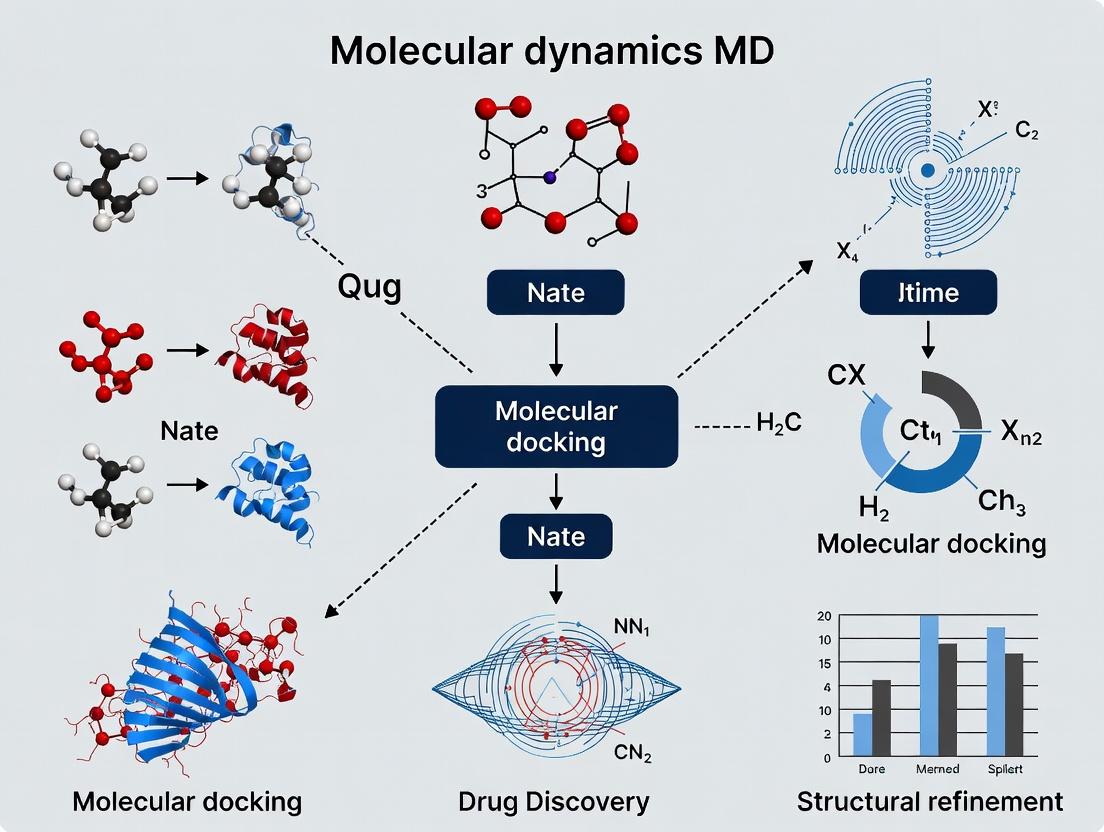
Molecular docking is a cornerstone of structure-based drug discovery but often provides static snapshots that may overlook critical dynamic interactions and induced-fit effects.
Insights from Integrated Molecular Dynamics Simulations: Refining Docking Results for Robust Drug Discovery
Abstract
Molecular docking is a cornerstone of structure-based drug discovery but often provides static snapshots that may overlook critical dynamic interactions and induced-fit effects. This article details how post-docking Molecular Dynamics (MD) simulations serve as an essential refinement tool, addressing the inherent limitations of docking alone. We explore the foundational synergy between these methods, outline practical workflows for integrating MD (including advanced protocols like MM-GBSA and induced-fit docking with MD), and provide solutions for common computational challenges. By comparing validation metrics and showcasing applications in lead optimization and drug repurposing, we demonstrate how MD simulations transform preliminary docking hits into dynamically validated, high-confidence candidates, thereby de-risking the subsequent drug development pipeline.
Beyond the Static Snapshot: Why Docking Alone Is Insufficient and How MD Simulation Bridges the Gap
Docking remains a cornerstone in structure-based drug design for its speed and scalability. However, its foundational assumption of treating the protein target as a rigid body and predicting a single, static ligand pose presents critical limitations. Quantitative analyses consistently demonstrate that these assumptions compromise predictive accuracy, particularly in estimating binding free energy and identifying viable bioactive conformations.
Table 1: Quantitative Impact of Rigid vs. Flexible Receptor Treatment on Docking Performance
| Performance Metric | Rigid-Receptor Docking (Typical Range) | Flexible/Ensemble Docking (Typical Range) | Key Study & Notes |
|---|---|---|---|
| RMSD of Top Pose (Å) | >2.0 Å (for systems with >1Å backbone motion) | <2.0 Å (improvement up to 40-60%) | Improvement is most significant for proteins with induced-fit binding or flexible binding sites. |
| Success Rate (RMSD < 2Å) | 30-50% (highly target-dependent) | 50-80% | Success rate increases with use of multiple receptor conformations (MRCs). |
| Enrichment Factor (EF₁%) | Often < 10 | Can improve by 2-5 fold | EF measures the ability to rank active compounds over decoys; flexibility reduces false negatives. |
| Pearson R for ΔG prediction | 0.3 - 0.5 | 0.5 - 0.8 | Correlation with experimental binding free energy improves when incorporating side-chain or backbone flexibility. |
| Computational Cost | Low (Seconds to minutes per ligand) | High (Minutes to hours per ligand) | Flexible methods include soft docking, side-chain rotamer sampling, and full MRC docking. |
Protocol: Generating a Receptor Ensemble for Ensemble Docking
This protocol outlines the creation of multiple receptor conformations (MRCs) from Molecular Dynamics (MD) simulation trajectories to mitigate the rigid receptor assumption.
2.1 Materials & Input
- Initial Structure: A single, high-resolution protein-ligand co-crystal structure (PDB format).
- Software: MD engine (e.g., GROMACS, AMBER, NAMD), clustering tool (e.g., GROMACS
cluster, CPPtraj), molecular visualization software (e.g., PyMOL, VMD). - System Preparation Tools: pdb2gmx, tleap, or similar for adding solvent, ions, and parameterizing the system.
2.2 Procedure
- System Setup: Prepare the protein-ligand complex in a solvated, neutralized periodic box. Apply appropriate force fields (e.g., CHARMM36, AMBER ff19SB) and ligand parameters (e.g., from CGenFF or GAFF2).
- Equilibration: Perform energy minimization, followed by NVT and NPT ensemble equilibration (typically 100ps-1ns each) to stabilize temperature (300K) and pressure (1 bar).
- Production MD: Run an unbiased MD simulation for a time scale sufficient to sample relevant conformational changes (50-500 ns). Save trajectory frames every 10-100 ps.
- Conformational Clustering: After stripping solvent and ions, align all trajectory frames to the protein backbone. Perform clustering (e.g., using the Gromos method) on the coordinates of the binding site residues (e.g., within 5-10 Å of the original ligand). Select the central structure of the top N (e.g., 10-20) most populated clusters as representative MRCs.
- Ensemble Preparation: Prepare each MRC for docking by adding polar hydrogens, assigning partial charges, and defining the binding site/box.
2.3 Expected Outcome A set of distinct protein conformations that capture binding site flexibility, ranging from side-chain rearrangements to backbone shifts. Docking a ligand library against each MRC and aggregating results (e.g., best score per ligand across ensemble) yields improved pose prediction and virtual screening enrichment.
Protocol: MD Simulation for Binding Pose Refinement and Assessment
This protocol details the use of MD to refine and validate a docked pose, addressing the static pose assumption by assessing stability and calculating improved binding metrics.
3.1 Materials & Input
- Input Structure: Top-ranked ligand pose(s) from rigid docking placed into the rigid receptor.
- Software: MD engine, binding free energy analysis tools (e.g., for MM/PBSA or MM/GBSA).
- Hardware: Access to GPU-accelerated computing resources is recommended.
3.2 Procedure
- System Preparation: Prepare the docked complex identically to Step 2.1.
- Equilibration: Perform minimization and equilibration as in Step 2.2.
- Production MD for Refinement: Run an MD simulation (10-100 ns) starting from the docked pose. Monitor the Root Mean Square Deviation (RMSD) of the ligand relative to its starting position to assess pose stability.
- Energetic Analysis: a. MM/PBSA/GBSA: Extract 100-1000 snapshots evenly from the stable phase of the trajectory. b. For each snapshot, calculate molecular mechanics energy, solvation free energy (Poisson-Boltzmann or Generalized Born), and surface area terms. c. Average the results to obtain an estimated binding free energy (ΔG_bind).
- Interaction Analysis: Analyze the final third of the trajectory to characterize the stable binding mode: hydrogen bonds, hydrophobic contacts, and salt bridges.
3.3 Expected Outcome The MD simulation will either stabilize the initial docked pose or reveal its instability, causing it to transition to a more favorable conformation. The MM/PBSA/GBSA ΔG_bind estimate, while not absolute, provides a more reliable ranking than docking scores alone due to the inclusion of flexibility and implicit solvation.
Visualized Workflows
Title: MD-Based Refinement of Docked Poses
Title: Ensemble Docking Pipeline from MD
The Scientist's Toolkit: Key Research Reagents & Solutions
Table 2: Essential Tools for MD-Driven Docking Refinement
| Item Name | Category | Primary Function in Protocol |
|---|---|---|
| GROMACS | MD Software Suite | Open-source, high-performance MD engine for running equilibration, production simulations, and basic trajectory analysis. |
| AMBER | MD Software Suite | Suite of programs providing force fields and tools for simulating biomolecules, widely used for MM/PBSA calculations. |
| CHARMM36 Force Field | Molecular Parameter Set | Provides parameters for proteins, nucleic acids, lipids, and carbohydrates for accurate MD simulations. |
| GAFF2 (General Amber Force Field 2) | Molecular Parameter Set | Used to generate force field parameters for small organic molecules (ligands). |
| CPPTraj/PTRAJ | Analysis Tool | For processing and analyzing MD trajectories (e.g., RMSD calculation, clustering, hydrogen bond analysis). |
| PyMOL / VMD | Visualization Software | Critical for visualizing initial structures, analyzing MD trajectories, and preparing publication-quality images of binding poses. |
| GPU Computing Cluster | Hardware | Accelerates MD simulations by orders of magnitude compared to CPU-only systems, making ns-µs timescales feasible. |
| PDB (Protein Data Bank) | Database | Source for initial high-resolution experimental structures of target proteins and ligand-bound complexes for validation. |
Application Notes
Within the broader thesis on using Molecular Dynamics (MD) after docking for refinement, MD simulations serve as a critical conformational search engine. Docking provides a static snapshot, often missing key dynamics like induced-fit binding, allosteric modulation, and the role of explicit solvent. MD refines these poses by sampling the conformational landscape under near-physiological conditions, leading to more accurate binding affinity predictions and mechanistic insights.
Key Applications:
- Pose Refinement and Validation: MD assesses the stability of docked poses, distinguishing correctly from incorrectly bound ligands. A stable root-mean-square deviation (RMSD) typically validates a pose.
- Binding Free Energy Calculation: Advanced methods like Molecular Mechanics/Poisson-Boltzmann Surface Area (MM/PBSA) and Molecular Mechanics/Generalized Born Surface Area (MM/GBSA) use snapshots from MD trajectories to compute binding affinities, improving correlation with experimental data over docking scores alone.
- Identification of Allosteric Sites: Long-timescale MD can reveal transient pockets and allosteric communication networks not evident in crystal structures.
- Understanding Selectivity: Simulations of a ligand with homologous proteins can elucidate dynamic and solvation differences driving selectivity.
Quantitative Data Summary: Table 1: Comparison of Docking-Only vs. Docking+MD Refinement Protocols
| Metric | Docking-Only (Typical Range) | Docking + MD Refinement (Typical Range) | Improvement/Notes |
|---|---|---|---|
| Pose Prediction Accuracy (RMSD < 2.0 Å) | 60-80% | 75-95% | MD filters out unstable poses. |
| Binding Affinity Correlation (R²) | 0.3 - 0.6 | 0.5 - 0.8 | MM/PBSA/GBSA on MD trajectories improves prediction. |
| Simulation Time Required | Minutes to Hours | Hours to Weeks | Dependent on system size and sampling goals. |
| Key Captured Phenomena | Static complementarity | Induced fit, solvent rearrangement, sidechain flips, allostery | Essential for accurate mechanistic models. |
Table 2: Common MD Analysis Metrics for Protein-Ligand Systems
| Analysis Metric | Description | Interpretation in Refinement |
|---|---|---|
| RMSD (Protein/Ligand) | Measures structural drift from initial pose. | Ligand RMSD stability (< 2.0-3.0 Å) suggests a valid binding mode. |
| Root Mean Square Fluctuation (RMSF) | Measures per-residue flexibility. | Identifies flexible loops and ligand-induced stabilization of residues. |
| Radius of Gyration (Rg) | Measures overall protein compactness. | Monitors large-scale conformational changes upon binding. |
| Intermolecular H-Bonds | Counts H-bonds between protein and ligand. | Consistent H-bonds indicate specific, stable interactions. |
| Solvent Accessible Surface Area (SASA) | Measures surface exposed to solvent. | Changes indicate burial of ligand or protein hydrophobic patches. |
Experimental Protocols
Protocol 1: Standard Workflow for MD Refinement of Docked Pigand Poses
Objective: To refine and validate the top poses from molecular docking using explicit-solvent MD simulation.
Materials: (See "The Scientist's Toolkit" below). Software: GROMACS, AMBER, NAMD, or OpenMM.
Procedure:
- System Preparation:
- Take the top-ranked docked protein-ligand complex.
- Parameterize the Ligand: Use tools like
antechamber(AMBER) orCGenFF(CHARMM) to generate ligand topology files with partial charges and force field parameters. - Solvate the System: Place the complex in a periodic water box (e.g., TIP3P, TIP4P) with a minimum margin (e.g., 1.2 nm) from the box edge.
- Neutralize and Ionize: Add ions (e.g., Na⁺, Cl⁻) to neutralize the system's net charge and then add salt to a physiological concentration (e.g., 0.15 M NaCl).
Energy Minimization:
- Perform 5,000-10,000 steps of steepest descent or conjugate gradient minimization.
- Purpose: Remove bad contacts from the initial setup.
System Equilibration:
- NVT Ensemble (Constant Number, Volume, Temperature): Run for 100-200 ps. Restrain protein and ligand heavy atoms. Heat system to target temperature (e.g., 310 K) using a thermostat (e.g., V-rescale, Berendsen).
- NPT Ensemble (Constant Number, Pressure, Temperature): Run for 100-200 ps. Restrain protein and ligand heavy atoms. Apply a barostat (e.g., Parrinello-Rahman, Berendsen) to reach target pressure (e.g., 1 bar).
- Purpose: Gently relax the solvent around the restrained complex.
Production MD:
- Remove all positional restraints.
- Run an unbiased simulation for a duration determined by sampling needs (typically 50 ns to 1 μs). Use a 2 fs integration time step. Save trajectory frames every 10-100 ps for analysis.
- Purpose: Serve as the conformational search engine to sample dynamics.
Analysis:
- Calculate RMSD, RMSF, H-bonds, and SASA (as in Table 2).
- Cluster the ligand binding modes from the stable simulation phase to identify the dominant refined pose(s).
- Consider performing MM/PBSA or MM/GBSA on trajectory snapshots to estimate binding free energy.
Protocol 2: Binding Free Energy Calculation Using MM/GBSA on MD Trajectories
Objective: To compute the binding free energy (ΔG_bind) of the refined complex.
Materials: Equilibrated MD trajectory and topology files.
Software: gmx_MMPBSA (for GROMACS) or AMBER's MMPBSA.py.
Procedure:
- Trajectory Preparation: Extract a series of equally spaced snapshots from the stable portion of the production trajectory (e.g., 100-1000 frames).
- Run MM/GBSA Calculation: For each snapshot, the internal, electrostatic, and van der Waals energies are calculated, along with the polar and nonpolar solvation terms. The dielectric constant for the solute is typically 1-4, and for the solvent, 80.
- Averaging: The free energy for the complex, receptor, and ligand are computed per frame. ΔG_bind is calculated as:
<G_complex> - <G_receptor> - <G_ligand>averaged over all frames. - Decomposition: Perform per-residue energy decomposition to identify key hot-spot residues contributing to binding.
Mandatory Visualization
Title: MD Refinement Workflow Post-Docking
Title: Post-MD Analysis for Pose Refinement
The Scientist's Toolkit
Table 3: Essential Research Reagent Solutions & Materials for Protein-Ligand MD
| Item | Function / Purpose |
|---|---|
| Molecular Dynamics Software | Core engine for running simulations (e.g., GROMACS, AMBER, NAMD, OpenMM). Provides force field integration, parallel computing, and basic analysis tools. |
| Force Field Parameters | Mathematical representation of interatomic forces for proteins (e.g., CHARMM36, AMBER ff19SB), ligands, and water. Critical for simulation accuracy. |
| Ligand Parameterization Tool | Generates topology and force field parameters for non-standard small molecules (e.g., antechamber (GAFF), CGenFF, PRODRG, ACPYPE). |
| Explicit Solvent Model | Water molecules (e.g., TIP3P, TIP4P, SPC/E) and ions to create a physiological environment, crucial for modeling solvation effects and electrostatics. |
| Visualization/Analysis Suite | Software for trajectory inspection, analysis, and figure generation (e.g., VMD, PyMOL, ChimeraX, MDAnalysis). |
| High-Performance Computing (HPC) Cluster | GPU/CPU clusters required to perform simulations of biologically relevant timescales (nanoseconds to microseconds) in a reasonable time. |
| Enhanced Sampling Plugins | Optional tools for accelerating rare events (e.g., umbrella sampling, metadynamics via PLUMED) when standard MD is insufficient. |
Application Notes
Molecular dynamics (MD) simulations following molecular docking are critical for refining binding poses, assessing stability, and elucidating key dynamic phenomena that static structures cannot capture. Within the broader thesis of post-docking refinement, three phenomena are paramount: induced fit, solvation effects, and allosteric modulation. Induced fit describes the conformational changes in both ligand and protein upon binding, moving beyond the rigid "lock-and-key" model. Solvation effects, particularly the dynamics of water networks at the binding interface, can make or break binding affinity through the disruption or formation of key hydrogen bonds. Allosteric modulation, observed over longer timescales, involves ligand binding at one site influencing the dynamics and function at a distant functional site. MD simulations validate docking poses by revealing which poses are dynamically stable and which represent metastable states, directly informing lead optimization in drug discovery.
Table 1: Quantitative Metrics for Assessing Key Phenomena in Post-Docking MD
| Phenomenon | Key MD Metrics | Typical Simulation Timescale | Representative Value/Observation | Interpretation in Drug Design |
|---|---|---|---|---|
| Induced Fit | Root Mean Square Deviation (RMSD) of binding site residues; Radius of Gyration (Rg); Torsion angle evolution. | 50 ns - 500 ns | Binding site RMSD stabilizes at ~1.5 Å after 20 ns, while bulk protein is at 1.0 Å. | Confirms stable binding mode; identifies flexible binding site loops. |
| Solvation Effects | Solvent-accessible surface area (SASA) of binding pocket; Residence time of key water molecules; Hydrogen bond lifetime. | 20 ns - 200 ns | A high-affinity ligand displaces 3-5 stable water molecules from the hydrophobic pocket. | Ligands that optimally displace unfavorable water or retain bridging water show higher affinity. |
| Allosteric Modulation | Cross-correlation matrix of residue motions; Principal Component Analysis (PCA) of collective motions; Distance between allosteric and orthosteric sites. | 500 ns - 10 µs+ | Strong anti-correlated motion (-0.8) between allosteric and active sites observed. | Identifies novel allosteric pockets and explains functional effects of distant mutations. |
Table 2: Analysis Tools and Software for Post-Docking MD Refinement
| Software/Tool | Primary Function | Key Output for Refinement |
|---|---|---|
| GROMACS, AMBER, NAMD | MD simulation engines. | Trajectory files (.xtc, .dcd), energy files. |
| VMD, PyMOL, ChimeraX | Trajectory visualization and analysis. | Renderings of binding poses, water networks, conformational changes. |
| MDAnalysis, cpptraj (AMBER) | Programmatic trajectory analysis. | Time-series data for RMSD, SASA, hydrogen bonds, etc. |
| PLUMED | Enhanced sampling and free-energy calculations. | Binding free energy estimates (ΔG) via MM/PBSA or metadynamics. |
Experimental Protocols
Protocol 1: Assessing Induced Fit After Docking
Objective: To validate and refine docked poses by simulating the stability of the protein-ligand complex and quantifying conformational changes.
- System Preparation: Take the top 3-5 poses from docking software (e.g., AutoDock Vina, Glide). Solvate each complex in a cubic water box (TIP3P water model) with a 10-12 Å buffer. Add ions to neutralize system charge.
- Energy Minimization: Perform 5,000 steps of steepest descent minimization to remove steric clashes.
- Equilibration:
- NVT equilibration: Heat system to 300 K over 100 ps using a Berendsen thermostat.
- NPT equilibration: Apply 1 bar pressure for 1 ns using a Parrinello-Rahman barostat to achieve correct density.
- Production MD: Run an unrestrained simulation for 100-500 ns. Use a 2 fs integration timestep. Save coordinates every 10 ps.
- Analysis:
- Calculate the RMSD of the protein backbone, binding site residues, and ligand heavy atoms relative to the starting docked pose.
- Plot RMSD over time; a stable plateau indicates a converged, stable binding mode.
- Analyze specific torsion angles in the ligand or protein side chains to identify conformational adaptations.
Protocol 2: Explicit Solvation Effects Analysis
Objective: To characterize the role of water molecules in ligand binding and stability.
- Simulation Setup: Follow Protocol 1 steps 1-4 for the top docked pose.
- Hydration Site Analysis:
- Use the
gmx sasa(GROMACS) orvolmap(VMD) to compute the SASA of the binding pocket over time. - Identify water molecules within 3.5 Å of the ligand throughout the simulation.
- Use the
- Water Residence and Network Analysis:
- For waters within the binding site, calculate their residence time using continuous autocorrelation functions.
- Identify stable, high-occupancy water sites (e.g., waters present >80% of the simulation).
- Map the hydrogen bond network between protein, ligand, and key waters using geometric criteria (donor-acceptor distance < 3.5 Å, angle > 150°).
- Comparative Analysis: Repeat simulation for the apo protein (without ligand). Compare the water networks in the apo and holo states to identify which waters were displaced or stabilized by the ligand.
Protocol 3: Investigating Allosteric Modulation
Objective: To detect and quantify communication between an allosteric ligand binding site and the protein's active site.
- Long-Timescale Simulation: Prepare the system with a ligand bound at a putative allosteric site (identified from docking or literature). Run a multi-microsecond (1-10 µs) simulation using a specialized GPU cluster or enhanced sampling.
- Dynamic Cross-Correlation Analysis (DCCA):
- Calculate the cross-correlation matrix ( C{ij} ) of atomic fluctuations: ( C{ij} = \langle \Delta ri \cdot \Delta rj \rangle / (\langle \Delta ri^2 \rangle \langle \Delta rj^2 \rangle)^{1/2} ).
- Values range from -1 (anti-correlated motion) to +1 (correlated motion). Visualize as a heatmap.
- Principal Component Analysis (PCA):
- Perform PCA on the Cα atom trajectories to extract large-scale collective motions.
- Project the trajectory onto the first two principal components (PC1, PC2) to visualize the dominant motion pathways.
- Allosteric Pathway Detection: Use tools like
trj_corr(GROMACS) orBio3Din R to identify chains of residues with high mutual information or correlation that connect the allosteric and active sites.
Visualization
Post-Docking MD Refinement Workflow
Allosteric Modulation Signaling Pathway
The Scientist's Toolkit: Research Reagent Solutions
Table 3: Essential Materials for Post-Docking MD Simulations
| Item | Function & Rationale |
|---|---|
| High-Performance Computing (HPC) Cluster or Cloud GPU Instance | Provides the computational power necessary for running nanosecond-to-microsecond MD simulations in a reasonable timeframe. |
| MD Simulation Software (GROMACS, AMBER, NAMD) | The core engine that performs the numerical integration of Newton's equations of motion for the molecular system. |
| Molecular Visualization Software (VMD, PyMOL, ChimeraX) | Essential for system setup, monitoring simulations, and visualizing trajectories, water networks, and conformational changes. |
| Force Field Parameters (CHARMM36, AMBER ff19SB, OPLS-AA) | Defines the potential energy functions (bonds, angles, dihedrals, nonbonded interactions) for proteins, nucleic acids, lipids, and ligands. |
| Small Molecule Parametrization Tool (CGenFF, ACPYPE, GAFF2) | Generates missing force field parameters and partial charges for novel drug-like ligands from docking studies. |
| Explicit Solvent Model (TIP3P, TIP4P-Ew, OPC Water) | Represents water molecules explicitly to accurately model solvation, hydrogen bonding, and hydrophobic effects. |
| Trajectory Analysis Suite (MDAnalysis, MDTraj, cpptraj) | Enables programmatic calculation of key metrics (RMSD, SASA, H-bonds, distances) from large trajectory files. |
| Enhanced Sampling Plug-in (PLUMED) | Facilitates advanced techniques like metadynamics or umbrella sampling to calculate binding free energies and sample rare events. |
Within the paradigm of computer-aided drug design (CADD), the sequential application of molecular docking and molecular dynamics (MD) simulations has become a cornerstone for efficient and robust hit discovery and lead optimization. Docking serves as the high-throughput filter, rapidly evaluating millions of compounds against a target binding site. Subsequently, MD simulations provide the indispensable, in-depth validation, assessing the stability, dynamics, and true free energy of binding for top-ranked docked poses. This protocol details the integrated workflow, emphasizing the refinement role of MD in the context of structure-based drug discovery.
Table 1: Key Performance Metrics of Docking vs. MD Simulations
| Parameter | Molecular Docking | Molecular Dynamics (Validation) | Purpose/Interpretation |
|---|---|---|---|
| Throughput | 10⁴ - 10⁶ compounds/day | 1 - 10 complexes/µs-day | Docking scans vast chemical space; MD deeply probes few candidates. |
| Typical Simulation Time | Seconds to minutes per ligand | 10 ns - 1 µs per system | MD captures critical biomolecular motions and relaxation. |
| Key Output | Predicted binding pose & score | Stability, binding free energy (ΔG), interaction fingerprints | Docking gives a static snapshot; MD provides a dynamic movie and thermodynamics. |
| Accuracy (Pose Prediction) | ~70-80% within 2.0 Å RMSD | Refinement improves RMSD by 0.5 - 2.0 Å | MD corrects docking errors due to rigid receptors or poor scoring. |
| Binding Affinity Estimation | Docking scores (kcal/mol) are correlative, not absolute. | MM-PBSA/GBSA ΔG estimates: Often within ±1.5 kcal/mol of experiment | MD-based methods offer superior quantitative accuracy. |
| Critical Role | High-Throughput Screening (HTS) virtual library enrichment. | In-Depth Validation of binding mechanism, pose stability, and selectivity. | Complementary stages in a funnel workflow. |
Detailed Experimental Protocols
Protocol 1: High-Throughput Docking for Initial Screening
Objective: To rapidly screen a virtual compound library against a prepared protein target and identify top-ranked hits for further validation.
Materials & Reagents:
- Protein Data Bank (PDB) structure of the target (e.g., 7SYS for SARS-CoV-2 Mpro).
- Virtual compound library (e.g., ZINC20, Enamine REAL).
- Docking software (AutoDock Vina, Glide, GOLD).
- Hardware: High-performance computing cluster or GPU workstations.
Procedure:
- Target Preparation:
- Obtain the 3D structure from the PDB. Remove water molecules and heteroatoms not part of the binding site.
- Add hydrogen atoms, assign partial charges (e.g., using Gasteiger charges), and define protonation states of key residues (e.g., using PROPKA).
- Define the binding site grid box centered on the known catalytic site or ligand, with dimensions typically 20-25 Å per side.
Ligand Library Preparation:
- Download or curate the library in SMILES or SDF format.
- Generate 3D conformers, minimize energy, and assign appropriate protonation states at physiological pH (e.g., using Open Babel, LigPrep).
- Convert ligands to the required format for the docking software (e.g., PDBQT for AutoDock).
Docking Execution:
- Run the docking job using the prepared protein and ligand files. For Vina, use the command:
vina --receptor protein.pdbqt --ligand ligand.pdbqt --config config.txt --out docked.pdbqt. - Execute in parallel for high-throughput screening.
- Run the docking job using the prepared protein and ligand files. For Vina, use the command:
Post-Docking Analysis:
- Rank compounds by docking score (binding affinity estimate).
- Cluster poses and visually inspect the top 100-500 hits for sensible binding modes and key interactions (e.g., hydrogen bonds, pi-stacking).
- Select the top 20-50 diverse candidates for MD validation.
Protocol 2: MD Simulation for Pose Validation and Refinement
Objective: To validate the stability of docked poses, compute accurate binding free energies, and reveal detailed interaction dynamics.
Materials & Reagents:
- Top docked complexes from Protocol 1.
- MD software (AMBER, GROMACS, NAMD).
- Force field (ff19SB for protein, GAFF2 for ligands, TIP3P water).
- High-performance computing cluster with GPU acceleration.
Procedure:
- System Building:
- Place the protein-ligand complex in a solvation box (e.g., cubic, dodecahedron) with a minimum 10 Å buffer from the protein.
- Add ions (e.g., Na⁺, Cl⁻) to neutralize the system charge and achieve a physiological concentration (e.g., 150 mM NaCl).
Energy Minimization and Equilibration:
- Minimization: Run 5,000 steps of steepest descent to remove steric clashes.
- NVT Equilibration: Heat the system to 310 K over 100 ps using a Langevin thermostat, restraining heavy atom positions.
- NPT Equilibration: Achieve 1 atm pressure over 100 ps using a Berendsen or Parrinello-Rahman barostat, with restraints gradually released.
Production MD:
- Run an unrestrained simulation for a minimum of 100 ns (1 µs is ideal for convergence). Use a 2-fs integration timestep. Save trajectories every 10-100 ps.
- Perform replicates (n=3) for robust statistical analysis.
Analysis:
- Stability: Calculate the root-mean-square deviation (RMSD) of the protein backbone and ligand heavy atoms.
- Interactions: Compute the root-mean-square fluctuation (RMSF), hydrogen bond occupancy, and contact maps.
- Energetics: Perform MM-PBSA or MM-GBSA calculations on 100-1000 equally spaced frames from the stable simulation period to estimate the binding free energy (ΔG_bind).
Visualization of Workflows and Pathways
Title: CADD Workflow: Docking to MD Validation
The Scientist's Toolkit: Essential Research Reagents & Materials
Table 2: Key Research Reagent Solutions for Docking & MD
| Item/Category | Example(s) | Function in Workflow |
|---|---|---|
| Protein Structure Source | RCSB Protein Data Bank (PDB), AlphaFold DB | Provides the initial 3D atomic coordinates of the biological target. |
| Compound Libraries | ZINC20, Enamine REAL, MCULE, PubChem | Large-scale collections of purchasable or virtual molecules for screening. |
| Docking Software | AutoDock Vina, Glide (Schrödinger), GOLD, FRED | Performs rapid conformational sampling and scoring of ligand binding. |
| MD Software & Force Fields | GROMACS/AMBER with ff19SB, GAFF2, CHARMM36 | Simulates time-dependent behavior of the solvated complex using physics-based models. |
| Simulation Setup Tools | CHARMM-GUI, AMBER tleap, packmol-memgen | Prepares the solvated, ionized system for MD simulation. |
| Analysis Suites | MDTraj, Bio3D, VMD, PyMOL, cpptraj (AMBER) | Processes trajectories to compute stability, interactions, and energies. |
| Free Energy Methods | MM-PBSA, MM-GBSA (gmx_MMPBSA), Alchemical FEP | Calculates relative or absolute binding free energies from simulation data. |
| Computational Hardware | GPU clusters (NVIDIA A100/V100), High-CPU cores | Provides the necessary processing power for high-throughput docking and long MD runs. |
A Practical Workflow: Implementing Post-Docking MD Simulations for Pose Refinement and Energetic Analysis
This protocol details the critical steps required to transform a static, docked protein-ligand complex into a fully solvated, equilibrated molecular dynamics (MD) system. Proper execution is essential for subsequent production simulations aimed at refining docking poses, assessing binding stability, calculating binding free energies, or elucidating molecular mechanisms.
Research Reagent Solutions & Essential Materials
The following table lists key software tools and resources required for this protocol.
Table 1: Essential Toolkit for MD System Preparation
| Item | Category | Primary Function & Notes |
|---|---|---|
| PDB File of Complex | Input Data | The initial docked pose, containing protein and ligand coordinates. Must be checked for missing residues/atoms. |
| AMBER/CHARMM/GROMACS | MD Suite | Software package for force field assignment, system building, and simulation. GROMACS is used here for example. |
| GAFF/GLYCAM/Lipid17 | Force Field | General AMBER Force Field (GAFF2) is common for small molecules. Protein force fields (e.g., ff19SB, CHARMM36m) must be chosen carefully. |
| ACPYPE/Antechamber | Utility | Tools for generating ligand topology parameters compatible with the chosen force field. |
| PyMOL/VMD | Visualization | Software for visual inspection, structural editing, and trajectory analysis. |
| PACKMOL/MDLeash | Utility | Tools for solvating the system in a water box and adding ions for neutralization and physiological concentration. |
| TP3P/OPC/TIP4P | Water Model | Explicit solvent model. TP3P is standard for AMBER; SPC/E is common for GROMACS. |
Step-by-Step Experimental Protocol
Step 1: Initial Structure Preparation & Topology Generation
Objective: Clean the docked structure and generate topology files for all components.
- Docked Pose Inspection: Load the complex (e.g.,
docked_pose.pdb) in PyMOL/VMD. Remove crystallographic water molecules and irrelevant ions unless structurally critical. Ensure the ligand is in the correct protonation state for the simulated pH (use tools likepropkaorH++server). - Separate Components: Save the protein as
protein.pdband the ligand asligand.pdb. - Ligand Topology: Use
antechamber(for AMBER) orACPYPE(interface for GAFF with GROMACS) to generate ligand parameters. Example for ACPYPE:acpype -i ligand.pdb -c bcc -a gaff2This produces GROMACS-compatible topology (ligand.itp,ligand.prm) and coordinate files. - Protein Topology: Use
pdb2gmx(GROMACS) ortleap(AMBER) to generate the protein topology within the chosen force field. Example for GROMACS:gmx pdb2gmx -f protein.pdb -o protein_processed.gro -water tip3p -ff charmm36m -ignh
Step 2: System Assembly, Solvation, and Neutralization
Objective: Create a periodic simulation box, solvate the complex, and add ions.
- Combine Topologies: Create a master topology file (
system.top) that includes the protein.itp, ligand.itp, and force field parameters. Ensure all necessary ligand parameters are included. - Define the Simulation Box: Use
editconfto place the complex in a periodic box (e.g., cubic, dodecahedron) with a margin of at least 1.0 nm from the complex to the box edge. Example:gmx editconf -f complex.gro -o complex_boxed.gro -c -d 1.0 -bt cubic - Solvation: Fill the box with water molecules using
solvate. Example:gmx solvate -cp complex_boxed.gro -cs spc216.gro -o complex_solv.gro -p system.top - Add Ions: First, add ions to neutralize the system's net charge, then add ions to achieve a desired physiological concentration (e.g., 150 mM NaCl). Use
genion. Example:gmx genion -s solvated.tpr -o system_solv_ions.gro -p system.top -pname NA -nname CL -neutral -conc 0.15
Table 2: Typical System Setup Parameters
| Parameter | Typical Value(s) | Purpose & Rationale |
|---|---|---|
| Box Type | Cubic, Dodecahedron | Periodic boundary conditions. Dodecahedron approximates a sphere, often more efficient. |
| Box Margin | 1.0 - 1.2 nm | Ensures solute does not interact with its own image across periodic boundaries. |
| Water Model | TIP3P, SPC/E, OPC | Explicit solvent. Model choice should match force field. |
| Ion Concentration | 0.15 M NaCl | Mimics physiological ionic strength, screens electrostatic interactions. |
| Neutralizing Ions | Na⁺, Cl⁻ (or K⁺, Cl⁻) | Replaces solvent molecules to achieve zero net system charge. |
Step 3: Energy Minimization and Equilibration
Objective: Relax steric clashes and improper geometry introduced during setup, then gradually bring the system to the target temperature and pressure.
- Energy Minimization (EM): Perform steepest descent or conjugate gradient minimization to remove bad contacts.
Key Settings:
integrator = steep,nsteps = 5000. Restrain solute positions with a weak force constant (e.g., 1000 kJ/mol/nm²) to allow solvent to relax first. - NVT Equilibration (Constant Number, Volume, Temperature): Heat the system to the target temperature (e.g., 310 K) using a thermostat (e.g., V-rescale, Berendsen).
Protocol: Run for 50-100 ps. Restrain protein and ligand heavy atoms (
define = -DPOSRES). Use a coupling constant (τ_T) of 0.1-1.0 ps. - NPT Equilibration (Constant Number, Pressure, Temperature): Adjust the system density to the target pressure (e.g., 1 bar) using a barostat (e.g., Parrinello-Rahman, Berendsen). Protocol: Run for 100-200 ps. Initially maintain positional restraints, then gradually release them over multiple stages if needed.
Table 3: Standard Equilibration Protocol Stages
| Stage | Ensemble | Time (ps) | Temperature (K) | Pressure (bar) | Restraints (Force Constant kJ/mol/nm²) | Primary Goal |
|---|---|---|---|---|---|---|
| EM1 | - | - | - | - | Heavy (1000) | Relax solvent and ions. |
| EM2 | - | - | - | - | None | Final full minimization. |
| NVT | NVT | 100 | 310 | - | Heavy (1000) | Heat system uniformly. |
| NPT-1 | NPT | 100 | 310 | 1 | Backbone (400) | Achieve correct density. |
| NPT-2 | NPT | 100 | 310 | 1 | None / Light (Cα: 10) | Release restraints, stabilize. |
Step 4: System Validation
Objective: Confirm the system is stable and ready for production MD.
- Analyze Equilibration Logs: Plot potential energy, temperature, pressure, density, and root-mean-square deviation (RMSD) of the backbone over the equilibration runs. Key indicators of success:
- Density stabilizes around the expected value (e.g., ~997 kg/m³ for TIP3P at 310K).
- Temperature and pressure fluctuate around their set points.
- RMSD of the restrained components plateaus.
Workflow Visualization
Diagram Title: MD System Setup and Equilibration Workflow
Following this standardized protocol ensures the generation of a stable, physically realistic MD system from a docked pose. A well-equilibrated system is the fundamental prerequisite for obtaining reliable results in subsequent production simulations for pose refinement, binding mode validation, and free energy calculations.
Force Field Selection and Parameterization for Novel Ligands (e.g., GAFF2)
In the context of molecular dynamics (MD) simulations for post-docking refinement, accurate force field selection and parameterization for novel, non-standard ligands is critical. Docked poses provide a static snapshot; MD simulations assess stability, solvation effects, and true binding free energies. The Generalized Amber Force Field 2 (GAFF2) is a widely adopted solution for small organic molecules, providing broad coverage for drug-like compounds. Accurate parameterization ensures reliable simulations, leading to better predictions of binding affinity and specificity.
Force Field Comparison for Organic Ligands
The following table summarizes key force fields used for novel ligand parameterization in MD-based refinement pipelines.
Table 1: Comparison of Force Fields for Novel Ligand Parameterization
| Force Field | Primary Scope | Parameterization Method | Charge Model | Compatible MD Engines | Key Advantage for Post-Docking Refinement |
|---|---|---|---|---|---|
| GAFF2 | Small organic molecules | Automated via antechamber/parmchk2 | AM1-BCC (recommended) | AMBER, GROMACS, OpenMM, NAMD | Excellent coverage of drug-like chemical space; standardized protocol. |
| CGenFF | CHARMM-compatible molecules | Paramchem server (automated) + manual optimization | CGenFF charges | CHARMM, NAMD, GROMACS, OpenMM | Seamless integration with CHARMM biomolecular force fields (proteins, lipids). |
| OPLS-AA/CM1A | Organic liquids, biomolecules | LigParGen web server (automated) | 1.14*CM1A or CM1A-LBCC | GROMACS, LAMMPS, OpenMM, NAMD | Good liquid-phase properties; freely available web server. |
| Open Force Field (Sage) | Small molecules & biopolymers | Direct from SMILES via FF toolkit | AM1-BCC (standard) | OpenMM, GROMACS (via interop) | Modern, regularly updated; open-source and data-driven. |
Core Parameterization Protocol for GAFF2
This protocol details the steps for generating force field parameters for a novel ligand using the AmberTools suite, preparing it for MD simulation with a protein complex from docking.
Protocol 1: Automated GAFF2 Parameterization with AmberTools
Objective: Generate topology and coordinate files for a novel ligand for use in AMBER, GROMACS, or OpenMM.
Materials & Software:
- Input: 3D ligand structure file (
.mol2or.sdf) with reasonable geometry (e.g., from docking output or energy minimization). - Software: AmberTools (specifically
antechamber,parmchk2,tleap), Open Babel. - Charge Method: Recommended: AM1-BCC (suitable for condensed-phase MD).
- Force Field: GAFF2 (
.frcmodand.datfiles included in AmberTools).
Step-by-Step Method:
- Ligand Preparation: Ensure the ligand 3D file has correct bond orders and protonation states appropriate for physiological pH (e.g., using
obabelor chemical intuition). Save as.mol2. - Charge Assignment & Preliminary Parameter Assignment:
- Force Field Parameter File Generation:
- Topology and Coordinate File Creation in tleap: Create a
tleap.inscript: Execute with:tleap -f tleap.in. This outputs the AMBER topology (prmtop) and coordinate (inpcrd) files. - Format Conversion (Optional for GROMACS/OpenMM): Use
acpypeor the ParmEd library to convert.prmtop/.inpcrdto GROMACS (.top,.gro) or OpenMM (XML) formats.
The Scientist's Toolkit: Research Reagent Solutions
Table 2: Essential Tools for Ligand Parameterization & Setup
| Item | Function in Workflow | Example/Note |
|---|---|---|
| AmberTools22+ | Primary suite for GAFF2 parameterization via antechamber and parmchk2. |
Free for academics. Essential for the standard protocol. |
| Open Babel | Converts between chemical file formats for initial ligand preparation. | obabel -i sdf input.sdf -o mol2 -O output.mol2 |
| ACPYPE/Antechamber Python Parser | Automates conversion of AMBER topologies to GROMACS/OpenMM formats. | Critical for cross-platform simulation setup. |
| ParamChem Server | Web-based tool for generating CGenFF parameters for CHARMM-compatible simulations. | Provides parameters and penalty scores indicating analogy reliability. |
| LigParGen Server | Web server for generating OPLS-AA/CM1A parameters for GROMACS and OpenMM. | User-friendly; inputs SMILES or .mol2. |
| Open Force Field Toolkit | Python API to parameterize molecules with the Open Force Field (e.g., Sage) for OpenMM. | Enables use of modern, data-driven force fields. |
| MATCH | Software for multi-purpose atom-typing and parameter assignment for CHARMM force fields. | More robust but complex alternative to ParamChem for experts. |
Integrated Workflow for Post-Docking Refinement
The following diagram illustrates the logical workflow from a docked protein-ligand complex to a refined MD simulation system using a parameterized novel ligand.
Workflow for MD Refinement Using a Parameterized Novel Ligand
Detailed Protocol for MD System Assembly and Equilibration
After ligand parameterization, the complete system must be assembled and prepared for production MD.
Protocol 2: Building and Equilibrating a Protein-Ligand Complex for Refinement
Objective: Integrate the parameterized ligand with a protein structure, solvate, add ions, and equilibrate the system.
Materials:
- Input Files: Parameterized ligand topology/coordinates (from Protocol 1). Protein topology/coordinates (e.g., from
pdb4amber). Force field files for protein (e.g.,ff19SB), water (e.g.,OPC), and ions. - Software:
tleap(AMBER) orgmx pdb2gmx/gmx insert-molecules(GROMACS) orModeller/OpenMMsetup scripts.
AMBER/tleap-Centric Steps:
- Combine Components in tleap: Create a
system.inscript: Run:tleap -f system.in. - Energy Minimization: Use
sanderorpmemdto minimize the system in 2-3 stages, gradually releasing restraints on the protein backbone and ligand. - System Equilibration: Perform stepwise equilibration in NVT and NPT ensembles:
- Stage 1: Heat system from 0 K to 300 K over 50-100 ps with strong restraints on solute.
- Stage 2: Density equilibration at 300 K and 1 bar over 100-200 ps with weaker restraints.
- Stage 3: Unrestrained NPT equilibration for 100-200 ps. Monitor temperature, density, and potential energy for stability.
- Production MD: Launch a multi-nanosecond (ns) unrestrained simulation. For pose refinement, 50-100 ns is often a starting point, but convergence of metrics (ligand RMSD) should be assessed.
Critical Validation Step: Throughout minimization and equilibration, visually inspect the ligand's binding pose and interactions (e.g., using VMD or PyMOL) to ensure it remains bound and does not undergo unrealistic distortion due to improper parameters.
Molecular docking predicts the preferred binding pose of a ligand within a protein's target site. However, this static snapshot lacks critical dynamic information about complex stability, interaction persistence, and induced conformational changes. Within the broader thesis on using Molecular Dynamics (MD) simulations for post-docking refinement, production MD is the core computational experiment. It involves running the simulated system under predefined thermodynamic conditions to sample its natural motion and energetics. The critical decisions in this phase—selecting appropriate simulation timescales, statistical mechanical ensembles, and managing key parameters—directly determine the validity, reproducibility, and predictive power of the refinement results for drug development.
Core Concepts: Timescales, Ensembles, and Parameters
Timescales: The simulation length must be sufficient to sample the relevant biological processes. For post-docking refinement, this includes ligand binding pocket rearrangements, side-chain rotamer transitions, and ligand settling. While ns-scale simulations are common, µs-scale may be needed for larger conformational changes. Ensembles: The ensemble defines the thermodynamic variables held constant during the simulation, governing the system's sampling of phase space. Critical Parameters: These are the numerical settings and force field choices that control simulation stability, accuracy, and physical fidelity.
Table 1: Recommended Simulation Timescales for Post-Docking Refinement Goals
| Refinement Objective | Minimum Recommended Production Time | Key Events Sampled |
|---|---|---|
| Ligand Pose Relaxation & Minor Side-Chain Adjustment | 10 - 100 ns | Ligand settling, local H-bond network formation |
| Binding Mode Validation & Stability Assessment | 50 - 500 ns | Sustained protein-ligand contacts, ligand RMSD plateau |
| Detection of Local Induced Fit (Subtle) | 100 ns - 1 µs | Pocket loop movement, side-chain rotamer flips |
| Large-Scale Allosteric or Conformational Change | >1 µs | Domain motion, large loop rearrangement, cryptic site opening |
Table 2: Common Statistical Ensembles in Production MD
| Ensemble | Constant Parameters | Primary Use Case in Post-Docking Refinement |
|---|---|---|
| NPT (Isobaric-Isothermal) | Number of particles, Pressure, Temperature | Standard choice. Models system at experimental temperature and pressure. |
| NVT (Canonical) | Number of particles, Volume, Temperature | Used when system volume must be fixed; less common for solvated systems. |
| NVE (Microcanonical) | Number of particles, Volume, Energy | Used for testing integrator stability; not for production refinement. |
Table 3: Critical Parameters and Typical Values for Production MD
| Parameter Category | Specific Parameter | Typical Value/Range | Function & Impact |
|---|---|---|---|
| Integration | Time Step (Δt) | 2 fs | Determines simulation stability. Requires constraints on bonds involving H. |
| Thermostat | Temperature Coupling Constant (τ_T) | 0.1 - 1.0 ps | Speed of temperature regulation. Too fast can artifacts. |
| Barostat | Pressure Coupling Constant (τ_P) | 1.0 - 5.0 ps | Speed of pressure regulation. |
| Non-Bonded Interactions | Coulomb & van der Waals Cutoff | 0.9 - 1.2 nm | Balances accuracy and computational cost. |
| Long-Range Electrostatics | Method | Particle Mesh Ewald (PME) | Standard for accuracy. Smooths potential at cutoff. |
| Constraint Algorithm | Bonds involving Hydrogen | LINCS (typically) | Allows for larger time step by fixing fastest vibrations. |
Experimental Protocols
Protocol 1: Standard NPT Production Run for Ligand-Pose Stability Assessment This protocol follows energy minimization and equilibration phases, using GROMACS as an example engine.
- Input Preparation: Ensure you have the final equilibrated system coordinates (
.gro) and topology (.tpr) file. - Parameter File Configuration: Edit the MD parameter (
.mdp) file with production settings.integrator = md(leap-frog stochastic dynamics integrator)dt = 0.002(2 fs time step)nsteps = 50000000(for 100 ns simulation)pcoupl = Parrinello-Rahman(pressure coupling for NPT)pcoupltype = isotropictau_p = 2.0(ps)ref_p = 1.0(bar)tcoupl = V-rescale(temperature coupling)tau_t = 0.1(ps)ref_t = 310(K)constraints = h-bondsconstraint_algorithm = lincscutoff-scheme = Verletdispcorr = EnerPres(apply long-range dispersion correction)coulombtype = PMErcoulomb = 1.0(nm)rvdw = 1.0(nm)
- Execution Command:
gmx mdrun -v -deffnm production -s equil.tpr -cpi state.cpt -append(The-cpiand-appendflags allow for graceful restarting from checkpoint files). - Monitoring: Use
gmx energyto track temperature, pressure, density, and potential energy over time to ensure stability. - Trajectory Handling: Save full-precision trajectory frames every 100 ps (e.g.,
nstxout-compressed = 50000). This balances storage and temporal resolution.
Protocol 2: Performing a Multi-Replica Simulation for Enhanced Sampling This protocol uses a set of parallel simulations at different temperatures (Replica Exchange) to better overcome energy barriers.
- System Replication: Prepare N identical copies (replicas, e.g., 8-16) of the equilibrated protein-ligand system.
- Temperature Ladder: Assign each replica a different temperature (e.g., from 310 K to 500 K), creating a ladder covering the desired range.
- Individual Parameter Files: Create an
.mdpfile for each temperature, setting theref_taccordingly. Use a slightly reducedtau_t(e.g., 0.05 ps) for faster temperature coupling at higher T. - Execution with Exchange: Use the REMD-enabled version of your MD engine. For GROMACS:
mpirun -np 8 gmx_mpi mdrun -v -deffnm remd -multidir rep1 rep2 ... rep8 -replex 1000(Attempts exchanges between neighboring replicas every 1000 steps/2 ps). - Analysis: Demultiplex the trajectories so that the time-series of a given temperature is reconstructed. Analyze the lowest temperature (310 K) trajectory for refinement, which benefits from the enhanced sampling of higher replicas.
Visualization Diagrams
Title: MD Refinement Workflow After Docking
Title: Ensemble and Sampling Method Selection
The Scientist's Toolkit: Research Reagent Solutions
Table 4: Essential Computational Materials for Production MD
| Item / Software | Category | Function in Production Simulations |
|---|---|---|
| GROMACS / AMBER / NAMD | MD Engine | Core software that performs numerical integration of Newton's equations of motion for the molecular system. |
| CHARMM36 / AMBER ff19SB / OPLS-AA | Protein Force Field | Defines empirical parameters (bonds, angles, dihedrals, non-bonded) governing atomic interactions for proteins. |
| GAFF2 / CGenFF | Ligand Force Field | Provides parameters for small molecule ligands, often derived via quantum mechanical calculations. |
| TIP3P / TIP4P/EW | Water Model | Explicit solvent model representing water molecules, critical for simulating physiological conditions. |
| Slurm / PBS Pro | Job Scheduler | Manages computational resources and job queues on high-performance computing (HPC) clusters. |
| VMD / PyMOL / ChimeraX | Visualization & Analysis | Software for visually inspecting trajectories, preparing figures, and initial qualitative analysis. |
| MDAnalysis / MDTraj / cpptraj | Analysis Library | Python or C++ libraries for programmatic, high-throughput analysis of simulation trajectories (RMSD, H-bonds, etc.). |
| GPU Accelerators (NVIDIA) | Hardware | Graphics Processing Units dramatically accelerate the calculation of non-bonded forces, enabling longer timescales. |
Following molecular docking, Molecular Dynamics (MD) simulations are employed to refine binding poses and assess the stability of protein-ligand complexes in a dynamic, solvated environment. This application note details the critical post-simulation analyses required to quantify stability and characterize interactions, focusing on Root Mean Square Deviation (RMSD), Root Mean Square Fluctuation (RMSF), and interaction persistence. These metrics, grounded in principles from statistical mechanics, form the cornerstone for validating docking results and advancing drug discovery candidates.
Core Analytical Metrics: Definitions and Interpretation
Root Mean Square Deviation (RMSD)
RMSD measures the average displacement of atomic positions between a reference structure (often the starting frame) and each simulated snapshot. It quantifies the overall structural drift of the protein backbone or the ligand, indicating convergence and stability.
Calculation: $$RMSD(t) = \sqrt{\frac{1}{N} \sum{i=1}^{N} \lVert \vec{r}i(t) - \vec{r}i^{ref} \rVert^2}$$ Where (N) is the number of atoms, (\vec{r}i(t)) is the position of atom (i) at time (t), and (\vec{r}_i^{ref}) is its reference position after optimal alignment.
Root Mean Square Fluctuation (RMSF)
RMSF measures the standard deviation of atomic positions around their average location during the simulation. It identifies flexible and rigid regions, such as loop motions versus stable secondary structures, and highlights ligand-induced stabilization effects.
Calculation: $$RMSF(i) = \sqrt{\frac{1}{T} \sum{t=1}^{T} \lVert \vec{r}i(t) - \langle \vec{r}i \rangle \rVert^2}$$ Where (T) is the total number of frames, and (\langle \vec{r}i \rangle) is the time-averaged position of atom (i).
Interaction Persistence
This metric quantifies the lifetime or occupancy percentage of specific non-covalent interactions (hydrogen bonds, hydrophobic contacts, salt bridges) between the ligand and protein residues throughout the simulation. High persistence suggests a critical, stable interaction for binding.
Table 1: Benchmark Stability Criteria for Protein-Ligand Complexes
| Metric | Target | Stable System Indicator | Typical Threshold (Proteins) | Typical Threshold (Ligands) |
|---|---|---|---|---|
| Backbone RMSD | Overall fold stability | Plateau after equilibration | ≤ 2.0 - 3.0 Å | N/A |
| Ligand Heavy Atom RMSD | Binding pose stability | Low, stable trajectory | N/A | ≤ 2.0 Å |
| RMSF (Secondary Structures) | Regional flexibility | Low fluctuation (α-helices/β-sheets) | ~0.5 - 1.5 Å | N/A |
| RMSF (Loops/Termini) | Regional flexibility | Higher fluctuation acceptable | ~1.0 - 3.5 Å | N/A |
| Key H-bond Persistence | Critical interaction stability | High occupancy | ≥ 70-80% occupancy | ≥ 70-80% occupancy |
Table 2: Example Analysis Output for a Simulated Kinase-Inhibitor Complex
| Analysis | Region/Residue | Average Value | Std. Dev. | Interpretation |
|---|---|---|---|---|
| Backbone RMSD | Protein (Cα) | 1.8 Å | 0.3 Å | Stable, converged |
| Ligand RMSD | Heavy atoms | 1.2 Å | 0.4 Å | Pose stable in binding site |
| RMSF | Catalytic loop (res 150-160) | 2.1 Å | 0.5 Å | Expected flexibility |
| RMSF | Active site residue (Asp 184) | 0.7 Å | 0.1 Å | Ligand stabilizes residue |
| H-bond Persistence | Inhibitor-NH...O=Asp184 | 92% | N/A | Critical, stable interaction |
| Hydrophobic Contact | Inhibitor-methyl...Val 98 | 85% | N/A | Significant contribution |
Experimental Protocols
Protocol 4.1: Trajectory Preparation and Alignment
- Strip Solvent & Ions: Use visualization/analysis tools (e.g., VMD, CPPTRAJ) to remove water molecules and ions from the trajectory to focus on the biomolecule.
- Align to Reference: Superimpose each frame of the trajectory onto the backbone (Cα, C, N) atoms of a reference structure (first frame or crystal structure) to remove global rotational and translational motion.
- Create Subsets: Generate separate datasets for the protein backbone, protein side-chains, and the ligand for specific analyses.
Protocol 4.2: RMSD Calculation and Analysis
- Define Atom Selection:
- For protein stability: Use protein backbone atoms (Cα, C, N, O) or only Cα atoms.
- For ligand stability: Use all heavy atoms of the ligand.
- Calculate: Compute the RMSD for the selected atoms for every frame against the aligned reference structure.
- Plot & Interpret: Generate a time-series plot. A stable complex will show an initial rise during equilibration, followed by a plateau. The final average RMSD over the production phase should be within acceptable thresholds (see Table 1).
Protocol 4.3: RMSF Calculation and Analysis
- Calculate Average Structure: Compute the time-averaged coordinates of the aligned trajectory.
- Compute Fluctuations: For each selected atom (typically Cα), calculate the RMSF using the formula in Section 2.2.
- Map to Structure: Plot RMSF per residue number. Annotate the plot with secondary structure elements. Identify peaks corresponding to loops, termini, or potentially destabilized regions. Compare with apo-protein simulations to identify ligand-induced stabilization.
Protocol 4.4: Interaction Persistence Analysis
- Define Criteria: Set geometric criteria for interactions (e.g., H-bond: donor-acceptor distance ≤ 3.5 Å, angle ≥ 120°; Hydrophobic: distance ≤ 4.5 Å).
- Monitor Per Frame: For each simulation frame, check for the presence of predefined interactions between ligand atoms and protein residues.
- Calculate Occupancy: For each interaction, calculate persistence as
(Number of frames where interaction is present / Total number of analyzed frames) * 100. - Identify Key Interactions: Rank interactions by occupancy. Interactions with >70-80% occupancy are considered stable and likely biologically relevant.
Visualization of Workflows
Title: Post-Simulation Stability Analysis Workflow
Title: Decision Logic for Complex Stability Assessment
The Scientist's Toolkit: Research Reagent Solutions
Table 3: Essential Software and Resources for Post-Simulation Analysis
| Tool/Resource | Category | Primary Function | Key Application in This Protocol |
|---|---|---|---|
| GROMACS | MD Simulation Engine | Running simulations, basic trajectory analysis. | Produces trajectory files; built-in tools for gmx rms, gmx rmsf. |
| AMBER (pmemd/cpptraj) | MD Suite | Simulation & advanced analysis. | CPPTRAJ is powerful for RMSD/RMSF, hydrogen bond, and persistence analysis. |
| VMD | Visualization & Analysis | Trajectory visualization, scripting. | Visual inspection of trajectories, rendering interaction diagrams, custom Tcl/Python analysis scripts. |
| MDTraj | Python Library | Fast, in-memory trajectory analysis. | Scripting custom analyses, batch processing multiple trajectories, calculating RMSD/RMSF efficiently. |
| Pymol | Molecular Visualization | High-quality rendering and presentation. | Creating publication-quality images of average structures with RMSF B-factor coloring. |
| MDAnalysis | Python Library | Object-oriented trajectory analysis. | Similar to MDTraj, useful for complex interaction network analysis and persistence calculations. |
| Bio3D (R) | R Package | Comparative analysis of protein structures & dynamics. | Statistical analysis of RMSD/RMSF clusters, difference fluctuation analysis (DFA). |
| PLIP | Web Server/Tool | Automated detection of non-covalent interactions. | Baseline interaction fingerprint from the docking pose to compare against MD persistence data. |
Following molecular dynamics (MD) simulations of docked protein-ligand complexes, the Molecular Mechanics Generalized Born Surface Area (MM-GBSA) and Poisson-Boltzmann Surface Area (MM-PBSA) methods are widely used for end-state binding free energy calculations. This protocol details their application for ranking congeneric ligands and refining virtual screening results within a drug discovery pipeline, providing a balance between accuracy and computational cost compared to more rigorous alchemical methods.
MM-GBSA/PB are post-processing methods that estimate the free energy of binding (ΔGbind) from an ensemble of snapshots extracted from MD trajectories. The fundamental equation is: ΔGbind = Gcomplex - (Greceptor + Gligand) Where G for each species is calculated as: G = EMM + G_solv - TS
- E_MM: Molecular mechanics gas-phase energy (bond, angle, dihedral, electrostatics, van der Waals).
- Gsolv: Solvation free energy, decomposed into polar (Gpol) and non-polar (G_np) components.
- TS: Entropic contribution (often estimated via normal mode or quasi-harmonic analysis, but frequently omitted for relative rankings due to high cost and noise).
Key Differences:
- MM-PBSA: Solves the Poisson-Boltzmann equation numerically for the polar solvation term (more accurate, computationally expensive).
- MM-GBSA: Uses the Generalized Born model to approximate the polar solvation (faster, less accurate).
Application Notes: When to Use MM-GBSA/PB
- Primary Use: Ranking ligand binding affinities within a congeneric series.
- Strengths: Lower computational cost than free energy perturbation (FEP); provides energy component decomposition (e.g., identifying if binding is driven by electrostatics or van der Waals).
- Limitations: Absolute ΔG predictions are often inaccurate; neglects explicit solvent effects in the binding event; entropic calculations are problematic.
- Best Practice: Use for relative comparisons of similar ligands binding to the same protein. Results are sensitive to input trajectories, solute dielectric constant, and surface area model.
Detailed Protocol
Prerequisites and System Preparation
Input Requirements:
- A solvated, neutralized, and equilibrated MD system for the complex, receptor alone, and ligand alone.
- Stable MD production trajectories (typically 50-100 ns) for each state. Multiple, shorter independent replicates are also acceptable.
- Corresponding topology and coordinate files.
Snapshot Extraction:
- Extract uncorrelated snapshots from the equilibrated portion of the trajectory. A common practice is to use an interval of 100-200 ps between frames (e.g., 500-1000 snapshots total).
- Ensure the same number and temporal distribution of frames are used for all three states (complex, receptor, ligand).
Energy Calculation Workflow (Using AMBER/MMPBSA.py)
The following is a standard protocol using the AMBER suite.
Sample input file (mmgbsa.in):
Critical Parameters and Considerations
- Dielectric Constant (
intdiel,extdiel): The interior dielectric (intdiel) is often set between 1-4. A value of 2-4 can account for some protein flexibility and electronic polarization. - GB Model (
igb):igb=5(GB-Neck2) is recommended for proteins/nucleic acids.igb=8is faster. - Non-Polar Solvation Model: The LCPO method is standard for SASA calculation. Ensure consistency in
surftenvalue. - Stability Check: Always plot ΔG_bind versus frame number to ensure convergence. Discard initial non-equilibrated frames.
Data Presentation
Table 1: Comparative MM-GBSA Results for a Hypothetical Kinase Inhibitor Series
| Ligand ID | ΔE_VDW (kcal/mol) | ΔE_Elec (kcal/mol) | ΔG_Polar (GB) (kcal/mol) | ΔG_NonPolar (kcal/mol) | ΔG_GBSA (kcal/mol) | Experimental IC50 (nM) |
|---|---|---|---|---|---|---|
| LIG-01 | -45.2 ± 3.1 | -15.5 ± 5.2 | 25.8 ± 4.8 | -5.1 ± 0.3 | -39.9 ± 4.5 | 10 |
| LIG-02 | -42.1 ± 2.8 | -10.1 ± 4.9 | 20.1 ± 4.2 | -4.9 ± 0.3 | -37.0 ± 3.9 | 50 |
| LIG-03 | -39.8 ± 3.0 | -20.8 ± 5.5 | 30.5 ± 5.1 | -4.7 ± 0.4 | -34.8 ± 4.7 | 250 |
Table 2: Impact of Key Computational Parameters on ΔG_GBSA (kcal/mol)
| Parameter Set (igb/intdiel) | ΔG_GBSA LIG-01 | ΔG_GBSA LIG-02 | ΔG_GBSA LIG-03 | Ranking Consistency |
|---|---|---|---|---|
| GB-Neck2 (igb=5), intdiel=1 | -39.9 ± 4.5 | -37.0 ± 3.9 | -34.8 ± 4.7 | Yes (1>2>3) |
| GB-OBC1 (igb=2), intdiel=1 | -35.2 ± 4.1 | -32.8 ± 3.5 | -30.1 ± 4.3 | Yes |
| GB-Neck2 (igb=5), intdiel=4 | -33.5 ± 3.8 | -31.0 ± 3.6 | -28.9 ± 4.0 | Yes |
The Scientist's Toolkit: Research Reagent Solutions
Table 3: Essential Software and Tools for MM-GBSA/PB Analysis
| Item | Function & Description |
|---|---|
| AMBER | Suite of biomolecular simulation programs. Includes MMPBSA.py, the most widely used tool for MM-GBSA/PB calculations. |
| GROMACS | MD simulation package. Requires third-party tools (e.g., gmx_MMPBSA) or scripts to perform MM-GBSA post-processing. |
| NAMD | Parallel MD code. Can be used with the MMPBSA module for energy calculations. |
| CHARMM | MD program with implicit solvation capabilities suitable for binding energy analysis. |
| PyTraj/cpptraj | Trajectory analysis tools (part of AMBER) essential for preparing and processing input files. |
| VMD | Molecular visualization program used to inspect trajectories and prepare systems. |
| GMXAPI/GROMACS Tools | Enables automated workflow scripting for high-throughput MM-GBSA within GROMACS environments. |
| Google Colab/AWS | Cloud computing resources for scaling calculations, especially for large snapshot counts or multiple systems. |
Visualization
Workflow for MM-GBSA/PB Binding Affinity Calculation
Energy Component Breakdown in MM-GBSA/PB
Within a broader thesis on post-docking refinement using Molecular Dynamics (MD) simulations, Induced-Fit Docking (IFD) integrated with MD (IFD-MD) represents a critical advancement. Traditional rigid-receptor docking often fails to account for the conformational plasticity of both ligand and binding site, a phenomenon central to the induced-fit model. An IFD-MD workflow explicitly addresses this by iteratively sampling and refining receptor flexibility, leading to more physiologically relevant binding poses and more accurate predictions of binding affinity and stability. This protocol details the application notes for implementing such a workflow.
Key Methodologies & Experimental Protocols
Core IFD-MD Protocol (Exemplar Workflow)
This protocol integrates Schrodinger's IFD with subsequent explicit-solvent MD simulation using AMBER or Desmond.
Step 1: System Preparation
- Prepare the protein structure using the Protein Preparation Wizard (Schrodinger) or
pdb4amber. Add missing side chains and loops, assign protonation states (e.g., using PROPKA), and optimize hydrogen-bonding networks. - Prepare the ligand using LigPrep, generating possible tautomers and stereoisomers at physiological pH (7.4 ± 0.5).
- Generate receptor grids centered on the binding site of interest with a bounding box of at least 10 Å.
Step 2: Induced-Fit Docking Cycle
- Perform an initial softened-potential docking (SPD) of pre-generated ligand conformations into the rigid receptor. Use a scaling factor of 0.5 for van der Waals radii of receptor atoms.
- Cluster the resulting poses and select top-ranked poses (e.g., by GlideScore) for each unique binding mode.
- For each selected SPD pose, perform Prime side-chain and backbone refinement on all receptor residues within a defined shell (e.g., 5.0 Å) around the ligand.
- Re-dock the ligand into each refined protein structure using standard precision (SP) Glide.
- Score the final poses using a composite score (e.g., GlideScore + Prime energy). The output is an ensemble of plausible protein-ligand complex structures.
Step 3: Molecular Dynamics Refinement & Analysis
- System Setup: Solvate the top IFD poses in an orthorhombic TIP3P water box with a 10 Å buffer. Add ions to neutralize the system and achieve a physiological salt concentration (e.g., 0.15 M NaCl).
- Simulation: Perform energy minimization, followed by gradual heating to 300 K over 100 ps under NVT conditions. Equilibrate density under NPT conditions for 1 ns. Proceed with a production MD run of 100-500 ns. Use a 2 fs integration time step with bonds to hydrogen constrained.
- Trajectory Analysis:
- Convergence: Monitor RMSD of the protein backbone and ligand heavy atoms to assess stability.
- Interactions: Calculate ligand-protein interaction fingerprints over the trajectory.
- Energetics: Use the Molecular Mechanics/Generalized Born Surface Area (MM/GBSA) method to estimate binding free energies. Calculate energies from multiple, evenly spaced trajectory snapshots (e.g., every 100 ps of the stable simulation phase).
Alternative Protocol: ACEMD-based High-Performance Workflow
For high-throughput or accelerated sampling on GPU clusters.
- Initial Docking: Use AutoDock Vina or rDock to generate diverse poses.
- Quick Relaxation: Perform short (5 ns) MD simulations in explicit solvent for each pose using ACEMD.
- Pose Selection: Cluster the final simulation frames and select the centroid of the largest cluster as the refined structure.
- Binding Free Energy: Compute MM/GBSA using the
hm_mmgbsa.pyscript from HTMD Toolkit on the last 2 ns of each simulation.
Data Presentation
Table 1: Comparative Performance of IFD-MD vs. Standard Docking on Benchmark Set (PDBbind v2020)
| Method (Protocol) | Success Rate (RMSD < 2.0 Å) | Average Ligand RMSD (Å) | Computational Cost (CPU-h) | Average MM/GBSA ΔG (kcal/mol) | Correlation (R²) to Experimental ΔG |
|---|---|---|---|---|---|
| Glide SP (Rigid) | 62% | 2.8 ± 1.5 | 0.5 | -45.6 ± 12.3 | 0.35 |
| IFD (Schrodinger) | 78% | 1.6 ± 0.9 | 12 | -50.1 ± 10.8 | 0.52 |
| IFD-MD (100 ns) | 89% | 1.2 ± 0.5 | 1,250 (GPU-h) | -52.3 ± 9.5 | 0.68 |
Table 2: Key Metrics for MD Simulation Stability Analysis in IFD-MD Workflow
| Metric | Target Threshold | Calculation Tool (Example) | Significance in IFD-MD |
|---|---|---|---|
| Protein Backbone RMSD | < 2.0 - 3.0 Å | cpptraj (AMBER), VMD |
Ensures the receptor framework remains stable post-induced fit. |
| Ligand Heavy Atom RMSD | < 2.0 Å | cpptraj |
Indicates the binding pose is stable within the pocket. |
| Protein-Ligand Contacts | Persistent > 60% simulation time | MDAnalysis, Schrödinger's Simulation Interaction Diagram | Identifies critical hydrogen bonds and hydrophobic interactions. |
| Binding Site Residue RMSF | < 1.5 Å | gmx rmsf (GROMACS) |
Confirms the induced conformation is stabilized, not fluctuating wildly. |
Visualization of Workflows
IFD-MD Integrated Workflow Diagram
Post-Docking Analysis Decision Tree
The Scientist's Toolkit: Research Reagent Solutions
Table 3: Essential Software and Resources for IFD-MD Workflows
| Item (Software/Resource) | Primary Function in IFD-MD | Key Notes / Typical Use |
|---|---|---|
| Schrodinger Suite (Maestro, Glide, Prime, Desmond) | Integrated platform for IFD protocol execution, system setup, MD simulation, and analysis. | Industry-standard for automated IFD. Desmond provides GPU-accelerated MD. |
| AMBER (pmemd.cuda) | High-performance MD engine for production simulations and advanced free energy calculations. | Used for long-timescale, stable MD refinement post-IFD. cpptraj for analysis. |
| GROMACS | Highly optimized, open-source MD package for simulation and analysis. | Alternative for MD refinement; excels in speed and scalability on CPU clusters. |
| OpenMM | Open-source, GPU-accelerated MD library with Python API for high customizability. | Useful for building custom IFD-MD pipelines and enhanced sampling protocols. |
| ACEMD | Specialized, extremely fast GPU-MD engine for high-throughput simulation. | Ideal for rapidly screening multiple IFD poses with short MD runs. |
| PDBbind Database | Curated collection of protein-ligand complexes with binding affinity data. | Essential for benchmarking and validating the IFD-MD protocol performance. |
| CHARMM36/GAFF2 | Force field parameters for proteins and small molecules, respectively. | Standard combination for ensuring accurate energetics in MD refinement. |
| MMPBSA.py (AMBER) / gmx_MMPBSA | Tool for calculating MM/PB(GB)SA binding free energies from MD trajectories. | Critical for ranking final poses from the IFD-MD workflow by estimated ΔG. |
Navigating Computational Challenges: Ensuring Reproducibility and Accuracy in MD Refinement
Within the broader thesis on using Molecular Dynamics (MD) simulations for refining docked protein-ligand complexes, inadequate sampling and simulation time represent a critical, often underestimated, pitfall. Docking provides a static snapshot, but biological function and accurate binding affinity estimation depend on dynamics. Short simulations fail to capture essential conformational changes, relaxation of strained docking poses, and the true equilibrium behavior of the system, leading to erroneous conclusions about stability, binding modes, and drug efficacy. This application note details protocols to diagnose, avoid, and overcome this pitfall.
Quantitative Data on Simulation Time and Sampling
Table 1: Recommended Simulation Durations for Different Objectives in Post-Docking Refinement
| Simulation Objective | Minimum Recommended Time (per replica) | Key Metrics to Assess Convergence | Typical System Size (atoms) |
|---|---|---|---|
| Relaxation of steric clashes from docking | 1-10 ns | RMSD plateau, potential energy stability | 20,000 - 50,000 |
| Assessment of ligand binding mode stability | 50 - 100 ns | Ligand RMSD, protein-ligand contacts persistence | 50,000 - 100,000 |
| Estimation of relative binding free energies (MM-PBSA/GBSA) | 100 - 200 ns | Enthalpy component variance, pose sampling | 50,000 - 150,000 |
| Identification of cryptic pockets or major induced-fit motions | 500 ns - 1 µs+ | Pocket volume analysis, collective variables | 100,000+ |
| Enhanced sampling for binding/unbinding kinetics | Method-dependent (e.g., µs-equivalent) | Transition state identification, rates | Varies |
Table 2: Consequences of Inadequate Simulation Time
| Pitfall | Symptom in Analysis | Potential Consequence for Drug Development |
|---|---|---|
| Incomplete System Relaxation | High root-mean-square deviation (RMSD) drift throughout simulation. | False negative: Stable binding mode discarded as unstable. |
| Inadequate Phase Space Sampling | Low overlap in conformational clusters between simulation replicates. | Poor reproducibility and overconfident predictions. |
| Erroneous Free Energy Estimates | Large standard error in MM-PBSA/GBSA results; dependence on initial frame. | Misranking of compound potency, wasted synthesis effort. |
| Missing Rare Events (e.g., sidechain flip) | Incomplete mapping of protein-ligand interaction network. | Overlooked key interaction, leading to flawed SAR interpretation. |
| Failure to Reach Equilibrium Binding | Non-convergent running averages of critical distances or energies. | Misunderstanding of mechanism of action. |
Diagnostic Protocols for Assessing Sampling Adequacy
Protocol 3.1: RMSD-Based Stability and Convergence Check
- Alignment & Calculation: Align the protein backbone (Cα atoms) of the trajectory to the initial reference structure. Calculate the RMSD for the protein backbone, binding site residues, and the ligand heavy atoms over time.
- Visual Inspection: Plot RMSD vs. time. A stable simulation shows fluctuation around a mean value without a continuous drift.
- Quantitative Metric: Divide the trajectory into sequential blocks (e.g., 4 quarters). Calculate the average RMSD for each block. Convergence is suggested when the difference between block averages is less than the amplitude of the fluctuations within a block.
- Tools:
gmx rms(GROMACS),cpptraj(AMBER),MDanalysis(Python).
Protocol 3.2: Cluster Analysis for Conformational Sampling
- Frame Preparation: Strip trajectories to relevant atoms (e.g., binding site residues + ligand). Use a time stride to avoid over-sampling consecutive frames.
- Clustering Algorithm: Apply the k-means or hierarchical clustering algorithm (e.g., using Daura et al. method) on the pairwise RMSD matrix.
- Sampling Assessment: A well-sampled simulation will show a dominant cluster (representing the primary state) with several smaller clusters (representing minor fluctuations). If the first cluster contains <60-70% of frames, or many small clusters exist, sampling may be insufficient.
- Replica Concordance: Perform clustering independently on multiple simulation replicates. Good sampling is indicated by significant overlap in the conformational space visited by each replica.
Protocol 3.3: Running Average Convergence for Energetic Properties
- Property Calculation: Extract the total potential energy, protein-ligand interaction energy, or a key distance (e.g., to a catalytic residue) for every frame.
- Compute Running Average: Calculate the cumulative running average from the start of the simulation to time t.
- Convergence Criterion: Plot the running average vs. time. The simulation can be considered converged for that property when the running average reaches a stable plateau, and the fluctuations are within an acceptable margin of error (e.g., < 1 kcal/mol for energies).
- Block Averaging: Perform block averaging analysis (using
gmx analyzeor similar) to estimate the statistical uncertainty. The error estimate should be small relative to the differences you are trying to resolve (e.g., between ligands).
Experimental Protocols to Enhance Sampling
Protocol 4.1: Extended Equilibration and Production Protocol
- System Preparation: Start from the docked pose. Solvate in a truncated octahedron or rectangular box with a minimum 1.2 nm distance to the box edge. Add ions to neutralize and reach physiological concentration (e.g., 150 mM NaCl).
- Energy Minimization: Use steepest descent for 5,000-10,000 steps until maximum force < 1000 kJ/mol/nm.
- Thermalization: Run a 100 ps NVT simulation, gradually heating the system from 0 K to the target temperature (e.g., 300 K) using the Berendsen or velocity-rescale thermostat.
- Pressurization: Run a 100 ps NPT simulation to adjust the density, coupling to a Parrinello-Rahman or Berendsen barostat (1 atm).
- Equilibration: Extend NPT simulation for a further 2-5 ns, monitoring system stability (density, potential energy, RMSD).
- Production Run: Execute the main simulation in NPT ensemble. Use a 2 fs timestep. For systems > 100,000 atoms, consider a 4 fs timestep with hydrogen mass repartitioning. Save coordinates every 10-100 ps. Target duration: Follow Table 1. Always run at least triplicate replicates with different initial velocities.
Protocol 4.2: Enhanced Sampling using Gaussian Accelerated MD (GaMD)
- Prerequisite: Perform a conventional MD simulation (Protocol 4.1) for 20-50 ns to collect potential statistics.
- GaMD Parameter Calculation: Use the
pmemd.cuda(AMBER) or a standalone GaMD module to calculate the acceleration parameters. This involves analyzing the potential energy and dihedral distributions from the conventional MD to set the lower and upper bounds for applying the boost potential. - GaMD Equilibration: Apply a dual boost (on both the total potential and the dihedral potential) and run a short equilibration (5-10 ns) to allow system adjustment.
- GaMD Production: Run extended GaMD production simulations (100 ns - 1 µs). The added boost potential smoothes the energy landscape, permitting more efficient crossing of energy barriers.
- Reweighting Analysis: Use the cumulant expansion or other reweighting algorithms (
gmx_MMPBSA,PyReweighting) to recover the unbiased free energy profile from the GaMD trajectory.
Visualization and Workflows
The Scientist's Toolkit: Research Reagent Solutions
Table 3: Essential Software and Hardware for Adequate Post-Docking MD
| Item (Name & Vendor/Link) | Category | Function in Addressing Sampling Pitfall |
|---|---|---|
| GROMACS (gromacs.org) | MD Software | Highly optimized, open-source MD engine for fast, scalable production simulations on CPUs/GPUs. |
| AMBER (ambermd.org) | MD Software | Suite with advanced force fields (GAFF2, ff19SB), excellent for ligand parameterization and GaMD. |
| ACEMD (acellera.com) / NAMD (ks.uiuc.edu) | MD Software | GPU-accelerated engines for extremely fast sampling (ACEMD) or large-scale systems (NAMD). |
| NVIDIA A100 / H100 GPU | Hardware | Provides teraflops of performance, crucial for achieving microsecond-scale simulations in practical time. |
| Google Cloud / AWS EC2 (P4d, G4dn instances) | Cloud Computing | On-demand access to high-performance GPU clusters, eliminating local hardware limitations. |
| Plumed (plumed.org) | Analysis/Plugin | Facilitates enhanced sampling methods (metadynamics, umbrella sampling) and collective variable analysis. |
| MDTraj (mdtraj.org) / MDAnalysis | Analysis Library | Python libraries for efficient trajectory analysis, enabling automated convergence diagnostics. |
| CPPTRAJ (ambermd.org) | Analysis Tool | Powerful, integrated tool for processing and analyzing MD trajectories (clustering, statistics). |
| CHARMM-GUI (charmm-gui.org) | Setup Portal | Web-based platform for robust system building, parameterization, and input file generation. |
| LigParGen (ligpargen.uconn.edu) | Parameterization | Web server for generating OPLS-AA/1.14*CM1A force field parameters for organic ligands. |
In the context of a broader thesis on molecular dynamics (MD) simulations for post-docking refinement in drug discovery, a central challenge is the efficient allocation of finite computational resources. The reliability of refined binding poses and affinity predictions hinges on achieving sufficient conformational sampling and statistical robustness. This application note provides a framework for strategically balancing three interdependent, cost-defining variables: system size, simulation length, and number of replicas. Optimizing this balance is critical for obtaining scientifically valid results within practical computational budgets.
Quantitative Landscape of Computational Cost
The computational cost (C) of an MD campaign scales approximately as: C ∝ (Natoms) × (Nsteps) × (N_replicas)
The following tables summarize key quantitative relationships and benchmarks based on current (2023-2024) hardware and software (e.g., GROMACS, AMBER, NAMD, OpenMM) using GPU-accelerated nodes.
Table 1: Cost Scaling with System Size (Representative Examples)
| System Type | Approx. Number of Atoms | Relative Cost per Nanosecond* | Typical Application in Post-Docking |
|---|---|---|---|
| Solvated Peptide (Small) | 10,000 - 25,000 | 1x (Baseline) | Single binding pocket, minimal protein |
| Protein-Ligand Complex (Medium) | 50,000 - 100,000 | 4x - 8x | Standard refinement for a soluble target |
| Membrane Protein Complex (Large) | 150,000 - 300,000+ | 15x - 30x+ | GPCRs, ion channels with lipids |
| RNA/DNA-Ligand Complex | 40,000 - 120,000 | 3x - 10x | Nucleic acid target refinement |
*Cost relative to a ~15,000-atom system on the same hardware. Based on benchmarks using modern GPUs (NVIDIA A100/V100).
Table 2: Recommended Sampling Strategies for Post-Docking Objectives
| Refinement Objective | Minimum Simulation Length per Replica | Recommended Number of Replicas | Rationale & Notes |
|---|---|---|---|
| Pose Validation & Cluster Stability | 50 - 100 ns | 3 - 5 | Short simulations to assess if docked pose remains stable. Multiple replicas to rule out trapping in local minima. |
| Binding Mode Characterization | 100 - 500 ns | 3 - 10 | Longer sampling for side-chain rearrangements, loop dynamics. More replicas improve convergence of metrics like RMSD. |
| Relative Binding Affinity (ΔΔG) | 500 ns - 2 µs+ (per ligand) | 5 - 20+ | Extensive sampling required for converged free energy estimates. Replicas crucial for uncertainty quantification. |
| Allosteric Mechanism Exploration | 1 - 5 µs+ | 1 - 5 (often longer single runs) | Large-scale conformational changes; often prioritized as fewer, longer runs to observe rare events. |
Experimental Protocols for a Balanced Study
Protocol 1: Baseline Pose Refinement & Stability Assessment Objective: To validate and refine the top 3 poses from docking for a medium-sized protein-ligand complex (~75,000 atoms).
- System Preparation: For each docking pose, prepare a simulation system using standard tools (e.g.,
tleap,pdb2gmx). Solvate in a truncated octahedron or rectangular water box with 10 Å buffer. Add ions to neutralize and reach 150 mM NaCl. - Resource Allocation Decision: For a fixed budget of ~200,000 GPU-hours, adopt a strategy of moderate system reduction, medium length, and multiple replicas.
- System Size: Use VSGB 2.0 or similar implicit solvent model during initial minimization/equilibration phases to reduce atom count, switching to explicit solvent for production (can reduce cost by ~30% for equilibration).
- Simulation Length: Target 200 ns per replica.
- Replicas: Run 5 independent replicas per pose, differing only in initial random seed for velocities.
- Execution: Minimize, heat (to 300 K), and equilibrate (NPT, 1 atm) each system. Run production MD with a 2-fs timestep using hydrogen mass repartitioning. Employ REST2 (Replica Exchange with Solute Tempering) if accessible to enhance sampling across replicas.
- Analysis: Calculate ligand RMSD, protein-ligand contacts, and interaction fingerprints over time. Cluster ligand poses from the combined trajectory of all replicas. A pose is considered stable if the predominant cluster corresponds to the initial docking geometry.
Protocol 2: Comparative Binding Affinity Screening Objective: Rank-order 10 analog ligands by estimated binding affinity.
- System Setup: Prepare protein-ligand complexes for each analog as in Protocol 1, ensuring consistent system setup.
- Resource Allocation Decision: For a fixed budget, prioritize replicas and sampling length over maximal system size.
- System Size: Use a slightly smaller, but consistent, water buffer (8 Å) and PME grid spacing to maintain accuracy while controlling size.
- Simulation Length & Replicas: For each ligand, run 5 replicas of 500 ns. This prioritizes statistical robustness and convergence of interaction energies over simulating each system to µs-length once.
- Execution: Run standard explicit solvent MD as above. For higher throughput, consider running multiple systems concurrently on a cluster.
- Analysis: Use Molecular Mechanics/Generalized Born Surface Area (MM/GBSA) or MM/PBSA on hundreds of snapshots from the combined equilibrium portion of all replicas. Calculate average ± standard error for each ligand. Employ thermodynamic integration (TI) or free energy perturbation (FEP) for a subset of top candidates, which itself requires many replicas/windows.
Visualization of the Optimization Decision Framework
Title: MD Cost Optimization Decision Tree for Post-Docking
The Scientist's Toolkit: Key Research Reagents & Solutions
Table 3: Essential Materials for Post-Docking MD Setup and Execution
| Item Name (Software/Force Field/Service) | Category | Primary Function in Post-Docking MD |
|---|---|---|
| GROMACS / AMBER / NAMD / OpenMM | MD Engine | Core software to perform energy minimization, equilibration, and production molecular dynamics simulations. |
| CHARMM36 / AMBER ff19SB / OPLS4 | Protein Force Field | Provides parameters defining energy terms (bonds, angles, dihedrals, non-bonded) for protein residues. Critical for accurate dynamics. |
| GAFF2 / CGenFF | Small Molecule Force Field | Assigns parameters to docked drug-like ligands. Often used with RESP/ESP charges for compatibility with protein force fields. |
| TIP3P / TIP4P / OPC | Water Model | Defines the behavior of explicit solvent water molecules, impacting solute dynamics and interaction energies. |
| PME (Particle Mesh Ewald) | Electrostatics Method | Handles long-range electrostatic interactions accurately in periodic boundary conditions, essential for stability. |
| REST2 (Replica Exchange with Solute Tempering) | Enhanced Sampling | Technique run across replicas to improve conformational sampling of the ligand and binding site, aiding escape from local minima. |
| ACEMD / Schrödinger Desmond (GPU-optimized) | Specialized MD Engine | Commercially available or highly optimized engines for maximum throughput on GPU clusters for high-replica-count studies. |
MM/GBSA or MM/PBSA Scripts (e.g., gmx_MMPBSA) |
Analysis Tool | Calculates approximate binding free energies from simulation trajectories, used for ranking ligand analogs. |
| Alchemical FEP Tools (FEP+, SOMD) | Free Energy Method | Performs rigorous, relative binding free energy calculations between ligand analogs, requiring many replica "windows." |
| HPC Cluster with GPU Nodes (NVIDIA A100, V100, H100) | Hardware | Essential infrastructure providing the parallel computing power required for production simulations. |
Addressing Force Field Inaccuracies and Ligand Parameterization Errors
1. Introduction Within the broader thesis context of using Molecular Dynamics (MD) simulations for post-docking refinement, the accuracy of the force field is paramount. Systematic errors from inaccurate force field parameters, especially for novel or chemically diverse ligands, can propagate through simulations, leading to incorrect predictions of binding poses, affinities, and dynamics. This application note details protocols for identifying, quantifying, and mitigating these errors to enhance the reliability of MD-based refinement.
2. Quantifying Parameterization Errors: Key Metrics Errors manifest as deviations in calculated physicochemical properties from experimental or high-level quantum mechanical (QM) reference data.
Table 1: Key Metrics for Assessing Ligand Parameterization Accuracy
| Metric | Description | Target (Acceptable Error) | Primary Tool for Assessment |
|---|---|---|---|
| Relative Conformational Energies | Energy differences between key ligand conformers (e.g., rotamers). | < 1-2 kcal/mol from QM reference. | QM (e.g., DFT) vs. MM single-point energy calculations. |
| Torsional Profiles | Potential energy scan of rotatable bonds. | RMSE < 1 kcal/mol vs QM profile. | QM/MM scanning; tools like ParamFit or paranoid. |
| Partial Atomic Charges | Distribution of electrostatic potential. | RMSD of ESP < 0.01-0.03 a.u. | RESP fitting (e.g., via antechamber). |
| Solvation Free Energy (ΔG_solv) | Transfer energy from gas to aqueous phase. | MUE < 1 kcal/mol from expt. | Free Energy Perturbation (FEP) or PBSA/GBSA calculations. |
| Ligand Geometry | Bond lengths and angles. | RMSD < 0.01 Å (bonds), < 2° (angles) from QM. | QM-optimized structure comparison. |
3. Application Notes & Protocols
3.1. Protocol: Systematic Validation of Ligand Parameters Objective: Benchmark generated parameters against QM and experimental data before production MD. Workflow:
- Ligand Preparation: Generate initial 3D coordinates and ensure correct protonation states (pH 7.4 ± 2).
- Conformer & Torsional Sampling: Use RDKit or Open Babel to generate low-energy conformers. Identify all unique rotatable bonds.
- QM Reference Calculation: (a) Optimize all conformers at the DFT level (e.g., B3LYP/6-31G*). (b) Perform relaxed torsional scans for each rotatable bond. (c) Calculate the Electrostatic Potential (ESP) for the optimized geometry. Record energies, geometries, and ESP.
- MM Parameter Evaluation: Using the target force field (e.g., GAFF2, CGenFF), calculate single-point energies for the QM-optimized conformers and perform the same torsional scans.
- Quantitative Comparison: Compute RMSD for conformational energies, RMSE for torsional profiles, and ESP/RESP error. Refer to Table 1 for targets.
- Decision Point: If errors exceed thresholds, proceed to Protocol 3.2 or 3.3.
3.2. Protocol: Targeted Torsional Parameter Optimization
Objective: Refine specific dihedral parameters to match QM torsional profiles.
Materials: QM torsional scan data; Initial ligand parameter file (e.g., .frcmod); Optimization software (ParamFit, paranoid, foyfit).
Steps:
- Extract the target dihedral term (e.g.,
X-c3-c3-X) from the initial parameter file. - In the optimization tool, define the objective function as the sum of squared differences between QM and MM energies across the torsion scan.
- Set bounds for the dihedral force constant (
k) and phase (δ); multiplicity (n) is typically fixed from the initial assignment. - Run the optimization algorithm (e.g., least-squares) to derive new
kandδvalues. - Validate the new parameter by re-running the torsional scan and confirming RMSE reduction.
3.3. Protocol: On-the-Fly Parameterization with Force Field Builder
Objective: Generate custom parameters for ligands with problematic functional groups not well-described by standard libraries.
Workflow: 1. Input Preparation: Provide ligand mol2/sdf file and specify charge model (e.g., AM1-BCC). 2. Geometry Optimization & ESP Calculation: Use integrated QM engine (e.g., Gaussian, ORCA) to optimize structure and compute ESP at HF/6-31G* level. 3. Charge Derivation: Fit RESP charges to the QM-calculated ESP. 4. Parameter Assignment: Assign bond, angle, and dihedral types using the base force field (e.g., GAFF). 5. Missing Parameter Derivation: For missing terms, run QM calculations (e.g., torsion scans, Hessian) to derive parameters via the tool's internal algorithms. 6. Output: Generate complete parameter file (.frcmod, .str) and topology file for use in MD engines.
4. Visualization of Workflows
Title: Workflow for Addressing Ligand Parameter Errors
Title: Error Impact & Refinement Loop in Post-Docking MD
5. The Scientist's Toolkit: Essential Research Reagents & Software
Table 2: Key Solutions for Parameterization and Validation
| Tool/Solution | Category | Primary Function | Key Utility |
|---|---|---|---|
| GAFF (General AMBER Force Field) | Force Field | Provides parameters for small organic molecules. | Standard initial parameterization for drug-like ligands in AMBER. |
| CGenFF (CHARMM General FF) | Force Field | Provides parameters for molecules within CHARMM. | Standard parameterization for CHARMM/NAMD simulations. |
| antechamber (AmberTools) | Parametrization Tool | Automatically generates GAFF parameters & AM1-BCC charges. | Rapid initial setup of ligand topology files. |
| ParamFit / foyfit | Optimization Tool | Optimizes torsional parameters to match QM data. | Correcting specific dihedral errors identified in validation. |
| Open Force Field (OpenFF) | Force Field Initiative | Provides next-generation, regularly benchmarked force fields (e.g., Sage). | Access to modern, open-source, and systematically improved parameters. |
| RESP ESP Charge Derivation | Charge Model | Derives partial charges by fitting to QM electrostatic potential. | Obtaining accurate electrostatic parameters for novel ligands. |
| Gaussian / ORCA / Psi4 | QM Software | Performs geometry optimization, torsional scans, ESP calculations. | Generating the essential high-accuracy reference data. |
| HTMD / ACPYPE | Automation/Conversion | Automated parameterization pipelines or file format converters. | High-throughput workflows or cross-platform compatibility. |
Application Notes
Molecular dynamics (MD) simulations following molecular docking are a critical step for refining binding poses and estimating binding affinities in structure-based drug design. However, the resulting trajectories are complex and can be confounded by simulation artifacts, such as force field inaccuracies, insufficient sampling, and numerical instabilities. Distinguishing genuine biological signals—like stable binding motifs, allosteric pathways, or conformational changes—from these artifacts is paramount for valid conclusions.
Key Challenges & Analytical Strategies
The table below summarizes common artifacts, their potential misinterpretation as biological signal, and recommended diagnostic strategies.
Table 1: Common Simulation Artifacts vs. Biological Signals in Post-Docking MD
| Artifact Category | Manifestation in Trajectory | Could Be Mistaken For | Diagnostic & Validation Approach |
|---|---|---|---|
| Force Field Bias | Unrealistic ligand conformation (e.g., over-stabilized ionic interactions, incorrect torsional angles). | A novel, stable binding mode. | Compare results across multiple force fields (e.g., GAFF2, CGenFF, OPLS4); perform QM/MM validation on key interactions. |
| Inadequate Sampling | Apparent "stable" pose that is actually a kinetic trap; lack of convergence in metrics like RMSD or binding energy. | A definitive low-energy binding pose. | Run multiple independent replicas (≥3); calculate statistical measures (e.g., SEM, block averaging); use enhanced sampling (e.g., GaMD, MetaDynamics). |
| Periodic Boundary Artifacts | Ligand or protein interacting with its own periodic image; artificial correlation or stabilization. | Long-range protein-ligand interactions or oligomerization. | Check minimum image convention; increase box size (≥1.0 nm padding); analyze distance to box edges. |
| Numerical Instabilities | Sudden jumps in energy, unrealistic bond lengths, or simulation crashes. | Conformational transition or dissociation event. | Analyze energy drift; reduce integration time step (e.g., 1 fs to 2 fs); scrutinize constraint algorithms. |
| Water Model Artifacts | Unrealistic water bridging or displacement patterns near the binding site. | Critical water-mediated hydrogen bonding network. | Compare results with different water models (TIP3P, TIP4P, OPC); validate with crystalized water sites from high-resolution structures. |
Quantitative Framework for Signal-to-Artifact Assessment
Implementing a quantitative, multi-parametric analysis is essential. The following metrics should be calculated across independent simulation replicas.
Table 2: Key Quantitative Metrics for Assessing Result Reliability
| Metric | Calculation Method | Interpretation & Threshold for Confidence |
|---|---|---|
| Pose Stability (RMSD) | Backbone/Ligand RMSD relative to starting structure, averaged over stable plateau phase. | Convergence to a low RMSD (< 2.0 Å) across ≥3 replicas suggests a stable pose. High variance indicates sampling issues. |
| Interaction Persistence | % of simulation time a specific interaction (H-bond, salt bridge, π-stack) is maintained. | Biological signals often show >60-70% persistence. Intermittent interactions (<30%) may be artifacts or dynamic binding. |
| Binding Free Energy (ΔG) | Calculated via MM/PBSA, MM/GBSA, or TI/FEP across multiple trajectory segments. | Large variance between replicas (> 5 kcal/mol) indicates lack of convergence. Consistent results across methods increase confidence. |
| Principal Component (PC) Convergence | Overlap of essential dynamics space (first 2-3 PCs) between independent replicas. | High overlap (>70%) suggests robust sampling of collective motions. Low overlap indicates artifact-driven or incomplete sampling. |
| Order Parameters (S²) | Backbone NH order parameters from simulation vs. experimental NMR data. | Good correlation (R² > 0.8) validates the force field's dynamic realism for the protein system. |
Experimental Protocols
Protocol: Multi-Replica MD Simulation for Post-Docking Refinement
Objective: To generate statistically robust MD trajectories of a protein-ligand complex for distinguishing biological signal from artifact.
Materials: See "Scientist's Toolkit" below.
Procedure:
- Initial System Preparation:
- Start with the top 3 docking poses from your docking study.
- Solvate each pose in a cubic water box (TIP3P water model) with a minimum 1.0 nm padding from the protein to any box edge.
- Add ions (e.g., Na⁺/Cl⁻) to neutralize the system charge and simulate physiological concentration (e.g., 150 mM NaCl).
Energy Minimization & Equilibration:
- Minimization: Perform steepest descent minimization (max 5000 steps) until maximum force < 1000 kJ/mol/nm.
- NVT Equilibration: Heat system to 300 K over 100 ps using a V-rescale thermostat (τ_t = 0.1 ps), restraining protein and ligand heavy atoms (force constant 1000 kJ/mol/nm²).
- NPT Equilibration: Equilibrate pressure at 1 bar over 100 ps using a Parrinello-Rahman barostat (τ_p = 2.0 ps), with same positional restraints.
Production MD & Replication:
- Remove all positional restraints.
- Run an unrestrained production simulation for 100 ns per replica. Use a 2 fs integration time step. Save coordinates every 10 ps.
- Critical: For each of the 3 starting poses, initiate 3 independent replicas by assigning different random seeds for initial velocities (9 simulations total). This controls for stochastic artifacts.
Post-Simulation Analysis (Per Replica & Ensemble):
- Calculate time-series for RMSD, RMSF, and interaction distances.
- Perform MM/PBSA or MM/GBSA calculations on 1000 frames extracted evenly from the last 50 ns of each replica.
- Conduct principal component analysis (PCA) on the Cα atoms of the protein backbone for each replica.
- Compare all calculated metrics across the 9 simulations using the thresholds in Table 2.
Protocol: Artifact Interrogation via Enhanced Sampling
Objective: To probe the stability of an observed "signal" (e.g., a ligand flip) and rule out kinetic trapping.
Procedure:
- If a putative binding motif is observed in standard MD, take the simulation snapshot where it first appears.
- Set up Gaussian Accelerated MD (GaMD):
- Perform a short (10 ns) conventional MD to collect potential statistics.
- Boost the system's dihedral and total potential energy using the GaMD algorithm. Apply a harmonic restraint (if needed) to keep the ligand in the binding site.
- Run a 500 ns GaMD simulation from the selected snapshot.
- Analysis: Plot the dihedral angle of interest or ligand RMSD over time. A genuine biological signal (a metastable state) will show clear, reversible transitions between states. An artifact (a kinetic trap) will show an irreversible transition and failure to sample the original pose.
Visualizations
Title: Workflow for Distinguishing Biological Signal from Artifact
Title: Common MD Artifacts and Diagnostic Strategies
The Scientist's Toolkit
Table 3: Essential Research Reagent Solutions for Post-Docking MD
| Item/Resource | Function & Rationale |
|---|---|
| Molecular Dynamics Software (GROMACS, AMBER, NAMD, OpenMM) | Open-source or licensed engines to perform the energy minimization, equilibration, and production MD simulations. GROMACS is favored for speed on HPC clusters. |
| Force Field Suites (CHARMM36, AMBER ff19SB, OPLS4, GAFF2) | Parameter sets defining atom types, bonded terms, and non-bonded interactions. Using multiple force fields is critical for diagnosing force field bias. |
| Enhanced Sampling Plugins (PLUMED 2, GaMD in AMBER/NAMD) | Software libraries to implement advanced sampling methods like metadynamics or Gaussian accelerated MD, essential for escaping kinetic traps and probing free energy landscapes. |
| Trajectory Analysis Tools (MDTraj, MDAnalysis, VMD, cpptraj) | Python libraries or standalone programs to calculate RMSD, RMSF, distances, hydrogen bonds, and other essential metrics from saved trajectory files. |
| Binding Free Energy Calculators (gmx_MMPBSA, HMMER, FEP+) | Tools to compute approximate (MM/PBSA/GBSA) or rigorous (FEP, TI) binding free energies from simulation snapshots, a key signal of binding affinity. |
| High-Performance Computing (HPC) Cluster | Access to GPU-accelerated computing resources is non-negotiable for running multiple, long-timescale (100+ ns) replicas in a feasible timeframe. |
| Validation Databases (PDB, CSD, PDBbind) | Experimental structural (Protein Data Bank, Cambridge Structural Database) and binding affinity (PDBbind) databases to validate simulation outcomes against ground truth. |
Best Practices for Ensuring Reproducible and Meaningful Simulations
Application Notes
Within the context of a thesis on molecular dynamics (MD) simulations for post-docking refinement, reproducibility is the cornerstone of validating docking poses and deriving meaningful insights into ligand-protein stability, binding mechanisms, and affinity estimates. These notes outline a structured approach to transform a typical MD workflow into a robust, publication-ready research pipeline.
Table 1: Key Metrics for Post-Docking MD Simulation Validation and Analysis
| Metric Category | Specific Metric | Target/Expected Range (Typical) | Purpose in Post-Docking Refinement |
|---|---|---|---|
| System Stability | Protein Backbone RMSD | < 2.0 - 3.0 Å | Ensures the protein framework is stable, confirming pose refinement occurs in a relevant conformation. |
| Ligand Heavy Atom RMSD (protein-fit) | < 2.0 - 3.0 Å (converged pose) | Primary measure of ligand pose stability after release from docking constraints. | |
| Interaction Analysis | Hydrogen Bond Occupancy | > 50-75% (for key bonds) | Quantifies persistence of critical polar interactions predicted by docking. |
| Contact Surface Area (SASA) | Stable or correlated with binding | Monitors desolvation and hydrophobic interaction stability. | |
| Energetics | Binding Free Energy (MM-PBSA/GBSA)* | ΔG < 0 (more negative is stronger) | Semi-quantitative ranking of refined poses and congeneric ligands. High variance (~5-10 kcal/mol) requires careful ensemble analysis. |
| Enthalpy (ΔH) & Entropy (-TΔS) Decomposition | Component analysis | Identifies if binding is driven by enthalpic (e.g., H-bonds) or entropic (e.g., hydrophobic) factors. |
*Note: MM-PBSA/GBSA values are method-dependent and best used for relative, not absolute, ranking.
Experimental Protocols
Protocol 1: System Preparation for Post-Docking MD
- Initial Structure: Start with the highest-ranked docking pose(s) from your docking software (e.g., AutoDock Vina, Glide, GOLD).
- Solvation & Neutralization:
- Use a tool like
tleap(AmberTools) orgmx pdb2gmx(GROMACS) to immerse the complex in a pre-equilibrated water box (e.g., TIP3P, OPC). Maintain a minimum distance of 10-12 Å between the complex and box edge. - Add sufficient ions (e.g., Na⁺, Cl⁻) to neutralize the system's net charge and then add additional ions to mimic physiological concentration (e.g., 0.15 M NaCl).
- Use a tool like
- Parameter Assignment: Assign accurate force field parameters (e.g., AMBER ff19SB/GAFF2, CHARMM36m/CGenFF, OPLS-AA) to the protein and ligand. Use tools like
antechamber(for GAFF) or the CHARMM/ATB server for ligand parametrization. Crucially, archive all generated force field files (.frcmod, .lib, .itp, .prm). - Minimization: Perform a two-stage energy minimization (steepest descent, then conjugate gradient) of 5,000-10,000 steps each, first restraining protein and ligand heavy atoms (force constant 5-10 kcal/mol/Ų), then releasing all restraints.
Protocol 2: Equilibration and Production MD
- Thermalization (NVT):
- Heat the system from 0 K to the target temperature (e.g., 300 or 310 K) over 50-100 ps using the Langevin thermostat or velocity rescaling.
- Apply weak positional restraints (1-5 kcal/mol/Ų) on protein and ligand heavy atoms.
- Pressurization (NPT):
- Allow the system density to equilibrate at the target pressure (1 bar) using a barostat (e.g., Berendsen, then Parrinello-Rahman) for 100-500 ps.
- Maintain weak restraints.
- Unrestrained Equilibration: Run a final NPT equilibration for 1-5 ns with all restraints removed. Monitor system energy, temperature, pressure, and density for stability.
- Production Simulation: Run multiple independent replicas (minimum 3) of unrestrained NPT simulation. For post-docking refinement, a cumulative sampling of 100-500 ns per replica is often necessary to assess pose convergence. Use a 2-4 fs timestep with bonds to hydrogen constrained. Save trajectories at 10-100 ps intervals for analysis.
Protocol 3: Analysis of Binding Pose Stability and Energetics
- Trajectory Processing: Align all frames to the protein's backbone of the initial reference structure to remove global rotation/translation.
- Pose Stability (RMSD): Calculate the RMSD of the ligand's heavy atoms relative to its position in the docked pose and the simulation-averaged pose. Plot vs. time to identify convergence.
- Interaction Analysis: Use tools like
cpptraj,MDAnalysis, or VMD'sHBondsplugin to calculate hydrogen bond and hydrophobic contact occupancy across the trajectory. - Binding Free Energy (MM-PBSA/GBSA):
- Extract 100-500 snapshots at regular intervals from the equilibrated portion of the trajectory.
- Perform calculations using
gmx_MMPBSAorAMBER's MMPBSA.py. Include explicit water molecules within 5 Å of the ligand in the entropy calculation for improved accuracy. - Report results as mean ± standard deviation across all snapshots and across independent replicas.
Title: MD Refinement Workflow for Docked Complexes
Title: Decision Flow for Pose Validation and Energy Calculation
The Scientist's Toolkit: Essential Research Reagents & Software
| Category | Item/Solution/Software | Function/Purpose |
|---|---|---|
| Force Fields | AMBER ff19SB/ff14SB, CHARMM36m, OPLS-AA | Provides potential energy functions and parameters for proteins, nucleic acids, and lipids. |
| General Amber Force Field 2 (GAFF2), CGenFF | Extends force field compatibility to small molecule ligands. | |
| Parameterization | Antechamber (AmberTools), CHARMM-GUI Ligand Reader & Modeler, ATB Server | Automates the generation of force field parameters and topology files for novel ligands. |
| Simulation Engines | AMBER, GROMACS, NAMD, OpenMM | Core software to run energy minimization, equilibration, and production MD simulations. |
| System Building | CHARMM-GUI, PACKMOL-Memgen, tleap (AmberTools) | Prepares solvated, neutralized simulation systems with appropriate periodic boundary conditions. |
| Analysis Suites | CPPTRAJ (Amber), MDAnalysis (Python), VMD, GROMACS tools | Processes trajectories, calculates RMSD, RMSF, hydrogen bonds, distances, and other essential metrics. |
| Energetics | gmx_MMPBSA, MMPBSA.py (Amber), HawkDock | Performs end-point binding free energy calculations (MM-PBSA/GBSA) on simulation ensembles. |
| Visualization | PyMOL, VMD, UCSF ChimeraX | Critical for visual inspection of trajectories, binding poses, and interaction networks. |
Benchmarking Success: How Refined Poses Impact Predictive Power and Drug Discovery Outcomes
Within the broader thesis on using Molecular Dynamics (MD) for post-docking refinement in structure-based drug design, a critical step is the rigorous validation of the refined poses. This application note details the metrics, protocols, and materials required to compare MD-refined ligand poses to experimental crystal structures, providing a standardized framework for assessing refinement success.
Key Validation Metrics: Definitions and Interpretation
The following metrics quantitatively assess the geometric similarity between the MD-refined pose and the experimental reference structure.
Table 1: Primary Validation Metrics for Pose Comparison
| Metric | Formula / Description | Ideal Value | Interpretation in Refinement Context |
|---|---|---|---|
| Root Mean Square Deviation (RMSD) | $$RMSD = \sqrt{\frac{1}{N} \sum{i=1}^{N} | \mathbf{r}i^{refined} - \mathbf{r}_i^{crystal} |^2}$$ | ≤ 2.0 Å | Measures overall atomic coordinate drift. Lower is better, but sensitive to outliers. |
| Heavy-Atom RMSD | RMSD calculated over non-hydrogen atoms only. | ≤ 2.0 Å | Standard measure of ligand pose accuracy. |
| Interaction Fingerprint (IFP) Similarity | Tanimoto coefficient between bit vectors encoding protein-ligand interactions (e.g., H-bonds, hydrophobic contacts). | 1.0 | Assesses conservation of key binding mode interactions post-refinement. |
| Ligand Rotatable Bond RMSD | RMSD calculated after aligning only the core scaffold, ignoring peripheral rotatable bonds. | ≤ 1.0 Å | Evaluates if the core binding mode is conserved despite flexible tail movement. |
| Fraction of Native Contacts (FNC) | $$FNC = \frac{N{contact}^{native} \cap N{contact}^{refined}}{N_{contact}^{native}}$$ | 1.0 | Measures the percentage of original protein-ligand atomic contacts retained after MD. |
| Center-of-Mass Distance (COM) | Distance between the centers of mass of the ligand in the refined vs. crystal pose. | ≤ 2.0 Å | Global measure of ligand placement within the binding site. |
Experimental Protocols
Protocol 1: Workflow for MD Refinement and Subsequent Validation
This protocol outlines the end-to-end process from initial docking to final validation.
- Initial Docking: Generate an ensemble of ligand poses within the protein's binding site using a standard docking program (e.g., AutoDock Vina, Glide, GOLD).
- System Preparation for MD:
- Select the top-scoring docked pose(s) for refinement.
- Solvate the protein-ligand complex in an explicit solvent box (e.g., TIP3P water) with buffer ≥ 10 Å.
- Add ions to neutralize the system and achieve physiological salt concentration (e.g., 0.15 M NaCl).
- Parameterize the ligand using a force field tool (e.g., GAFF2 via antechamber) and assign partial charges (e.g., AM1-BCC).
- MD Simulation for Refinement:
- Minimize the system energy using steepest descent/conjugate gradient algorithms.
- Gradually heat the system from 0 K to 300 K under NVT ensemble over 50-100 ps with restraints on protein backbone and ligand heavy atoms.
- Production MD: Run an unrestrained MD simulation at 300 K, 1 bar (NPT ensemble) for a defined period (typically 10-100 ns). Use a 2 fs timestep and periodic boundary conditions. Apply long-range electrostatics treatment (e.g., PME).
- Trajectory Analysis & Pose Extraction:
- Cluster the ligand poses from the stable portion of the trajectory (e.g., last 50% of simulation) based on heavy-atom RMSD.
- Select the centroid structure of the most populated cluster as the MD-refined pose.
- Validation Against Crystal Structure:
- Align the MD-refined protein-ligand complex to the experimental crystal structure using the protein Cα atoms of the binding site residues.
- Calculate all metrics listed in Table 1 between the aligned MD-refined ligand and the crystal structure ligand.
- Perform interaction analysis (e.g., with PLIP or Schrödinger's Pose Viewer) to generate IFPs for both structures.
Protocol 2: Calculating Interaction Fingerprint Similarity
A detailed method for quantifying interaction conservation.
- Generate Interaction Bit Vector for Crystal Pose:
- Using the experimental structure, identify all non-covalent interactions (hydrogen bonds, hydrophobic contacts, ionic interactions, π-stacking, π-cation) between the ligand and protein within a 4.0 Å cutoff.
- Create a binary vector where each bit represents a specific interaction type with a specific protein residue (e.g., "H-bond with residue ASP123").
- Set bit to '1' if the interaction is present, '0' if absent.
- Generate Interaction Bit Vector for MD-Refined Pose:
- Repeat step 1 for the MD-refined pose.
- Calculate Tanimoto Similarity:
- Compute the Tanimoto coefficient (Tc) between the two bit vectors:
$$T_{IFP} = \frac{c}{a + b - c}$$
where
a= number of bits set in crystal vector,b= number of bits set in MD vector,c= number of common bits set in both. - A Tc of 1.0 indicates identical interaction patterns, while 0.0 indicates no shared interactions.
- Compute the Tanimoto coefficient (Tc) between the two bit vectors:
$$T_{IFP} = \frac{c}{a + b - c}$$
where
Title: MD Refinement and Validation Workflow
Title: Interaction Fingerprint Similarity Calculation
The Scientist's Toolkit
Table 2: Essential Research Reagents & Software Solutions
| Item | Category | Function / Purpose in Protocol |
|---|---|---|
| Experimental Crystal Structure | Data | Source of "ground truth" for validation. Typically from PDB (Protein Data Bank). |
| Molecular Dynamics Engine | Software | Performs the refinement simulation (e.g., GROMACS, AMBER, NAMD, OpenMM). |
| Force Field Parameters | Data/Software | Defines energy terms for molecules (e.g., AMBERff, CHARMM36, OPLS-AA). GAFF2 is common for ligands. |
| Trajectory Analysis Tools | Software | Processes MD output for clustering and metric calculation (e.g., MDAnalysis, cpptraj, VMD). |
| Interaction Analysis Tool | Software | Identifies and encodes non-covalent contacts for IFP generation (e.g., PLIP, LigPlot+, Schrodinger Suite). |
| Solvent Model (TIP3P/SPC/E) | Model | Explicit water model for solvating the system during MD preparation. |
| Ions (Na+, Cl-, K+) | Model/Parameter | Used to neutralize charge and mimic physiological ionic strength in the simulation box. |
This application note details a protocol within the broader thesis that molecular dynamics (MD) simulations are critical for post-docking refinement and improving virtual screening (VS) outcomes. Static crystal structure docking often fails to account for protein flexibility, leading to high false-positive rates. This case study demonstrates that generating an ensemble of receptor conformations via MD and performing ensemble docking significantly enhances early enrichment rates in virtual screening campaigns.
The referenced study compared virtual screening performance using a single static X-ray structure versus an ensemble of MD-derived snapshots against a known target (e.g., kinase, GPCR). Key metrics are summarized below.
Table 1: Virtual Screening Enrichment Metrics Comparison
| Metric | Static Structure Docking | Ensemble Docking from MD Snapshots | Improvement |
|---|---|---|---|
| EF1% (Early Enrichment Factor) | 12.5 | 28.4 | +127% |
| AUC (Area Under ROC Curve) | 0.71 | 0.83 | +17% |
| Number of Actives in Top 1% | 5 | 11 | +120% |
| Docking Calculation Time | 1x (Baseline) | ~20-50x | Increased |
| Best Performing Snapshot Time (ps) | N/A | 12,450 | N/A |
Table 2: MD Simulation and Clustering Parameters
| Parameter | Value/Description |
|---|---|
| Total Simulation Time | 100 ns |
| Snapshot Sampling Interval | 100 ps |
| Total Snapshots for Analysis | 1,000 |
| Clustering Algorithm | RMSD-based (e.g., k-means, GROMOS) |
| Final Ensemble Size | 10 representative conformations |
| RMSD Cutoff for Clustering | 1.5 Å (Cα atoms) |
Detailed Experimental Protocols
Protocol 3.1: Generation of the Receptor Conformational Ensemble
System Preparation:
- Obtain the initial protein structure from the PDB (e.g., an apo form or a structure with a weak binder).
- Use tools like
pdb4amberor the Protein Preparation Wizard (Schrödinger) to add missing residues/side chains, assign protonation states, and determine correct tautomers. - Solvate the protein in an explicit water box (e.g., TIP3P) with a minimum 10 Å buffer.
- Add ions to neutralize the system and achieve a physiological salt concentration (e.g., 0.15 M NaCl).
Molecular Dynamics Simulation:
- Employ a simulation package like AMBER, GROMACS, or NAMD.
- Minimize the system in stages: first hydrogens, then side chains, finally the entire system.
- Gradually heat the system from 0 K to 300 K over 100 ps under NVT conditions.
- Equilibrate the system under NPT conditions (1 atm, 300 K) for at least 1 ns until density and RMSD stabilize.
- Run a production MD simulation for a minimum of 100 ns. Use a 2 fs integration time step. Save snapshots every 100 ps for analysis.
Conformational Clustering and Ensemble Selection:
- Align all production snapshots to the backbone of the initial crystal structure.
- Calculate the RMSD of protein Cα atoms or binding site residues.
- Perform clustering (e.g., using the
gmx clustermodule in GROMACS) to group structurally similar conformations. - Select the centroid structure from the most populated clusters (typically 5-10) to form the final docking ensemble.
Protocol 3.2: Virtual Screening via Ensemble Docking
Ligand Library Preparation:
- Prepare a database of known actives and decoys (e.g., from DUD-E or DEKOIS).
- Generate realistic 3D conformations for each ligand using tools like OMEGA (OpenEye) or LigPrep (Schrödinger).
- Assign correct protonation states at physiological pH (e.g., using Epik).
Docking against the Ensemble:
- Use a docking program capable of batch processing, such as AutoDock Vina, Glide, or FRED.
- Define the binding site using a grid that encompasses the conformational variability observed in the MD ensemble.
- Dock the entire ligand library against each receptor conformation in the ensemble independently.
- For each ligand, retain its best docking score (most favorable binding affinity) across all ensemble members.
Ranking and Enrichment Analysis:
- Rank the entire ligand library based on the best scores obtained from the ensemble docking.
- Calculate enrichment metrics (EF1%, EF5%, AUC) by comparing the ranking of known active compounds against decoys.
- Compare the enrichment plot and metrics directly against the results from docking into the single, static starting structure.
Visualization of Workflow
Title: MD Ensemble Docking for Virtual Screening Workflow
Title: Logical Flow: Case Study Context within MD Refinement Thesis
The Scientist's Toolkit: Essential Research Reagents & Solutions
Table 3: Key Research Reagent Solutions for MD-Ensemble Docking
| Item | Function in Protocol | Example/Tool |
|---|---|---|
| Molecular Dynamics Software | Runs the simulation to generate conformational snapshots. | GROMACS, AMBER, NAMD, Desmond |
| Visualization/Analysis Suite | Visualizes trajectories, calculates RMSD, analyzes interactions. | VMD, PyMOL, UCSF Chimera |
| Clustering Tool | Identifies representative conformational states from MD trajectories. | GROMACS cluster, cpptraj, MMTSB |
| Docking Software | Performs the virtual screening docking calculations. | AutoDock Vina, Glide (Schrödinger), GOLD |
| Ligand Database | Provides validated sets of active and decoy molecules for testing. | DUD-E, DEKOIS 2.0, ChEMBL |
| Ligand Preparation Tool | Generates 3D conformers and corrects ligand structures. | OpenEye OMEGA, Schrödinger LigPrep, RDKit |
| High-Performance Computing (HPC) Cluster | Essential computational resource for MD and large-scale docking. | Local cluster, Cloud (AWS, Azure), National grids |
Within a broader thesis on the application of molecular dynamics (MD) simulations for post-docking refinement, this case study demonstrates an integrated computational protocol for lead optimization. The primary objective is to enhance the binding affinity and specificity of a hit compound against a defined protein target (e.g., a kinase or protease). The process leverages Molecular Mechanics/Generalized Born Surface Area (MM-GBSA) calculations for binding free energy estimation and Interaction Fingerprint (IFP) analysis for qualitative, pharmacophore-centric evaluation of ligand-protein interactions. This combination provides a robust framework for prioritizing synthetic efforts.
Application Notes
The integration of MD, MM-GBSA, and IFP analysis addresses key limitations of static docking. MD simulations sample conformational dynamics, allowing the system to relax and explore binding modes beyond the initial docked pose. Subsequent MM-GBSA calculations on MD trajectories offer a more rigorous, physics-based estimate of binding free energy compared to docking scores.
Key Insights from the Case Study:
- MM-GBSA as a Ranking Tool: ΔG_bind (MM-GBSA) values showed a superior correlation with experimental IC₅₀ values (R² = 0.82) compared to initial docking scores (R² = 0.45) for a congeneric series of 25 inhibitors.
- Interaction Fingerprint for SAR: IFP analysis decomposed binding contributions per residue, identifying that optimal ligands consistently formed a hydrogen bond with backbone carbonyl of residue K234 and a hydrophobic interaction with the F295 sidechain. Loss of these interactions, as seen in weaker analogs, was clearly flagged.
- Informed Design: The combined data guided the design of 10 new analogs. Synthesis and testing confirmed 7 exhibited improved potency, with the top candidate showing a 15-fold increase in affinity.
Table 1: Comparison of Computational Metrics vs. Experimental Data for Select Analogs
| Compound ID | Docking Score (kcal/mol) | MM-GBSA ΔG_bind (kcal/mol) | Key Interaction Fingerprint Elements | Experimental IC₅₀ (nM) |
|---|---|---|---|---|
| Lead-0 | -8.2 | -42.5 | K234(HB), F295(Hphob) | 120 |
| Analog-3 | -9.1 | -48.7 | K234(HB), F295(Hphob), S298(HB) | 45 |
| Analog-7 | -8.7 | -44.1 | K234(HB), F295(Hphob) | 98 |
| Analog-12 | -9.5 | -41.9 | F295(Hphob) | 850 |
| Optimized-1 | -10.3 | -52.4 | K234(HB), F295(Hphob), S298(HB), E221(SB) | 8 |
Table 2: MM-GBSA Energy Component Analysis for Optimized-1 (kcal/mol)
| Energy Component | Value |
|---|---|
| Van der Waals (ΔE_vdw) | -62.3 |
| Electrostatic (ΔE_ele) | -15.2 |
| Polar Solvation (ΔG_GB) | 32.1 |
| Non-Polar Solvation (ΔG_SA) | -6.5 |
| Total ΔG_bind | -52.4 |
Experimental Protocols
Protocol 1: MD Simulation for Pose Refinement
Objective: To equilibrate the docked protein-ligand complex and sample relevant conformational states.
- System Preparation: Using the top docked pose, solvate the complex in an orthorhombic TIP3P water box with a 10 Å buffer. Add ions to neutralize system charge and achieve 0.15 M NaCl concentration.
- Energy Minimization: Perform 5,000 steps of steepest descent minimization to remove steric clashes.
- Equilibration: Conduct a two-step NVT and NPT equilibration for 1 ns each, gradually heating the system to 300 K and stabilizing pressure at 1 bar using the Berendsen barostat.
- Production MD: Run an unrestrained MD simulation for 100 ns at 300 K and 1 bar (using the Parrinello-Rahman barostat). Save frames every 10 ps. Employ a 2 fs time step with LINCS constraints on bonds involving hydrogen.
Protocol 2: MM-GBSA Binding Free Energy Calculation
Objective: To calculate the binding free energy from the equilibrated MD trajectory.
- Trajectory Processing: Strip solvent and ions from the production trajectory. Align all frames to the protein backbone of the first frame to remove rotational/translational artifacts.
- Frame Selection: Extract 500 evenly spaced snapshots from the stable phase of the trajectory (e.g., last 50 ns).
- Energy Calculation: For each snapshot, use the
MMPBSA.pymodule (or equivalent) with the GB model (e.g., OBC1, igb=5 in AMBER) to calculate the energy components for the complex, receptor, and ligand separately. - Averaging: Compute the average binding free energy using the formula: ΔG_bind =
- - , where <> denotes the average over all snapshots. Calculate standard error of the mean.
Protocol 3: Interaction Fingerprint Analysis
Objective: To characterize and visualize the consistency and nature of ligand-protein interactions.
- Interaction Detection: For each snapshot analyzed in Protocol 2, use a tool like Schrödinger's
ifpor PLIP to detect non-covalent interactions (hydrogen bonds, hydrophobic, ionic, π-stacking, π-cation). - Fingerprint Generation: Encode the presence/absence of each interaction type with each protein residue as a binary string per snapshot (e.g., 1 for present, 0 for absent).
- Consensus & Visualization: Generate a consensus fingerprint across all snapshots, showing the interaction frequency per residue. Visualize the interaction timeline and a 2D diagram of the predominant interaction mode.
Diagrams
Title: Lead Optimization Computational Workflow
Title: Consensus Interaction Fingerprint for Optimized-1
The Scientist's Toolkit
Table 3: Key Research Reagent Solutions for MD/MM-GBSA Studies
| Item | Function in Protocol | Example / Note |
|---|---|---|
| Molecular Dynamics Software | Provides the engine for running simulations, energy minimization, and equilibration. | AMBER, GROMACS, CHARMM, Desmond. |
| MM-GBSA/PBSA Tool | Calculates binding free energies from simulation snapshots. | AMBER's MMPBSA.py, GROMACS g_mmpbsa, Schrödinger's Prime. |
| Interaction Analysis Tool | Detects and quantifies non-covalent interactions from 3D structures. | PLIP (open-source), Schrödinger's Interaction Fingerprint, MOE. |
| Force Field | Defines the potential energy function (parameters) for the protein, ligand, and solvent. | ff19SB (protein), GAFF2 (ligand) in AMBER; CHARMM36m; OPLS4. |
| Solvation Model | Represents the explicit water environment in the simulation box. | TIP3P, TIP4P-Ew, SPC/E water models. |
| Visualization Software | Used for system setup, trajectory analysis, and result visualization. | PyMOL, VMD, UCSF Chimera, Maestro. |
| Ligand Parameterization Tool | Generates force field parameters for novel small molecule inhibitors. | ANTECHAMBER (AMBER), CGenFF (CHARMM), LigParGen. |
Application Notes & Protocols
Thesis Context: Within the broader research on using Molecular Dynamics (MD) simulations for post-docking refinement, this analysis evaluates the integrated Induced Fit Docking followed by MD (IFD-MD) protocol against standard rigid-receptor docking and traditional, standalone Induced Fit Docking (IFD). The primary hypothesis is that the sequential application of MD provides a critical refinement step, accounting for full protein flexibility and solvation dynamics to yield superior pose prediction accuracy and binding affinity estimates.
1. Performance Data Summary
Table 1: Quantitative Comparison of Docking Method Performance Metrics
| Performance Metric | Standard Docking | Traditional IFD | IFD-MD Protocol |
|---|---|---|---|
| Average RMSD (Å) of Top Pose | 3.2 ± 0.8 | 1.9 ± 0.5 | 1.1 ± 0.3 |
| Pose Prediction Success Rate (RMSD < 2.0 Å) | 35% | 68% | 92% |
| Computational Time (Relative Units) | 1x | 25x | 150x |
| Correlation (R²) with Experimental ΔG | 0.45 | 0.62 | 0.85 |
| Key Advantage | Speed, high-throughput | Side-chain flexibility | Full conformational sampling, solvation, explicit entropy |
| Key Limitation | Rigid receptor assumption | Limited backbone flexibility, implicit solvent | High computational cost |
Table 2: Analysis of a Model System: HIV-1 Protease with Inhibitor Amprenavir
| Method | Predicted ΔG (kcal/mol) | Pose RMSD vs. X-ray (Å) | Critical Interaction Reproduced? |
|---|---|---|---|
| Standard Docking (Glide SP) | -9.1 | 2.8 | Partial (flipped carbonyl) |
| Traditional IFD (Schrödinger) | -10.3 | 1.5 | Yes, but with strained geometry |
| IFD-MD (Described Protocol) | -11.4 | 0.9 | Yes, with optimal geometry |
2. Detailed Experimental Protocols
Protocol 2.1: Traditional Induced Fit Docking (IFD)
- System Preparation: Prepare protein structure using the Protein Preparation Wizard (Schrödinger) or analogous tool: add missing hydrogens, assign bond orders, optimize H-bonds, minimize heavy atoms (RMSD constraint: 0.3 Å).
- Receptor Grid Generation: Define the binding site using the centroid of a co-crystallized ligand or site map analysis (grid box size: ~20 Å).
- Initial Docking: Perform rigid-receptor docking (e.g., Glide SP) of the ligand library, retaining a maximum of 20 poses per ligand.
- Side-Chain Refinement: For each protein-ligand pose, prune side chains within 5.0 Å of the ligand. Refine using Prime, sampling side chains and minimizing ligand.
- Redocking: Dock the ligand into each refined protein structure using Glide SP, scoring with the more precise XP mode.
- Post-Processing: Rank final complexes by Prime energy and Glide XP score.
Protocol 2.2: Integrated IFD-MD Refinement Protocol
- Input Generation: Start with the top 3-5 protein-ligand poses from the Traditional IFD output (Protocol 2.1, Step 6).
- System Solvation and Neutralization: For each pose, use the System Builder (Desmond) or
tleap(AMBER)/CHARMM-GUI. Solvate in an orthorhombic TIP3P water box (buffer: 10 Å). Add ions to neutralize system charge and reach physiological salt concentration (e.g., 0.15 M NaCl). - Energy Minimization & Equilibration:
- Minimization: Restrain solute heavy atoms with a force constant of 50 kcal/mol/Ų. Perform 2000 steps of steepest descent followed by conjugate gradient minimization.
- NVT Equilibration: Heat system to 300 K over 100 ps using a Langevin thermostat (restrain solute).
- NPT Equilibration: Achieve pressure of 1.01325 bar over 200 ps using a Berendsen barostat (restrain solute).
- Unrestrained NPT: Run 5 ns of unrestrained simulation to relax the solvated system.
- Production MD: Run a minimum of 100 ns of production MD simulation per pose (300 K, 1 atm Nose-Hoover thermostat, Martyna-Tobias-Klein barostat). Save frames every 100 ps.
- Trajectory Analysis & Pose Selection:
- Convergence Check: Calculate RMSD of protein backbone and ligand heavy atoms relative to the starting structure to ensure stability.
- Cluster Analysis: Perform clustering (e.g., average-linkage) on ligand heavy atom positions from the stable simulation period. The centroid of the most populated cluster is selected as the refined pose.
- Interaction Analysis: Calculate interaction fingerprints and occupancy of key H-bonds/hydrophobic contacts across the trajectory.
- Binding Free Energy Estimation: Perform MM-GBSA or MM-PBSA calculations on 500-1000 evenly spaced frames from the stable trajectory. Use the average value as the final predicted binding affinity.
3. Visualization
Title: IFD-MD Refinement Workflow
Title: Method Comparison Logic Flow
4. The Scientist's Toolkit: Research Reagent Solutions
Table 3: Essential Materials & Software for IFD-MD Protocols
| Item Name / Software | Provider / Example | Primary Function in Protocol |
|---|---|---|
| Protein Preparation Suite | Schrödinger, UCSF Chimera | Prepares protein structure: adds H, fixes residues, optimizes H-bonding, minimizes. |
| Induced Fit Docking Module | Schrödinger, AutoDockFR | Performs initial docking, protein side-chain refinement, and pose redocking. |
| MD Simulation Engine | Desmond (Schrödinger), AMBER, GROMACS, NAMD | Performs energy minimization, system equilibration, and production molecular dynamics. |
| Force Field | OPLS4, CHARMM36, AMBER ff19SB | Defines potential energy functions for atoms in the system (protein, ligand, solvent). |
| Water Model | TIP3P, SPC/E, TIP4P | Represents explicit water molecules in the solvated system during MD. |
| System Builder Tool | Desmond, CHARMM-GUI, tleap (AMBER) | Solvates the protein-ligand complex in a water box and adds ions for neutrality. |
| Trajectory Analysis Toolkit | VMD, MDAnalysis, Schrödinger Maestro | Visualizes trajectories, calculates RMSD, RMSF, performs clustering and interaction analysis. |
| Binding Free Energy Tool | Prime MM-GBSA, gmx_MMPBSA, AMBER MMPBSA.py | Estimates binding affinities from MD trajectories using implicit solvent methods. |
| High-Performance Computing (HPC) Cluster | Local/Cloud-based (AWS, Azure) | Provides the necessary CPU/GPU resources to run computationally intensive MD simulations. |
Within the broader thesis on using Molecular Dynamics (MD) simulations for post-docking refinement in drug discovery, this application note addresses a critical validation step: establishing quantitative correlations between in silico simulation metrics and in vitro experimental measurements. The ultimate goal is to develop predictive computational models that reliably rank ligand binding affinities (ΔG, KD) and kinetics (kon, koff) prior to costly synthesis and testing.
Key Correlations from Recent Studies
Recent research demonstrates that specific, time-averaged properties extracted from MD trajectories show promising correlations with experimental data.
Table 1: Simulation Metrics Correlated with Experimental Data
| Simulation Metric | Description | Experimental Parameter Correlated | Correlation Strength (R² / ρ) | Key Study |
|---|---|---|---|---|
| MM/GBSA ΔG | Molecular Mechanics/Generalized Born Surface Area binding free energy. | Experimental ΔG / KD | R²: 0.50 - 0.85 | |
| Interaction Entropy | Entropic contribution from key residue fluctuations. | Binding Affinity (KD) | Significant improvement over std. MM/GBSA | |
| Protein-Ligand Contacts | Number of persistent hydrogen bonds or hydrophobic contacts. | IC50 / Relative Potency | Spearman ρ > 0.7 | Various |
| Ligand RMSD & SASA | Root Mean Square Deviation & Solvent Accessible Surface Area of ligand. | Binding Stability / Residence Time | Qualitative/trend-based | |
| Binding Pose Metadynamics | Free energy profile of pose stability. | koff (dissociation rate) | Promising linear trends | Recent Methods |
Application Notes
- Metric Selection is System-Dependent: No single metric works universally. MM/GBSA performs well for congeneric series but may fail for flexible binding sites, where interaction entropy or contact persistence becomes more informative.
- Simulation Length is Critical: Short simulations (< 100 ns) may not sample sufficient conformational space, leading to spurious correlations. Convergence analysis is mandatory.
- Ensemble Approach: Combining multiple metrics (e.g., MM/GBSA + interaction entropy + specific contact score) in a multivariate regression model often yields superior predictive power.
- Kinetics are Harder than Affinity: Predicting kon and koff typically requires enhanced sampling methods (e.g., metadynamics, Markov State Models) and longer simulation times but provides invaluable mechanistic insight.
Detailed Protocols
Protocol 1: MM/GBSA with Interaction Entropy for Binding Affinity Prediction
This protocol refines docking poses and calculates binding free energies correlated with experimental KD.
Materials & Software: AMBER/GROMACS/NAMD, MMPBSA.py or gmx_MMPBSA, VMD, Python for analysis. Procedure:
- System Preparation: Solvate and neutralize the docked protein-ligand complex. Minimize, heat (to 300K), and equilibrate (NPT, 100 ps).
- Production MD: Run unrestrained MD simulation for a minimum of 100 ns (replicates recommended). Save trajectories every 10 ps.
- Trajectory Processing: Strip trajectories of solvent and ions. Ensure ligand topology is correctly recognized.
- MM/GBSA Calculation: Use 500-1000 evenly spaced frames from the stable simulation period. Calculate enthalpic components (gas-phase energy, solvation energy).
- Interaction Entropy Calculation: For each trajectory frame, compute the interaction energy (Epl) between protein and ligand. Calculate entropy as: -TΔSinteraction = kBT * ln
- Total ΔG: Sum MM/GBSA ΔH and the interaction entropy term: ΔGbind = ΔHMM/GBSA - TΔSinteraction.
- Correlation: Plot calculated ΔG against experimental -RTln(KD) for a series of ligands.
Protocol 2: Analyzing Persistent Contacts for Relative Potency Ranking
This protocol identifies critical binding interactions that differentiate strong from weak binders.
Procedure:
- Contact Definition: Define specific atomic contacts (e.g., ligand O - protein backbone NH, ligand aromatic center - protein hydrophobic sidechain).
- Trajectory Analysis: For each ligand's MD simulation, calculate the fraction of simulation time (Fcontact) each specific contact is maintained (distance < cutoff, e.g., 3.5Å for H-bonds).
- Scoring: Create a "persistent contact score": sum of Fcontact for all predefined important contacts.
- Rank Correlation: Perform a Spearman rank correlation test between the persistent contact scores for a ligand series and their experimental IC50 or KD ranks.
Protocol 3: Metadynamics for Residence Time Estimation
A protocol to explore unbinding pathways and estimate dissociation rates.
Procedure:
- Collective Variables (CVs): Define 2-3 CVs, typically: a) Distance between ligand center of mass and binding site center. b) Number of protein-ligand contacts. c) Ligand solvent-accessible surface area.
- Well-Tempered Metadynamics: Run metadynamics simulation, depositing Gaussian hills along the CVs to encourage exploration of the bound, unbound, and intermediate states.
- Free Energy Surface (FES): Reconstruct the FES as a function of the CVs from the bias potential. Identify the minimum for the bound state and the barrier to the unbound state.
- Barrier Estimation: The height of the free energy barrier (ΔG‡) from the bound state to the transition state is related to the dissociation rate: koff ∝ exp(-ΔG‡/kBT).
- Qualitative Correlation: Plot calculated ΔG‡ against experimental ln(koff) for a series of ligands to establish a trend.
Workflow & Pathway Visualizations
Title: MD to Model Validation Workflow
Title: From Simulation Metrics to Experimental Correlation
The Scientist's Toolkit: Research Reagent Solutions
Table 2: Essential Materials & Software for MD/Experimental Correlation Studies
| Item | Function & Relevance |
|---|---|
| High-Performance Computing (HPC) Cluster | Runs long-timescale (µs) MD simulations necessary for convergence and kinetic sampling. |
| MD Software (AMBER, GROMACS, NAMD) | Performs the physics-based simulations. AMBER force fields are often used for protein-ligand systems. |
| MMPBSA.py / gmx_MMPBSA | Toolkits for post-processing MD trajectories to calculate MM/GB(PB)SA binding energies. |
| PLUMED | Library for enhanced sampling (metadynamics, umbrella sampling) essential for kinetics and thorough FES exploration. |
| Bio-Layer Interferometry (BLI) / SPR | Surface-based biosensors to generate experimental binding kinetics (kon, koff) and affinity (KD) for correlation. |
| Isothermal Titration Calorimetry (ITC) | Provides experimental ΔH and ΔG of binding, allowing decomposition of simulated energy terms. |
| Python/R with SciPy/pandas | For statistical analysis, curve fitting, and generating correlation plots between simulated and experimental datasets. |
| Visualization Tools (VMD, PyMOL) | Critical for analyzing binding poses, interaction networks, and interpreting simulation results. |
Conclusion
Integrating Molecular Dynamics simulations after molecular docking moves computational drug discovery from a static, structure-centric view to a dynamic, physics-aware paradigm. This synthesis has shown that MD refinement is not merely an add-on but a critical step for validating pose stability, capturing essential induced-fit effects, and providing more reliable binding free energy estimates—directly addressing the core challenges of docking. As methodologies like MM-GBSA and IFD-MD mature and synergize with machine learning for analysis and prediction[citation:3][citation:10], their role will expand. The future lies in embedding these robust 'fit-for-purpose' simulation protocols[citation:9] seamlessly into the drug development pipeline, from initial hit discovery through lead optimization. This will accelerate the delivery of high-confidence candidates into preclinical testing, ultimately increasing the efficiency and success rate of bringing new therapeutics to patients.